


Home

Resources
Blogs
Blog
Get insights on AI, productivity, and the future of work.


Thank you! Your submission has been received!
Oops! Something went wrong while submitting the form.

SEO
Oct 7, 2025
5 mins
Stop Guessing - This SEO Framework Shows Exactly How CNC Companies Can Rank Higher In Search
Batul Beawarwala
For CNC companies, ranking on Google is about attracting the right buyers who understand the precision, material expertise, and capabilities that go into your work.
But here’s the problem: With so many generic SEO strategies out there, it's easy to waste resources targeting the wrong audience.
How often have you found yourself buried under a heap of irrelevant leads or disappointed by high traffic that doesn't convert into real leads?

This article is going to help you target the procurement teams, engineers, and decision-makers who are actively looking for precision machining services. Struggling to rank for industry-specific terms like “CNC aerospace machining”? Not showing up when local buyers search for services nearby?
This guide will walk you through the SEO tactics that can help your shop rise above the competition.
Why SEO Is the Missing Gear in Your CNC Growth Strategy?
Your CNC shop may have the best machines, tightest tolerances, and fastest turnaround, but if potential buyers can't find you online, you’re leaving valuable leads on the table. SEO for CNC companies is about attracting the right buyers who are actively searching for the services you provide.
Without effective SEO, you might be competing in the dark while your competitors get the spotlight.
- Buyers are no longer walking into your shop; they’re searching online
The days of relying on foot traffic or word-of-mouth are over. Engineers, procurement managers, and OEMs now begin their buying process with a Google search.
If your shop doesn't appear for relevant queries, high-quality leads who are ready to engage are being missed.
- Engineers trust Google before they trust suppliers
Google’s search results are seen as a form of validation. When buyers are looking for CNC machining services, they will trust what Google ranks higher, assuming that businesses with strong search visibility are more credible.
If your shop needs to be ranked high enough, or if your credibility might be questioned.
- The real ROI of SEO: more leads, fewer cold calls
The beauty of SEO is its ability to generate inbound leads. An optimized website attracts high-quality leads actively searching for your services, not cold calls.

Know Who’s Googling You, And What They Actually Want
Different buyers search differently. Engineers care about technical specifications, procurement managers focus on cost and reliability, and OEMs care about scalability and timelines.
Understanding these different needs and aligning your content with buyer intent will ensure your SEO strategy is effective.
Engineers, procurement heads, and OEM buyers all search differently
Engineers are often focused on specific capabilities, like “precision CNC machining” or “tolerance for titanium parts.” Procurement heads might search for “best CNC machining service providers for medical components.”
Meanwhile, OEMs may search for “custom CNC manufacturing solutions” that can scale with their operations.
“CNC milling near me” is a query with buying intent
Local SEO is powerful for CNC companies. When buyers search for “CNC milling in [city]” or “CNC machining near me,” they’re browsing with the intent to make a decision.
Optimizing for local keywords will help your shop rank for these high-conversion queries.
Match your content to their intent (research, compare, or buy)
Some users are in the research phase, looking for general information about CNC machining. Others are comparing prices or services. The most valuable leads, however, are those actively looking to buy.
Tailor your content based on the buyer's stage in their decision-making process.
Focus on Keywords That Drive Revenue, Not Just Traffic
Create a Website That Runs as Smoothly as Your CNC Machines
Your website is your digital storefront, and just like your CNC machines, it needs to operate smoothly for optimal results. A well-structured website not only attracts traffic but also converts visitors into leads.
A website that lacks user-friendliness means losing potential customers who can’t easily find what they’re looking for.
- One page per service, no more “everything in one” pages
Every service you offer should have its own dedicated page. Avoid cramming all your services into one page. By creating separate pages for “CNC turning,” “CNC milling,” etc., you increase your chances of ranking for those specific keywords.
- Group pages by industries, not just machines
Instead of just listing your machines, create pages dedicated to specific industries, like “CNC machining for aerospace” or “medical device CNC machining.” This helps Google understand your expertise and rank you for industry-specific searches.
- Use internal links like a toolpath, guide users from the blog to the lead
A strong internal linking strategy improves both SEO and user experience. Link your blog posts to relevant service pages to guide users through their journey and increase engagement on your site.

Craft Pages That Speak to Engineers (Not Algorithms)
Engineers don’t care about fluff; they want specifics. Your website should focus on providing clear, detailed, and accurate information about your CNC capabilities. Crafting content with technical depth not only attracts engineers but also helps you rank better on Google.
Write like you’re explaining tolerances, clear, specific, and confident
When describing your services, be precise. Instead of saying "high precision," use exact terms like "±0.001 mm tolerance."
This builds trust with engineers who need to know you can meet their exact specifications.
Show specs, machines, and materials, not buzzwords
Skip the fluff. Engineers want to see the specifications of your machines, the types of materials you work with, and the exact processes you use. Providing these details will help your site rank higher and build credibility.
Add visuals: part photos, CMM reports, 3D renders, show proof
Visual proof can be a powerful way to showcase your work. Add images of parts, reports, and 3D models to give engineers a clear understanding of your capabilities.
Place CTAs smartly, “Upload Drawing” beats “Contact Us” any day
Engineers don’t want to fill out long forms. Make it easy for them to submit their designs with a simple “Upload Drawing” button. This encourages quicker conversions.

Creating conversion-ready pages takes time, but your team doesn’t need to do it manually.
Delegate repetitive SEO and content tasks to a trained remote assistant and focus on what really matters: precision and production.
Free Up Your Time


Fix the Tech That’s Slowing Your Site (and Sales)
Your website is like a CNC machine; it needs precision and speed to deliver the best results. If your website isn’t performing optimally, it could be costing you leads, no matter how great your shop is.
Slow load times, unoptimized images, and poor mobile functionality can all negatively impact user experience and SEO.
Fast-loading pages win trust, slow sites lose leads
In today’s fast-paced digital world, buyers expect websites to load quickly. If your site takes longer than 3 seconds to load, you risk losing potential leads.
- Key Action: Test your website speed regularly using Google PageSpeed Insights or GTMetrix.
- Bonus Tip: Reduce HTTP requests and minimize JavaScript to improve loading times.
Optimize those massive part images without losing clarity
Part images are essential to showcasing your CNC capabilities, but they can slow your site down. Optimizing them for web use without compromising quality is key.
- Actionable Tip: Use WebP format for images, which reduces file size without sacrificing quality.
- Bonus Tip: Apply lazy loading for images, meaning images only load when they are in the visitor’s view.
Keep your site mobile-ready, buyers browse from shop floors, too
More potential clients are browsing from their phones, on the shop floor or commuting. If your site lacks mobile-friendliness, a significant chunk of your audience is being missed.
- Actionable Tip: Test your site’s mobile-friendliness using Google’s Mobile-Friendly Test.
- Bonus Tip: Responsive design ensures your content adjusts seamlessly across all devices, improving engagement.

Own Your Territory with Local SEO
If your CNC shop serves specific regions, local SEO is your key to standing out and attracting buyers who are searching locally.
By optimizing for local searches, you can capture more high-quality leads from your own backyard and increase your competitive edge.
Update your Google Business Profile, your digital front gate
Your Google Business Profile (GBP) is often the first interaction potential buyers have with your shop. Make sure it's fully updated with:
- Accurate business hours, contact details, and service offerings.
- High-quality real photos of your shop and completed projects.
- A compelling business description that includes local keywords like “CNC machining in [City].”
Add photos, services, and real job shots, no stock images
Authenticity is crucial. Buyers want to see the real work behind your services. Use:
- Before-and-after project photos.
- Images of your team at work and completed parts.
- Authentic job shots instead of generic stock photos to build trust.
Create “city-specific” pages, your local ranking goldmine
Target local markets with dedicated landing pages for each region you serve:
- Use location-based keywords (e.g., “CNC machining in [City]”).
- Include local testimonials and case studies to build relevance.
Make Your Content Do the Talking (and the Selling)
Content is a powerful tool for CNC shops to showcase expertise and attract highly qualified leads. Rather than just relying on traditional sales tactics, high-quality content can work 24/7 to engage potential buyers, answer their questions, and guide them towards making a decision.
Turn your process know-how into high-performing blog topics
Your CNC shop likely has a wealth of technical knowledge that can be turned into valuable content. Writing blog posts that explain the nuances of CNC machining, including CNC turning, precision milling, and tolerance specification, attracts buyers who are in the research phase of their decision-making process.
- Actionable Tip: Create step-by-step guides on processes your team handles daily. Topics like “How CNC Milling Works” or “The Importance of Tolerances in Precision Machining” will engage engineers and procurement managers looking for specific answers.
- Bonus Tip: Use long-tail keywords that reflect questions your audience is asking, such as “what is the best material for CNC machining?” These are often lower-competition but highly relevant to buyers actively searching.
Case studies = proof you deliver precision and reliability
There’s no better way to demonstrate your CNC shop’s capabilities than through real-world case studies. These provide social proof and showcase your success in solving complex challenges for clients. Buyers want to know your machining process works, and they want examples of it in action.
- Actionable Tip: Structure your case studies to include before-and-after photos, client testimonials, and measurable outcomes (e.g., “Reduced lead time by 20% for aerospace client”).
- Bonus Tip: Include industry-specific case studies (e.g., aerospace, automotive, or medical) to appeal to a broader range of targeted buyers, positioning your shop as a specialist in their field.
Create link-worthy content, tolerance charts, machining guides, checklists
Content like tolerance charts, machining guides, and checklists not only help your audience but also increases the chances of other websites linking back to you. When you create useful resources that others in your industry find valuable, they’ll link to your content, boosting your SEO rankings.
- Actionable Tip: Develop downloadable resources such as machining tolerance charts or step-by-step CNC setup guides that engineers can use regularly.
- Bonus Tip: Promote these resources through guest blog posts, social media, and industry forums to increase the chances of earning backlinks.
Creating content that ranks can feel endless.
Get expert-backed SEO execution without expanding your in-house team.
Scale Content Easily
Don’t Just Rank: Convert Every Click Into a Lead
Traffic is great, but conversions are what matter. Your website should guide visitors to become qualified leads, requesting a quote or learning more about your services.
Here’s how to convert clicks into meaningful business.
Make your lead forms engineer-friendly, upload options, NDAs, and fast replies
Engineers value efficiency. Make your lead forms simple with file upload options for drawings, NDAs, and fast replies.
- Tip: Allow CAD uploads and ensure your forms are quick to fill out.
- Bonus: Auto-reply confirmations set clear expectations.
Flaunt your certifications and industries served upfront
Showcase your ISO certifications and highlight industries you serve (aerospace, medical, automotive).
- Tip: Display your industry credentials on the homepage and service pages for quick visibility.
- Bonus: Add client logos for added credibility.
Use social proof, project photos, before-and-after shots, and testimonials
Case studies and project photos provide concrete evidence of your CNC shop’s capabilities.
- Tip: Show before-and-after photos of your work to highlight precision.
- Bonus: Add client testimonials or video reviews for personal trust-building.
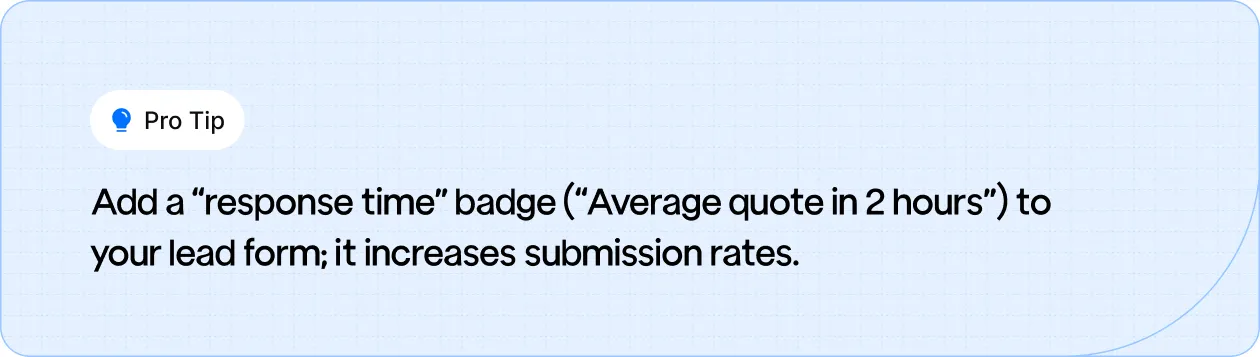
Set expectations for fast responses. A “response time badge” encourages users to submit their details, knowing they’ll receive a quick follow-up.
Focus on What Drives Results and Drop What’s Holding You Back
If you’re not measuring the right metrics, you’re guessing. Traffic doesn’t always equal leads. To succeed, focus on conversions. By tracking real KPIs, you can optimize your strategy for better results.
Measure the right metrics, not vanity traffic
Stop focusing on page views and bounce rates. What matters is conversions, how many visitors are turning into leads.
- Track these KPIs: Conversion rate, lead quality, and customer acquisition cost.
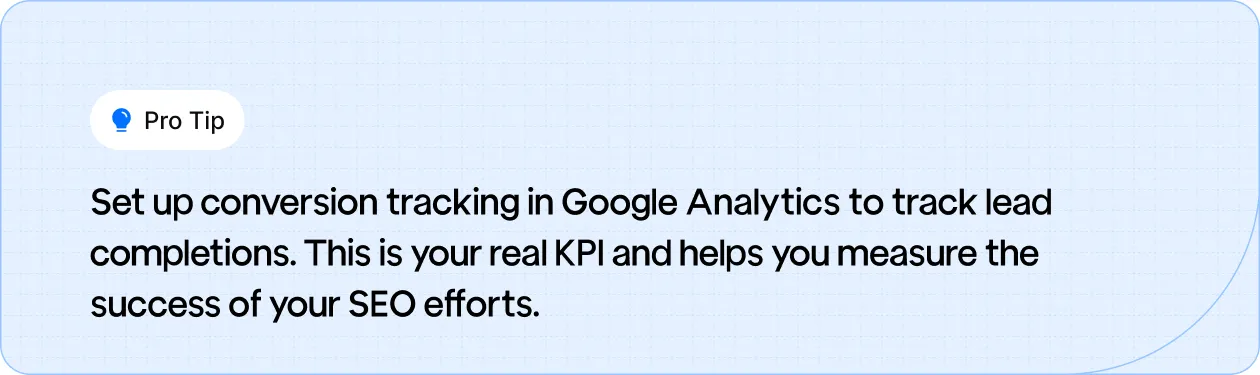
- Bonus Tip: Set conversion goals in Google Analytics to track form submissions and phone calls.
Use GA4, Search Console, and call tracking like audit tools
Tools like GA4, Search Console, and call tracking help you understand what’s working and where to optimize.
- Track leads and form completions using GA4’s custom reports.
- Bonus Tip: Set up call tracking to identify which channels are driving phone leads.
Review your wins quarterly, adjust like a machinist, fine-tuning a part
You need to review your performance every three months to see what’s driving the most conversions and adjust your strategy.
Actionable Tip: Set new goals based on quarterly performance reviews and competitor analysis.
Mistakes Most CNC Shops Make (and How to Fix Them)
These common mistakes are costing you leads, but they’re easy to fix. Let’s take a look at the issues and how to avoid them.
Using jargon-heavy content, no buyer understands
CNC buyers don’t need technical jargon; they need clear, simple explanations of your services.
- Actionable Tip: Use plain language to explain processes like CNC milling or prototyping.
- Bonus Tip: Break down complex topics with infographics or step-by-step guides.
Overlooking local search, while competitors dominate
Many CNC shops focus on national SEO and ignore local search. Optimize for location-based keywords to attract regional customers.
- Actionable Tip: Add city-specific pages and optimize your Google Business Profile (GBP).
- Bonus Tip: Respond to Google reviews to increase local engagement.
Treating SEO like a one-time setup, not a process
SEO is a continuous process. Regular updates and audits are necessary to stay competitive.
- Actionable Tip: Conduct quarterly SEO reviews and update content.
- Bonus Tip: Add new case studies or projects to keep content fresh and relevant.

You’ve seen what goes wrong, now see what works.
Get tailored SEO workflows for your CNC business.
Build Your Game Plan
What’s Next: Where CNC SEO Is Headed?
SEO is always evolving, and so should your strategy. What worked yesterday might not deliver results tomorrow. As technology advances and search behaviors change, it’s crucial to adapt your approach to stay ahead of the competition.
AI-generated content vs. real engineering expertise
AI can generate content, but when it comes to CNC, nothing beats the real engineering expertise you bring.
Search engines are evolving to favor authentic and knowledgeable content. Emphasize your team's experience and technical knowledge to differentiate your content from generic alternatives.
Voice search (“Hey Google, CNC shop near me”) is rising
With the rise of voice search, the way people search for CNC services is changing. Phrases like “CNC shop near me” are becoming more common, so ensure your website is optimized for local SEO and voice-based queries.
Tailoring your content to conversational keywords will help you rank higher for these voice searches.
3D visuals, the new trust factor in industrial SEO
As the digital world becomes more immersive, 3D visuals are gaining traction in industrial SEO.
Including interactive images, 3D renders, or even virtual tours of your CNC processes can set you apart, build trust, and engage potential clients in a more meaningful way.

Taking Your CNC SEO to the Next Level
To truly dominate the SEO landscape in the CNC industry, you must stay ahead of emerging trends and adapt to changes as they happen.
AI-generated content, voice search, and 3D visuals are shaping the future, but only if your strategy remains flexible and forward-thinking. The problem is converting that ranking into real leads.
Ready to future-proof your SEO and get your CNC shop found by the right buyers? Gushwork can help.
Let us build a custom strategy tailored to your team’s needs.
Book a Consultation
FAQs
Q1: How can I effectively market my CNC shop online?
A1: Focus on local SEO by optimizing your Google Business Profile, creating location-specific landing pages, and gathering customer reviews. Additionally, share real project photos and detailed case studies to build trust.
Q2: What are the common challenges when starting a CNC business?
A2: Unexpected costs, noise, space requirements, and the unpredictability of product demand are common hurdles. It's essential to plan for these factors to ensure business sustainability.
Q3: How do I determine pricing for CNC machining services?
A3: Pricing can be based on material costs, machine time, labor, and overhead. Some shops use quoting software or develop custom Excel calculators to estimate costs.
Q4: What makes buyers respond to a CNC supplier's outreach?
A4: Buyers are more likely to engage when they find relevant content, clear capabilities, and a user-friendly website. Effective SEO practices can enhance visibility and attract potential clients.
Q5: What are the benefits of having a niche in the CNC industry?
A5: Specializing allows for better quality control, faster turnaround, and the ability to cater to specific customer needs, which can lead to a more loyal client base.
Q6: How can I improve my CNC shop's online presence?
A6: Regularly update your website with fresh content, optimize for mobile devices, and ensure fast loading times. Engaging with customers through blogs and social media can also boost visibility.
Q7: What are the key factors in choosing CNC quoting software?
A7: Consider ease of use, integration with existing systems, accuracy in cost estimation, and scalability to match your business growth. Some shops prefer open-source solutions, while others opt for specialized paid software.

Digital Marketing
Oct 6, 2025
5 mins
10 Simple Steps That Helped Cabinet Manufacturer Increase Qualified Leads By 42% In 60 Days
Batul Beawarwala
For cabinet manufacturers, the real challenge lies in attracting the right leads.
Those who understand the value of custom craftsmanship and are ready to invest. Wasting time on unqualified leads with no intention of purchasing or who lack alignment with your offerings can drain resources and hinder growth.

Generating traffic is easy, but generating leads that convert requires a strategy focused on precision and targeted efforts.
This guide will help you attract high-quality leads who value your expertise and craftsmanship, ensuring your sales pipeline is filled with prospects that truly matter.
1. Stop Guessing Who Your Buyers Are: This is How You Find Them
Understanding who your buyers are is the first step to crafting an effective lead generation strategy. Homeowners, contractors, and commercial clients all have different purchasing behaviors and priorities.
Buyer personas help you pinpoint the specific needs of each group and sell smarter, not harder.
- Homeowners may prioritize design and aesthetics.
- Contractors focus on cost-effectiveness and reliability.
- Commercial clients look for durability and large orders.
By developing detailed personas, you’ll know exactly who you're targeting and how to speak their language.
2. Stop Letting Your Website Sit Idle, Turn It Into a Virtual Sales Floor
Your website should function like a 24/7 sales representative. With the right tools and content, it can help convert visitors into leads.
Make it work harder with these features:
- Galleries to showcase your custom designs.
- Calculators to estimate costs and ROI.
- Chatbots to answer questions instantly and guide users through their buying journey.
First impressions matter, so ensure your website offers an engaging and seamless experience that encourages conversions.
3. Own Your Local SEO, Don’t Let Competitors Take the Lead
When prospects search for "cabinets near me," you want to be at the top of the results. If you’re not ranking, your competitors are reaping the benefits.
Boost your local SEO with these tactics:
- Service-area pages that target your specific geographic locations.
- Local backlinks from relevant sources to increase your authority.
This ensures your business appears in local search results, helping you claim your space in the market.
Struggling to stay visible in search when competitors dominate local results?
There are smarter ways to claim your space without burning your budget.
Boost Your Local Visibility
4. Reviews Are the New Word-of-Mouth (And They Sell Harder Than You Do)
Potential customers rely on Google reviews, Houzz stars, and video testimonials to gauge the quality of your work before they make a decision.
Key benefits of leveraging reviews:
- Instant credibility that builds trust with new leads.
- Social proof that validates your expertise and quality.
- Showcasing reviews on your website, in emails, and across social media platforms.
Make sure you highlight reviews everywhere to build confidence and convert leads into customers.
5. Target Smart with Ads, Don’t Waste Budget on Generic Campaigns
Generic advertising campaigns are ineffective and waste your budget. Instead, focus on targeting specific customer intents.
Effective ad strategies:
- Google Ads: Use targeted keywords like “custom kitchen cabinets” to attract customers with intent.
- Pinterest: Perfect for reaching people in the “design dreaming” phase.
- Retargeting ads: Bring back visitors who were interested but didn’t convert.
By focusing your ads on platforms where your ideal buyers are active, you’ll increase your chances of generating quality leads.
6. Make Content Your Silent Sales Team
Content marketing is like having a team working for you, even when you're not online. Blogs, guides, and tools help answer questions your leads are already asking.
Why it works:
- Educates leads before they even reach out.
- Builds trust by providing value upfront.
- Positions you as an expert in cabinetry.
The more helpful content you provide, the stronger the relationship you build with prospects, leading to more conversions.
Also Read: Manufacturing Lead Generation: A Complete Guide to Building Your Sales Pipeline
7. Use Social Media to Build Relationships, Not Just Posting Pretty Pictures
Social media is a space for connecting with potential buyers and nurturing relationships.
Here’s how to use social media effectively:
- Instagram and Pinterest: Showcase your beautiful designs and behind-the-scenes processes.
- Facebook: Share customer projects, client testimonials, and helpful design tips.
- Engage with followers: Answer questions, comment, and build a community around your brand.
It’s about turning followers into leads by offering value and building real connections, not just posting pretty pictures.
8. Your Best Sales Reps? Designers, Builders, and Happy Customers
Your network is one of your strongest sales tools. Partnering with designers, builders, and happy customers can open doors to new leads.
Here’s how to leverage your network:
- Referral programs: Reward those who bring in new business.
- Collaborations with pros: Work with designers and builders to expand your reach.
- Trade shows: These events help you meet potential clients and network with industry professionals.
A strong network leads to a stronger sales pipeline.
9. Nurture Leads with Purpose: Turn Emails into Relationships
Lead nurturing is about keeping potential clients engaged and moving through the sales funnel.
Use email segmentation and drip campaigns to stay in front of leads:
- Segment email lists based on customer behavior or project type.
- Send targeted value through educational content, case studies, or promotional offers.
- Use a CRM to track interactions and ensure follow-up happens at the right time.
A well-executed email campaign turns one-time leads into long-term customers.
10. Track Your Data, Don’t Leave Your Strategy to Chance
Effective lead generation is built on data. Track key metrics to refine your strategy and improve performance over time.
Important metrics to track:
- Website traffic: How many visitors are converting into leads?
- Lead quality: Are you attracting the right type of leads?
- Conversions: How many leads are turning into customers?
A/B testing helps you understand which tactics work best, allowing you to fine-tune your approach.
Minimalist Designs, Eco-Friendly Materials, and Smart Storage: What Customers Crave
Today’s customers are more discerning than ever, looking for cabinetry that’s functional and aligns with modern aesthetics and sustainable values.
As trends shift toward minimalism, sustainability, and efficient storage, understanding these evolving preferences will position your brand as the go-to choice for forward-thinking buyers.
Minimalist Designs
Minimalist cabinetry is all about simplicity, clean lines, and maximizing space. Homeowners and businesses alike seek these designs for their versatility and timeless appeal, making them a must-have in today’s market.
Eco-Friendly Materials
As sustainability becomes a priority, using eco-conscious materials like reclaimed wood and low-VOC finishes can set your cabinets apart, catering to the environmentally conscious customer.
Smart Storage
With homes and businesses looking to optimize every inch of space, smart storage solutions like pull-out drawers and vertical shelving are essential for maximizing functionality without sacrificing style.
Also Read: Top 5 Lead Generation Companies for Manufacturers to Boost Your Sales
Create Memorable Experiences, Not Just Discounts
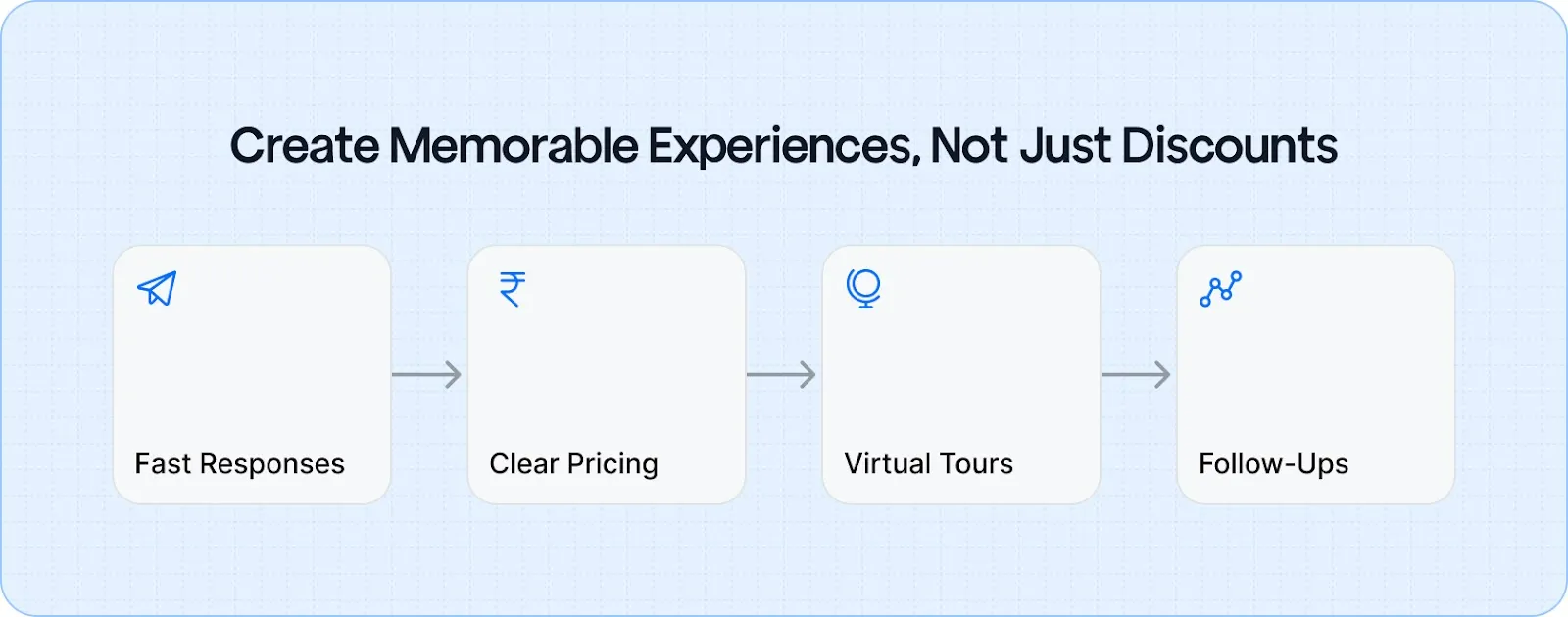
It's not enough to simply offer a discount today. Building a memorable experience, from the initial interaction to post-purchase follow-ups, can set your business apart and keep customers coming back for more.
Focus on delivering value at every stage of the buying process.
Fast Responses
Today’s buyers expect quick engagement. Providing immediate responses shows that you value their time and are ready to help, which builds trust from the start.
Clear Pricing
Transparency is key. Offering clear and upfront pricing builds confidence and reduces friction in the buying process, making it easier for customers to make decisions.
Virtual Tours
With many customers preferring to shop online, virtual tours allow them to explore your cabinet offerings and make informed decisions, even from a distance.
Follow-Ups
The sale doesn’t end once the cabinet is installed. Following up after the purchase helps maintain strong relationships, encouraging repeat business and referrals.
Customers Remember How You Made Them Feel: Focusing on creating a positive, memorable experience rather than just offering discounts can turn one-time buyers into loyal customers who return and refer others.
Your Leads Are Waiting, Are You Ready?
The key to success in cabinet manufacturing is adapting to modern lead generation strategies, from SEO and targeted ads to referrals and customer-first practices.
When you focus on providing an exceptional experience, you'll naturally attract higher-quality leads and grow your business.
If managing all these moving parts feels overwhelming, Gushwork helps cabinet manufacturers simplify the process, capture qualified leads, and scale without the trial-and-error.
If managing all these moving parts feels overwhelming, Gushwork is here to help.
We simplify the process, capture qualified leads, and help cabinet manufacturers grow without the trial-and-error.
Book a Consultation
FAQs
Q1. How can cabinet manufacturers generate high-quality leads?
A1. Cabinet manufacturers can generate high-quality leads by focusing on targeted strategies such as developing detailed buyer personas, optimizing their website with engaging tools like galleries and chatbots, and investing in local SEO to ensure they appear in local searches.
Leveraging reviews, running smart ad campaigns, and offering valuable content also play a key role in attracting leads who are ready to invest.
Q2. What is the best way to target local customers for cabinet manufacturing?
A2. To target local customers effectively, cabinet manufacturers should focus on local SEO. This includes creating service-area pages, obtaining local backlinks, and ensuring their website is optimized for relevant search terms like "cabinets near me."
Engaging with local communities and encouraging reviews from local customers can further increase visibility in local searches.
Q3. How important is it to use reviews in cabinet manufacturing marketing?
A3. Reviews are crucial in building trust and credibility with potential customers. Positive Google reviews, Houzz stars, and video testimonials act as powerful social proof, helping to convince leads of the quality and reliability of your cabinets. Highlighting these reviews on your website and social media platforms can significantly boost conversions.
Q4. Should cabinet manufacturers use paid ads for lead generation?
A4. Yes, paid ads, like Google Ads targeting specific keywords such as “custom kitchen cabinets,” are highly effective for capturing leads with high intent. Additionally, retargeting ads and Pinterest ads can be leveraged to target design-conscious buyers who are in the decision-making phase, helping to increase the quality of leads and reduce wasted ad spend.
Q5. How can content marketing help cabinet manufacturers attract leads?
A5. Content marketing acts as a silent sales team, helping to attract leads by answering customer questions before they even ask. By creating valuable content such as blogs, guides, and design tools, cabinet manufacturers can establish themselves as experts and build trust with potential customers, ultimately leading to more conversions.
Q6. What role does social media play in lead generation for cabinet manufacturers?
A6. Social media platforms like Instagram, Pinterest, and Facebook provide an opportunity to showcase your work, build relationships, and engage directly with potential customers.
Sharing customer projects, behind-the-scenes processes, and design tips can help turn followers into qualified leads by offering value and creating connections.
Q7. How can cabinet manufacturers nurture leads to increase sales?
A7. Cabinet manufacturers can nurture leads by using CRM tools to segment email lists and create drip campaigns that provide targeted, valuable content over time.
Following up with leads post-purchase, offering design consultations, and providing additional educational content can keep the relationship strong, encouraging repeat business and referrals.
Digital Marketing
Oct 6, 2025
5 mins
Inbound Marketing for Distributor Companies: The Complete Guide
Batul Beawarwala
For distributor companies, attracting the right leads remains a constant struggle. Relying on traditional methods like trade shows or cold calls often leads to wasted time and money chasing unqualified prospects.
Sales teams are left sorting through low-quality inquiries that rarely convert. Inbound marketing offers a smarter approach, helping distributors reach the exact customers they need.

This guide will show you how to build a targeted pipeline that drives sales, customer loyalty, and long-term growth.
Why Old-School Distributor Marketing Just Doesn’t Cut It Anymore
The B2B buying cycle is longer and more complex than ever. With multiple stakeholders involved in purchasing decisions and complex pricing tiers, trying to engage potential buyers with outdated methods is inefficient.
Inbound vs. Outbound: Which Works Better for Distributors?
- Outbound marketing (cold calls, print ads) is increasingly ineffective. It’s costly, difficult to scale, and feels intrusive to today’s buyers who are used to researching and making decisions online.
- Inbound marketing, on the other hand, is a scalable, cost-effective approach. By providing the right content at the right time, you can attract the right buyers, educate them, and convert them into loyal customers, without the pressure of cold outreach.
The Gap Competitors Miss
Most distributors focus on resellers/jobbers alone, but today's most successful distributors target both resellers and end customers. Understanding that your audience has multiple buyer personas is critical in an inbound strategy.
Without this focus, your marketing will miss key opportunities to drive revenue across the entire channel.
The Real Marketing Challenges Distributors Can’t Ignore
Distributors face unique challenges that hinder growth, and addressing these pain points is crucial for adapting to the digital landscape.
Outdated Reliance on Catalogs, Trade Shows, and Cold Outreach
These traditional methods can no longer provide the same return on investment. The cost per lead for trade shows and print advertising is high, and the ROI is often uncertain. Additionally, cold outreach lacks the personalization that today’s buyers demand.
Difficulty Differentiating in a Crowded Market
Many distributors sell similar products. Without clear differentiation, standing out in a saturated market is tough.
Generic marketing campaigns that don’t speak directly to specific customer needs fall flat.
Channel Conflicts: Manufacturer vs. Distributor Branding
Distributors often face tension between promoting their own brand and representing the manufacturer’s brand.
This conflict can result in a lack of consistency in messaging and customer confusion. Inbound marketing solves this by building trust and authority directly with customers.
Long ROI Timelines Due to Extended Buyer Journeys
Buyers in the distribution industry often spend months researching and comparing products before purchasing.
This makes it difficult to track immediate ROI and can lead to frustration. Inbound marketing nurtures these long journeys by consistently providing valuable content until the buyer is ready to make a purchase.
Most distributors know they need inbound marketing, but struggle with execution.
What if you could cut trial-and-error and get a ready framework?
Start Your Inbound Journey
What Actually Works for Distributors in Inbound Marketing?
Here’s what’s been proven to drive results for distributors:
Be Seen First: Winning Visibility in a Crowded Market
Inbound marketing starts with being found by the right audience. For distributors, this means implementing SEO strategies that target the right keywords and attract quality traffic.
- SEO strategies tailored to distribution: Use long-tail keywords related to your specific products and services. Target supplier directories and regional searches to make sure you're visible to potential buyers.
- Content ideas: Create product explainer videos, technical blogs, and use-case guides that speak directly to the needs of your buyers, whether they are jobbers, contractors, or end users.
- Social media: Engage on LinkedIn for B2B connections and YouTube for product demos. Social media is essential for distributors, too.
Turn Browsers Into Buyers: Smart Ways to Convert Leads
The next step is turning curious visitors into paying customers.
- CTAs and landing pages: Design specific landing pages that speak to your buyer personas, offering lead magnets like ROI calculators, bulk purchase options, and exclusive product info.
- ERP/CRM integrations: Capture lead data automatically and ensure all information syncs to improve follow-up precision.
- Personalization: Tailor your content to each buyer type (jobber, retailer, or end user) for more relevant engagement.
Keep Them Hooked: Retaining Clients Beyond the First Order
Retention is just as important as acquisition. Building lasting relationships ensures long-term business growth.
- Automated email workflows: Set up workflows to send reorder reminders, seasonal offers, and exclusive updates to clients.
- Case studies and testimonials: Show your existing customers' success stories to build trust and encourage new buyers.
- Channel partner enablement content: Provide partners with training kits and co-branded assets to foster loyalty and support from the ground up.
Case Study: How Trash Truck Rentals Leveraged Inbound Marketing for Distributor Success
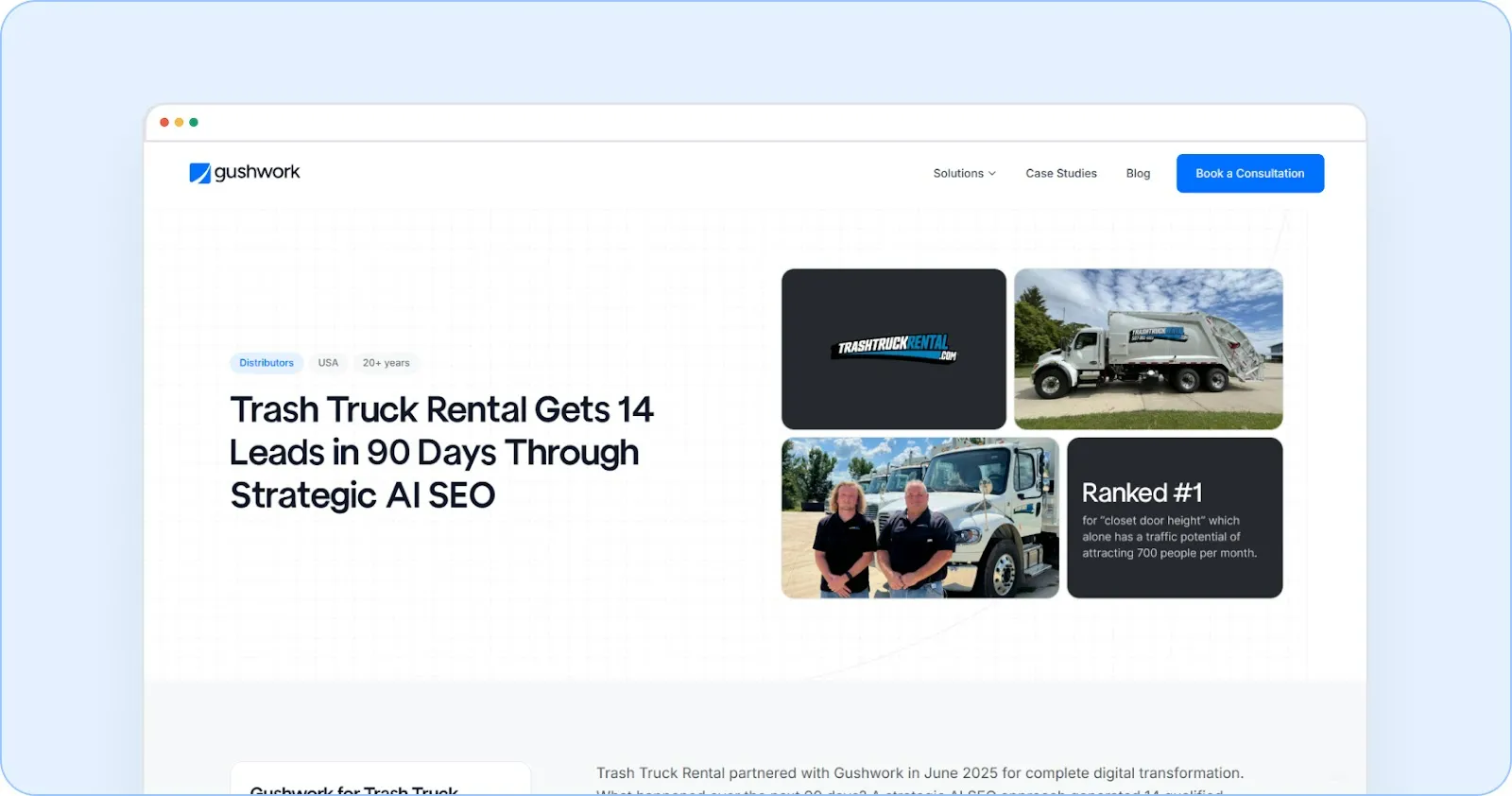
Challenge: Digital Invisibility
Despite excellent service, Trash Truck Rental faced a critical issue: no online presence. As a result, they were missing out on high-intent leads from waste management companies searching for garbage truck rentals online.
The Problem: Competitors Dominated the Market
Competitors, with stronger digital footprints, captured all online demand for rental trucks. Key search terms like “trash truck rental” and “garbage truck rental” were dominated by those with better search rankings.
The Solution: AI-Powered SEO
Trash Truck Rental partnered with Gushwork to implement an AI-driven SEO strategy, focusing on capturing high-demand search terms.
- AI Market Intelligence: We mapped over 1M searches and identified 2,223 valuable keywords.
- Rapid Execution: Using AI, we optimized content quickly, achieving rankings that would normally take 12+ months in just 90 days.
Results: Unprecedented Growth
- 14 qualified leads generated within 90 days.
- #1 rankings for “trash truck rental” and other key terms.
- 100% relevant leads from high-intent prospects.
- Scalable lead flow, replacing inconsistent referral patterns.
Market Dominance
- Achieved top 10 rankings for 23 transactional keywords like “garbage truck rentals” and “roll-off truck rental.”
- Increased online visibility for every major search term in their market, giving them the competitive edge over rivals.
Impact
Trash Truck Rental's inbound marketing transformation helped them:
- Dominate their local rental market.
- Attract high-quality leads who found them online first.
- Establish a predictable lead flow that fuels long-term business growth.
Read the full case study here: Trash Truck Rental Gets 14 Leads in 90 Days Through Strategic AI SEO
Inbound Moves That Would Actually Get You Results
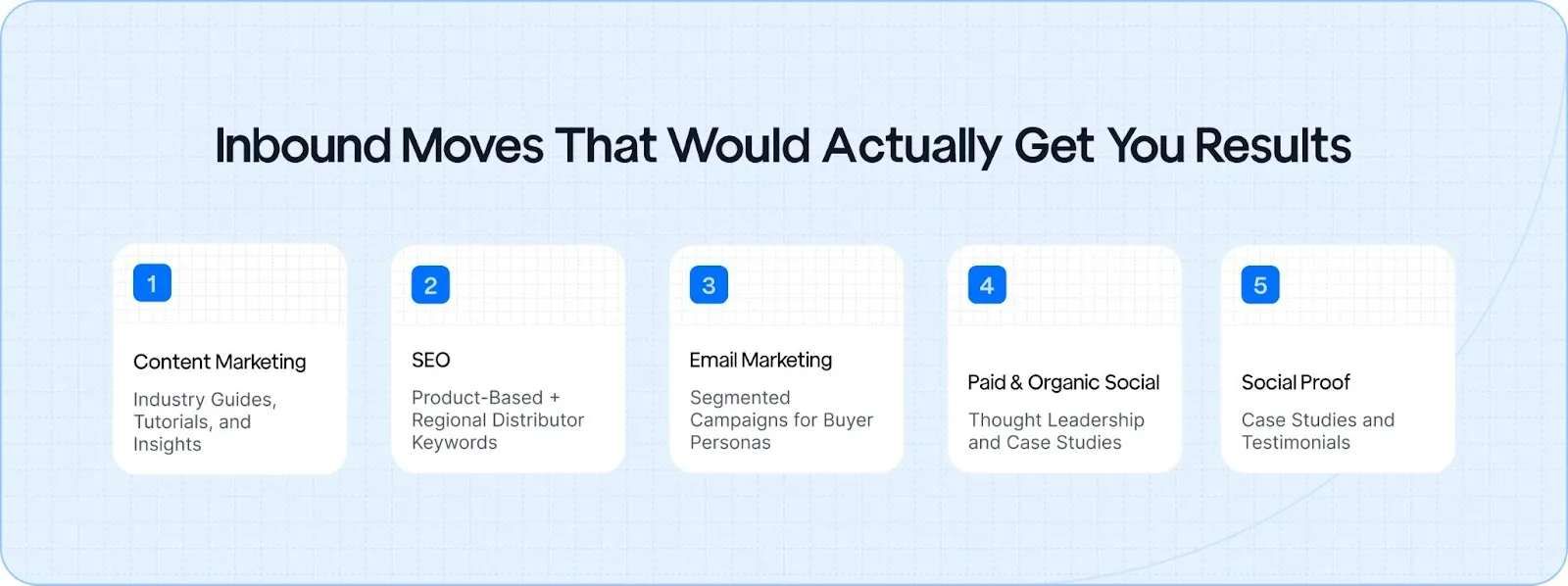
Inbound marketing for distributors is about providing valuable content that nurtures trust and drives conversions. Content marketing plays a pivotal role in establishing your brand as a reliable source of information while guiding potential customers through their buying journey.
Let’s dive into some specific strategies that can move the needle for your distributor business.
Content Marketing: Industry Guides, Tutorials, and Insights
- Industry Guides: Create comprehensive guides on relevant topics in your industry (e.g., supply chain management, product sourcing). These resources position your company as a thought leader.
Example: A guide on optimizing inventory management for distributors.
- Product Tutorials: Develop step-by-step video tutorials that help customers understand how to use, install, or troubleshoot products. These reduce buyer friction and establish your company as a trusted advisor.
Example: A video on how to install and maintain your product for better performance.
SEO: Product-Based + Regional Distributor Keywords
- Long-Tail Keywords: Optimize your content with specific, long-tail keywords related to your products. These keywords are less competitive and attract highly targeted traffic.
Example: “Best hydraulic pumps for construction in Texas.”
- Local SEO: Focus on region-specific keywords to capture local demand from distributors in your area. Include terms that combine product and location to improve visibility for buyers near you.
Example: “Wholesale plumbing parts in Florida.”
Email Marketing: Segmented Campaigns for Buyer Personas
- Segmentation: Divide your email list by buyer personas (e.g., jobbers, retailers, end users) to tailor your messaging and increase relevance.
Example: Jobbers get bulk discounts, while retailers receive updates on new product lines.
- Automated Workflows: Set up automated email sequences that nurture leads based on their actions (e.g., email after downloading a guide or making an inquiry).
Example: Send a follow-up email with product recommendations after a user downloads a product guide.
Paid & Organic Social: Thought Leadership and Case Studies
- LinkedIn Thought Leadership: Share industry insights, articles, and success stories to engage your B2B audience. This builds credibility and keeps your brand top-of-mind.
Example: Post a long-form article about trends in the distribution industry and how your products address these challenges.
- YouTube for Demos: Use YouTube to showcase product demos, tutorials, and behind-the-scenes looks. Video content resonates well with distributors looking for product validation.
Example: A product demo video highlighting key features and benefits of your offerings.
- Case Studies: Create detailed case studies that show how your products solved specific problems for other distributors. This builds trust and shows potential customers the real-world impact of your solutions.
Social Proof: Case Studies and Testimonials
- Client Testimonials: Display customer feedback on your website and marketing materials. Authentic testimonials reinforce trust and credibility.
Example: “The product helped us reduce downtime by 20%.”
- Case Studies: Share real-life examples of how distributors have succeeded with your products, detailing specific challenges and solutions.
Example: A case study showing how a distributor improved their supply chain efficiency after adopting your solution.
Bonus! Advanced Strategies to Outperform Competitors
To outperform competitors, distributors must go beyond basic inbound tactics and implement advanced strategies that drive targeted growth.
From personalization and account-based marketing to data-driven optimizations, these strategies will elevate your marketing efforts.
ABM (Account-Based Marketing) for High-Value Distributors/Retail Partners
- Target the Right Accounts: Focus on specific, high-value accounts that have the potential to deliver significant long-term revenue. ABM allows you to tailor your messaging and approach to the needs of these key distributors or retail partners.
- Personalized Outreach: Craft highly targeted campaigns with personalized content, offers, and incentives designed to attract and convert these high-value prospects.
AI-Driven Personalization: Product Recommendations & Dynamic Pricing Alerts
- Product Recommendations: Use AI to suggest products based on customer behavior or past purchases, improving the customer experience and increasing the chances of upselling or cross-selling.
Example: "Since you purchased X, we recommend Y, which works perfectly with your existing purchase."
- Dynamic Pricing Alerts: Use AI to trigger pricing notifications for customers, especially when there are discounts or price changes for high-demand products. This increases engagement and drives sales.
Data-Driven Decision-Making: CRO Testing for Landing Pages
- A/B Testing: Conduct conversion rate optimization (CRO) tests to refine landing page elements such as headlines, CTAs, and imagery.
This ensures that your pages are optimized for maximum conversion rates.
- Continuous Improvement: Use data from these tests to constantly iterate and improve your marketing strategies. The more you test, the better you understand what resonates with your audience.
Aligning Sales Reps with Inbound Campaigns: Content + CRM Sync
- Seamless Integration: Ensure that your sales teams are aligned with your inbound marketing efforts by syncing CRM systems with inbound campaigns.
This ensures that sales reps are working with up-to-date lead information, making their outreach more personalized and timely.
- Better Follow-Up: By integrating content with your CRM, sales reps can use the same content assets to engage leads at the right moment in their journey. This improves the quality of follow-ups and enhances lead conversion.
Example: Sales reps can reference case studies, white papers, or other content in follow-up emails to further nurture leads and close deals.
Here's Your No-Fluff, Actionable Framework for Distributor Inbound Marketing
To achieve tangible results, distributors must focus on strategic actions that align with their buyer's journey and deliver real value at every stage.
The following steps outline how to implement these tactics and start seeing measurable success.
Step 1: Define Your Ideal Customers with Detailed Buyer Personas
Create personas for jobbers, contractors, retailers, and end customers to target specific needs and challenges. Focus on their goals and pain points to craft relevant content.
Step 2: Audit Your Current Marketing and Sales Processes
Review your existing marketing and sales efforts to identify gaps in content, lead conversion, and follow-up. Improve where needed to streamline operations.
Step 3: Build a Content Calendar That Matches the Buyer’s Journey
Plan content that aligns with each stage of the buyer's journey: awareness, consideration, and decision-making. Tailor content for different personas at each stage.
Step 4: Optimize Your Website and SEO for Distributor-Focused Keywords
Optimize your website for relevant distributor-specific keywords (e.g., “wholesale plumbing supplies”). Ensure content is discoverable to attract qualified leads.
Step 5: Set Up Lead Nurturing Workflows to Convert Leads into Customers
Automate email workflows to guide leads through the sales funnel with personalized content and follow-ups based on their stage in the journey.
Step 6: Align Your Sales Team and Inbound Marketing Efforts with CRM/ERP Integration
Integrate CRM systems with inbound campaigns to provide sales teams with insights on lead behavior, ensuring timely and relevant follow-ups.
Step 7: Measure, Iterate, and Refine for Continuous Growth
Regularly track key metrics like traffic growth and lead conversion rates. Adjust your strategies based on performance to continually optimize results.
Scale Your Results with Gushwork’s Tailored Inbound Marketing
You’ve learned that inbound marketing is the key to moving away from outdated, costly methods and driving predictable, high-quality leads for your distribution business. The real challenge is about using the right strategies that align with your buyers' journey.
- Traditional methods can’t compete with the scalability and efficiency of inbound.
- Aligning sales and marketing efforts ensures a smoother path to conversions.
- Using AI-driven SEO and personalized content gives you a competitive edge.
Your frustration with uncertain lead flows and missed opportunities is understandable. But there’s a better way.
Ready to scale your inbound marketing and drive measurable results?
Gushwork can help you implement a strategy that’s fast, efficient, and tailored for distributors.
Book a Consultation
FAQs
Q1: What are the benefits of inbound marketing for distributor companies?
A1: Inbound marketing helps distributors attract qualified leads, reduce reliance on cold outreach, and create long-term relationships through personalized content and targeted campaigns. It’s more cost-effective and scalable compared to traditional methods.
Q2: How does inbound marketing work for B2B distributors?
A2: Inbound marketing for B2B distributors focuses on creating valuable content tailored to specific buyer personas, such as jobbers, contractors, and retailers, which drives traffic, educates prospects, and nurtures them into loyal customers over time.
Q3: What are some successful inbound marketing strategies for distributors?
A3: Successful strategies include SEO optimization for distributor-specific keywords, creating educational content like industry guides, using automated email workflows for lead nurturing, and leveraging social proof through case studies and testimonials.
Q4: How do I improve my distributor company's lead generation using inbound marketing?
A4: Focus on high-quality content like blog posts, explainer videos, and tutorials that address your buyer's needs. Combine this with SEO strategies for better search rankings and lead nurturing through automated emails to convert prospects into loyal customers.
Q5: What makes inbound marketing better than traditional outbound methods for distributors?
A5: Inbound marketing is more efficient because it attracts leads who are already interested in your services, reduces cold outreach, and provides measurable results. Unlike traditional methods, inbound marketing builds trust through consistent, helpful content and engages leads throughout their buyer journey.
Q6: How can distributors leverage AI for inbound marketing?
A6: AI helps distributors by automating SEO strategies, optimizing content creation, and offering personalized product recommendations based on customer behavior, which improves lead targeting and conversions. AI also allows for dynamic pricing alerts and behavioral retargeting to drive sales.
Q7: What role does CRM/ERP integration play in inbound marketing for distributors?
A7: Integrating your CRM and ERP systems with inbound marketing efforts ensures smooth lead management, personalized communication, and efficient follow-up. This alignment helps sales teams access up-to-date lead data, resulting in faster conversions and more targeted outreach.

SEO
Oct 6, 2025
5 mins
The 20+ Best Tools for SEO in Manufacturing and How Teams Actually Use Them
Ishani Mitra
Most manufacturing teams do not struggle because they lack SEO tools. They struggle because they are surrounded by too many of them, all promising insight, none offering clarity on what actually matters.
Between keyword data, technical audits, traffic reports, and rankings, it becomes easy to track activity without understanding the impact. The right SEO tools simplify decisions. The wrong ones create noise, slow teams down, and disconnect SEO from real business outcomes.
In this blog, we break down the best SEO tools for manufacturing, how each category supports a specific part of the SEO process, and how to use them to measure visibility, quality, and performance without overcomplicating your workflow.
What Is Manufacturing SEO?
Manufacturing SEO is about being visible at the moment a real buying decision starts to take shape. It helps your business appear when someone is researching suppliers, comparing capabilities, checking materials, or trying to understand whether a manufacturer can actually meet their requirements.
Manufacturing buyers do not move quickly or casually. They search in phases, often over weeks or months, asking technical questions, validating specifications, and narrowing options internally. A solid manufacturing SEO foundation supports that entire journey.
Important SEO KPIs To Measure Success
In manufacturing, the right KPIs focus less on raw traffic and more on visibility, relevance, and commercial intent across long buying cycles.
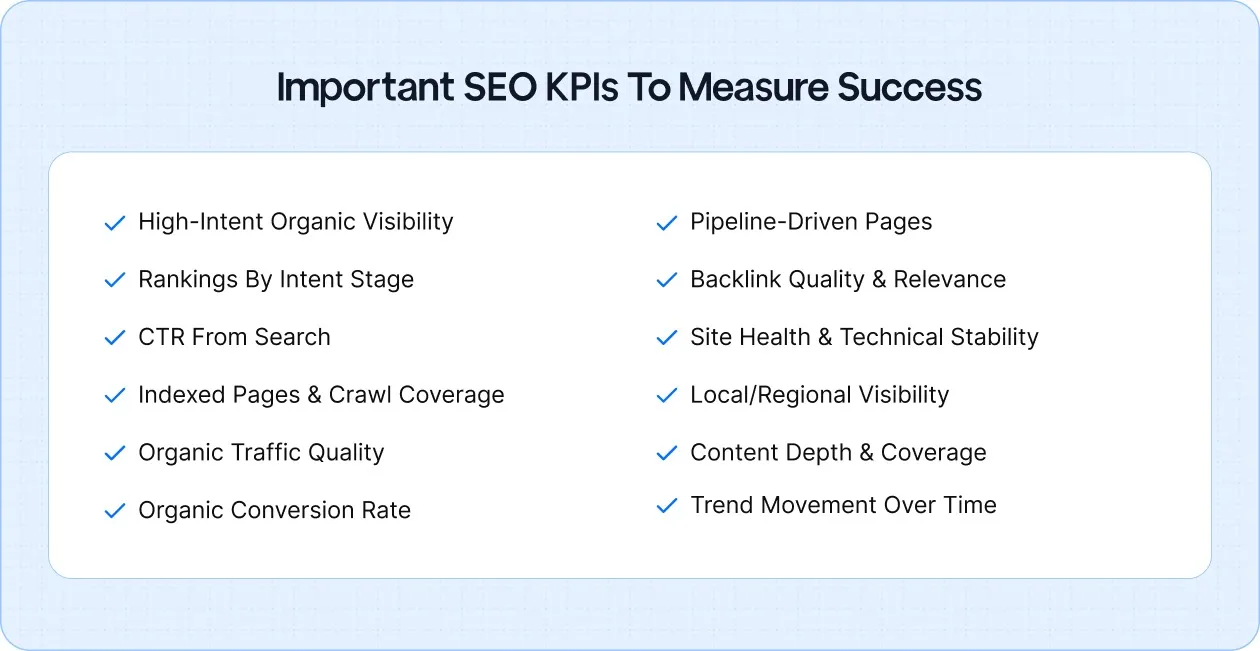
Below are the most important SEO metrics tools that help track, and why each one matters in a manufacturing context.
- Organic visibility for high-intent keywords: This measures how often your site appears for searches tied to capabilities, processes, materials, or services. It helps you understand whether you are visible where real buying research happens.
- Keyword rankings by intent stage: Tracking rankings by early research, comparison, and decision-stage keywords shows whether your content supports the full buyer journey. Tools help separate surface-level visibility from commercially meaningful presence.
- Click-through rate (CTR) from search results: CTR indicates how compelling your titles and descriptions are compared to competitors. In manufacturing, low CTR often signals unclear positioning or overly generic messaging.
- Indexed pages and crawl coverage: This KPI shows how much of your site search engines can actually access and understand. It is critical for large manufacturing sites with many service, capability, or product pages.
- Organic traffic quality: Rather than total sessions, this focuses on engagement metrics like time on page, scroll depth, and repeat visits. High-quality traffic usually reflects alignment between search intent and page content.
- Conversion rate from organic traffic: This measures how often SEO traffic turns into enquiries, quote requests, or meaningful actions. It is one of the strongest indicators of whether SEO is attracting the right audience.
- Top-performing pages by pipeline contribution: Identifies which pages consistently assist or generate leads. This helps prioritise optimisation and content expansion around pages that already influence revenue.
- Backlink quality and referring domain relevance: Tools track not just how many links you have, but where they come from. In manufacturing, links from industry publications, suppliers, or technical resources carry far more weight than generic sites.
- Site health and technical stability score: This includes page speed, broken links, mobile usability, and indexing issues. Technical instability can quietly suppress rankings even when content quality is strong.
- Local and regional visibility: For manufacturers serving specific geographies, local ranking data shows whether the business is discoverable in priority regions.
- Content coverage and topical depth: Measures whether your site sufficiently covers the topics buyers expect to see addressed. Tools surface gaps where competitors provide more complete answers.
- Trend movement over time: SEO tools help track whether visibility and engagement are improving, stagnating, or declining. Direction matters more than short-term fluctuations.
When tracked together, these KPIs show whether SEO is building authority, attracting qualified demand, and supporting long-term growth.
Simplify Manufacturing SEO
Turn tools, metrics, and workflows into a clear system that supports enquiries and growth.
Build My SEO System
20+ Best Tools for SEO for Manufacturing
Manufacturing SEO rarely breaks because of one missing tool. It breaks when teams use the wrong tools for the wrong job, or rely on a single platform to solve problems that span research, technical health, content quality, and performance tracking.
The tools below are grouped by what they actually help you do in a manufacturing SEO workflow. You do not need all of them. You need the right mix, used with intent.
Keyword Research And Search Intent Discovery Tools
These tools help uncover how engineers, buyers, and procurement teams phrase their searches at different stages of evaluation.
- Google Keyword Planner: While designed for advertisers, this tool is valuable for manufacturers because it reveals commercial intent through CPC and competition data. It helps validate whether keywords relate to purchasing activity or early-stage research.
- Google Autocomplete: Autocomplete surfaces real queries users type into Google, making it especially useful for identifying problem-driven searches. Manufacturers can use it to spot application-based and comparison-style queries that rarely appear in traditional keyword tools.
- AnswerThePublic: This tool visualises how buyers phrase questions around processes, materials, tolerances, and use cases. It is particularly effective for shaping blog content and FAQ sections that support early research stages.
- AlsoAsked: AlsoAsked shows how search questions branch logically, which helps structure long-form content and pillar pages. For manufacturing SEO, it’s useful for understanding how buyers progress from general questions to technical validation.
- Keywords Everywhere: This extension adds search volume, CPC, and competition data directly inside Google search results. It is useful for quick keyword validation when reviewing SERPs or evaluating new content ideas.
- Google Trends: Google Trends helps manufacturers identify rising demand, seasonal patterns, and declining interest across products or processes. It is especially helpful when prioritising which services or capabilities to invest in content for.
Competitor, Market, And SERP Intelligence Tools
These tools help manufacturers understand where authority exists and what level of competition is realistic.
- Ahrefs: Ahrefs is widely used to analyse backlink profiles, identify authoritative industry links, and understand which competitor pages attract visibility. It helps manufacturers see how authority is built within their niche.
- Semrush: Semrush provides a broad view of keyword rankings, competitor overlap, and content gaps. Manufacturing teams often use it to benchmark their visibility against similar suppliers and distributors.
- SimilarWeb: SimilarWeb offers directional insights into competitor traffic sources and audience behaviour. It helps determine whether competitors rely heavily on SEO, paid media, or partnerships.
- ProductRank.ai: This tool tracks how brands appear in AI-generated search experiences. As buyers increasingly rely on AI summaries, ProductRank.ai helps manufacturers monitor visibility beyond traditional SERPs.
Content Optimization And Topic Coverage Tools
These tools help ensure content meets depth and relevance expectations without compromising clarity.
- Surfer: Surfer analyses top-ranking pages and provides guidance on structure, headings, and topical coverage. It is useful for refining service pages and technical blogs where completeness matters.
- Clearscope: Clearscope focuses on semantic relevance and topic coverage rather than keyword density. Manufacturing teams use it to ensure complex topics are fully addressed in one place.
- Claude: Claude is often used to simplify technical explanations, improve clarity, and proofread long-form content. It supports human-led writing rather than replacing it.
Technical SEO And Site Health Tools
Manufacturing websites often face challenges with crawl depth, heavy media, and legacy structures.
- Screaming Frog: Screaming Frog crawls websites to identify broken links, duplicate content, redirect chains, and indexability issues. It is essential for auditing large manufacturing sites.
- Google Search Console: Search Console provides first-party data on impressions, clicks, indexing status, and technical errors. It is one of the most reliable tools for understanding how Google views your site.
- Bing Webmaster Tools: Bing’s toolset offers additional diagnostics and crawl insights. It often highlights technical issues that complement Google’s data.
Rank Tracking And Performance Monitoring Tools
These tools track how visibility changes over time for high-intent manufacturing keywords.
- SE Ranking: SE Ranking provides affordable rank tracking, audits, and competitor monitoring. It is well-suited for manufacturers managing regional or niche keyword sets.
- Nightwatch: Nightwatch is often used for precise local and regional rank tracking. It supports manufacturers targeting specific geographic markets.
Analytics, Reporting, And Attribution Tools
These tools help connect SEO efforts to business outcomes.
- Google Analytics 4: GA4 tracks user behaviour, engagement, and conversions from organic traffic. It helps manufacturers understand which pages support enquiries and lead paths.
- Looker Studio: Looker Studio allows teams to combine SEO, traffic, and conversion data into clear dashboards. This is useful for internal reporting and executive visibility.
Website Platforms Built For SEO Execution
Execution matters as much as strategy.
- Webflow: Webflow allows manufacturers to build fast, structured, and SEO-friendly websites. It supports clean URLs, responsive design, and flexible content architecture without heavy development overhead.
12 Proven Strategies for Successful Manufacturing SEO
Manufacturing SEO works when it is intentional, structured, and grounded in how industrial buyers actually research suppliers. The strategies below are not shortcuts. They reflect what consistently improves visibility, enquiry quality, and long-term authority for manufacturing companies.
1. Intent-Driven Keyword Mapping
Map every search phrase to a buyer task and create content that answers that exact task. Start by breaking your universe of terms into clear buckets: capability research, specification validation, supplier comparison, and RFQ/procurement. For each bucket:
- Build keyword sets that include technical qualifiers buyers use — material grades, tolerances, standards, throughput ranges, and equipment types. Capture variations in phrasing used by engineers (e.g., “±0.02mm” vs “0.02 mm tolerance”).
- Create an intent matrix that assigns each keyword to one canonical page type (capability page, spec sheet, comparison guide, or procurement form). Don’t let multiple pages compete for the same commercial intent.
- Add contextual modifiers for buyers: include “lead time”, “minimum order quantity”, “certified”, “lot traceability”, and similar modifiers as separate target keywords where they match buyer behaviour.
- Maintain a living keyword map that ties search phrases to buyer personas, e.g., procurement searches vs. engineering searches, so content tone and depth match the visitor.
- Use these maps to inform page templates: specify which sections a capability page must contain (spec table, equipment list, QA methods, lead times) based on the highest-value keywords assigned to it.
Focus on Real Buyer Intent
Identify how engineers and procurement teams actually search so SEO effort stays tied to commercial demand.
Map My ICP and Keywords
2. Capability Pages That Match How Buyers Evaluate Suppliers
Design each capability page as a self-contained dossier that answers feasibility questions at a glance and provides depth on demand.
- Open with a concise capability statement that names the process, materials, and typical part geometries. Follow with a short “fit” line describing where you are commonly selected (industries, part types).
- Provide a compact spec table up front: materials supported, max/min dimensions, tolerance range, surface finishes, typical batch sizes, throughput rates, and standard tooling constraints.
- Follow with an equipment and capacity section listing machine models, critical tooling, automation level, and fallback options. Buyers read this to assess whether their part fits your factory.
- Include a quality & inspection section detailing inspection methods, frequency, and what test reports look like (e.g., CMM reports, hardness tests). Give buyers the language they can include in their procurement documents.
- Add an applications section with short, specific examples of parts you make and the performance outcomes achieved (e.g., “brackets for HVAC assemblies, delivered with ASME-compliant welds”).
- Close with clear, intent-matching CTAs: download the spec sheet, request an indicative lead time for X qty, or request a capability review with a short form that asks only technical qualifiers (material, part size, tolerance).
3. Technical Proof Built Into Content
Place proof where buyers look for it: next to specifications, not in separate marketing pages.
- Embed certification snapshots and scopes within the capability page and label what the certificate actually covers (e.g., processes, facilities, product families). Buyers need scope clarity more than logos.
- Write short process notes on inspection steps, sampling plans, and acceptance criteria directly under related spec entries so readers immediately see how quality is controlled for their exact requirement.
- Add anonymised sample reports or redacted inspection screenshots showing typical CMM output, measurement headers, and tolerance calls. Explain what each section communicates to a procurement reviewer.
- Describe material traceability practices in plain terms: lot coding, supplier verification steps, and how you handle non-conforming materials. Buyers evaluate traceability early in supplier selection.
- Summarise testing capabilities and limits (e.g., tensile testing up to X kN, salt spray testing hours) and link to deeper resources for engineers who require full protocols.
Build Content That Earns Trust
Create technically accurate content that supports research, comparison, and shortlisting.
Strengthen My SEO Content
4. Crawlable Site Architecture for Large Catalogs
Organise content so it maps to the buyer’s mental model and search behaviour.
- Define a strict taxonomy and URL pattern that reflects buyer journeys: /industries/[industry]/[capability]/[process-or-material]/[case-study-or-spec]. Use this template consistently as new pages are created.
- Create industry landing pages that act as entry funnels; each should summarise relevant capabilities, link to the capability pages, and surface typical applications. These pages match early-stage discovery queries.
- For capability pages, ensure a single canonical URL. Use canonical tags for variations and avoid allowing faceted navigation to create indexable permutations unless they represent distinct buyer queries.
- Build resource hubs that aggregate spec sheets, test reports, and case studies by capability and make them discoverable from both industry and capability pages. This keeps technical proof within two clicks of discovery.
- Maintain an internal linking rule: every new capability page must be reachable from an industry page and from at least one resource or case study page to avoid orphans.
5. On-Page SEO That Improves Shortlisting
Make the page’s purpose and buyer fit visible in search results and on-page headings.
- Use title tags that combine the process, material/application, and the most important differentiator (e.g., capacity or tolerance). This immediately signals fit in search results.
- Structure H2s and H3s as evaluation prompts: “Materials and Grades Supported”, “Tolerance & Surface Finish Capabilities”, “Inspection & Certification”, “Typical Lead Time & Batch Sizes”.
- Write meta descriptions that communicate three quick facts buyers care about: capability, a specific proof point (e.g., ISO scope), and an action (download spec or request quote).
- Place a short “at-a-glance” section near the top that answers buyers’ immediate filter questions, yes/no style bullets for material, max size, tolerance, and certifications, so they can self-select before reading deeper.
- Use FAQ blocks that address procurement and engineering questions in plain, precise language; answer format should be concise and technical rather than marketing-oriented.
6. Internal Linking That Mirrors Real Buyer Paths
Use links to move buyers logically from discovery to procurement, not from one generic page to another.
- From industry pages, link to capability pages with anchor text reflecting buyer intent (e.g., “custom injection molding for medical devices”).
- Within capability pages, link to spec sheets, downloadable test reports, and relevant case studies using action-oriented anchors like “view typical CMM report” or “download packing & handling specs”.
- In blog posts or technical articles that explain a manufacturing problem, insert contextual CTAs that point directly to the capability page that solves it (e.g., an article on corrosion resistance links to your stainless processing capability with a matching CTA).
- Build a “related capabilities” section on each capability page that surfaces complementary services or secondary processes a buyer often needs during production planning.
- Keep anchor text descriptive and technical; avoid “click here” and use precise terms buyers will search for in the future.
7. Technical Hygiene as a Baseline
Treat technical stability as a gating factor for visibility and buyer experience.
- Audit indexation rules and set clear guidelines for which page types should be indexable (capabilities, industry pages, spec resources) and which should not (admin, temporary campaign filters).
- Standardise templates to avoid accidental duplication: capability pages should follow the same field structure so search engines and buyers find consistent information.
- Implement clear redirect rules for moved pages and maintain a redirect map; never leave deprecated URLs without structured 301 fallbacks that lead to the most relevant canonical page.
- Optimise page templates for performance: ensure spec tables render quickly, images are lazy-loaded where appropriate, and PDF downloads are served efficiently without blocking page load.
- Use server-side logs and crawl reports to identify crawl budget waste — reduce low-value indexable pages and improve the crawl prioritisation of capability and resource pages.
8. Content That Supports Engineering-Led Research
Produce content that speaks the buyer’s language and directly supports engineering evaluation.
- Create technical comparison guides that break down trade-offs, thresholds, and rule-of-thumb calculations (e.g., when a part should be machined vs. cast based on volume, complexity, and tolerance).
- Publish material selection notes that cover performance in specific environments (temperature, corrosive exposure, fatigue scenarios) and include practical tables of properties and recommended applications.
- Offer detailed process descriptions that include achievable tolerances, normal defect rates, typical setup times, and any common constraints engineers should be aware of.
- Provide downloadable decision tools and templates, e.g., a one-page checklist for sample qualification, a template for RFQ technical requirements, that procurement teams can reuse and that embed your brand into their internal process.
- Maintain a technical glossary and a short-form “how to read our spec sheet” guide so non-technical procurement stakeholders can translate engineer-level documentation into procurement decisions.
9. SERP Ownership for Comparison Searches
Comparison searches sit very close to a buying decision. When someone searches “supplier A vs supplier B” or “process X vs process Y,” they are actively narrowing options, not browsing.
- Publish pages that compare suppliers, processes, or approaches without overt selling. Focus on criteria buyers care about: capability scope, tolerance ranges, material compatibility, lead times, quality systems, and typical use cases.
- Build pages such as “CNC machining vs die casting for low-volume parts” or “in-house fabrication vs contract manufacturing.” Explain cost structures, setup effort, scalability, and constraints so buyers can self-select the right option.
- Create “how to evaluate” guides that walk buyers through what to check during supplier vetting: certifications, inspection methods, sample approval, documentation, and communication practices. These pages often rank well and support downstream RFQs.
- Tables, checklists, and side-by-side summaries perform well for both users and search engines. They help buyers scan quickly and help search systems understand comparative intent.
- Comparison content should naturally route buyers to your capability pages once they understand where you fit, without forcing a sales pitch.
10. Authority Building from Relevant Ecosystems
Manufacturing authority is earned inside ecosystems buyers already trust. Generic backlinks rarely influence industrial purchasing decisions.
- Contribute technical articles, application notes, or process explainers to trade publications and industrial blogs where engineers and procurement teams already read.
- Membership pages, technical committees, certification listings, and association directories often provide highly relevant links and credibility signals that search engines value.
- Request inclusion on supplier, distributor, or partner resource pages with proper context describing your role, capabilities, and certifications.
- Co-author technical guides, host joint webinars, or contribute case studies with material suppliers, OEMs, or integrators. These collaborations often lead to durable, high-quality links.
- A handful of links from deeply relevant industrial sources typically outperform dozens of generic marketing links in manufacturing SEO.
11. AI Visibility Readiness (AEO Fundamentals)
As AI-driven search and answer engines grow, manufacturing content must be structured so it can be quoted accurately and confidently.
- For each capability, process, or term, include short definition blocks written in plain, technical language. Avoid metaphors or marketing phrasing that could distort meaning.
- AI systems often extract information from tables. Include clear rows for materials, tolerances, lead times, certifications, and use cases.
- Include step-by-step summaries of how a process works, its limits, and its typical outputs. These sections are frequently surfaced in AI-generated answers.
- Use questions sourced from RFQs, sales calls, and Search Console data. Keep answers precise, factual, and scoped to avoid ambiguity.
- Ensure that definitions, specs, and terminology are consistent across your site. Inconsistency reduces trust signals for AI systems.
12. Conversion Paths That Match Manufacturing Enquiries
Manufacturing enquiries are rarely casual. Your site should make it easy for serious buyers to move forward without friction.
- Place RFQ and enquiry CTAs directly on capability pages, spec pages, and comparison content.
- Ask only for information buyers expect to provide: process, material, quantity, tolerance, timeline, and a drawing upload option. Avoid unnecessary marketing fields.
- Use labels such as “Request capability review” or “Get indicative lead time” instead of generic “Contact us.”
- Offer lighter-commitment options like spec downloads or sample requests for buyers who are not ready to submit a full RFQ.
- Identify which capability, comparison, and technical content pages consistently appear in the paths leading to enquiries so SEO priorities stay aligned with revenue.
How Gushwork Helps Manufacturing Teams Turn Tools Into Growth
Most manufacturing SEO programs fail because tools are treated like the strategy. Teams collect data, run audits, and track rankings, but execution stays fragmented, and outcomes stay unclear.
Gushwork helps you turn SEO tooling into a system. We combine AI and human strategy to improve manufacturing visibility across search and AI responses, and link that visibility to enquiry quality.
- SEO strategies tied directly to manufacturing buying behaviour: Gushwork maps keywords and content to how engineers, procurement teams, and operations managers actually research suppliers. This ensures visibility aligns with commercial intent, not just informational traffic.
- Content depth that reflects technical and operational reality: Their SEO content goes beyond surface-level explanations, focusing on specifications, processes, use cases, and decision criteria that buyers expect to see before trusting a manufacturer.
- Website structure designed for scale and clarity: Gushwork prioritises site architecture, internal linking, and content hierarchy so large manufacturing websites remain crawlable and easy to expand without losing clarity.
- Measurement focused on lead quality and pipeline contribution: Instead of reporting on traffic alone, they track how SEO influences enquiries, sales conversations, and downstream opportunities, making performance easier for leadership teams to evaluate.
Gushwork is a strong fit for manufacturers who want SEO to reduce sales friction, improve enquiry quality, and support long-term growth.
Conclusion
The best SEO tools make manufacturing SEO manageable.
When chosen correctly, tools help you understand how buyers search, where your site falls short, which content builds authority, and whether SEO is actually supporting enquiries and growth. They remove confusion and replace it with direction.
You do not need every platform listed. You need a stack that fits your size, your sales cycle, and your technical reality. Start with tools that reveal intent and performance. Add others only when they help you make better decisions. When tools support strategy instead of driving it, SEO becomes a system you can trust.
Ready for SEO That Actually Helps
Align tools, strategy, and execution around real manufacturing buying behaviour.
Book A Consultation

Digital Marketing
Oct 6, 2025
5 mins
These 9 Strategies Are Helping Distributors in the USA Win More Deals. Are You Using Them?
Batul Beawarwala
As a distributor, you’ve likely spent countless hours creating content, only to see minimal engagement from your target audience.
The real challenge? Generating leads who understand the complexity of your supply chain, or worse, investing in strategies that miss the mark.
When trying to attract retailers or strengthen relationships with existing partners, generic content strategies often fail to address your unique needs. This guide focuses on creating content that directly speaks to your B2B customers, cutting through the noise and driving tangible results.
1. Know Your Audience Like the Back of Your Hand
Segmenting your audience ensures your content speaks directly to their unique needs, be they manufacturers, retailers, or end buyers.
This targeted approach improves engagement and helps avoid wasting resources on irrelevant content.
How to implement:
- Create distinct customer personas for each audience segment. Identify the different roles within your audience; manufacturers may care about supply chain efficiency, while retailers may focus on product offerings. Tailor content to address these needs.
- Develop targeted content based on their specific needs and buying journey. Map content to the buyer’s journey: Awareness (industry insights), Consideration (product comparisons), Decision (testimonials, case studies).
- Use data from past sales or analytics to refine your audience segments. Look at customer behavior, website engagement, and past sales data to segment your audience effectively and adjust content strategies for each group.
Understanding your audience allows you to create more relevant content.
Want to boost your content marketing? We can help optimize your strategy.
Discover How to Optimize
2. Solve Problems, Don’t Just Sell Products
Distributors are problem-solvers. Educational content that addresses specific challenges helps build trust and positions you as an authority in the industry.
How to implement:
- Publish product guides, FAQs, and how-to articles to help customers. Offer content that answers common questions or challenges. This could include “how to choose the right equipment” or “best practices in managing inventory.”
- Share industry insights that provide real value and solutions. Rather than just promoting products, share tips, trends, and case studies that demonstrate how your products or services solve real problems in your customers' industries.
- Simplify technical content to appeal to a broader audience. Technical jargon can be overwhelming. Break it down into digestible blog posts, videos, or infographics that both experts and non-experts can understand.

3. Show Off Your Success with Real-Life Examples
Case studies and testimonials provide concrete evidence of your capabilities, helping potential clients visualize working with you and boosting their confidence in your services.
How to implement:
- Collect testimonials from satisfied clients. Ask your best customers for feedback or offer incentives for detailed reviews. Real, unsolicited testimonials are more impactful than generic endorsements.
- Create detailed case studies that show how your product solved a problem. Use specific examples to show how you helped customers overcome a challenge. Be sure to highlight the measurable results, such as improved efficiency, cost savings, or increased sales.

4. Make Your Content Easy to Find with SEO
SEO (Search Engine Optimization) is essential because it ensures that your content is visible to your target audience when they search for relevant information. Without SEO, even the best content can go unnoticed, meaning you're missing out on valuable traffic.
How to implement:
- Research and include relevant keywords: Start by identifying keywords related to your products, services, and industry. Use tools like Google Keyword Planner, Ahrefs, or SEMrush to find terms your potential customers are searching for. Be sure to focus on both broad and niche keywords to cover all aspects of the search funnel.
- Optimize your blog posts and product pages: Apply SEO best practices to each page on your website, from titles and meta descriptions to alt text and header tags. Make sure your content is structured for both readability and search engine crawling, including using bullet points, short paragraphs, and keyword-rich headings.
- Use internal linking: Link your content to other relevant pages on your site to improve SEO performance. This increases time on site and helps search engines better understand the structure of your website.

5. Engage Your Audience with Video Content, People Love It
Video is an incredibly engaging medium that allows you to demonstrate your products in action and connect with your audience on a deeper level. It grabs attention quickly and can convey complex ideas more clearly than text alone.
How to implement:
- Create product demos and explainer videos: Show how your products work in real-life scenarios. Product demos are perfect for technical products or complex services. Explainer videos break down key concepts or highlight product features that your audience may not fully understand.
- Host webinars or live Q&A sessions: These interactive formats help answer your audience’s questions in real-time. Use them to address common concerns, demonstrate product capabilities, or share industry insights.
- Use behind-the-scenes footage: Give your audience a peek behind the curtain of your operations. This humanizes your brand and builds a stronger connection with your audience.
6. Keep the Conversation Going with Email
Email marketing remains one of the most effective ways to nurture leads and build lasting relationships. It allows you to send personalized, direct messages to customers at every stage of their buying journey.
How to implement:
- Build segmented email lists for targeted campaigns: Not all of your customers are at the same point in their buying journey. Use segmentation to send targeted messages that are relevant to each customer group.
- Send newsletters with valuable content: Share useful information, updates, and special offers through regular email newsletters. Content could include industry insights, new product features, or success stories.
- Use personalized email campaigns: Send personalized messages based on customer behavior. For example, send an email about a product they viewed or offer special discounts to repeat buyers.

7. Use Social Media to Amplify Your Voice
Social media is an excellent platform for building brand awareness, engaging with your audience, and driving traffic to your site. It's also a great way to amplify your content and make it shareable.
How to implement:
- Share your content across platforms: LinkedIn, Facebook, or Instagram. Share your blog posts, product updates, and industry insights. Tailor your message to each platform’s audience.
- Use LinkedIn for B2B engagement: LinkedIn is the go-to platform for connecting with industry professionals, procurement teams, and decision-makers. Share thought leadership content, connect with potential partners, and build your reputation as an industry expert.
- Repurpose blog content into smaller social posts or infographics: By creating shorter, bite-sized pieces of content (like snippets, quotes, or stats), you can reach a larger audience and drive traffic to your website.

8. Use Lead Magnets to Pull in the Right Leads
Lead magnets like eBooks, whitepapers, or checklists are invaluable tools for capturing potential customers' information. They provide value upfront, enticing visitors to share their contact details in exchange for your helpful content.
How to implement:
- Offer downloadable resources such as case studies, pricing guides, or whitepapers in exchange for contact information.
- Promote lead magnets on your website and through social media. Make sure they’re easily accessible and prominently featured on your homepage, landing pages, or social media profiles.
- Use lead magnets to address customer pain points: Tailor your lead magnets to solve a specific problem your audience is facing. For example, offer a “10-Step Guide to Reducing Distribution Costs” to attract cost-conscious businesses.
9. Measure, Tweak, and Do It Better
Reviewing your content’s performance is key to continuous improvement. By measuring key metrics, you can identify what's working and adjust what’s not to improve your strategy.
How to implement:
- Track KPIs like website traffic, lead generation, and social media engagement: Use tools like Google Analytics, HubSpot, or social media insights to track how your content is performing.
- A/B test headlines, CTAs, and content formats: Regularly experiment with different versions of your content to see what resonates most with your audience.
- Analyze conversion rates: Understand which content types lead to conversions (e.g., downloads, purchases, form submissions) and adjust accordingly.
Ready to optimize your content strategy?
Let’s measure, tweak, and improve your results with actionable insights.
Start Measuring Success
Building a Content Marketing Machine for Distributors
Creating a well-oiled content marketing machine is essential for keeping your brand consistent and relevant in front of your target audience. A content marketing strategy should be both organized and adaptable to ensure that it aligns with key business objectives and evolves based on performance.
Below are actionable steps you can take to build a content machine that works for your distribution business:
1. Create a Content Calendar
Planning content ahead of time around key events like trade shows or product launches ensures consistency. Aligning your content with sales cycles helps target specific business needs at the right time, while flexibility allows for adjustments as needed.
2. SEO Optimization for Distributor Websites
Targeting the right industry-specific keywords and keeping your content fresh helps your distributor website rank higher in search results. Effective SEO ensures your site attracts qualified B2B buyers actively searching for the products or solutions you offer, aligning directly with your distribution goals.
3. Repurpose and Update Content
Maximizing the value of existing content through repurposing and updating ensures your materials stay fresh and relevant. Refresh case studies and product brochures to provide new insights or formats that keep your audience engaged.
4. Track Performance and Refine Your Strategy
Using analytics tools to track the success of your content allows you to identify areas for improvement. By measuring lead generation and conversions, you can refine your approach to achieve better results over time.
The Secret to Growing Your Distribution Business
For distributors looking to scale, content marketing is a powerful tool. However, it’s essential to focus on the strategies that truly resonate with your audience and drive conversions.
Understanding what works and measuring its impact ensures that you’re maximizing your efforts and making smart, data-driven decisions.
Here’s how to grow your distribution business through effective content strategies:
- Identify What Resonates with Distributor Audiences
Engaging your audience starts with understanding what type of content they connect with. Track which content performs best, be it product-focused, industry news, or thought leadership, and create more of what resonates.
- Track Traffic Sources for Distributors
Understanding where your leads are coming from helps you focus your efforts on the most effective channels. Organic search, social media, or referral networks, optimizing these channels increases lead quality.
- Improve Conversion Rates for Distributors
Optimizing landing pages and product catalogs ensures that visitors convert into customers. Focus on improving CTAs and content structure to guide your audience toward taking the desired action.
- Measure ROI for Distributor Content
To ensure your content is working, track how it contributes to lead generation and sales. Calculating ROI helps you understand the effectiveness of your marketing efforts and make informed decisions moving forward.
The Power of Content Marketing to Grow Your Distribution Business
Content marketing is no longer optional for distributors; it's a necessity. The strategies outlined in this article will help you build meaningful relationships, boost your online visibility, and ultimately close more deals.
By implementing a well-planned content marketing strategy, you’re creating opportunities for growth and long-term success.
Ready to start your content marketing journey?
Let Gushwork help you optimize your distribution strategy with personalized content solutions and proven tactics.
Get Started with Gushwork
FAQs
Q1. What is content marketing for distributors?
A1. Content marketing for distributors involves creating and sharing valuable, relevant content to attract and engage potential clients. Instead of traditional advertising, distributors provide useful information that addresses their audience's needs and pain points, establishing trust and authority in their industry.
Q2. How can distributors measure the success of their content marketing efforts?
A2. Success can be measured through various metrics such as website traffic, lead generation, conversion rates, and engagement on social media. Tools like Google Analytics and CRM systems help track these metrics and provide insights into the effectiveness of content strategies.
Q3. What types of content should distributors create?
A3. Distributors should focus on creating educational and informative content like product guides, case studies, blog posts, videos, infographics, and webinars. The content should address the specific challenges and questions their target audience faces, providing solutions and insights.
Q4. How often should distributors publish new content?
A4. Consistency is key in content marketing. Distributors should aim to publish new content regularly, weekly, bi-weekly, or monthly. The frequency should align with their audience's preferences and the resources available to maintain quality content production.
Q5. Should distributors use paid advertising to promote their content?
A5. Paid advertising can amplify content reach, especially when targeting specific demographics or industries. It should complement organic content efforts and be strategically used to maximize ROI.
Q6. How can distributors repurpose existing content?
A6. Repurposing content involves taking existing materials and presenting them in different formats, such as turning a blog post into social media posts, infographics, or videos. This approach saves time and ensures content reaches various segments of the audience.
Q7. What are common mistakes distributors make in content marketing?
A7. Common mistakes include creating content without a clear purpose, not understanding the target audience's needs, neglecting SEO, and failing to measure and analyze content performance. Avoiding these pitfalls leads to more effective content marketing strategies.

SEO
Oct 6, 2025
5 mins
Why SEO Is the Most Affordable Growth Channel - And Why Distributors Must Start Today
Batul Beawarwala
Are you struggling to attract the right leads for your distribution business?
Many distributors use digital marketing to reach potential customers, but turning that traffic into qualified leads requires a strong SEO strategy. Your website needs to be SEO optimized, or you're missing out on reaching customers who are actively searching for the products you offer.
Your competitors are already capturing those leads by ranking higher on search engines.

This guide will show you how to improve your SEO strategy, attract the right customers, and turn that traffic into real business opportunities.
What is SEO for Distributors?
SEO, or Search Engine Optimization, for distributors is the process of optimizing your website so that it ranks higher on search engines when potential customers search for products you distribute.
SEO ensures your website appears when customers search for products you sell, allowing you to reach those looking for exactly what you offer.
Why Do You Need It Now?
Increased Visibility:
- The Problem: Most people only click on the first page of Google search results. Your potential customers may never find you if you are not visible online.
- The Solution: SEO helps your website rank on the first page of search results, so more people see your business.
Long-Term ROI:
- The Numbers: Organic SEO leads convert at a 14.6% rate, twice as high as paid ads.
- The Advantage: SEO provides long-term results with more qualified leads that cost less in the long run than ads.
Competitor Insight:
- The Reality: If your competitors are using SEO and you’re not, they’re capturing your leads.
- The Solution: Implementing a strong SEO strategy allows you to level the playing field and win over those leads.
SEO Strategies To Help Scale Your Distribution Business: Step-by-Step Guide
SEO is a powerful tool for distributors looking to boost visibility and attract the right customers. Below are simple, effective strategies that can help scale your distribution business.
Step 1. Start with a Simple Website Check-Up
Your website is the foundation of your online presence. If it’s not working properly, it won’t matter how much traffic you're driving; it won't convert into business. The first step to optimizing your website for SEO is to make sure it's technically sound, fast, and easy for both users and search engines to navigate.
Actionable Steps:
- Mobile-Friendly Design: More than half of internet users access websites via mobile devices, so your site must be optimized for mobile. Google also uses mobile-first indexing, meaning it prioritizes the mobile version of your site for ranking.
- Fast Loading Speed: If your site takes too long to load, visitors will leave before they even get a chance to engage. Tools like Google PageSpeed Insights can help you assess your website's speed and suggest improvements.
- Technical Soundness: Ensure that your website is free from technical issues like broken links, faulty redirects, or missing metadata. These issues can confuse search engines and negatively affect your ranking.
Tools:
- Google PageSpeed Insights: This tool evaluates your site’s speed and gives suggestions for improvement.
- SEMrush: Provides an in-depth website audit to identify technical problems, such as slow pages, broken links, and other SEO issues.
When you’re ready to improve, a strategic SEO plan can significantly boost website performance.
Get Expert Help
Step 2. Find the Right Searches Your Customers are Typing on Google
Knowing the right keywords to target is crucial. Keywords are the phrases potential customers type into search engines when looking for products you distribute. Finding the right keywords allows you to optimize your site and attract qualified leads.
What to Do?
Research long-tail keywords (i.e., phrases with 3 or more words) that are relevant to your products. For example, instead of just “electrical parts,” try something more specific like “wholesale electrical parts near me.”
These long-tail keywords have lower competition and are more likely to lead to conversions.
Tools: Ahrefs, Google Keyword Planner, SEMrush: These tools help you find high-ranking keywords related to your business and check the competition for those keywords.
Step 3. Create Useful Content for Your Customers
Content is the backbone of SEO. Your content should provide real value to your potential customers. Create informative content that solves problems, educates, and answers questions relevant to your industry.
Content Ideas:
- Product Guides: Help your customers make informed decisions by providing in-depth guides about your products.
- Industry Reports: Share valuable insights and data related to the distribution industry to position yourself as a trusted resource.
- Case Studies: Showcase success stories that demonstrate the value your products bring to customers.
- Customer Testimonials: Positive reviews from past customers can build trust with new leads.
Example: If you’re an electrical distributor, a guide on “Choosing the Right Wiring for Your Commercial Projects” can position you as a go-to expert, helping potential customers make informed purchasing decisions.
Step 4. Make Your Website Easy to Find
Your website needs to be easy for search engines to find and index. Search engines use meta tags, headers, and images to understand what your website is about and how relevant it is to a search query.
- Meta Tags: Ensure your title tags and meta descriptions include relevant keywords. These appear in search results and should provide a clear idea of what each page is about
- Image Optimization: Optimize your images by using alt text (descriptive text for images) that includes your target keywords. Compress your images to ensure they load quickly.

The right SEO strategy drives better rankings and more traffic.
Let experts help take your SEO strategy to the next level.
Optimize with Experts
Step 5. Build Authority with Quality Backlinks
Backlinks are links from other websites that point to yours. Search engines view these links as a signal of trust and authority, which can help improve your website’s ranking.
Actionable Steps:
- Industry Partnerships: Reach out to other businesses or industry-related websites for backlinks.
- Guest Posts: Write guest blog posts on reputable websites within your industry and include links to your site.
- Business Directories: Ensure your business is listed in reputable industry directories.
Step 6. Get Noticed Locally
For distributors with physical locations, local SEO is essential. It helps you appear in search results when people are looking for businesses in your area.
- Google My Business: Make sure your business is listed on Google My Business with accurate information (NAP, Name, Address, Phone Number). This improves your visibility in local searches.
- Local Keywords: Include location-based keywords on your product and content pages. For example, “distributors of HVAC equipment in [City].”
Step 7. Fix Technical Issues on Your Website
A technically sound website is critical for SEO. Slow websites, mobile-unfriendly pages, or websites that are hard for Google to crawl can all hurt your rankings.
Actionable Steps:
- Page Speed: Make sure your website loads quickly. Users leave if it takes too long.
- Mobile-Friendliness: Ensure your site works well on mobile devices, especially since more people browse on smartphones.
- Google Crawling: Make sure Google can easily crawl and index your site’s pages.
Tools: Google Search Console helps identify issues on your site.
Step 8. Turn Visitors into Customers
Driving traffic to your website is only half the battle. You need to convert that traffic into leads and sales.
Improve User Experience: Make sure your website is easy to navigate, and that visitors can easily find the information they need.

Measuring Your SEO Success: Key Metrics for Distributors
Tracking the right metrics is essential for understanding how well your SEO efforts are paying off. By closely monitoring the right indicators, you can make data-driven decisions to further optimize your site and improve results.
Traffic:
- Organic traffic refers to visitors who find your website through unpaid search results. Tracking this metric helps you understand how many people are discovering your site through search engines.
- Tools: Google Analytics is a powerful tool that allows you to track organic traffic, identify which pages attract the most visitors, and gain insight into visitor behavior.
Rankings:
- Monitoring your keyword rankings helps you track your progress and see where you stand in search engine results for important terms. If you notice certain keywords slipping, it's an indicator that you need to adjust your strategy.
- Tools: Tools like SEMrush or Ahrefs allow you to track keyword positions and get insights on where you can improve to push higher in the rankings.
Leads and Conversions:
- SEO is about converting that traffic into leads and customers. Tracking how many visitors take action, such as filling out a form or making a purchase, is key to understanding the effectiveness of your site.
- What to Do: Monitor conversion rates from organic traffic. This helps you measure how well your SEO efforts are turning visitors into business opportunities.
Common SEO Mistakes Distributors Make (And How to Avoid Them)
Even with the best SEO strategies in place, some common mistakes can still hold your website back from reaching its full potential. Here’s what to look out for and how to avoid them.
- Ignoring Mobile Users: With 64.35% of internet traffic coming from mobile devices, your website must work seamlessly on smartphones and tablets.
Potential customers may leave before engaging with your content or making a purchase if your site is not mobile-friendly.
- Neglecting Technical SEO: A slow website, poor navigation, or incorrect technical setup can negatively impact your rankings. Search engines prioritize websites that load quickly and are easy to navigate.
A website that is hard to crawl or has technical issues will hurt your SEO performance.
Regular Audits and Updates: SEO is an ongoing process. Regularly auditing your website and adjusting your strategy is essential to staying ahead of the competition and maintaining strong rankings.
Elevate Your Distributor Business with SEO
A robust SEO strategy is a necessity. You need to be visible when your customers search, or you are losing out on valuable opportunities.
Implementing the right tactics can help your business rank higher, attract qualified leads, and drive sustainable growth.
Dominate your market with a custom SEO strategy built for long-term results.
Gushwork's expertise can help you implement the right tactics to elevate your distributor business and drive results.
Book a Consultation
FAQs
Q1. What is SEO, and why is it important for distributors?
A1. SEO (Search Engine Optimization) helps distributors optimize their websites to rank higher in search engine results, making it easier for customers to find their products. This is crucial because it increases visibility, attracts qualified leads, and ultimately boosts sales.
Q2. How long does it take to see results from SEO efforts?
A2. SEO is a long-term strategy, and it usually takes 3 to 6 months to see significant results in search rankings and traffic, depending on factors like competition and website age.
Q3. What are the key components of an effective SEO strategy for distributors?
A3. Key components include keyword research, on-page optimization (meta tags, headers), technical SEO (site speed and mobile-friendliness), content creation, and building quality backlinks from reputable sites.
Q4. How can local SEO benefit my distribution business?
A4. Local SEO helps you appear in local search results, attracting nearby customers who are searching for products you sell. Optimizing your Google Business Profile and using location-specific keywords can drive more local leads and traffic to your physical location.
Q5. What are common SEO mistakes distributors should avoid?
A5. Common mistakes include ignoring mobile users, neglecting technical SEO (slow websites, poor structure), not optimizing for local SEO, and failing to measure SEO success using key metrics like traffic, rankings, and conversions.
Q6. Do I need an SEO expert, or can I handle it myself?
A6. While some SEO tasks can be managed in-house, hiring an SEO expert can provide a more comprehensive strategy, especially for technical SEO and link-building, leading to better long-term results.
Q7. How do I measure the success of my SEO efforts?
A7. Success can be measured by tracking organic traffic, keyword rankings, and conversion rates. Tools like Google Analytics and Google Search Console help monitor these metrics to assess the effectiveness of your SEO strategy.

Digital Marketing
Oct 6, 2025
5 mins
What Content Marketing for Manufacturers Can Actually Do: 25+ Ways to Drive Revenue
Percy Brown
Content marketing for manufacturers is the practice of publishing technical, application-level, and buying-related information so industrial buyers can find, evaluate, and shortlist your company before reaching out.
In the U.S., over 60% of B2B buyers now research suppliers online before speaking to sales. For manufacturing companies, this means buyers often review your content before they review your capabilities deck.
As trade shows become more costly and cold outreach yields fewer conversions, content marketing offers manufacturers a repeatable way to generate online inquiries.
In 2026, winning manufacturers aren’t louder than their competitors. They’re just clearer, more helpful, and easier to trust during the 60–70% of the buying journey that happens before sales ever get involved. Let’s get started with some market insights!
How Content Influences Manufacturing Growth in 2026
Today, 98% of manufacturers generate sales-qualified leads through digital marketing, and 88% of industrial SEO and marketers use content marketing to build brand awareness.
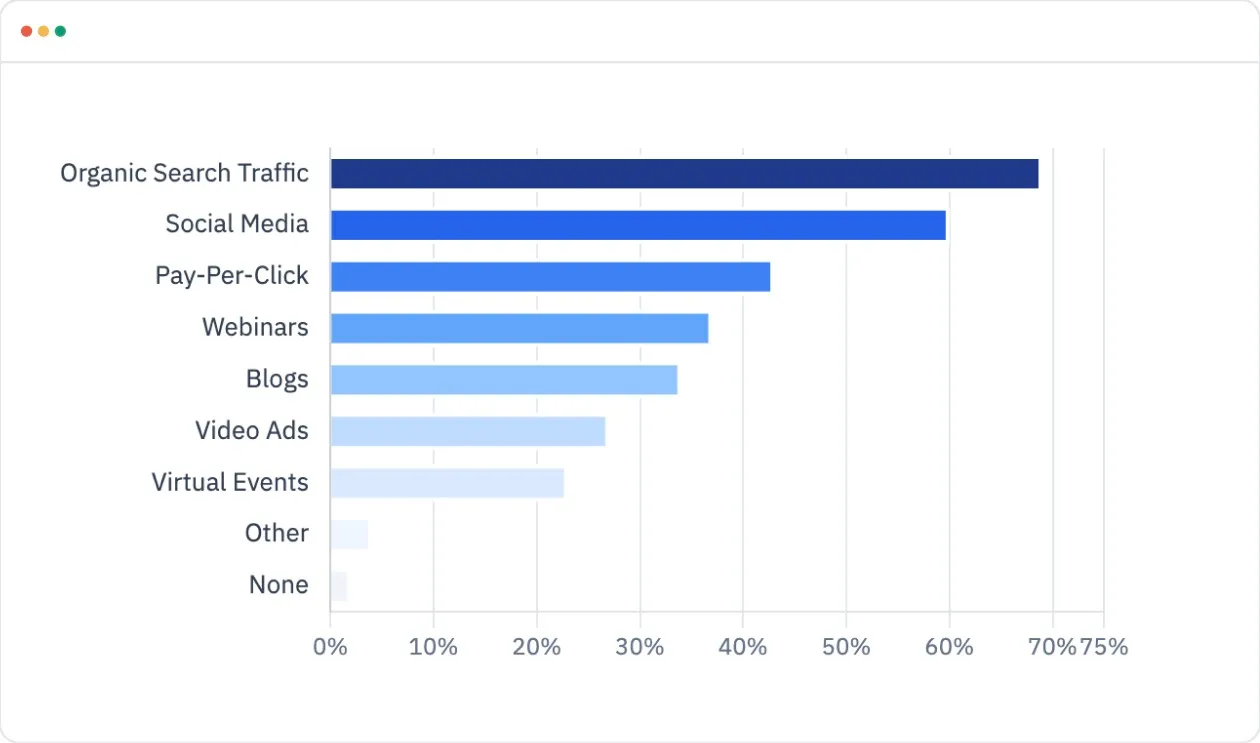
Content-focused manufacturing marketing is one of the top strategies, as B2B industrial buyers now complete 60-70% of their research before contacting sales.
Your content shapes their decisions during this critical period—educating them on solutions, building trust through case studies and technical documentation, and pre-qualifying leads. Hence, your sales team focuses on serious prospects.
Unlike traditional channels such as trade shows or cold outreach, content marketing for industrial companies provides consistent visibility and lead flow while addressing repetitive questions at scale.
This approach directly improves sales efficiency, lead quality, and sustainable revenue growth for manufacturers.
You Can Create 6 Months of SEO Content in Weeks!
AI agents in the market can now produce technical industrial content faster than any traditional SEO agency.
Get a Free Content Strategy
Remember, content doesn’t influence growth all at once.
It works by supporting buyers throughout their decision-making process—long before a quote is requested.
How Manufacturing Content Marketing Guides Buyers Through 3 Critical Stages
Your prospects don't wake up ready to buy. They move through three distinct stages before making any purchase decision.
This journey is often referred to as the marketing funnel, with each stage representing the number of prospects remaining as they move closer to purchase.
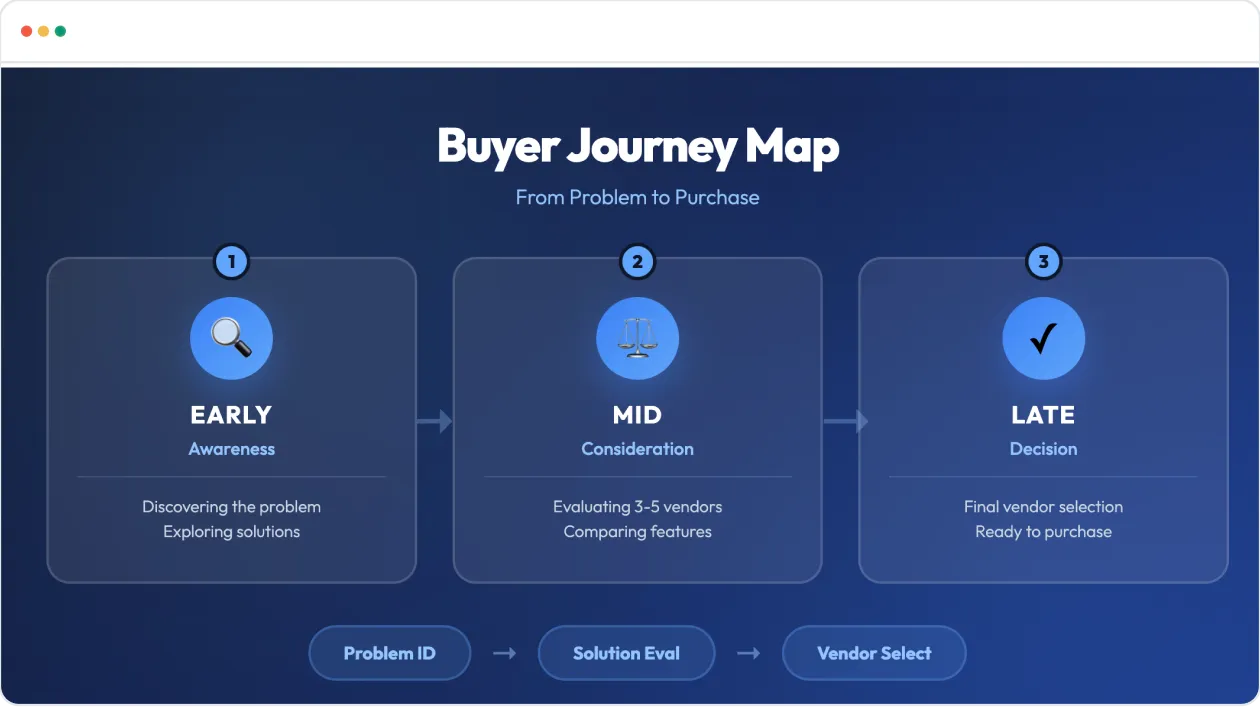
Here's what's happening at each stage and what they need from you:
1. Awareness (Top of Funnel)
The funnel stage: This is where your funnel is widest—you're reaching the largest audience of potential buyers who are just beginning to recognize they have a problem.
Your prospect just realized they have a challenge— production inefficiency, quality issues, or compliance needs. They're researching and educating themselves, but aren't ready to speak with vendors yet.
They're asking: "Why is this happening? What solutions exist? Who else has this problem?"
What they need: Educational content that helps them understand their problem and potential solutions—blog posts, how-to guides, videos, and industry insights.
Your role: Be a helpful educator, an industry expert, not a salesperson.
2. Consideration (Middle of Funnel)
The funnel stage: Your audience narrows here—fewer prospects, but they're more qualified and actively evaluating solutions.
They've defined a problem and are now comparing 3-5 potential vendors. Multiple stakeholders are involved—engineers, procurement, operations—and they're digging into details.
They're asking: "Which product (or a service) fits my specific needs? What's the ROI? Can I trust this vendor?"
What they need: Proof—comparison blogs, case studies, product demos, comparison sheets, customer testimonials, and technical deep-dives.
Your role: Prove your value with evidence and data.
3. Decision (Bottom of Funnel)
The funnel stage: This is the narrowest point—only serious, qualified buyers who are ready to purchase remain.
You're on their shortlist of 1-2 final vendors. They need final reassurance before signing and are negotiating terms while seeking executive approval.
They're seeking answers: "Will this really work for us? Are these the best terms? What do other customers say?"
What they need: Hands-on experience—product in action, pricing info, product PDFs, free trials, personalized consultations, video testimonials, custom proposals, and detailed specifications.
Your role: Remove all barriers to purchase.
Here are some of the proven content types that have worked for many manufacturing companies to grow their revenue.
Spotlight: Top 10 Types of Content for Manufacturing Growth
Manufacturing companies using a strategic mix of these content types saw an average of $1.4 million in new revenue with 856% ROI over 3 years.
The key is to choose the right formats for each stage of your buyer's journey and execute consistently.
1. Educational Blog Posts
Written articles that address specific industry challenges and provide valuable solutions without being overly sales-focused. These posts educate your audience on topics they're actively searching for.
How to start: Identify your audience's top 5-10 pain points through customer interviews or sales team feedback. Create a content calendar targeting one pain point per week. Use keyword research tools to find what your prospects are searching for. Write 800-1,200-word posts that provide actionable advice. Post it on your social media, website, or communities to increase visibility.
2. Video Tutorials
Visual demonstrations that show how products work, explain complex processes, or solve common problems. Highly engaging format that reduces confusion.
How to start: Identify your most frequently asked "how does it work?" questions. Use screen recording software or a smartphone camera. Keep tutorials to 2-5 minutes. Upload to YouTube and embed on your website. Add captions for accessibility.
3. Product Demos (Video)
Recorded or live video walkthroughs showing your product in action, highlighting key features and real-world applications. Helps prospects visualize the solution.
How to start: Create a demo script highlighting the top 5-7 features. Show the product solving actual customer problems. Keep it 5-10 minutes. Use screen recording for software or high-quality video for physical products. Offer live demos for qualified leads.
4. Email Newsletters
Regular email communications (weekly, bi-weekly, monthly) delivering curated content, industry news, product updates, and exclusive insights to subscribers.
How to start: Choose an email platform (Mailchimp, HubSpot, ActiveCampaign). Segment your list by industry, interest, or buyer stage. Create a consistent template and schedule. Mix content types (blog posts, case studies, tips, news). Track open and click rates to optimize.
5. How-To Guides
Step-by-step instructional content that walks readers through a specific process or task. These guides demonstrate your expertise while helping prospects solve immediate problems.
How to start: List the most common questions your sales team receives. Choose processes that prospects struggle with before purchasing. Create detailed guides with numbered steps, screenshots, and downloadable checklists. Gate premium guides to capture leads.
6. SEO-Optimized Articles
Long-form articles, such as blog posts, categories, products, and service pages, are written to rank for targeted keywords in search engines. Drives organic traffic from prospects actively searching for solutions.
How to start: Use tools like SEMrush, Ahrefs, or Google Keyword Planner to find relevant long-tail keywords. Target keywords with decent search volume but lower competition. Write comprehensive 1,500-2,500-word articles. Include proper headers, internal links, and optimize meta descriptions.
Read more: SEO For Manufacturers: A comprehensive guide
7. Whitepapers on Industry Insights
Research-driven, authoritative documents (8-15 pages) exploring industry trends, challenges, or emerging technologies. Establishes deep expertise and thought leadership.
How to start: Choose a timely, complex topic your audience cares about. Conduct original research, surveys, or compile industry data. Structure with executive summary, introduction, body sections, conclusions, and next steps. Design professionally and gate for lead capture.
8. Case Studies
Detailed success stories showing how your product/service solved a specific customer's problem with measurable results. Follows a problem-solution-results format with hard data.
How to start: Identify 3-5 customers with impressive, quantifiable results. Talk to them about their challenge, decision process, implementation, and outcomes.
Use a template: Challenge, Solution, Results (with specific metrics like "20% efficiency increase"). Include customer quotes and visuals.
9. Customer Testimonials (Video)
Recorded video interviews with satisfied customers sharing their experiences, results, and recommendations. More authentic and emotionally compelling than written testimonials.
How to start: Reach out to enthusiastic customers who are willing to be on camera. Prepare 5-7 interview questions focusing on challenges, decision factors, and results. Film professionally or use a high-quality smartphone video. Keep videos 60-90 seconds. Add captions and your branding.
10. Social Media Posts
Regular content shared on platforms like LinkedIn, Instagram, and Twitter to build community, share insights, and humanize your brand. Mix educational content with behind-the-scenes glimpses.
How to start: Choose 1-2 primary platforms where your audience is active (LinkedIn for B2B manufacturing). Create a posting schedule (3-5x per week). Share industry news, quick tips, team highlights, and company culture. Use a mix of text, images, and video.
Beyond core formats, manufacturers that scale faster use additional content types to reinforce trust, accelerate decisions, and reduce friction throughout the buying process.
15+ Additional Manufacturing Content Types That You Can Try
- Infographics pages: Simplify complex manufacturing data into shareable visuals that position your brand as an industry resource and drive social engagement.
- Webinars on Industry Trends: Host live sessions on emerging technologies to capture early-stage leads and establish thought leadership in your market.
- Podcasts with Industry Experts: Build long-term brand authority through audio content that reaches prospects during commutes and establishes you as an industry voice.
- Interactive Quizzes: Automatically qualify and segment leads while delivering value, improving conversion rates by 40-50% compared to static forms.
- FAQs: Address objections on platforms such as Reddit, AnswerMyPublic, and LinkedIn communities before prospects reach sales, reducing the sales cycle by 20-30% and improving win rates.
- Comparison Sheets: Accelerate decision-making by clearly showing your advantages, shortening the evaluation phase, and increasing close rates. Share this in PDF format on your website or social media.
- Podcasts: Engage engineering decision-makers with deep technical knowledge in a conversation.
- ROI Calculators: Quantify value immediately for prospects, helping them build internal business cases and increasing average deal size.
- Free Trials: Remove purchase risk by letting prospects experience value firsthand, converting 15-25% of trial users into paying customers.
- Personalized Consultations - Build relationships with high-value prospects through 1-on-1 attention, increasing close rates for enterprise deals.
- Third-party Reviews: Third-party validation on platforms like G2 or Capterra that influences 70-80% of B2B buyers' final decisions.
- eBooks: Capture contact information from high-intent buyers while providing decision-making resources, generating 3- 5x more qualified leads.
- Live Q&A Sessions - Build transparency and trust in real time, address final objections.
- Custom Proposals: Demonstrate commitment to solving unique challenges with tailored solutions, winning competitive deals at 2x the rate of generic proposals.
Content only works when it’s intentional. Random publishing rarely produces results in manufacturing—strategy does. Try the following method to get started.
How to Create a Manufacturing Content Strategy in 6 Simple Steps
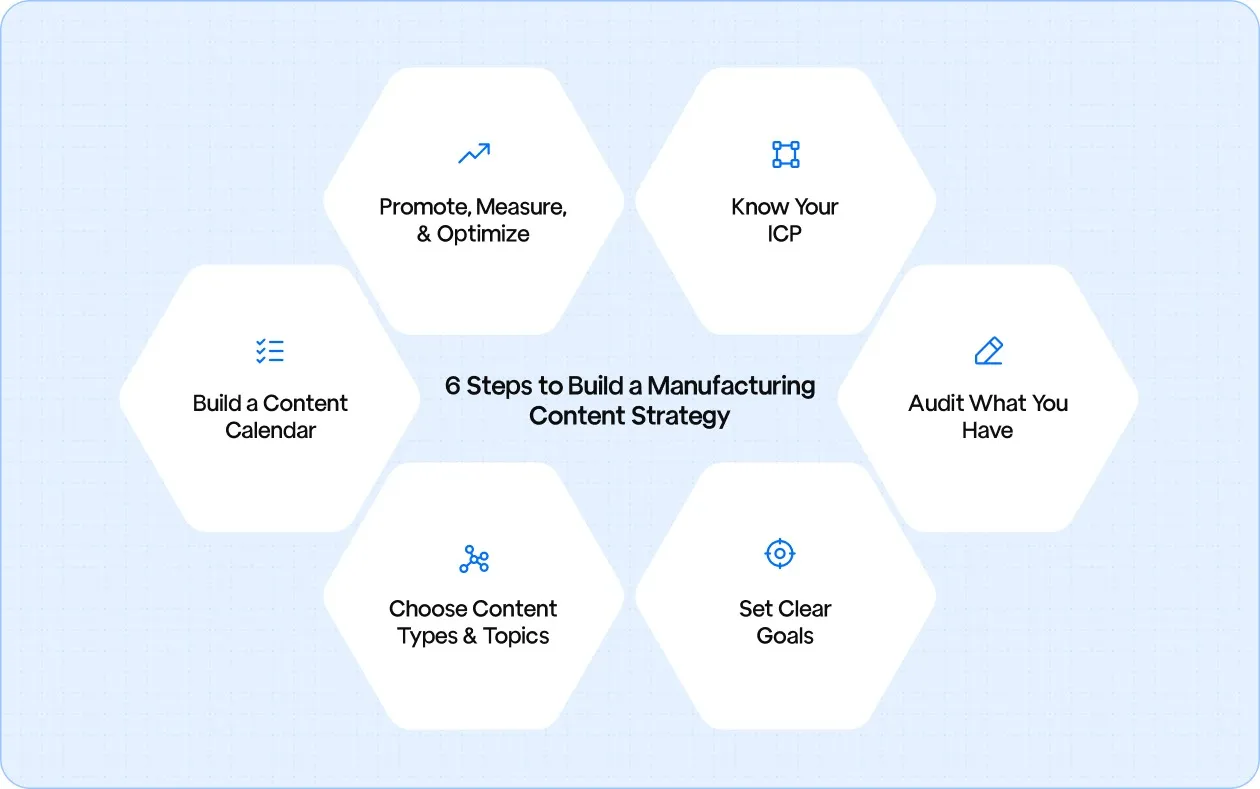
Creating a content marketing strategy for the manufacturing industry doesn't require a large team or budget. Follow these six actionable steps to build a strategy that drives qualified leads and supports your sales team.
Step 1: Know Your Buyer Inside Out
What to do: Define exactly who you're creating content for and what challenges keep them up at night.
Why it matters: You can't create relevant industrial content marketing if you don't understand your audience's specific pain points, how they search for solutions, and what influences their decisions.
Action items:
- Identify 2-3 key buyer personas (e.g., Plant Manager, Procurement Director, Operations VP)
- Interview your sales team about the top 10 questions prospects ask
- Talk to 5-10 existing customers about their biggest challenges before they found you
- Document how they typically discover, evaluate, and purchase solutions
Time needed: 1-2 weeks
Deliverable: One-page buyer persona document for each key audience
Step 2: Audit What You Already Have
What to do: Take inventory of all existing content and identify gaps in your coverage across the buyer journey.
Why it matters: Most manufacturers have more content than they realize—product sheets, technical specs, presentations. Don't start from scratch when you can repurpose and optimize what exists.
Action items:
- List all existing content (website pages, blog posts, videos, case studies, datasheets, presentations)
- Tag each piece as Awareness, Consideration, or Decision stage
- Use Google Analytics to identify your top-performing content by traffic and conversions
- Identify which buyer stages have little or no content
Time needed: 1 week
Deliverable: Content inventory spreadsheet mapped to buyer stages with performance data
Get a free website gap analysis in minutes.
Reveal Gaps.
After mapping your existing content, you can clearly see what’s missing—and that clarity enables goal-setting.
Step 3: Set Clear, Measurable Goals
What to do: Define what success looks like with specific metrics you can track.
Why it matters: Without clear goals, you can't measure ROI or prove that your industrial manufacturing marketing strategy is working. Goals keep your team focused and accountable.
Action items:
- Align content goals with business objectives (e.g., "Generate 100 qualified leads per quarter")
- Choose 3-5 key metrics to track:
- Traffic: Organic website visitors, page views
- Engagement: Time on page, content downloads
- Lead generation: Form submissions, gated content downloads
- Conversion: Marketing qualified leads (MQLs) to sales qualified leads (SQLs)
- Revenue: Pipeline value from content-driven leads
- Document current performance and set realistic 6-month targets (e.g., "Increase organic traffic by 30%")
Time needed: 2-3 days
Deliverable: Goals dashboard showing baseline metrics and 6-month targets
Step 4: Choose Your Content Types & Topics
What to do: Select which content formats you'll create and the specific topics you'll cover based on your resources and audience needs.
Why it matters: Not all content types work for every manufacturer. Focus on formats you can produce consistently rather than trying everything at once.
Action items:
- Start with 3-5 core content types you can realistically produce (e.g., blog posts, case studies, video tutorials)
- Ensure you have at least 2 content types per buyer stage (Awareness, Consideration, Decision)
- Use keyword research tools (SEMrush, Ahrefs, Google Keyword Planner) to find what your audience searches for
- Create a topic bank with 50-100 content ideas organized by:
- Pain points your solution solves
- Product features and use cases
- Industry trends and best practices
- Educational how-tos and technical guides
Time needed: 1-2 weeks
Deliverable: Prioritized list of content types and a topic bank with 50+ ideas
Get 100+ Ready-to-Publish Topics for Your Manufacturing Business
AI-generated topic bank and content calendar tailored to your niche.
Generate My Content Plan Now
Step 5: Build Your Content Calendar & Workflow
What to do: Create a realistic production schedule and define clear roles and responsibilities for your team.
Why it matters: Consistency beats perfection in content marketing for manufacturing companies. A calendar keeps you on track and ensures regular content publication, which is critical for SEO and audience engagement.
Action items:
- Choose publishing frequency: Start realistic (e.g., 2 blog posts/month, 1 case study/quarter, 1 video/month)
- Create a 90-day rolling calendar: Use Google Sheets, Asana, or CoSchedule to schedule content 3 months ahead
- Assign clear roles:
- Content strategist: Plans topics, maintains calendar
- Writers: Create blog posts, whitepapers, case studies
- Subject matter experts: Provide technical input and review
- Designer: Produce visuals and infographics
- Editor: Reviews and ensures quality
- Publisher: Schedules and publishes content
- Define your production workflow:
- Week 1: Topic research and outline
- Week 2: First draft
- Week 3: Review, edit, design
- Week 4: Publish and promote
- Build reusable templates: Blog post structure, case study layout, email newsletter format
Time needed: 1 week to set up, then ongoing maintenance
Deliverable: 90-day content calendar with assigned owners and deadlines
Step 6: Promote, Measure & Optimize
What to do: Amplify your content's reach through multiple channels, track performance religiously, and continuously improve based on data.
- Promote Your Content:
- Email marketing: Send to segmented lists (customers, prospects, newsletter subscribers)
- Social media: Post 3-5x per week on LinkedIn, share in industry groups
- Paid promotion: Boost top-performing content with LinkedIn ads or PPC for manufacturers
- Sales enablement: Equip your sales team with content for each buyer stage
- Repurpose content: Turn one blog post into an infographic, social posts, and an email series
- Measure Performance:
- Set up Google Analytics and marketing automation dashboards
- Monitor weekly: Traffic, engagement, conversions for recent content
- Track monthly: Progress against your goals from Step 3
- Key metrics to watch:
- Organic traffic growth
- Lead generation (downloads, form fills)
- Time on page and bounce rate
- MQL to SQL conversion rates
- Revenue influenced by content
- Optimize Continuously:
- Double down on winners: Create more content on topics that perform well
- Update underperformers: Refresh old content with new data, better SEO, improved formatting
- A/B test: Headlines, calls-to-action, content formats, distribution channels
- Gather feedback: Survey your audience about content preferences
- Quarterly strategy review: Assess what's working, adjust your approach, update calendar
Time needed: 4-6 hours per month for analysis and optimization
Deliverable: Monthly performance reports and quarterly strategy adjustments
Publishing content is only half the job. What determines success is how well that content is distributed, measured, and improved over time.
To make this more tangible, here’s what a realistic manufacturing content rollout looks like over the first few weeks.
A Quick Content Marketing Strategies Timeline
- Weeks 1-2: Complete Step 1 (Buyer research) and Step 2 (Content audit)
- Week 3: Complete Step 3 (Set goals)
- Weeks 4-5: Complete Step 4 (Choose content types and topics)
- Week 6: Complete Step 5 (Build calendar and workflow)
- Week 7+: Execute content creation and implement Step 6 (Promote, measure, optimize)
Some manufacturing SEO Companies are already doing this for many small- to medium-sized manufacturers in the US. Check out the agencies here.
Is Content Marketing Right for Your Manufacturing Company?
If you’re trying to understand how to market a manufacturing company in 2026, the answer begins with educating buyers—not persuading them.
Some manufacturing marketing agencies deliver measurable business outcomes, but they also require commitment and strategic execution to achieve the best results. Here's what to expect:
The Reality: Benefits Outweigh Challenges
While marketing for manufacturing companies presents real challenges, the benefits are substantial and lasting. Manufacturers who commit to a 6-12 month timeline, involve technical experts, and maintain consistency see measurable improvements in lead quality, sales efficiency, and revenue growth.
The manufacturers struggling most are those still relying solely on trade shows and referrals, while their competitors capture buyer attention through online marketing during the critical 60-70% of the research phase that occurs before sales contact.
Internet marketing for manufacturers using content isn't easy, but in 2026, it's essential for sustainable growth.
When you step back, the pattern becomes clear.
Wrapping Up
Content marketing for manufacturers isn't optional in 2026—it's how industrial buyers discover, evaluate, and select suppliers. With 60-70% of purchase decisions happening before sales contact, your content shapes buying decisions, whether you're actively creating it or not.
Modern manufacturer marketing happens quietly, as buyers research processes, compare capabilities, and reduce risk long before they speak to a supplier
Start with the fundamentals: understand your buyers, audit existing content, set measurable goals, and choose 3-5 core content types you can produce consistently. Focus on the top of funnel awareness content, mid-funnel proof, and bottom-funnel conversion materials.
Results take 3-6 months, but manufacturers who commit see sustained lead generation, shorter sales cycles, and measurable revenue growth.
How AI-Powered SEO Works for Manufacturing Companies
Top manufacturers in the US are using AI to scale content production and generate consistent leads without traditional agency timelines.
Start Exploring Potential Leads with AI SEO
Digital Marketing
Oct 6, 2025
5 mins
How to Win at Digital Marketing for Heavy Equipment Companies
Batul Beawarwala
Selling heavy equipment isn't as simple as making a quick sale. It's about cultivating trust and relationships over a long buying cycle, something that's increasingly happening online.
The problem? Many heavy equipment companies are still relying on traditional marketing methods like print ads or word-of-mouth, hoping they’ll catch the right lead. But with today’s buyers already doing their research online before even reaching out, this approach just doesn’t cut it anymore.

The real issue is attracting the right leads, those who are actively searching for the equipment you sell and value the specific features you offer.
This guide is here to help you move beyond outdated tactics and implement digital marketing strategies that target your ideal audience, streamline your sales cycle, and drive meaningful results.
Why Your Marketing Needs to Evolve In Today’s Time?
The heavy equipment industry, much like other sectors, has been heavily influenced by digital transformation in recent years. Traditional marketing methods, such as print ads and cold calls, are rapidly losing their effectiveness.
Buyers in the heavy equipment space now look online first for information, reviews, and purchasing options.
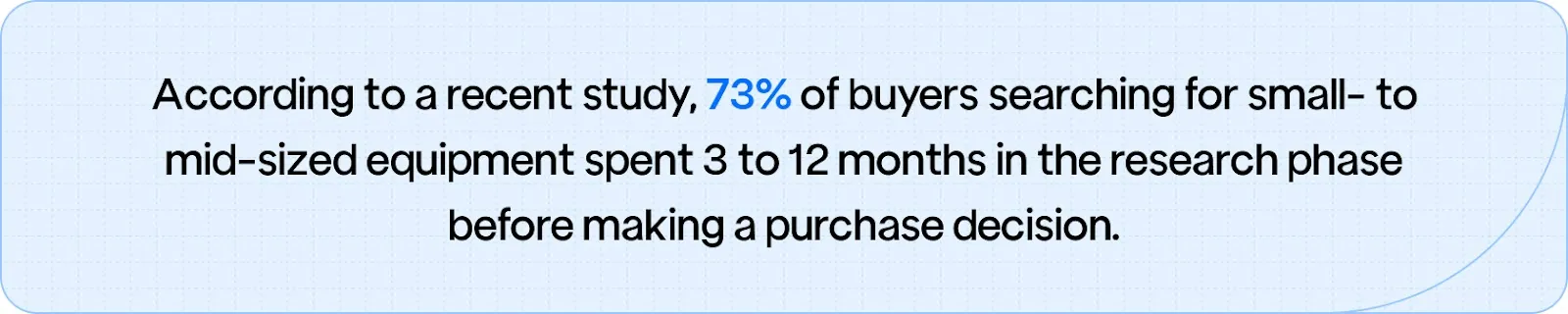
Why is Digital Marketing Important?
Digital Marketing today is more of a necessity and less of a preference. As competition intensifies and customer behaviors change, heavy equipment companies must adapt to stay relevant.
Shifting from outdated marketing tactics to digital solutions is crucial for survival.
Digital marketing enables you to reach your audience where they already are, online, and armed with information that will guide their purchasing decisions.
Who’s Really Buying Your Equipment? Know Your Audience
Understanding your audience is the first step to crafting a marketing strategy that resonates. In the heavy equipment market, key decision-makers like contractors, fleet managers, and project planners are the ones pulling the trigger on purchasing decisions.
But what makes them tick?
- Target Audience: Contractors are interested in machinery that offers reliability and durability. Fleet managers focus on ROI and maintenance costs, while project planners are typically driven by equipment availability and how well it meets project specifications.
By knowing these motivations, you can tailor your messaging and ensure you're speaking directly to their needs.
- Long Sales Cycle: Heavy equipment sales don’t happen overnight. The buying cycle is long and often involves multiple stakeholders. Relationships and trust are paramount. Nurturing these leads over time is essential. Buyers are conducting research online, gathering as much information as possible before making their decision.
Digital marketing can help you stay visible and provide the information your prospects need to make informed decisions when the time is right.
- The Digital Advantage: The key difference in today’s world is the role of the internet in the buying process. Your customers are already online, searching for solutions to their equipment needs.
If your company isn’t visible in those searches, you’re missing a critical opportunity to connect with high-quality leads.
Make Your Website a Lead-Generating Powerhouse
Your website is the cornerstone of your digital marketing strategy. It’s where leads are generated, relationships are built, and deals are closed. But to turn casual visitors into customers, your website needs to be more than just a digital brochure.
Key Features Your Site Must Have:
- Simple Navigation: Make it easy for visitors to find key information like product specs, demo requests, and contact details with a clear and straightforward layout.
- Product Pages That Build Trust: These should do more than show off your equipment. Each product page should include detailed specifications, high-quality images, videos, and customer reviews to create a sense of reliability and trust.
- Lead Capture Forms: Ensure your website has forms throughout, allowing visitors to request quotes, schedule demos, or ask for more information. These are crucial for converting visitors into qualified leads.
Make Sure They Find You When They Need Equipment (Your Tool for This: SEO)
SEO (Search Engine Optimization) is critical for heavy equipment companies. If your potential customers are searching for equipment online, your website needs to show up at the top of search results. Local SEO is especially important for equipment dealers, as many customers are searching for solutions nearby.
- Local SEO Wins: Make sure you're optimizing for geo-targeted keywords. For example, instead of just “excavators,” target keywords like “excavator rental [city name]” or “used bulldozers near me.” This helps you stand out in local search results and attract more relevant leads
- Optimizing Product Pages: Each of your product pages must be optimized with the right keywords. For instance, targeting terms like “buy used bulldozer near me” ensures your pages rank for the search queries that matter most to your potential buyers.
![Use high-intent long-tail keywords like “excavator rental in [city]” to target ready-to-buy customers.](https://cdn.prod.website-files.com/6614dca1d3aa7b076d6f3004/68e353c5cf99e31547a17466_ac0b244f.webp)
Let’s get you to the top of local search results and bring in more leads.
Optimize Your Digital Presence
Paid Ads: Get Immediate Results When You Need Them
While SEO helps you build long-term traffic, paid ads (PPC) provide immediate results. With PPC, you can target specific, high-intent search terms that can lead to quick conversions.
For heavy equipment companies, terms like “buy excavators” or “heavy equipment rental near me” can drive highly relevant traffic to your website right away.
- PPC to Jumpstart Your Leads: Paid ads allow you to target customers who are actively searching for what you offer.
For example, if someone is searching for “excavator rental in [city],” you can target that exact phrase with a paid ad, ensuring you’re visible at the moment they’re looking for solutions.
- Smart Ad Targeting: It’s not just about using Google Ads. Platforms like LinkedIn and Facebook are excellent for targeting decision-makers like fleet managers and project planners.
Remarketing ads can help bring back visitors who didn’t convert on their first visit, keeping your brand top of mind.
Social Media: Building Relationships, One Post at a Time
Social media isn’t just for consumer brands. For heavy equipment companies, it’s a valuable tool to engage with your audience, share behind-the-scenes insights, and showcase your products in action.
Focus on the Right Platforms:
- LinkedIn: The go-to platform for B2B networking.
- Instagram: Perfect for sharing high-quality images of your equipment.
- YouTube: A great space for product demos and how-to videos.
Content Strategy:
- Share Behind-the-Scenes Content: Give your followers a peek behind the curtain to humanize your brand.
- Customer Success Stories: Showcase how your equipment is helping your customers solve problems
- Collaborate with Industry Influencers: Partnering with influencers can help you extend your reach to a larger audience.

Content Marketing: Educate, Engage, and Convert
Content marketing is about providing value that solves real problems for your audience.
For heavy equipment companies, content like blogs, case studies, videos, and how-to guides establishes credibility and positions your company as an industry expert.
Examples of Effective Content:
- Blog Posts: Answer questions like “How to choose the right excavator for your site.”
- Case Studies: Show measurable results, e.g., how your machinery improved project efficiency.
- Videos: Product demos or operational tips that showcase equipment in action.
- How-To Guides: Step-by-step advice for proper equipment use or maintenance.
Real-World Impact
- Highlight tangible results from your equipment.
- Share customer success stories with measurable outcomes: cost savings, time reduction, or increased productivity.
Email Marketing: Stay Top of Mind and Build Relationships
Use website forms, gated content, and social media to capture leads. The goal is to build a high-quality, segmented list to nurture prospects effectively.
Types of Emails That Work:
- Lead Nurturing: Share product updates, industry news, or relevant offers.
- Follow-Up Emails: Send after demos, quotes, or consultations to maintain engagement.
- Re-engagement Emails: Target past leads or inactive customers with new offers or insights.
SEO vs. PPC: Finding the Perfect Balance for Your Equipment Business
Balancing SEO and PPC is crucial for heavy equipment companies to reach the right buyers at the right time. Combining both strategies ensures you capture immediate leads while building lasting online visibility.
- SEO: Long-term strategy for organic visibility, building trust and credibility.
- PPC: Short-term strategy for instant visibility and targeted lead capture.
When to Use Each:
- PPC: Launching new products or entering competitive markets.
- SEO: Long-term growth, organic traffic, and reduced dependency on paid ads.
Measuring Success: Track What Actually Matters
Tracking the right metrics is essential for understanding the effectiveness of your marketing efforts. Focus on key performance indicators (KPIs) that drive results and optimize your strategy.
Metrics to Monitor:
- Website Traffic: Track both organic and paid traffic sources.
- Conversion Rates: Measure form submissions, demo requests, or quote inquiries.
- Social Media Engagement: Likes, shares, and comments indicate content resonance.
- Lead Nurturing Success: Monitor how leads progress through email campaigns and sales funnels.
Tools You Can Use:
- Google Analytics
- HubSpot
- LinkedIn Analytics
Stay Ahead in the Digital Marketing Race for Heavy Equipment Companies
The heavy equipment market is highly competitive, and relying on scattered tactics isn't enough. Success comes from a strategic, integrated approach that combines SEO, PPC, content marketing, and social media to connect with the right buyers at the right time.
The real challenge is about consistently attracting qualified leads while demonstrating trust and credibility in every interaction.
Ready to take the next step?
With the right strategy, you can see your marketing efforts come to life, attract quality leads, and boost your sales.
Book a Consultation
FAQs
Q1. How can digital marketing help my heavy equipment business grow?
A1. Digital marketing enables you to reach a broader audience, build brand awareness, and generate qualified leads. By leveraging SEO, PPC, content marketing, and social media, you can attract potential customers actively searching for equipment and services online.
Q2. What are the key components of a successful website for heavy equipment companies?
A2. A well-structured website should include:
- Detailed product listings with specifications and high-quality images.
- Clear navigation and responsive design for mobile users.
- Easy-to-find contact information and lead capture forms.
- Content that builds trust and demonstrates expertise.
These elements help convert visitors into leads and customers.
Q3. How important is SEO for my heavy equipment business?
A3. SEO is crucial for improving your website's visibility in search engine results. By optimizing your site with relevant keywords, local SEO strategies, and quality content, you can attract more organic traffic and potential customers.
Q4. Should I invest in paid advertising for my equipment business?
A4. Yes, PPC campaigns can provide immediate visibility and drive targeted traffic to your website. By focusing on high-intent keywords and platforms like Google Ads and LinkedIn, you can reach decision-makers and generate quality leads.
Q5. How can social media benefit my heavy equipment company?
A5. Social media platforms like LinkedIn, Facebook, and Instagram allow you to showcase your equipment, share customer success stories, and engage with your audience. Consistent posting and interaction can build brand loyalty and attract new customers.
Q6. What role does content marketing play in my digital strategy?
A6. Content marketing helps establish your authority in the industry by providing valuable information to your audience. Blog posts, case studies, videos, and how-to guides can answer customer questions, showcase your expertise, and improve SEO.
Q7. How can I measure the success of my digital marketing efforts?
A7. Track key performance indicators (KPIs) such as website traffic, conversion rates, lead quality, and return on investment (ROI). Utilize tools like Google Analytics, HubSpot, and LinkedIn Analytics to monitor and adjust your campaigns for optimal performance.

Digital Marketing
Oct 1, 2025
5 mins
Top 10 Digital Marketing Agencies for Audio Visual (a/v) Manufacturers
Batul Beawarwala
Selling A/V systems is about attracting the right kind of leads who understand the complexity and value of your products.
The challenge? Many manufacturers waste money on digital marketing strategies that bring in tire-kickers instead of qualified buyers.
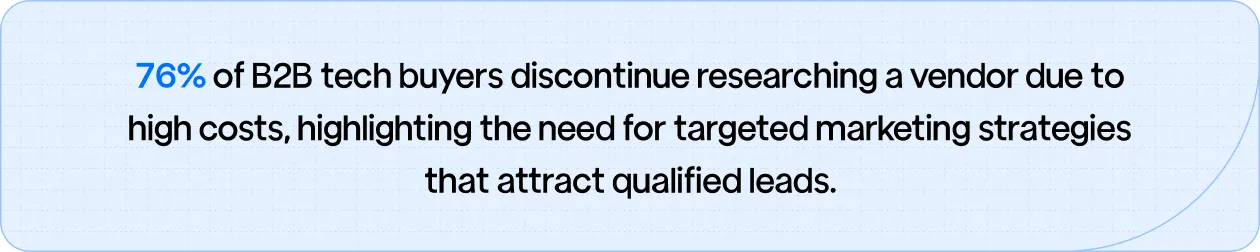
With long sales cycles and niche buyers, you need a marketing agency that specializes in A/V manufacturing and knows how to engage your target audience effectively. This is about finding the decision-makers who are already looking for solutions like yours.
This guide will show you how the right marketing agency can make all the difference in turning your digital efforts into measurable growth.
1. Gushwork
Gushwork stands out as a digital marketing agency that truly understands the unique needs of A/V manufacturers. With extensive expertise in the sector, Gushwork offers tailored solutions to help A/V businesses achieve their marketing goals.
Their strategies, including SEO, PPC, content marketing, and lead generation, are carefully crafted to ensure measurable results.
- Key Services: SEO, PPC, content marketing, lead generation
- Core Focus: Industry-specific strategies for growth, visibility, and conversions
- Why Choose Them?: Gushwork’s deep knowledge of the A/V sector allows them to craft campaigns that attract highly qualified leads and maximize ROI.
2. THE rAVe Agency

THE rAVe Agency brings over 45 years of combined experience to the table, with a clear focus on elevating brand visibility and engagement. Their expertise in creative, editorial, and strategic services has helped many A/V companies develop strong, engaging marketing campaigns.
- Key Services: Editorial, creative strategy, content development
- Core Focus: Enhancing brand visibility and audience engagement
- Why Choose Them? Their in-depth knowledge of the A/V sector ensures that campaigns resonate with the right audience.
3. AV Marketing

AV Marketing specializes in helping A/V manufacturers drive sales and improve their online presence. Offering services like SEO, PPC, and web design, they focus on customer acquisition and building a strong brand identity.
- Key Services: SEO, PPC, web design, customer acquisition
- Core Focus: Improving brand presence and boosting conversions
- Why Choose Them?: AV Marketing’s targeted approach ensures that the right people see manufacturers and generate quality leads.
4. Twelverays
Twelverays excels in creating engaging audio-visual content that resonates with A/V manufacturers’ target audiences. By integrating visual storytelling with strategic marketing, they drive brand recognition and improve user experience.
- Key Services: Visual content creation, marketing integration
- Core Focus: Enhancing user experience through creative marketing
- Why Choose Them? Their expertise in audio-visual elements ensures that your message reaches your audience powerfully and engagingly.
5. Launch Marketing
Launch Marketing focuses on B2B marketing strategies designed to elevate A/V manufacturers in competitive markets. Their services, including strategic campaign planning and content creation, help companies improve visibility and attract qualified leads.
- Key Services: Campaign strategy, content creation, lead generation
- Core Focus: Building targeted marketing campaigns for A/V companies
- Why Choose Them? Launch Marketing’s deep industry knowledge ensures tailored, results-driven strategies.
6. Venveo
Venveo takes a personalized approach to digital marketing, offering tailored strategies that cater to A/V manufacturers’ specific needs. They focus on connecting businesses with the right audience and delivering long-term success.
- Key Services: SEO, PPC, content marketing, strategy development
- Core Focus: Creating personalized marketing solutions for A/V manufacturers
- Why Choose Them? Venveo’s expertise in A/V manufacturing ensures strategies that are built for growth and engagement.
7. R.H. Blake
With over 30 years of experience, R.H. Blake offers a range of digital marketing services designed to help A/V manufacturers grow their online presence. Their offerings include SEO, paid advertising, and social media marketing.
- Key Services: SEO, paid advertising, social media, email marketing
- Core Focus: Building an online presence and driving quality leads
- Why Choose Them? R.H. Blake’s extensive experience in manufacturing marketing guarantees efficient, results-focused strategies.
8. Thrive Internet Marketing Agency
Thrive Internet Marketing Agency is known for its award-winning SEO, PPC, and social media services. Their digital strategies help A/V manufacturers succeed by optimizing their online presence and driving conversions.
- Key Services: SEO, PPC, social media marketing
- Core Focus: Driving measurable growth and increasing visibility
- Why Choose Them? Thrive’s proven track record in digital marketing helps A/V manufacturers achieve their growth objectives effectively.
9. WebFX
WebFX combines award-winning digital marketing expertise with data-driven strategies to help A/V manufacturers achieve tangible results. They specialize in SEO, PPC, and content marketing to generate high-quality leads and increase brand visibility.
- Key Services: SEO, PPC, content marketing, web design
- Core Focus: Delivering results-driven campaigns through strategic data use
- Why Choose Them?: WebFX’s data-backed approach ensures that your campaigns are always optimized for maximum impact.
10. VaynerMedia
VaynerMedia offers integrated strategy, creative services, and media buying to help A/V manufacturers engage their target audience effectively. Their creative approach to digital marketing ensures your brand’s message stands out in a crowded marketplace.
- Key Services: Strategy, creative services, media buying
- Core Focus: Brand engagement through creative and media strategies
- Why Choose Them? VaynerMedia's comprehensive approach makes it a strong choice for A/V manufacturers looking to scale their marketing efforts.
How to Choose the Right Digital Marketing Agency for Your A/V Manufacturing Business
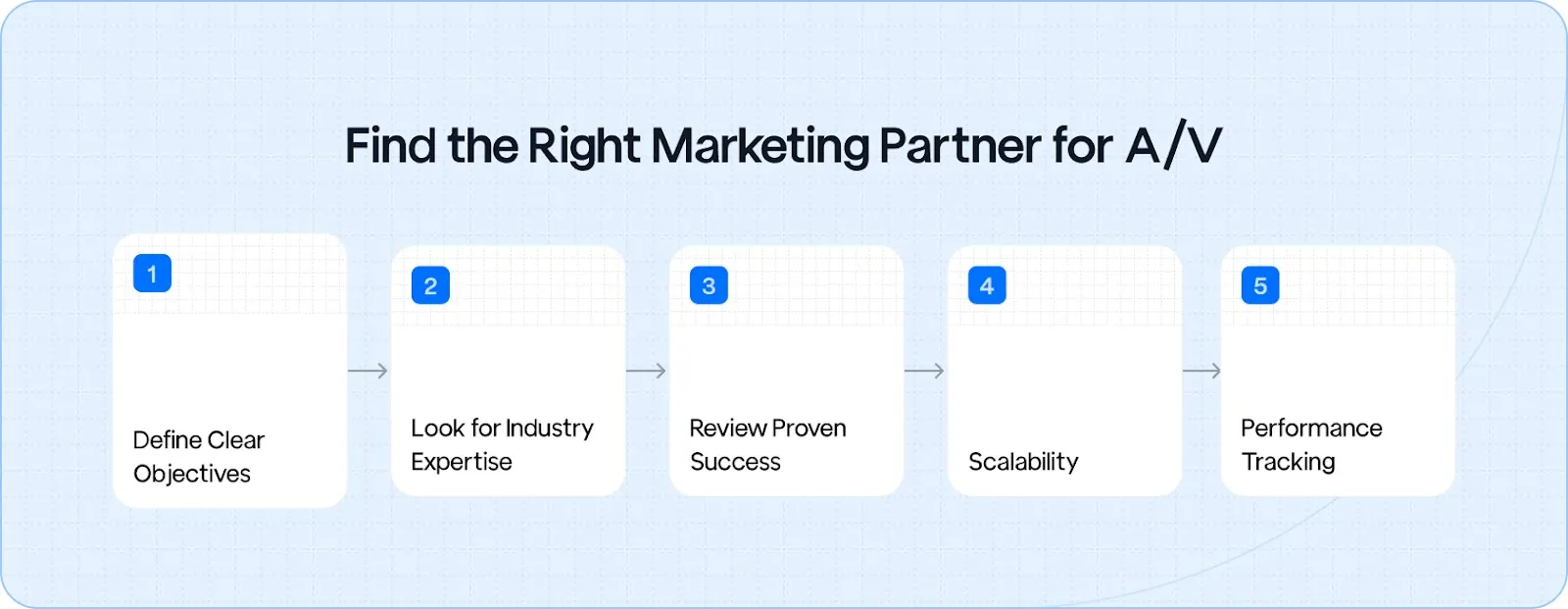
Choosing the right digital marketing agency for your A/V manufacturing business is about finding the right partner who truly understands your industry and its challenges.
A/V manufacturers face a unique set of marketing obstacles, including long sales cycles, technical product complexities, and niche customer needs. To ensure success, it’s critical to partner with an agency that has digital marketing expertise and a deep understanding of the A/V sector's intricacies.
Here’s what to keep in mind when choosing the right agency:
- Define Clear Objectives: Before selecting an agency, define what you want to achieve. Driving lead generation, improving brand visibility, and increasing customer retention, having a clear goal will help guide your marketing strategy and ensure alignment with your business needs.
- Look for Industry Expertise: An agency that specializes in A/V manufacturing will know how to create specialized strategies that address the unique demands of your business.
They'll have experience in overcoming technical marketing challenges, navigating long decision-making processes, and connecting with hard-to-reach, highly specific target audiences.
- Review Proven Success: Make sure to ask for case studies, client testimonials, and measurable results from previous campaigns. This will give you insight into the agency's ability to execute strategies that lead to real, measurable growth for businesses like yours.
- Scalability: Your business needs are likely to evolve as you grow. Choose an agency that has the flexibility to scale its services and adapt strategies as your needs change, ensuring continued success as your business expands.
- Performance Tracking: A good agency should provide detailed analytics and performance tracking to help you measure the success of your campaigns.
With consistent tracking, you can ensure that your marketing efforts are delivering the results you want and refine your strategy for continuous improvement.
Looking for an agency that understands A/V manufacturing?
Choose a team with proven experience and a results-driven approach.
Start Growing Your A/V Brand
The ROI of Digital Marketing for A/V Manufacturers
Investing in digital marketing offers a significant return on investment for A/V manufacturers. By leveraging strategies like SEO, PPC, and targeted content marketing, agencies can help you achieve tangible results in key business areas such as lead generation, brand visibility, and customer engagement.
Here’s how digital marketing can yield an ROI:
- Enhanced Lead Generation: SEO, PPC, and content marketing strategies can help you reach highly qualified leads who are actively seeking A/V solutions. These strategies ensure that your brand is seen by decision-makers who understand your products’ value.
- Increased Brand Visibility: Digital marketing helps to boost your online presence, ensuring that your A/V business stands out in a crowded market.
With the right strategy, you can attract more attention from your target audience and gain higher visibility on search engines and social media platforms.
- Better Customer Engagement: Personalized content, email marketing, and case studies keep your prospects engaged throughout their buyer journey. By nurturing these relationships, you’ll turn prospects into loyal customers who keep coming back.
- Measurable Results: A strong digital marketing agency will provide ongoing reporting to ensure that your campaigns are performing well. With clear analytics, you can see exactly what’s working, optimize strategies, and get the best possible ROI.
Ready to see tangible results for your A/V brand?
A marketing agency that specializes in delivering measurable growth.
See How We Drive Results
Elevate Your A/V Brand with the Right Digital Marketing Partner
Selecting the right digital marketing agency is critical to your success as an A/V manufacturer. With personalized strategies, proven expertise, and data-driven results, the right agency can transform your marketing efforts into measurable growth.
By clarifying goals, understanding your industry’s unique needs, ensuring scalability, and tracking performance, the right team helps you stay ahead in a competitive market.
Key Takeaways:
- Goal clarity is essential for effective strategies.
- Industry expertise and scalability are key to long-term success.
- Performance tracking ensures you get the best ROI.
Stop wasting time on ineffective marketing. Partner with Gushwork.
Boost your growth, visibility, and lead quality with a proven, industry-focused team.
Book a Consultation
FAQs
Q1. What services does a digital marketing agency for A/V manufacturers offer?
A1: A digital marketing agency for A/V manufacturers typically offers services such as SEO, PPC advertising, content marketing, lead generation, and social media management. These services are tailored to attract qualified leads, increase brand visibility, and optimize conversions for A/V manufacturers.
Q2. How do I know if a digital marketing agency understands A/V manufacturing?
A2: Look for agencies with experience in the A/V industry. Check case studies, testimonials, and their knowledge of A/V-specific challenges such as long sales cycles and technical product marketing. An agency familiar with your industry will be able to create specialized strategies that align with your business goals.
Q3. What’s the ROI of digital marketing for A/V manufacturers?
A3: The ROI of digital marketing for A/V manufacturers includes increased lead generation, higher brand visibility, improved customer engagement, and better conversion rates. Agencies measure success through detailed performance analytics, ensuring every marketing dollar spent contributes to measurable growth.
Q4. Can a marketing agency help with long sales cycles typical in A/V manufacturing?
A4: Yes, a specialized marketing agency can help by creating strategies that nurture leads through the extended sales cycle. Through content marketing, email campaigns, and retargeting, they keep prospects engaged until they’re ready to make a purchase decision.
Q5. How do digital marketing agencies measure the success of their campaigns for A/V manufacturers?
A5: Agencies measure success through metrics like lead quality, conversion rates, website traffic, and engagement levels. They provide detailed reports and use data analytics to refine strategies, ensuring continuous optimization and a strong return on investment.
Q6. How can I ensure that my digital marketing agency delivers results for my A/V business?
A6: Choose an agency with proven expertise in A/V manufacturing. Ask for case studies and detailed reports on past campaign results. Ensure they provide consistent performance tracking and are transparent about their strategies to ensure they align with your business goals.
Q7. What makes Gushwork different from other digital marketing agencies for A/V manufacturers?
A7: Gushwork stands out for its deep expertise in the A/V manufacturing sector. They offer tailored strategies specifically designed for A/V brands, focusing on attracting high-quality leads, improving visibility, and maximizing ROI through SEO, PPC, and content marketing, all while understanding the unique challenges of A/V manufacturing.

“For the first time, we’re proud to add SEO services. Six months in, impact evident.”
Read Case Study

In Conversation with

Abhijith HK
Founder & CEO of Codewave
Want us to do the same for your business?
Talk to an Expert
.svg)
.svg)

