


Home

Resources
Blogs
Blog
Get insights on AI, productivity, and the future of work.


Thank you! Your submission has been received!
Oops! Something went wrong while submitting the form.

SEO
Nov 7, 2025
5 mins
How SEO Roofing Can Help Ohio Homeowners Find Your Service?
Ishani Mitra
As a roofing company, your success depends on being visible to local homeowners when they need you most. More and more people are turning to online search to find roofing services in their area, which means if your business isn’t showing up in these local search results, you’re missing out on key opportunities.
Local SEO is essential for boosting your online visibility, ensuring you appear at the top of search results when homeowners search for roofing services near them.
In this blog, we’ll cover actionable local SEO roofing tips to help your roofing business rank higher, attract more local leads, and grow your customer base.
What Is Roofing SEO?
When we talk about “roofing SEO”, we’re referring to the strategic actions a roofing company takes to ensure that your business ranks at the top when a potential customer searches for a roofer nearby.
Here’s a simple breakdown of what it means:
- Being found in search: SEO for roofing is all about making sure your website, your business listing, and your online presence show up.
- Focusing on your service area: Since you serve particular cities or regions (for example: Ohio and nearby counties), roofing SEO emphasizes local searches, so you show up for people in your area, not across the country.
- Optimizing your online assets: It includes several elements:
- Your website (fast load time, mobile-friendly, clear services)
- Your business listing (for example, on Google Business Profile: accurate name, address, photos, reviews)
- Your local mentions and reviews (so search engines and customers trust you)
- Smart keyword use (words people actually type in search when they have a roofing problem)

SEO for roofing means you adjust your online presence so when someone needs your service right now, they find you, not your competitor. And once they find you, it’s your job to make it easy for them to contact you, and start the job.
9 Best SEO Practices for Roofing Businesses
Ranking on the first page of Google is about following smart, consistent best practices that match how Google works today.
Especially for roofing businesses in Ohio, securing those top‑spots means doing the right things well. Below are proven practices you can apply now:
1. Optimize Your Google Business Profile (GBP)
Your Google Business Profile is the most influential asset in local roofing SEO. It’s the listing that appears in Maps and in the local 3-pack, which often captures the majority of calls for urgent roofing issues.
Homeowners rely on Google Maps when they need fast help. Google uses GBP activity to decide which roofers look legitimate, nearby, and trustworthy.
What to do:
- Fill out every available field, including services, service areas, hours, and business categories.
- Add real job-site photos, crew photos, before/after work, and short videos.
- Use an accurate roofing description that includes natural local terms such as “roof repair in [city].”
- Post updates weekly or monthly to show activity.
- Add FAQs to the Q&A section and answer customer questions.
- Collect reviews steadily and respond to each one.
- Keep NAP (name, address, phone) consistent across your website and directories.
- Add your business to key directories like Apple Maps, Bing Places, Yelp, and home-service platforms.
A well-optimized GBP is often the deciding factor in whether your business appears in the local 3-pack.
Maximize Your Roofing Business Visibility Today!
Don’t let your competition take the lead. Optimize your Google Business Profile and start ranking higher now!
Get Started with SEO


2. Build a Keyword Strategy Based on Real Roofing Search Intent
Keyword planning for roofing has to match how homeowners search when they need service. Roofing demand is spread across dozens of variations, so the total opportunity is bigger than any single keyword metric will show.
Why this matters:
“Roof repair near me” doesn’t behave the same as “roofing companies in [city].” Some phrases show urgent intent, others show research intent. Your strategy should capture both.
What to do:
- Target high-intent terms like “roof repair near me”, “roofing contractor [city]”, “shingle replacement [city]”.
- Use multiple keyword variations, not just one or two broad terms.
- Include core service keywords: roof repair, roof installation, roof replacement, storm damage repair.
- Use keyword tools to understand volume, but assume real demand is higher due to variation overlap.
- Match keywords to the right page instead of forcing too many onto one page.
A strong roofing keyword strategy ties directly into your site structure and local relevance.
3. Build Service Pages and Location Pages
Google looks for clear signals that your page is the best match for what the searcher typed. If you mix too many topics or locations into one page, you dilute relevance.
What to do:
- Create separate pages for each roofing service:
- Roof repair
- Roof installation
- Roof replacement
- Storm damage repair
- Emergency roofing
- Commercial roofing
- Build city pages for every area you serve, even without a physical office.
- Combine service + location when possible (“Roof Repair in Akron OH”).
- Write clear local content mentioning neighborhoods, weather patterns, and problems common in that region.
- Use strong title tags and meta descriptions that include the target keyword + a differentiator (years in business, reviews, warranties, availability).
- Keep pages conversion-focused: simple forms, visible phone buttons, trust badges, and project photos.
Roofing SEO is built on clarity. The cleaner your structure, the easier it is for Google to rank you.
4. Improve Website Quality, Mobile Experience, and User Trust
Roofing searches are often urgent. If the site loads slowly or feels unreliable, homeowners immediately hit back and choose someone else. Google sees that bounce and lowers your ranking.
What to do:
- Prioritize mobile-friendly design.
- Keep load times under ~3 seconds.
- Use clear navigation and simple layouts.
- Include real project photos instead of stock images.
- Show roofing licenses, warranties, and certifications.
- Add schema markup so Google understands your business type and service area.
- Place call buttons and quote buttons at the top of key pages.
Google ties website quality to homeowner trust. A clean site signals a professional roofing company.
5. Generate and Manage Reviews
Reviews influence two things: whether you show up in local search and whether homeowners trust you enough to call.
What to do:
- Aim for a rating of 4.7 or higher.
- Match or exceed competitor review counts.
- Ask immediately after completing a job using text or a QR code.
- Encourage homeowners to mention service + city in their review.
- Respond to every review.
- Keep review flow steady throughout the year.
Reviews can make or break your lead flow, especially during storm season.
6. Prepare High-Quality Backlinks
Backlinks are endorsements from other websites. Roofing companies with strong backlinks outperform those without them.
What to do:
- Analyze competitor backlinks to find local directories and industry listings you’re missing.
- Get links from local businesses, suppliers, chambers of commerce, and community sites.
- Contribute quotes or insights to journalists using media request platforms.
- Write helpful articles or guides and pitch them to local publications.
You don’t need hundreds, just a consistent, relevant set.
7. Keep Technical SEO Clean and Error-Free
Technical SEO ensures your site works the way search engines expect. If the site struggles to load, has broken links, or is difficult to use on mobile, Google’s ranking systems see it as a poor user experience.
What to do:
- Improve load time by compressing images and reducing scripts.
- Ensure layout doesn’t shift on mobile.
- Fix broken internal links.
- Use clean URLs like /roof-repair-columbus-oh/.
- Add HTTPS security.
A technically sound site supports every other SEO effort.
8. Publish Helpful, Local, Problem-Solving Roofing Content
Blog posts, guides, and case studies help Google understand your expertise. They also help homeowners feel confident calling you.
What to do:
- Write content about seasonal roofing issues in your region.
- Explain common roofing decisions (repair vs replace, cost breakdowns, insurance questions).
- Create “roof cost in [city]” pages—these rank well and generate high-intent visitors.
- Create project case studies by neighborhood.
- Add a roof maintenance or storm checklist tailored to your service area.
Good content builds authority over time and feeds organic traffic long after it’s published.
9. Track All Roofing Leads with Proper Analytics
If you don’t track where leads come from, you can’t improve your SEO or spend your budget effectively.
What to do:
- Install GA4 for web traffic and conversions.
- Use Google Search Console to see which keywords and pages bring visitors.
- Use a call tracking tool to identify whether a call came from SEO, ads, Maps, or a specific page.
- Review call recordings to measure lead quality.
- Track map rankings separately to see your local improvements.
The goal is simple: identify what brings profitable roofing jobs and put more energy into those channels.
What Are the Benefits of SEO for a Roofing Business?
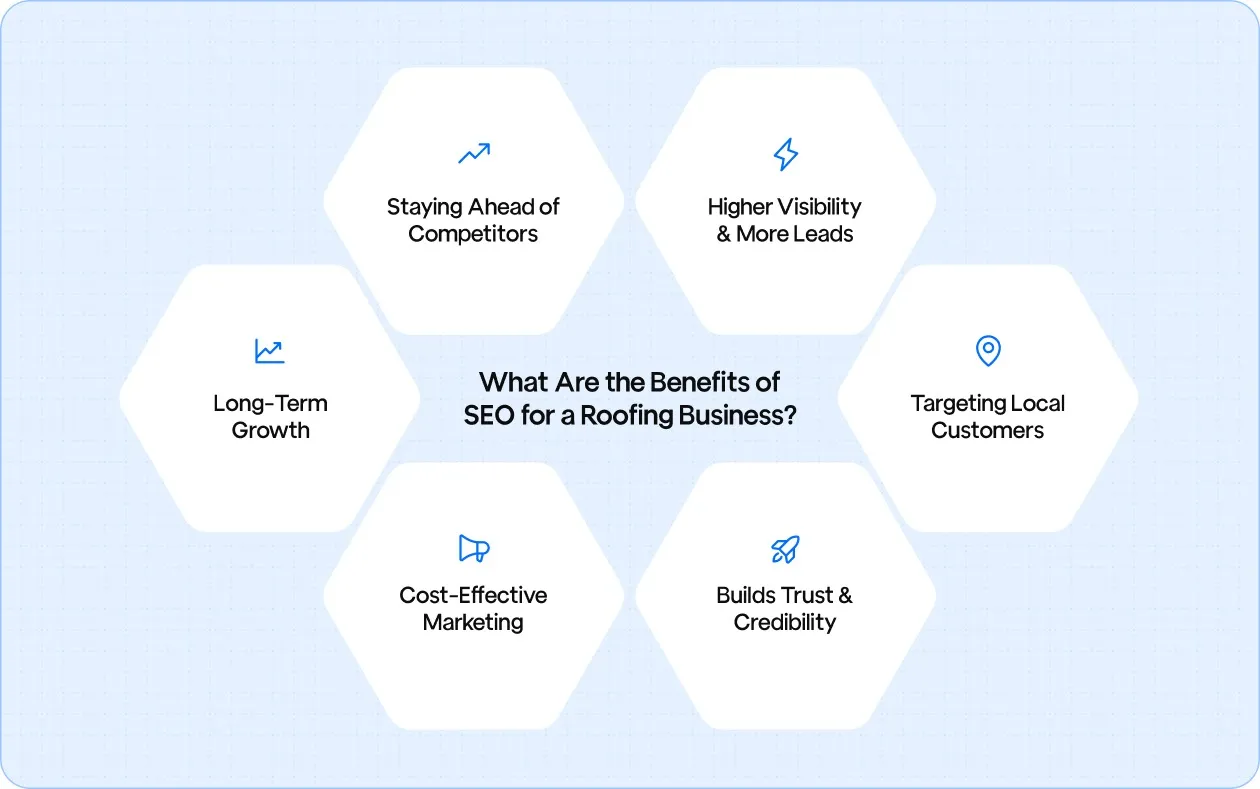
Let’s break down the benefits so you can see how SEO can make a real difference for your roofing company:
1. Higher Visibility and More Leads
SEO helps your roofing business rank higher in search results, making it easier for potential customers to find you when they need your services.
How SEO achieves this:
- Improved Google rankings: SEO strategies (like keyword optimization and technical improvements) push your website to the top of search results.
- Increased click-through rates (CTR): Appearing on the first page of Google increases the likelihood that users will click on your business link.
- Targeting high-intent keywords: Focusing on terms like “roof repair near me” or “emergency roof replacement” helps you capture leads who are ready to hire immediately.
2. Targeting Local Customers Who Are Ready to Hire
Local SEO roofing ensures your roofing business is reachable to people in your area who are actively searching for roofing services.
How SEO achieves this:
- Local keyword optimization: Using keywords with location-specific terms (e.g., “roofing company Columbus” or “roof replacement Cleveland”) targets customers in your service area.
- Google Business Profile: An optimized profile helps you appear in local map searches when potential clients are looking for roofers nearby.
- Location pages: Creating landing pages dedicated to specific cities or neighborhoods helps you rank for various locations within your service area.
3. Builds Trust and Credibility
SEO builds trust with both search engines and potential clients by improving your online presence and providing proof of your expertise.
How SEO achieves this:
- Positive reviews: Collecting and showcasing customer reviews on Google and other platforms helps build credibility.
- High-quality content: Offering useful, informative content (e.g., blog posts, case studies) establishes your authority and reliability in the roofing industry.
4. Cost-Effective Marketing
Unlike traditional advertising, SEO works continuously to attract roofing leads without ongoing costs for each new client.
How SEO achieves this:
- Organic traffic: Once your website is ranked for targeted keywords, it continues to bring in free traffic without the need for additional paid ads.
- Broader results: The results of SEO can last for months or even years, unlike short-term ad campaigns that need constant funding.
- Better ROI: SEO offers one of the highest returns on investment compared to paid ads, as the traffic you receive is earned, not bought.
5. Long-Term Growth
SEO is an investment that pays off over time. As you continue to build and refine your SEO strategy, your roofing business will steadily gain traffic.
How SEO achieves this:
- Evergreen content: Blog posts and landing pages continue to drive traffic long after they’re published, as long as they remain relevant.
- Cumulative effect: SEO efforts build on themselves, meaning your website’s authority and rankings improve over time, providing a snowball effect.
- Sustained traffic: As you strengthen your site’s SEO, it consistently brings in new leads with minimal ongoing effort.
6. Staying Ahead of the Competition
SEO helps you stay competitive by ensuring your roofing business ranks higher than others in your area.
How SEO achieves this:
- Competitive keyword targeting: By choosing the right keywords and focusing on local search terms, SEO helps you outrank competitors in your area.
- Regular updates and optimizations: Keeping your website fresh with updated content and continuous technical improvements ensures you maintain a competitive edge.
- Long-term ranking stability: SEO helps you reach the top and also maintains your position by ensuring strong, consistent optimization.
Drive More Leads with Local SEO for Roofing
Stop missing out on opportunities. Optimize your website and get found by the right clients in your area.
Start SEO Today
What’s Changed in Google’s SEO Landscape?
The rules of online visibility are shifting and fast. For a roofing business in Ohio, this means that the way your website ranks today may be very different from how it will rank a year from now. Understanding these changes gives you the edge.
Here’s a breakdown of key updates and how they affect your local roofing SEO strategy:
More Frequent & Broad Algorithm Updates
Google has been rolling out major changes more often. For example, they issued a broad “core update” in March 2025 and again in June 2025.
- These updates aren’t about specific sites. Google says they are built to improve how the whole system works.
- For you, this means rankings can shift quickly—even if you didn’t change anything.
- So keeping up‑to‑date and ready to adjust your site is now part of the job.
Local SEO Signals Are Evolving
Recent studies show that for local businesses, proximity (how close the business is to the searcher) accounts for over 55.2% of ranking influence.
- Review count and review quality (19.2% influence) matter more than before.
- What this means: For a roofing company in Ohio, showing up first isn’t just about keywords. It’s about being the nearby company people trust.
Rise of AI & Structured Data in Search
Google is now using AI-powered features and structured data (like schema markup) to deliver answers right in search results.
- Content that’s structured, clear, and provides value gets picked up more often.
- Simply stuffing keywords won’t work anymore. Your content must actually help someone with their roofing problem.
User Experience, Mobile & Trust Signals Matter More
Google’s updates increasingly reward sites that give users a good experience: fast loading, mobile‑friendly, trustworthy.
- If your site loads slowly, or isn’t mobile‑friendly, you’ll lose ground.
- Confirming your business details (name, address, phone) and building genuine reviews make a real difference.
Roofers Win When They Control Multiple Spots on Page One
Modern roofing SEO is about securing as many positions on page one as possible so homeowners trust you more than the competition. High-performing roofing companies appear:
- In the map pack
- In the organic listings
- In People Also Ask results
- In Google Ads, LSAs, or map extension ads
When a homeowner sees the same roofing brand multiple times, it signals reliability and often leads to the fastest conversions.
The Future of Roofing SEO Is a Blended System
Based on current trends, the roofing companies that grow strongest combine:
- Local SEO
- Traditional SEO
- Google Ads (Search, LSAs, Performance Max, Map Extensions)
- Social ads with strong visual proof (Meta, YouTube)
With each piece working together, you stay visible whether the homeowner is searching urgently, browsing reviews, or comparing quotes.
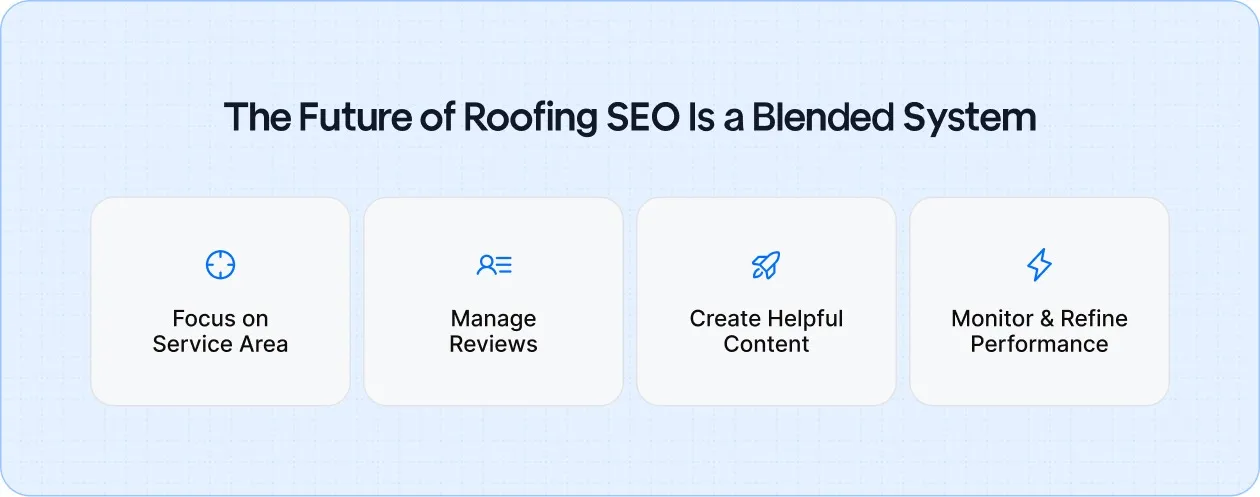
What This Means for You
- Focus on your service area (e.g., Columbus, Cleveland) and make sure all local listings reflect that.
- Collect good reviews and respond to them. This is a ranking factor now.
- Create content that answers questions your customers are asking (e.g., “How much does a new roof cost in Dayton?”) and make sure it’s structured for search engines.
- Regularly check your traffic, rankings, and leads. If you see drops after an update, don’t panic. Assess, adjust, and refine.
Is Your Roofing Business Ready to Rank?
Take your local SEO to the next level and get noticed by more clients in Ohio. Let us help you rise to the top!
Boost Your Roofing SEO Now
Understanding how Google’s SEO landscape is evolving is just the initial step. To make sure your roofing business stays visible on Google’s first page, it’s essential to implement best practices that align with these changes.
What to Look for in a Roofing SEO Agency
Choosing the right roofing SEO partner comes down to whether they understand how homeowners search, how roofing leads convert, and how to build long-term visibility you can rely on. Here are the key things to check before hiring:
1. Proven roofing industry experience: They should understand roofing keywords, seasonality, storm-driven demand, and how homeowners make decisions.
2. Clear local SEO expertise: They must know how to optimize Google Business Profiles, build location pages, earn reviews, and rank in the local 3-pack.
3. A track record of ranking and revenue results: Look for case studies showing increases in calls, map rankings, organic traffic, and booked jobs.
4. Transparent reporting: They should show where every lead comes from and how it ties to revenue, not vague traffic reports.
5. Strong technical and on-page SEO abilities: Fast websites, clean structure, optimized title tags, schema, and service pages should be standard.
6. Clear keyword strategy with service + city targeting: They should build pages around roof repair, replacement, storm damage, and your specific service areas.
7. Content that builds authority: Ask if they create blogs, FAQs, guides, and project pages tailored to your local market.
8. Ability to manage and improve your GBP: They should know review generation, photo strategy, posting cadence, and category optimization.
9. No long-term lock-in contracts: Good agencies rely on results, not contracts, to keep you.
Wrapping Up
At the end of the day, homeowners don’t pull out directories, they pull out their phones. And when they do, you want your roofing business to be the one they call. By embracing local SEO strategies, you position yourself at the exact moment someone needs you most.
The competition is already showing up online. Make sure you do, too. The tools are available, and the opportunity is right in front of you. The only thing standing between your business and more local leads is action.
Let’s get your roofing company seen and booked. Contact us now!
Get Your Roofing Business Ranked Higher!
Enhance your online presence with targeted SEO strategies and start attracting more local clients today.
Boost My SEO Now

Digital Marketing
Nov 7, 2025
5 mins
The 8-Step Digital Marketing Formula for Contractors to Get Found, Win Jobs, and Scale
Ishani Mitra
In contracting businesses, delivering high-quality work is just part of the equation. The other half is making sure the right people know about your services, and that’s where digital marketing comes in.
A great reputation and flawless execution can go unnoticed if your business isn’t visible online. Digital marketing helps you stand out, attract the right leads, and build a reputation that keeps your phone ringing.
For contractors, the key is being present where potential clients are searching. With the right digital marketing strategies, you can grow your online presence, convert leads into clients, and build long-term business success.
In this blog, you’ll learn the key components of digital marketing and the mistakes many contractors make in it, and how you can avoid them to grow your business smarter and faster.
Why You, as a Contractor, Must Embrace Digital Marketing?
Clients go online first, search for someone nearby, check reviews, compare quotes. If your business isn’t visible where they’re looking, you’re missing out.
Here are clear reasons why digital marketing for contractors is important:
- You Get Found When People Are Actively Searching
Most customers now start online. If you only rely on referrals, you miss people searching for terms like “contractor in Ohio” or “home renovation California.” Local SEO puts you in front of buyers in your service area without wasting effort outside it.
- You Build Trust Before the First Call
A professional online presence, clear website, project photos, reviews, testimonials, makes new clients feel confident choosing you. Many competitors still ignore this, which gives you an instant credibility advantage.
- You Can Track What Works and Improve Fast
Digital marketing shows exactly where your leads come from, unlike flyers or print ads. When you see which pages, listings, or ads drive calls, you can invest more in what performs and cut what doesn’t. This makes your budget far more efficient.
- You Stay Ahead of Competitors as the Market Shifts
Homeowners expect to research contractors online. If you show up consistently with good reviews and proof of work while others don’t, you win more jobs. Digital strategies can grow with you, from SEO to ads to social content.
- You Open the Door to Better Opportunities
A strong online presence attracts higher-value projects, subcontracting opportunities, and even better hires. As you expand services or service areas, your digital footprint helps you grow faster.
Take the First Step Toward Digital Growth
Don’t wait for clients to find you! Ensure they can find you easily. Embrace SEO marketing and put your business on the map.
Learn More About SEO
By embracing digital marketing, you’re setting your contracting business up in a better position, with more qualified leads, better trust, and a stronger future.
How To Create a Digital Marketing Plan for Contractors?
According to a 2024 study, 57% of businesses with a strong online presence say their marketing efforts significantly impact sales, compared with fewer than 2% of those with weak or no online presence.
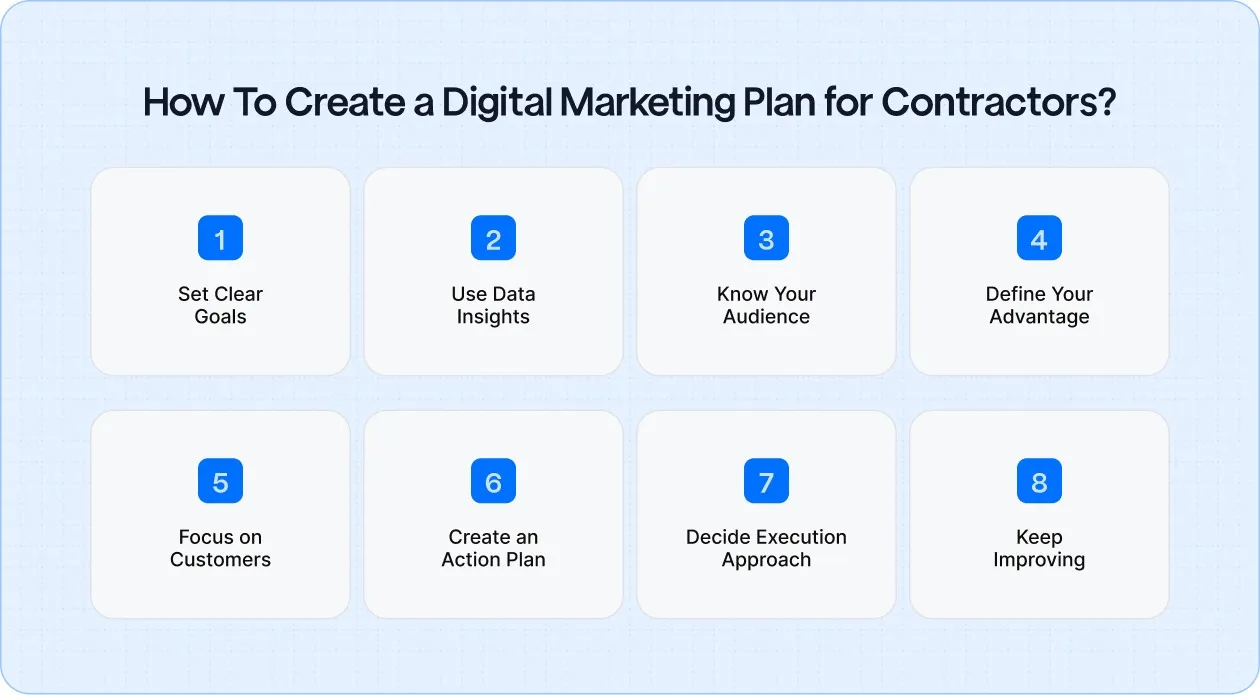
A strong digital marketing plan gives your business structure, direction, and clarity. Here’s how to build one, step by step:
1. Start With Clear, Purposeful Goals
Your marketing plan needs goals that actually mean something for your business. Goals give your strategy a destination and help you measure whether your efforts are working.
How to put this into action:
- Define what success looks like: Decide whether you want more qualified leads, stronger local visibility, more booked jobs, or better brand recognition.
- Set measurable targets: Instead of saying “increase traffic,” define a number or percentage you want to reach within a specific timeframe.
- Match goals to capacity: Make sure your goals align with the size of your team, available budget, and how much work your business can realistically handle.
- Prioritize the essentials: Focus on two or three core goals at first so your efforts stay tight and effective.
2. Use Data To Shape Your Path Forward
Data tells you what is already working, where you’re losing opportunities, and what needs attention first.
How to put this into action:
- Audit your current marketing: Review website traffic, search visibility, social engagement, and conversion rates.
- Identify gaps and bottlenecks: Look for pages with high traffic but low conversions, keywords you rank poorly for, or channels that aren’t contributing meaningful results.
- Benchmark against competitors: See where they appear in search, how often they publish content, and what kind of messaging they use.
- Turn insights into steps: Use your data to decide which strategies deserve investment and which ones need refining or replacing.
3. Understand Exactly Who You Want to Reach
Your digital marketing becomes far more effective when it's built around the people you want to attract. This is where clarity about your ideal customer matters.
How to put this into action:
- Build detailed buyer profiles: Include job role, industry, challenges, goals, budget constraints, and decision factors.
- Learn how they research: Identify the keywords they search for, the type of content they read, and the objections they commonly have.
- Document their buying journey: Map out the early-stage questions they ask, mid-stage comparisons they make, and final concerns that determine their decision.
- Shape messaging around their needs: Speak directly to their pain points and provide solutions that feel practical and easy to understand.
4. Define What Makes Your Business the Better Choice
Your positioning explains why someone should choose your business instead of a competitor. Strong positioning keeps your marketing consistent and persuasive.
How to put this into action:
- Identify your real strengths: Highlight the specific things you do better: faster service, quality workmanship, specialized expertise, or local presence.
- Connect strengths to customer value: Explain why your strengths matter and how they make life easier, safer, or more efficient for your customer.
- Clarify what you stand for: Your tone, messaging, and visual identity should reinforce the way you want to be perceived.
- Repeat it across every channel: Consistency builds recognition, trust, and credibility.
5. Build Strategies That Put Your Customer First
Your digital marketing should revolve around helping your ideal customer reach a decision comfortably and with clarity.
How to put this into action:
- Choose channels based on buyer behaviour: If your audience is searching online, focus on SEO. If they research visually, invest in strong content and social proof.
- Create content that solves real problems: Offer explanations, examples, comparisons, checklists, and guides that help them understand their options.
- Match content to their journey: Provide introductory content early, detailed content mid-journey, and decision-driving content when they’re close to choosing.
- Remove friction: Make it easy to contact you, request a quote, view pricing, or learn about services.
6. Turn Strategy Into a Clear, Actionable Plan
A strategy becomes useful only when translated into specific tasks, owners, and timelines.
How to put this into action:
- Create a simple execution calendar: Plan when content will be published, when ads will run, and when pages will be updated.
- Assign responsibilities: Decide who handles writing, design, optimization, social posts, and reporting.
- Set review checkpoints: Evaluate progress weekly or monthly so you can adjust quickly instead of losing momentum.
- Use tools to stay organized: Project boards, content calendars, and dashboards help you track everything in one place.
7. Choose Whether To Execute In-House or With Outside Help
Not every business can execute a full marketing plan internally. Choosing the right path saves time, stress, and unnecessary expense.
How to put this into action:
- Evaluate your team’s skills: Identify what you can realistically handle and what might require expertise.
- Understand the value of an agency: Agencies bring systems, experience, and speed, especially when you want consistent growth.
- Blend both approaches if needed: Many businesses handle basic tasks internally while outsourcing advanced SEO, design, or content.
- Prioritize long-term fit: Choose the option that keeps your plan consistent, not the one that only works for a month.
8. Maintain and Improve Your Marketing System Over Time
A marketing plan is never finished. It should evolve based on results, market changes, and customer feedback.
How to put this into action:
- Track performance consistently: Monitor traffic trends, keyword rankings, conversions, and engagement.
- Adjust strategies based on results: Double down on what works and replace what isn’t moving the needle.
- Stay adaptable: Industry trends, buyer behaviour, and platforms shift, your plan should evolve with them.
- Review goals quarterly: Make sure your plan continues to support your business direction and capacity.
Suggested read: Digital Marketing Problems Manufacturers Face (and How to Fix Them)
Key 12 Strategies of Digital Marketing for Contractors
Digital marketing is a powerful tool to grow your business, attract local clients, and stand out from the competition. But with so many aspects to manage, it can be overwhelming to know where to start.
The good news is, by focusing on a few key components, you can create a solid foundation for your digital marketing efforts that will deliver real results.
Below are the main building blocks you should focus on.
1. A Professional Website That Converts
Your website is your digital storefront. It needs to be:
- Easy to navigate on mobile and desktop.
- Showcasing your services clearly (e.g., “Electrical wiring”, “Bathroom renovation”), with dedicated pages.
- Featuring your portfolio: photos of past jobs, before/after pictures, client testimonials.
- Having clear contact info: phone number, form, address. Including a “Call now” button is critical because many users search on mobile.
Recommended read: Redesigning Your Manufacturing Website? Here’s How To Ensure It Becomes A Growth Engine
2. Local SEO & Your Google Business Profile
For contractors, local SEO is the most important. Here’s what to do:
- Create or claim your Google My Business (now Google Business Profile) listing and fill in all details: business name, address, phone, service area.
- Use keywords like “contractor in [region]” or “home renovation services in [region]” on your site and in your profile.
- Collect and display reviews: asking satisfied clients to leave reviews helps strengthen trust and ranking.
- Add high‑quality photos of work, your team, your office.
- Make sure your website and listings mention your service area, so Google knows your locality.
Get Found Locally with Google Business Profile
Stand out in local searches and attract more customers by optimizing your Google Business Profile today.
Claim and Optimize Your Profile Now
3. SEO (Search Engine Optimization)
Beyond local SEO, you’ll want your website pages to be optimized so you show up when people search for your services. Important elements include:
- Keyword research: find what clients are searching for (e.g., “roof replacement contractor Denver”).
- On‑page SEO: use those keywords in page titles, headings, meta descriptions, image alt tags.
- Off‑page SEO: build authority through quality links and testimonials.
- Link‑building/authority: Get relevant links from local business directories or partner sites (this helps SEO but is less urgent at the start).
4. Paid Advertising (PPC & Local Ads)
Since SEO takes time, you can use paid advertising to get faster results:
- Use Google Ads (Pay‑per‑click) targeting your service area with keywords like “book contractor near me”.
- Target your service area, pick keywords with intent (e.g., “hire electrical contractor Seattle”), and track your spend vs. leads to make sure you’re getting value.
- Use strong calls to action (CTA) in your ads: “Get Free Estimate”, “Schedule Today.” Make sure your landing page matches the ad promise.
- Be clear about your budget, target area, and measure cost per lead so you know what is working.
5. Multi-Channel Social Media Marketing
Contractors who grow fast today treat social media as a real business asset. Accounts like @contractors.of.insta and @justaconstructionguy prove it. They cracked the formula of showing real work, posting often, and staying visible where homeowners already spend time.
Here’s how you can apply the same approach:
- Share real project visuals: Post before-and-after photos, progress videos, and short clips of your team at work. This shows skill, quality, and professionalism in a way text never can.
- Stay active where your customers already are: Facebook and Instagram remain strong for homeowners, while YouTube is ideal for walkthroughs and tutorials. Pick channels that match your audience.
- Engage consistently: Respond to comments, answer questions, and interact with local community groups. Activity signals reliability.
- Use location tags and service-based hashtags: Tags like #ClevelandContractor or #KitchenRemodelSeattle help people in your region discover your work.
- Repurpose content across platforms: A project photo can become a Google Business Profile update, a Facebook post, and an Instagram reel. More reach with less effort.
6. Reviews & Reputation Management
Reviews matter a lot. With many contractors vying for work, clients check ratings and reviews before they hire. Make sure you ask satisfied clients to leave reviews on Google, Yelp, or other relevant platforms. You can:
- Ask past clients to leave reviews (Google, Facebook).
- Display testimonials on your website.
- Respond to any negative feedback promptly and professionally.
- Consistent good reviews improve trust and local search ranking.
7. Analytics, Tracking & Continuous Improvement
- One of the big advantages of digital marketing is that you can track what’s working. Use tools like Google Analytics and phone‑call tracking to understand where leads are coming from and which campaigns are delivering results.
- Review your data regularly (monthly at minimum): what keywords led to calls, which service pages convert best, which ads are costing too much.
- Based on what you learn, adjust your strategy: update keywords, tweak ads, improve page design, or focus more on the service categories that deliver the best ROI.
8. Consistent Content & Engagement
- Regular content helps maintain a strong presence. This includes blog posts, social media updates, email newsletters, and project highlight posts.
- Engagement means responding to comments, answering questions, being active on social media, showing behind‑the‑scenes of your work. This builds a connection with your target audience and nurtures trust.
9. Email Marketing
Email is one of the most reliable channels for contractors because it keeps your business in front of homeowners who may not be ready today but will need you later.
What to focus on:
- Build a simple email list: Add email capture forms on your website, estimate pages, and project galleries. Offer something valuable like a maintenance checklist or seasonal reminders.
- Send useful updates: Share tips, project highlights, promotions, and reminders about seasonal work (roof inspections, HVAC tune-ups, drainage checks).
- Segment your audience: Send different emails to past customers, new leads, and high-value prospects for more personalized communication.
- Automate follow-ups: Set up automated flows for quote follow-ups, post-project check-ins, and review requests.
Email marketing helps contractors stay top-of-mind, build trust between projects, and increase repeat business with very little cost.
10. Advanced Technology and Automation
Contractors often lose leads because of slow responses, missed follow-ups, or scattered communication. Automation tools help you stay organized and respond faster.
What to focus on:
- Automated lead responses: Use tools that send instant replies when someone fills out your website form or calls after hours.
- Appointment scheduling tools: Let customers book estimates directly using automated calendars.
- Project updates: Automate status updates to customers for transparency and professionalism.
- Review requests: Trigger automatic review requests after completing a job to grow your ratings without manual effort.
11. Must-Have Marketing Tools for Contractors
Good digital marketing for contractors needs the right tools behind it. These tools help you manage your website, track leads, measure performance, and improve your online visibility.
Tools worth using:
- Google Analytics: Tracks website traffic, conversions, and engagement.
- Google Search Console: Shows search rankings, keywords, and site errors.
- CRM platforms (HubSpot, Housecall Pro): Manage leads, estimates, and customer communication.
- Email tools (Mailchimp, Klaviyo): Create automated email sequences and newsletters.
- Social media schedulers: Keep your posts consistent without manual effort.
12. The KPIs Every Contractor Should Track
Knowing your numbers ensures you don’t waste money on the wrong strategies. KPIs show which efforts bring real leads and which ones need improvement.
Important KPIs to monitor:
- Cost per lead (CPL): How much you pay to get each inquiry from ads or marketing efforts.
- Lead-to-booking rate: How many leads turn into scheduled estimates.
- Organic traffic: How many visitors reach your site through Google search.
- Local rankings: Where your Google Business Profile appears in the map pack for key services.
- Conversion rate: What percentage of visitors call, fill out forms, or request estimates.
- Email engagement: Open rates, click-through rates, and responses.
- Return customer rate: How many clients hire you again for additional work.
Tracking KPIs helps you invest in strategies that produce real revenue and cut the ones that drain your budget.
Build a Strong SEO Foundation
Ready to get started? Focus on the key components that drive results and watch your business grow.
Start Your SEO Journey
While implementing these components is crucial, it’s equally important to avoid common digital marketing mistakes that can slow down your progress.
Also read: 16 Digital Strategies That Separate Growing Manufacturers From The Old-School Pack
Final Thoughts
Gone are the days when a simple sign on the side of the road or a business card handed out at the local coffee shop was enough. Now, your future clients are online, searching for help with their next big project.
But don’t worry, getting it right doesn’t have to be complicated. Digital marketing doesn’t just help you get more work; it helps you build trust, show off your skills, and connect with clients who need your expertise.
Your next client is out there searching right now. Let’s make sure they find you. Contact us today!

SEO
Nov 5, 2025
5 mins
Landscaping SEO Made Easy: 15 Steps to Improve Visibility and Get More Calls
Batul Beawarwala
You might create stunning lawns and gardens week after week, yet still notice fewer calls than expected. Many landscaping businesses face this gap because people nearby search online for services, but cannot find them. SEO for landscaping helps close that gap.
It means improving your website so Google understands what you do and shows your business when someone searches for phrases like “landscaper near me” or “garden design in Boston.” The goal is to bring more visitors to your website and turn them into inquiries.
With the right SEO approach, your business can stay visible to local homeowners already searching for the services you offer.
Why Landscaping SEO Matters for Every Local Business?
Every day, homeowners search online for help with things like patchy lawns, untrimmed trees, or outdoor makeovers. The businesses that show up first on Google get the call, while others lose out even if they do great work.
SEO for landscaping changes by making sure your business appears when nearby customers look for services you already offer. It is about showing up where people are already searching. When your website ranks high in search results, you earn visibility and trust before a customer even visits your page.
The more often your business appears online, the more it feels like a familiar and reliable choice to potential clients.
The SEO Basics You Need to Get Right
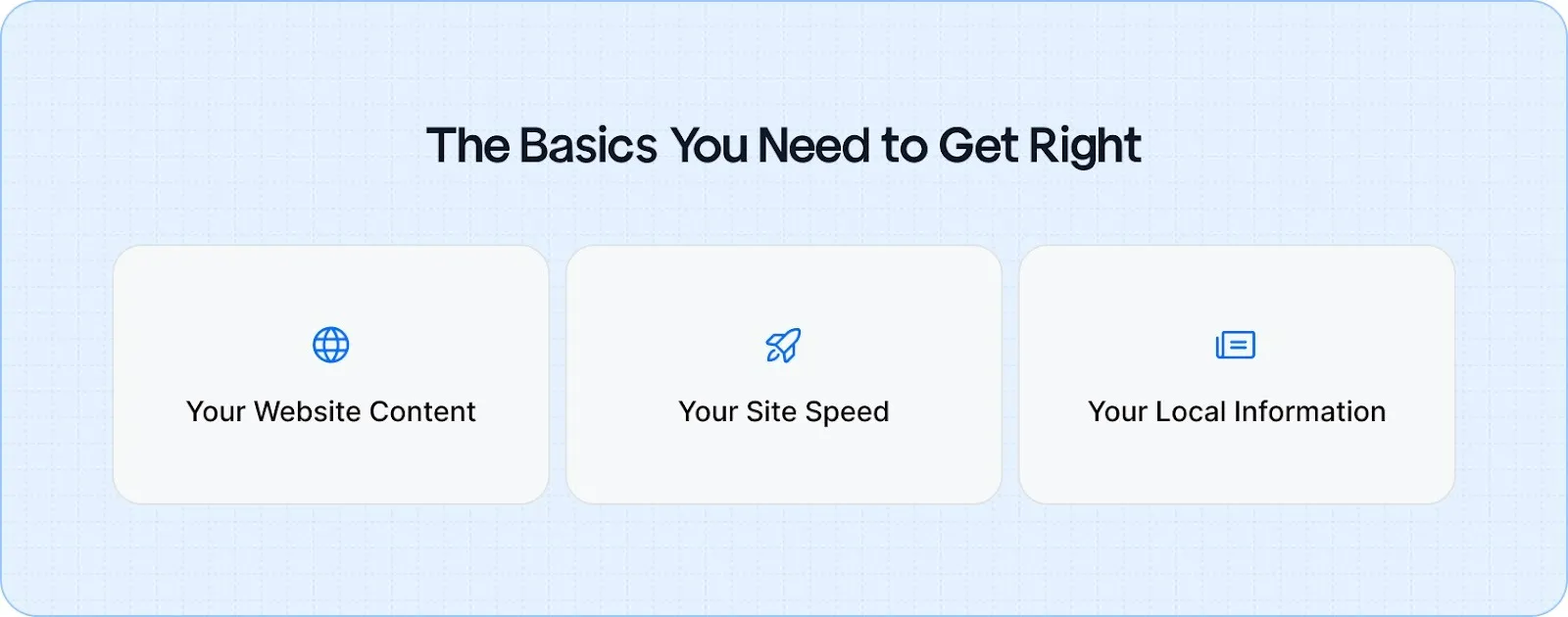
Before you spend a single dollar on tools or ads, three simple foundations decide how visible your landscaping business becomes online. When these are strong, every other marketing effort performs better.
1. Your Website Content
Your website is your digital front yard. Service pages should clearly explain what you offer, from lawn care to stone patios, while a blog helps you share practical advice that earns trust.
2. Your Site Speed
A slow website turns visitors away before they even see your work. Fast-loading pages keep potential clients engaged and ready to contact you.
3. Your Local Information
Your business name, address, and phone number (often called NAP) must match perfectly everywhere online, from Google to Facebook. This consistency helps search engines trust your business and rank it higher.
Keeping up with SEO can feel like its own full-time project.
What if your marketing quietly brought you inquiries while you focused on your next big build?
Get Inquiries with SEO
15 Actionable SEO Steps to Expand Your Customer Base and Drive Growth
The following steps will guide you through the key SEO practices to help your landscaping business stand out and attract more customers consistently.
1. Invest in a Professional Logo for SEO and Branding
Your logo is a critical part of your branding. A professional, memorable logo helps establish trust and recognition, which can indirectly support your SEO efforts by increasing website visits and engagement.
How to Do It:
- Hire a professional designer to create a logo that reflects your brand’s values and services.
- Use your logo consistently across your website, social media, and marketing materials.
Why It Matters: A high-quality logo gives your website a polished look, which improves user experience and trust. This can result in higher engagement and more website traffic.
2. Register Your Branded Website Domain
Securing a branded domain name is an essential step in building your online identity. It should be easy to remember, and ideally, reflect your business name or the services you offer.
How to Do It:
- Choose a domain name that includes your business name and keywords related to your services.
- Register your domain as soon as your business is official.
Why It Matters: A branded domain enhances your credibility and SEO, helping customers find you easily and increasing your chances of ranking higher in search results.
3: Optimize Your Google Business Profile and Apple Business Connect
Your Google Business Profile is a crucial tool for local SEO. Optimizing it helps you appear in local search results when potential customers look for landscaping services in your area.
Additionally, Apple Business Connect provides another platform for businesses to enhance their local presence, helping you reach iPhone users through Maps, Siri, and more.
How to Do It:
- Claim and verify your profile on both Google and Apple Business Connect.
- Complete your business details: Add your business name, address, phone number, hours, and website.
- Upload photos of recent landscaping projects to showcase your work and attract more attention.
- Engage with reviews by responding to both positive and negative feedback, as this builds trust and credibility with potential clients.
Why It Matters: A well-optimized Google Business Profile and Apple Business Connect listing improves your chances of appearing in local search results and increases your trustworthiness with potential customers, making it easier for them to contact you.
4: Find Local Long-Tail Keywords for Landscaping SEO
To increase your visibility online, the first step is keyword research. For a landscaping business, long-tail keywords are particularly useful. These keywords are more specific and relevant to the services you offer, as well as the locations you serve.
- How to Do It:
- Use tools like Google Keyword Planner, SEMrush, or Ubersuggest to find keywords that are specific to your services and geographic area. For example, search for “lawn care in Boston” or “tree trimming services in Louisville.”
- Focus on long-tail phrases: These typically have lower competition and higher conversion rates because they reflect more specific customer needs.
- Why It Matters: By targeting these local, long-tail keywords, you increase your chances of ranking in searches made by people actively looking for your services in your area. This is essential for local SEO.
Local, long-tail keywords are a game-changer for getting found by the right customers.
Simplify and optimize your keyword strategy, so you target the right phrases and get noticed fast.
Get Keyword Guidance
5: Local SEO - Build Location-Specific Landing Pages
Creating location-specific landing pages on your website is a highly effective way to target local search queries. These pages help Google and customers find your services when they search for landscaping near them, ensuring you're visible to potential clients.
How to Do It:
- Create individual landing pages for each location you serve, focusing on the services provided in each area.
- Use local keywords in the page headings, URLs, and content to ensure it’s optimized for specific locations.
- Showcase relevant projects by adding images and testimonials from clients in the area, highlighting your local expertise.
- Why It Matters: These location-specific pages increase your visibility in local searches and help potential clients find your services quickly. Optimizing for various service areas can drive more traffic to your website and expand your reach without spreading your resources thin.
Creating location-specific landing pages helps Google understand where you’re targeting customers.
But building these pages consistently takes time. Let experts take care of it.
Speed Up Your SEO
6: Optimizing Title Tags and Meta Descriptions for SEO
Your title tags and meta descriptions are some of the first elements potential customers see in search results, so it’s crucial to make them as compelling as possible. These elements play a key role in attracting clicks and improving your rankings.
How to Do It:
- Include your main keyword in both the title tag and meta description.
- Create descriptions that entice users to click, using clear, actionable language and highlighting the benefits of your services.
- Keep your title tag under 60 characters and your meta description under 160 characters for optimal display.
- Why It Matters: Optimized title tags and meta descriptions increase your click-through rate (CTR), which is a key ranking factor for Google. A higher CTR signals to search engines that your content is relevant and valuable, improving your SEO performance.
Optimizing title tags and meta descriptions is very important for attracting clicks.
If you’re not seeing the results you hoped for, it’s time to take a deeper look and fine-tune your on-page SEO.
Optimize Your Content
7: Content Creation to Drive SEO and Trust
Content marketing is a cornerstone of effective SEO. By creating valuable and informative content, you improve your search engine ranking and build trust with your audience.
How to Do It:
- Start a blog with posts answering common landscaping questions, such as “How to Care for Your Lawn in Winter” or “Tips for Planting Trees in Your Backyard.”
- Use videos and infographics to engage users and keep them on your site longer, which can positively affect your rankings.
- Why It Matters: Content that answers customer questions establishes your expertise and keeps visitors engaged. The more valuable your content, the higher the chance they’ll convert into leads.
Content marketing builds trust and improves SEO, but managing it can be tricky.
Let experts take the reins on your content creation, ensuring it aligns perfectly with your SEO goals.
Create SEO Optimized Content
8: The Power of Customer Reviews and Social Proof
Online reviews are increasingly important for SEO, especially for local businesses.
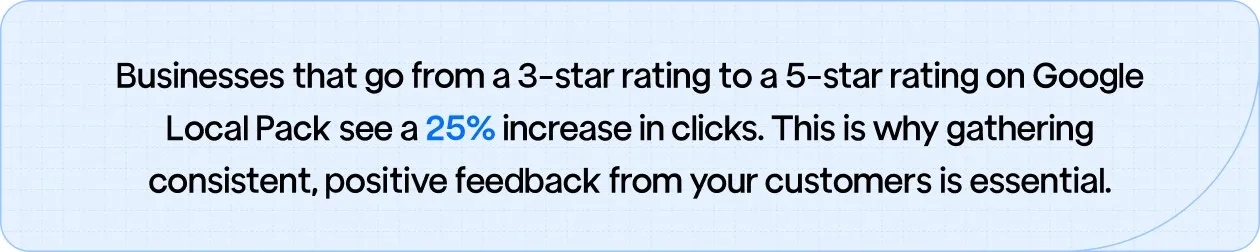
The more positive reviews you have, the more likely you are to rank in local search results.
How to Do It:
- Ask satisfied clients to leave reviews on your Google Business Profile, Yelp, or Facebook.
- Respond to reviews in a professional and timely manner, even if the feedback is critical.
Why It Matters: Positive reviews help you build social proof and credibility, both of which influence your SEO rankings. Plus, they encourage potential customers to trust you.
9: Technical SEO - Site Speed, Mobile Optimization, and Security
Technical SEO focuses on the behind-the-scenes aspects of your website that improve user experience and ensure search engines can crawl and index your pages correctly.
How to Do It:
- Improve website speed using tools like Google PageSpeed Insights.
- Ensure your website is mobile-friendly, as most local searches are done on smartphones.
- Use HTTPS to secure your site and protect your visitors' data.
Why It Matters: A fast, mobile-friendly, and secure website improves user experience and helps you rank higher in search results, especially with Google’s mobile-first index.
Tip: Ensure your blog loads fast on mobile devices and includes elements like clear Call-To-Actions (CTAs) that are easy to interact with on mobile.
10: Types of Content to Improve SEO
Content is the backbone of any successful SEO strategy. By diversifying your content, you can engage different segments of your audience, keep your site fresh, and increase your visibility on search engines.
How to Do It:
- Create a variety of content to cater to different preferences, including:
- Blog Posts
- Videos
- Ebooks
- Infographics
- And More
- Use visual content like infographics to explain complex topics or provide statistics.
- Repurpose your content for different platforms to reach a broader audience and increase backlinks to your website.
Why It Matters: A diverse content strategy keeps your website dynamic and appealing to both users and search engines. Regularly updated content improves your site’s relevance and authority, leading to better SEO performance and higher rankings.
Fresh, varied content is key to long-term SEO success.
Create high-quality SEO-optimized content that resonates with your audience and improves your rankings.
Create Engaging Content
11: Seasonal SEO Strategies for Landscaping
For landscaping businesses, seasonality is a significant factor. Seasonal SEO ensures that your business remains relevant throughout the year, capturing customers' attention as their needs evolve. For example, updating your content for snow removal in winter or lawn care in spring helps you target specific demand periods effectively.
How to Do It:
- Update your website content to reflect the services you offer throughout the year. Highlight seasonal services and ensure your content targets season-specific keywords, like "snow removal services" in winter or "lawn fertilization in spring."
- Optimize your Google Business Profile to align with seasonal changes. For instance, update service offerings for the current season to ensure they appear in relevant local searches.
- Use relevant seasonal keywords in blog posts, service pages, and metadata to capture search traffic during peak times.
Why It Matters: By targeting seasonal search terms, you ensure your business remains visible when demand is highest. This approach helps capture leads who need immediate services, improving conversions and ensuring you don't miss out on valuable seasonal business.
12: Voice Search Optimization for Local Landscaping SEO
With the rise of voice assistants, voice search optimization is becoming increasingly important for local businesses. Optimizing for voice search ensures that your landscaping business appears when customers perform voice searches, which often tend to be more conversational and specific.
How to Do It:
- Optimize for natural, conversational keywords that people are likely to speak rather than type. For instance, instead of “lawn care services,” use more conversational phrases like “Where can I find affordable lawn care?”
- Focus on local intent: Ensure your content answers common voice search queries related to your services in your area.
- Provide concise answers to frequently asked questions on your website. Structure your content so it's easy for voice assistants to pull information.
Why It Matters: As more customers use voice search on mobile devices and smart speakers, optimizing for voice search gives you a competitive edge. It helps you capture local traffic from users seeking immediate and relevant information about your services.
Must Read: 10 Effective Landscaping Marketing Tactics to Increase Your Client Base
13: Video SEO to Showcase Landscaping Projects
Video content is incredibly engaging and offers significant SEO benefits. For landscaping businesses, videos can help showcase completed projects, provide educational content, and build trust with potential clients. Video SEO is the process of optimizing your videos to rank higher in search results.
How to Do It:
- Create high-quality before-and-after videos showcasing your landscaping projects. These can visually demonstrate the impact of your services, making it easier for customers to envision working with you.
- Optimize video titles, descriptions, and tags with relevant keywords. Include details about the services offered and the location served in the video metadata.
- Embed videos on your website and share them across social media platforms to increase their reach and engagement.
Why It Matters: Videos help increase user engagement and on-site time, which are positive ranking signals for Google. Additionally, videos can rank in Google search results, driving more traffic to your site and helping potential customers see the quality of your work.
14: Optimizing Hyperlocal SEO to Dominate Local Markets
Hyperlocal SEO focuses on optimizing your business for specific local areas, like individual neighborhoods, streets, or landmarks. It’s especially important for businesses that serve smaller geographic areas, as it helps you show up in search results for highly specific location-based queries.
How to Do It:
- Target hyperlocal keywords such as “landscaping near Garden District” or “tree trimming in Martha’s Vineyard.”
- Create pages for specific service areas on your website. These pages should focus on local projects, include customer testimonials from the area, and highlight services offered in that neighborhood.
- Ensure your Google Business Profile includes location-specific details and use consistent NAP (name, address, phone number) across all directories.
Why It Matters: Hyperlocal SEO helps your business stand out in very specific searches, increasing your visibility when potential customers search for services near them. This is essential for dominating local markets and ensuring you attract customers who are looking for services in their immediate area.
15: Referral Rewards and Discounts to Improve SEO
Referral programs bring in new customers and help generate valuable social proof, which can positively impact your SEO. Customers who refer others are more likely to leave reviews, share their experiences online, and become repeat clients.
How to Do It:
- Offer incentives for customers who refer friends, family, or neighbors. These could include discounts, free services, or exclusive offers.
- Encourage satisfied customers to leave reviews on your website, Google Business Profile, and social media pages.
- Promote your referral program through email marketing, social media, and on your website.
Why It Matters: Referral programs increase your credibility, attract new customers, and improve your SEO rankings. Reviews and word-of-mouth recommendations enhance your online presence and build trust with both customers and search engines.
Your 90-Day Landscaping SEO Plan to See Real Results
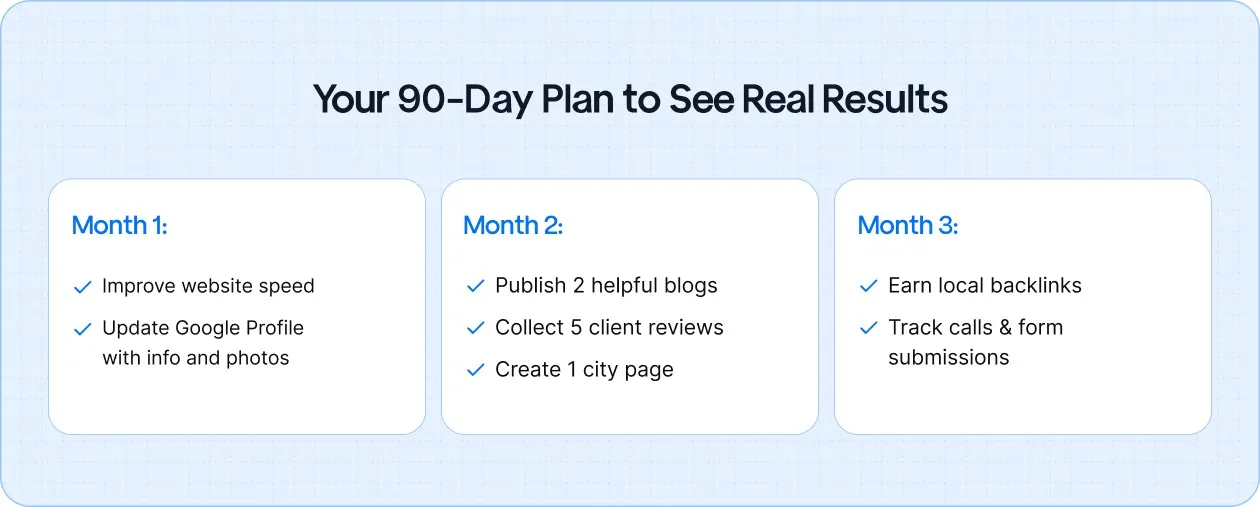
In just 90 days, your landscaping business can move from being invisible online to becoming the first name people call in your area. Here is how a structured plan unfolds when done right:
Month 1
- Fix your website speed so pages load quickly and visitors stay engaged
- Refresh your Google Business Profile with accurate details and recent photos
Month 2
- Publish two helpful blogs that answer common landscaping questions
- Collect five new client reviews to build credibility
- Create one city page to attract leads from nearby towns
Month 3
- Earn a few quality local backlinks from trusted sources
- Track how many calls and form submissions your website generates
Each month builds on the last, with more visibility, more trust, and more real inquiries from nearby homeowners. When the right strategy is in place, you can clearly see which efforts bring your next paying client.
Know the Cost and Timeline Before You Begin
Every landscaping business grows at its own pace, but the right SEO plan follows a clear rhythm of effort, consistency, and return. Understanding your investment upfront helps you plan realistically and see steady progress.
- Smaller businesses usually invest between $500 and $1,000 per month to build a strong local presence.
- Larger companies with multiple service areas or crews often allocate up to $3,000 per month to scale faster.
- With consistent effort, you can start noticing measurable local growth, more website visits, calls, and quote requests, within 3 to 6 months.
Turn Your Landscaping Website Into a 24/7 Lead Engine with SEO
When your website appears at the right time, it earns trust before you even pick up the phone. Over time, that visibility turns into steady calls, project requests, and loyal customers.
But keeping that growth going takes consistency. Once your rankings improve, the real work begins: staying visible, following up with leads, and nurturing the ones who showed interest.
SEO with the right expertise turns your digital presence into a dependable engine that works around the clock, so your next client is already lined up when you finish the current project.
Consistent SEO improves visibility, but managing inquiries requires ongoing effort.
Gushwork optimizes your SEO and content marketing behind the scenes, ensuring steady growth while you focus on your business.
Book Your Free Consultation
SEO
Nov 5, 2025
5 mins
Why Construction Companies That Master SEO Get More Projects: 8 Key Strategies to Get Started
Batul Beawarwala
Running a construction company today means competing both on job sites and online. Property owners and developers increasingly search online to find contractors, which makes your online presence a key factor in winning business. That’s where SEO for construction companies becomes crucial.
By mastering SEO, you ensure your company appears at the top of search results, helping you attract more inquiries and secure more projects.
This guide will discuss 8 straightforward strategies that will help your company stand out and win more work.
What SEO Really Means for Construction Companies?
Two construction businesses can have the same skills, experience, and satisfied clients, yet one consistently receives project inquiries online while the other waits for word-of-mouth referrals. The reason behind this gap is simple: visibility.
That visibility comes from SEO, or Search Engine Optimization, the process of improving your website so that Google recommends it when people search for services like “commercial builders near me” or “home renovation contractors in Texas.” It’s how potential clients find you before they ever make a call.
Here’s why SEO works so well for construction businesses:
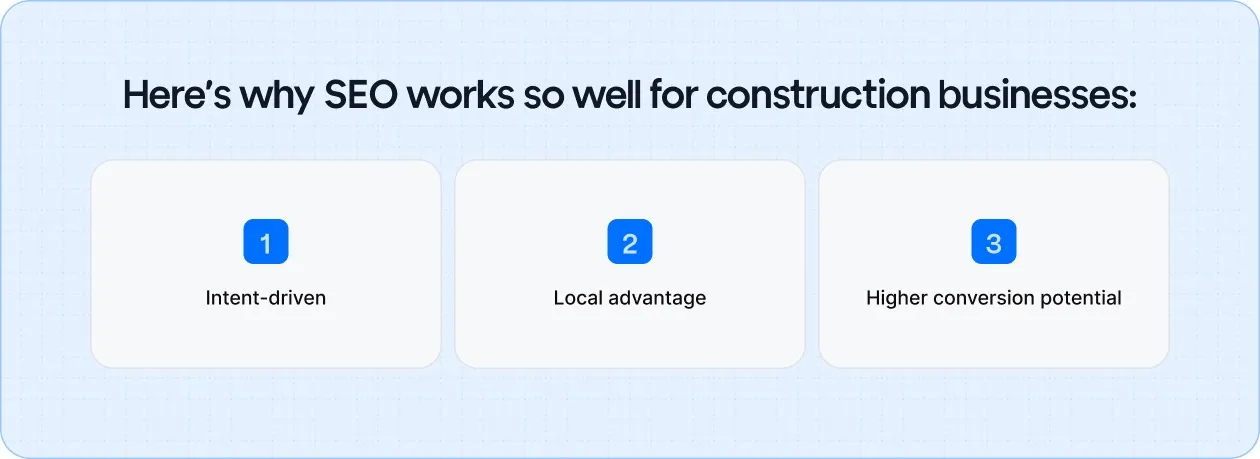
- Intent-driven: When people find your site via a search engine, they have already identified a problem, such as the need for a renovation or construction project, and are searching for the right provider to help them.
- Local advantage: Many of these searchers are looking for local services, which means you show up exactly when they're looking to make a decision. This increases your chances of converting that searcher into a paying client.
- Higher conversion potential: Unlike social media, which often focuses on awareness or engagement, SEO drives people who are more likely to take action. These individuals are already further down the decision-making process, making them much more likely to hire you.
Why this matters:
- SEO = Immediate Relevance: You show up exactly when potential clients are ready to make decisions.
- Social media = Awareness: While social media can build awareness, it doesn’t always translate into immediate action or sales.
By focusing on SEO, your construction business has the chance to attract clients who are actively looking for your services, making it a much more predictable and effective lead source than social media.
You perfect every project, earn strong referrals, but still miss out on clients online.
The missing piece is visibility. Let’s bridge that gap with expert SEO strategies.
Make My Business Visible
8 Key Strategies to Improve Your Construction Marketing and Get More Customers
To build a strong online presence and attract more clients, construction companies need to focus on key marketing strategies that improve visibility and establish trust.
From optimizing local listings to creating a user-friendly website, these 8 strategies will ensure your business stands out in a competitive market and drives real leads.
1. Improve Your Local Visibility with Google Business Profile and Apple Business Connect
Most construction companies rely on word-of-mouth, but clients now search online before choosing who to hire. When someone looks up "office builder near me" or "home renovation in Chicago," Google decides which businesses appear first. And those businesses get the calls, quotes, and contracts.
To earn that spot, start with the foundation, your Google Business Profile (GBP). Don’t forget, Apple Business Connect also plays a crucial role in local SEO, especially in regions where Apple Maps is used for location-based searches.
- Fill in accurate business information, business name, address, contact details, and service hours.
- Add real photos of your projects, crews, and office. Authentic visuals build trust.
- Ensure NAP consistency across all online listings and directories. A mismatch in your name, address, or phone number across the web can hurt your rankings.
Once your profile is ready, strengthen it:
- Ask happy clients for reviews: Every positive review is like a public referral that boosts your credibility and local ranking.
- Stay active: Post new project photos, quick updates, or short insights about your work. Google notices consistent engagement and rewards it with visibility.
When your business details are complete, accurate, and active, your profile works as your digital word-of-mouth, visible to every client searching in your area.
Is your business profile really working for you?
Optimizing your Google and Apple Business listings helps you show up at the top in local searches.
Optimize My Listings
2. Design a Construction Website That Turns Visitors into Customers with SEO
Your website is often the first impression before a client ever makes a call. It should feel like walking into your office, clear, professional, and reassuring. A strong construction website answers three questions instantly:
- What do you build?
- Where do you work?
- How can clients reach you?
Service Pages: Build separate pages for each service you offer, residential construction, commercial projects, roofing, renovations, etc. Each page should explain your process, the scope of work, and what makes your approach reliable.
This type of organized content structure helps both users and Google navigate your offerings, making it easier for potential clients to find exactly what they need.
A clear content hierarchy:
- Service Pages
- Project Portfolios
- Blogs
This ensures both Google and your visitors understand the structure of your website. This makes your site easier to navigate and allows Google to index your pages more effectively, helping you rank higher for relevant keywords.
Lastly, ensure that your website is mobile-friendly and fast-loading. Many potential clients browse on mobile, and a slow or confusing layout can cost you inquiries even before someone reads your offer.
This is why website speed, security (HTTPS), and responsiveness are critical elements of your SEO for construction companies' strategy.
3. Use Project Pages to Turn Visitors into Real Leads
Every completed project tells a story of challenges solved, timelines met, and trust earned. Yet many construction companies leave those stories untold, hidden in photo folders or client emails. When shared the right way, each project can bring in your next big client.
Create dedicated project pages that walk potential clients through your work. Start with the client’s challenge, maybe an outdated office space, a leaking roof, or a commercial expansion. Then explain how you approached it:
- Outline the project scope, materials, and construction method.
- Mention the timeline and any special requirements you handled.
- Add before-and-after photos to showcase transformation and results.
- Include a short testimonial from the client to reinforce credibility.
These project pages display your work; they show proof of reliability, quality, and experience. Plus, when written naturally, they include local keywords that help you rank higher on Google without forced optimization.
The more specific and authentic your project stories are, the more likely potential clients will see themselves in them and reach out for their next build.
4. Write Helpful Content That Builds Trust and Search Rankings
Most potential clients start with questions, not quotes. They want to know how long a renovation might take, what permits they’ll need, or how much a new warehouse could cost. When your website provides those answers, you become their first trusted source, long before they decide who to hire.
Use your blog or FAQ section to address real, everyday client questions, such as:
- “What permits are required for commercial construction in New York?”
- “How much does a home renovation cost in San Francisco?”
- “What affects the timeline for an industrial project?”
This type of content serves two purposes. It helps people feel informed, and it helps Google recognize your website as an authority in your field. The more helpful and consistent your content is, the higher your chances of appearing when someone searches for construction help in your area.
When clients find clear, honest information on your site, they associate your business with credibility and expertise. That trust often turns a reader into your next inquiry.
You don’t need complex marketing, just clear, honest writing that highlights your expertise.
The right words and a solid SEO strategy can turn interest into inquiries.
Convert Words to Projects
5. Earn Mentions from Reputable Construction and Local Websites to Strengthen Your SEO
Every time another website links to yours, it acts as a digital referral. Just as a satisfied client recommending you to a neighbor builds trust in the real world, backlinks from credible sources build trust online, both with potential clients and with Google.
Start with connections you already have:
- Industry platforms like Houzz, Angi, or regional business directories
- Partners and collaborators, like material suppliers, architects, or subcontractors, who can reference your work
- Local recognition through press releases or articles like "Top Construction Companies in Dallas."
These authentic, local backlinks help strengthen your reputation and SEO for construction companies.
6. Make Technical Improvements That Help Google Rank Your Site
You would never hand over a building plan with weak foundations; the same rule applies to your website. Behind every great-looking site is solid technical work that ensures it’s fast, secure, and easy to navigate for both visitors and search engines. Here’s how to build a strong digital foundation:
Website speed:
- If your pages take longer than 3 seconds to load, potential clients will often leave before they even see your projects.
- Compress large images, especially high-resolution site photos, to improve performance without losing quality.
Security:
- Use HTTPS to protect visitor data. This builds trust with your clients and signals to search engines that your site is secure.
- A secure website is a crucial factor in both client confidence and ranking.
Mobile compatibility:
- With most people browsing on their phones, a slow or broken mobile layout can cost you valuable leads.
- Test how your website looks and functions on different devices to ensure it’s responsive and user-friendly.
Navigation:
- Make your website easy to use with clear menus, logical page links, and easily accessible contact buttons.
- The simpler and more intuitive the navigation, the better the user experience, which can increase client engagement.
By focusing on these technical elements, you’ll create a website that both visitors and search engines can navigate with ease, helping you keep clients engaged and improving your online visibility.
Must Read: 15 Proven Construction Industry Marketing Strategies for Business Growth
7. Show Proof That Clients and Google Can Trust You
Trust is the foundation of every successful construction project, and your online presence should reflect the same strength. Before a client decides to call, they look for signals that prove your credibility. Google does too.
Start by giving both clients and search engines solid proof of who you are and what you stand for:
- Display your credentials clearly: Licenses, insurance, and safety certifications speak louder than promises. They show your business operates responsibly.
- Use genuine visuals: Share real photos of your worksites, crews, and finished projects instead of stock images. Authentic visuals create emotional connection and confidence.
- Highlight recognition: Showcase awards, associations, and professional memberships. They validate your reputation in your industry and community.
- Let clients speak for you: A short testimonial from a satisfied customer builds more trust than any tagline ever could.
These proof points help Google understand your authority and reassure potential clients that your company delivers exactly what it promises. When visitors feel that credibility, they stay longer, engage deeper, and reach out faster.
8. Track Results Without Complicated Tools
You would never pour concrete without checking the measurements first; the same logic applies to your marketing. Tracking results shows which efforts actually bring clients through the door and which ones need adjustment.
You don’t need expensive software to do it. A few free tools can tell you almost everything you need to know:
- Google Analytics helps you see how many people visit your website and which pages attract the most interest. If certain pages bring in more quote requests, you know what’s working.
- Google Business Profile Insights shows real actions, such as how many people called, messaged, or asked for directions after finding your business online.
- Focus on what truly matters: calls, inquiries, and confirmed projects, not vanity metrics like clicks or impressions.
By checking these numbers once or twice a month, you’ll know exactly where your next client is coming from. That insight helps you spend time and money on what delivers real results.
Follow a Simple 90-Day Plan to Start Seeing SEO Results
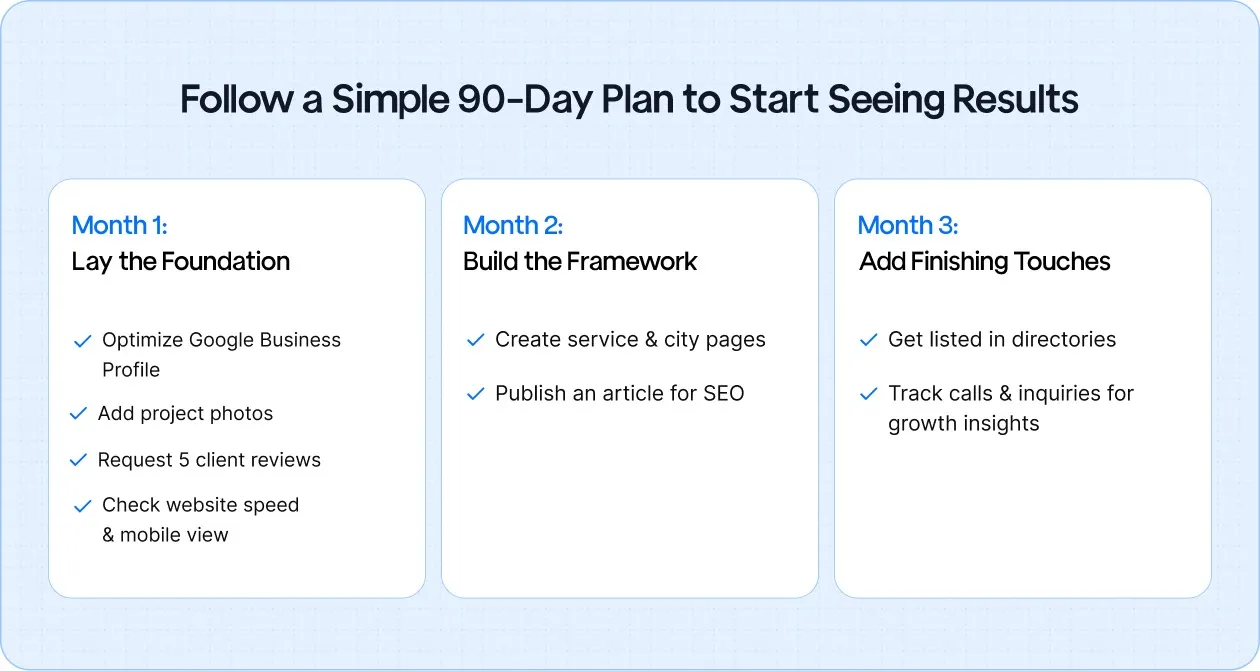
Every strong build starts with a clear timeline; SEO is no different. When you treat your online presence like a project plan, you can measure progress, track milestones, and see steady growth within just 90 days.
Month 1: Lay the Foundation
Your first month is all about groundwork.
- Claim and fully optimize your Google Business Profile.
- Add new project photos that show your quality and attention to detail.
- Ask at least five clients for honest reviews to increase trust and local visibility.
- Check your website speed and mobile view; your digital foundation must be solid.
Month 2: Build the Framework
Now that you’re visible, strengthen your structure.
- Create separate service and city pages with clear, well-written descriptions.
- Publish one valuable article that answers a question your clients often ask. This builds authority and helps you rank higher.
Month 3: Add the Finishing Touches
The final stage focuses on visibility and measurement.
- Get listed in reputable directories and industry associations.
- Track your calls, quote requests, and inquiries to see where growth is coming from.
By the end of this plan, you’ll have a digital presence strong enough to attract clients consistently, and data to show what’s working best.
Start with a solid foundation, build the core, and fine-tune for success.
A well-structured SEO strategy drives long-term growth and lasting results.
Start My SEO Plan
Build Long-Term Growth with SEO for Construction Companies
SEO lays that groundwork, helping people find you, trust you, and choose you long before they ever pick up the phone.
When your listings are optimized, your content speaks to real client needs, and your projects are showcased with pride, your website becomes more than a digital presence; it becomes your strongest business partner. Over time, that steady visibility brings in consistent leads, repeat clients, and the kind of growth that keeps your schedule full year-round.
Strong projects deserve a strong pipeline and a strategic SEO approach.
Gushwork simplifies SEO for construction companies, turning consistent efforts into measurable growth with clear results. Let us help you attract more clients, faster.
Book a Consultation

SEO
Nov 4, 2025
5 mins
11 Proven SEO Strategies for Home Services to Increase Calls and Leads
Batul Beawarwala
A homeowner spots a water stain spreading across the ceiling. Another feels warm air instead of cool from the vents. Within minutes, they search online for help, and the first few businesses they see get the job. The rest are forgotten.
That single online search decides who wins new business each day. No glossy brochures or billboards can match the influence of a simple local search that connects need with nearby expertise.
SEO for home services helps your business appear at that decisive moment, right where customers are looking for solutions. It builds visibility, trust, and authority so that your expertise is seen first and chosen fast.
This article breaks down proven strategies to strengthen your online presence, earn consistent leads, and build a brand that your local community recognizes instantly.
Why SEO for Home Services Is Non-Negotiable?
Homeowners rarely spend time comparing endless options online. When a pipe bursts or an outlet stops working, they click on one of the first businesses they see.
That one behavior shapes the success of every home service company today.
- Visibility leads to trust. The higher you appear in search, the more credible you seem.
- Trust leads to action. People click, book, and remember the businesses that appear first.
- Action leads to revenue. Every optimized page becomes a gateway to new clients.
Home services SEO ensures your business appears right when someone needs help, helping you win the job before competitors are even noticed.
In a Reddit thread, users agreed that while anyone can handle basic SEO, true progress comes from consistent execution and data-backed strategy. Experienced professionals bring structure, save time, and apply insights that DIY methods often miss.
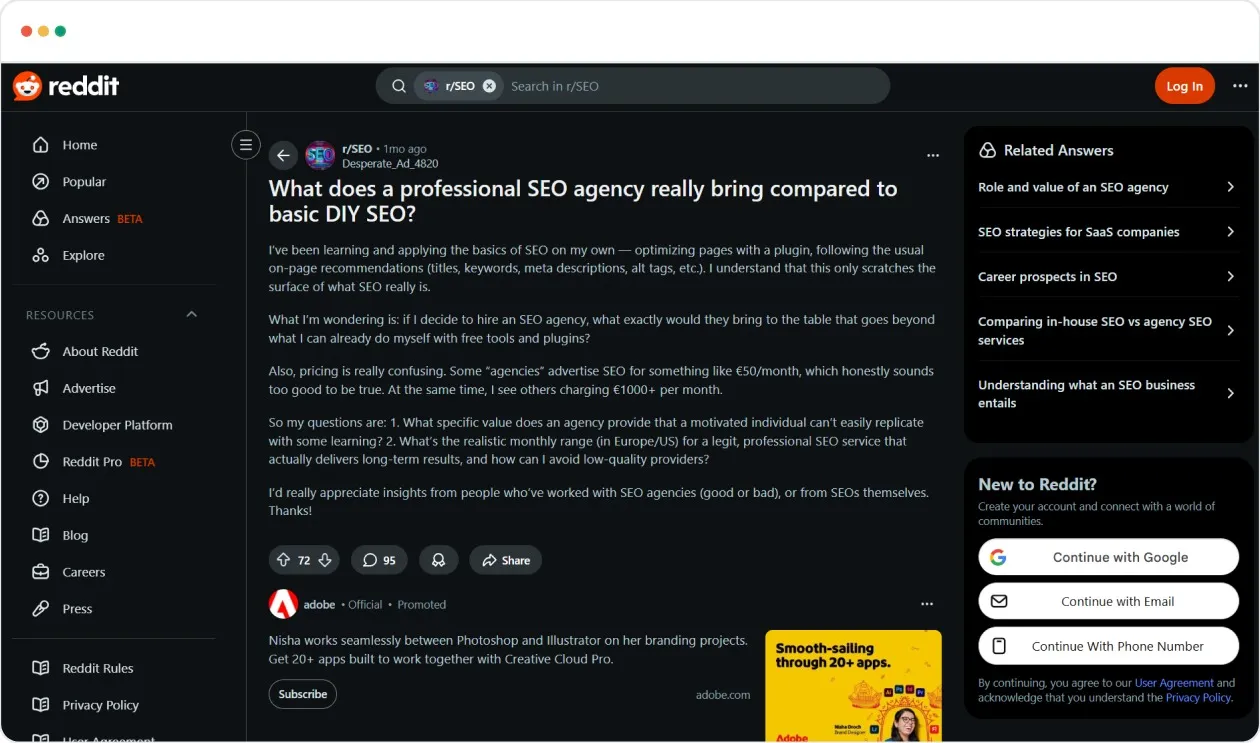
For home service providers, this highlights the value of systems that track performance and refine what works, exactly what expert-managed solutions like Gushwork help you achieve.
11 SEO Strategies to Win More Home Service Clients
You already know SEO shapes how customers find and choose your services. The next step is applying it with structure. The following strategies focus on practical execution, improving visibility, building credibility through local signals, and ensuring every click has a clear path to conversion.
Each one is designed to make your marketing system measurable, consistent, and ready to drive real calls, not vanity metrics.
1. Claim and Optimize Your Google Business Profile
For local contractors, your Google Business Profile (GBP) is more influential than your website. It is the first impression most customers see.
Steps to optimize your profile:
- Claim and verify your business ownership.
- Add every detail, address, contact info, working hours, and service areas.
- Upload high-quality, original images from real projects.
- Use posts weekly for limited-time offers or seasonal maintenance reminders.
- Answer FAQs directly on your profile.

When your online listings are consistent, every lead matters.
Automate how you track performance, connect outreach across channels, and see which listings actually drive qualified leads.
Connect Now
2. Nail Your Keyword Strategy
Keywords are the bridge between what you offer and what customers search for. Yet many contractors guess rather than analyze.
Use data-backed insights to target what truly converts:
- Service keywords: “AC installation,” “plumbing repair,” “roof replacement.”
- Location keywords: “electrician in Denver,” “pest control Houston.”
- Problem-based searches: “furnace blowing cold air,” “leaky ceiling fix.”
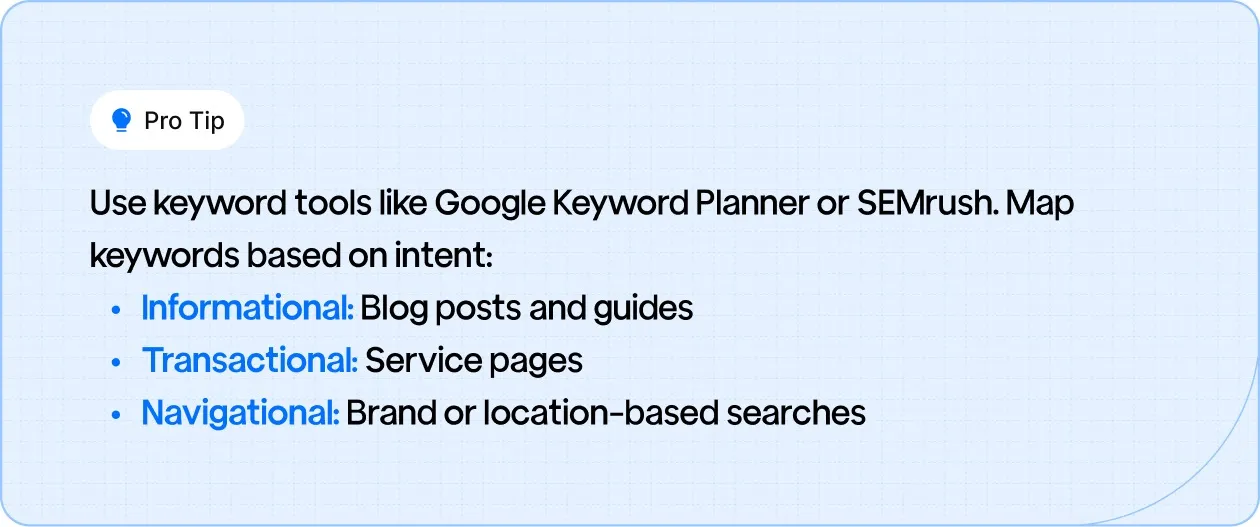
This ensures every page matches a real customer intent.
3. Build Service Pages
Your service pages are digital storefronts; they must build confidence in seconds.
Each page should include:
- A clear headline that states what you do and where.
- A short intro addressing the customer’s core pain point.
- Detailed services list with benefits, not features.
- Visual proof: before-and-after photos or video snippets.
- Credibility signals: reviews, certifications, and badges.
- A strong CTA: “Request a Quote” or “Schedule a Visit.”
Add schema markup (Service, Review, FAQ) so Google understands your content better.
Your website should act like a trained salesperson, one that never forgets a lead.
Delegate follow-ups, qualify prospects effectively, and turn every visit into a measurable opportunity.
Turn Visitors into Leads
4. Get Consistent With NAP and Local Citations
Inconsistent business details across directories confuse both Google and potential customers.
Ensure uniformity across your Name, Address, and Phone Number (NAP):
- Audit listings on platforms like Angi, Houzz, Yelp, and Thumbtack.
- Use tools such as Moz Local to identify inconsistencies.
- Update old business addresses or numbers from legacy platforms.
- Revisit listings quarterly to keep data accurate.
Consistency builds trust, and trust improves ranking authority.
5. Collect and Manage Online Reviews the Smart Way
Reviews shape perception before customers even click your website. Businesses with steady, positive reviews enjoy higher visibility and conversion rates.
Effective ways to collect and manage reviews:
- Request reviews within 24 hours of job completion.
- Send a short text or email with a direct link to your Google review page.
- Display positive reviews prominently on your site.
- Reply to every review, appreciate compliments, and resolve complaints respectfully.
Follow-ups shouldn’t drain your time.
Delegate review requests and performance tracking to experts who manage the process while you focus on delivering great service.
Get In Touch
6. Create Localized, Helpful Content That Builds Trust
Customers engage with businesses that understand their neighborhood realities.
Examples of valuable local content:
- “Summer HVAC Maintenance Tips for Austin Homes”
- “Roof Repair Costs in Phoenix: What to Expect”
- “Pest Prevention Checklist for Coastal Homes”
Ideas to add depth:
- Publish case studies or before-and-after project summaries.
- Write seasonal posts highlighting preventive maintenance.
- Add FAQs that answer common customer concerns.
Educational content signals authority while improving search rankings.
7. Strengthen Authority With Local Backlinks
A backlink from a trusted local source acts as a vote of confidence for your business.
High-value backlink opportunities:
- Partner with local builders, architects, or realtors for cross-referrals.
- Sponsor community events or charity drives.
- Get listed on local media or business associations’ websites.
- Offer expert quotes to local journalists (through platforms like HARO).
Avoid irrelevant or spammy link exchanges; they harm credibility more than they help.
8. Speed, Mobile, and Technical SEO Fixes You Cannot Skip
Half of your potential customers leave if a page takes longer than 3 seconds to load.
Technical must-haves:
- Compress and resize all images.
- Use HTTPS and clean URLs.
- Fix broken links and redirects.
- Ensure mobile responsiveness and simple navigation.
- Regularly test using Google PageSpeed Insights and GTmetrix.
9. Use Content to Capture “Cost” and “Near Me” Searches
When people search for cost-related terms, they are already close to hiring.
How to win these searches:
- Create transparent pricing pages (“Roof repair cost in Atlanta 2025”).
- Add FAQs about labor, materials, and timeline.
- Highlight financing or warranty details clearly.
- Use structured data for pricing ranges.
Transparency attracts serious buyers and improves dwell time on your site.
10. Track Every Lead From SEO
Without data, you can’t tell which effort drives results.
Tracking essentials:
- Set up Google Analytics 4 and Google Search Console.
- Use UTM parameters for links in your GBP or social profiles.
- Track conversions from calls, forms, and direction requests.
- Review data monthly to optimize ad spend and SEO focus.
Data-driven decisions fuel sustainable growth.
Know exactly which campaigns bring qualified leads and where your marketing truly pays off, with insights that guide every next move.
See How Content Drives Results
11. Use New-Age Tactics to Stay Ahead
Homeowners’ search behavior evolves constantly. The key is adapting faster than competitors.
Modern tactics that elevate your SEO game:
- Use AI-assisted keyword clustering and content briefs for precision.
- Optimize for voice search (e.g., “Who fixes water heaters nearby?”).
- Upload short-form videos of real projects to YouTube and GBP.
- Add interactive tools like cost calculators or maintenance schedulers.
Innovation, paired with consistency, keeps your business visible and trusted year-round.
See How Online Searches Can Turn Into Real Projects
Every homeowner’s search starts with a moment of need, a dripping pipe, a flickering light, or a faulty AC that suddenly gives out. What happens next depends on how visible, trusted, and ready your business is to respond.
That’s the power of SEO for home services. It turns those small, urgent searches into real opportunities, steady leads, stronger visibility, and lasting customer relationships.
Each review, click, and optimized page builds a digital reputation that keeps working long after the job is done.
But consistent results need consistent systems.
Stop Chasing Leads.
Let AI SEO Bring Them to You.
Book a Free Consultation
FAQs
Q1. What makes SEO different for home service businesses like plumbing or HVAC?
A1. Home service businesses operate with location-based demand and immediate need signals. Unlike broader ecommerce, the focus is on appearing when someone types “emergency plumber near me” or “AC repair in [city]”. That means optimizing for service + area + urgency, managing your local profile, and ensuring your website converts inquiries into jobs. The faster you show up and the clearer your offer appears, the higher your chance of booking the job.
Q2. How long will it take before I see real results from home services SEO?
A2. Results depend on your current state: website quality, profile optimization, reviews, and local competition. Many home service businesses see improvements in visibility and incoming leads within 3-6 months if they maintain consistent SEO work (keywords, citations, reviews). Full impact, higher rankings, steady calls, booked jobs, often take 6-12 months, especially in competitive markets.
Q3. Can I skip local citations and directory listings if my website is strong?
A3. It’s risky to skip them. Local citations establish proof of your business’s legitimacy for search engines and potential customers. Consistent listings across directories (name, address, phone) reinforce your presence in local searches. Even if your website is strong, missing or inconsistent directory listings can hold you back from top local pack rankings.
Q4. What kinds of keywords should I target for my home services business?
A4. Target keywords that reflect:
- The service you provide (e.g., “water heater installation”)
- The location you serve (e.g., “Denver”)
- The problem or emergency (e.g., “burst pipe repair”)
Segment these by intent: informational (blogs), commercial (service pages), and transactional (contact/quote). That way, you match what your potential customers are searching for and whether they’re ready to act.
Q5. Will getting more online reviews really impact my SEO ranking?
A5. Yes, reviews are a strong trust signal for both search engines and humans. A business with many high-quality recent reviews appears more credible and has a higher chance of appearing in the local map pack. Responding to reviews also shows engagement and builds trust. Regular positive reviews can improve local visibility and conversion rates.
Q6. I already pay for ads, does that mean I can ignore SEO?
A6. No. Paid ads generate leads, but stop when the budget stops. SEO builds an owned presence that drives leads over time at a lower incremental cost. For a home service business, SEO means your organic presence will serve you when people search, not just when you turn the ad budget on. Combining both gives you the best coverage: paid for immediate triggers, SEO for sustained visibility.
Q7. What technical issues should I check on my website to support home services SEO?
A7. Some vital technical items include:
- Fast page load times (especially on mobile)
- Secure site (HTTPS)
- Clear site structure (service pages, location pages)
- Proper schema markup (Service, LocalBusiness, FAQ)
- Mobile-friendly design
- Consistent NAP on the site matches your local listings
Fixing these improves user experience, supports search visibility, and helps convert site visits into bookings.

Digital Marketing
Nov 4, 2025
5 mins
15 Contractor Marketing Strategies That Actually Bring You More Clients
Batul Beawarwala
Some days, the phone rings because a past client remembered your work. Other times, a neighbor recommends you after seeing your truck outside their home. Those moments still matter. But not every new project comes from word-of-mouth anymore.
Contractor marketing steps in to keep that momentum going, so you’re visible, credible, and ready when someone starts searching for help online. It bridges the gap between reputation and reach, helping you turn recognition into steady, reliable business.
This guide walks you through practical ways to make that happen, without complicated jargon or wasted effort.
1. Build a Website That Sells Your Services
Your website is often the first time someone meets your business. It should look professional, load quickly, and answer one question immediately: “Can this contractor help me?”
To make that happen:
- Keep navigation simple and mobile-friendly.
- Add clear service pages and customer testimonials.
- Include a “Get a Quote” or “Book a Call” button on every page.
In marketing terms, traffic refers to visitors who come to your site, while leads are those who contact you. A well-built site turns visitors into paying customers, quietly, every day.
Your website content should start conversations even while you’re on-site.
Add automated tools to capture and qualify visitors 24/7.
Connect Now
2. Optimize Your Google Business Profile
Your Google Business Profile (GBP) is your online business card. When someone types “contractor near me,” it decides if your name shows up.

Make sure it includes:
- Correct name, address, and phone number (NAP)
- Business hours, services, and photos
- A steady flow of reviews and responses
Google rewards active profiles, so reply to every review and post updates regularly.
3. Use Local SEO to Attract Nearby Clients
Local SEO connects you to clients in your service area, people searching for help right now.

To strengthen your local visibility:
- Use keywords like “home renovation in Dallas” on your website.
- Keep your contact info consistent everywhere online.
- Add your location and services to your page titles and headings.
When marketers mention quality traffic, they mean visitors who are actually interested in hiring you, not random browsers. That’s the goal of local SEO.
4. Create Dedicated Landing Pages
If your homepage tries to cover everything, it converts nothing. Give each service its own page, “Roof Repair,” “Bathroom Remodeling,” or “Deck Installation.”
These focused pages help:
- Search engines understand your specialities
- Customers find answers faster
- You get more calls from people looking for that specific service
While you’re building your next project, let your content attract the right leads and drive results.
Set My Content in Motion
5. Run Google & Meta Ads the Right Way
Paid ads help you appear exactly when people need your service.
- Google Ads reach people searching for urgent jobs, “AC repair near me.”
- Meta Ads (Facebook and Instagram) target those planning ahead, like a kitchen renovation.
A balanced mix builds immediate leads and long-term visibility.
6. Add Tracking to Every Campaign
Running ads without tracking is like working without a measuring tape.
Tracking tools show:
- Which ads bring calls or form submissions
- Which keywords convert best
- Where your marketing money works hardest
This clarity lets you stop guessing and focus your budget on results.
7. Build Trust with Content Marketing
Homeowners do research before they decide. Sharing your knowledge positions you as a trusted pro.
Write short blogs or guides answering questions like:
- “How long does a bathroom remodel take?”
- “What’s the average cost of roofing in Texas?”
This kind of content builds familiarity. When they finally need help, they’ll remember who gave them real answers.
8. Use Videos to Showcase Your Work
Video gives your business a face. Show short clips of your team at work, time-lapse transformations, or quick maintenance tips.
Post them on:
- YouTube for credibility
- Instagram and Facebook for visibility
- Your website for conversion
People trust what they can see, and video builds that trust instantly.
9. Collect and Showcase Reviews
Your past clients are your best marketers.

- Ask for a review right after a project, when satisfaction is highest.
- Make it easy by sending a direct link via text or email.
Reviews are digital word-of-mouth, and the more you collect, the stronger your online reputation becomes.
10. Build a Referral Program
When clients are happy, they naturally talk about you, giving them a reason to do it more.
- Offer small rewards like discounts, vouchers, or priority scheduling.
- Send a thank-you note or message when they refer someone.
It keeps relationships strong and your client base growing without relying solely on ads.
11. Automate Email & Follow-Ups
Following up shows care, and it brings repeat business. Use automation tools to send:
- “Thank you” notes after job completion
- Maintenance reminders during seasonal changes
- Occasional newsletters with helpful tips
A CRM (Customer Relationship Management tool) can handle all of this quietly while you focus on work.
The same way every project needs a plan, your marketing needs a system, one that works as hard as you do.
Start My Smart System
12. Use Social Media for Visibility
Your potential clients scroll through social media every day. Be where they are.
- Post recent project photos and behind-the-scenes moments.
- Respond to comments to show you’re approachable.
- Use local hashtags and join community groups.
Consistency builds familiarity, and familiarity builds trust, the first step to getting hired.
13. Partner with Related Professionals
Collaboration opens new doors. Work with real estate agents, designers, and suppliers who already serve your target homeowners.
A simple referral agreement or mutual promotion can bring steady, high-quality leads without extra spending.
14. Track Performance and Refine Your Strategy
Numbers tell the truth; marketing opinions can’t. Keep an eye on:
- Cost per lead: How much it costs to get one inquiry
- Conversion rate: How many of those leads turn into paid jobs
- Return on ad spend (ROAS): What you earn for every dollar spent
Review these monthly and tweak what’s not working. It’s like fine-tuning a tool; small adjustments can bring sharper results.
Growth doesn’t come from guessing; it comes from seeing what truly works.
Real-time insights show you which efforts lead to calls, contracts, and lasting client relationships.
Show Me What Works
15. Use AI Tools to Save Time
Your time is best spent building, not juggling admin work. AI tools can handle repetitive marketing tasks such as:
- Replying to website inquiries instantly
- Sending follow-up reminders
- Sorting and qualifying leads automatically
It’s like having a reliable site manager for your marketing, working even when you’re not.
Even when tools are packed away, your marketing can keep working.
Automation turns quiet hours into new opportunities.
Let It Work For Me
Let Your Marketing Work as Hard as You Do
Every project starts with a plan, a set of tools, and a promise to deliver quality. Marketing should work the same way. The best systems don’t replace your effort; they support it, keeping your name visible, your leads organized, and your business running even when you’re out in the field.
When done right, contractor marketing feels less like “promotion” and more like momentum. Each review, video, and follow-up adds to your reputation.
Each ad and email strengthens the connection between you and your next customer. It’s about building a rhythm where new work finds you, not the other way around.
That’s exactly what Gushwork helps you achieve.
From tracking leads to uncovering key insights, Gushwork keeps your marketing efforts on track while you focus on what truly matters.
Book Your Free Consultation
FAQs
Q1. What exactly does contractor marketing involve?
A1. Contractor marketing covers all the activities you use to find new clients, keep past ones engaged, and encourage repeat business. That means your website, online listings, reviews, ads, content, and follow-up systems all play a part.
Q2. How can I tell if a lead is “qualified” in my business?
A2. A qualified lead in a contracting business is someone who: (a) needs the specific service you offer, (b) is located in your service area, and (c) is ready to act within a reasonable timeline. Tracking leads helps you focus on these instead of chasing low-probability prospects.
Q3. How much should I spend on marketing for my contracting business?
A3. There’s no one-size-fits-all number, but many sources suggest contractors allocate a percentage of revenue (for example, 7-10%) to marketing. The key is tracking your spending vs. the business you win and adjusting as you learn.
Q4. Why do I need separate web pages for each service rather than one general homepage?
A4. Separate pages allow you to speak directly to each kind of customer need. Someone searching “deck installation” will find your deck page faster. This improves usability for the visitor and relevance for search engines, which means better ranking and more relevant leads.
Q5. What’s the difference between organic search results and paid ads for contractors?
A5. Organic search means your website appears naturally in search results based on relevance and quality (no direct payment for placement). Paid ads (such as Google or Meta) mean you pay to have your message shown. Both have value: organic builds long-term presence; paid ads get you in front of people now.
Q6. How important are reviews and referrals in contractor marketing?
A6. Extremely important. Reviews act as digital word-of-mouth: they show prospects you’ve delivered on your promises. Referrals turn satisfied clients into sources of new business. Together, they reduce cost per lead and increase trust long before you speak with a homeowner.
Q7. Will marketing still work if my budget is small?
A7. Yes, even with a modest budget, marketing can work if you focus on the right channels and track results. For example, start with optimizing your online listing, collecting reviews, and publishing one helpful article. As you get results, you invest more in ads or broader campaigns.

Digital Marketing
Nov 4, 2025
5 mins
15 Smart Marketing Moves to Drive Growth for Your Home Services Business
Batul Beawarwala
You’ve poured years into perfecting your skills and building a reputation for reliability and quality across essential services like plumbing, electrical work, HVAC, carpentry, roofing, landscaping, pest control, and home cleaning.
But when the phone stays quiet, it’s hard not to wonder why the right customers aren’t reaching out. You've tried ads and social media, but still, the leads don’t come in like they should.
More than just keeping on doing more, you need to connect with the right people in the right way. Let’s dive into how to make your business stand out and attract the clients who need your expertise.
Why Community Connections Matter in Home Services Marketing?
The best businesses aren’t always the ones with the flashiest ads or biggest budgets; they’re the ones trusted in the community.
When homeowners need a service, they think of the company they’ve seen around, the one that shows up on time, and the one their neighbors recommend. That’s the power of community connections.
Once that connection is made, your business becomes the go-to, spreading through referrals and recommendations.
Why It Matters for Your Success?
Building strong local connections establishes the foundation of your business. Trust isn’t built in a day, but once you’ve earned it, customers will choose you over the competition every time.
When people see you actively involved in your community, both online and offline, they feel more confident in hiring you. They know you are not just here for a quick buck, but here to provide lasting, reliable service.
Your business deserves to be the go-to name in your community.
Focus on what really matters: your reputation. Let your reviews, ads, and social engagement work for you, automatically.
Get Started Now
15 Strategies to Take Your Home Services Business to the Next Level in 2025
Running a home services business means staying relevant, visible, and trusted by your community.
But how do you make sure your services stand out when the competition is growing? You need a plan that drives results, builds relationships, and ensures your business reaches the right customers.
Here are 15 powerful marketing strategies to help you grow and connect with more clients in 2025.
1. AI in Marketing
AI tools are a game-changer for home services businesses, predicting customer needs based on past interactions. For instance, after plumbing repairs, AI can suggest follow-up services at the right time.
- Predict customer needs before they ask.
- Increase engagement by sending personalized offers.
- Keep your business top-of-mind with automated reminders.
2. Local SEO
Local SEO ensures that your business is visible to customers near you.

Optimize your website with local keywords, claim your Google Business Profile, and improve local visibility.
- Claim and optimize your Google Business Profile.
- Add location-specific keywords to your website content.
- Create landing pages for each service area to increase local search ranking.
3. Google Local Services Ads (LSAs)
Google LSAs put your business front and center when a customer is ready to book your services. You only pay when someone contacts you, not just when they click on your ad.
- Feature at the top of Google search results for high-intent searches (searches where people are actively looking to hire).
- Earn the Google Guaranteed badge for added credibility.
- Capture leads who are actively searching and ready to book services, making them highly valuable.
4. Automated Reviews
Positive reviews help build your reputation and attract more customers. Automated review requests save you time by ensuring you gather feedback after each job.
- Send automated requests via email or SMS right after you complete a service.
- Highlight positive reviews on your website, social media, and ads to show new customers that you’re trustworthy.
- Respond to both positive and negative reviews to show your commitment to improving your services.
5. Video Marketing
Video marketing helps showcase your work and build connections with customers. People trust what they can see, and videos give you the opportunity to display your expertise.
- Share behind-the-scenes footage of your team at work, giving potential customers a glimpse into your process.
- Post success stories or customer testimonials to build trust.
- Use how-to videos to educate your audience on common home maintenance tips, positioning yourself as an expert.
6. Voice Search Optimization
With voice search becoming more popular, optimizing for voice queries is crucial. People often use voice assistants to ask questions like “best plumber near me.” By tailoring your content to these conversational phrases, you can improve your chances of appearing in these searches.
- Focus on long-tail keywords (phrases that are longer and more specific) that mimic natural speech.
- Create FAQ-style content to directly answer common voice search questions.
- Ensure your website is mobile-friendly so that voice search users can find what they need quickly.
7. Engaging Social Media Campaigns
Social media is a chance to connect with your community. By sharing relatable, authentic content, you can build a loyal following and keep your business top-of-mind for potential customers.
- Share customer success stories and behind-the-scenes glimpses of your work.
- Engage with followers by responding to comments, messages, and reviews.
- Post useful, educational content such as maintenance tips or how-to videos that demonstrate your expertise.
8. A Mobile-Optimized Website
A mobile-friendly website is no longer optional. Your site needs to load quickly, be easy to navigate, and convert visitors into customers, especially those browsing on their phones.
- Optimize for fast loading speeds to reduce bounce rates (the percentage of people who leave your site without taking action).
- Make sure contact forms and booking options are easy to use on mobile devices.
- Use clear calls to action (CTA) like "Book Now" or "Get a Quote" to encourage conversions.
No more clunky websites that turn potential customers away.
Your site should be sleek, fast-loading, and speak directly to your audience.
Supercharge Your Site
9. Mastering PPC Ads
Pay-per-click (PPC) ads are a great way to put your business directly in front of people actively searching for your services. With targeted keywords and precise ad copy, you can attract high-quality leads.
- Use PPC ads to appear at the top of search results for specific services (like “emergency plumber” or “24-hour HVAC service”).
- Test different ad variations to see what works best for your audience.
- Track conversions (the actions you want visitors to take, like booking a service) and optimize campaigns based on performance data to ensure you’re getting the best ROI.
10. AI Chatbots for Instant Lead Conversion
AI-powered chatbots can engage with potential customers 24/7, answering their questions, booking appointments, and following up with leads even when you’re offline.
- Respond instantly to customer inquiries, ensuring they don’t leave without engaging.
- Capture leads automatically, even outside of business hours.
- Use chatbots to answer common questions, schedule services, or offer promotions on your site.
11. Referral Programs
Word-of-mouth is incredibly powerful in the home services industry. A referral program encourages satisfied customers to refer their friends and neighbors by offering rewards like discounts or gifts.
- Offer rewards such as discounts, free services, or small gifts for every successful referral.
- Make it easy for customers to refer others through personalized links or cards.
- Track and thank customers who refer new business, ensuring they feel appreciated.
12. Mobile Marketing
With the majority of users accessing information on mobile devices, mobile marketing allows you to meet your customers where they are.
- Send SMS promotions, reminders, or appointment confirmations directly to your customers' phones.
- Ensure your website is optimized for mobile to convert visitors into customers.
- Use mobile ads to promote your services to customers who are on the go.
13. Subscription-Based Service Packages
Offering subscription-based maintenance packages is a smart way to create a steady income stream while keeping your customers loyal.
- Provide discounted rates or priority service for customers who subscribe to maintenance plans.
- Ensure your packages include valuable services like regular check-ups or emergency call-outs.
- Use subscription services to build long-term relationships, ensuring customers always have access to your services when needed.
14. Local Sponsorship
Becoming involved in your local community builds trust and helps you stand out as a business that cares. Sponsoring local events or charities is an excellent way to increase your visibility.
- Sponsor local youth sports teams, community events, or charity fundraisers.
- Use branded materials at these events to increase recognition.
- Strengthen your relationship with the community, making them more likely to choose you when they need services.
15. Geofencing
Geofencing lets you send targeted offers or reminders to customers when they’re near your service area. It’s a great way to stay top of mind.
- Send special promotions to customers as they enter your service area.
- Use geofencing to target customers right after they’ve visited a competitor.
- Increase the likelihood of conversions by reminding customers of your services just when they need them most.
These strategies are proven methods that help businesses like yours attract more customers. By taking action on these, you’ll not only keep up with the competition but also outpace them, making sure your business continues to thrive.
Build a Home Services Marketing Plan That Works for You
Running a successful home services business is about making sure the right people know about you and trust you.
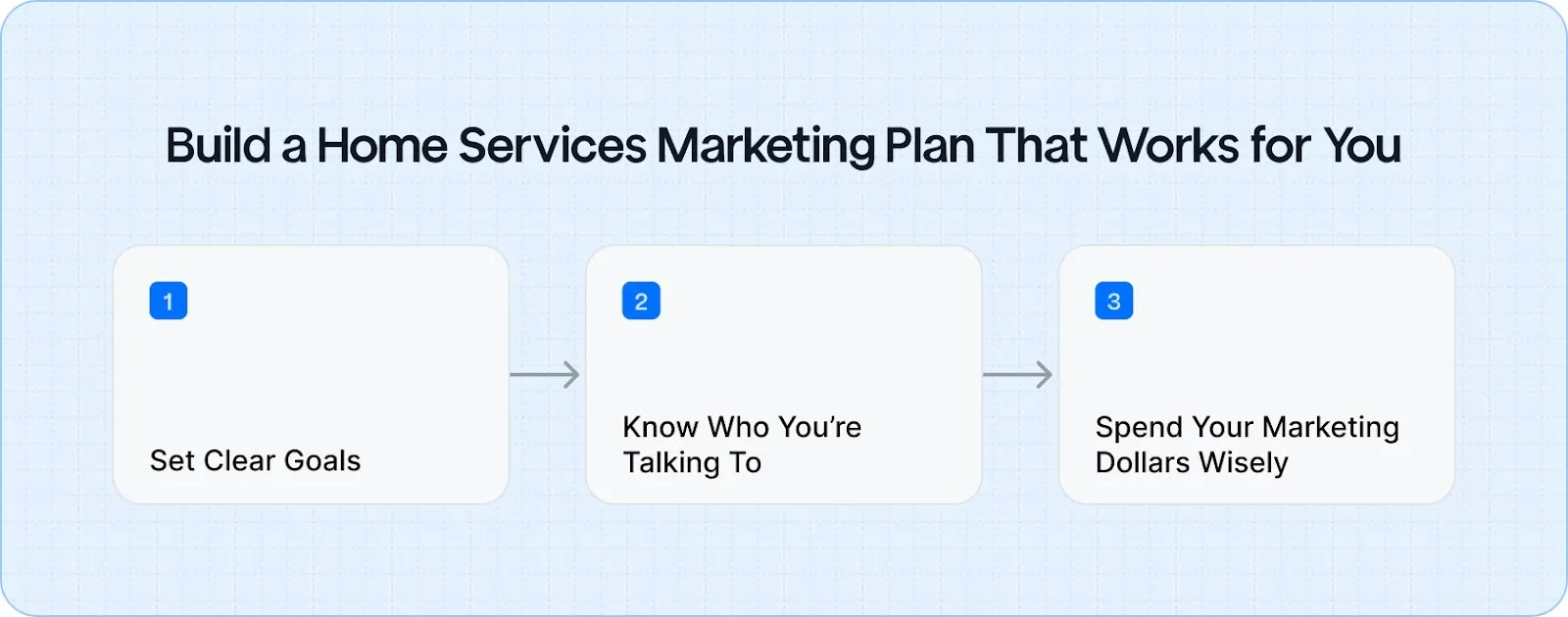
So, how do you make sure your marketing efforts don’t go to waste? How do you keep attracting the right customers and keep them coming back for more? Let's break it down into steps that actually work.
Step 1: Set Clear Goals
Before you spend a penny on marketing, you need to know what you’re aiming for. Are you trying to get more people to call you for an estimate (that’s increasing leads)? Or are you working on building a loyal customer base that comes back every year for a check-up (that’s customer retention)? Maybe you want to expand and offer your services in new areas.
Whatever it is, set your goals clearly. If you don’t know what you want, how will you know when you’ve got it?
Without a clear goal, you might end up spending money on things that don’t move the needle for you. That’s a dangerous game to play.
Step 2: Know Who You’re Talking To
Next, it’s time to really get into the head of your ideal customer. Who are they? Where do they live? What are their pain points? For example, if you’re a plumber, are you targeting homeowners who are dealing with emergency leaks or people looking for routine maintenance?
These are your customer personas, which are detailed profiles of the people who need your services. When you know exactly who you’re targeting, your marketing becomes laser-focused and much more effective.
Without this step, you risk throwing your marketing budget at random people who might not even need your services, which means you’re burning money and missing out on potential customers.
Step 3: Spend Your Marketing Dollars Wisely
Now that you know your goal and your audience, it's time to put your marketing money where it matters. Marketing is about doing the right things.
Invest in local SEO to appear in search results, pay for Google Ads to target customers searching for services like yours, and build your social media presence. Focus your budget on strategies most likely to bring a return.
The key here is ROI (return on investment). If you spend money on marketing, you want to see real results: more phone calls, more bookings, more customers.
Key channels to focus on:
- Google Business Profile: This is where people first find you online. Optimizing it helps ensure your business shows up when someone searches for local services like yours.
Reviews, photos, and accurate details; these small touches can make a huge difference in building trust with potential customers.
- Local SEO: This is all about getting your business noticed by local homeowners when they search online for the services you offer.
If you’re not showing up in local search results, your competitors are stealing the traffic that should be yours.
- Paid Ads: If you’re looking to get customers quickly, paid ads on Google or Local Services Ads can put your business at the top of search results. It’s a fast track to getting noticed by people who are actively looking for help.
But it’s easy to waste money if you don’t know what you’re doing, so make sure your ads are targeting the right people.
Take Charge of Your Home Services Marketing Today
You have the strategies, now it’s time to act. Leverage AI for smarter decisions and use the power of referrals to help your business rise above the competition.
The key to growth lies in turning these strategies into real, measurable results.
If these strategies had you nodding your head, it’s time to take action.
Gushwork is here to give you the tools you need to automate, streamline, and elevate your marketing.
Book a Free Consultation
FAQs
Q1. How can I improve my local SEO for home services marketing?
A1. To improve local SEO, focus on optimizing your Google Business Profile with accurate information, encourage reviews, and include location-specific keywords on your website. Additionally, create local content and get listed on local directories to boost visibility.
Q2. What are the best marketing strategies for home services businesses?
A2. The best strategies include local SEO, Google Local Services Ads (LSAs), social media marketing, automated review collection, and video marketing. These approaches help build trust, visibility, and engagement with your local audience.
Q3. How do PPC ads work for home services businesses?
A3. PPC ads allow you to pay for visibility in search results based on targeted keywords. For home services, running ads on Google helps you appear when potential customers search for specific services, driving high-quality traffic directly to your business.
Q4. How can social media help my home services business grow?
A4. Social media platforms like Facebook, Instagram, and NextDoor are great tools for engaging with your community. Share customer stories, behind-the-scenes content, and service updates to build trust and attract new leads.
Q5. Why are reviews important for home services marketing?
A5. Positive reviews build credibility and trust. They also improve local SEO, making your business more visible to people searching for services like yours. Encouraging happy customers to leave reviews can directly impact your online reputation and attract more leads.
Q6. What’s the role of AI in home services marketing?
A6. AI helps you predict customer needs and personalize marketing efforts. With AI, you can customize offers and services based on previous interactions, ensuring that you reach out to customers at the right time with the right message, enhancing lead generation and customer retention.

SEO
Nov 4, 2025
5 mins
Electrician SEO That Turns Your Website Into a Lead Machine
Batul Beawarwala
You’re a skilled electrician with a strong reputation, but it’s hard to stand out when people can’t find you online. The reality is that most customers start their search for an electrician on Google.
They type in terms like “electrician near me” or “licensed electrician in [city],” and if your name isn’t on that list, you’ve lost their business.
Search engine optimization (SEO) is the key to ensuring your business shows up where it counts, on the first page of Google, when people are looking for the exact services you offer.
SEO isn’t just for big companies with deep pockets. This guide will explore simple strategies to improve your online presence, so you can connect with more customers who are actively searching for help.
What is SEO for Electricians and How Does It Work?
SEO for electricians is the process of optimizing your website so that it appears when people search for the services you provide. Consider SEO as your online "open sign," ensuring that when someone searches for electrical services, your business is the first they see. For example:
- If someone searches for "reliable home rewiring services" or "outdoor lighting installation near me," SEO helps your website appear in their search results.
- It’s about ensuring that your website ranks high when customers need your services, for a home renovation or a quick repair.
Why is it Important?
Most people won’t look beyond the first few search results when they need something. If your website isn’t on that first page, potential clients might never even know you exist.
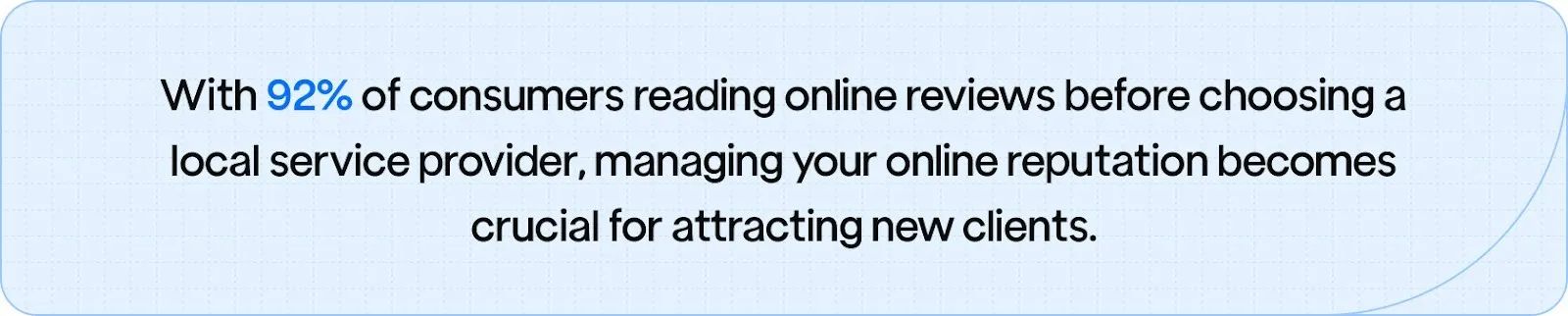
Here’s why SEO is crucial for electricians:
- Increased visibility: It ensures your website appears at the top of search results, putting you in front of local customers.
- Attracting the right clients: By appearing for specific searches like “fuse box repair in [city]” or “24-hour electrical services near me,” you’re connecting with people who are actively looking for your services.
- Affordable marketing: Unlike paid ads, SEO is a cost-effective, long-term solution that keeps working for you.
SEO ensures your business stands out when people are looking for help with electrical services, making sure they find you at the moment they need a trusted expert.
Finding it difficult to climb the SEO ranks?
What if the right tools could help you get found by the right customers, effortlessly? It’s time to make SEO work for you.
Start Optimizing Today
5 Key SEO Strategies for Electricians
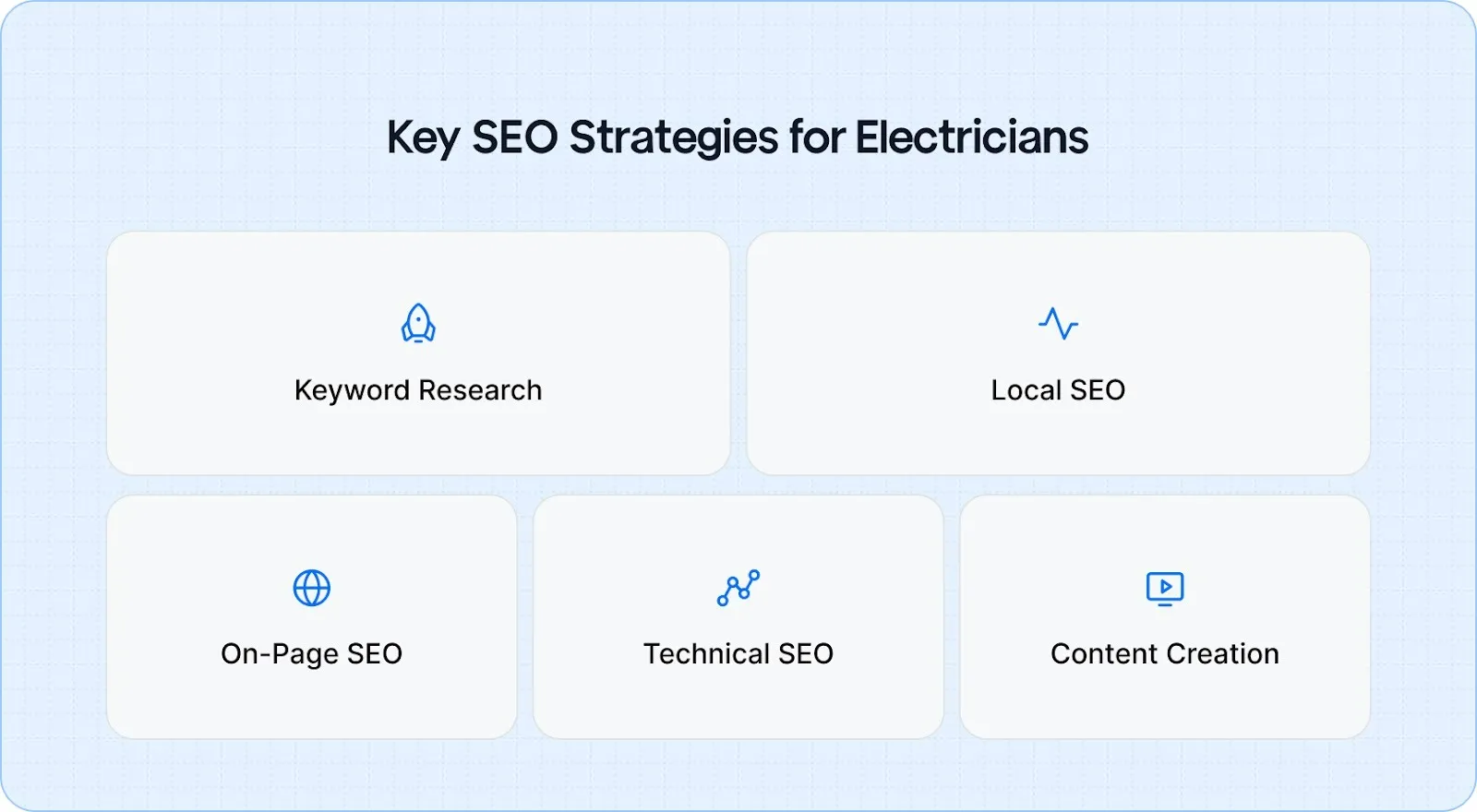
When you’re running an electrical business, the last thing you want is for potential customers to overlook your expertise simply because they couldn’t find you online.
The right SEO strategies can help you change that, making sure your business stands out when customers are searching for electrical services.
1. Keyword Research
Before your customers can find you, they need to know what to search for. Keyword research is all about identifying the terms people are typing into Google when they need your services.
By targeting high-traffic keywords like “electrical panel installation” or “reliable electrician in [city],” you ensure that your website ranks for the terms most likely to bring in the right kind of leads.
2. Local SEO
Your community is where your business thrives, and Local SEO makes sure that your name is visible to the people who need you most. Here’s how to make the most of it:
- Optimize Your Google Business Profile (GBP): When someone searches for “licensed electrician near me”, your GBP listing ensures that your business is front and center. It’s a simple yet powerful way to increase local visibility.
- Create Localized Content: Including location-specific keywords in your website content, such as “emergency electrician in [city]”, helps you show up in search results when people in your area are actively looking for your services.
3. On-Page SEO
Once potential customers find your website, you want them to stick around and convert into leads. On-page SEO is about optimizing each page to ensure it’s both user-friendly and search engine-friendly. Here’s what you need to focus on:
- Service Pages and Meta Descriptions: Each service you offer should have its own dedicated page with clear descriptions and optimized keywords, like “fuse box replacement”. Also, concise, compelling meta descriptions increase the likelihood of people clicking on your site when it shows up in search results.
- Mobile Optimization and Site Speed: With the majority of searches happening on mobile devices, ensuring your site is responsive and loads quickly is critical to keeping visitors engaged.
4. Technical SEO
The technical side of SEO ensures your website is built to support both search engines and visitors. Technical SEO focuses on making sure your site works smoothly under the hood. Here’s what to keep in mind:
- Website Speed: A slow website can turn away potential customers before they even see your services. Optimizing images, reducing load times, and choosing reliable hosting will help speed up your site.
- Security (HTTPS): Switching your site to HTTPS improves security for your visitors and boosts your ranking with Google, making your site more trustworthy in the eyes of both customers and search engines.
- Mobile Usability: With so many customers searching on their phones, your site needs to be mobile-friendly. A well-optimized mobile site ensures that visitors can easily navigate and access your services on any device.
5. Content Creation
Content is a great way to show potential customers that you’re an expert in your field. By creating helpful, informative content, you can improve your SEO while building trust with your audience. Here’s how:
- Blog Posts and FAQs: Posting regular blog articles about common electrical issues, like “How to prevent electrical fires” or “When to upgrade your electrical panel,” provides valuable information and helps improve your search rankings.
- Answering Common Questions: Adding a well-structured FAQ section to your website ensures that you’re answering the questions your customers are asking, increasing your chances of showing up in both search results and voice search queries.
Building Authority with Off-Page SEO
Establishing your business as a trusted local expert goes beyond your website. By earning quality backlinks and managing your online reputation, you can significantly increase your visibility and credibility.
Backlink Building
You’ve probably heard that backlinks are one of the most powerful ways to improve your site’s authority. But what does that really mean for you as an electrician? In simple terms, backlinks are like "votes of confidence" from other websites that tell search engines your business is credible.
The more quality sites link to your page, the higher you rank. Start by earning backlinks from local directories, industry-related blogs, or even suppliers you work with. These links improve your SEO and help you build trust with both search engines and customers.
Reputation Management
Your online reputation is one of your strongest assets. Customer reviews are a key part of that. A good review can make a potential client choose you over the competition. Actively managing reviews means responding to both positive and negative feedback, showing customers that you care about their experience.
Encouraging satisfied clients to leave positive reviews on platforms like Google, Yelp, or Facebook can significantly increase your local SEO rankings and establish your business as a trusted provider in the area.
In a relevant Reddit thread, many electricians and local service providers discuss how simple local SEO practices, like optimizing your GBP and collecting reviews, can help drive real results.
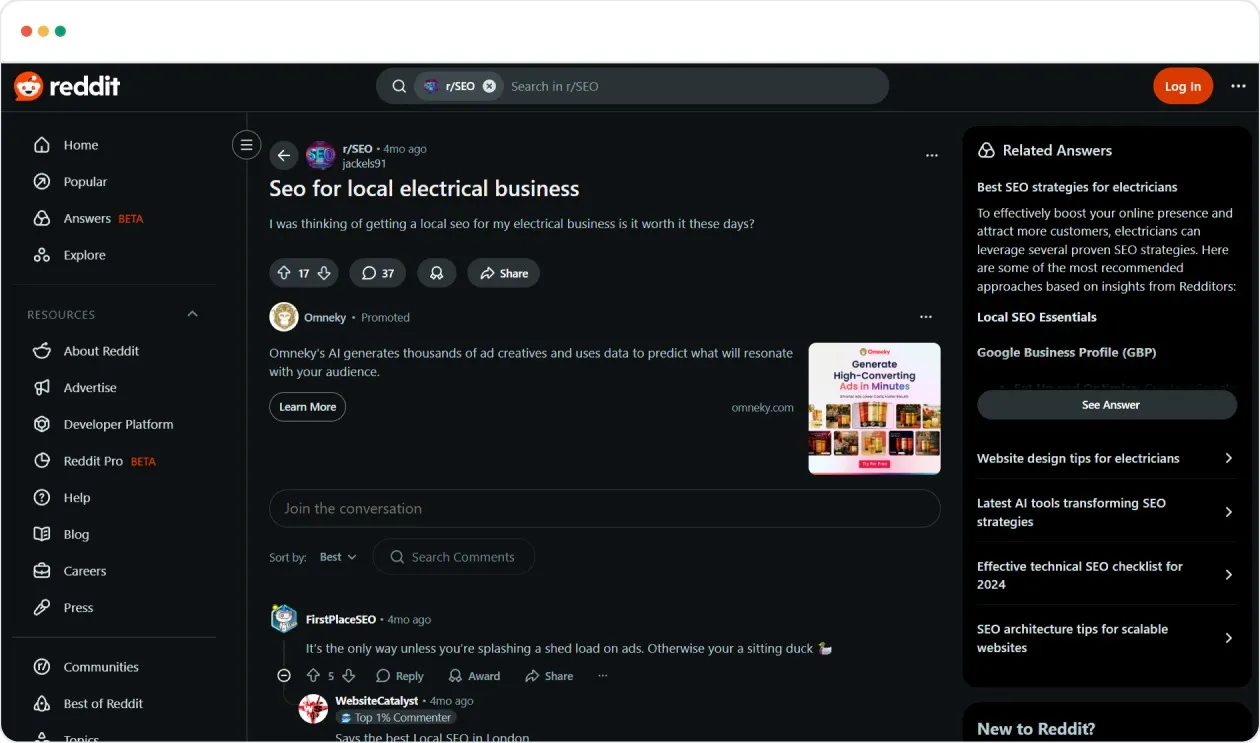
This kind of reputation management is crucial for improving your SEO standing and gaining visibility when potential customers are looking for your services.
Balancing SEO with running your business can feel overwhelming.
What if the right tools could handle your SEO, giving you more time to focus on serving your clients?
Let’s Simplify Your Workday
How to Rank in Google’s “Local Pack”
When potential customers search for an electrician in your area, you want your business to be one of the first they see.

The Local Pack is where your business can shine, but getting there requires a few key steps:
- Claim and Optimize Your Google Business Profile (GBP): Your GBP is the foundation of your local SEO strategy. Think of it as your online business card. Make sure your profile is fully filled out with up-to-date information, including photos, hours, and service details.
The more complete and accurate your profile, the more likely it is to show up when someone searches for local services.
- NAP Consistency: Name, Address, and Phone Number (NAP) need to be consistent across all platforms, including your website, directories, and social media profiles.
This simple step tells Google that your business is trustworthy and helps you rank higher in local searches.
- Customer Reviews: Reviews are one of the strongest factors in improving your local SEO rankings. Ask your satisfied customers to leave positive feedback, and don’t forget to respond to each review.
When Google sees active reviews, it increases your credibility and helps you rank higher in search results.
Advanced SEO Tips for Electricians
Now that you’ve mastered the basics, it’s time to elevate your SEO strategy with more advanced techniques.
By fine-tuning these elements, you’ll ensure your business is found more easily and engages potential customers more effectively.
- Voice Search Optimization: More and more people are using voice assistants like Siri or Google Assistant to search for services. People don’t type like they speak, so it’s important to adapt your content.
Use natural, conversational phrases in your content, like “Best electrician in [city] for home repairs”, to match how customers ask questions.
- Video Content: Videos are a powerful way to engage with potential customers. A tutorial on common electrical issues or a customer testimonial can make your content more relatable and increase your rankings.
Google loves video content, and when you post engaging videos on your website or YouTube, you create valuable touchpoints for future clients.
- Schema Markup: Think of Schema Markup as giving Google a roadmap of your website. It helps Google understand exactly what your business does, making it easier for them to display your services in search results.
By adding structured data to your website, you increase the chances of appearing in featured snippets, local searches, and other specialized results.
How to Measure SEO Success and Keep Your Business Growing
Once you've put the work into optimizing your website, it's crucial to track how well it's performing. Measuring SEO success is about understanding how your efforts are translating into real results. Here’s what to look for:
- Key Metrics: Think of organic traffic, keyword rankings, and conversions as the pulse of your SEO strategy. Tools like Google Analytics and Search Console provide the data you need to see what’s working and where you can improve.
Are more people finding your website through Google? Are they sticking around to book your services? These metrics tell you exactly that.
- Continuous Optimization: SEO is an ongoing process. Regularly updating your content and adjusting your strategy based on performance data ensures that you stay ahead of the competition.
By refining your approach over time, you’ll ensure that your business continues to grow and attract more local customers.
Ready to Spark Your SEO?
Local SEO, great content, and managing your online reputation are the keys to making sure your business stands out when customers need you most.
These strategies are about building trust, engaging with your community, and becoming the go-to electrician in your area.
You’ve learned the strategies, now let’s make them work for you.
Gushwork’s expert can help streamline your SEO and business operations, so you can grow with ease.
Book Your Free Consultation
FAQs
Q1. What are the most important SEO strategies for electricians?
A1: The most important SEO strategies for electricians include local SEO optimization, keyword research, and reputation management. Start by optimizing your Google Business Profile, use location-specific keywords in your content, and encourage customer reviews. Additionally, ensure your website is mobile-friendly and fast to load.
Q2. How do I optimize my Google Business Profile for SEO?
A2: To optimize your Google Business Profile (GBP), ensure all your business details are accurate and up-to-date, including your name, address, phone number (NAP), and service areas. Add high-quality photos, write a compelling business description, and regularly post updates and promotions to stay active and visible in local searches.
Q3. What is local SEO for electricians?
A3: Local SEO focuses on optimizing your website and online presence so that you appear in search results for customers near you. It includes tactics like optimizing your GBP, using local keywords (e.g., "electrician in [city]"), and ensuring your name, address, and phone number are consistent across directories and platforms.
Q4. How long does it take to see SEO results for an electrician?
A4: SEO is a long-term strategy, and it usually takes 3 to 6 months to see significant results. The time it takes depends on various factors, such as the competitiveness of your market, the quality of your content, and how well your website is optimized for search engines.
Q5. How do I get more customer reviews for my electrical business?
A5: Encourage satisfied customers to leave reviews by making it easy for them. Send follow-up emails or texts asking for feedback after completing a job, and provide direct links to your review platforms. Responding to all reviews, both positive and negative, shows you value customer input and can improve your reputation.
Q6. What are the best tools for tracking SEO performance for electricians?
A6: Tools like Google Analytics, Google Search Console, and SEMrush are excellent for tracking SEO performance. These tools allow you to monitor traffic, keyword rankings, and customer engagement, helping you adjust your strategy for better results over time.
Q7. How can I improve my electrician website’s ranking?
A7: To improve your website’s ranking, focus on optimizing your content with relevant keywords, ensuring your website is mobile-friendly and fast, and building high-quality backlinks. Regularly update your site with helpful blog posts and FAQs that answer customer questions and enhance your website’s authority.
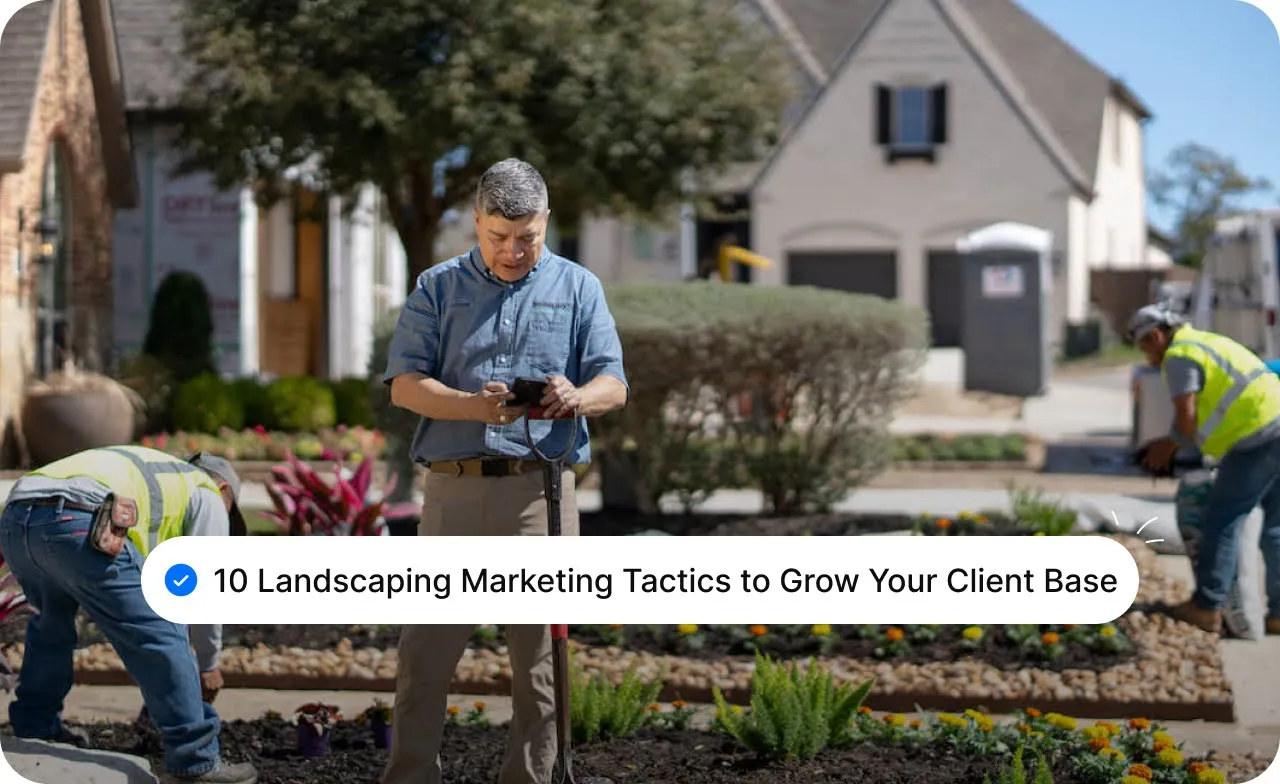
Digital Marketing
Nov 4, 2025
5 mins
10 Effective Landscaping Marketing Tactics to Increase Your Client Base
Batul Beawarwala
Creating beautiful outdoor spaces is an accomplishment, but getting the right clients to notice your work is where many businesses struggle.
Despite the quality of your projects, attracting consistent, high-value leads can feel like a never-ending challenge. In an industry where competition is fierce, relying solely on word of mouth isn’t enough to drive growth.
This guide will equip you with proven landscaping marketing strategies that will help your business stand out, attract high-value clients, and drive long-term success, starting today.
1. Define Your Ideal Landscaping Clients for Targeted Marketing
Quality work alone won’t drive your business forward if you’re not reaching the people who value your expertise.
The key to success lies in identifying who your ideal clients are and personalizing your marketing efforts to speak directly to them.
Actionable Strategy:
- Create buyer personas: Think about the specific characteristics of the clients who are most likely to benefit from your services. Consider demographics like income level, project needs, and where they live. For instance, if you specialize in upscale outdoor spaces, you’ll want to target neighborhoods where residents are likely to invest in premium landscaping projects.
- Differentiate between residential and commercial clients: These two types of clients have very different needs. Residential clients might need regular lawn care or garden design, while commercial clients might require ongoing maintenance contracts or larger-scale projects.
Example: If you’re skilled in high-end landscape design, target affluent neighborhoods where homeowners are more likely to invest in custom features like outdoor kitchens or water features.
2. Build a Strong and Memorable Landscaping Brand
Your brand should clearly communicate who you are, what you offer, and why your business is the best choice for your clients. When your brand resonates with potential clients, it builds trust and helps you attract the right audience.
Actionable Strategy:
- Design a simple, modern logo: Your logo should reflect the quality and style of your work while being easy to recognize. It should also be adaptable across different marketing materials.
- Create consistent visual identity: Use a cohesive color scheme, fonts, and imagery that align with your brand’s personality. This consistency will make your business instantly recognizable across your website, social media, and even your truck.
- Craft a Unique Selling Proposition (USP): Highlight what makes your services unique. From eco-friendly practices and quick project turnarounds to exceptional customer service, make sure it’s clear why clients should choose you over the competition.
3. Create a Lead-Generating Landscaping Website
Your website is your digital storefront. If it’s difficult to navigate or doesn’t effectively communicate the services you provide, visitors will quickly move on.
A website that clearly presents your offerings and makes it easy for clients to reach you can convert casual visitors into paying customers.
Actionable Strategy:
- Mobile-friendly design: Since many people search for services on their smartphones, ensure your website is optimized for mobile viewing.
- Clear service descriptions and high-quality images: Show your best work with professional photos of completed projects. The more detailed and high-quality the images, the more potential clients will trust your expertise.
- Easy quote requests: Make it simple for visitors to contact you or request a quote directly through your website. The easier it is for them, the more likely they are to take the next step.
Your website is ready, but visitors aren’t booking yet.
With a few small adjustments, you can turn your site into a lead-generating tool that brings in quality clients.
Optimize Your Website for Leads
4. Use Local SEO to Improve Your Visibility
Being visible when potential clients search for landscaping services nearby is essential.

Local SEO ensures that your business appears at the top of search results when people in your area are actively looking for the services you offer.
Actionable Strategy:
- Claim and optimize your Google Business Profile: This free listing ensures your business shows up when people search for landscaping services nearby. Fill it out completely with accurate details, including your hours of operation and services.
- Use location-based keywords: Ensure your website includes terms like "landscaping in [city]" to increase your chances of showing up in local searches.
- Encourage customer reviews: Positive reviews help you build credibility and improve your local search rankings.
5. Engage Clients on Social Media for Brand Awareness
Social media is a powerful marketing tool that can help you build relationships and trust with potential clients.

When used effectively, social media can elevate your brand and encourage people to choose you for their landscaping needs.
Actionable Strategy:
- Share high-quality images and videos: Showcase your work with before-and-after photos or time-lapse videos of your projects.
- Engage with your audience: Don’t just post your work, respond to comments, answer questions, and share useful tips that demonstrate your expertise.
- Use paid social media ads: Run targeted ads to reach people in your local area who are searching for landscaping services.
6. Invest in Google Ads for Immediate Leads
Google Ads allow you to target people actively searching for landscaping services in your area. By targeting high-intent keywords, you can quickly connect with clients who are ready to take action.
Actionable Strategy:
- Use Local Services Ads: These ads appear at the top of Google search results when someone searches for landscaping services near them, allowing you to capture immediate leads.
- Invest in Search Ads: Focus on high-conversion keywords like “landscaping near me” or “lawn care services.”
7. Nurture Leads with Email Marketing Campaigns
You've generated interest, but how do you keep your business top-of-mind until they’re ready to book? That's where email marketing comes in, helping you stay in touch with potential and existing clients and turning leads into long-term customers.
Actionable Strategy:
- Set up automated email campaigns: Automate follow-ups, seasonal offers, and quotes to make sure you’re always engaging with your leads.
- Personalize your emails: Personalize your messages to the services your clients are most interested in, like sending a lawn care reminder in spring or promoting hardscaping services in summer.
- Segment your email list: Divide your leads based on factors like past services, interest, or geographic location to send them the most relevant content.
8. Leverage Customer Referrals for New Business
There's no better endorsement for your landscaping business than a satisfied customer telling their friends and family about your services.
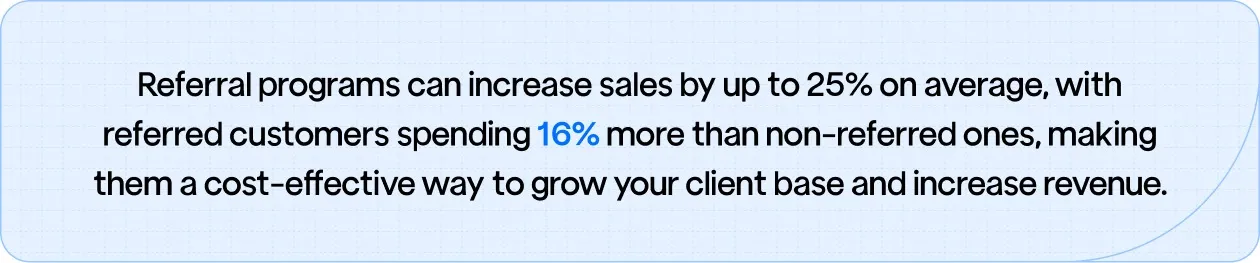
Referral marketing taps into the trust people place in personal recommendations, helping you grow your client base with minimal effort.
Actionable Strategy:
- Create a customer referral program: Offer existing clients an incentive for referring new customers, like a discount or a free service upgrade.
- Ask for testimonials: After completing a project, ask happy clients to share their experience with a review or testimonial, either on your website or Google Business Profile.
- Reward your top referrers: Recognize clients who refer the most business by offering exclusive rewards, like a free seasonal cleanup or a gift card.
9. Network with Local Businesses for Joint Marketing Opportunities
Networking is an opportunity to create strategic partnerships that help grow your business. By collaborating with complementary local businesses, you can tap into new client bases and build mutually beneficial relationships that go beyond one-time sales.
Actionable Strategy:
- Collaborate with home improvement or real estate businesses: Work with realtors, home builders, or interior designers to offer joint services or promotions.
- Attend local events and trade shows: Being visible in your community at events can connect you with other businesses and potential clients who might need your services.
- Sponsor local community events: Contribute to charity runs, festivals, or public gardens and use the opportunity to showcase your landscaping skills.
10. Track and Analyze Marketing Performance for Continuous Improvement
To see real growth, you need to analyze how well your marketing strategies are performing.
Tracking key metrics will help you understand what’s driving leads and conversions, so you can continually improve your approach.
Actionable Strategy:
- Track key metrics: Focus on website traffic, conversion rates (how many visitors turn into leads), and the source of your leads, from organic search, paid ads, or social media.
- Use analytics tools: Platforms like Google Analytics, Facebook Insights, and your CRM software can help you monitor the performance of your campaigns.
- Test and optimize: Experiment with A/B testing to find out what messages, images, or offers perform best with your target audience.
Take Your Landscaping Business to New Heights
You have seen how implementing these 10 proven landscaping marketing strategies can make all the difference.
From defining your ideal client to optimizing your website and using local SEO to your advantage, each tactic has the power to help you attract the right leads, build lasting relationships, and ultimately grow your business.
Marketing doesn’t have to be overwhelming. With the right strategies in place, you can see consistent results, from gaining more clients and increasing your revenue to building your brand’s reputation.
Gushwork offers tools to streamline lead generation and simplify marketing.
So you can focus on what you do best, creating stunning landscapes.
Book a Free Consultation
FAQs
Q1. What are the best landscaping marketing strategies?
A1. The best landscaping marketing strategies include a combination of local SEO, social media engagement, Google Ads, and email marketing. It's essential to identify your target audience and use clear, high-quality visuals of your work to capture their attention. Additionally, creating a user-friendly website with an easy way for clients to request quotes is crucial for generating leads.
Q2. How can I attract more landscaping clients?
A2. Attracting more landscaping clients starts with a strong online presence. Optimize your website for local SEO, run targeted ads on social media and Google, and engage with clients on platforms like Instagram and Facebook. Word-of-mouth referrals are also powerful, so encourage satisfied customers to leave reviews and share their experiences.
Q3. What is the best way to advertise landscaping services?
A3. The best way to advertise landscaping services is through a mix of online and offline methods. Invest in Google Ads and local SEO to appear in search results when potential clients look for landscaping services nearby. You can also use social media platforms to showcase your work, engage with your audience, and promote special offers. Offline methods like direct mail and sponsoring community events also help increase visibility.
Q4. How do you target customers for landscaping?
A4. Targeting customers for landscaping requires a deep understanding of your ideal client. Define buyer personas based on factors such as location, income level, and the types of services they need. Use local SEO to make your business visible to nearby clients and run targeted ads to reach specific demographics. Networking with local businesses and asking for referrals can also help you attract the right customers.
Q5. What is local SEO for landscaping?
A5. Local SEO for landscaping involves optimizing your online presence to rank higher in search results for location-based keywords like "landscaping near me" or "lawn care in [your city]." This includes claiming and optimizing your Google Business Profile, adding your business to local directories, and ensuring your website includes keywords specific to the areas you serve. Positive customer reviews and local backlinks are also important for improving local SEO.
Q6. How do I generate leads for my landscaping business?
A6. To generate leads for your landscaping business, focus on creating a strong online presence. This includes optimizing your website for SEO, using social media platforms to engage with potential clients, and running targeted Google Ads. Offering promotions, creating informative blog content, and using email marketing to stay in touch with prospects can also help convert interest into leads.
Q7. What marketing tools are best for landscapers?
A7. Some of the best marketing tools for landscapers include Google Ads for targeted advertising, social media platforms like Instagram and Facebook for showcasing work, and local SEO tools like Moz or Yoast to optimize your website. For managing leads and customer interactions, tools like HubSpot or Jobber can help automate processes and track marketing performance. Email marketing platforms like Mailchimp are also useful for nurturing leads.

“For the first time, we’re proud to add SEO services. Six months in, impact evident.”
Read Case Study

In Conversation with

Abhijith HK
Founder & CEO of Codewave
Want us to do the same for your business?
Talk to an Expert
.svg)
.svg)

