


Home

Resources
Blogs
Blog
Get insights on AI, productivity, and the future of work.


Thank you! Your submission has been received!
Oops! Something went wrong while submitting the form.

Digital Marketing
Aug 25, 2025
5 mins
Social Media Marketing for Manufacturers: Smarter Conversion Paths To Beat Posting More
Preksha Bharadwaj
Let's be honest. You've probably tried social media marketing for your manufacturing business before. Perhaps you've posted photos of your facility on LinkedIn, shared a few industry articles on Facebook, or even tried to join Instagram because "that's where everyone is."
However, the reality is different for the B2B space.
Top industries (manufacturers or distributors) that see real results aren't just posting content and hoping for the best. They're using social media as part of an integrated lead generation system that connects to their multiple other lead-generating channels.
Once you understand how your buyers actually research and make decisions, you can design your social media strategy around their behavior, rather than fighting against it.
TL;DR
- The Problem: Most manufacturers post generic content that attracts industry peers rather than actual buyers, with no system in place to convert social media engagement into sales conversations.
- The Solution: Create content that solves prospect problems (plant managers, procurement directors), use LinkedIn as your primary platform, and connect every social media touchpoint to your sales process.
- The Strategy: Follow the 40/30/20/10 content rule (educational content / behind-the-scenes / customer success / promotional), optimize profiles for lead generation, and track metrics that matter—website visitors and actual leads, not likes.
- The Integration: Social media works best when combined with website content (blogs, service pages, product pages), paid ads, and email marketing to create a comprehensive lead generation system that systematically turns prospects into customers.
You might've heard many manufacturers saying, "Isn't social media just for B2C companies? Our customers are businesses, not consumers scrolling through Instagram."
This skepticism is completely understandable.
But what you should know is that your customers are businesses run by real people. People who check LinkedIn during lunch, watch YouTube to learn about processes, and research suppliers online before making decisions.

The goal isn't viral posts or thousands of followers. It's building relationships, demonstrating expertise, and staying top-of-mind so when they have a need, you're their first call.
But here's where most manufacturers go wrong. They understand the importance of social media, yet they're making mistakes that prevent them from achieving these goals.
Common Issues in Social Media Marketing That You Must Know

Most industrial companies are making the same three critical mistakes on social media, and they don't even realize it.
The Pattern:
- Monday: Post an industry article on LinkedIn
- Wednesday: Share a photo of your latest shipment
- Friday: Celebrate an employee milestone
The likes roll in. A few shares here and there. Your industry peers comment with "Great work!" and "Congratulations!"
But when the phone rings with new business inquiries? Silence.
Here's what you must see if it’s breaking in your business..
#1 Inconsistent Lead Generation from Social Media
The problem is visible. Your posts get attention from other manufacturers and industry publications, not from the plant managers and procurement teams who actually buy what you make.
Getting 50 likes from your competitors doesn't pay the bills. You need content that attracts decision-makers with budgets and purchasing authority.
The real answer is that it's not "How many people saw my post?"
It's "Did the right people see my post, and do they know how to contact me?"
#2 Lack of Integration with Sales and Lead Generation Systems
Consider this common scenario:
- Someone comments on your LinkedIn post, asking about your capabilities
- You reply in the comments thread
- The conversation dies there
- That potential customer moves on to your competitor
Your social media becomes a dead end instead of a pathway to your business. Most manufacturers treat social media like a bulletin board—post something, walk away, hope for the best.
However, even if you resolve the integration problem, there's still another critical issue that most manufacturers overlook entirely.
#3 Difficulty in Tailoring Content for the Right Audience
Common industrial posts that you see on social media are generic and mostly look like:
- "Happy Friday from our team!"
- "Check out this industry trend..."
- "Celebrating 25 years in business!"
There's nothing wrong with these posts, but they don't address the specific problems your ideal customers face every day.
A procurement director scrolling LinkedIn isn't looking for feel-good content. They're looking for solutions to their supply chain challenges.
You're trying to appeal to everyone instead of speaking directly to your ideal customers—the plant managers, procurement directors, and engineering teams who actually make purchasing decisions.
These challenges provide insight into why most manufacturers struggle with social media. However, the real game is when you also have a proven solution to maximize the effectiveness of social media marketing for your business.
How to Turn Social Media Marketing into a Lead Generation Machine

The solution isn't complicated. You don't need a massive budget, a full-time social media manager, or to become the next viral sensation.
What you need is a strategic approach that treats social media as one piece of a larger puzzle, your complete lead generation system.
#1 Creating Engaging Social Media Content That Attracts Qualified Leads
Your prospects don't care about your new machine. They care about their problems—missed deadlines, quality issues, supply chain headaches, and cost pressures.
Here’s an overview of content types that get decision-makers to pay attention:
The Content Rule: Before posting anything, ask: "After seeing this, would a plant manager think 'I need to talk to these people'?" Then, take them live.
Remember, you also need to connect that content to actual business conversations.
#2 Aligning Social Media with Your Lead Generation Strategy
Industries generating real leads from social media have established a clear path between their online content and sales conversations.
Here’s a realistic CTA framework that works:
- For LinkedIn posts: "If you're dealing with [specific problem], we've helped companies like [industry example] solve this. Send me a message and I'll share what we learned."
- For YouTube videos: "Facing a similar challenge in your operation? Contact us at [phone/email] to discuss your specific situation. We've solved this problem for [number] companies in [industry]."
- For case studies: "Want to see how this approach could work for your manufacturing process? Download our detailed case study at [website link] or call [phone] to discuss your requirements."
But how would you know if they're actually generating business results?
#3 Track and Measure Success
Most manufacturers track vanity metrics like followers and likes. Here's what you should track instead:
- Track Metrics That Actually Drive Business:
- How many people visit your website from your social media posts
- How many of those visitors actually contact you or request quotes
- How much are you spending to get each new lead
- Whether prospects from social media buy faster than other leads
- Monthly Review Questions:
- Which posts generated the most website traffic?
- Which prospects contacted us through social media?
- How many leads came from each platform?
- What's our social media to sales conversion rate?
To make it easier to understand, here’s what that actually looks like…
At this point, you might be thinking, “This all makes sense, but where do I actually start?” Most manufacturers get overwhelmed trying to implement everything at once. But the process is actually simple.
How to Get Started with Social Media Marketing for Manufacturers

The key is to start with the foundation and build up systematically. Here are 4 simple steps that will get you generating leads from social media:
Step 1: Define Your Audience
Look at your most profitable accounts from the last two years. What industries are they in? Who signed the contracts? How did they research before buying?
Target Audience Checklist:
- Job titles identified (Plant Manager, Procurement Director, Manufacturing Engineer)
- Industries specified (Automotive, Aerospace, Food Processing)
- Company size defined (50-500 employees, $10M-$100M revenue)
- Key challenges documented (Supply chain delays, quality issues, cost pressures)
- Research behavior understood (LinkedIn browsing, YouTube learning, supplier evaluation process)
Create content for ONE persona at a time. Don't try to speak to everyone in every post.
Step 2: Develop a Content Calendar
With your goals and audience in place, it's time to map out what you'll post and when.
Use this 40/30/20/10 content framework for regular posting:
Consider this monthly planning framework:
- Week 1: Focus on one major customer challenge
- Week 2: Industry insights and expertise
- Week 3: Problem-solving focus
- Week 4: Authority building
This framework ensures you're consistently providing value while positioning yourself as the go-to expert in your field.
Step 3: Optimize Your Social Media Profiles
Your profile is often the first thing prospects see when they find you online. Make sure it immediately tells them who you are, what problems you solve, and how to contact you
Profile Optimization Checklist:
- Company description explains problems you solve (not just what you do)
- Direct contact information included (phone, email, website)
- Clear call-to-action added ("Schedule facility tour," "Download capabilities guide")
- Best content pinned (customer success story or educational post)
- Professional imagery and branding are consistent
- Industry keywords included for searchability
Once your profiles are optimized and you're posting consistently, you need to track what's actually working and what isn't.
Step 4: Monitor, Measure, and Improve
The only way to know if your social media efforts are generating real business results is to measure the right things consistently.
You now have everything you need to build a social media strategy that actually generates leads. But here's the reality: social media alone isn't enough to sustain a growing manufacturing business.
Is Social Media the Right Tool for You? Let's Find Out.
You're looking for ways to use social media marketing for manufacturers effectively—but is it the best solution for generating qualified leads for your specific business?
Social media works best when you already have the fundamentals:
- Professional website that converts visitors into leads
- Clear messaging about what problems you solve (not just what you make)
- A sales process that follows up with interested prospects
Without these foundations, you'll drive social media traffic to a website that doesn't convert, create confusion about what you actually do, or generate interest that dies because no one follows up.
Think of it this way: social media is like bringing prospects to your front door of your production unit.
But if your "industry" isn't ready to welcome them and guide them toward a purchase, they'll just walk away and go to a competitor who has their act together.
The next step is converting these social media visitors into actual leads and customers.
Here’s a Complete System That Fills Your Sales Pipeline
The industries getting the best results utilize a mix of marketing approaches where each channel enhances the effectiveness of the others.
Gushwork builds and manages this entire system, providing you with a dashboard that tracks your website visitors and leads. Book a Free Demo here!
Frequently Asked Questions (FAQs)
1. How long does it take to see results from social media marketing for manufacturers?
Most manufacturers begin to see increased website traffic within 30-60 days of consistent posting. However, qualified leads typically take 3-6 months to develop, as B2B buyers have longer research cycles. The key is staying consistent with valuable content while building relationships with prospects. Companies that integrate social media with their website, email marketing, and sales process see faster results than those treating social media as a standalone activity.
2. What's the best social media platform for manufacturing companies?
LinkedIn is the most effective platform for B2B manufacturers, with 93% of industrial marketers prioritizing it for lead generation. Your prospects—plant managers, procurement directors, and engineers—use LinkedIn to research suppliers and connect with industry professionals. YouTube works well as a secondary platform for product demonstrations and process videos. Avoid spreading yourself thin across multiple platforms; master LinkedIn first, then expand to YouTube.
3. How much should manufacturers spend on social media marketing?
Most successful manufacturers allocate 10-15% of their marketing budget to social media, but focus on consistent content creation rather than just ad spending. You can start effectively with $500-1000/month, covering content creation, basic advertising, and management tools. The bigger investment is time. Plan for 5-10 hours weekly for content creation, engagement, and lead follow-up. ROI comes from lead generation, not follower count.
4. Can small manufacturing companies compete with larger ones on social media?
Absolutely. Small manufacturers often outperform larger competitors on social media because they can be more personal, responsive, and agile. Focus on showcasing your expertise, customer service, and specialized capabilities rather than trying to match big companies' production scale. Share behind-the-scenes content, customer success stories, and industry insights that position you as the go-to expert in your niche. Authenticity beats corporate polish in B2B social media.
5. Which social media platforms should manufacturers prioritize for lead generation?
Start with LinkedIn as your primary platform—93% of industrial marketers prioritize it because that's where plant managers, procurement directors, and engineers research suppliers. Add YouTube as your secondary platform for product demonstrations and process videos that build trust. Consider Facebook and Instagram only after mastering LinkedIn and YouTube, as they support credibility but won't directly generate B2B leads. Focus on 1-2 platforms initially rather than spreading yourself thin.
6. What types of social media content generate the most leads for manufacturers?
Problem-solution stories work best—share how you solved specific customer challenges with measurable results. Behind-the-scenes manufacturing content that shows your quality processes builds trust. Customer success stories positioned from the customer's perspective (not yours) create powerful social proof. Industry insights that interpret trends for practical business implications establish expertise. Always ask: "Would a plant manager think 'I need to talk to these people' after seeing this content?"

Digital Marketing
Aug 25, 2025
5 mins
Manufacturers Lose Hundreds Of Leads Every Year Because They Ignore These Inbound Fundamentals
Batul Beawarwala
The manufacturing industry is evolving. While traditional marketing methods like trade shows and cold calls remain valuable for face-to-face connections, the modern buyer’s journey increasingly begins with online research.
To capture these buyers and maximize your outreach, a new approach is essential: inbound marketing.
TL;DR
- Inbound marketing for manufacturers focuses on attracting, engaging, and nurturing leads through valuable content and SEO, rather than relying on traditional sales tactics.
- By aligning content with each stage of the buyer’s journey, manufacturers can build trust and guide prospects from awareness to purchase.
- This method is cost-effective, generating 54% more leads than outbound methods while significantly reducing costs.
- Key metrics like website traffic, lead conversion rates, and customer lifetime value are essential for measuring inbound marketing success and optimizing strategies.
- Case studies, such as Pazago and Paniflex, show how inbound marketing drives increased lead generation, improved brand visibility, and higher sales.
- Platforms like Gushwork can streamline inbound marketing efforts, offering tools for content automation, lead tracking, and performance optimization.
What is Inbound Marketing?
Inbound marketing is a strategic approach that helps manufacturers in the U.S. attract potential customers by providing valuable content and experiences tailored to their specific needs, rather than relying on traditional ads that disrupt. For manufacturers, this means building trust with industry professionals by offering informative resources that solve real challenges.

Traditional marketing methods are losing their effectiveness, and your competitors are already adapting to the shift.
Inbound marketing for manufacturers isn't just a trend; it's the future of how businesses attract and retain customers.
This method works by guiding customers through the buyer's journey with content creation, SEO, social media engagement, and personalized communication. For U.S. manufacturers, this translates into producing high-quality content that speaks directly to pain points and needs, ensuring you connect with prospects at every stage, whether they're just learning about your solutions or ready to make a purchase.
How Inbound Marketing Helps Manufacturers Drive Growth

This strategy offers manufacturers a strategic approach to attract, engage, and retain customers without the need for intrusive advertising. By focusing on creating valuable content and experiences personalized to the needs of potential clients, manufacturers can build trust and establish long-term relationships.
Let's explore how it can benefit your manufacturing business:
1. Increased Lead Generation
Instead of relying on cold calls or unsolicited emails, this approach attracts qualified leads who are actively seeking solutions to their problems. By providing informative content that addresses their needs, manufacturers can draw in prospects who are already interested in their offerings.
2. Cost-Effective
Traditional marketing methods, such as trade shows and direct mail campaigns, can be expensive and yield uncertain results. In contrast, inbound marketing incorporates content creation and search engine optimization (SEO) to generate leads at a fraction of the cost, making it a more affordable option for manufacturers.
3. Better Alignment with Buyer Needs
Inbound marketing allows manufacturers to create content that speaks directly to the challenges and questions of their target audience. By addressing specific pain points and providing solutions, manufacturers position themselves as trusted advisors, building stronger connections with potential customers.
4. Enhanced Customer Retention
By continuing to provide valuable content and educational resources even after a sale, manufacturers can nurture customer relationships, encouraging repeat business and growing brand loyalty. This ongoing engagement helps transform one-time buyers into long-term advocates.
5. Measurable Results
One of the key advantages of inbound marketing is its measurability. Manufacturers can track metrics such as website traffic, lead conversions, and customer acquisition costs to assess the effectiveness of their marketing efforts and make data-driven decisions for continuous improvement.
Understanding Your Customer's Journey and How to Align with It

In the manufacturing world, your potential customers follow a clear journey, and how you guide them through it can directly impact your sales. Understanding this journey allows manufacturers to build trust and close more deals.
Let’s break down the key stages of the buyer’s journey and how you can align your strategy to meet prospects at every step.
Awareness (They realize they have a problem or need)
At this stage, prospects realize they have a problem that needs solving, like improving operational efficiency or tackling production bottlenecks. The goal is to capture their attention with valuable content such as blog posts, guides, or industry reports that educate and address their pain points.
Recent Insight: A study by 6sense found that 81% of B2B buyers have already selected a preferred vendor before contacting a sales representative.
Here’s how to align with it:
Attract: Bringing the Right People to You
SEO Optimization: When someone searches for "industrial automation solutions" or "manufacturing equipment suppliers," you want your business to show up first. SEO (Search Engine Optimization) ensures your website is easy to find by using industry-specific keywords that potential customers are already searching for. This is the first step in making sure the right prospects are discovering you online.
Content Creation: Creating valuable content, like blogs, videos, or case studies, allows you to show your expertise and address the real challenges your potential customers face. For example, if you're a manufacturer of industrial machinery, creating a guide on "how to choose the right equipment for your factory" helps solve the problem your audience is actively searching for, while positioning you as a trusted resource.
Social Media Engagement: Social platforms like LinkedIn, YouTube, and Twitter aren't just for social interaction; they're tools to connect with decision-makers in your industry. By sharing insights, case studies, or success stories on these platforms, you create direct engagement opportunities that can spark meaningful conversations with people who matter to your business.
Stage 2: Consideration (They start researching potential solutions)
Prospects now begin researching potential solutions, evaluating different technologies, methods, and providers. At this stage, manufacturers should offer content like product demos, case studies, or whitepapers to help prospects make informed decisions
Here’s how to align with it:
Convert: Turning Interest into Leads
Lead Magnets: Think of lead magnets like "free samples" of your expertise. Offering resources like eBooks, whitepapers, or industry reports in exchange for contact details allows you to start conversations with qualified prospects. It's a great way to show value upfront and start building a relationship.
Landing Pages: A landing page is a dedicated webpage where prospects can easily request more information, sign up for a product demo, or schedule a consultation. The goal is to simplify the process for them to take the next step in their buying journey without any distractions.
Calls-to-Action (CTAs): CTAs are simple, clear actions that encourage your website visitors to engage further. Whether it's downloading a free eBook on production optimization or requesting a free consultation, these small but powerful prompts guide prospects to the next step, getting closer to a purchase.
Stage 3: Decision (They’ll choose a specific solution or vendor)
Prospects have narrowed down their choices and are ready to purchase based on value and fit. Clear, compelling CTAs are essential here, guiding them to the final decision with personalized quotes or consultations.
Recent Insight: The 2024 B2B Buyer Experience Report shows that 85% of buyers have already established purchase requirements before engaging with sales.
Here’s how to align with it:
Close: Turning Leads into Customers
Email Nurturing: Once you've got leads, it's time to nurture them with personalized emails, follow-ups, and valuable content. Keep them engaged with industry insights, product updates, or solutions that address their unique needs. By staying top of mind, you build trust and increase the likelihood they'll choose your solution when they're ready to buy.
CRM Integration: Using tools like HubSpot or Salesforce, you can track all interactions with leads in one place. This allows you to keep everything organized, see where prospects are in their journey, and ensure no lead falls through the cracks. It also makes follow-ups more efficient, leading to higher conversion rates.
Sales Alignment: For inbound marketing to truly succeed, sales and marketing need to work hand-in-hand. Sales teams should follow up with leads who are ready to make a purchase, using the insights and information shared by marketing. This creates a seamless transition from interest to sale, resulting in more opportunities to close deals.
The Final Step: Don’t Just Close, Delight!
You've done the hard work of attracting them, nurturing their interest, and closing the deal. But what happens after the contract is signed? The final, and perhaps most important, part of your inbound strategy is making sure your customers feel valued long after their purchase.
Delight: Building Long-Term Customer Relationships
Customer Support: Once a customer makes a purchase, your relationship doesn’t end there. Offering exceptional post-purchase support helps build trust, ensures customer satisfaction, and encourages repeat business. A happy customer is more likely to return and recommend you to others.
Feedback Loops: Gathering customer feedback through testimonials or reviews allows you to improve your products and services. Positive feedback not only helps you improve but can be used to build trust with new prospects by showcasing the great experiences your customers have had with your company.
Referral Programs: If your customers are happy, they can become your best marketers. By encouraging them to refer others to your business, you create a cycle of continuous growth without spending more on advertising. A referral program can turn satisfied customers into loyal brand advocates.
By embracing these strategies, manufacturers can stop chasing leads and instead attract them through content that’s valuable, engaging, and aligned with their needs. With the right approach, you will not only close more sales but also build lasting relationships that drive long-term success.
Is It Working? How to Measure Your ROI
To truly understand the effectiveness of your marketing efforts, you need to measure how well you're meeting your business goals. By tracking specific metrics, manufacturers can gain valuable insights into what’s working, what needs improvement, and how to refine strategies for better outcomes. Here are the key performance indicators (KPIs) that can help you measure success and ROI.
Key Performance Indicators (KPIs):

- Website Traffic (from organic search): Track the number of visitors coming to your website through search engines. This shows how well your content is performing and driving interest.
- Lead Conversion Rates: Measure the percentage of visitors who turn into leads. This helps evaluate how effectively your website and content are engaging and capturing potential customers.
- Customer Acquisition Cost (CAC): Calculate how much it costs to acquire a new customer. This includes all marketing and sales expenses and helps determine the efficiency of your efforts.
- Customer Lifetime Value (CLV): Track the total revenue a customer brings over the duration of their relationship with your business. This helps you understand the long-term value of your customer base and refine retention strategies.
- Continuous Improvement: Regularly assess your marketing strategies based on these metrics and adjust accordingly to improve results and maximize ROI. This data-driven approach ensures ongoing optimization and growth.
Check These Real-World Results: Case Studies and Examples

Pazago
Pazago, a manufacturer specializing in industrial packaging solutions, used inbound marketing to significantly improve its lead generation efforts. By creating targeted content that addressed common pain points in the packaging industry, like cost efficiency and material durability, Pazago attracted a more qualified audience.
Their strategic use of SEO and content marketing increased their website traffic and resulted in a noticeable uptick in inbound leads. With an improved lead conversion rate, Pazago was able to close more sales and strengthen relationships with existing customers.
Paniflex
Paniflex, a manufacturer of flexible packaging solutions, embraced inbound marketing to enhance its online visibility and attract new customers. Through a combination of detailed case studies, educational blog posts, and product demos, Paniflex positioned itself as an industry expert.
This approach helped drive organic traffic to their website, where interested prospects could access valuable resources. As a result, Paniflex saw improved brand recognition and increased inquiries, leading to higher revenue and expanded market reach. Both Pazago and Paniflex demonstrate how manufacturers in niche industries can leverage inbound marketing to build stronger connections with their target audience, increase website traffic, and ultimately drive sales growth.
Next Steps: How to Implement Inbound Marketing for Your Manufacturing Business
Now that you understand the power of inbound marketing for manufacturers, it’s time to consider how you can implement these strategies to drive growth for your business. Inbound marketing is a powerful tool to attract, convert, and retain customers, but how you execute it is just as important.
What’s Next?
You have two options:
- DIY Approach: With some research and effort, you can begin implementing inbound marketing strategies on your own. But keep in mind that it requires ongoing optimization and time to see significant results.
- Get Help: For manufacturers looking to accelerate their success and maximize ROI, partnering with an experienced inbound marketing platform like Gushwork can be a game-changer. Gushwork can help you streamline your marketing processes, optimize content, track results, and provide the expertise needed to get the best possible outcomes faster.
Whether you choose to take the DIY route or seek professional help, the key is getting started. Our team at Gushwork can provide the support you need to set up a comprehensive inbound marketing strategy, helping you save time, avoid common pitfalls, and ultimately see faster, more sustainable results.
Common Questions Manufacturers Have About Inbound Marketing
Q1. How long does it take to see results from inbound marketing in manufacturing?
A1. The timeline for seeing results can vary, but manufacturers typically begin to notice an increase in website traffic and lead generation within 3-6 months. However, consistent content creation and SEO optimization will drive long-term growth and stronger brand recognition over time.
Q2. What are the most effective content types for manufacturers in inbound marketing?
A2. For manufacturers, the most effective content includes case studies, product demos, whitepapers, and educational blog posts. These types of content address real industry challenges and provide solutions that resonate with your target audience, positioning your business as an industry leader.
Q3. How can I measure the effectiveness of my inbound marketing strategy?
A3. Key metrics to track include website traffic, lead conversion rates, customer acquisition cost (CAC), and customer lifetime value (CLV). By analyzing these KPIs, you can gain insights into how well your inbound efforts are performing and optimize them for better results.
Q4. Is SEO important for inbound marketing in manufacturing?
A4. Yes, SEO is crucial for inbound marketing success. By optimizing your website and content with industry-specific keywords, you improve your chances of being discovered by potential customers who are actively searching for solutions you provide.
Q5. Can inbound marketing work for all types of manufacturers?
A5. Absolutely. Inbound marketing is flexible and can be tailored to any manufacturing niche, from industrial equipment to packaging solutions. By understanding your target audience’s challenges and creating relevant content, you can build trust and attract leads in any manufacturing sector.
Q6. How can Gushwork help manufacturers with inbound marketing?
A6. Gushwork provides a comprehensive suite of tools to streamline your inbound marketing efforts. From automating content delivery to tracking results, Gushwork helps manufacturers create personalized, data-driven marketing campaigns that attract, engage, and convert leads more efficiently.

CRM
Aug 22, 2025
5 mins
One CRM Shift Can Instantly Double Your Sales Team Productivity And Follow-Up Speed
Preksha Bharadwaj
Are your competitors winning deals because they respond faster? Is your sales team spending more time on data entry than on client relationships? These are the symptoms of an outdated system. The solution for smart distributors is a strategic shift to a CRM that puts all the right information at their fingertips.
Your customers are now more informed, demanding, and have more options than ever before. To stay ahead, distributors need to move beyond traditional sales methods and embrace technology that helps them build stronger relationships and streamline their operations.
Once considered a tool for large, B2C corporations, CRM has become an essential asset for smart distributors. It’s no longer just about tracking sales; it's about gaining a 360-degree view of your business, from initial contact to post-sale support.
TL;DR
- What is CRM? – A centralized system that stores all customer information, order history, and communications in one place, eliminating the need to hunt through emails and spreadsheets.
- Main Benefits: – Faster customer service, automated follow-ups, better sales forecasting, and more time for actual selling instead of administrative tasks.
- When You Need It: – When leads are getting lost, customer information is scattered across multiple systems, or you're making business decisions without clear data.
- Getting Started: – Choose a simple, user-friendly system that integrates with your existing tools and start with one team before expanding company-wide.
Four Problems Every Distributor Faces (And How CRM Solves Them)
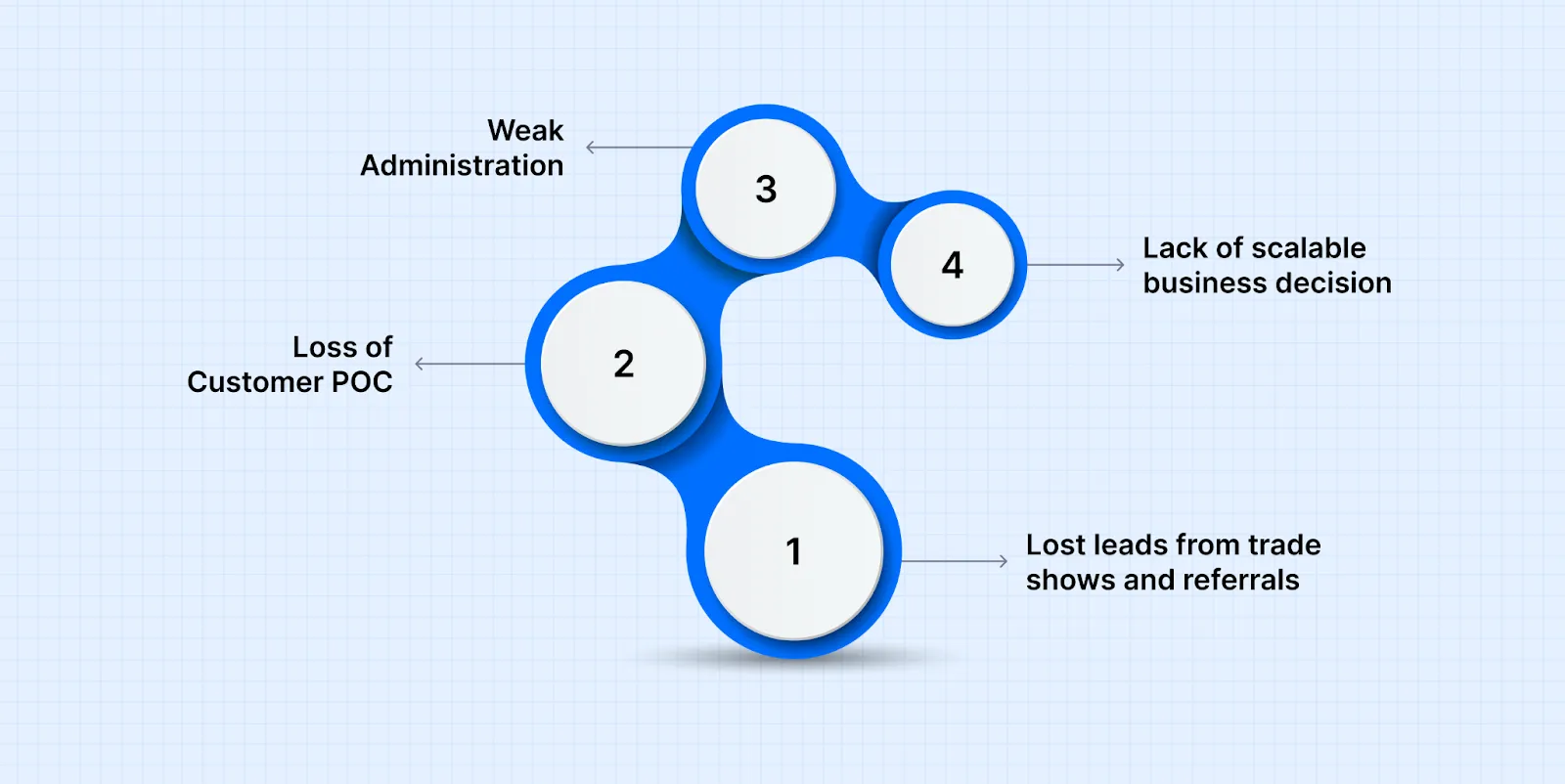
Problem #1: Lost Leads From Trade Shows and Referrals
Trade show ends, you've got business cards and notes scattered everywhere. That promising lead gets buried in someone's follow-up pile. By the time you call, they've moved on. The same thing happens with referrals. You mean to follow up, but urgent orders take priority, and good opportunities disappear.
Here’s how CRM solves it for you. Every lead gets logged immediately with notes about their needs and timeline. Automated reminders ensure follow-ups happen on schedule. You can set it up so that trade show leads get a follow-up email the next business day, then a phone call three days later. Nothing falls through the cracks because the system tracks it all.
Problem #2: The "Who Handled This?" Problem
Customer calls with a question about their order. Sarah's at the warehouse, Jim's with another client. You're scrambling through emails and notes while the customer waits. When key people are out sick or on vacation, their customer knowledge goes with them.
Here’s how CRM can be useful. Anyone on your team can pull up complete customer history in seconds. Order details, previous conversations, special requirements, payment terms—it's all there. Your customer gets immediate answers instead of "let me find who handled that and call you back."
Problem #3: Hours Lost on Administrative Tasks
Your sales reps spend half their day on paperwork instead of selling. Generating quotes, scheduling follow-ups, and updating spreadsheets. Time that should be spent with customers gets eaten up by admin work that could be automated.
Here’s how CRM solves it for you. Quote templates save hours of repetitive work. Follow-up emails can be automated based on customer behavior. Sales activities get logged automatically when emails are sent or calls are made. Your team spends more time building relationships and closing deals.
Problem #4: Flying Blind on Business Decisions
You're making inventory and staffing decisions based on gut feelings because you can't clearly see your sales pipeline. Which customers are likely to reorder? What products are trending up or down? Without clear data, you're guessing instead of planning.
Here’s how can CRM help you. Real-time dashboards show exactly where your sales stand. You can see which customers typically reorder every six months, which products are gaining traction, and where your sales efforts are generating the best returns. Data-driven decisions replace educated guesses.
These problems might sound familiar, but recognizing them is only the first step. The real question is..
When to Make the Move to Use a CRM System
You don't need to be a Fortune 500 company to use CRM. In fact, small and mid-sized distributors often see the biggest impact because they're moving from completely manual processes to automated efficiency.
The transformation is dramatic. Imagine going from handwritten notes and scattered spreadsheets to having every customer detail at your fingertips in seconds.
While large corporations might see incremental improvements, smaller distributors experience complete operational overhauls that fundamentally change how they do business.
The Four Clear Signs It's Time to Invest
- Your Team is Growing and Coordination is Getting Harder
- Customer Requests Are Falling Through the Cracks
- You Can't Accurately Forecast Sales or Inventory Needs
- You're Ready to Scale, But Your Current Processes Won't Support Growth
Getting Started the Right Way to Build a CRM System
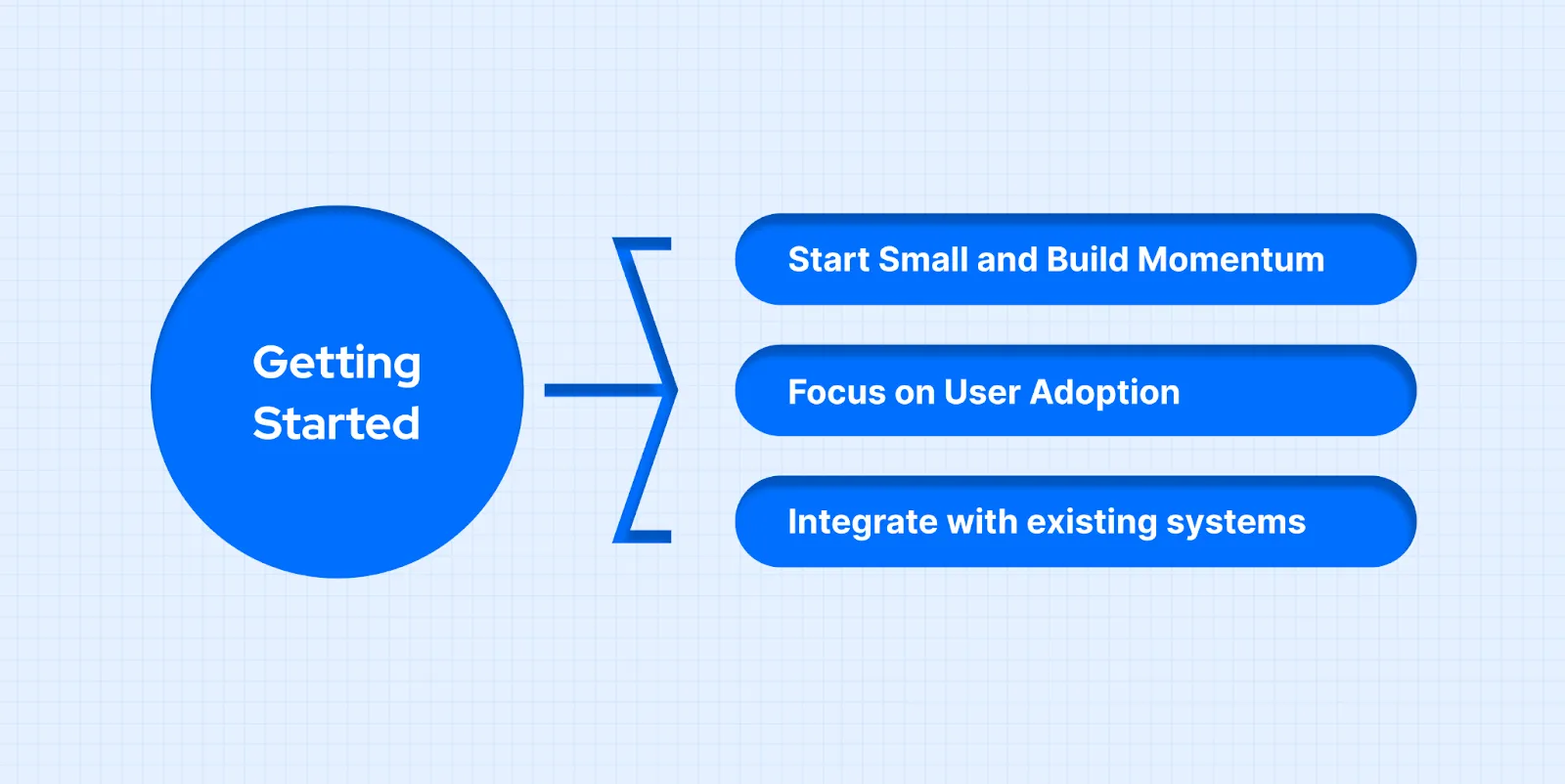
The key to successful CRM implementation isn't the software itself—it's the approach. Most distributors who struggle with CRM adoption made the same mistake: they tried to change everything at once instead of building momentum gradually.
#1 Start Small and Build Momentum
Pick one team or process to pilot the system before rolling it out company-wide. This isn't about being cautious—it's about being smart.
When you start with your entire operation, problems get magnified. If something isn't working, everyone's frustrated. If training is inadequate, the whole company struggles. But when you pilot with one team, you can iron out the wrinkles while most of your business continues running normally.
The best starting points for most distributors:
- Lead tracking from trade shows or referrals (immediate, visible impact)
- Customer service inquiries (everyone sees faster response times)
- One sales rep's accounts (builds internal expertise before wider rollout)
Once your pilot group is comfortable and seeing results, they become advocates who help train the rest of your team. This peer-to-peer learning is often more effective than formal training sessions because it addresses real-world questions from people who actually use the system daily.
#2 Focus on User Adoption Over Features
The best CRM in the world won't help if your team won't use it. Choose something intuitive and invest in proper training—but understand that adoption is more about mindset than technical skills.
Your team needs to see immediate personal benefits, not just company benefits. When Sarah realizes she can pull up complete customer history in 10 seconds instead of digging through emails for 10 minutes, she becomes a believer. When Jim stops forgetting follow-up calls because the system reminds him automatically, he starts trusting the process.
What drives adoption:
- The system makes their daily work easier, not harder
- They can see their personal productivity improve within the first week
- Training focuses on their specific tasks, not generic features
- Leadership uses the system consistently (teams follow what they see, not what they're told)
Resist the temptation to choose software based on impressive feature lists. A simple system your team actually uses will deliver far better results than a sophisticated system that sits unused because it's too complicated or time-consuming.
#3 Integrate With What You Have
Look for solutions that connect with your existing ERP, accounting, and communication systems. The goal is to eliminate duplicate data entry and create seamless information flow, not to replace everything you're currently using.
Good integration means when a customer places an order in your ERP system, that information automatically appears in your CRM. When your accounting system processes a payment, your sales team sees it instantly. When someone sends an email, it gets logged to the customer record without manual entry.
Critical integrations for most distributors:
- Email system (so communications are automatically tracked)
- Accounting software (for payment history and credit information)
- Phone system (to log calls and enable click-to-dial)
- Any existing inventory or order management systems
Poor integration creates more work instead of less. If your team has to enter the same information in multiple places, they'll either skip the CRM updates or become frustrated with the extra steps. Either outcome defeats the purpose of implementing the system in the first place.
The Implementation Timeline That Actually Works
Most successful implementations follow this pattern:
Week 1-2: Set up the system and import basic customer data. Don't worry about getting everything perfect. Focus on having core information accessible.
Week 3-4: Train your pilot group on daily tasks, not advanced features. They should be comfortable with basic functions before you add complexity.
Month 2: Let the pilot group identify what's working and what needs adjustment. Make necessary changes while the scope is still manageable.
Month 3-4: Roll out to additional teams based on lessons learned from the pilot group. By now, you have internal experts who can help with training and troubleshooting.
The biggest mistake distributors make is trying to compress this timeline. Successful CRM implementation is a gradual process that builds habits and confidence over time, not a switch you flip overnight.
Getting the Whole Team on the Same Page
While sales teams are usually the primary CRM users, the real power comes when you connect multiple departments around shared customer information. Instead of each department having its own incomplete picture, everyone works from the same story.
#1 Customer Service Gets Faster
Before: Customer calls with a problem. Your rep asks them to explain everything because they have no context.
With CRM, customer calls, and your rep immediately sees what they ordered, when they ordered it, and any previous issues.
The conversation starts with "I see you're calling about those hydraulic pumps" instead of "Can you give me your account number?"
The result is simple. Issues resolved in one call instead of three.
#2 Marketing Actually Works
Before: Generic newsletters sent to everyone, mostly ignored.
With CRM, you see that 40% of customers reorder every six months, so you send automatic reminders when they're due. You see seasonal patterns, so you send relevant promotions at the right time.
The Result becomes easier. Higher response rates because messages are relevant.
#3 Management Gets Real Data
Before: Monthly meetings where everyone tries to remember what happened with customers.
With CRM, real-time dashboards show your pipeline, overdue reorders, and trending products.
The result shows that the decisions are based on data, not guesswork.
Here’s a Simple Example
Imagine a customer calls on Monday with an urgent request for CNC precision parts. Customer service sees they're a high-value account and prioritizes it. Sales sees that they typically follow rush orders with bigger purchases and schedules follow-up. The warehouse prefers morning deliveries.
Instead of four separate, confused interactions, you have one smooth response that impresses the customer and creates more opportunities.
The result is simple. Your entire operation becomes more responsive, more efficient, and more profitable.
The Cost of Waiting
Many distributors postpone CRM implementation because they're "too busy" or want to wait until they're "more organized." This is backwards thinking. You implement CRM precisely because you're too busy and need better organization.
Consider the hidden costs of delaying:
- Lost Revenue: Every missed follow-up or forgotten customer inquiry represents potential sales walking out the door
- Customer Churn: Poor service experiences drive customers to more organized competitors
- Team Burnout: Manual processes become more frustrating as volume increases, leading to employee turnover
- Opportunity Cost: Time spent searching for information is time not spent building relationships or closing deals
- Competitive Disadvantage: While you're struggling with manual processes, competitors with better systems are winning business
But here's the good news: you don't have to wait until you're in crisis mode to make this change.
Ready to Make the Decision? Here’s A Simple Test to Help You
Ask yourself these three questions:
- Can any team member instantly access complete information about your top 10 customers?
If the answer is "only certain people" or "it would take some digging," you need better systems.
- Do you know exactly how many qualified prospects you're currently working with and where each one stands in your sales process?
If you have to spend 30+ minutes compiling this information, your pipeline visibility is insufficient. - Could your business continue operating normally if your most knowledgeable employee were unavailable for two weeks?
If customer relationships and operational knowledge are trapped in individual people's heads, you have a systemic risk.
If you answered "no" to any of these questions, you've already reached the point where CRM implementation would provide immediate value.
The distributors who thrive over the next decade will be the ones who build scalable systems now, while they still have the time and energy to implement them thoughtfully.
The question isn’t whether you’ll eventually need better customer management systems; it’s whether you’ll implement them proactively or reactively. A CRM is the first step toward building a business that can grow without chaos.
Gushwork helps you evaluate your current lead generation system and determine whether it's time for a new CRM or if you need a more effective marketing engine to drive prospects into your pipeline.
Schedule Your Free Consultation here!
Frequently Asked Questions (FAQs)
1. What is the best CRM for small distribution companies?
The best CRM for small distributors is one your team will actually use. Look for simple, intuitive systems that integrate with your existing accounting and email tools. Popular options include HubSpot, Pipedrive, and Zoho CRM. Focus on core features like contact management, sales tracking, and automated follow-ups rather than complex customizations you don't need.
2. How much does CRM software cost for distributors?
CRM costs for small distributors typically range from $30-$100 per user per month. Basic plans start around $15/month, while more robust systems with integrations cost $50-75/month per user. Most distributors find CRM pays for itself within 3-6 months through improved efficiency and better customer retention. Consider implementation and training costs in your budget.
3. Do I need CRM if I only have a few customers?
Even with fewer customers, CRM becomes valuable when you're tracking multiple touchpoints, quotes, and reorder patterns. If you're spending time searching for customer information, forgetting follow-ups, or can't quickly see your sales pipeline, you'd benefit from CRM. It's easier to implement when you're smaller than waiting until chaos hits.
4. How long does it take to implement CRM for a distribution business?
Proper CRM implementation takes 2-4 months for most distributors. Week 1-2 is usually set up and data import. Week 3-4 is for pilot team training. Month 2 is adjustments based on real usage. Month 3-4 is a company-wide rollout. Rushing this timeline leads to poor adoption. Start with one team or process, then expand gradually for better results.
5. Can CRM integrate with our existing inventory management system?
Most modern CRMs offer integrations with popular inventory and ERP systems through APIs or third-party connectors like Zapier. Key integrations include accounting software, email systems, and order management tools. Good integration eliminates duplicate data entry and ensures customer information flows seamlessly between systems. Check integration capabilities before choosing a CRM.

Web Design
Aug 21, 2025
5 mins
25+ Manufacturing Website Design Examples That Generate Leads (Strategy Checklist Included)
Preksha Bharadwaj
A great manufacturing product isn’t enough!
Six months ago, a major automotive company needed custom-machined components. Tight tolerances. 50,000-unit order. Right in your wheelhouse.
They searched online. Your competitor's website loaded instantly with case studies, an ROI calculator, and a "Get Quote in 24 Hours" button.
Your website? "Welcome to ABC Manufacturing," with that 2018 building photo.
They called your competitor. You never knew they existed.
The agenda is simple to understand. Your website is often the first point of contact for potential customers, and if it's not optimized to generate leads, you're leaving money on the table.
A well-designed manufacturing website doesn't just showcase your products; it builds trust, demonstrates expertise, and guides visitors toward a conversion.
To help you get inspired, we've compiled a list of over 25 manufacturing website examples that are doing it right. We'll also provide a strategic checklist you can use to audit your own site and turn it into a lead-generating machine.
TL;DR
- Small Operations (Under $5M) Website Examples: Path Robotics, Marley, Kongskilde Industries, Energy Park, VJTechnologies, FasTest Connectors, C.H.I. Overhead Doors, Amazon Filters, Hajster
- Mid-Size Manufacturers ($5M-$500M) Website Examples: Packwire, Airthings, Micro Weld, Dover Tubular Alloys, McNally Industries, Holland Supply Company, HydroPoint, Halco USA, WIC
- Industry Giants ($500M+) Website Examples: Siemens Manufacturing, Caterpillar, 3M Manufacturing, Honeywell Industrial, Emerson Electric, Minnesota Rubber & Plastics, SuperMax Tools, NXP Semiconductors
- The 5 Success Patterns: What every lead-generating manufacturing website does (it's simpler than you think) + PDF Checklist included
- Realistic Implementation Guide: Budgets ($10K-$150K), platforms, and 6-16 week timelines based on your company size
- Real Results Proof: See how one B2B company got 300% more leads using these same strategies
A. Small Manufacturing Operations (Under $5M Revenue)
"Local Focus, Personal Touch, Speed Advantage"
Running a smaller manufacturing operation? You know the challenge.
Bigger companies. Deeper pockets. More resources.
But the smart ones quickly figured out that the websites help you compete with bigger companies without spending more money.
The manufacturers listed below will prove that you don't need Fortune 500 budgets to get Fortune 500 results. They're using their natural advantages like speed, personal service, and local expertise to steal business from the big guys.
Example 1: Path Robotics - AI-Powered Welding Systems

Why It Works: This $50M robotics company goes head-to-head with billion-dollar automation giants, and wins deals because its website works smarter, not harder.
Smart Positioning:
- Clear Value Proposition: Instead of confusing tech jargon, they lead with "Autonomous Welding Powered by AI Technology", so that anyone can understand what they do in 5 seconds.
- ROI Calculator: Prospects punch in their welding volume and instantly see potential savings. No waiting for a sales call to get ballpark numbers
- 24-Hour Demo Guarantee: While big competitors take weeks to respond, they promise demos in 24 hours
- Customer Success Stories: Real customer names with real results—not generic "Client A saved 30%" stories
- Mobile Excellence: Their site loads quickly on phones, featuring one-tap calling and mobile-optimized quote forms, ideal for engineers researching during plant visits.
What You Can Apply: Stop trying to be everything to everyone. Path Robotics focuses solely on AI welding systems. Pick your specialty and own it. Then create simple tools (even a basic calculator) that help prospects see the value before they call you.
Example 2: Marley Building Products - Roofing Systems

Why It Works: This mid-size building products company goes up against Home Depot and Lowe's every day. It wins because they make it easier for contractors to choose and use their products.
Visual Problem-Solving:
- 3D Product Visualization: Instead of flat product photos, contractors can see exactly how roofing components fit together before ordering
- Installation Resource Center: All the technical docs, installation guides, and specifications in one place, no digging through multiple PDFs
- Project Gallery: Photos of their products on real buildings, not just warehouse shots
- Contractor Locator: Homeowners can find certified installers in their area, creating a win-win for everyone
What You Can Apply: Stop showing just product photos. Show your products doing the job they were made for. If you work through distributors or dealers, make their lives easier. Give them the tools that help them sell your products. When you support your channel partners, they'll push your products over the competition.
Example 3: Kongskilde Industries - Pneumatic Conveying Systems

Why It Works: This global conveying systems company could have built a single generic website, but instead, they created separate experiences for grain farmers and industrial manufacturers, and it's paying off with higher-quality leads.
Multi-Market Approach:
- Separate Industrial and Grain Pathways: A grain elevator operator and a chemical plant manager have completely different needs, so they get completely different website experiences
- Application-Specific Landing Pages: Instead of one confusing "conveying systems" page, they have dedicated sections for material handling, food processing, and chemical applications
- Technical Resource Library: Engineers can download system design guides, sizing calculators, and installation specifications without jumping through hoops
What You Can Apply: If you serve different industries, don't force them all through the same front door. Create separate paths for your main customer types. And don't dumb down the technical information; the engineers evaluating your equipment actually want more detail, not less.
Example 4: Energy Park - EV Charging Infrastructure

Why It Works: This charging station manufacturer recognized something important for their viewers. Today's buyers don't just want functional products; they want to feel good about their purchasing decisions.
Sustainability Focus:
- Environmental Impact Calculator: Prospects can see exactly how many tons of CO2 they'll save by installing these charging stations, giving them concrete numbers for board presentations
- Dynamic Hero Video: Instead of boring product shots, visitors see charging stations in action at busy locations with real cars and real people
- Future-Focused Messaging: They position their products as infrastructure investments, not just equipment purchases
What You Can Apply: Modern buyers, especially younger engineers and facility managers, care about more than just specs and price. If your products help customers save energy, reduce waste, or work more safely, make that a big part of your story. And replace those static product photos with videos that show your equipment actually working.
Example 5: VJTechnologies - Radar Detection Systems

Why It Works: This radar systems manufacturer could have built a basic industrial website. Still, they chose to look as sophisticated as their technology, and it attracts customers who appreciate (and pay for) high-end engineering.
Premium Brand Positioning:
- Dark, Sophisticated Design: The website looks like it belongs to a high-end tech company, not a traditional manufacturer, which is exactly the impression they want to make
- Clear Information Hierarchy: Bold headings and strategic use of color guide visitors to the most important information without overwhelming them
- Technical Credibility: All the detailed specifications, technical documents, and engineering data are easy to find; no hiding behind "contact us for details."
What You Can Apply: If you manufacture precision or high-tech products, don't be afraid to look the part. A professional website design tells prospects they can expect professional results from your products. And if your products are complex, show that complexity proudly. Engineers trust companies that understand the technical details.
Example 6: FasTest Connectors - Engineered Sealing Solutions

Why It Works: This connector manufacturer solved a common problem—engineers need standard parts fast, but they also need custom solutions for special projects. So they built a website that handles both.
Engineer-Focused Design:
- Product Finder Tool: Engineers punch in their pressure, temperature, and material requirements and get a list of connectors that will work. No guessing or lengthy phone calls
- Technical Resource Center: CAD files for immediate download, installation guides, and compatibility charts all in one place
- E-Commerce Integration: Standard connectors can be ordered online with immediate pricing and delivery dates
What You Can Apply: You don't have to choose between online sales and custom manufacturing. Handle the routine orders online so your sales team can focus on the complex, high-value custom work. Provide engineers with the technical resources they need to specify your products accurately the first time.
Example 7: C.H.I. Overhead Doors - Garage Door Manufacturing

Why It Works: This regional garage door manufacturer goes up against Clopay and other national brands every day. However, they win by making it easier for customers to get exactly what they want, exactly where they are.
Customer-Centric Approach:
- Product Configurator: Homeowners can design their ideal garage door online, see what it looks like on their house, and get instant pricing, no waiting for a sales visit
- Residential/Commercial Split: A homeowner and a warehouse manager need completely different information, so they get completely different experiences from the first click
- Local Dealer Integration: The website connects customers directly to certified installers in their area, making the whole process seamless
What You Can Apply: Use your local advantage. While national companies have to be everything to everyone, you can focus on serving your region better than anyone else. Make it easy for customers to find local dealers, installers, or service providers. And if possible, let customers configure or customize products online—even a basic version beats making them call for every little detail.
Example 8: Amazon Filters - Industrial Filtration Systems

Why It Works: This filtration company offers thousands of different filters, and they've realized something important. If customers can't find the right filter quickly, they'll go somewhere else that makes the process easier.
Search and Discovery:
- Advanced Product Search: Instead of scrolling through endless pages, customers filter by their specific application (HVAC, industrial, automotive), material type, and required certifications
- Visual Product Gallery: Every filter has multiple high-quality photos showing different angles, plus all the technical specifications right there—no clicking to separate spec sheets
- Live Chat Support: When customers get stuck trying to find the right filter, they can instantly connect with a technical expert who actually knows the products
What You Can Apply: If you offer a wide range of products, don't require customers to search for what they need. Create simple ways to filter and search your product catalog. Place the key specifications directly on the product pages, rather than burying them in downloadable PDFs. And make it easy to get help from someone who knows your products inside and out.
Example 9: Hajster - Industrial Pumps

Why It Works: This pump manufacturer made a bold choice. Instead of looking like every other industrial website, they decided to showcase their precision pumps like works of art.
Creative Differentiation:
- Artistic Product Photography: Their pumps are photographed like precision machinery, showing the craftsmanship and quality that goes into each piece
- Dynamic Animations: Subtle movements and transitions guide visitors' attention without being distracting or gimmicky
- Modern Typography: Clean, contemporary fonts that appeal to younger engineers and purchasing managers who are increasingly making buying decisions
What You Can Apply: Don't assume industrial buyers want boring websites. The next generation of engineers and facility managers grew up with smartphones and expect better design. If your products are precision-made, show that precision in how you present them.
Sometimes, standing out from the crowd of generic industrial websites is exactly what gets you noticed.
B. Mid-Size Manufacturers ($5M-$500M Revenue)
"Too Big for Local, Too Small for Giants"
You're in the toughest spot.
Too big to compete on local relationships alone. Not big enough to outspend industry giants.
But that's exactly where these companies found their advantage. They stopped trying to be everything to everyone and started dominating specific niches.
Example 10: Packwire - Custom Packaging Solutions
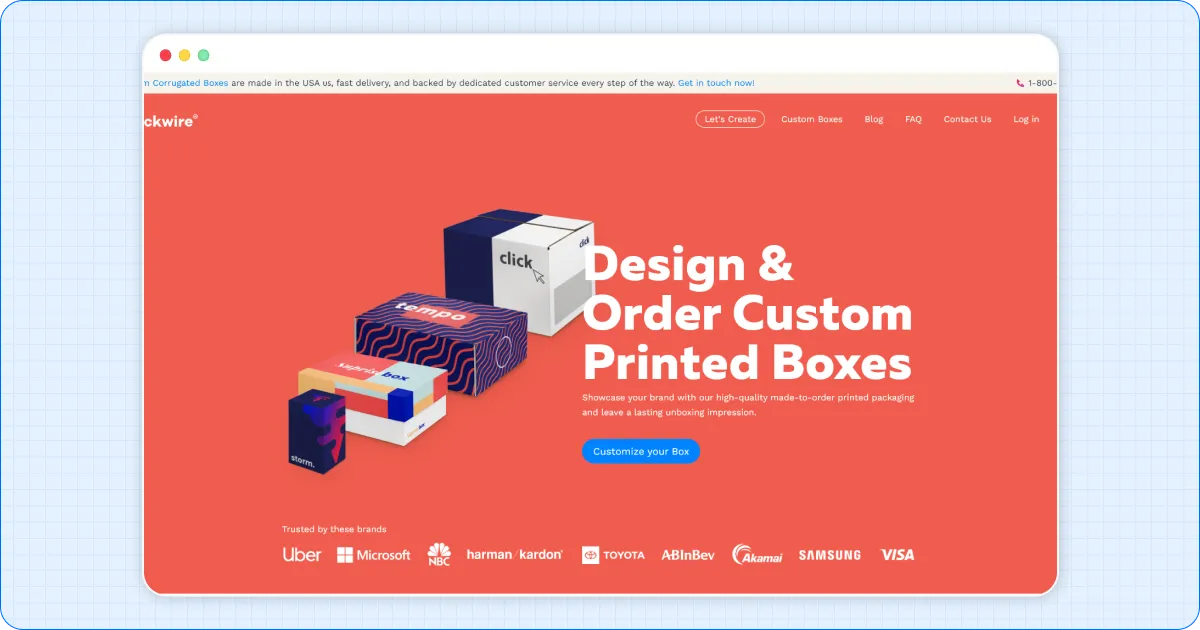
Packwire built an interactive design tool that lets customers create mockups instantly and order same-day samples. While big packaging companies make customers wait weeks for samples and quotes, Packwire delivers both in 24 hours.
Your takeaway here is simple. Speed beats size. Find one thing you can do faster than the big players and make it your competitive advantage online.
Example 11: Airthings - Environmental Monitoring Equipment

Airthings created separate website paths for homeowners (simple DIY setup) and businesses (technical specifications and compliance data). A facilities manager and a homeowner need completely different information about air quality monitors, so they get distinct experiences from the first click.
Your takeaway here should be easy. If you serve both consumers and businesses, don't force them through the same front door. Create clear paths for each audience.
Example 12: Micro Weld - Precision Welding Equipment

Micro Weld built a smart filtering system that lets customers find the exact welder for their metal type, industry, and welding requirements in seconds. Instead of scrolling through 100+ welders, customers filter by their specific needs and see only relevant options. Plus, "Nearly 100 Years of Experience" builds instant credibility.
Your takeaway here is that if you have a complex product line, make it searchable. And if you've been around for decades, use that experience as proof you know what you're doing.
Example 13: Dover Tubular Alloys - Industrial Tubing Distribution

Dover's website clearly states "B2B wholesale only" and optimizes everything for fast reordering with no time wasted on retail customers. Purchasing agents can quickly filter by tube specifications, see availability, and reorder standard materials without phone calls or emails.
Your takeaway here is that if you only serve specific customer types (wholesale, retail, etc.), say so upfront. Then optimize everything for how those customers actually buy from you.
Example 14: McNally Industries - Defense & Aerospace Manufacturing

McNally uses conservative, professional design with heavy emphasis on quality certifications and compliance standards—exactly what government contractors expect to see. Defense buyers don't want flashy websites; they want proof you can meet strict quality and security requirements.
Your takeaway here is easy. You should match your website style to your industry's expectations. If you serve conservative industries, look conservative. If you serve creative industries, show some personality.
Example 15: Holland Supply Company - Industrial Gas & Utility Equipment
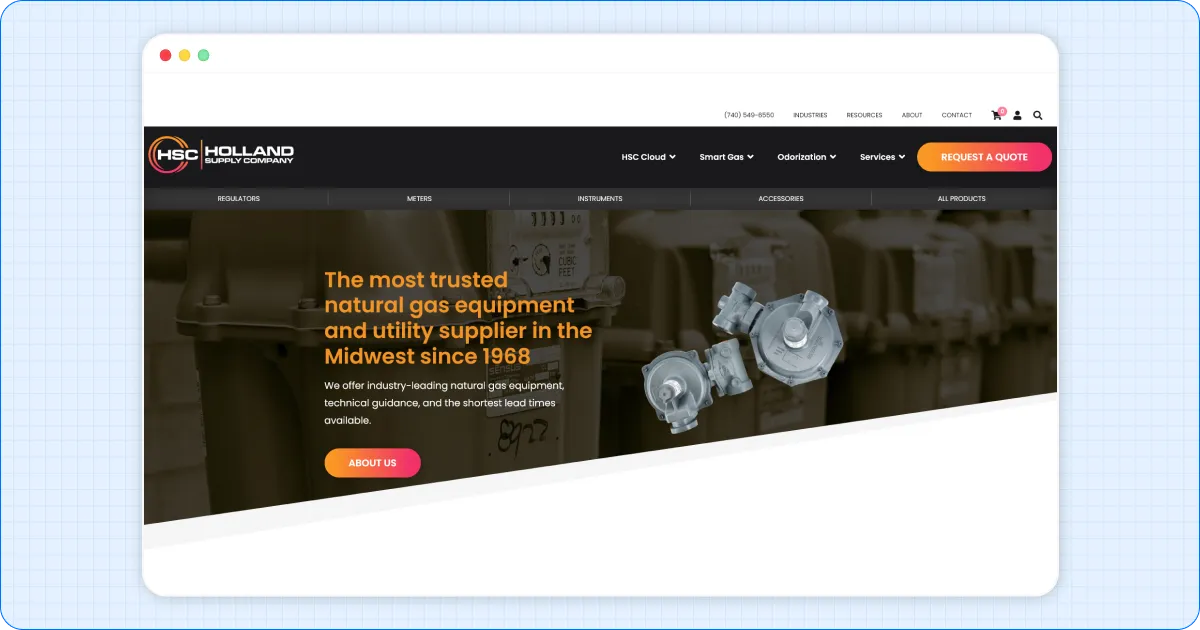
New ownership scrapped Holland's old website entirely and built a custom e-commerce platform designed specifically for their industry. Instead of trying to patch up an outdated website, they started fresh with a system built for how their customers actually buy gas and utility equipment.
Your takeaway is simple. Sometimes a complete rebuild works better than endless tweaks. If your current website can't grow with your business, it might be time to start over.
Example 16: HydroPoint - Smart Water Management Systems

HydroPoint designed its mobile-optimized website for irrigation managers who research solutions while standing in fields, not sitting at desks. Field-based buyers use their phones to research equipment on-site, and HydroPoint's website works perfectly on mobile with easy contact options.
What you should do is optimize for mobile-first if your customers work in the field (construction, agriculture, utilities). They're researching your products while standing next to broken equipment.
Example 17: Halco USA - Specialty Fastener Manufacturing

Halco created separate landing pages for automotive, aerospace, medical, and hygiene applications, each speaking that industry's specific language. A medical device engineer and an automotive engineer need different certifications, specifications, and compliance information for the same basic fastener.
Your takeaway is easy. If you serve multiple industries, create industry-specific pages. Don't make an aerospace engineer dig through automotive applications to find what they need.
Example 18: WIC (Western Industries Corporation) - Multi-Market Manufacturing

WIC added a Spanish language option, recognizing that many of their customers prefer to research and buy in their native language. Instead of losing potential customers who struggle with English-only websites, WIC makes it easy for Spanish-speaking buyers to understand their products and place orders.
Your takeaway is that if a significant portion of your customers speaks another language, add that language to your website. It shows you understand and value their business.
Want a website that works as hard as your production floor?
See how Gushwork is helping top industries in the US build a lead-generating website.
Book A Demo Here


C. Industry Giants ($500M+ Revenue)
"Billion-Dollar Strategies You Can Use Today"
These companies didn't get big by accident. They use proven website strategies that started simple and scaled up. Here's what they figured out, and how you can use the same principles without the massive budget.
Example 19: Siemens Manufacturing - Global Industrial Automation

What They Do: 40+ language versions, AI-powered search across 100,000+ products, digital twin showcases, and regional compliance centers for every country they serve.
What You Can Do: Start with 2-3 languages for your actual markets, basic product filtering, video demonstrations of your equipment working, and highlight your relevant certifications prominently.
The Core Principle: Make it easy for customers to find what they need in the language and format they prefer.
Budget Reality: Siemens spends millions on global infrastructure. You can get 80% of the benefit with WordPress multilingual plugins ($200/year) and organized product pages.
Example 20: Caterpillar - Heavy Equipment & Machinery
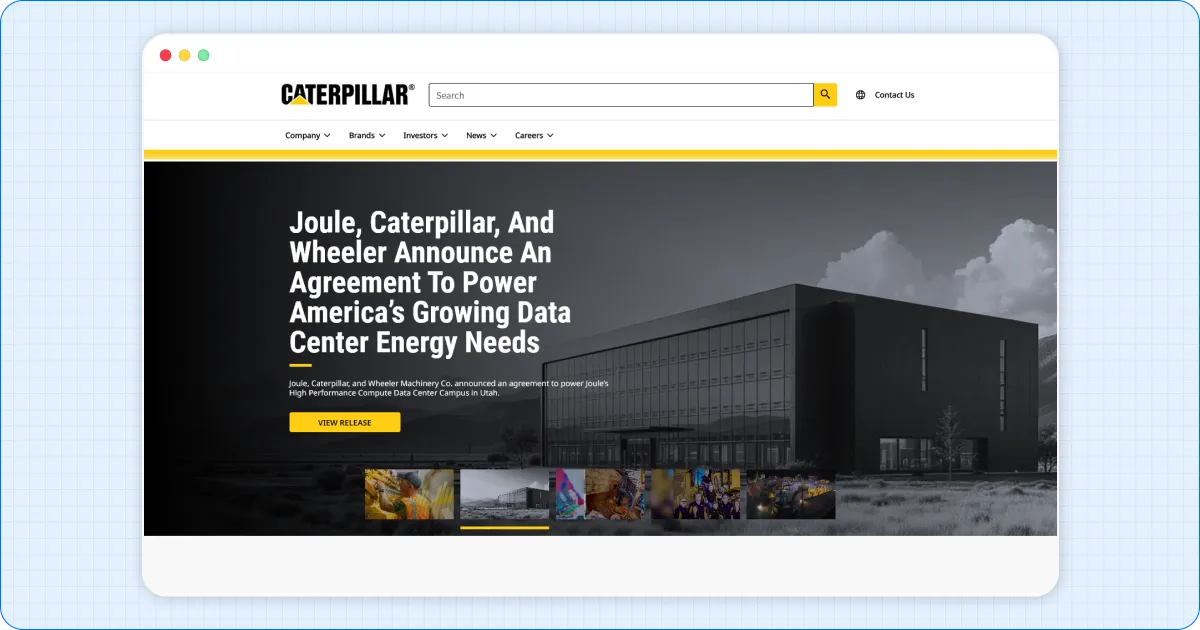
What They Do: Real-time inventory tracking across 190+ countries, custom equipment configurators with instant pricing, enterprise fleet management portals, and VR showroom experiences.
What You Can Do: Simple dealer locator with Google Maps, basic product configurator using quote forms, customer login area for repeat buyers, and 360-degree product videos.
The Core Principle: Make it easy for customers to find local support and configure products without endless phone calls.
Budget Reality: Caterpillar's global infrastructure costs millions. You can deliver similar convenience with Google Maps (free) and basic form builders ($50/month).
Example 21: 3M Manufacturing - Diversified Technology

What They Do: Manage 60,000+ products across dozens of industries with smart segmentation, showcase their R&D pipeline and patent portfolio, maintain massive technical libraries, and integrate real-time global supply chain tracking.
What You Can Do: Focus on 3-4 main industries maximum, highlight your latest products and improvements, organize PDF guides and spec sheets logically, and send simple email order updates.
The Core Principle: Don't overwhelm customers—guide them to exactly what they need for their specific industry and application.
Budget Reality: 3M's product management system costs millions. You can organize your offerings effectively with WordPress industry pages and basic email automation tools.
Example 22: Honeywell Industrial Solutions - Process Automation

What They Do: Industry-specific ROI calculators, interactive process optimization tools, comprehensive safety compliance databases, and predictive analytics dashboards with IoT integration.
What You Can Do: Basic cost savings calculator, downloadable efficiency checklists, key regulation summaries, and before/after case studies showing measurable customer improvements.
The Core Principle: Help customers justify your solution internally by showing concrete business benefits, not just product features.
Budget Reality: Honeywell's advanced analytics cost millions to develop. You can help customers see value with embedded Google Sheets calculators and well-documented case studies.
Example 23: Emerson Electric - Automation Solutions

What They Do: Complete industry-specific portals for oil & gas, chemical, and power generation, comprehensive engineering tool suites, full learning management systems, and integrated partner collaboration platforms.
What You Can Do: One focused landing page per main industry, simple calculators and selection guides, an organized resource center with training materials, and a basic partner directory listing certified installers.
The Core Principle: Different industries have different needs—create separate experiences rather than forcing everyone through the same generic funnel.
Budget Reality: Emerson's industry portals cost millions to build and maintain. You can serve different industries effectively with focused landing pages and basic tools ($30/month).
Example 24: Minnesota Rubber & Plastics (MRP) - Custom Materials

What They Do: Comprehensive material property database with thousands of compounds, guided custom solution wizards, showcases of ISO, AS9100, and medical device certifications, and global manufacturing network integration.
What You Can Do: Simple material comparison charts, step-by-step quote forms for custom projects, prominently display your ISO, AS9100, or other quality certifications, and a clear capability overview explaining what you can manufacture.
The Core Principle: For custom manufacturing, help customers understand their options and guide them through the specification process step by step.
Budget Reality: MRP's material database costs hundreds of thousands to maintain. You can help customers choose materials with comparison tables and multi-step forms ($15/month).
Example 25: SuperMax Tools - Woodworking Equipment

What They Do: Dual audience pathways for hobbyists versus commercial users, video-rich product pages with multiple demonstration tabs, an interactive dealer network with real-time inventory, and user community features with project galleries.
What You Can Do: Clear entry points for different customer types (retail vs. commercial), product demo videos showing your equipment in action, a simple dealer finder listing distributors or service centers, and a customer gallery with project photos.
The Core Principle: If you serve both consumer and commercial markets, create separate experiences—a weekend woodworker and a cabinet shop need completely different information.
Budget Reality: SuperMax's interactive dealer network costs thousands to maintain. You can serve different audiences with YouTube videos, Google Maps, and a simple customer photo gallery.
Example 26: NXP Semiconductors - Technology Manufacturing

What They Do: Application-focused navigation for automotive, IoT, mobile, and infrastructure segments, comprehensive technical documentation portals, design support ecosystem with field application engineer access, and real-time global logistics integration.
What You Can Do: Show your products in real-world use cases, organize datasheets and technical guides logically, provide clear contact methods for technical support, and simple availability indicators for key products.
The Core Principle: For complex technical products, organize information by how customers actually use your products, not by your internal product categories.
Budget Reality: NXP's global logistics system costs millions to integrate. You can help customers find technical information with an organized download center and basic inventory status updates.
Want websites turning into 24/7 sales machines?
Gushwork helps tranform website visitors to actual revenue, automatically..
Let's Talk Strategy
How Do You Know These Manufacturing Websites Actually Work?
You just saw 26 manufacturing websites, but here's what makes this list different from every other "best website" roundup you've seen.
We Didn't Pick Pretty Designs. We Picked Lead-Generating Ones
We didn't choose these websites because they look good in screenshots or win design awards. We chose them because they actually generate qualified leads and sales calls for manufacturing businesses.
Here's How We Evaluated Lead Generation:
- Conversion Performance: Do they actually generate qualified inquiries that turn into sales calls? We looked for websites where the phone rings with serious prospects, not just tire-kickers.
- Lead Capture Design: Are the contact forms, quote requests, and call-to-action buttons designed for how manufacturing buyers actually behave?
(Hint: they're usually researching on mobile during facility visits or between meetings.) - Mobile Lead Generation: Do they capture leads from prospects researching on smartphones and tablets?
Because 60% of B2B research now happens on mobile devices. - Measurable Results: Can we verify that these websites actually increased lead volume and quality?
We looked for companies that could point to real business growth from their website investments.
Why Should You Consider Company Sizes While Looking at Website Design?
Most "best website" lists always make a critical mistake. They either focus only on Fortune 500 giants (with completely unrealistic budgets for most manufacturers) or only showcase small companies (which limits your growth vision).
We took a different approach: We analyzed the entire manufacturing ecosystem, from $1M local machine shops to $50B global leaders, because the most effective strategies often work across different company sizes when adapted correctly.
You saw examples from:
- Your Current Peer Group: Companies with realistic budgets and challenges you can relate to. These show what's possible to implement in the next 6-12 months with your current resources.
- Companies One Size Up: Growing manufacturers who've figured out how to scale their lead generation. These reveal the strategies you'll want to adopt as you grow.
- Industry Leaders: Billion-dollar companies whose proven principles you can adapt to your scale. Their basic strategies often started when they were much smaller, before they had massive budgets.
The key takeaway here is that those industry giants didn't start with billion-dollar marketing budgets. Many of their most effective website strategies began when they were exactly your size, facing the same challenges you face today.
The Big Company Secrets That You Should Know (PDF Linked)
You just saw 26 examples. Now here's the pattern behind what actually works.
Every lead-generating manufacturing website uses these same five strategies, regardless of company size or budget.
Your Next Step is Simple. Building a Manufacturing Website That Converts
Ready to put these strategies into action? Here's your step-by-step roadmap…
First Step. A Simple Budget & Platform Guide
Second Step is Your Implementation Timeline – When You'll See Results
Here’s a simple roadmap for your ROI Timeline.
Small Operations (6-10 weeks)
Growing Manufacturers (10-16 weeks)
Bottom Line: Your website investment should pay for itself within 12 months through increased lead quality and volume. If it doesn't, something's wrong with the strategy.
Here's Proof These Strategies Work – How Pazago Transformed Their Lead Generation

THE CHALLENGE
Pazago faced the same challenge every growing B2B company faces: their website looked professional, but it wasn't converting visitors into qualified leads.
Sound familiar? They applied the exact same principles you just learned.
THE RESULTS
Let Pazago's results speak for themselves:
- 300% increase in qualified leads within 6 months
- $2.3M in additional revenue directly from website improvements
- 890% ROI on their website investment
- 45% improvement in lead-to-customer conversion
THE STRATEGY
They applied the same principles you just learned:
- Mobile-first design for on-the-go buyers
- Conversion-focused layouts that guide prospects
- Strategic lead capture without being pushy
- Systematic follow-up for long sales cycles
WHY THIS MATTERS TO YOU
While Pazago operates in B2B logistics, they faced the exact same challenge you're facing right now.
The strategies that work for precision manufacturers work for any B2B company. The patterns that convert industrial buyers convert business executives.
READ THE COMPLETE PAZAGO CASE STUDY HERE
Frequently Asked Questions (FAQs)
1. Is there an AI for website design?
Yes, several AI tools help with website design, including Wix ADI, Bookmark, and 10Web. However, for manufacturing businesses, these tools often create generic sites that don't convert visitors into leads. While AI can handle basic design, manufacturing websites need industry-specific features like product configurators, technical resource centers, and lead capture assistance from companies like Gushwork that provide human expertise to implement effectively.
2. How much does it cost to get a website made for a business?
Business websites typically cost $3,000-$150,000, depending on complexity. For manufacturing companies, expect $10,000-$50,000 for small operations and $25,000-$150,000 for growing manufacturers. This includes mobile optimization, lead generation systems, and technical content creation. Template-based sites cost less ($1,000-$5,000) but often fail to generate qualified leads for industrial businesses.
3. What is an OEM website?
An OEM (Original Equipment Manufacturer) website showcases companies that design and manufacture products sold by other businesses under different brand names. These sites typically focus on B2B audiences, highlighting manufacturing capabilities, quality certifications, production capacity, and technical specifications. OEM websites emphasize reliability, compliance standards, and the ability to scale production for partner companies.
4. Who owns the rights to design a website?
Website design ownership depends on your contract with the designer or agency. Typically, you own the content and final website, while the designer retains rights to design elements and code they created. Always clarify ownership in writing before starting. For manufacturing companies, ensure you own your website completely, including technical content, product specifications, and customer data, so you can make updates independently.
5. Why do most manufacturing websites look terrible?
Most manufacturing websites look outdated because many manufacturers view websites as "necessary expenses" rather than sales tools. They often prioritize production over digital presence, use outdated design firms, or try DIY solutions. Additionally, manufacturing decision-makers sometimes assume industrial buyers don't care about website quality, but 77% of B2B buyers research online first, making professional web design crucial for winning contracts.

Digital Marketing
Jan 21, 2026
5 mins
9 Lead Generation Strategies for Manufacturing Companies
Percy Brown
Manufacturing works when systems run smoothly. Every process, from machines to procurement, is designed to keep output steady and predictable.
But lead generation rarely works that way.
Inquiries come in fits and starts. Sales teams scramble when things get busy and wait when things slow down. There’s no clear process, and what works one month may fail the next.
Lead generation for manufacturers is the process of attracting, capturing, and qualifying potential buyers interested in their products or services. It turns inquiries, from your website, referrals, trade shows, or other sources, into sales-ready manufacturer leads that your team can follow up on and convert into orders.
This guide looks at how to bring the same discipline and planning from the shop floor to lead generation and management. You’ll see what a reliable system looks like and how to make opportunities consistent, without needing a full marketing team.
9 Must-Try Manufacturing Lead Generation Strategies
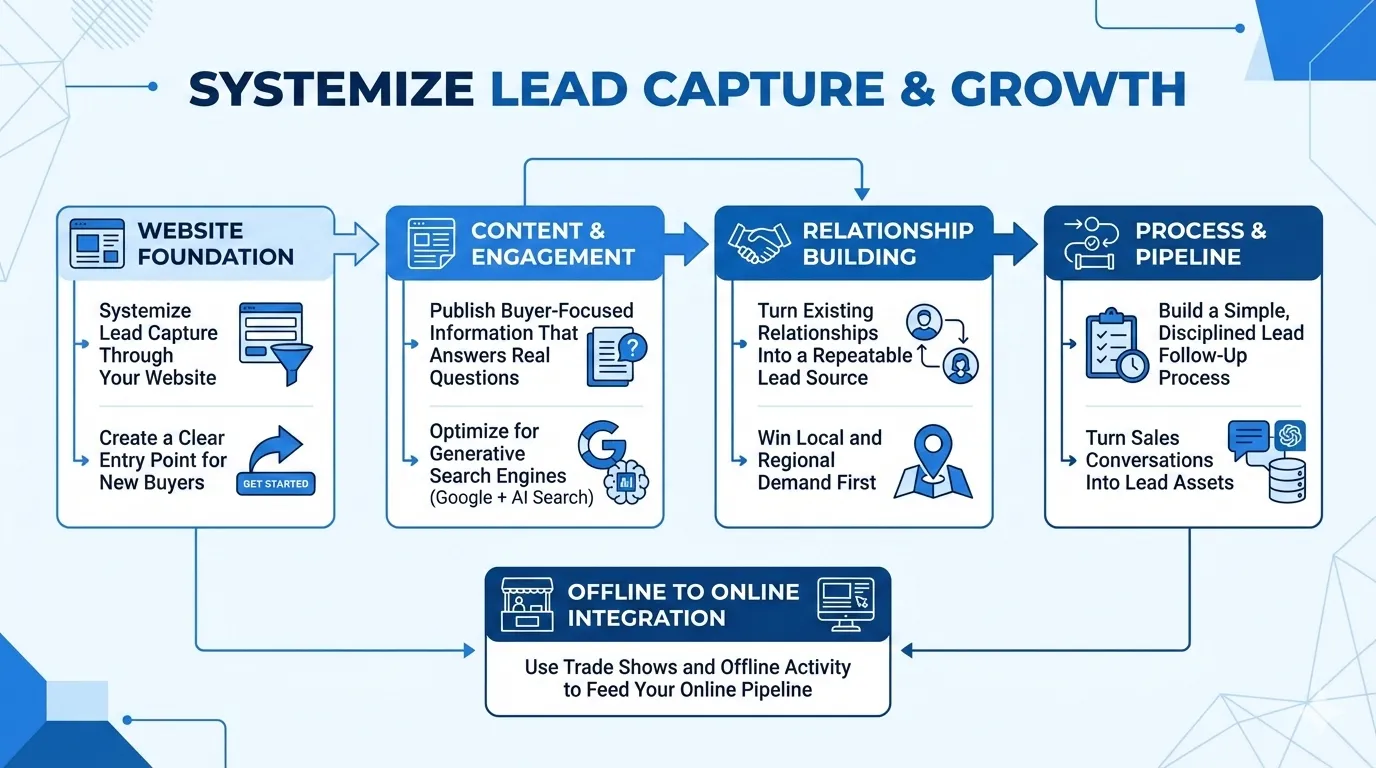
In industrial marketing, 60% of B2B buyers say content influences their purchase decisions. 71% of B2B buyers start the journey with search engines.
These 9 are practical, proven strategies manufacturers can use to create a steady flow of qualified leads without a full marketing team.
Strategy 1: Systemize Lead Capture Through Your Website
Most manufacturers already have a website. The issue isn’t site traffic—it’s that interested buyers don’t know what to do next, or their inquiries get lost.
Your website should act like a front-desk operator:
- It should clearly show what you do
- Tell visitors who it’s for
- And make it obvious how to start a conversation
Here’s how to implement:
- Add one clear action on every important page:
- “Request a Quote”
- “Send Drawing for Review”
- “Talk to an Expert”
- Use a small form fill (name, company, email, requirement). That’s enough.
- Make sure form submissions go directly to the sales inbox or CRM—not a generic mailbox no one checks.
This alone often turns an invisible website into a steady lead source.
Don’t Know How to Manage Leads On Your Website?
That’s understandable. Many manufacturers are pros on the industry floor, but struggle to manage leads. Gushwork’s AI System helps you automate inbound leads directly into your sales inbox with instant notifications.
Get the Proposal Here
Strategy 2: Turn Existing Relationships Into a Repeatable Lead Source
Most manufacturers rely on referrals—but only when they happen naturally. That’s wasted potential.
Instead of waiting for referrals, build a simple process around them, just like you would with suppliers or quality checks.
How to implement (non-technical):
- Identify 5- 10 people who already trust you: long-term customers, dealers or distributors, or vendors and partners
- Create one simple habit: After a successful project or delivery, ask: “Do you know anyone else facing a similar requirement?”
- Track referrals in a basic sheet:
- Who referred
- Who was introduced
- Outcome
This works because manufacturing buying decisions are trust-driven.
Strategy 3: Publish Buyer-Focused Information That Answers Real Questions
Buyers today don’t call first—they research first. If your company isn’t part of that research, you’re invisible. You need clear answers to common buyer questions.
What to create (simple assets):
- A short page or PDF explaining:
- “How to choose the right [product/process].”
- “Common mistakes buyers make.”
- “Specs, tolerances, materials, compliance standards”
- Case summaries: Problem → approach → outcome (in your niche)
How to use it
- Put these on your website
- Share them during sales follow-ups
- Use them when responding to inquiries
This filters out poor-fit leads before sales even get involved.
Read More: Content Marketing For Manufacturers: A Complete Guide
Strategy 4: Build a Simple, Disciplined Lead Follow-Up Process
Many manufacturers lose leads not because demand is low, but because follow-up is inconsistent.
Every lead deserves a process—just like every order or inspection.
How to implement (very practical):
Decide on one rule: Every new inquiry gets a response within 24 hours
Create a basic follow-up sequence:
- Day 0: Call + email
- Day 1: Follow-up email
- Day 5: Final check-in
Track leads in one place: CRM, spreadsheet, or even a shared doc
Assign ownership. One person is responsible for acknowledging the lead, logging it, and closing the loop (win or no-fit)
Discipline here often increases revenue without generating a single new lead.
Strategy 5: Win Local and Regional Demand First
Many manufacturers try to “go broad” too early. In reality, local and regional buyers convert faster and cost less effort.
Make it easy for nearby buyers to find and trust you before you chase national demand.
How to implement (simple):
- Clearly mention: City, state, or industrial region you serve on your website
- Create one page or section like: “Manufacturing Services in [Region/State]”
- Ensure your Google Business profile is claimed, updated with photos, hours, and contact details
Local demand is often the lowest-effort, highest-conversion source that manufacturers ignore.
Strategy 6: Turn Sales Conversations Into Lead Assets
Your sales team already answers the same questions repeatedly. Those answers are lead generation material, even if you never “market” them.
Capture what sales already know and reuse it to attract and qualify buyers.
How to implement (no tech required):
- Ask sales: “What questions do buyers ask before sending drawings?”, “What confuses them the most?”
- Turn those into:
- A one-page FAQ
- A simple checklist
- A short explainer page on your site
- Share these on your website, during follow-ups and inquiries – follow strategy #3
If sales keep explaining it, buyers are searching for it.
Strategy 7: Create a Clear Entry Point for New Buyers
Many manufacturing websites assume buyers already know what to ask for. First-time buyers often don’t—and they leave.
Lower the barrier for someone who’s unsure but interested.
Here’s how to implement:
- Add one low-commitment option:“Not sure what you need? Start here.”
- Offer a short form, or a “describe your requirement” field
- Respond with guidance, not a hard sell
Many good leads don’t look “qualified” on day one.
Strategy 8: Use Trade Shows and Offline Activity to Feed Your Online Pipeline
Trade shows shouldn’t end when the booth comes down. Most manufacturers waste 70–80% of that effort. Use offline events to build ongoing inbound, not just short-term conversations.
How to implement:
- After every trade show, upload a short page: “Met us at [Event Name]?”
- Share capabilities, case examples, and easy contact options
- Follow up with attendees by pointing them to that page
Offline trust + online follow-up = compounding demand.
Strategy 9: Optimize for Generative Search Engines
Manufacturing buyers are now changing how they search.
Earlier, they typed a few words into Google and clicked the top search results and links.
Now, many buyers ask full questions to AI tools like ChatGPT, Gemini, Claude, and other AI search assistants. For example:
- “Who manufactures custom stainless steel enclosures in the US?”
- “Best supplier for low-volume CNC machining for medical devices”
- “Vendors that meet ISO standards for automotive components”
These tools don’t just show links. They recommend companies.
If your website doesn’t clearly explain what you do, who you serve, and where you’re a fit, you simply don’t show up—no matter how good your shop floor is.
About Generative AI and Search
Think of AI search like a very smart researcher. It reads your service pages, product pages, case studies, technical content, FAQs, and industry explanations.
Then it decides: “Which companies should I mention when someone asks this question?”
If your website only has a basic homepage, a vague “Services” page, or a few outdated blogs, AI tools don’t have enough information to trust you.
Big manufacturers win on brand size. Small and medium-sized manufacturers win on clarity and specialization. AI doesn’t care how big you are. It cares whether you clearly explain the above. That means smaller manufacturers can outrank and out-recommend bigger players—if their content is true, impactful, and structured correctly.
Gushwork Supercharges Exactly This
Instead of slowly creating content over 6–12 months, Gushwork's AI system specifically focuses on the manufacturing market to build a comprehensive content system in weeks—optimized for Google, ChatGPT, Gemini, and other AI platforms.
Book a Free Consultation Here
3 Additional Strategies That You Can Use for Manufacturing Lead Generation
If you want to speed things up, add these strategies to your system.
1. SEO (Search Engine Optimization) for Lead Generation
Search engines are where most buyers start their journey today. Even without a marketing team, manufacturers can use SEO to make sure potential customers find them exactly when they need a solution.
By optimizing service and product pages, case studies, buyer guides, FAQs, and technical content to your buyer’s search queries...
…you’re not just increasing site traffic—you’re capturing qualified manufacturer leads that are already looking for your capabilities.
Done right, it feeds directly into your lead generation system and consistently strengthens industrial lead generation, manufacturing leads, and lead generation for manufacturing companies.
Read More: SEO For Manufacturers: A Comprehensive Guide
2. PPC (Pay-per-Click) for Lead Generation
PPC works best after your website and follow-up systems are in place.
Useful for:
- High-intent searches (e.g., “custom [process] manufacturer”)
- Capacity backfill during slow periods
Emphasize small, controlled tests, strict budget caps, and sales-ready keywords only.
SEO has one of the lowest costs per lead among B2B channels and often the best return on investment. In a general B2B benchmark, SEO cost per lead can be as low as ~$30, far below paid channels.
3. Social media for Lead Generation
Social media platforms support trust. It doesn’t replace sales. Focus on LinkedIn and Meta (Facebook) for credibility and visibility when buyers check you out.
You can also be active on YouTube by posting real experiences, industry-floor activities, production videos, etc. This builds trust in your customers over time.
You can also share case work, post once or twice a month, or repost trade show activity. You’re not chasing engagement—you’re reducing friction when buyers evaluate you.
Some of the top SEO agencies for manufacturers are using these exact strategies to improve revenue and growth for many small and medium businesses.
How Lead Generation for Manufacturers Impacts Long-Term Revenue
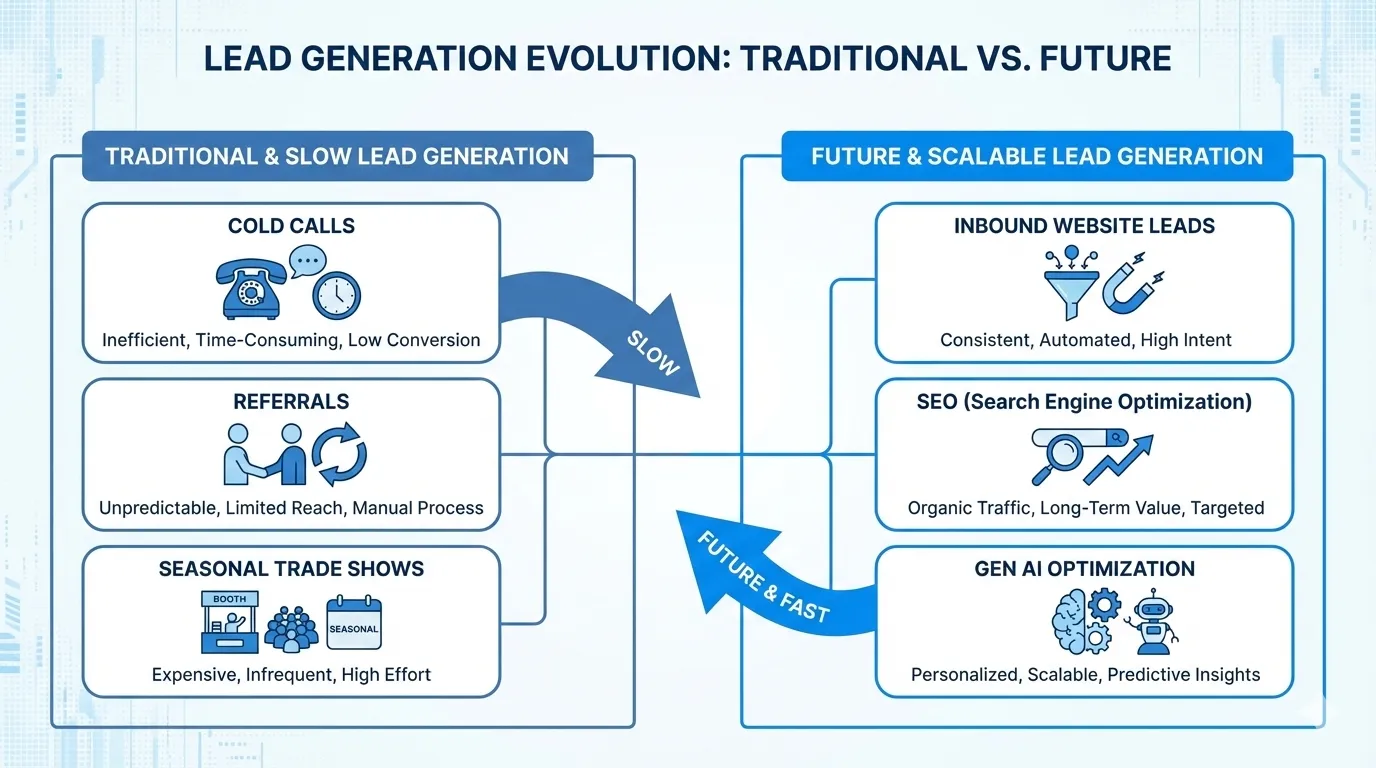
Taken together, the above strategies turn lead generation from a scattered activity into a repeatable system—one that aligns with how manufacturing companies already operate.
Instead of relying solely on cold calls, referrals, or seasonal trade shows, you start building a manufacturing lead generation system that works in the background, consistently.
This approach strengthens website lead generation, improves the quality of inbound inquiries, and ensures manufacturer leads don’t get lost due to slow or inconsistent follow-up. Over time, it creates a clear lead generation system where sales teams know where leads come from, how to handle them, and which ones are worth pursuing.
For small and mid-sized manufacturers, this reduces dependence on expensive lead-generation services or heavy lead-generation marketing services. You’re not chasing volume—you’re building qualified manufacturing sales leads that convert faster and align with your capacity.
The result is more predictable industrial marketing, better visibility into lead generation sales, and a foundation that can scale—whether you manage it in-house or later work with a lead gen company or online lead generation services.
In short, this is lead generation for manufacturers built on process, not random guesswork.
What is the Usual Lead Journey in Industrial Markets?
For industrial companies, lead generation isn’t a one-step event. It’s a progression, similar to how a buyer moves from inquiry to purchase on the shop floor.
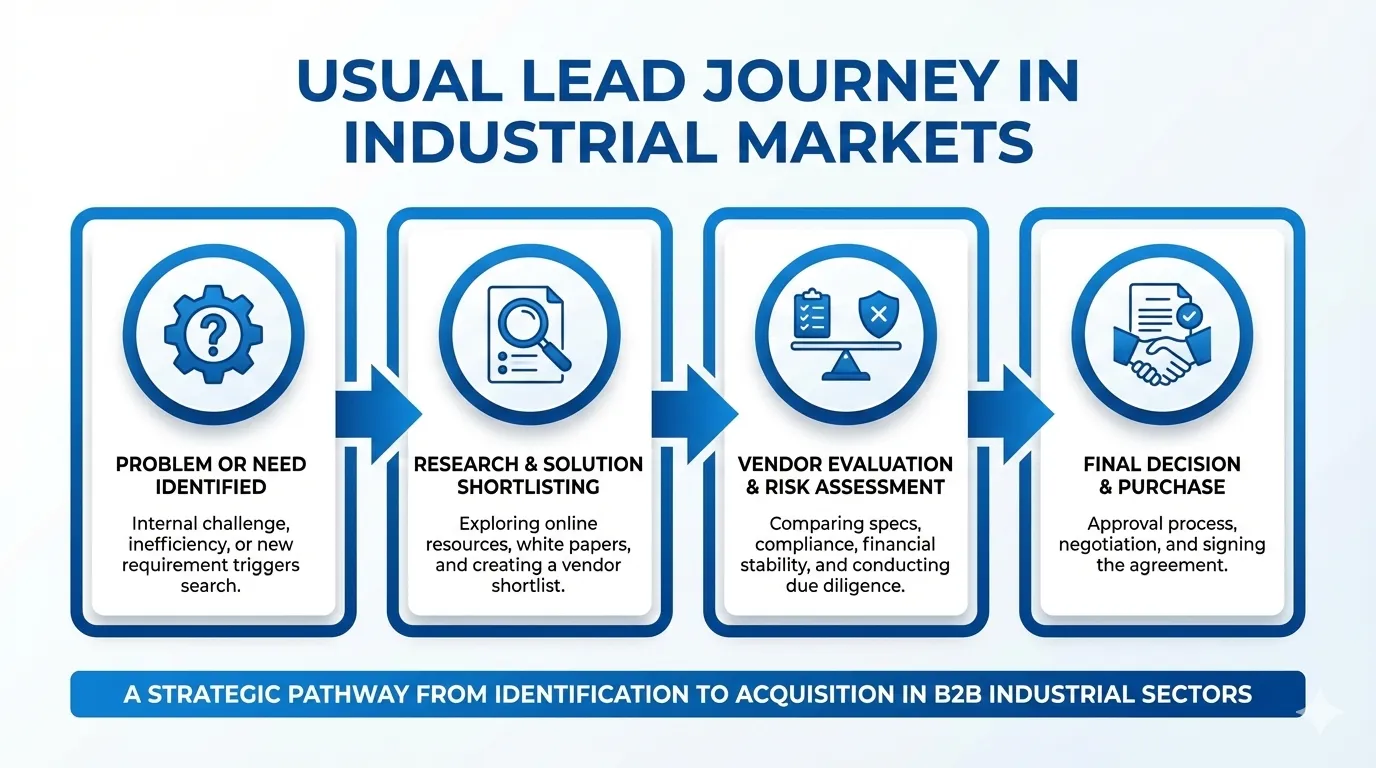
1. When a Problem or Need Comes Up
It starts on the shop floor or in planning. A machine issue, capacity gap, quality concern, or new requirement triggers a search for options. At this stage, buyers are gathering information, not selecting vendors. They’re trying to understand what solutions exist and what’s technically possible.
2. Shortlisting Possible Solutions
Once options are clearer, buyers begin comparing. They look at specifications, materials, tolerances, certifications, applications, and examples of past work. Internal discussions happen between engineering, procurement, and operations to see which vendors fit the requirements.
3. Evaluating Vendors and Risk
Now the focus shifts to trust and reliability. Buyers evaluate suppliers based on experience, references, consistency, delivery timelines, and past performance. Pricing matters, but so does confidence that the job will be done right.
4. Final Decision and Purchase
Only at the end does the purchase decision take shape. Contracts, pricing, timelines, and implementation details are finalized. By this point, the buyer has already done most of their research.
Therefore, manufacturing buyers don’t convert after one interaction. Being visible online early, helpful throughout, and responsive when they’re ready is what turns interest into real opportunities. When lead generation follows this journey, it becomes a process—not guesswork.
Closing Note
Lead generation for manufacturers works best when it’s treated like a system, not a set of disconnected activities. By structuring how leads are captured, qualified, followed up, and nurtured (online and offline), manufacturers can build a predictable pipeline that supports steady growth without relying solely on cold calls, referrals, or seasonal events.
Gushwork helps manufacturers build this system faster by creating a complete, content-led SEO engine that generates qualified leads from Google and AI search platforms. See how it works. Check Out Pricing.
.webp)
Trade Shows
Aug 14, 2025
5 mins
FREE Trade Show Lead Form Template (Word, PDF)
Preksha Bharadwaj
You spent the money, shipped the gear, and stood on the floor answering the same question for three days. You left with a stack of business cards and a CRM full of vague notes. Everyone calls those "leads." Very few become customers.
Why? Because most trade show forms treat attendees like contacts instead of projects. They collect names, emails, and titles. They do not capture whether the person actually needs something now, who signs the checks, or whether a budget exists.
Across the aisle, someone else asked the right questions. They learned the timeline, the decision-maker, and the main constraint. They didn’t waste time chasing curiosity. They found opportunities that could close.
In this blog, we’ll break down what a trade show lead capture form should actually collect, the common mistakes that quietly kill lead quality, and how to build a booth intake form your sales team can follow up on with confidence.

Download Trade Show Lead Form Templates Below
- PDF Print-Ready Versions - Ready for immediate printing
- Google Document Template - Fully customizable for your business
- Word Document Template - Customize, print, use at your next show
This exact form helped a top US manufacturer book 23 qualified meetings from a single 3-day show.
Here’s how you can start.
It’s simple: Print the template on heavy paper, grab a clipboard, and you're ready for your next show. The form is designed to be completed in under 2 minutes while capturing the qualification data you need to prioritize follow-ups.
Pro Tip: Test print one copy before the show to ensure everything is set up correctly. What looks perfect on screen sometimes needs spacing adjustments when people are writing by hand at a busy booth.
But Here's the Problem Most Manufacturers Don't See Coming...
You get the template. You print it. You use it at your next show.
Three months later, you're staring at a stack of completed forms, wondering why only 2 out of 89 leads turned into actual sales conversations.
When you asked, "What's your company size?", your competitors asked, "What's driving you to look at this CNC machine right now?"
Think about your last trade show follow-up call: "Hi Sarah, this is Mike from ABC Manufacturing. We met at the Industrial Expo..."
"Oh, right," she says. "Remind me what you guys do again?"
Now imagine this conversation instead: "Hi Sarah, this is Tom from XYZ Equipment. You mentioned you're evaluating new stamping equipment for your Q2 expansion and need to stay under $200K. I have the ROI analysis you requested..."
Same prospect. Same trade show. Completely different conversation.
The difference isn't in the template design, it's in the questions that separate browsers from buyers.
How to Customize Such Templates for Your Business
First things first.
- Replace the header with your company name and logo.
- Customize the qualification questions for your specific products (machinery, components, services).
- Add your contact information and booth number for easy reference.
- Adjust the follow-up options to match your sales process. Test print on the exact paper you'll use at the show.
Here’s a simple checklist to help you achieve this better:
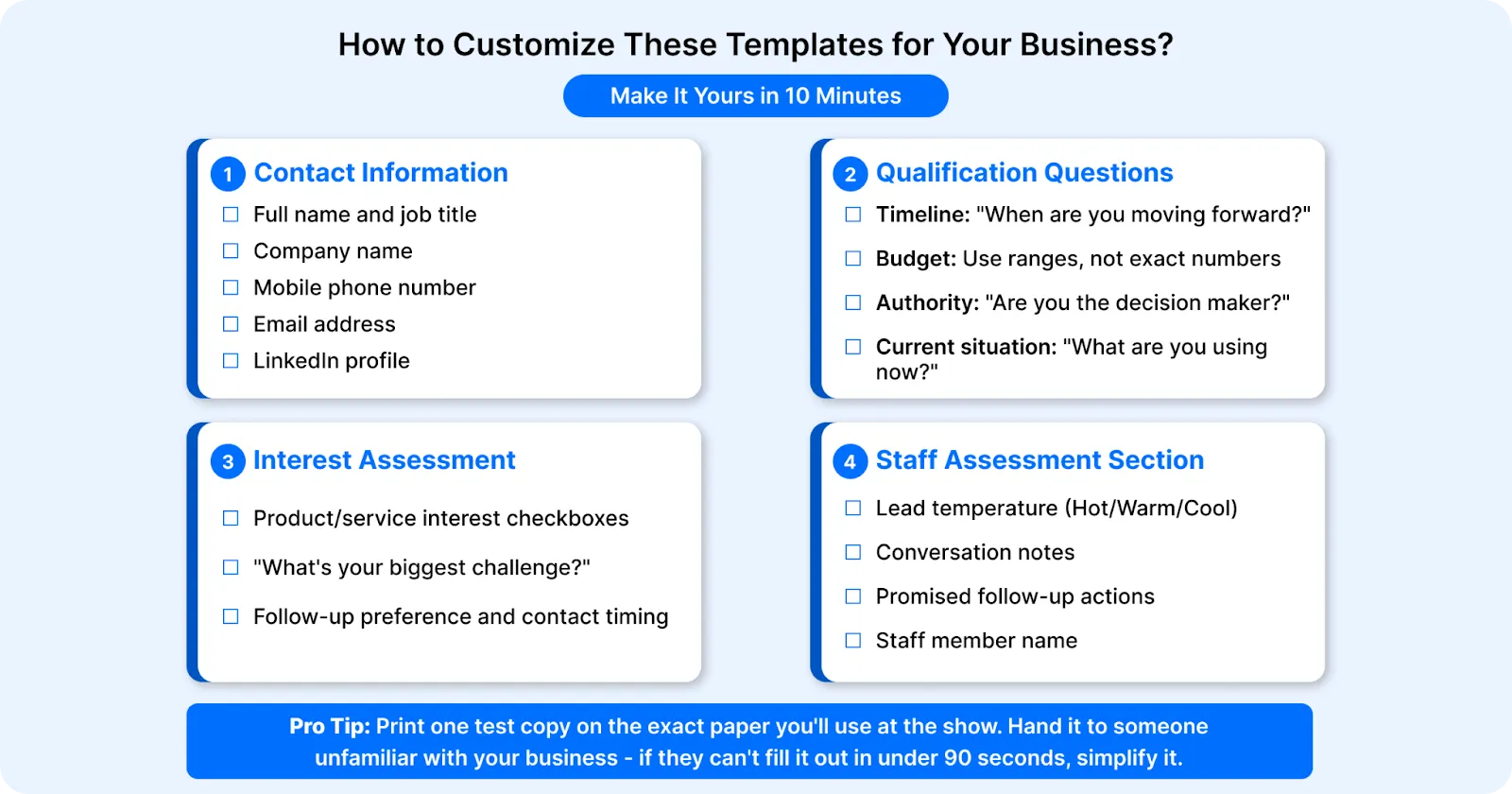
Stop. Before you start printing forms and heading to your next show, there's something critical you need to know.
Having the right fields is only half the battle. The other half? Avoiding the 5 deadly mistakes that turn perfectly good forms into expensive paperwork.
Why Most Trade Show Lead Forms Fail?
Your template covers what to include. You may have customized it to meet your specific needs. Here's what kills lead quality before you even start collecting forms.
Mistake #1: Too Many Fields
Nobody wants to fill out 15+ fields at a busy trade show booth. Qualified prospects walk away while tire-kickers fill out everything with fake information. You're optimizing for data collection instead of buying signals.
Think about it: A plant manager evaluating $500k machine won't spend 10 minutes on your form while competitors are offering quick conversations and immediate answers.
Mistake #2: Questions That Don’t Qualify
"Company size" tells you nothing about buying intent.
"What's driving you to look at new solutions?" tells you if there's a real project with real urgency.
Generic questions attract generic prospects. Specific questions demonstrate expertise and attract serious buyers.
Mistake #3: No Clear Booth Strategy
Your booth team reads the form for the first time when prospects hand it back. They don't know that "0-3 month timeline" plus "decision maker" plus "specific budget range" means a hot lead that needs a call tomorrow.
Forms without staff training become expensive clipboards.
Mistake #4: Same Form for Every Lead
Same form for CEOs evaluating million-dollar systems and maintenance managers researching spare parts. You're either overwhelming small prospects or under-qualifying enterprise buyers.
Mistake #5: No Follow-Up System
Perfect forms followed by terrible follow-up. Leads sit in piles for weeks while competitors follow up within 24 hours. Great forms need great follow-up systems, or you're just taking expensive notes.
The Reality Check: If your current forms aren't generating sales meetings, they're just expensive paperwork.
However, the good news is that every single mistake above is fixable without requiring a redesign of your entire approach. In fact, you can implement these changes before your next show…
How to Fix Your Lead Form Strategy?
You've seen what kills lead quality. Here's how to fix it with changes you can make before your next show.
Fix #1: Ask Questions That Reveal Buying Intent
Stop asking "Budget?" Start asking, "What investment range makes sense for solving this?" Stop asking "Timeline?" Start asking "When would you like to see results?"
Better questions create better conversations and reveal real buying intent. When prospects feel understood rather than interrogated, they give you better information.
Fix #2: Train Your Booth Team to Get Qualified Leads
Your team needs three things: the 30-second pitch for introducing the form, a qualification mindset focused on fit rather than contact collection, and clear follow-up commitments they can make confidently.
Untrained staff turn great forms into wasted opportunities. Every person working your booth should know the difference between hot, warm, and cold leads before the show starts.
Fix #3: Tag Leads on the Spot
A-Leads get phone calls within 24 hours. B-Leads get valuable information and follow-up within a week. C-Leads enter educational nurture sequences.
Without categories, every lead gets the same mediocre treatment. With categories, your hottest prospects get the attention that closes deals.
Fix #4: Set Follow-Up Rules Before the Event
Know exactly what happens to each lead type before you collect the first form. A-Leads need immediate personal outreach with specific solutions. B-Leads need value-based follow-up that moves conversations forward. C-Leads need educational content that keeps you top-of-mind for months.
Fix #5: Follow Up Within 48 Hours
Every lead should know exactly what happens next before they leave your booth, and you must deliver on that promise within 48 hours.
Here's what this sounds like: "Mike, based on your Q2 expansion timeline, I'm sending you three equipment configurations by Wednesday morning. You'll have them before your budget meeting on Friday."
Not: "We'll be in touch soon about this..." or "Someone from my team will follow up with you on your requirements..."
The 48-hour commitment accomplishes two things: it sets clear expectations that differentiate you from competitors who make vague promises, and it forces you to have follow-up systems ready before the show starts.
Remember, speed kills your competition. While you're deciding what to do with leads, your competitors are already having follow-up conversations.
This Is Where Trade Show Leads Get Won.
Most manufacturers spend $$ on trade shows, then use forms that collect contacts instead of customers. You now have the templates and those contract-sealing strategies that separate serious exhibitors from those who are just collecting business cards.
Trade show forms need landing pages that convert, email sequences that nurture, and follow-up content that closes deals.
That's where manufacturers get stuck.
Gushwork helps manufacturers (distributors or suppliers) create complete content systems. From common trade show questions answered through blogs to email templates or service/product pages that turn booth conversations into closed deals.
Your next trade show should generate a pipeline of leads, not just activity.
If you want to know how other manufacturers are finding leads around the year, Schedule a Call here!

Trade Shows
Aug 14, 2025
5 mins
Why Trade Show Leads Die After Events and What You Can Do to Fix It
Preksha Bharadwaj
Your best prospect from Tuesday's trade show just signed with your competitor.
While you were back at the office catching up on emails, planning to "follow up next week," your competitor called on Wednesday morning. By Thursday, they had a demo scheduled. By Friday, they were discussing implementation timelines.
Same product category. Similar pricing. Your booth was even busier than theirs.
So what happened?
You lost the 48-hour window. And in manufacturing sales, that window is everything.
The numbers don't lie: Leads contacted within 24 hours are 7x more likely to convert. Wait 48 hours, and that drops to 3x. Wait a week? You're fighting for scraps.

Key Takeaways:
- Complete 48-Hour Action Plan: Exact timeline showing what to do in each phase, from lead scoring in the first 6 hours to final recovery strategies at 48 hours.
- Lead Qualification System That Works: Learn to separate real buyers from tire-kickers in 45 minutes using conversation intelligence. Stop wasting time on prospects who were just collecting free swag.
- The SPARK Framework for Systematic Follow-Up: 5-step methodology that works for trade shows, cold outreach, and referrals. Scale your follow-up process across your entire sales team with consistent, high-converting approaches.
- Why Smart Manufacturers Fail (And How to Avoid It): Real breakdown of the system failures that kill good leads, plus recovery strategies for non-responders. Turn your trade show investment into predictable meetings instead of forgotten business cards.
Bonus: Get proven email templates you can copy-paste immediately.
Before You Begin, Here’s The Timeline Focus
What really happens while you're "planning to follow up" matters a lot to manufacturers (distributors or suppliers) who attend trade shows:
Hour 6: Your hot prospect mentions your conversation to their plant manager: "Met an interesting supplier at the show. Might solve our downtime issue."
Hour 24: Your competitor calls with a specific follow-up: "You mentioned losing 4 hours weekly to system crashes. Here's exactly how we'd fix that."
Hour 48: Your prospect thinks: "ABC Manufacturing seemed nice, but XYZ actually listened to our problem and has a plan."
Hour 72: You finally send your follow-up email. It goes to someone who's already mentally moved on.
The brutal truth: You're not losing deals because your solution isn't good enough. You're losing them because your timing isn't fast enough.
But here's how to flip that script:
Hours 1-6: Your First Move While Conversations Are Still Fresh
At this point, you have a narrow window when prospects remember your face, your demo, and the specific problem they shared with you. Use it or lose it.
Follow these steps to capture lead quality while the conversation is still fresh in both your memory and theirs…
Step 1: Brain Dump Everything (30 minutes)
Before you forget, capture what actually happened at each conversation:
- What specific challenge did they mention?
- What was their timeline?
- Who else is involved in their decision?
- What got them excited during your demo?
- What objection did they raise?
Don't trust your memory. Write it down now while you can still picture their face.
Pro Tip: If you have a team member who can write down notes when you speak with every prospect, that would be more helpful and detailed.
Step 2: Score Your Leads Based on Real Conversations
Stop treating all leads equally. Use this simple scoring system. Use 45 minutes of your time after the trade show to segregate:
Hot Leads (Contact in 2 hours):
- Named a specific project starting in 90 days
- Mentioned current costs or problems
- Asked about pricing or implementation
- Wanted to introduce you to their team
Warm Leads (Contact within 24 hours):
- Expressed interest, but no timeline
- Asked good questions about your solution
- Took detailed notes or photos
- Requested more information
Cold Leads (Nurture sequence):
- Just browsing or collecting information
- No specific need or timeline
- Vague responses to qualifying questions
- Focused mainly on free swag
This system needs to be set to ensure your hot prospects receive immediate attention, while nothing falls through the cracks.
Step 3: Set Up Your Follow-Up System (2 hours)
Create three email templates based on conversation type:
- Problem-focused (for prospects who shared specific challenges)
- Solution-focused (for prospects interested in your demo)
- Information-focused (for prospects requesting materials)
Schedule your first round of outreach for hours 6-12. Set calendar reminders for the second and third touches.
Instead of: "Interested in your manufacturing software",
Capture phrases like:
- The current ERP system crashes twice weekly, costing 4 hours of downtime
- Looking to replace by Q2
- Budget approved
- The decision team includes the plant manager and IT director
By hour 6, you should have your leads scored with these many details, your follow-up system ready, and your first messages scheduled.
Hours 6-24: Now That You've Sorted Your Leads, Here's How to Reach Out
At this stage, your hot leads are already getting contacted by 5-10 other vendors.
The difference between getting a response and getting ignored comes down to one thing: making your follow-up feel like a continuation of your booth conversation, not a generic sales pitch.
Every effective follow-up has three elements:
- Specific callback to something they said
- Value connection to their stated problem
- Clear next step that moves the conversation forward
Instead of: "Thanks for stopping by our booth at [Trade Show]. I'd love to schedule a call to discuss how we can help your business."
Try this: "Hi Sarah, you mentioned your current system crashes twice weekly and costs 4 hours of downtime each time. Based on what you shared about your Q2 timeline, I put together a quick analysis of how similar manufacturers solved this exact problem. Worth a 15-minute call Thursday?"
Here’s What Else You Can Do With Your Hot Lead Outreach
Send this email to them within 12 hours:
Why this works: It proves you listened, references their specific situation, and asks for a concrete next step.
For Those Warm Lead Approach (Hours 12-24)
For interested prospects without urgent timelines, send this:
Why this works: It delivers promised value while positioning a peer success story that makes your solution feel proven and low-risk.
The difference between a response and radio silence comes down to your opening line. Stop leading with your company.
Start with their problem. Try these follow-ups:
- Don't write: "ABC Manufacturing provides innovative solutions..."
Write: "That downtime issue you mentioned costs most plants $50K annually..." - Don't write: "I wanted to follow up on our conversation..."
Write: "You asked about ROI timelines for [specific solution]..." - Don't write: "Let me know if you have any questions."
Write: "Are you free Thursday at 2 PM or Friday at 10 AM?"
Sometimes, even the best message structure falls flat if it sounds mass-produced. Try using templates without sounding like you're using templates.
The secret isn't avoiding them - it's about customizing the right way for your needs.
Keep your structure consistent, but personalize these elements:
- Opening reference: "You mentioned your ERP system crashes twice weekly."
- Problem statement: "Costing 4 hours of downtime each time"
- Value proposition: "Similar plants reduced crashes by 90% in 60 days."
- Call to action: "Free Thursday at 2 PM for a 15-minute call?"
By hour 24, your hot prospects should have heard from you twice: once with a direct follow-up, and once with additional value.
Your warm prospects should have one personalized message in their inbox that references your actual conversation.
While your competitors are still drafting their first "thanks for visiting our booth" email, you're already scheduling demos. And the best part is, some of them are already responding to you. Now you need to capitalize on that interest before it cools off.
Hours 24-36: They Responded - Here's How to Keep the Momentum Going
A response is not a win - it's an opportunity.
How you handle the next 12 hours determines whether that "thanks for reaching out" email turns into a calendar invite or fades into another round of email tag.
Your goal isn't just to keep the conversation going; it's to engage with their pain points. It's to schedule something while the trade show energy is still fresh in their minds.
The fastest way to kill momentum is by failing to deliver on what you promised at the booth. Here's how to follow through immediately.
Follow Through on Every Booth Promise
Remember what you committed to during your booth conversation. Now deliver it, fast. If you promised:
- A case study → Send it with a 2-sentence summary of why it's relevant to their situation
- An ROI calculator → Include their rough numbers and invite them to refine it on a call
- An introduction → Make the connection within 24 hours with context about their specific need
- A demo → Offer 3 specific time slots within the next week
When they reply to your follow-up, don't just acknowledge it; instead, respond thoughtfully and thoroughly. Use their response to push for a meeting while the momentum is high.
- If they say: "Thanks for the case study. Interesting approach."
You reply: "Glad it was helpful. The company in that case study had the same timeline pressures you mentioned. Want to see how they implemented it? I have 20 minutes Thursday afternoon or Friday morning." - If they say, "Can you send me more information about pricing?"
You reply: "Absolutely. Pricing depends on your specific setup, which we discussed briefly at the booth. Let's spend 15 minutes going through your requirements so I can give you accurate numbers. Are you free tomorrow at 2 PM?" - If they say, "I need to discuss this with my team first."
You reply: "Perfect - that's exactly what [similar company] did. I can join that conversation to answer any technical questions you may have. When's your team meeting?"
If they haven't committed to a meeting yet, send one additional piece of value:
- Industry benchmark data related to their challenge
- A short video explanation of the solution you demonstrated
- A one-page ROI breakdown using numbers from your booth conversation
Remember: Stop asking "when works for you" - it creates decision fatigue. Instead, offer specific options tied to their stated urgency.
By hour 36, every prospect who responded should either have a meeting scheduled or have received additional value that moves the conversation forward.
The key is maintaining urgency without being pushy - you're simply matching their expressed timeline with appropriate next steps.
But what about the prospects who haven't responded yet?
Don't write them off. Some of your best deals come from this final phase.
Hours 36-48: What to Do When Someone Hasn't Responded Yet
Remember: In manufacturing, decision-makers juggle production schedules, address supply chain issues, and manage equipment breakdowns.
Your follow-up might be sitting in an inbox behind three plant emergencies and a vendor crisis.
Re-engaging these prospects who've gone quiet without seeming desperate or annoying is challenging. Understand these:
- Committee dynamics: They're waiting for the next leadership meeting to discuss
- Budget timing: Fiscal year considerations that weren't mentioned at the booth
- Information overload: They're sorting through 15 other vendor follow-ups
- Authority gaps: They need approval before engaging further
- Plant floor urgency: A machine breakdown takes priority over your email
The key insight here is that most of these non-responses aren't rejections - they're delays. When email doesn't work, try these manufacturing-specific approaches:
1. The Production Impact Angle
"Hi [Name], I know you're dealing with [their mentioned challenge]. Just saw a report that similar production delays are costing manufacturers 15% more this quarter. Worth a quick call to see if we can help you avoid that hit?"
2. The Peer Reference Approach
"Hi [Name], I just helped [similar manufacturer] solve the exact same [problem] you mentioned at [Trade Show]. They went from [before state] to [after state] in 90 days. Want to see their approach?"
3. The Industry Insight Hook
"Hi [Name], new regulations are hitting [their industry sector] hard. Based on what you shared about your compliance challenges, this might affect your timeline. Worth a 10-minute call?"
If none of these approaches gets a response, it's time for your final play. These last-chance strategies acknowledge the silence while giving prospects one compelling reason to re-engage.
Last-Chance Strategies That Convert
Your final outreach should acknowledge the delay while creating new urgency:
- The Assumption Close "Hi [Name], haven't heard back, so I'm assuming this project got pushed to next quarter. If that timeline changes and you need to move faster, I'm keeping [specific solution] available for the next two weeks."
- The Alternative Decision Maker "Hi [Name], since you mentioned [other person] handles [specific area], should I reach out to them directly about the [solution] we discussed?"
- The Break-Up Email That Brings Them Back "Hi [Name], I know you're swamped with plant operations. I'll stop following up after this, but wanted to share one quick thing: [specific recent industry development] might accelerate your [project] timeline. If so, I'm here."
- The LinkedIn Pivot. If email isn't working, try LinkedIn with this approach: "Hi [Name], saw your recent post about [industry challenge]. Reminded me of our conversation at [Trade Show] about [their specific problem]. Still working on solving that?"
You're not trying to close these deals in 48 hours - you're trying to stay top-of-mind when they're ready to move forward.
Even if they don't respond during your 48-hour window, you've established yourself as the vendor who follows through, references actual conversations, and understands their industry challenges.
That positioning pays off when their project timeline accelerates or their current solution fails to meet expectations.
Knowing their timeline is only half the battle. The manufacturers who consistently convert trade show leads into deals don't just follow a schedule - they follow a system.
Now You Have the Timeline - Here's the Framework That Makes It All Work
"A good system shortens the road to the goal." - Orison Swett Marden
Random follow-up gets random results. Systematic follow-up gets predictable revenue.

Every successful trade show follow-up follows the same pattern, which is the SPARK Method.
Master this framework and you'll never wonder what to say or when to repeat it.
The SPARK Follow-Up System
S - Segment by Buying Intent: Your booth attracted three types:
- Buyers: Budget + timeline + authority → Immediate attention, direct meeting asks
- Researchers: Gathering info for future → Educational content, weekly nurture
- Browsers: No immediate need → Quarterly newsletters
Keep in mind: Most manufacturers fail because they treat researchers like buyers.
P - Personalize Every Message. Reference their specific:
- The problem they shared
- Timeline they mentioned
- Solution that interested them
- Role in decision-making
Generic emails are dead. Prove you listened.
A - Act on Their Timeline
- "Need this by Q1" → Daily follow-up until meeting scheduled
- "Looking for next year" → Weekly industry insights
- "Just exploring" → Monthly educational content
Match their urgency or lose credibility.
R - Reference Industry Challenges: Show you understand manufacturing by mentioning:
- Regulations affecting their timeline
- Supply chain challenges
- Production cycles driving urgency
- Compliance requirements
This separates you from generic tech vendors.
K - Keep Strategic Momentum Five touchpoints that build value:
- Reference booth conversation + deliver promises
- Share industry insight for their challenge
- Send a case study of a similar manufacturer
- Invite to plant visit based on timeline
- Introduce a technical specialist for details
Each touch should advance toward a meeting, rather than merely maintaining contact.
Why This Systematic Approach Beats Random Follow-Up
Most manufacturers wing their trade show follow-up. They send whatever feels right, whenever they remember. This creates three problems:
Problem 1: Inconsistent messaging that confuses prospects about your value proposition.
Problem 2: Poor timing that misses peak interest windows or overwhelms busy decision-makers.
Problem 3: No clear progression from initial contact to scheduled meeting to closed deal.
The SPARK Method fixes all three. It gives you a repeatable process that works regardless of trade show size, industry focus, or lead volume. More importantly, it scales. Train your entire team on SPARK, and everyone follows the same high-converting approach.
Once You Master the 48-Hour Window, Here's What Changes
The 48-hour framework is about developing a systematic mindset that transforms how you approach every aspect of manufacturing sales.
Beyond Follow-Up: Building Your Sales Pipeline
When you master systematic follow-up, you develop an eye for creating urgency and maintaining momentum throughout your entire sales process:
- Cold outreach: Instead of generic prospecting emails, you research specific operational challenges and reference industry trends affecting their timeline.
- Referral follow-up: You immediately capitalize on warm introductions while the referrer's recommendation is fresh in the prospect's mind.
- Quote follow-up: You don't just send proposals and wait. You create systematic touchpoints that address specific concerns and maintain buying momentum.
This systematic thinking transforms how you design marketing campaigns, structure sales processes, and measure results across your entire revenue engine.
Honestly? You Could Do All This Yourself, But...
Look, you can build all these systems yourself, spend months creating templates, content, and testing sequences.
Or you can focus on running your manufacturing business while we handle the systematic follow-up infrastructure.
Gushwork creates traffic to your trade show through website content, executes cold outreaches through blogs, service pages, and landing pages, and drives more leads through Google Ads that automatically turn prospects into revenue.
If you want to know how the top Manufacturers in the US did it, schedule a Call here!
Frequently Asked Questions (FAQs)
1. How quickly should I follow up after a trade show?
Within 6 hours for hot leads, 24 hours maximum for everyone else. Studies show leads contacted within 24 hours are 7x more likely to convert. Your competitors are probably waiting until "next week" - that's your advantage. Use the first 6 hours to sort leads by buying intent while conversations are fresh, then start personalized outreach immediately.
2. What's the biggest mistake manufacturers make with trade show follow-up?
Treating all leads equally with generic "thanks for visiting our booth" emails. Hot prospects with budgets and timelines get the same treatment as tire-kickers collecting swag. Smart manufacturers segment immediately: buyers get direct meeting requests, researchers get educational content, and browsers get quarterly newsletters. This targeted approach dramatically improves conversion rates.
3. How do I make my follow-up emails stand out from competitors?
Reference specific problems they mentioned at your booth, not generic booth visits. Instead of "Great meeting you at the trade show," try "You mentioned your system crashes twice weekly - here's how similar manufacturers solved that exact problem." Prove you listened by using their exact words and timeline urgency.
4. What if prospects don't respond to my initial follow-up?
Non-response doesn't mean disinterest - manufacturing decision-makers juggle production crises and supply chain issues. Try alternative approaches: industry insights related to their challenges, peer references from similar manufacturers, or LinkedIn messages referencing their recent posts. Most "dead" leads just need different timing or channels.
5. How many times should I follow up before giving up?
Don't think in terms of "giving up" - think in terms of nurture sequences. Hot leads get daily follow-up until meetings are scheduled. Warm leads get weekly touchpoints with industry insights. Cold leads get monthly educational content. Each follow-up should add value, not just ask for meetings. Persistence with purpose wins.
Trade Shows
Aug 14, 2025
5 mins
Want 3x More Prospects at Your Next USA Trade Show? Start With These Tools
Preksha Bharadwaj
You just spent three days at your industry's biggest trade show. Your booth looked professional. Your team was knowledgeable. You collected 47 business cards from "interested prospects."
Two months later? Zero closed deals.
Meanwhile, your competitor in the next aisle, with the same budget and target market, is already quoting three major projects from the same event.
Here's what the numbers don't tell you: Trade shows cost manufacturers $811 per lead (the highest of any marketing channel), yet only 1 in 17 exhibitors convert those expensive leads into actual contracts.
So why are 93% of trade show attendees saying these events are major factors in their purchasing decisions, while most manufacturers walk away empty-handed?

The answer isn't in your booth design or your product quality. It's in how you capture and convert those conversations with new tools and techniques.
Think about what really happened at your last show:
You collected business cards from 47 people who seemed interested. Your competitor captured detailed information from 20 qualified prospects, including their budget ranges, project timelines, and decision-making processes.
You spent the next week manually entering contact details into spreadsheets. They had leads flowing directly into their CRM (sales system) with personalized follow-up emails triggering automatically.
You sent generic "nice to know about your plan to buy the XYZ machine" messages two weeks later. They were calling hot prospects within 24 hours with specific solutions to the problems discussed at the booth.
Here’s what you should know about the real difference between lead capture and lead retrieval:
Lead capture = collecting 200 business cards that sit in a drawer
Lead retrieval = identifying 20 qualified prospects with $100K+ budgets ready to buy within 90 days
The gap isn't luck or bigger marketing budgets. It's having tools that turn booth conversations into qualified sales opportunities instead of hoping prospects will remember you weeks later.
But with numerous lead retrieval tools in the market claiming to solve your lead problems, which ones actually deliver results for manufacturers dealing with complex sales cycles and technical decision-makers?
At a Glance:
Top 20 tools for automating lead retrieval at manufacturing trade shows
- iCapture
- Captello
- Cvent LeadCapture
- Whova
- HubSpot Business Card Scanner
- Accelevents
- EventMobi
- Eventdex
- Grip
- vFairs
- Swapcard
- Bizzabo
- Momencio
- Webex Events (formerly Socio)
- Cvent Event Cloud
- atEvent
- Leadature
- Zuddl
- fielddrive Leads
- 6Connex
Shortlist: 5 Tools You Should Definitely Consider at Industrial Trade Shows
The G2 rankings, user reviews, and real manufacturing results for these 5 tools have consistently outperformed the competition.
These are the systems actually being used by manufacturers who consistently walk away from trade shows with qualified prospects (say 20 meetings scheduled in 3 days) instead of business card collections.
#01: iCapture

The problem you're solving: Your team collects leads perfectly, then spends three days manually entering them into spreadsheets while competitors are already calling those same prospects.
Remember the last show where you collected 50 business cards, then spent half a week typing contact information into your CRM? By the time you finally called those prospects, your competitor had already sent personalized proposals and scheduled follow-up meetings.
iCapture eliminates that deadly delay. When someone hands you their business card or you scan their badge, their information flows directly into your sales system within minutes. Your automated follow-up sequences trigger immediately while the conversation is still fresh in their mind.
What this means for your next deal: Instead of calling prospects a week later who barely remember your conversation, you're sending personalized emails within hours that reference exactly what you discussed. Your sales team gets task reminders to call hot prospects the next morning, not next Monday.
Why manufacturers choose this over manual entry: Your leads never sit in limbo. No more "I'll enter these leads when I get back to the office" promises that turn into lost opportunities.
#02: Captello

The problem you're solving: Industrial equipment isn't exactly eye-catching, and qualified prospects walk past your booth without engaging.
Let's be honest—your CNC machine or industrial valve display doesn't naturally draw crowds like a smartphone demo. While you're standing behind your table hoping someone will notice your technical specifications, qualified prospects are walking past because nothing signals them to stop.
Captello's interactive experiences create that initial "what's this?" moment that gets engineers and plant managers curious enough to engage. Once they're at your booth playing an industry-relevant game or taking a quick quiz, you can transition into real business conversations about their actual challenges.
What this means for your next deal: Instead of waiting for prospects to find you, you're actively drawing them in. The ice is already broken when you start discussing their production bottlenecks or equipment needs.
Why manufacturers choose this over hoping for foot traffic: You control who stops at your booth instead of relying on chance encounters with people who might not even be qualified buyers.
#03: Cvent LeadCapture

The problem you're solving: You're spending valuable time on prospects who will never buy while missing the ones with real budgets and decision-making authority.
Manufacturing sales involve multiple stakeholders—engineers who evaluate technical specs, procurement teams who negotiate contracts, and finance executives who approve budgets. At trade shows, you meet all three types, but they don't wear name tags identifying their role or buying authority.
Cvent's real-time qualification system helps you identify who actually has budget authority and timeline urgency during your booth conversations. Their 1-5 rating system lets you instantly separate hot prospects from information gatherers.
What this means for your next deal: You can immediately prioritize the plant manager with a confirmed $200K budget and 90-day timeline over the engineer who's "just looking at options for maybe next year." Your follow-up focuses on prospects who can actually make purchasing decisions.
Why manufacturers choose this over treating all leads equally: Your sales team knows exactly who to call first, and you don't waste follow-up efforts on prospects who were never going to buy.
#04: Whova

The problem you're solving: You're missing prospects who engage with you virtually, attend your presentations, or visit your booth at different times during multi-day events.
Modern trade shows aren't just about booth visits anymore. Prospects might attend your virtual demonstration, join your technical presentation, download your case study, and then visit your physical booth—all as separate interactions that need to be tracked and connected.
Whova captures leads regardless of how prospects engage with you. Whether they visit your physical booth, join your virtual presentation, or participate in your live Q&A session, every interaction gets recorded and qualified consistently.
What this means for your next deal: You have a complete picture of each prospect's interest level and engagement history. When someone visits your booth after attending your technical presentation, you know exactly what they've already learned and can continue the conversation from there.
Why manufacturers choose this over single-channel tracking: You don't lose prospects who engage through multiple touchpoints, and you can see which combination of interactions indicates serious buying intent.
#05: HubSpot Business Card Scanner

The problem you're solving: You want to test whether systematic lead capture actually improves your trade show results, but you're not ready to invest in expensive software before seeing proof.
Maybe you've been manually collecting business cards for years and you're skeptical that technology will actually improve your results. Or maybe your trade show budget is tight and you need to prove ROI before investing in premium tools.
HubSpot's scanner uses machine learning to turn business cards into CRM contacts in seconds, and it gets smarter with every scan. You can test the entire lead capture concept without any upfront investment or ongoing fees.
What this means for your next deal: You can compare your results from systematic lead capture versus your old manual methods using real data from the same types of events and prospects.
Why manufacturers start here: Zero financial risk to discover whether organized lead capture actually translates to more closed deals. Perfect for testing the concept before scaling up to more advanced systems.
15 Additional Tools for Specific Challenges: When You Need More Than the Basic Five
Once you've mastered systematic lead capture with one of the core five tools, these additional systems address specific manufacturing challenges that the basics don't handle.
#6 Accelevents: When you're running multiple booth staff across several trade shows simultaneously, you need unlimited user access without per-person fees. Perfect for manufacturers who exhibit at 10+ events annually with different team members.
#7 EventMobi: Scored 4.7/5 for ease of use, which means your booth staff can focus on technical conversations instead of figuring out complicated software. Ideal when you're training new team members or using temporary trade show staff.
#8 Eventdex: If you're already using Salesforce for your entire sales process, this integrates seamlessly without disrupting your existing lead scoring rules or territory assignments.
#9 Grip: Uses AI to analyze attendee behavior and identify high-value prospects before you even talk to them. Valuable at massive technical conferences where finding the right contacts among thousands of attendees is like finding needles in a haystack.
#10 Swapcard: AI connects your booth staff with attendees who've actually expressed interest in your specific capabilities, eliminating time wasted on unqualified conversations.
#11 Momencio: Specializes in 6-12 month capital equipment sales cycles with AI-powered lead enrichment that automatically pulls company data and buying signals for long-term nurturing.
#12 vFairs: Creates 3D virtual showrooms for equipment too large or expensive to ship internationally. Perfect for showcasing complex industrial machinery without logistics nightmares.
#13 Webex Events: Provides hardware rental services that eliminate the hassle of shipping badge scanners and check-in equipment to international trade shows.
#14 6Connex: Comprehensive virtual event platform for large-scale product launches and virtual trade shows with immersive environments for complex equipment demonstrations.
#15 atEvent: Compliance tools ensure lead handling meets industry standards for aerospace, medical devices, or defense contractors with security clearance requirements.
#16 Cvent Event Cloud: Complete lifecycle management for dedicated trade show managers handling 10+ events annually across different regions.
#17 Leadature: Multi-method capture that works at any event regardless of organizer technology, plus immediate literature delivery while prospects are still evaluating at your booth.
#18 Zuddl: Creates unified experiences that maintain relationship continuity when prospects attend virtual webinars before visiting physical booths, with real-time sync to prevent duplicate outreach across channels.
#19 fielddrive Leads: Mobile-first design delivers 70% faster lead response times, working seamlessly on tablets and phones that booth staff actually carry around during busy show periods.
#20 Bizzabo: Enterprise platform with smart badges that provide deeper engagement data than basic QR codes, ideal for complex booth setups and multiple product lines at major industry events.
Are "Tools" All That You Really Need to Capture Leads?
Now, with 20 solid options laid out, you might be wondering which one will finally solve your trade show lead problems. However, before you begin comparing pricing plans and integration features, there's an important point to consider.
We've analyzed hundreds of trade show campaigns, and here's what we discovered: The manufacturers who consistently outperform their competitors don't necessarily pick the "best" tool on paper. They pick tools that excel at the specific functions that turn booth conversations into closed deals.
The difference between success and disappointment isn't in the software features; it's in understanding what actually converts prospects into customers.
6 Must-Have Features Your Lead Capture System Needs to Convert
Every successful lead capture system, whether it costs $0 or $10,000, must excel at these six fundamental capabilities. Get these right, and even basic tools deliver results.
Miss any one of them, and even the most expensive software will fail you.

First, your leads must reach your sales team instantly. If you're manually entering contact information days after the show, your competitors are already calling those same prospects. Your system needs to push leads directly into your CRM the moment you capture them, not when you remember to sync the data.
Second, your system must work when the convention center WiFi fails. This isn't optional—it's survival. Networks crash during peak hours when your most qualified prospects are visiting booths. Your tool must capture everything offline and sync automatically when the connection returns.
Third, you need to qualify prospects during the conversation, not later. Generic contact capture won't cut it for complex manufacturing sales. You must identify budget ranges, project timelines, decision-makers, and technical requirements while you're talking to them.
Fourth, your system must help you prioritize follow-up. Not all leads are equal in manufacturing. You need to know immediately which prospects deserve phone calls within 24 hours versus which ones enter long-term nurturing campaigns.
Fifth, automated follow-up must trigger without your intervention. The 48-hour window is critical for trade show leads. Your system should send personalized emails and create task reminders for your sales team automatically, not when someone remembers to do it.
Sixth, you need analytics that actually improve your results. You must know which booth conversations convert to sales, what qualification questions predict success, and how each show compares to previous events.
Here's What Might Surprise You About Choosing Tools
Most successful manufacturers don't pick just one "perfect" solution. They combine tools strategically based on their specific challenges.
You might use HubSpot's free scanner for smaller regional shows while deploying iCapture for major industry exhibitions. Or pair Captello's engagement tactics with Cvent's qualification system to accurately score prospects who visit your booth.
The key isn't finding the one tool that does everything. It's starting with one core system that handles your biggest challenge, then adding specialized tools as your trade show program grows and matures.
But here's what we've learned from manufacturers who've tried every tool on this list...
Use HubSpot's free scanner for smaller regional shows while deploying iCapture for major industry exhibitions. Or pair Captello's engagement tactics for booth attraction with Cvent's qualification capabilities for lead scoring.
The key is starting with one core system that handles your primary challenge, then adding specialized tools as your trade show program matures.
Will Better Lead Capture Actually Fix Your Trade Show Problems?
The answer might surprise you.
We've tracked manufacturers who've implemented every tool on this list, from free scanners to $10,000 enterprise platforms.
Some saw dramatic improvements in their trade show ROI. Others continued struggling with the same problems, just with more expensive software.
The difference wasn't in their choice of technology. It was in solving the fundamental challenges that technology can't fix.
You can have the most sophisticated lead capture system in the world, but if prospects aren't stopping at your booth in the first place, no amount of software will help you. Before investing in any tool, you need to answer these three critical questions honestly:
Are prospects actually finding you? If attendees walk past your booth without stopping, you have a visibility problem, not a technology problem. The best badge scanner won't help if no one stops to engage with your team in the first place.
Do you understand what drives their purchasing decisions? If you can't clearly explain why someone should choose your solution over cheaper alternatives, you have a positioning problem that goes much deeper than lead capture software.
Is your entire sales process actually aligned? If your booth messaging promises one thing, your follow-up emails say something different, and your website presents yet another story, you have a consistency problem that no tool can solve.
Here's what separates the manufacturers who dominate trade shows from those who wonder what went wrong: They spend months before the show creating content that positions them as the technical experts prospects are already searching for online.
They build websites that convert researchers into qualified leads. They run targeted campaigns that drive the right people to their booths with specific problems they need solved.
They arrive at trade shows with calendars full of pre-scheduled meetings with qualified prospects, not hoping for random foot traffic.
Turn Your Trade Show Investment Into Predictable Revenue
At Gushwork, we help manufacturers build complete lead generation systems that make your lead capture tools dramatically more effective.
While other exhibitors hope for foot traffic, our clients walk into events with:
- Strategic content that positions them as the go-to experts prospects search for when researching solutions
- Optimized websites that convert online researchers into qualified leads before they ever attend the show
- Targeted campaigns that drive the right attendees to their booths with specific challenges to discuss
- Systematic follow-up that nurtures relationships through complex manufacturing sales cycles
The best lead capture system in the world can't fix poor positioning or an invisible online presence. But when you combine systematic lead capture with strategic content that drives qualified traffic to your booth, trade shows become your highest-converting sales channel.
Ready to fill your booth with pre-qualified prospects instead of hoping for random conversations?
Schedule a strategy call with our team and discover how manufacturers like you are turning trade shows into predictable revenue generators.
Frequently Asked Questions
1. How do we handle lead capture when booth visitors include existing customers, not just prospects?
Set up custom qualifier fields to track current customers separately. Many booth visitors are existing clients looking for updates, new products, or expansion opportunities—they need a completely different follow-up than new prospects. Your system should flag these relationships so your sales team can focus on account growth rather than new business development.
2. What happens if WiFi crashes during peak hours when we're capturing our most important leads?
This is why offline capability isn't optional—it's essential. Convention center networks fail when thousands of people are online simultaneously, usually during the busiest hours when your most qualified prospects are visiting booths. Your system must store everything locally and sync automatically when the connection returns. Test this thoroughly before every show.
3. How do we get booth staff to actually use the technology effectively?
Choose tools with simple, intuitive interfaces that require minimal training. Booth staff want to focus on technical conversations and relationship building, not wrestle with complicated software. The key is consistency—use the same system across all events so your team doesn't have to relearn everything at every show.
4. Should we capture detailed conversation notes during busy periods, or focus on speed?
You need both speed and context. Badge scanners grab contact info quickly, but they miss the crucial details about what prospects actually need. Since the person capturing leads often isn't the one following up later, those conversation notes become the only way to understand what was discussed. Focus on specific pain points and requirements rather than generic notes like "interested in our product."
5. How do we stay compliant with data privacy laws when exhibiting internationally?
Look for platforms with built-in GDPR compliance and SOC 2 certifications. When exhibiting internationally, verify your tool offers proper encryption, data storage location controls, and consent management features. Industrial sectors sometimes have even stricter requirements, so verify compliance capabilities match your industry standards before committing to any system.
Trade Shows
Aug 14, 2025
5 mins
Manufacturers Who Master These 30 Steps See 3–4x More Qualified Leads From Trade Shows
Preksha Bharadwaj
You're standing at your booth on day two, watching your competitor three aisles down shake hands with their 8th qualified prospect. At the same time, you're still waiting for the 3rd prospect of the trade show.
The math is brutal. Same $25,000 investment. Same target market. Same competitive products.
Then, why are they generating 3x more leads than you?
The difference isn't luck or budget. Your competitors are using a proven manufacturing trade show playbook that transforms passive booth space into active prospect magnets.
Whether you're preparing or attending any other upcoming manufacturing event, these core strategies will help you walk away with a pipeline, not just a pile of business cards.
Let’s start with something that’s set to make you win!
TL;DR
- Pre-Show Preparation: Target 30-50 ideal prospects with personalized outreach, create event landing pages, and run contests to arrive with pre-scheduled meetings.
- Interactive Booth Experience: Design hands-on demos, use bold headlines, gamify with trivia, and train staff to ask observation-based questions instead of generic greetings.
- Strategic Networking: Roam competitor areas, coffee stations, and after-hours events while hosting exclusive VIP events for top prospects.
- Systematic Follow-Up: Contact within 48 hours via LinkedIn/email/phone, then launch multi-channel nurturing campaigns segmented by lead tier (A/B/C).
- Bottom Line: Explore 30 ways to transform your $$ trade show investment into consistent pipeline growth through systematic execution.
The difference between 3 leads and 30 leads isn't the budget. It's the process.

Quick-List: 10 Ways The Top Manufacturers are Capturing Leads, Again & Again!
1. Target Pre-Show Accounts with Personalized Outreach
The most successful manufacturers treat the event like a sales campaign that starts weeks (sometimes months) in advance.
First step is to identify high-priority clients from your sales team, past event leads, industry prospect lists, and the show’s own attendee roster (if available).
Your goal is simple. Build a “must-meet” list of 30–50 companies that match your ideal customer profile — decision-makers with budgets, authority, and a real use case for your solution.
Here's your 4-week system for guaranteed booth traffic:
- Week 4: Build your list of 30-50 ideal prospects from the attendee roster.
- Week 3: Launch personalized outreach that references their specific projects or pain points.
- Week 2: Follow up aggressively and lock in meeting times.
- Week 1: Send booth locations and confirm final details.
The difference between generic outreach and meetings that actually happen comes down to relevance.
Here are a few sample messages that can get you responses:
Instead of "Visit us at Booth #241,"
Try LinkedIn messages like "Hi Mark, I'll be at IMTS next month and would love to connect, especially since your team is leading the new robotics integration project."
For email outreach: "John, I know your team is evaluating laser welding solutions this quarter. We're bringing a live demo to the show—want me to block 15 minutes for you?"
The key is demonstrating you've done your homework on their business before asking for their time.
2: Craft an Interactive and Experiential Booth

The most magnetic booths aren't the flashiest; they're the ones prospects can't walk past without engaging.
While your competitors display static brochures, smart exhibitors create hands-on environments where plant managers and operations directors can actually experience solutions to their daily headaches.
We’ve compiled four elements that transform browsers into buyers:
- Live demonstrations: Run your CNC machine through a precision cut, show your automated QC system catching defects in real-time, or demonstrate how your software reduces changeover time from 45 minutes to 8 minutes.
- Interactive stations: Let prospects visualize your solution in their facility. Use touchscreens where visitors can input their production parameters and see projected cost savings, or set up VR headsets that show your equipment integrated into their existing production line.
- Problem-solving corners: Create immediate value. When a plant manager mentions downtime issues, your technical team can walk them through a potential solution right there, using your booth setup as the demonstration platform.
- Before-and-after displays: Provide proof that resonates with your audience. Show physical samples of parts produced with and without your process, or create side-by-side cost breakdowns that highlight the impact on your ROI.
Your booth staff should be trained to engage the moment curiosity sparks.
When someone watches your machine run a flawless weld, that's the perfect time to ask, "Want to see what that could do in your facility?"
3: Master Strategic Roaming and Off-Floor Networking
If you're glued to your booth all day, you're missing 70% of the opportunities at the show.
Strategic roaming is hunting for prospects in their natural networking environments where the competition isn't breathing down their necks.
The four hunting grounds that competitors ignore:
- Competitor areas: When you spot someone spending 10 minutes at a competing booth, you know they have a budget and the authority to make decisions. Strike up a conversation nearby: "I see you're looking at automation solutions—what's your current setup like?"
- Coffee stations and lounges: These create opportunities for relaxed conversation. Plant managers drop their guard here, and a genuine question about industry challenges can quickly turn into a booth visit.
- Educational sessions: These attract engaged, learning-focused attendees. Sit near presenters discussing topics relevant to your solution, then connect afterward with audience members who asked thoughtful questions.
- After-hours events: These help build relationships when sales pressure is absent. Hotel bars and mixer events are where real partnerships form because the focus shifts from pitching to problem-solving.
Your portable pitch must be conversational, not salesy.
"We help manufacturers cut machine changeover time in half without adding headcount," opens doors.
"What's your biggest production bottleneck?" keeps them talking. This combination turns random encounters into scheduled follow-ups.
4: Implement Modern Lead Capture and Qualification Technology
Trade show leads can take months to convert, which makes real-time qualification your competitive advantage.
You need to know who deserves an immediate phone call and who gets added to a nurturing campaign before you leave the venue.
Modern lead capture eliminates the follow-up guesswork:
- Automatic CRM Sync: Badge scanning with an automatic sales system sync (CRM, if it exists) means contact details flow directly into your sales-enabled system.
- Instant Lead Scoring: Lead scoring based on responses separates hot prospects from tire-kickers instantly.
- Offline Capability: Offline capability allows you to continue collecting leads even when the venue's Wi-Fi connection fails.
- Custom Qualification Questions: Custom qualification questions built into your app ensure every rep collects the same critical data. These solid questions reveal buying readiness. Questions like:
- "What's your current production volume?" establishes scale and fit.
- "Do you have a budget allocated for this type of project?" separates shoppers from buyers.
- "What's your implementation timeline?" reveals a sense of urgency.
- "Who else is involved in this decision?" maps the buying committee.
5: Qualify and Tier Leads On-Site
Trade show floors are chaotic, noisy, and full of distractions. Deals close when you turn qualified prospects from the chaos into focused environments for real business discussions. Use a three-tier lead scoring system to guide your follow-up and event invitations:
Trade show floors are chaotic and noisy. Real deals happen when you move qualified prospects into focused, high-trust environments away from the competition.
6: Host Exclusive, High-Value Events
Once you've identified your Tier A leads, invite them to exclusive events that foster deeper conversations:
- Private Product Demos: Book quiet meeting rooms for 15-30 minute technical deep-dives. Your prospects can ask detailed questions without competitors listening in, and you can tailor demonstrations to their specific challenges.
- Executive Breakfasts: Host intimate networking sessions with 8-12 plant managers and operations directors. These relaxed settings encourage open discussions about real challenges like supply chain issues or workforce shortages.
- VIP Facility Tours: If you're local to the event, invite top prospects to see your production capabilities firsthand. Nothing builds confidence like watching your quality processes in action.
- Industry Roundtables: Position yourself as a thought leader by facilitating peer-to-peer discussions on pressing topics like automation adoption or reshoring strategies. Limit attendance to 10-15 decision-makers.
Success tips:
- Promote these events during pre-show outreach to ensure attendance
- Keep groups small (under 15 people) to maintain intimacy
- Focus on value and networking, not hard selling
- Schedule during slower show times (early morning, lunch breaks)
These invitation-only formats create exclusivity and allow for the meaningful conversations that turn prospects into customers.
7: Design an Impactful and Memorable Exhibit
Your booth layout should guide prospect behavior like a well-designed production line.
Most exhibitors treat their booth like a storage unit—cramming in as much product as possible. Smart manufacturers design their space to create natural conversation flow and demonstrate value at first glance. Here's your strategic booth design framework:
- Open, welcoming entrance: Avoid barriers like tables or displays that block access. Position your most engaging demonstration where people walking by can see it immediately.
- Clear conversation zones: Create distinct areas for different interaction types—discovery conversations near the aisle for easy escape, detailed technical discussions deeper in the booth for privacy, and product demonstrations in the center where crowds can gather.
- Clear sight lines: Arrange displays so visitors can see through your booth, not around it. This reduces the intimidation factor and makes your space feel approachable rather than overwhelming.
The goal is simple: make it impossible for your ideal prospect to walk past without stopping.
#8: Train Your Staff for Maximum Engagement
Your booth staff can make or break your lead generation efforts. Even the best booth design fails if your team doesn't know how to start meaningful conversations.
Use the "Observation + Question" technique:
Instead of "How can I help you?" try:
- "I noticed you're from [Company Name]—what brings you to the show?"
- "I saw you checking out the demo—dealing with similar challenges?"
- "What catches your eye about this setup?"
Listen for these buying signals:
- Supplier complaints ("Our vendor can't meet deadlines")
- Budget mentions ("We're investing in automation this quarter")
- Timeline pressure ("We need this before busy season")
- Growth plans ("Opening a second facility next year")
Follow this conversation flow:
- Open: Observation + Question
- Discover: "Tell me about your current process."
- Demo: "Here's how this solves that problem."
- Qualify: "What's your timeline?"
- Close: "Let's schedule a follow-up call."
Energy tips:
- Rotate staff every 2-3 hours
- End every conversation with specific next steps
- Stay energized—tired staff kill deals
Train everyone to turn conversations into scheduled follow-ups, not vague "we'll be in touch" promises.
9: Automate Rapid, Personalized Follow-Up
The 48-hour follow-up window separates lead converters from lead losers. While your conversation is still fresh in their memory, you need a systematic approach that feels personal, not robotic.
Your follow-up timeline:
- Within 4 hours: Send LinkedIn connection requests with personalized notes referencing your specific conversation: "Great talking with you about your changeover time challenges at the CNC demo today."
- Within 24 hours: Send targeted emails that include relevant resources, not generic thank-you messages. Reference specific pain points they mentioned and attach case studies or technical specs that directly address their situation.
- Within 48 hours: Make phone calls to all Tier A prospects while you're still top-of-mind. Have a clear agenda: recap the conversation, provide additional value, and schedule next steps.
The key is speed with relevance, fast response times with content that proves you were listening.
10: Launch Multi-Channel Follow-Up and Nurturing Campaigns
Successful follow-up extends beyond email.
A single follow-up email isn't enough. Trade show leads require consistent, multi-touch campaigns that keep your solution top-of-mind during their evaluation process. Create 90-day nurturing sequences by lead tier:
Tier A (Hot prospects): Weekly touchpoints through multiple channels
- Week 1: Personal phone call + LinkedIn message + email with proposal
- Week 2: Case study email + LinkedIn engagement on their posts
- Week 3: Direct mail package + follow-up call
- Week 4: Demo invitation + retargeting ads
Tier B (Warm prospects): Bi-weekly value-driven content
- Educational email series addressing their industry challenges
- LinkedIn connections and regular engagement with their content
- Invitations to webinars and industry events
- Quarterly check-in calls
Tier C (Future opportunities): Monthly touchpoints
- Industry newsletter subscription
- Quarterly market reports
- Holiday greetings and company updates
- Annual "checking in" outreach
Multi-channel tactics that work:
- Email: Value-driven content, not sales pitches
- LinkedIn: Engage with their posts before pitching
- Direct mail: Personalized items for top prospects (branded tools, industry reports)
- Retargeting ads: Show-specific messaging on industry websites they visit
- Phone calls: Quarterly check-ins to maintain relationships
Remember: some trade show relationships take 6-12 months to mature. Consistent, valuable touchpoints ensure you're there when they're ready to make a purchase.
Still struggling to turn trade show leads into real sales?
Gushwork helps manufacturers capture, nurture, and convert leads year-round with targeted content, optimized pages, and campaigns.
Book a Call here!
Beyond these fundamentals, there are numerous additional ways to amplify your results. This helps you capture more leads, create buzz, and convert conversations into measurable pipeline growth.
20 Additional Ways to Maximize Leads During and After Your Trade Show

With your foundation set, these 20 additional tactics give you the competitive edge when everyone else is just “showing up”.
These ideas are built for the two most critical phases: the high-energy buzz of the show day itself and the crucial post-show follow-up period.
Master these, and you’ll turn more handshakes into deals, even after the booths are packed away.
11. Gamify your booth with industry trivia
Instead of passive browsing, give attendees something to do.
For example, if you sell industrial safety gear, run a “spot the hazard” quiz with photos. Offer a small prize for correct answers. The longer they play, the longer you have to connect.
12. Offer show-only specials
Scarcity sells.
Announce “Event Exclusive” pricing or free setup for orders placed by the show’s last day.
For instance, a software vendor could offer 3 bonus months for any annual subscription signed on-site.
13. Use social media during the show
Post live videos of demos, use the official event hashtag, and tag keynote speakers or big-name attendees.
If you show a new product prototype on Instagram Stories, someone across the hall might walk over just to see it in person.
14. Create a dedicated, optimized event landing page
Event landing pages on your website help prospects find you before, during, and after the event. It also captures pre-show registrations and post-show interest, extending ROI well beyond the floor.
Example: “AcmeTools.com/IMTS2025” with booth location, product previews, and a booking link for demos.
Want your trade show-specific page to work harder for you?
Gushwork creates SEO-friendly pages with engaging content and lead capture, helping prospects discover your solutions and book demos before they arrive.
Schedule a Free Call here
15. Partner with industry influencers
Bring in a known voice in your niche to do a live walkthrough of your booth on LinkedIn.
If they’re speaking at the event, their audience will naturally wander over.
16. Offer unique, custom-branded giveaways
Instead of yet another pen, give away something your ICP will actually use — like an engraved torque wrench for mechanics, or a laminated industry spec chart for engineers.
Because nothing says ‘remember us’ like a wrench that actually gets work done.
17. Run a pre-show contest or giveaway
Build awareness before the first handshake. Early engagement increases booth traffic from attendees already invested in visiting you.
For example, “RSVP to visit our booth for a chance to win a premium tool set.”
This creates a warm lead list before the doors even open, and gives people a reason to seek you out.
18. Strategically distribute marketing materials
Place brochures in coffee lounges, charging stations, or near conference room doors where your target audience congregates.
A well-placed flyer in a VIP lounge can get into more C-level hands than 100 random booth handouts.
19. Ensure your booth has a bold, readable headline
Attendees decide in 3 seconds whether to stop. A strong headline communicates your value instantly, making your space stand out from the noise.
Instead of “Innovating for the Future,” try “Cut Your Assembly Time in Half — Ask Us How.”
Make it visible from across the aisle so attendees know instantly why to stop.
20. Create pre-show content like webinars
Host a 20-minute pre-event webinar on “Top 5 Industry Trends to Watch in 2025.”
Attendees who join will recognize you at the show, and they arrive pre-qualified because they’ve already engaged with your expertise.
21. Include a clear call-to-action (CTA) on post-show emails
Instead of just saying “Thanks for visiting,” guide prospects toward a specific next step. This could involve booking a demo, downloading a technical guide, signing up for a webinar, or scheduling a follow-up call.
Make the CTA prominent and easy to act on, like a brightly colored button or a single-click calendar link.
You can also personalize the CTA based on their conversation at the booth. For example, “See how our automated assembly line can cut your cycle time by 20%—book your demo now.”
This keeps momentum alive and turns post-show interest into actionable engagement.
22. Segment your email lists for targeted outreach
If one prospect discussed pricing and another asked about integration, don’t send the same follow-up.
Tailor messages to each of them, so each recipient feels like you’re continuing their conversation.
23. Create special product bundles
Bundle related products at an exclusive “Trade Show Pack” rate.
If you sell components, create a discounted starter kit that solves a common pain point you heard during the event.
24. Send personalized direct mail or gifts
Ship a small, thoughtful item that relates to your booth conversation — if they admired a particular prototype, send a miniature model or a high-quality photo print of it.
Include a handwritten note referencing your discussion to make it personal. This approach cuts through the clutter, strengthens memory recall, and demonstrates your value for the relationship by going beyond generic follow-ups.
25. Use behind-the-scenes event content on social media
Post a LinkedIn carousel showing your setup, your team in action, and candid moments with attendees. Share short clips of demos, highlight key interactions, or capture the energy of your booth.
This humanizes your brand, builds FOMO (Fear of Missing Out) for those who couldn’t attend, and gives non-visitors a reason to reach out after the show.
Even simple LinkedIn posts or Instagram reels can keep your event top-of-mind and extend engagement beyond the floor.
26. Create dedicated resource hubs for different prospect segments
Set up targeted stations for different buyer types: case studies on tablets for technical evaluators, ROI calculators for budget holders, and industry-specific product videos for implementation teams.
Add QR codes for easy demo booking. These focused resource hubs replace generic brochures and give each prospect exactly what they need to continue evaluating your solution after the show.
27. Use live polling or interactive surveys
Engage attendees by asking quick, real-time questions about their challenges or priorities using tablets or QR codes.
This sparks conversation, provides instant insights into your audience, and gives you actionable data for follow-up, while making your booth feel dynamic and participatory.
28. Use competitor intelligence gathering
Turn your competitors' booth traffic into your lead generation advantage. Position team members to observe who spends significant time at competing booths—these prospects clearly have a budget and buying authority.
Approach them immediately after competitor conversations while your solution is top-of-mind. Listen to prospect complaints or questions competitors can't answer, then use this intelligence to position your solution as the better alternative.
If competitors focus only on price, emphasize the total cost of ownership. If they push features, focus on business outcomes and ROI.
29. Create a shoppable microsite*
Allows attendees to browse, customize, and order products on-site — ideal for those who are ready to buy but don't want a lengthy sales process.
For prospects ready to buy, a mini-site with your featured products lets them act immediately — no waiting for quotes or back-and-forth emails.
*A microsite is a mini, focused website built for a specific campaign or event.
30. Send a "What You Missed" highlight reel
Even for attendees who visited your booth, a post-show recap keeps engagement alive. Share contest winners, key demo takeaways, or highlights from mini-seminars. This reinforces your expertise, reminds them of the value you showcased, and encourages follow-up conversations or conversions for prospects.
Mastering these 30 strategies transforms your trade show presence from a fleeting showcase into a predictable, high-converting lead generation engine, ensuring every handshake, demo, and conversation counts toward real business growth.
Your Complete Trade Show Success Checklist
Use this complete trade show success checklist to stay on track from planning to follow-up and make every show count.

Once You’re Ready, Turn Every Interaction into a Growth Opportunity
The last handshake at the show should be the first step toward a deal. Every meeting, demo, and side conversation you had is a spark. Without the right follow-up system, those sparks fade.
This is exactly where Gushwork keeps the momentum alive and turns your short-term event buzz into long-term sales growth. Here’s how we make it happen:
- Follow Up Immediately – Personalized blogs and content go live within days, so prospects get their common questions answered.
- Be There When They Look For You– Google Ads and optimized pages. We ensure you appear when buyers search online.
- Prove You’re the Best Choice – Case studies, expert content, and resources show your value and credibility.
- Capture Leads 24/7 – Not just at events, your website becomes a year-round, high-performing sales channel.
- Make Buying Easy – Streamlined forms, direct CTAs, and smooth booking flows remove all friction.
- Know What Works – Clear reporting ties every inquiry and sale back to your trade show effort.
With Gushwork, your pipeline doesn’t dry up after the show; it keeps flowing and compounding, always! Talk to an expert to know how!
Frequently Asked Questions
1. How do I make my trade show booth stand out?
Focus on creating an interactive and engaging experience. Instead of static displays, incorporate hands-on demonstrations, live product testing, or virtual reality (VR) setups that allow attendees to experience your product or service in action. Ensure your booth staff is approachable and well-trained to initiate conversations naturally. Utilize clear, benefit-driven messaging on banners and screens to quickly communicate your value proposition. Additionally, consider using QR codes linked to exclusive content or offers to encourage digital engagement.
2. What's the best way to collect leads at a trade show?
Use modern lead capture apps that sync directly to your CRM, but prioritize meaningful conversations over badge scanning. Ask qualifying questions during interactions and offer value in exchange for contact details—exclusive demos, relevant resources, or show-only pricing.
3. How soon should I follow up after a trade show?
Within 48 hours maximum, while your conversation is still fresh. Send personalized messages referencing your specific discussion, and avoid generic thank-you emails. Include relevant resources and clear next steps to maintain momentum.
4. How can I measure ROI from trade shows?
Track lead quantity and quality, cost per qualified lead, conversion rates, and time to close. Use unique tracking codes and create separate CRM campaigns for trade show leads to track their progress effectively. Remember that some relationships take months to mature, so measure both immediate and long-term returns.

“For the first time, we’re proud to add SEO services. Six months in, impact evident.”
Read Case Study

In Conversation with

Abhijith HK
Founder & CEO of Codewave
Want us to do the same for your business?
Talk to an Expert
.svg)
.svg)

