


Home

Resources
Blogs
Blog
Get insights on AI, productivity, and the future of work.


Thank you! Your submission has been received!
Oops! Something went wrong while submitting the form.
Digital Marketing
Sep 5, 2025
5 mins
7 Digital Marketing Strategies Top-Performing Metal Manufacturers Are Following To Win High-Intent Buyers
Batul Beawarwala
Every metal shop owner knows this pain: the machines are ready, the team’s on the floor, but the orders aren’t steady. Some months you’re overloaded, and the next, the phone barely rings. You’ve built the setup, invested in precision, and proven your work a hundred times over. The problem isn’t production. It’s visibility.
Your ideal buyers are already looking for suppliers like you. They just can’t find you. They search online for the exact parts you make, and end up calling another company that may not even match your capability, only because that business showed up first.
That’s what good digital marketing fixes. It helps your factory show up in front of the right buyers, at the exact time they need what you make. It strengthens your existing sales, too.
This guide outlines the essential strategies to help you reach the right audience and achieve long-term growth.
What is Digital Marketing?
Digital marketing is just another form of showcasing what you already do best. Only this time, your audience isn’t walking through your factory gate, they’re sitting behind a computer searching for a supplier like you.
Simply put, it’s the process of taking what happens on your shop floor and putting that information where buyers look first: online. It’s how you turn your production strength into something visible and easy to trust for someone who’s never met you.
Here’s how it changes your business:
- It helps buyers see that you can handle specific metals, thicknesses, and tolerances.
- It shows your experience through real projects and photos.
- It makes your business visible to buyers who need reliability, not just a low quote.
When buyers can understand your capacity from a few clicks, they’re far more likely to contact you.
How Can It Help Your Metal Fabricator Business?
1. Buyers come to you first: Instead of waiting for referrals or cold calls, new customers find you themselves when they search for the kind of work you do.
2. Your work speaks before you do: Photos of your machines, projects, and team give buyers a sense of trust. They can see your setup before even calling.
3. Keeps production consistent: Even when local demand slows down, online inquiries help balance the load and keep your machines running.
4. Saves you time and energy: Your website quietly does the explaining for you, so you spend less time repeating details and more time closing real orders.
5. Opens doors beyond your current network: The internet doesn’t care about region or referrals. If someone in another state needs your service and you show up in their search, that’s a new opportunity right there.
Who Are You Really Marketing To?
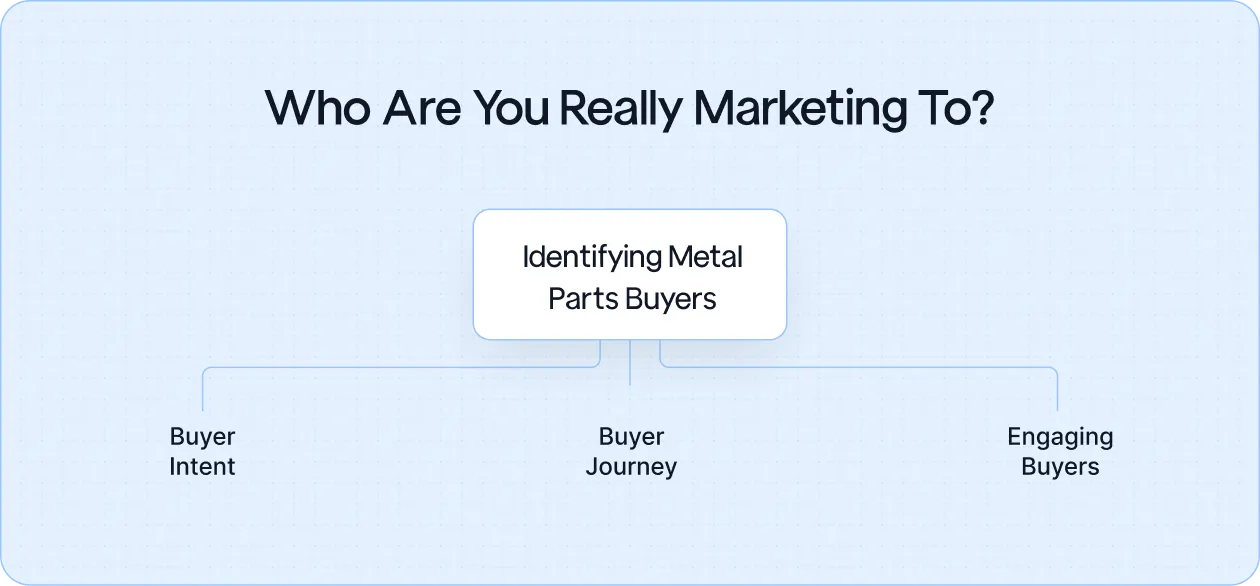
In the metal manufacturing industry, it’s crucial to understand exactly who you’re marketing to, as generic approaches won’t cut it. Key decision-makers, including procurement managers, engineers, and operations managers, drive purchasing decisions. Knowing their needs and challenges allows you to tailor your marketing strategy effectively and increase your chances of success.
Buyer Intent in the Manufacturing Space
Manufacturing buyers want solutions to specific problems. These decision-makers have clear objectives, whether it’s improving operational efficiency, reducing costs, or ensuring product quality. For instance:
- Procurement Managers prioritize cost efficiency and timely delivery.
- Engineers focus on quality, precision, and material performance.
- Operations Managers are concerned with reliability, longevity, and performance under real-world conditions.
To effectively engage these buyers, you need to understand these priorities and craft your messaging accordingly. By positioning your metal parts as solutions that address their unique challenges, you not only demonstrate your understanding of their needs but also build credibility.
Understanding the Buyer’s Journey
In manufacturing, the buyer's journey tends to be longer and more complex. Before making a purchasing decision, buyers typically conduct thorough research. They seek out product reviews, ask for recommendations, and refer to case studies that show how your solutions can meet their needs. Therefore, it's essential to create content that speaks directly to their pain points and showcases your products' value.
Engaging with the Buyer at Every Stage
To effectively capture the interest of decision-makers, your marketing strategy should offer tailored content that guides them throughout their journey. This could include:
- White Papers that provide in-depth information about your solutions.
- Case Studies that demonstrate how your metal parts solve specific challenges.
- Detailed Product Specifications that highlight the precision and performance of your parts.
By focusing on the needs of procurement managers, engineers, and operations managers, and demonstrating how your metal parts provide real solutions, you can better connect with buyers and increase your chances of securing their business.
Turn Website Clicks into Contracts
In the competitive world of metal manufacturing, your website serves as the primary interface between your business and potential clients. To effectively convert visitors into customers, it's essential that your site not only showcases your products and services but also instills trust and credibility.
Website Design That Converts
A B2B website in the manufacturing sector must prioritize clarity, professionalism, and functionality. Key elements include:
- Intuitive Navigation: Ensure that visitors can easily find information about your products, services, and company background.
- Compelling Value Proposition: Clearly communicate what sets your business apart and how you address the specific needs of your target audience.
- Trust Signals: Incorporate testimonials, certifications, and case studies to build credibility and demonstrate expertise.
- Responsive Design: Optimize your website for mobile devices to accommodate users accessing your site from various platforms.
- Fast Load Times: Improve page speed to reduce bounce rates and enhance user experience.
Implementing these design principles can lead to higher engagement and increased conversion rates.
Getting Found on Google: What Metal Shops Need to Know
Getting your website to show up (Search Engine Optimization) when people search online is like putting up a big, clear sign that helps customers find your shop. Here's how to make sure people can find you easily:
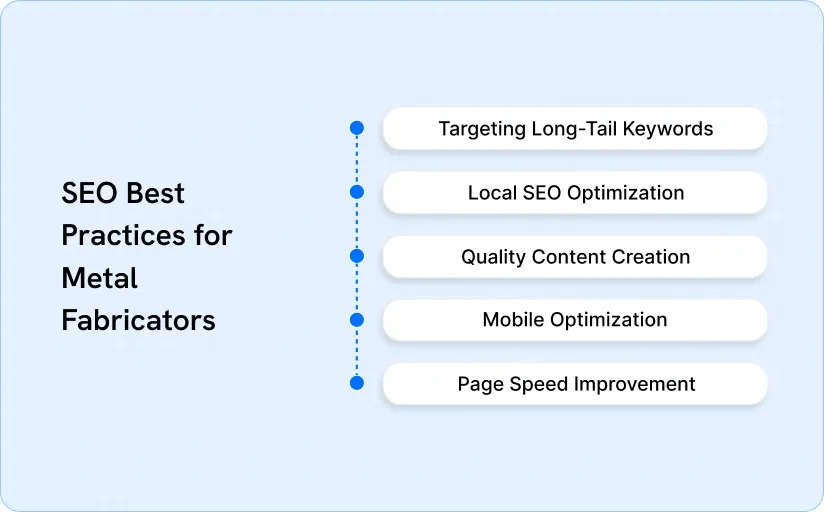
- Targeting Long-Tail Keywords: Focus on specific, less competitive phrases like “custom metal fabrication for aerospace parts” to attract highly qualified leads.
- Local Search Optimization: Enhance your presence in local search results by optimizing your Google Business Profile and ensuring consistent NAP (Name, Address, Phone Number) information across directories.
- Quality Content Creation: Develop informative content that addresses common questions and challenges in the metal fabrication industry, positioning your business as a knowledgeable resource.
- Mobile Optimization: Ensure your website is mobile-friendly to accommodate the growing number of users accessing sites via smartphones and tablets.
- Page Speed Improvement: Optimize images and streamline code to enhance load times, as faster websites provide a better user experience and can improve search rankings.
Make Your SEO Work Without Extra Effort
We can set up simple automation that handles the heavy lifting for you, so your website starts showing up for the buyers who matter.
Set Up My SEO System


Use Content to Become the Go-To Expert
By creating valuable, informative content, you can position your business as a trusted expert in your field, build stronger relationships with your audience, and ultimately drive more business.
Why Content Is Key in Manufacturing Marketing?
Content plays a vital role in marketing for manufacturers by:
- Building Trust and Authority: Sharing technical blogs, case studies, and how-to guides helps establish your business as an expert that customers can rely on.
- Educating Your Audience: Offering practical solutions to common problems shows your customers that you understand their needs and are here to help.
By focusing on education, you create a connection with your audience, making it easier for them to trust your business and see the value in your products or services.
Content Ideas for Metal Fabricators
For metal fabricators, the best content addresses the specific needs and interests of your customers. Consider these ideas:
- Case Studies: Highlight real examples of how your products have solved challenges for industries like automotive, aerospace, or construction.
- Technical Guides: Provide step-by-step instructions to help your audience understand complex processes and how your solutions can help them.
- Industry Trend Blogs: Write about emerging trends and technological advances in the metal fabrication industry to keep your audience informed and engaged.
These content types demonstrate your expertise and help potential customers better understand how you can solve their challenges.
Building Trust with Educational Content
Customers today value education more than direct sales pitches. Offering resources like:
- Webinars: Host live sessions where you can discuss industry topics and share your expertise with your audience.
- Blogs: Keep your audience engaged with regular blog posts that provide useful information and solutions to their challenges.
- Whitepapers: Provide in-depth resources that tackle complex issues and showcase your business’s knowledge.
Ready to Become the Fabricator Buyers Trust First?
We can help you create blogs, service pages and simple educational content that shows your expertise and brings serious buyers to your door.
Build My Content
By offering educational content, you help nurture relationships and guide potential customers toward making a decision, all while building your long-term credibility as a trusted resource.
Which Platforms Do Your Buyers Actually Use?
When it comes to reaching the right people in the metal manufacturing industry, LinkedIn is a powerful tool. While platforms like Instagram may not always be ideal for businesses like yours, LinkedIn offers a place to connect with professionals, share valuable information, and build your business's reputation.
Using LinkedIn to Connect with the Right People
LinkedIn is an important platform for metal shops to engage with decision-makers, such as procurement managers, engineers, and operations managers. Here’s why:
- Reach Key Decision-Makers: LinkedIn allows you to directly connect with people who influence buying decisions.
- Share Your Expertise: Post useful information like case studies, how-to guides, and industry updates to show that you know your stuff.
- Build Trust: By sharing valuable content and joining industry discussions, you can position your business as a trusted expert.
By using LinkedIn to share relevant content and engage with the right people, you can build relationships and grow your business.
Visual Content for Manufacturing Businesses
While LinkedIn is great for professional connections, platforms like Instagram and YouTube can help show off the visual side of your work. Here’s how:
- Instagram: Share pictures of your projects, finished products, or your team in action. It's a good way to showcase your work and build interest.
- YouTube: Upload videos showing how your products are made or providing a behind-the-scenes look at your process. This helps potential customers understand your work and quality better.
While LinkedIn helps with professional networking, Instagram and YouTube are great for giving people a closer look at what you do, helping to attract attention and build trust.
How Do You Stay on a Buyer’s Radar Without Chasing Them?
As a metal fabricator, attracting new customers is only half the battle. The real challenge is keeping them engaged and interested in your business. One of the most effective ways to do this is through email marketing.
By building an email list and sending targeted, useful content, you can keep potential customers "warm" and ready to buy without constantly chasing after them.
Building an Email List
Email marketing starts with building a list of people who are interested in what you offer. To get started, you can offer something valuable in exchange for their email address. This could be a free guide, a helpful checklist, or even a discount on their first order.
Once someone subscribes, you have a direct line of communication to keep them informed and engaged. Over time, this list will become a solid database of prospects that you can nurture into paying customers.
Effective Email Campaigns for Metal Fabricators
Sending the right type of email at the right time is key to keeping your leads interested. Here’s how you can do this effectively:
- Segment Your List: Divide your email list into different groups based on their interests or where they are in the buying process. For example, someone who downloaded a guide on “precision machining” might be interested in receiving product updates related to that.
- Send Valuable Content: Email your leads with content they find helpful. This could include:
- Technical guides on how your products can solve specific problems.
- Product updates to keep them informed about new features or services.
- Industry news to position your business as a knowledgeable resource in the metal fabrication space.
By sending relevant and useful content, you keep your leads engaged and remind them of why your business is the right choice.
Why Email Marketing Is a Long-Term Strategy?
Email marketing is one of the most cost-effective ways to reach and nurture your leads.
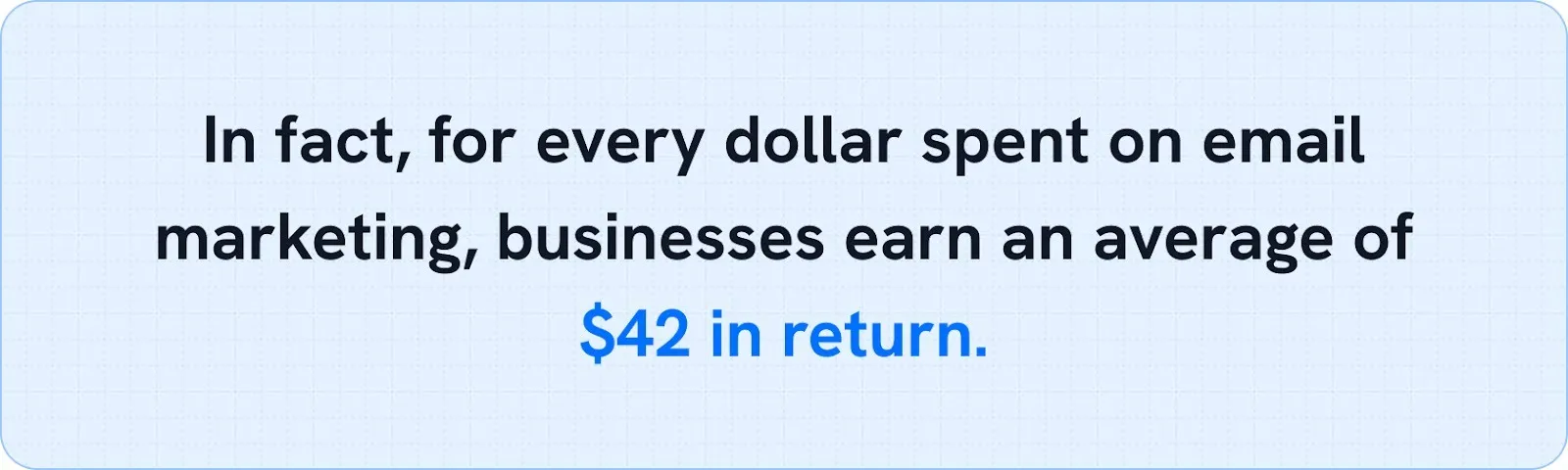
This means that email marketing provides one of the best returns on investment (ROI) for your marketing dollars.
The best part? Email marketing doesn’t just generate sales right away; it helps build long-term relationships with prospects. By staying in touch with them over time, you can continue to nurture them and keep your business top-of-mind. When they're ready to make a purchase, you’ll be the first business they think of.
Is Your Marketing Spend Bringing Anything Back?
Many manufacturers find themselves spending money on marketing efforts without knowing if they're seeing any real results. To avoid wasting resources, it's crucial to measure the effectiveness of your digital marketing campaigns.
By tracking the right metrics and optimizing campaigns based on data, you can ensure that your marketing dollars are working to generate revenue and drive business growth.
Measuring Marketing Effectiveness
To determine whether your marketing budget is being spent wisely, focus on key metrics:
- Lead Volume: The number of leads generated through your campaigns. While a higher volume is important, it’s essential to consider the quality of these leads.
- Lead Quality: Not all leads are created equal. Evaluating how well leads match your ideal customer profile (ICP) helps assess if your marketing efforts are attracting the right audience.
- Customer Acquisition Cost (CAC): This metric helps you understand how much it costs to acquire a new customer. By comparing this to the value of the customer over their lifetime, you can determine if your marketing spend is yielding a positive return.
By regularly tracking these metrics, you can gain insight into the success of your campaigns and make informed decisions about where to allocate your budget.
Optimizing Campaigns Based on Data
One of the biggest advantages of digital marketing is the ability to adjust campaigns in real-time. With the help of analytics tools, manufacturers can:
- Track Campaign Performance: Monitor the effectiveness of various marketing channels (like Google Ads, email marketing, or social media) and see which ones are delivering the best results.
- Make Data-Driven Adjustments: If a campaign isn’t performing as expected, real-time data allows you to tweak targeting, adjust ad copy, or change the bidding strategy to optimize performance.
- Align Strategy with Revenue Goals: By continuously analyzing data, manufacturers can ensure their marketing efforts are aligned with the goal of increasing revenue, not just driving traffic.
Want to See Which Marketing Efforts Actually Work?
We can set up a clear dashboard that shows what’s bringing real enquiries and what’s wasting money, so you can make smarter decisions without guessing.
Show Me the Real Results
Optimizing campaigns based on data allows manufacturers to maximize their marketing spend, ensuring that every dollar contributes to driving leads and sales.
Are Technical Issues Hurting Your Reputation Online?
In the metal fabrication industry, trust and reliability are everything. Just as a bad weld can weaken the integrity of a product, a bad review can quickly damage the reputation of your business. With more customers turning to online reviews to make purchasing decisions, managing your online reputation has never been more crucial.
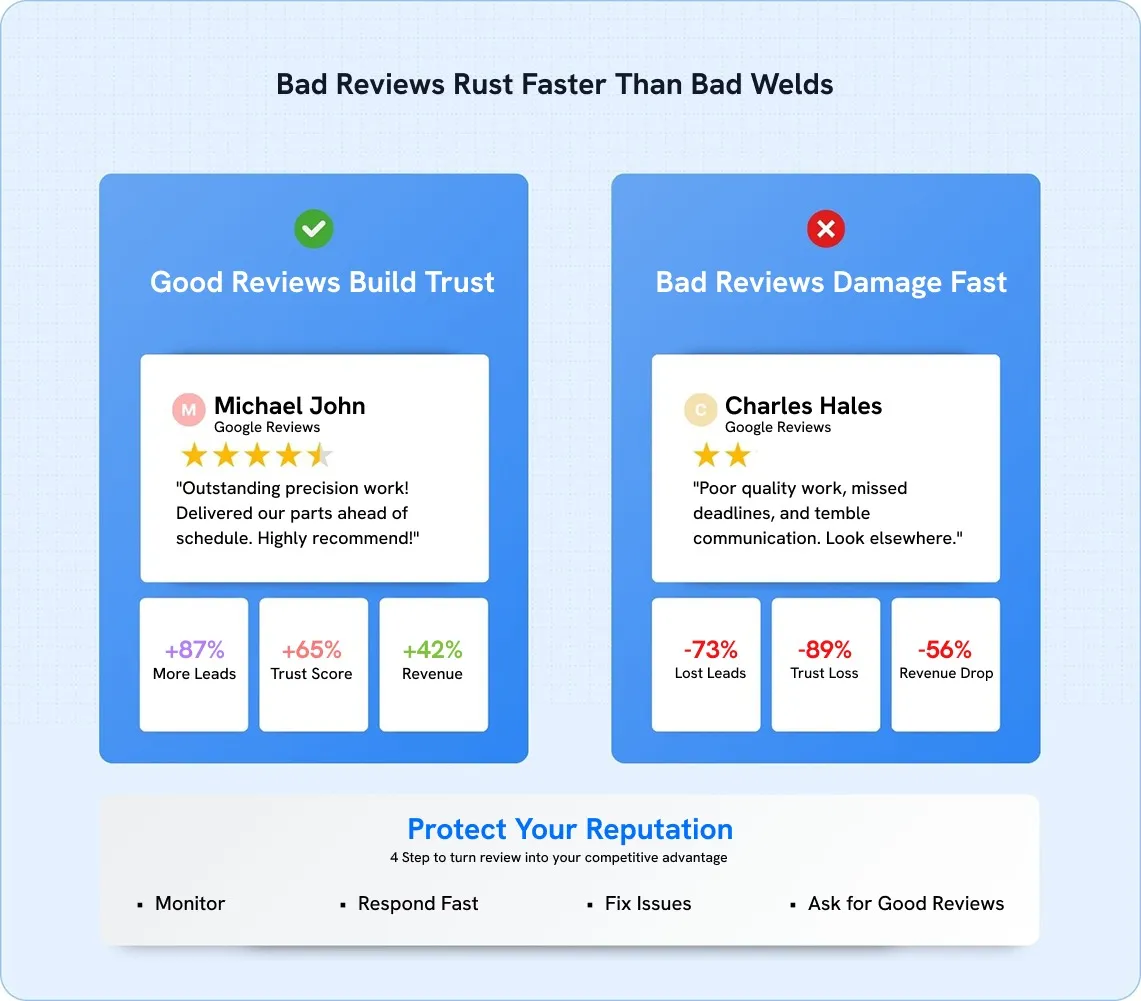
The Power of Online Reviews
Positive reviews are invaluable for building trust with potential customers. For metal fabricators, platforms like Google and LinkedIn are particularly important for showcasing your expertise and reliability. Here's why:
- Builds Credibility: Positive reviews serve as social proof that your business delivers quality products and services. This is especially important in industries like metal fabrication, where customers want to be confident in the reliability of the products they’re purchasing.
- Influences Buying Decisions: This means that a strong collection of positive reviews can be the deciding factor in whether a potential customer chooses your business over a competitor.
- Improves Search Engine Visibility: Platforms like Google reward businesses with good reviews by increasing their visibility in local search results. This makes it easier for new customers to find you when they search for metal fabrication services.
Managing Your Online Reputation
Actively responding to reviews and ensuring consistent information across all platforms is key to maintaining a positive brand image. Here’s how you can manage it:
- Monitor Reviews Regularly: Check platforms like Google, Yelp, and LinkedIn for reviews, both positive and negative. Responding to feedback shows that you care about your customers' experiences.
- Address Negative Reviews: If a negative review does pop up, don’t ignore it. Respond professionally, acknowledge the issue, and offer a solution. This can turn a negative experience into an opportunity to showcase your customer service and commitment to quality.
- Keep Business Information Consistent: Ensure your business name, address, phone number, and website are consistent across all platforms. This helps with local SEO and ensures customers can easily reach you.
By actively managing your online reputation and encouraging positive reviews, you can strengthen your brand, build trust, and attract more customers.
AI and Automation for Metal Marketing
In an increasingly digital world, metal manufacturers can greatly benefit from adopting AI and automation tools to streamline marketing efforts. These technologies help save time, improve efficiency, and enhance customer engagement, ultimately boosting your business's performance and growth.
AI Tools for Streamlining Marketing Efforts
AI-powered tools can automate many aspects of digital marketing, making it easier for metal manufacturers to connect with the right prospects and manage their marketing activities more effectively. Key tools include:
- Chatbots for Lead Qualification: AI chatbots can engage with visitors on your website, answer basic questions, and qualify leads by gathering essential information. This reduces the workload for your sales team and ensures that they focus on high-quality prospects.
- Content Generators: AI tools can create basic content like blog posts, email templates, or social media updates. These tools save you time and ensure that you consistently publish relevant content that keeps your audience engaged.
By incorporating these AI tools, metal manufacturers can reduce manual effort, improve response times, and focus on high-priority tasks that directly contribute to growth.
Predictive Analytics and Personalization
AI is not just about automation; it can also enhance the way you engage with your customers through predictive analytics and personalization. Here's how:
- Predictive Analytics: AI tools analyze vast amounts of data to identify trends and patterns. For metal fabricators, this means understanding market demand, predicting future trends, and optimizing your marketing strategies accordingly.
- Personalized Experiences: With the help of AI, you can offer tailored experiences to your prospects. By analyzing customer behavior and preferences, AI can help you deliver content that resonates with individual customers, increasing the likelihood of conversion.
Want to Make Your Marketing Easier to Manage?
We’ll show you simple tools that cut out repetitive work, sort genuine enquiries faster, and keep your team focused on real buyers.
Book a Consultation
Start Small, Scale Over Time
While digital marketing is critical, it's important to take it one step at a time. Manufacturers can start with one or two strategies, such as SEO or content marketing, and gradually build on these efforts as they see results.
- Begin with One or Two Strategies: Focus on one digital marketing approach, like improving your website's SEO or starting a blog to share your expertise. This helps you understand what works best for your business.
- Measure Effectiveness: Monitor the success of your initial efforts through analytics so that you can adjust your strategy based on real data.
- Gradually Scale: Once you’ve gained confidence and seen results, consider adding more strategies like social media marketing to expand your digital reach.
As your digital marketing efforts grow, platforms like Gushwork can help streamline and automate marketing tasks. From managing campaigns to optimizing your marketing strategy, Gushwork makes it easier for manufacturers to take control of their digital presence and scale effectively over time.
FAQs
Q1. What is digital marketing for metal manufacturing?
A1. Digital marketing for metal manufacturing involves using online strategies like SEO and content marketing to increase visibility, attract qualified leads, and drive business growth.
Q2. How does SEO benefit metal manufacturers?
A2. SEO helps metal manufacturers improve their website's ranking on search engines, making it easier for potential customers to find them when searching for specific services like "metal fabrication" or "precision machining."
Q3. Why is content marketing important for metal fabricators?
A3. Content marketing, such as blogs, case studies, and guides, builds trust with potential customers by providing valuable insights and showing your expertise in solving industry-specific problems.
Q4. How can AI improve marketing efforts for metal manufacturers?
A4. AI tools, like chatbots and content generators, automate marketing tasks such as lead qualification and content creation. This helps improve efficiency, save time, and engage prospects effectively.
Q5. What is the best way to start digital marketing for my metal fabrication business?
A5. Start by focusing on one or two strategies, such as SEO or content marketing, and gradually scale up as you measure results. This ensures you build a solid foundation before expanding your efforts.

SEO
Sep 4, 2025
5 mins
SEO for Packaging Companies: Make Product Pages Rank or Stay Invisible In Search
Batul Beawarwala
Packaging companies deal with steady demand, but winning the right customers takes more than a good product line. Buyers search online first, compare suppliers fast, and expect clear answers before they reach out. If your website doesn’t show up when they look for specific packaging solutions, competitors take the lead.
That's where focused SEO for packaging companies helps. It brings your business in front of buyers who are already searching for the materials, equipment, or capabilities you offer.
With the right strategy, packaging companies can improve visibility, build trust, and pull in qualified customers in a short time.
In this blog, you’ll learn how SEO works for packaging companies and how a simple, targeted approach can help you attract more customers within 90 days.
What Is SEO?
SEO for packaging manufacturers is the process of improving your website so buyers can find you when they search for the products you offer. It focuses on making your content clear, matching the terms customers use, and helping search engines understand why your pages deserve to show up.
For packaging companies, this often includes material-specific keywords, industry applications, and capability driven topics that buyers actively look for.
What Will It Do for Your Packaging Business?
SEO helps companies show up for the exact searches buyers use when they compare suppliers. When done right, it supports your growth in several ways:
- Brings in buyers who are already looking for your materials and capabilities
- Highlights your strengths, certifications, and production capacity
- Builds trust by showing clear, accurate, helpful information
- Reduces reliance on paid ads or cold outreach
- Helps your sales team get more qualified conversations
It’s a straightforward way to improve visibility and attract customers who are ready to act.
Target These Keywords That Convert
Showing up for keywords that sound good but don’t bring buyers is one of the biggest mistakes packaging manufacturers make. Terms like “packaging industry” might generate a few hundred searches, but they attract students, job seekers, and researchers, not the customers you want.
What drives actual quotes and purchase orders are high-intent keywords: searches that signal someone is ready to buy, compare vendors, or request samples.
Here’s where you should focus:
High-Intent Keywords Competitors Often Miss
Industry-Specific “Money Keywords”
Different industries have different compliance and branding needs. These terms capture serious buyers with purchase power:
Local Modifiers That Work
Never underestimate local SEO. Adding phrases like:
This turns a general keyword into one that’s immediately actionable, often with much less competition.
Reach Buyers Searching for Packaging Solutions Now
Use the right keywords to connect with high-intent customers ready to compare suppliers and request quotes.
Get My Keyword Plan
Keywords to Stop Wasting Time On
- “packaging industry” (320 searches): vague, attracts researchers, not buyers.
- “types of packaging” (450 searches): informational, low buyer intent.
- “packaging definition” (1,000+ searches): purely educational, zero sales value.

Three Site Fixes That Can Improve Your SEO
Even the best keywords won’t matter if your site isn’t built to perform. Google’s algorithm rewards packaging manufacturers whose websites are fast, mobile-friendly, and structured properly, and penalizes those that aren’t. The good news? These are fixable issues that don’t require a massive budget, just some smart tweaks.
1. Site Speed Under 3 Seconds
Buyers won’t wait for your site to load, especially if they’re comparing multiple packaging vendors. Studies show that if a page takes longer than 3 seconds, over 50% of users bounce. Google factors this into rankings, too.
- How to test: Run your homepage and key product pages through GTmetrix.com. Aim for a Grade A (fully loaded under 3 seconds).
- How to fix:
- Compress large images before uploading using TinyPNG.com.
- Enable gzip compression (your developer or hosting provider can help).
- Use a content delivery network (CDN) if your customers are spread across the U.S.
2. Mobile-Friendly Product Pages
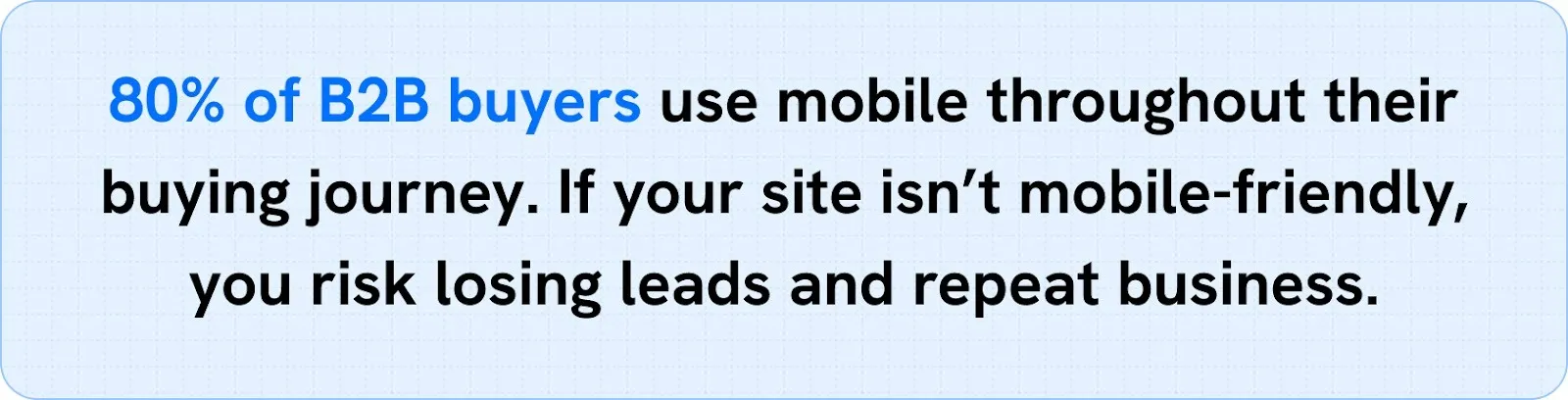
- How to test: Run your product pages through Google’s Mobile-Friendly Test.
- Best practices for manufacturers:
- Buttons and links should be at least 44px so they’re easy to tap.
- Product images should load quickly and resize properly on mobile.
- Keep text readable without pinching or zooming.
3. Product Page URLs That Make Sense
Your URLs should tell both Google and your buyers exactly what the page is about. Long strings of numbers and random IDs hurt your SEO and look unprofessional.
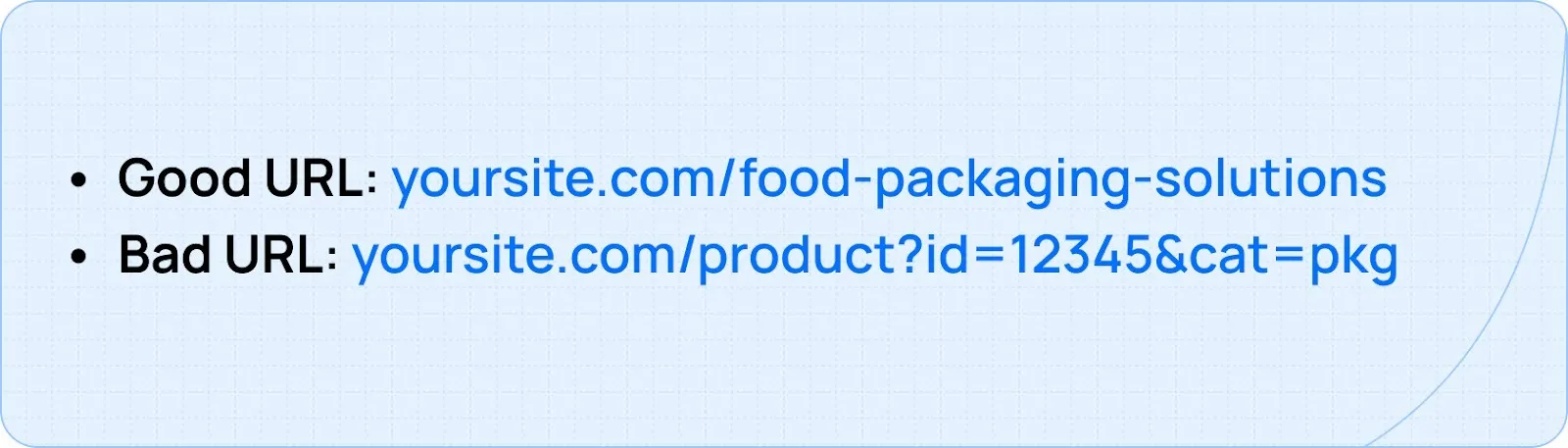
Tip: Always include your main keyword in the URL (e.g., “custom corrugated boxes” or “pharmaceutical blister packs”).
Quick Technical Wins:
- Add your company name, address, and phone number (NAP) in the footer of every page, critical for local SEO.
- Create and submit an XML sitemap (use a plugin like Yoast if your site runs on WordPress).
- Set up Google Analytics and Google Search Console, both free, both essential for tracking performance.
- Make sure every page has a unique title tag that includes your primary keyword. Example: “Custom Food Packaging Solutions | [Your Company Name]”.
When your site is fast, mobile-optimized, and structured properly, you’ll not only climb the rankings but also make it effortless for buyers to explore your products and request quotes.
Create Varied Content Pages
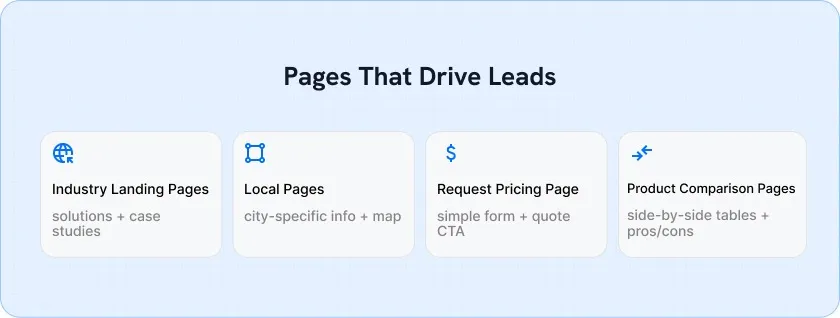
Most packaging manufacturers miss out on sales because their websites only have a generic homepage, an “About Us” page, and a products page. That setup doesn’t rank well on Google, and it doesn’t convince buyers to request a quote.
What works are specific, conversion-driven pages, built around industries, local markets, and buyer decisions. These pages consistently rank higher and generate qualified leads.
Here’s exactly what to create:
Industry Landing Pages
Buyers want to see packaging solutions tailored to their industry. One page per vertical (food, pharma, e-commerce, industrial) gives you the SEO footprint to capture those searches while showing credibility.
- Title: “[Industry] Packaging Solutions | [Your Company]”
- Layout that converts:
- Headline: “[Industry] Packaging Solutions – Get Quote in 24 Hours”
- 3 benefit bullets with icons (e.g., FDA-approved, eco-friendly, fast turnaround)
- Contact form above the fold (Name, Email, Phone, Project Details)
- Client logos (6–8 recognizable brands)
- 2–3 case studies with photos and outcomes
- FAQ section (5 questions buyers always ask)
- Pricing clarity: “Starting at $X” or “Typical orders: $X–Y”
Why it works: Industry landing pages rank for high-intent terms like “food packaging supplier” or “pharmaceutical blister packs”, and they prove expertise with case studies.
Local Pages
When someone searches “packaging suppliers near me” or “packaging company in Chicago”, Google prioritizes local results. By creating a dedicated page for every major city you serve, you grab those leads before competitors do.
- Title: “Packaging Suppliers in [City] | Same-Day Quotes”
- Layout that converts:
- Headline: “Packaging Suppliers in [City] – Same Day Service”
- Local address and phone number displayed prominently
- “Serving [City] since [Year]” credibility statement
- Embedded Google Map for easy directions
- Local client testimonials with real company names
- Service area list (surrounding cities/counties you cover)
Why it works: Buyers trust local suppliers and want quick service. Even if you ship nationwide, showing a presence in their city makes you more credible.
Request Pricing Page
The “Request a Quote” form is often buried or overly complicated. Instead, build a dedicated Request Pricing page that’s streamlined and persuasive.
- Title: “Request Custom Packaging Pricing | Get Free Quote”
- Form fields: Quantity, Material, Size, Industry (keep it simple)
- Supporting content:
- 2–3 specific case studies with numbers (e.g., “Client X reduced costs by 23% with [solution]”)
- Before/after photos showing packaging improvements
- Clear call-to-action: “Get Similar Results – Request Pricing Today”
Why it works: Buyers comparing suppliers want fast, transparent pricing. A clean request form captures leads at the moment of purchase intent.
Product Comparison Pages
Decision makers often Google “Corrugated vs Plastic Packaging” or “Paper vs Plastic Packaging.” Instead of sending them to a competitor’s article, own the comparison content.
- Examples:
- “Corrugated vs Plastic Packaging: Cost Analysis”
- “Paper vs Plastic Packaging: Environmental Impact Comparison”
- What to include:
- Side-by-side pricing tables
- Decision flowcharts (help them choose based on volume, durability, compliance)
- Pros/cons with real data (cost, sustainability, speed to market)
- Why it works: These pages capture research-stage buyers and guide them toward requesting a quote with your company.
Where to Get Quality Links in Your Industry?
Easy wins you can submit today
- Google Business Profile (free): Foundational for Local Pack visibility and a high-trust citation. Create/claim your profile if you haven’t already.
- Yelp for Business (free account): Claim your page; it’s a common data source for local search.
- BBB Business Profile (free; accreditation is paid/optional): Get a trusted citation; accreditation fees are separate.
- Your local Chamber of Commerce (paid membership, usually modest): Membership directories typically link to members; sponsorships often include a website mention. Use your city/region chamber, and consider event sponsorships for an extra link/citation.
Industry directories where buyers actually look
- Thomasnet, free company profile: Claim and fill out your supplier profile; buyers use Thomas to source US manufacturers.
- PMMI ProSource: PMMI’s supplier directory for packaging & processing; if you’re a member/supplier, make sure you’re listed and optimized.
- Packaging Digest (publisher site): Secure a company profile mention or contributor bio page by pitching real, technical content (case studies, QA/regulatory, line integration). Editor contact details are public.
- Packaging World (PMMI Media Group): Pitch plant-floor wins or automation/cost-out stories; they feature case studies from OEMs and converters.
- Packaging Strategies: Accepts contributed articles; use their “Contribute” page to pitch.
- MFR/partner directories you’re already in: Ask machinery OEMs, material suppliers, and integrators you partner with to list you on their “Partners/Suppliers” pages (reciprocal case-study links perform well). (General best practice; pair with Google’s link guidelines to keep it compliant.
Additional credible citations that most packaging buyers check
- Better listings on Thomasnet (beyond free): If ROI justifies it, premium placements can increase discovery, but start with the free profile first.
- Regional manufacturing associations: Many publish member directories online (citation + referral traffic). Example structure via PMMI ecosystem.
- Local industrial news/business journals: Contribute ops expansions or sustainability wins; many include do-follow company links in coverage. (Use each outlet’s contributor or news tips page.)
- Customer “Suppliers We Use” pages: Offer a short write-up and logo in exchange for a link when you complete a project; pair it with a permissioned case study on their site. (Compliant if it’s editorial and not a paid link).
- Event listings (PACK EXPO, regional shows): Exhibitor pages often link to your site; make sure your profile is complete pre-show.
What works vs. what to skip
- Works: Credible citations where buyers actually search (GBP, Thomasnet, PMMI/ProSource), editorial placements (real case studies), and local authority listings (Chamber, associations). These help Local Pack visibility and organic rankings. GBP optimization is repeatedly highlighted in local ranking research.
- Doesn’t work: Paying for random directory links or Fiverr-style link packages. Google treats manipulative link schemes as spam and can discount or penalize them. If a link is paid/sponsored, it should be tagged appropriately.
Your Core 4 Metrics to Keep a Watch on
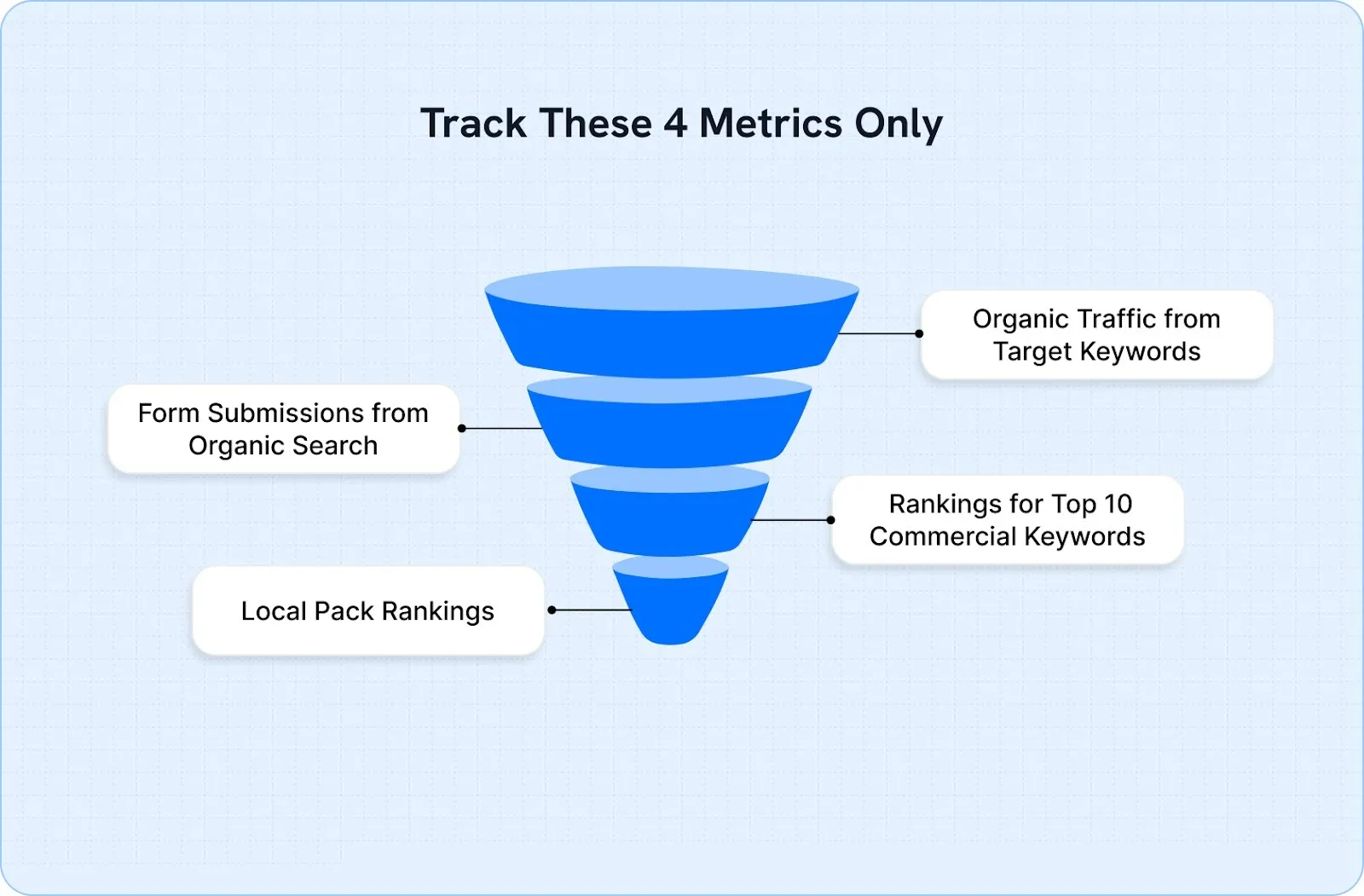
1. Organic traffic from target commercial keywords
- Why: Shows if the right buyers (not students/blog readers) are reaching product/industry pages.
- How to measure: In GA4, report conversions/traffic by source/medium and landing page; build an exploration filtered to organic and your industry/product pages.
2. Form submissions from organic search
- Why: Direct lead indicator tied to SEO; tells you if pages and CTAs are working.
- How to measure: Define a GA4 conversion event for your RFQ/“Get Quote” form and segment by “Session default channel group = Organic Search.” Better Business Bureau
3. Rankings for your top 10 commercial keywords (e.g., “custom corrugated boxes Ohio,” “FDA-approved food packaging supplier”)
- Why: Leading indicator for pipeline pages; track movement after you publish new landing pages.
- How to measure: Use Google Search Console’s Performance report to monitor queries and specific page rankings/CTR; export weekly.
4. Local Pack rankings for “packaging suppliers [city]”
- Why: Most buyers run local/vendor searches; showing in the 3-Pack drives calls and quote requests.
- How to measure: Use a local rank tracker that emulates search from target ZIPs to see true Local Pack positions (e.g., BrightLocal).
Quick action checklist
- Claim/optimize Google Business Profile + Yelp + BBB Business Profile.
- Claim your Thomasnet company profile (free) and complete every field (capabilities, industries, certifications).
- Ensure you appear in PMMI ProSource (if applicable) and update categories and copy.
- Draft one case-study pitch and send to Packaging World/Packaging Digest/Packaging Strategies editors.
- Join or renew local chamber/association membership and confirm your web listing is live; consider a small event sponsorship for an extra, high-trust local link.
Your 90-Day SEO Roadmap
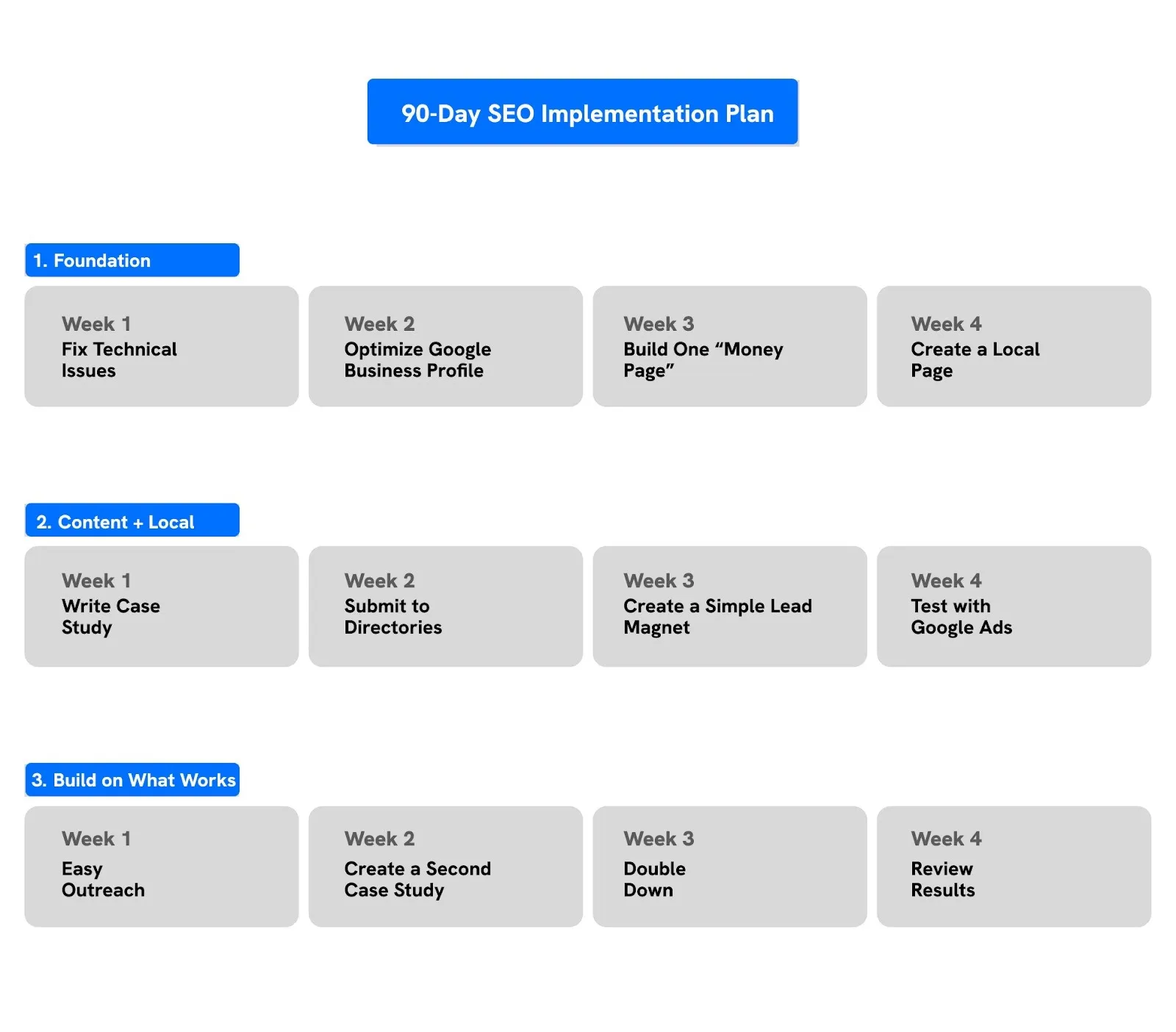
This plan is designed for packaging manufacturers who need more qualified leads without wasting time. Each week builds on the last, so you see progress quickly.
Month 1: Laying the Foundation
Week 1: Fix Technical Issues (2–3 hours)
- Run your site through GTmetrix → compress slow-loading images.
- Test mobile-friendliness using Google’s Mobile-Friendly Test.
- Add your phone number to the header/footer of every page (boosts local SEO + conversions).
Week 2: Optimize Google Business Profile (1 hour)
- Claim at business.google.com.
- Upload 5 recent photos (facility, packaging lines, sample products).
- Ask 2–3 happy customers to leave reviews (start with long-term clients).
Why it matters: Google Business Profile is the #1 factor in Local Pack rankings (the top 3 map results).
Week 3: Build One “Money Page” (3–4 hours)
- Create “[Your Industry] Packaging Solutions” page (e.g., Food Packaging Solutions).
- Include:
- Contact form above the fold
- “Starting at $X” pricing info
- 1–2 customer testimonials
Why it matters: These pages target buyer-intent keywords like “custom food packaging supplier”, the kind of searches that drive RFQs.
Week 4: Create a Local Page (2 hours)
- Example: “Packaging Suppliers in Chicago”.
- Reuse structure from Week 3, but add:
- Local address + phone number
- Service area list (surrounding cities/counties)
- Google Map embed
Why it matters: 76% of people who search “near me” visit a business within 24 hours
Month 2: Content + Local (Easier Wins)
Week 1: Write One Case Study (2 hours)
- Pick your strongest client success story.
- Add specific results (e.g., “Reduced packaging costs 20%”).
- Include before/after photos.
Why it matters: Case studies = social proof. 92% of B2B buyers are more likely to purchase after reading a trusted review/case study.
Week 2: Submit to Directories (1–2 hours)
- Add listings to:
- Google Business Profile
- Yelp
- Better Business Bureau (BBB)
- Ensure NAP (name, address, phone) matches exactly everywhere.
Why it matters: Consistent citations improve local rankings.
Improve Your Content and SEO Rankings
Get support creating stronger case studies and fixing your local listings so buyers can find you and choose you faster.
Improve My SEO Rankings
Week 3: Create a Simple Lead Magnet (1 hour)
- Example: “Packaging Cost Comparison: Corrugated vs. Plastic.”
- Gate it behind an email signup.
- Share with existing customers and prospects.
Why it matters: Helps capture leads earlier in the buying process.
Week 4: Test with Google Ads ($200 budget)
- Run ads on your top keyword (e.g., “custom packaging supplier [city]”).
- Track calls and form fills.
- Pause any ads that don’t convert.
Why it matters: Ads give fast feedback on which keywords actually drive calls, useful for refining SEO targeting.
Month 3: Build on What Works
Week 1: Easy Outreach (1 hour)
- Email 3 industry newsletters (Packaging Digest, Packaging World, local manufacturing groups) offering a short tip/article.
- Ask happy customers if they can mention you on their website.
- Join a local business/manufacturing association.
Week 2: Create a Second Case Study (1 hour)
- Same format as Month 2, Week 1.
- Use a different industry (e.g., pharma if the first was food).
- Post on LinkedIn + add to your site.
Week 3: Double Down (time varies)
- If ads worked, increase spend.
- If industry/local pages worked, create 1–2 more.
- If case studies got traction, publish another.
Week 4: Review Results (30 minutes)
- In Google Analytics: check leads from organic search.
- In Google Search Console: check keyword rankings for your top 10 commercial terms.
- For local SEO: search “packaging suppliers [your city]” and note your Local Pack ranking.
At the end of 90 days, you’ll have:
- A technically sound, mobile-ready site
- At least 2 industry landing pages + 1 local page
- Case studies with measurable results
- Directory listings + Google Business Profile generating trust
- Data from ads + analytics showing what drives real leads
Free vs. Paid Options for Improving SEO
One of the biggest mistakes manufacturers make is either buying expensive SEO tools they never use or relying only on guesswork. Here’s the truth: you don’t need dozens of subscriptions to win in search, you just need the right mix of free must-haves and a few paid tools (if budget allows).
Free Tools
These should be your non-negotiables. They’re powerful, and they cost nothing.
- Google Search Console → Shows which keywords your site ranks for, click-through rates, and technical issues.
- Google Business Profile → Absolutely critical for showing up in the Local Pack (map results).
- Google Analytics → Tracks which pages actually drive leads, not just traffic.
- GTmetrix → Tests your website speed and gives specific improvement tips.
- Google's Mobile-Friendly Test → Quickly checks if your product pages work well on phones (where most buyers first research).
With just these five, you can already measure traffic, leads, rankings, and site health.
Paid Options Worth Considering
You don’t need all of these; pick one or two based on your biggest SEO priority.
- Gushwork → Highly useful if you want to build a complete marketing infrastructure: optimized website, content systems, SEO dominance, lead management, and targeted ads that work together as one unified growth engine. Instead of hiring extra admin staff, you can automate these workflows at scale.
- SEMrush ($99/month) → Excellent for keyword research, competitor analysis, and tracking how your rankings move over time.
- Ahrefs ($99/month) → Best for link building, competitor backlinks, and finding content opportunities.
- LocalFalcon ($20/month) → Lets you track your exact rankings in the Google Maps 3-Pack across different ZIP codes, perfect if you serve multiple U.S. cities.
Get started with Gushwork if you want to speed up execution without adding overhead.
Free Templates and Checklists
To save you hours of trial and error, here are practical resources manufacturers can use immediately:
- Technical SEO Audit Checklist (31 points) → Quick monthly scan to ensure nothing’s broken.
- Content Calendar Template → Plan at least 3 months of industry pages, local pages, and case studies.
- Link Prospect Spreadsheet → Track outreach to industry publications, associations, and partners.
With these in place, you’ll know exactly what to work on each month instead of chasing shiny objects.
What Stops Working in 2025?
Not every SEO tactic holds up year after year. In fact, a lot of what used to work is now actively hurting manufacturers’ rankings. If you’re still doing any of the following, it’s time to pivot before Google leaves you behind.
- Keyword stuffing → Google’s algorithms are too advanced to fall for “custom packaging manufacturer” repeated 20 times on a page. Content now needs to read naturally while targeting high-intent keywords.
- Buying cheap directory links from overseas → Google can detect irrelevant, spammy links. Instead, invest in industry-relevant links (ThomasNet, Packaging Digest, PMMI).
- Generic “About Us” pages → If your company page could fit any other manufacturer, it won’t build trust. Share certifications (FDA, ISO, OSHA), client industries, and a real story about your facility.
- Ignoring mobile users → If your product pages don’t load fast and function well on phones, you’re losing buyers before they ever call.
- Not tracking phone calls from organic search → If you only track form fills, you’re missing most of your SEO ROI.
- Slow websites → If your site takes longer than 3 seconds, more than half of users leave. Manufacturers with heavy product catalogs are especially at risk.
- Not ranking in the top 10 for your company name → If a prospect Googles you and finds competitors, directories, or worse, nothing, you’re losing deals you should have closed.
- No organic growth in 6+ months → SEO is not static. If you haven’t seen steady gains, it means competitors are outranking you with fresher content, better links, or a stronger local presence.
The Bottom Line
Packaging manufacturers don’t need more “marketing ideas” you need a reliable system that gets you visible exactly when buyers are ready to request a quote. That means focusing on high-intent keywords, fixing the speed/mobile issues that quietly kill rankings, publishing industry/local pages that convert, earning credible links, and tracking the four KPIs that prove pipeline impact.
Let’s build the infrastructure that consistently generates qualified RFQs in 90 days.
Ready To Bring In More Packaging Customers?
Get a clear SEO plan built to improve visibility, strengthen your content, and attract better buyers.
Start My SEO
Digital Marketing
Sep 4, 2025
5 mins
Machinery Buyers Do 70% of Research Online Before Sales - Is Your Brand Visible In Search?
Batul Beawarwala
As a machinery manufacturer, you're facing a simple but urgent question: how do you stand out when buyers are increasingly turning to the digital world?
In-person relationships and traditional sales cycles have long defined the industrial machinery sector. But the traditional marketing methods just don't cut it anymore. Reaching the right customers at the right time is more challenging than ever. But here's the good news: digital marketing can be the game-changer you need.
By adopting the right digital strategies, you can not only boost your visibility but also create lasting relationships with customers who are actively searching for your solutions.
TL;DR
- Digital marketing for machinery manufacturers is about being visible when buyers are actively searching, not about flashy campaigns.
- Focus on SEO, paid ads, content marketing, and social media to attract, engage, and convert qualified leads.
- Platforms like Gushwork for AI-driven lead capture, campaign tracking, and performance insights.
- Track key metrics like lead conversion rate, cost per lead, and ROI to measure success and optimize strategies.
- Manufacturers who adapt now will lead the market in 2025 and beyond by building a predictable and scalable lead generation system.
Why Your Machinery Manufacturing Competitors Are Stealing Your Customers Online?

If your machinery manufacturing business isn't showing up on Google, you're invisible to the very buyers you're trying to reach.
- 80% of B2B buyers initiate first contact only after completing 70% of their buying journey
This means your potential customers are already well into their decision-making process before they reach out. If you're not visible online, you're missing out on valuable opportunities. - The average B2B buying cycle lasts 11.5 months
Buyers spend a significant amount of time researching and evaluating options. Without a strong online presence, your competitors have the upper hand in influencing their decisions. - Over 90% of buyers have prior experience with at least one of the vendors they consider
If your company isn't actively engaging with potential customers online, you're not even in the running. - Buyers are evaluating an average of 4.6 vendors during their journey
This means your business is competing with several others for attention. A strong online presence can help you stand out. - 81% of buyers have already established purchase requirements before reaching out
This highlights the importance of providing clear, detailed information on your website to meet buyer expectations.
The 4 People Who Actually Buy Manufacturing Equipment (And How to Reach Each One)
When it comes to purchasing machinery, multiple decision-makers are involved, each with their own priorities and concerns. Understanding who they are and tailoring your messaging accordingly is crucial to a successful digital marketing strategy.
Here are the four key people who influence machinery purchases and how you can effectively reach each one:
- Production Managers
Production managers are primarily concerned with uptime and efficiency. They need equipment that minimizes downtime and maximizes operational output.
How to reach out: Your messaging should emphasize reliability, ease of integration, and performance metrics that directly impact production schedules. Use data-driven content like performance reports, uptime statistics, and case studies that demonstrate how your machinery improves efficiency.
- Procurement Teams
These teams focus on cost and supplier reliability. They need to know that the machinery will fit within budget and that you can deliver on time.
How to reach out: Highlight your competitive pricing, flexible financing options, and proven track record of meeting delivery deadlines in your marketing materials.
- Engineers
Engineers look for technical specifications, compatibility, and long-term viability. They care about the details, how well the machinery integrates with existing systems and whether it meets specific technical requirements.
How to reach out: Offer detailed whitepapers, technical sheets, and videos showcasing the machine's specifications and how it integrates with existing systems.
- Executives
Executives are ultimately focused on the ROI and the competitive advantage the machinery will provide. They want to ensure that the investment will lead to cost savings, improved productivity, and a stronger market position.
How to reach out: Your messaging should focus on the long-term value, cost-benefit analysis, and how your equipment can provide a competitive edge in the industry. Highlight ROI projections, industry reports, and long-term savings that show how your machinery will provide a competitive edge.
By creating distinct messaging for each decision-maker, you'll be able to connect with the right audience at the right stage in their buying journey.
Get Found When Manufacturers Search for Solutions
Manufacturers are increasingly turning to online searches to find the right equipment, services, and solutions. If your business isn’t visible when they look for answers, you risk losing valuable opportunities. Here are four strategies to help your business get found and attract the right customers:

- Target "Machinery Manufacturing Equipment" and Specific Model Searches
Many buyers search for specific machinery models or equipment types when considering a purchase. By targeting precise, long-tail keywords such as "CNC machine for small businesses" or "hydraulic press for metalworking," you can capture more qualified leads.
Optimizing your website content for these search terms ensures your products are visible when buyers are ready to make a decision.
- Local SEO for Regional Distributors and Service Centers
Local SEO is essential for manufacturers with regional operations, distributors, or service centers. By optimizing for location-specific keywords like “machinery equipment in [city]” or “industrial service center near me,” you improve your chances of reaching manufacturers who need equipment or support nearby.
Optimizing for local search will make your business more accessible to nearby decision-makers looking for reliable, local suppliers.
- Technical Content That Ranks Higher Than Competitor Brochures
Instead of relying solely on brochures, manufacturers should create detailed, technical content that addresses customer needs and ranks well on search engines.
High-quality content, such as product guides, case studies, and whitepapers, can attract valuable traffic by answering specific questions that potential customers have.
- Voice Search Optimization for Mobile Research
With the increasing use of voice-activated devices, manufacturers often use voice search to quickly find products or services. Optimizing your content for voice search involves targeting natural language queries like “Best CNC machine for metalworking” or “Industrial equipment service near me.”
Customizing your content to voice search ensures your business is visible when buyers are conducting hands-free research.
By incorporating these four strategies, targeting specific search terms, optimizing for local SEO, producing technical content, and preparing for voice search, you can significantly increase your chances of being found by manufacturers who are actively searching for solutions.
Content That Convinces Machinery Buyers to Choose You
To convince machinery buyers to choose your products, focus on content that addresses their needs and builds trust. Here are four effective content types:
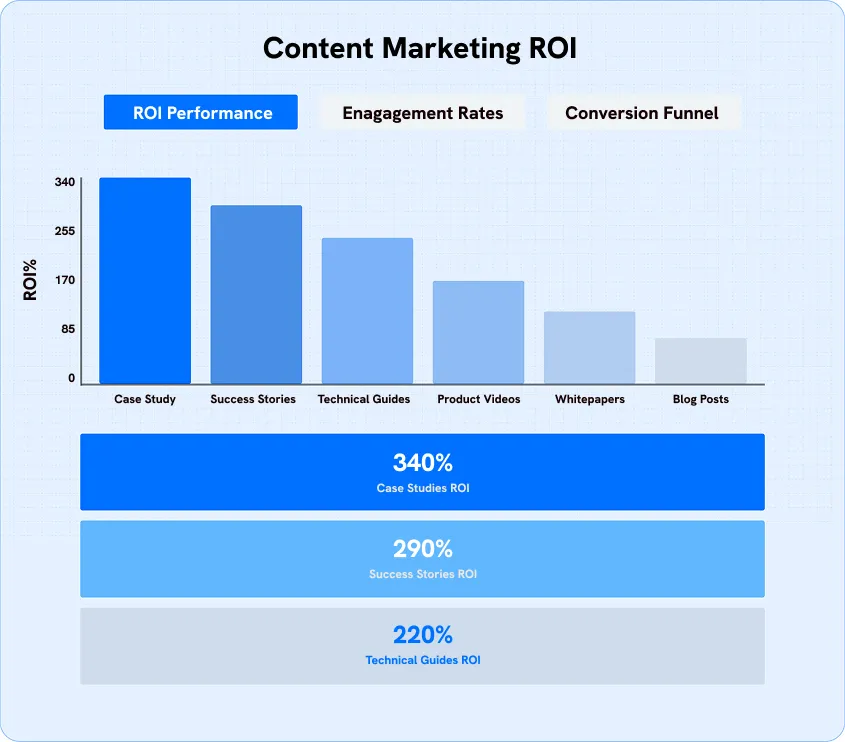
- Real Customer Success Stories with Measurable Results
Showcase how your machinery has helped customers improve efficiency or reduce costs with specific metrics, like "Reduced downtime by 30%" or "Increased output by 25%."
- Problem-Solving Guides
Offer actionable solutions, like "How to Reduce Machine Downtime by 40%," to directly address common pain points and demonstrate your expertise.
- Industry Trend Analysis and Future Predictions
Share data and insights on industry trends, such as automation or Industry 4.0, to position your brand as a thought leader and engage decision-makers.
- Side-by-Side Equipment Comparisons with Honest Pros/Cons
Provide clear comparisons of your machinery versus competitors, highlighting key features and offering an honest evaluation to help buyers make informed decisions.
By using these content types, you'll build trust and help buyers see the value of your machinery.
Video Marketing That Shows Your Machinery in Action
Video is one of the most effective ways to demonstrate your machinery’s value. Here’s how you can leverage it to engage potential buyers:
- Live Equipment Demonstrations Solving Real Problems
Show how your machinery addresses specific operational challenges. This helps buyers visualize the impact your equipment will have on their own operations.
- Customer Testimonials Recorded on Their Factory Floors
Capture real customer stories on their factory floors, discussing how your machinery has improved their efficiency, reduced costs, or solved a specific problem.
- Virtual Facility Tours and Manufacturing Process Videos
Offer a transparent look at your manufacturing process with a virtual tour. Highlight the quality of materials, technology, and craftsmanship behind your machinery.
- Quick Tutorial Videos for Common Maintenance Issues
Create short videos addressing common maintenance problems. This shows your commitment to customer support while demonstrating the ease of maintaining your equipment.
These video strategies give buyers an inside look at how your equipment works and the value it can bring to their operations.
Paid Advertising That Reaches Serious Machinery Buyers
Paid advertising can be a game-changer for getting your machinery in front of the right buyers. Here’s how you can use it effectively to reach decision-makers who are ready to buy:
Google Ads Strategy
Think of Google Ads as a way to show up exactly when someone is looking for equipment like yours. For example, when someone searches for "industrial CNC machine supplier," your ad can appear right in front of them.
- Target high-intent keywords like “industrial [equipment type] supplier” to attract buyers actively searching for machinery.
- Geographic targeting helps you focus on specific regions where you operate or want to sell your products.
- Dedicated landing pages for each type of machinery make it easier for buyers to find exactly what they need and get more information on your equipment.
LinkedIn Advertising
LinkedIn is a great place to reach decision-makers like production managers, engineers, and procurement teams in the manufacturing industry. Instead of pushing a hard sales pitch, think about sharing helpful content, like industry insights or case studies, that show how your machinery can solve their problems.
- Target by job title and company size to ensure your ads reach the right people, whether they’re managing a small workshop or a large factory.
- Sponsor content that provides value rather than just a sales message. This approach helps you build trust and get on the radar of decision-makers.
Paid advertising doesn’t need to be complicated. By targeting the right people with the right message, you’ll get your machinery in front of those who are ready to invest.
Social Media for Machinery Manufacturing (Done Right)
Social media isn't just for influencers; it's a powerful tool for manufacturers to connect with potential buyers and showcase their expertise. Here's how to use LinkedIn and YouTube effectively:
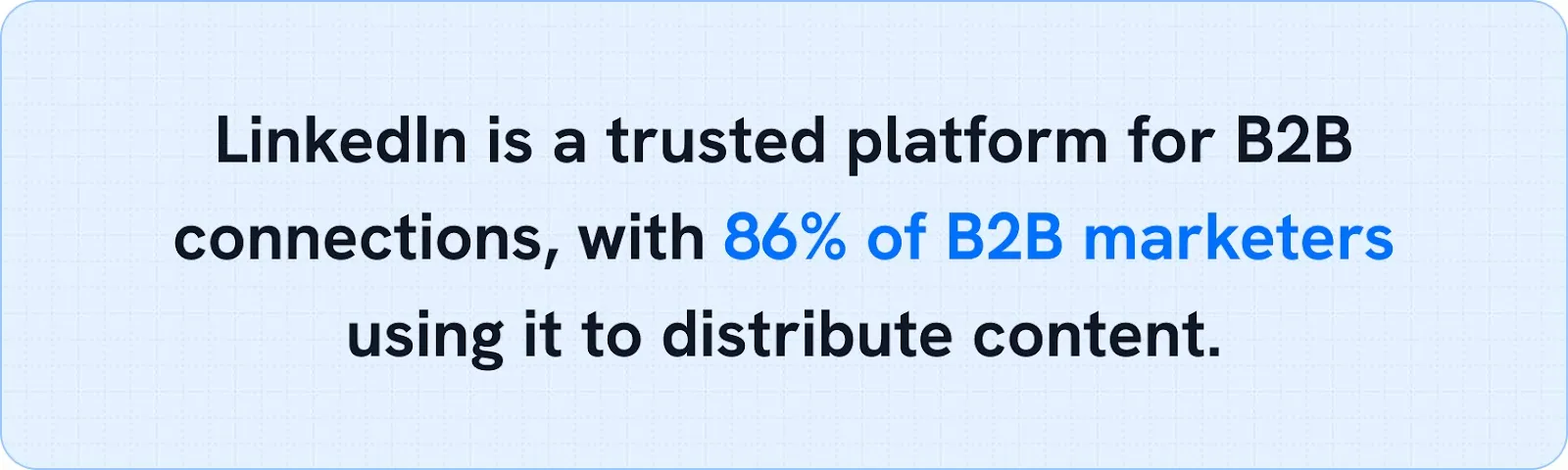
LinkedIn for B2B Connections
- Share Industry Insights and News
Keep your audience informed about trends, new technologies, and market shifts. This positions your company as a thought leader in the industry.
- Participate in Relevant Industry Group Discussions
Engage with professionals in your field by answering questions, sharing knowledge, and joining conversations that matter.
- Showcase Employee Expertise and Company Culture
Highlight the skills and dedication of your team, and give a behind-the-scenes look at your company's values and work environment.
YouTube for Visual Learners
- Equipment Demonstration Playlists
Create a series of videos showcasing your machinery in action, highlighting its features and benefits.
- Educational Content Series
Offer valuable information on topics like maintenance tips, industry best practices, or how-to guides related to your products.
- Customer Case Study Videos
Share stories from satisfied clients who have benefited from your equipment, providing social proof and building trust.

By strategically using LinkedIn and YouTube, you can effectively showcase your machinery, engage with potential buyers, and build lasting relationships in the manufacturing industry.
Email Marketing for Complex Sales Cycles
Email marketing can be a game-changer for manufacturers, especially when dealing with long and complex sales cycles. By using email strategically, you can stay top of mind, nurture leads, and ultimately drive conversions. Here’s how to make it work:
- Segment Your List by Buyer Role and Manufacturing Industry
Not all buyers are looking for the same thing. Segment your email list based on factors like buyer role (e.g., production managers, procurement teams) and the specific manufacturing industry they’re in. Tailoring your messages to each group ensures they receive relevant content that speaks directly to their needs.
- Monthly Newsletter with Industry News and Insights
A well-crafted monthly newsletter can keep your audience informed and engaged. Share industry news, trends, and insights that are relevant to your buyers. This positions your business as a trusted source of information, making your audience more likely to think of you when they’re ready to make a purchase.
- Automated Nurture Sequences for Different Buyer Stages
Not every lead is ready to buy right away. Automated nurture sequences allow you to guide prospects through their buying journey with the right content at the right time. Whether they’re in the awareness, consideration, or decision stage, providing targeted emails will help move them closer to making a purchase.
- Follow-up Campaigns for Trade Show Leads and Inquiries
After meeting potential buyers at trade shows or receiving inquiries, timely follow-ups are crucial. Use email to reconnect with leads, remind them of the value you offer, and provide additional information to keep the conversation going. A well-timed follow-up can turn a casual lead into a customer.
By segmenting your email list, sharing valuable content, automating nurture sequences, and following up promptly, you can effectively guide leads through complex sales cycles and increase the likelihood of converting them into customers.
Track the Right Metrics for Manufacturing Marketing
For manufacturers, every marketing dollar needs to count. It’s not just about getting leads; it’s about getting the right leads and converting them into long-term customers. Here are the five most important metrics you should be tracking to ensure your marketing efforts are driving real results:
- Cost per Manufacturing-Qualified Lead (MQL)
This metric shows you how much you’re spending to generate high-quality leads, those that are more likely to convert into paying customers. Tracking your cost per MQL helps you understand if your marketing budget is being spent effectively, ensuring you're focusing on high-value prospects.
- Lead Conversion Rate by Source
Not all marketing channels perform the same. Whether it's from trade shows, Google Ads, LinkedIn, or other sources, knowing the conversion rate by source lets you see which channels are bringing in the best leads. This data allows you to focus your efforts on the sources that deliver the highest return.
- Time from Inquiry to Sale
The manufacturing sales cycle is often longer, but that doesn't mean it should be inefficient. Tracking time from inquiry to sale helps you spot delays in your process. Are leads getting stuck at certain stages? Understanding this metric allows you to identify bottlenecks and speed up the process, improving your conversion rate.
- Customer Lifetime Value (CLV) by Acquisition Channel
It’s crucial to look at not just how many leads you’re bringing in, but how valuable they are over time. Customer lifetime value (CLV) helps you measure how much a customer is worth over their entire relationship with your business.
Tracking CLV by acquisition channel shows you which marketing channels bring in the highest-value customers, allowing you to double down on what works.
- Return on Marketing Investment (ROMI) by Campaign
Tracking ROMI for each campaign tells you how much return you’re getting for every dollar spent. This helps you see which marketing efforts are driving real sales and profit. If you’re not tracking this, you could be wasting money on campaigns that aren’t performing.
Your 30-Day Quick Start Plan
Starting a digital marketing journey for your manufacturing business can feel overwhelming, but with the right plan, you can create impactful strategies that drive results.
This 30-day quick start plan is designed to help you systematically audit your current digital presence, identify key opportunities, and implement a targeted approach to attract and nurture leads.
Week 1: Audit Your Current Website and Online Presence
The first step in transforming your manufacturing marketing strategy is understanding your current digital presence. In Week 1, conduct a comprehensive audit of your website and online presence, evaluating key areas like website structure, content, and user experience (UX).
- Website Review: Assess the design and functionality of your website. Is it mobile-responsive? Does it load quickly? Is the navigation intuitive for potential customers searching for your products or services?
- SEO Health Check: Use tools such as Google Analytics and SEMrush to evaluate your website’s SEO performance. Are your product pages optimized with relevant keywords? Are there any broken links or technical issues impacting your rankings?
- Social Media & Online Listings: Review your presence on social media platforms (LinkedIn, YouTube, Facebook) and business directories (Google Business, Yelp). Is your profile information consistent? Are your posts engaging your target audience?
By the end of Week 1, you’ll have a clear understanding of your digital footprint, pinpointing areas that need immediate improvement.
Week 2: Research Competitor Strategies and Identify Content Gaps
With an understanding of your own website’s performance, Week 2 is focused on competitive analysis and identifying content opportunities to strengthen your position in the market.
- Competitor Analysis: Research your competitors' digital marketing strategies. Explore their websites, social media, content, and paid ads. What keywords are they targeting? What is their approach to engaging potential customers?
- Content Gaps: Identify areas where your website may be lacking content. Are there industry topics or frequently asked questions that are missing? Are there types of content like case studies, white papers, or blogs that your competitors are excelling in that you could enhance or approach differently?
- Customer Pain Points: Investigate common issues in your industry that your competitors aren’t addressing adequately. This will provide insights into content that directly speaks to your audience’s needs.
By the end of Week 2, you will have identified content gaps and strategic opportunities to distinguish your brand and address the needs your competitors may be missing.
Week 3: Set Up Tracking and Launch Your First Targeted Campaign
Week 3 is about laying the groundwork for data-driven marketing. You will establish tracking systems and launch your first targeted digital campaign based on the insights from Week 2.
- Set Up Analytics: Implement tracking tools like Google Analytics and Google Tag Manager on your website. Ensure you have conversion tracking set up to measure important actions like form submissions, downloads, or quote requests.
- Define KPIs: Establish key performance indicators (KPIs) that will help measure your campaign success. Examples include website traffic, lead generation, and sales conversions.
- Launch Your Targeted Campaign: Based on the insights from Week 2, launch your first targeted campaign. Consider running a Google Ads campaign targeting specific keywords like “rubber extrusion services” or a LinkedIn ad campaign targeting key decision-makers in industries like automotive.
Week 3 is about transforming your research into actionable campaigns. Monitor performance closely to ensure you’re reaching your goals.
Week 4: Publish Valuable Content and Start Nurturing Leads
Now that you've set the stage with your campaigns, Week 4 is all about leveraging content to establish authority and begin nurturing the leads you’ve attracted.
- Publish Engaging Content: Create and distribute high-value content that addresses the challenges your audience faces. This could include blog posts, case studies, product demos, or industry reports.
- Lead Nurturing: Set up email marketing automation to nurture leads who have engaged with your content. Share additional valuable resources, such as whitepapers or webinars, to guide them through the buyer journey.
- Social Proof: Incorporate customer testimonials, success stories, and case studies that demonstrate real-world results and build trust with potential clients.
- Optimize and Refine: Use insights gathered from the campaigns in Weeks 1-3 to optimize your content and outreach efforts. Review what resonates with your audience and fine-tune your approach.
Week 4 is about building lasting relationships with your audience by providing continuous value and refining your strategy for future campaigns.
By following this 30-day plan, you’ll set up a strong foundation for digital marketing that grows your online presence, attracts quality leads, and strengthens your position in the plastics and rubber manufacturing industry.
Ready to Stop Losing Deals to Better-Marketed Competitors?
Digital marketing for machinery manufacturing isn't about flashy campaigns or trends; it's about ensuring you're visible when your ideal customers are actively searching for solutions. The companies that adapt their marketing strategies now will have the competitive edge today and in the years to come.
Your next steps:
- Honestly Evaluate Your Current Digital Presence
Take a hard look at how your business is represented online. Are you easy to find? Do you rank well for key search terms? Is your website optimized to convert visitors into leads? If the answer is no, now is the time to make changes. Platforms like Gushwork offer free audits to help you identify exactly what’s missing and how to fix it.
- Identify Which Competitors Are Winning Online
Take the time to research what your competitors are doing right. What keywords are they ranking for? What kind of content are they publishing? What channels are driving traffic to their sites? Understanding your competitors’ strengths gives you a clear direction on where to focus your efforts.
- Choose 2-3 Strategies and Commit to Doing Them Consistently
Digital marketing is not a one-time effort; it’s a long-term commitment. Choose 2-3 strategies (like SEO, paid ads, content creation, or social media) that align with your goals and commit to doing them consistently.
Are You Losing Leads to Competitors?
Get a free analysis of your online presence and discover exactly why machinery buyers aren’t finding you first.
Claim Your Free Lead Audit
The manufacturers who take action now, building a solid digital marketing foundation, will not only keep up with their competitors, but they'll dominate the market for years to come. Don’t wait until 2025 to start. Claim your free lead audit with Gushwork today and start building the predictable, scalable lead generation system your business needs to succeed.
FAQs
Q1. How can digital marketing help machinery manufacturers generate more qualified leads?
A1. Digital marketing helps machinery manufacturers by improving online visibility, targeting high-intent buyers, and providing valuable content that attracts, engages, and nurtures leads through their decision-making process.
Q2. What are the best digital marketing strategies for manufacturing companies?
A2. The best strategies include SEO for organic search visibility, paid ads targeting specific buyer needs, content marketing to educate potential customers, and social media to build relationships and authority within the industry.
Q3. How can I improve my manufacturing company’s website to generate more leads?
A3. To improve your website, ensure it’s optimized for SEO, has clear CTAs, is mobile-friendly, and offers valuable content. Tools like Gushwork can help create high-converting landing pages and track what’s working to optimize lead capture.
Q4. What’s the role of content in attracting qualified buyers for manufacturing companies?
A4. Content plays a crucial role by addressing potential customers' pain points and questions. By offering educational materials like technical guides, case studies, and product demos, manufacturers can build trust and authority, ultimately converting leads into customers.
Q5. How long does it take to see results from digital marketing in the manufacturing sector?
A5. Digital marketing results can vary, but with consistent effort, manufacturers can see noticeable improvements within 3-6 months. SEO and content strategies may take longer to yield results, while paid campaigns can show more immediate returns.
Q6. How can I track the effectiveness of my marketing campaigns?
A6. Use tools like Google Analytics and Gushwork’s lead tracking system to monitor key metrics such as website traffic, conversion rates, and ROI. Tracking these metrics helps you understand which campaigns are working and where to optimize.
.webp)
CRM
Sep 3, 2025
5 mins
5 CRM Tools To Help Manufacturing Teams in the USA Align Sales, Operations, And Marketing
Batul Beawarwala
For small and medium-sized manufacturers, growth is all about efficiency. You're juggling requests for quotes, managing technical specifications, and trying to keep track of a handful of large, high-value deals.
But if you're like many in the industry, you're still relying on spreadsheets and manual processes, which leads to lost data, missed opportunities, and the nagging feeling that you're falling behind.
It's a frustrating situation: you know a Customer Relationship Management (CRM) system could help, but the market is full of options, and most seem built for every industry except yours. How can a CRM help with things like inventory management, order tracking, or demand forecasting?
This guide breaks down what a CRM can do for your business and highlights some of the top platforms that are a good fit for manufacturing.
We’ll look at everything from specialized solutions built just for your industry to flexible options that can be adapted to your unique needs.
TL;DR:
Manufacturing businesses lose deals to poor lead tracking, not bad products. Here are 5 CRM platforms that can fix that:
1. Gushwork - The only CRM built exclusively for manufacturers. Goes beyond basic lead tracking to include integrated marketing, SEO, and content systems.
2. HubSpot CRM - Free tier makes it perfect for testing CRM waters. Good pipeline visualization and email integration. Starting point for small manufacturers new to CRM.
3. Salesforce Manufacturing Cloud - Enterprise-level solution with advanced forecasting and AI insights. Expensive ($150+/month) but handles complex global operations.
4. SugarCRM - Highly customizable with strong ERP integration capabilities. Mid-range pricing ($52-85/month) for manufacturers with specific workflow needs.
5. Zoho CRM - Budget-friendly option ($14/month) with quote management and inventory integration. Good for small manufacturers and startups.
Most manufacturers need to fix their lead generation before worrying about CRM features. Gushwork addresses this by combining CRM with marketing infrastructure, while the others focus purely on managing leads you already have.
1. Gushwork - Built Exclusively for Manufacturers

When it comes to a CRM for manufacturing, most companies miss the point. You're offered a piece of software and it's called a solution. But for you, the real problem isn't just a lack of software, it's a lack of a cohesive system.
You're losing leads because your website isn't connected to your sales team. You're spending too much time on manual tasks because your CRM isn't built for leads. You're trying to grow, but you’re stuck managing a scattered collection of tools that don't talk to each other.
Gushwork is different because it’s not just a CRM; it’s an integrated marketing and sales infrastructure built specifically for the way manufacturers do business.
Gushwork understands that your buyers are different. They're technical. They need detailed information. The sales cycle isn't a simple funnel, it's a complex journey from a technical specification to a final quote. You can't rely on generic tools.
This single, powerful system takes a buyer from their first search to their final order. The system is built to optimize your website to attract the right people, create content that answers their technical questions, and implement a lead management system that's ready for your leads.
How Gushwork Solves Your Biggest Problems:
- You're losing leads and opportunities. Gushwork ensures every lead is captured and routed correctly from the first moment of contact. The platform provides pre-built workflows for managing leads and technical specifications, so you never miss a detail or a deadline again.
- Your sales and marketing teams are out of sync. With Gushwork, your website, content, SEO, and lead tracking all work as one cohesive unit. Marketing generates the right leads, and your CRM gives your sales team the full context they need to close the deal.
- You’re tired of managing complex, disconnected tools. Gushwork offers a complete, single solution. You won't need to duct-tape a generic CRM to an external marketing tool. The system is designed to handle your specific needs, from multi-location inventory visibility to built-in compliance tracking.
- You want to build long-term value, not just short-term campaigns. Gushwork builds an engine that gets stronger over time. Your SEO improves, your content library grows, and your CRM data becomes a valuable asset for future growth.
Best For: Mid-market manufacturers who need an industry-specific solution and a complete marketing system that understands their unique pain points and is built for long-term growth.
2. HubSpot CRM - Free Entry Point with Scaling Options
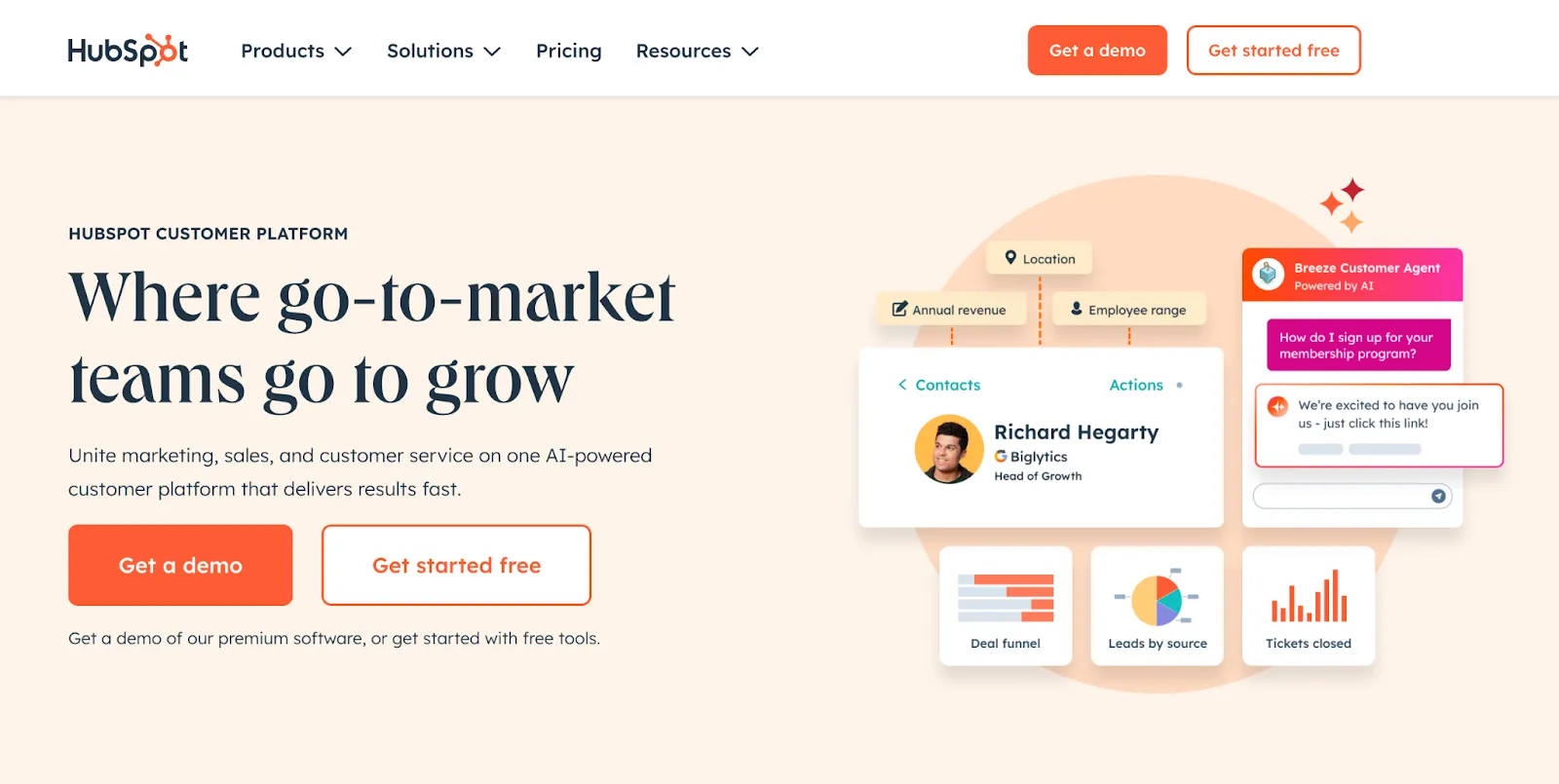
HubSpot is a household name in the CRM world, and for good reason. Its freemium model makes it an excellent starting point for manufacturing SMBs who want to test the waters of a CRM without a significant financial commitment.
Key Features
- Free Tier: The free version offers basic but powerful tools for contact management, deal pipelines, and task automation.
- Email Marketing Integration: Easily manage email communication with leads and customers directly within the platform.
- Deal Pipeline Customization: You can customize the sales pipeline to match your specific sales stages, from initial inquiry to closed deal.
- Document Management: Store and share quotes, proposals, and product documents with your team and clients.
Lead Tracking
HubSpot provides a visual pipeline that lets you see where every deal stands. You can use its lead scoring to prioritize which leads to follow up with and see a complete activity timeline for every contact.
Pricing
The free tier is a great starting point, with paid plans offering more advanced features starting at $45/user/month.
Best For
Small manufacturers who are new to CRM and want an easy-to-use platform with a generous free tier to get started.
3. Salesforce Manufacturing Cloud
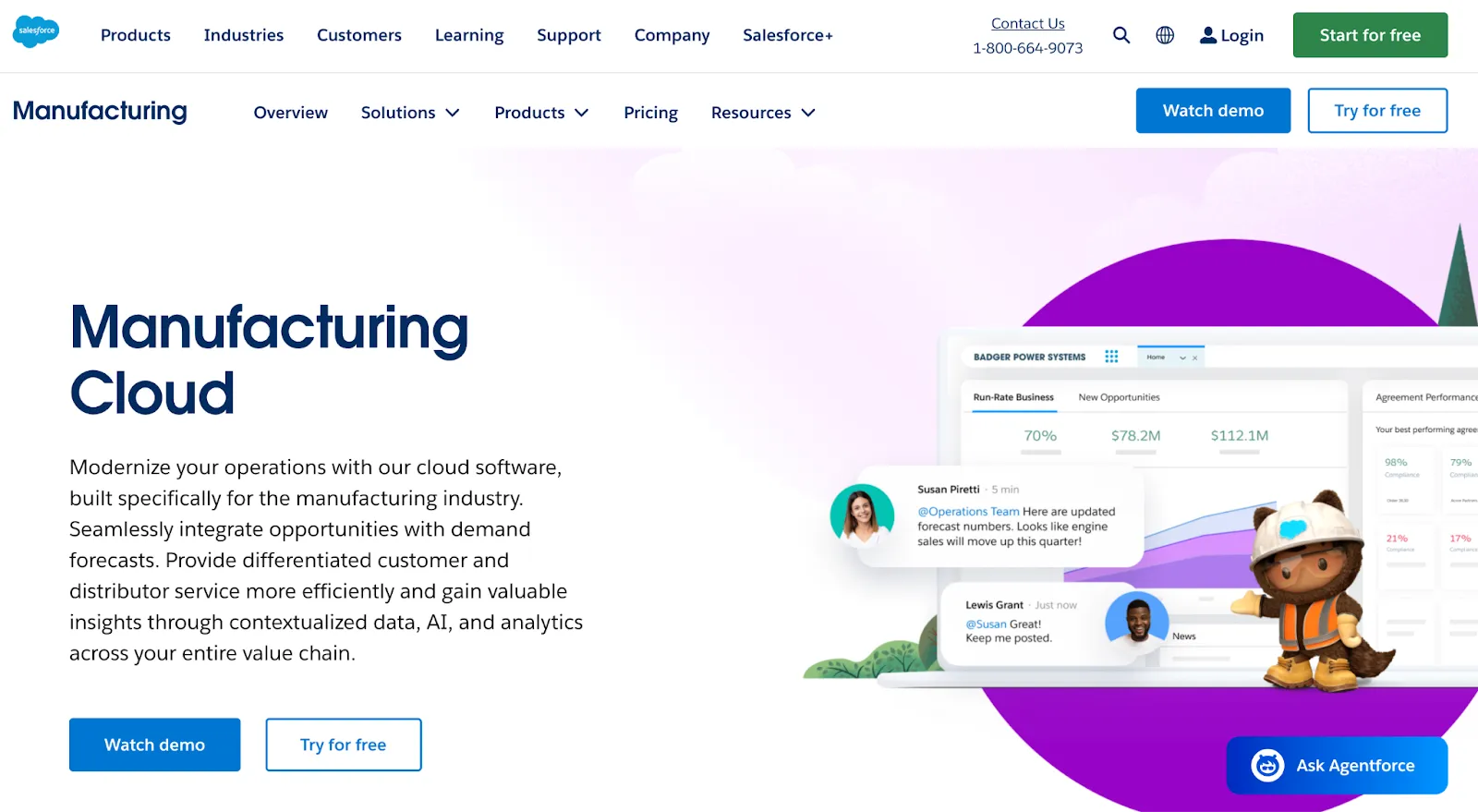
For larger enterprises and those with complex global operations, Salesforce Manufacturing Cloud offers a robust and comprehensive solution. It's built on the world's leading CRM platform but with modules specifically designed to address the needs of the manufacturing sector.
Key Strengths
- Account-Based Selling: Tools that help you manage and grow relationships with key accounts and partners.
- Partner Relationship Management: Effectively manage your network of dealers, distributors, and other channel partners.
- Advanced Forecasting: Use sophisticated tools to predict demand and manage sales forecasts with greater accuracy.
- AI-Powered Insights: Get data-driven recommendations on how to prioritize leads, improve sales processes, and identify new opportunities.
Lead Tracking
Salesforce provides a highly comprehensive lead tracking system with advanced analytics and reporting capabilities. It can handle large-scale data and complex sales processes with ease.
Pricing
Pricing is on the higher end, starting at around $150/user/month. This is a premium solution for businesses with a premium budget.
Best For
Large manufacturers with complex sales processes, global operations, and a need for highly advanced forecasting and analytics.
4. SugarCRM - Flexible and Customizable
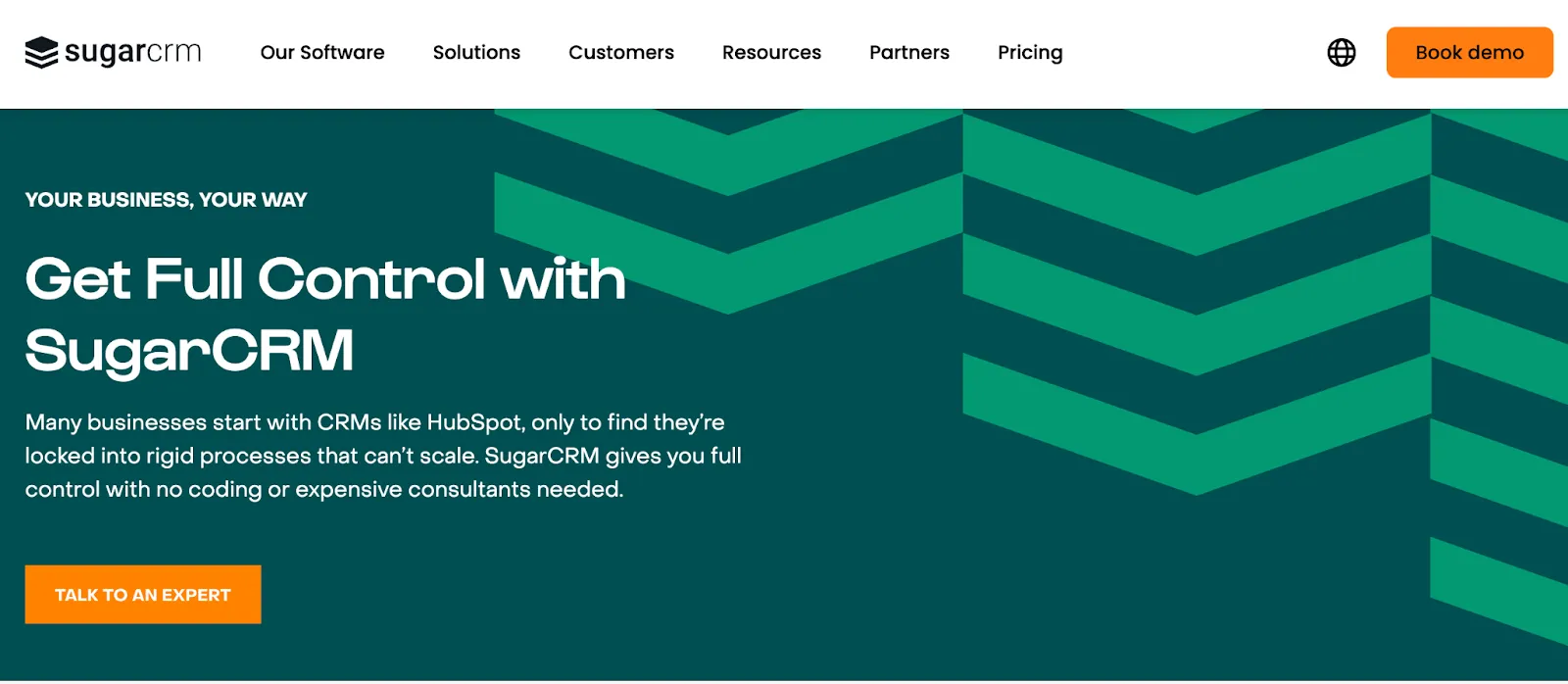
SugarCRM is a great option for manufacturers who need a highly customizable platform that can be tailored to their specific workflows. Built on an open-source foundation, it offers flexibility that many other CRMs don't.
Key Strengths
- Highly Customizable Workflows: You can design and automate custom workflows that match your unique sales and production processes.
- Strong ERP Integration Capabilities: SugarCRM is known for its ability to integrate with Enterprise Resource Planning (ERP) systems, which is critical for tying sales to production and inventory.
- Channel Partner Management: Tools to help you manage relationships and sales with your channel partners.
Lead Tracking
SugarCRM offers customizable pipelines and detailed reporting, so you can track leads in a way that makes sense for your business.
Pricing
Mid-range pricing, with plans starting at around $52-$85/user/month.
Best For
Manufacturers who have specific workflow requirements or a need for deep integration with existing ERP systems.
5. Zoho CRM - Another Popular Option
For small businesses just starting their CRM journey, Zoho CRM is an excellent and affordable choice. It offers a wide range of features, with specific add-ons that can be useful for manufacturers.
Key Features
- Quote Management: Generate and send quotes directly from the CRM, streamlining the quoting process.
- Inventory Integration: Connect with your inventory system to get real-time stock levels and manage orders.
- Multi-channel Lead Capture: Capture leads from your website, social media, and other channels.
Lead Tracking
Zoho provides a clean and intuitive interface for tracking leads and managing deals, with enough features to get the job done without being overwhelming.
Pricing
Pricing is highly competitive, starting at just $14/user/month, making it one of the most budget-friendly options on the market.
Best For
Small manufacturers and startups looking for an affordable yet powerful CRM with room to grow.
Even with a budget-friendly and powerful tool like Zoho, a common challenge remains: understanding how a CRM will fit into your existing, often manual, processes. You can have the best tool in the world, but if you don't know how to use it to solve your real-world problems, it won't help you grow.
But Wait, Will Any of These Actually Help You?
Now that you've seen your options, let's make sure you're solving the right problem. Even with a budget-friendly and powerful tool like Zoho, a common challenge remains: understanding how a CRM will fit into your existing, often manual, processes.
You can have the best tool in the world, but if you don't know how to use it to solve your real-world problems, it won't help you grow.
Before investing time and money in a CRM system, you need to honestly assess whether your current problems are ones that CRM can actually solve.
Here are the warning signs that indicate a CRM would make a real difference for your manufacturing business.
Still Using Spreadsheets? It's Time to Move On
If you're tracking leads and customers in spreadsheets, you're probably experiencing these problems: someone updates the wrong version of the file, critical information gets lost when people forget to save changes, and your team wastes time searching through multiple sheets to find basic customer details.
Here's the test: Can anyone on your team instantly tell you the status of your top 10 prospects right now?
If the answer involves opening multiple files, making phone calls, or checking different email threads, a CRM will help. When customer information is scattered across spreadsheets, emails, and people's heads, you're losing deals because of poor organization, not poor products or pricing.
Can't See the Bigger Picture? CRM Gives You the Full View
Ask yourself these questions: Do you know how many leads you got last month versus this month? Can you predict which deals are most likely to close next quarter? When a customer calls upset about a delayed order, does your team scramble to piece together what happened?
If you can't answer these questions quickly, you're operating blind.
Manufacturing businesses deal with long sales cycles and complex projects where small details matter. When you can't see the full picture of your sales pipeline and customer relationships, you make reactive decisions instead of strategic ones.
A CRM gives you the data visibility needed to spot trends, predict problems, and allocate resources effectively.
Stop Guessing About Your Sales Pipeline
Book a free 15-minute audit call to identify the gaps in your current tracking system and see exactly where deals are falling through.
Book a Consultation
What If CRM Isn't Your Real Problem?
You might be thinking, "I've tried a CRM, and it didn't work." But before you blame the software, it's important to ask yourself some tough questions about the foundation of your business: your marketing and lead generation. A CRM is a fantastic tool for managing leads, but it can't create them out of thin air.
Are You Even Getting Enough Leads?
If your marketing isn't generating enough qualified leads, no CRM in the world will fix that. It's crucial to have a solid marketing engine in place first to drive traffic and capture interest. A CRM is only as effective as the leads it receives. Without a steady stream of qualified prospects, even the most advanced CRM will sit empty.
Are You Capturing Leads the Right Way?
Once you start generating leads, are you capturing them in a way that provides the most value? Are you using well-designed website forms? Are you offering valuable content downloads?
A good CRM helps you track and manage these leads, but you have to make sure your lead capture methods are effective. The data you put into the CRM is what you'll get out of it.
It Might Be Time to Look at Your Marketing, Not Just the CRM
If you're not seeing the results you want, it might not be the CRM. It might be time to evaluate your entire marketing system. Are you reaching the right people? Are your messages compelling? If you fix the foundation, a CRM can then become the powerful engine that helps you convert leads into customers.
Is Your CRM Really the Problem? Let’s Find Out.
Book a free consultation to figure out if you need a new CRM or just a better marketing system to drive the right leads.
Let’s Talk!
So What Should You Actually Look For in a Manufacturing CRM?
Now that you understand what's available and what problems CRM actually solves, let's talk about choosing wisely. You don't need a system with hundreds of features you'll never use. You need a tool that's simple, powerful, and tailored to your specific needs.
The key is to avoid the overwhelming list of features and focus on what truly matters for growth.
Keep It Simple, But Powerful
Your ideal CRM should focus on a few core functionalities: a clear sales pipeline to monitor the status of every deal, tools to capture and nurture leads effectively, and automation for repetitive tasks like follow-up reminders.
These are the essentials that will deliver the most value without overwhelming your team.
Look for features that specifically address manufacturing challenges, such as the ability to attach technical specifications to deals, track RFQ responses, and manage long sales cycles with multiple touchpoints.
The interface should be intuitive enough that your team will actually use it, not so complex that it becomes another burden.
Integration is Key
A siloed CRM is a useless CRM. Make sure the platform you choose can easily integrate with the other tools you already use, such as your email marketing platform, accounting software, and even your inventory management system. This ensures a seamless flow of data across your entire operation.
The best CRMs for manufacturing connect with ERP systems, allowing you to see inventory levels when making promises to customers and automatically updating production schedules when deals close.
This integration eliminates duplicate data entry and ensures everyone is working with the same information.
The Real Benefits You'll See with the Right Manufacturing CRM
Now that you know what to prioritize when evaluating CRM options, let's talk about what success actually looks like.
Say Goodbye to Lost Leads and Missed Opportunities
Every manufacturing business has horror stories about leads that got lost in the shuffle. Someone called asking for a quote, but the message got buried in emails.
A potential customer filled out a form on your website, but nobody followed up for a week. These missed opportunities add up fast when you're dealing with high-value deals.
A CRM eliminates these problems by creating a systematic approach to lead capture and follow-up. Every inquiry is automatically logged, assigned to the right person, and tracked until completion.
You'll have automated reminders for follow-ups, so no lead sits ignored. For manufacturing SMBs where each deal can represent significant revenue, this level of organization can be the difference between hitting your growth targets and falling short.
Improve Communication Across Your Team
In many manufacturing companies, the sales team operates independently from production, and customer service works in its own silo. This disconnect creates confusion about order status, delivery timelines, and customer requirements.
When a customer calls with a question, your team spends valuable time tracking down information instead of solving problems.
A CRM breaks down these barriers by centralizing all customer information. Your sales rep can see production schedules, your production manager can access customer specifications, and your customer service team knows the complete history of every interaction.
This improved communication leads to faster response times, fewer errors, and ultimately, happier customers who see your company as organized and professional.
Scale with Ease
The biggest challenge for growing manufacturing businesses isn't just getting more customers—it's managing the increased complexity without drowning in administrative work. As your customer base grows, manual processes become increasingly difficult to maintain.
A CRM grows with your business by automating routine tasks and providing the structure needed to handle increased volume.
You can manage twice as many customers without doubling your administrative workload. The system handles lead scoring, follow-up reminders, and status updates automatically, freeing your team to focus on what they do best: building relationships and closing deals.
That’s all! Now Take the Next Step: Optimize Your Manufacturing Business with CRM
Most manufacturers make the mistake of jumping straight into CRM selection without addressing the fundamentals.
The manufacturing companies that see real results from CRM follow a different playbook. They fix their lead generation engine first, choose tools their team will actually use, and integrate everything from day one. This approach turns CRM from an expensive data repository into a revenue-generating machine.
Here's your roadmap to CRM success:
Step 1: Fix Your Lead Generation First
If you're getting fewer than 10-15 qualified leads monthly, your marketing needs work before any CRM can help. Audit your website: Can prospects find you easily and understand what you do?
Most manufacturing sites bury their value proposition under technical specs.
Step 2: Choose the Right Fit
Get input from everyone who'll actually use the system daily. Don't get swayed by flashy features in sales presentations, focus on whether your team can actually navigate the system and complete their daily tasks efficiently.
Step 3: Plan Integration from Day One
Map your current process first, then choose a CRM that fits your workflow rather than forcing your team to adapt to the software. Connect it to your existing tools immediately, duplicate data entry kills adoption faster than poor training.
Turn More Prospects Into Paying Customers
Connect to know if your current system is working as hard as it should.
Book a Consultation

Industrial Sales
Sep 3, 2025
5 mins
If Your Revenue Isn’t Growing Despite Hiring Manufacturing Reps, This Could Be The Reason
Batul Beawarwala
Most manufacturers choose sales reps because the math seems straightforward: no base salaries, no benefits, commission-only payments. You only pay when they close deals, which feels like the safest way to control sales costs.
And on paper, it makes perfect sense. Why risk the overhead of building an internal sales team when you can tap into existing rep networks that already have relationships in your target markets?
But there's an assumption built into this logic that many manufacturers don't examine closely enough: that commission-only payment actually guarantees efficient use of your resources.
Here's what we've observed working with manufacturers across different industries:
While you're not paying unsuccessful reps a salary, you are paying in lost time-to-market, delayed revenue, and missed opportunities with better prospects.
What Are Manufacturers' Representatives? (The Basics You're Looking For)
If you're researching this topic, you need to understand exactly what you're considering before weighing the strategic implications.
What Are Manufacturers’ Representatives?
A manufacturers' representative can be either an individual sales professional or a sales agency/firm that represents your products in specific markets or territories.
These external sales partners (also called manufacturer sales reps, rep firms, or independent sales agencies) work commission-only, they earn nothing unless you sell. Unlike direct employees, they operate as independent contractors whether working solo or as part of a multi-person agency.
Here's how these arrangements typically work in practice:
How Manufacturer Reps Work
The business model is straightforward, but the operational details determine whether this approach works for your specific situation.
1. Commission-Only Structure: No Base Salary, No Benefits
Manufacturer reps operate as independent contractors, typically earning 3-15% commission on sales depending on your industry and product complexity. You pay no salary, benefits, or overhead costs. This structure transfers financial risk from you to the rep, if they don't perform, you don't pay.
2. Multi-Line Representation: Carrying Complementary Product Portfolios
Most reps carry 8-20 complementary (non-competing) product lines from different manufacturers. For example, a rep selling industrial pumps might also represent filtration systems, control valves, and monitoring equipment. This portfolio approach gives them more reasons to visit the same customers and potentially increases their earning potential per sales call.
The Apparent Financial Appeal
This commission-only structure creates two immediate cost advantages that make manufacturer reps attractive to most manufacturers evaluating their options.
Variable Costs That Scale With Sales Performance
Traditional sales employees cost you whether they sell or not. A $75,000 salary plus benefits costs roughly $100,000 annually regardless of results. With reps, your sales costs only occur when revenue comes in, creating a direct correlation between expense and performance.
No Overhead for Salaries, Benefits, or Training
Beyond commissions, reps handle their own expenses: travel, entertainment, trade shows, business development, and ongoing education. They invest their own time and money into relationship building, territory development, and product knowledge acquisition.
So far, the manufacturer rep model sounds like the perfect solution, all the benefits of a sales force with none of the overhead risks. But this is where most manufacturers stop their analysis, missing critical considerations that only become apparent after working with reps for 12-18 months.
The Hidden Problem With Relying on Manufacturer Reps Alone

Yes, manufacturer reps only get paid when they close deals. Your financial ROI seems protected. But here's the catch: you're still dependent on their priorities, their existing relationships, and their ability to identify and pursue the right opportunities.
The Time ROI Problem: While your money might be "safe" with commission-only reps, your time to market isn't. Reps work multiple lines, chase leads across their entire portfolio, and may spend months on prospects that never convert, all while your growth timeline ticks away.
While they're chasing uncertain deals, your growth timeline extends and competitive windows close.
Stop Losing Valuable Time
Let’s take a deep dive into your sales pipeline and identify where time is slipping away. Book a consultation now to identify where you can improve time-to-market and boost your revenue.
Book a Consultation
The Dependency Risk You're Not Calculating
Beyond the obvious financial considerations, there are strategic vulnerabilities that many manufacturers don't fully evaluate when choosing the rep model.
Multi-Line Priorities: Where Does Your Product Rank?
When a rep carries 15 product lines, your products compete for attention within their own portfolio. A rep might prioritize a $50,000 equipment sale over your $5,000 component sale, even if your component has a higher probability of closing. Their economic incentives don't necessarily align with your growth priorities.
Relationship Ownership: What Happens When Reps Change?
Customer relationships belong to the rep, not to you. When reps retire, change territories, or drop your line, those relationships often leave with them. You're building someone else's asset rather than your own market presence.
The Lead Quality Gap
Even motivated, experienced reps face a fundamental challenge that the commission-only model doesn't solve: they still need to find and qualify prospects before they can sell to them.
Cold Prospecting vs. Warm, Qualified Opportunities

Manufacturer reps must divide their time between prospecting activities: researching companies, making cold calls, attending trade shows, and following up on unqualified leads, and actually selling to qualified prospects.
The more time they spend on prospecting, the less time they have available for closing deals. While you're not paying them during prospecting time, you are paying in delayed results and extended sales cycles.
Why Even Great Reps Struggle Without Marketing Support
The best reps are relationship builders and deal closers, not necessarily lead generation experts. Many excel at nurturing warm prospects but struggle with the modern digital research behaviors of technical buyers.
Today's engineering and procurement professionals do extensive online research before engaging with sales reps, but most reps lack the marketing tools and content to influence this early research phase.
Maximize Lead Quality
Book a consultation to learn how marketing can help qualify leads and shorten sales cycles.
Book a Consultation
This brings us to an important strategic decision point: given these inherent limitations with the rep-only model, what alternatives should manufacturers consider?
The Smarter Strategy: Marketing-Driven Sales (With or Without Reps)
Instead of choosing between expensive internal teams or uncertain external reps, build a marketing engine that creates qualified opportunities. Then your sales approach, whether internal team or manufacturer reps, focuses on high-probability conversations instead of cold calling.
How This Changes Everything: Marketing identifies prospects, nurtures them through educational content, and qualifies their buying readiness. Your sales resources (internal or external) work warm leads with clear buying signals instead of chasing anyone who might possibly need your product.
Marketing + Internal Sales Team: The Control Advantage
When you combine marketing-generated leads with internal sales teams, you create a controlled, predictable growth engine with two key advantages.
Qualified Pipeline Feeding Dedicated Product Experts
Internal sales teams receiving marketing-qualified leads can focus entirely on your products, understand your technical specifications completely, and represent your brand exactly as you intend. When they're working warm prospects instead of cold territory, conversion rates typically improve 40-60%.
Full Brand Control and Relationship Ownership
You control the entire customer experience from initial contact through post-sale support. Customer relationships become company assets rather than individual rep assets, creating sustainable competitive advantages and higher customer lifetime values.
Marketing + Manufacturer Reps: The Efficiency Play
Even if you choose to work with manufacturer reps, marketing support dramatically improves their effectiveness and your results.
Giving Reps Warm Leads Instead of Cold Territory
When you provide reps with marketing-qualified leads, their effectiveness increases dramatically. Instead of spending 60% of their time prospecting, they can focus on relationship building and deal closure. This often results in shorter sales cycles and higher conversion rates.
Higher Rep Performance When They're Not Prospecting
Reps perform best when they're selling, not prospecting. Marketing support allows them to leverage their relationship skills and product knowledge rather than spending time on activities they may not excel at or enjoy.
Protect Your Sales Pipeline
Don’t leave your sales growth to chance. Book a 15-minute consultation to learn how to build a more efficient sales system with better visibility.
Book a Consultation
Understanding these dynamics helps determine whether manufacturer reps align with your specific growth objectives and market conditions.
When Manufacturer Reps Make Sense (And When They Don't)
The strategic context of your business determines whether reps provide clear advantages or create unnecessary limitations.
Geographic Expansion Without Infrastructure Investment
There are specific scenarios where manufacturer reps provide clear strategic advantages over building internal capacity.
Testing New Markets Before Full Commitment
Reps provide market entry without requiring significant upfront investment in local hiring, office space, or market development. This approach works well when you're testing demand in new regions or industries before committing resources to direct market development.
Leveraging Existing Relationships in Established Territories
Established reps bring immediate access to decision-makers you might spend years trying to reach directly. In mature markets where relationships drive purchase decisions, rep networks can accelerate your market penetration significantly.
The Limitations Most Manufacturers Overlook
However, the rep model also creates constraints that can limit your growth potential in certain situations.
Divided Attention Across Multiple Product Lines
Reps follow their own sales methodologies, pricing discussions, and customer service approaches. While this might work fine for commodity products, complex technical solutions often require more controlled sales processes to ensure proper solution positioning and pricing discipline.
Limited Control Over Sales Process and Customer Experience
Reps excel at territory coverage but may lack deep technical expertise in your specific products. This trade-off works well for standard products but can be problematic for complex solutions requiring consultative selling or technical problem-solving.
Regardless of which sales model you choose, marketing support amplifies effectiveness by improving lead quality and reducing prospecting time.
Building Marketing That Multiplies Any Sales Strategy
Whether you work with internal teams or external reps, strategic marketing creates qualified opportunities that improve conversion rates and shorten sales cycles.
The Manufacturing Lead Generation Challenge
Before diving into specific tactics, it's important to understand why traditional marketing approaches fail in manufacturing markets.
Why Technical Buyers Ignore Generic Sales Approaches
Engineering and procurement professionals receive dozens of sales calls weekly. They've developed sophisticated filtering mechanisms to avoid wasting time on irrelevant pitches. Generic outreach, whether from internal reps or external reps, gets filtered out before reaching decision-makers.
Long Sales Cycles and Complex Decision-Making Units
Manufacturing sales cycles often span 6-18 months and involve multiple stakeholders: engineers, procurement, operations, and finance. Success requires nurturing relationships with different personas over extended periods, something traditional sales approaches handle inefficiently.
Given these realities, the question isn't whether to use manufacturer reps or not—it's how to set them up for success regardless of their limitations.
How to Make Manufacturer Reps Actually Work: The Marketing Foundation They Need
Whether you work with manufacturer reps or build internal teams, the fundamental challenge remains the same: most sales approaches fail because they start with cold prospects instead of warm, qualified opportunities.
Here's how to fix that.
The companies getting the best results from manufacturer reps aren't just handing them territories and hoping for the best, they're providing them with systematic marketing support that transforms how reps spend their time and dramatically improves their conversion rates.
Marketing Strategies That Transform Rep Performance
The most successful manufacturer rep relationships we've seen involve companies that build marketing engines specifically designed to support their reps with qualified, warmed-up prospects.
Content Marketing That Pre-Educates Your Rep's Prospects
Technical buyers research solutions extensively before engaging with any sales reps. When you create educational content addressing their specific challenges, application guides, technical comparisons, case studies, you position both your company and your reps as trusted resources rather than just another vendor cold-calling.
This approach means that when your manufacturer rep finally connects with a prospect, that buyer has already consumed your educational content, understands your solutions, and is further along in their buying process.
Instead of starting with "Let me tell you about our products," reps can start with "I saw you downloaded our guide on optimizing pump efficiency, what specific challenges are you facing in your facility?"
SEO That Captures Prospects When They're Actively Researching
Engineers search for specific technical specifications, application guidance, and problem-solving approaches. When you optimize content for these technical search queries, you capture high-intent prospects at the exact moment they're evaluating solutions.
These prospects then enter your marketing system, get nurtured with relevant content, and eventually become marketing-qualified leads that you can pass to your manufacturer reps.
Instead of reps spending their time prospecting, they spend that time building relationships with prospects who already understand your value proposition.
Start Your Marketing-Driven Sales Strategy
Book a consultation to explore how you can start generating qualified leads through marketing and accelerate your sales process.
Book a Consultation
Account-Based Marketing for High-Value Prospect Development
For large accounts or complex solutions, account-based marketing (ABM) focuses resources on specific target companies rather than broad market outreach. This approach works exceptionally well with manufacturer reps because it aligns perfectly with their relationship-building strengths.
ABM combines personalized content, targeted advertising, and coordinated outreach to engage multiple stakeholders within priority accounts simultaneously. Your marketing identifies and warms up key decision-makers, then your manufacturer rep leverages their relationship skills to convert those warm prospects into customers.
The Technology That Makes Rep Success Predictable
Modern marketing technology creates opportunities for precision and efficiency that transform how manufacturer reps operate.
Sales Intelligence That Times Rep Outreach Perfectly
Marketing tools provide detailed insights into prospect behavior: which content they've consumed, how frequently they visit your site, which team members are researching solutions.
This intelligence allows your manufacturer reps to time their outreach perfectly and customize their approach based on demonstrated interest.
Instead of reps making cold calls hoping to catch someone at the right time, they're reaching out to prospects who have already shown buying signals through their digital behavior. This dramatically improves connection rates and shortens sales cycles.
Integrated Systems That Ensure No Prospects Fall Through Cracks
When marketing and sales systems integrate properly, lead handoffs become seamless, follow-up becomes systematic, and no prospects disappear into the void.
Whether you're working with internal reps or external manufacturer reps, integrated systems ensure consistent follow-up and relationship nurturing throughout extended manufacturing sales cycles.
Your manufacturer reps receive not just contact information, but complete prospect intelligence: what content the prospect has consumed, which solutions they've researched, who else from their company is involved in the evaluation, and what stage they're at in their buying process.
The Answer: It's Not About the Reps, It's About What Feeds Them
Manufacturer reps aren't automatically the answer to sales growth, nor are they necessarily the wrong choice.
The deciding factor isn't rep vs. internal team, it's whether your chosen sales approach receives qualified opportunities or wastes time on cold prospecting.
If You're Considering Manufacturer Reps:
- Evaluate whether they'll receive marketing support or rely solely on cold prospecting
- Assess how your product priority ranks within their portfolio
- Determine ownership of customer relationships and territory development
If You're Building Internal Capacity:
- Calculate the full cost of lead generation, not just sales team overhead
- Plan for 12-18 month ramp-up periods before expecting full productivity
- Consider marketing investment as essential infrastructure, not optional enhancement
The Hybrid Approach Many Choose:
Start with marketing-driven lead generation feeding manufacturer reps in new territories. As territories prove viable and relationships develop, transition high-potential regions to internal teams while maintaining rep coverage in developing markets.
Your immediate next step: Audit your current lead generation process. Whether you choose reps or internal teams, improving lead quality will improve results more than changing sales structure alone.
The companies achieving the fastest, most sustainable growth aren't just choosing between sales models, they're building systematic approaches that make any sales model more effective.
Building a marketing engine for manufacturing doesn't have to be overwhelming.
At Gushwork, we specialize in creating lead generation systems specifically designed for technical products and B2B manufacturing companies. We understand the unique challenges of reaching engineers, procurement teams, and decision-makers in industrial markets.
Whether you're looking to support your existing manufacturer reps with qualified leads or build a pipeline for an internal sales team, the foundation remains the same: strategic content marketing, technical SEO, and targeted outreach that speaks directly to your buyers' research process.
Want to explore what a marketing-driven growth strategy could look like for your manufacturing company?
We'd be happy to discuss your specific situation and share insights on how companies in your industry are successfully generating qualified leads. No pressure, no pitches, just a conversation about what's working in manufacturing marketing today. Let’s connect!
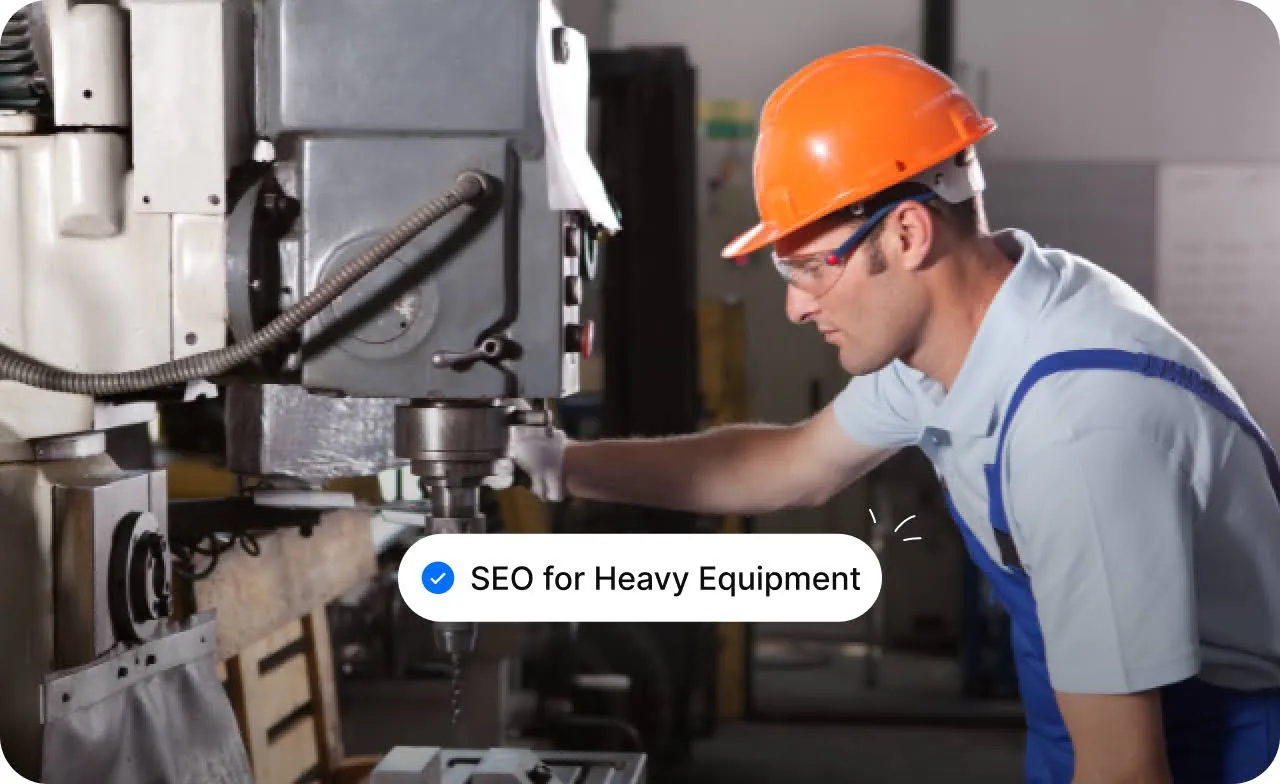
SEO
Aug 29, 2025
5 mins
These 10 SEO Strategies Bring in More Heavy Equipment Buyers Than Your Ad Campaigns
Batul Beawarwala
Have you noticed how buyers no longer ask broad questions about equipment? They already know what they want before they talk to you. The model. The load capacity. The operating conditions. Sometimes even the year range.
And yet, while your team is ready to explain, quote, and demonstrate, most of those buyers never reach you. They make decisions quietly, online, comparing who looks most capable to handle the job. Not who has the biggest yard or the longest history. Who makes it easiest to trust their expertise.
That’s the gap SEO fills in heavy equipment sales. It shapes what buyers see, how they interpret your capability, and whether they even consider starting a conversation. When your SEO strategy reflects the way serious buyers research, evaluate, and narrow options, your website starts doing the heavy lifting before your sales team ever picks up the phone.
This blog breaks down a practical SEO strategy built for heavy equipment businesses that want to turn serious searches into real enquiries and real revenue.
How Heavy Equipment SEO Actually Works?
Most sellers think SEO is just about getting their website higher on Google. In reality, it is a system that decides which equipment listings get seen first, which ones look credible, and which pages search engines choose to ignore.
SEO for industrial companies works by sending clear signals about three things: relevance, structure, and authority.
- Relevance tells search engines what each machine is really about
This is where detailed page titles, accurate descriptions, and proper use of model names and specifications matter. A page that clearly focuses on one machine type or model performs far better than a vague “our equipment” page.
- Structure helps search engines understand your inventory
Logical navigation, clean URLs, and organized categories help search engines map your site like a digital catalogue. When this is missing, even strong machines get buried online.
- Authority proves your business knows its market
Helpful guides, technical content, useful resources, and backlinks from industry sources strengthen your credibility in the eyes of search engines.
SEO also works across different buyer stages:
- Early stage buyers researching options
- Mid-stage buyers comparing machines
- Late-stage buyers ready to enquire or book a demo
Each stage needs different content and different optimisation. When your strategy covers all three, you stop relying on random traffic and start capturing demand throughout the decision cycle.
This is where heavy equipment SEO becomes powerful. Not because it looks impressive, but because it quietly moves your machines into the right conversations at the right time.
Building a Winning SEO Framework
To compete in today’s market, heavy equipment sellers need an SEO framework designed for high-value, high-intent buyers. Here’s a clear roadmap to help you attract qualified leads and boost sales:
1. Conduct Audience and Keyword Research
The first step to any successful SEO strategy is knowing what your buyers are actually searching for online. You need to focus on keywords that attract high-quality, decision-ready leads, not just random traffic.
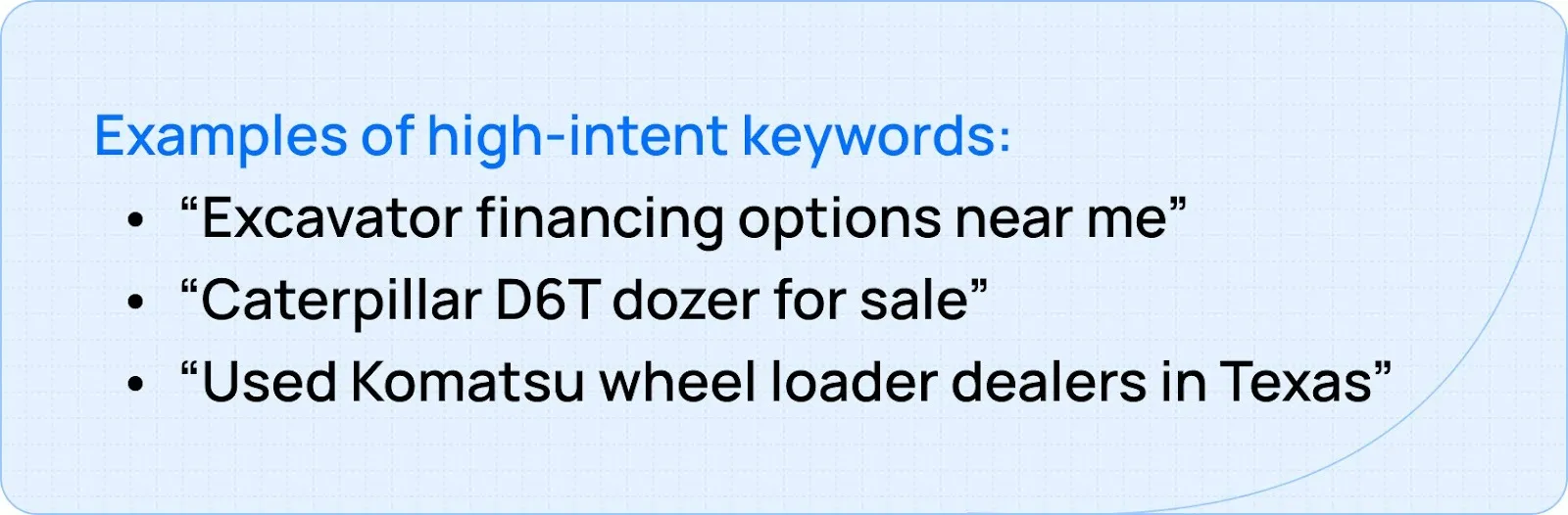
Tools to use: Google Keyword Planner, SEMrush, Ahrefs
How to structure your keyword strategy:
- Broad keywords: “Heavy equipment sales”—builds brand visibility and awareness
- Transactional keywords: “Buy Caterpillar bulldozer online”—targets ready-to-buy customers
- Informational keywords: “Best mini excavator brands”—educates early-stage researchers
When you focus on specific, industry-relevant phrases, you naturally attract the right audience—buyers who are most likely to convert.
Target the Right Buyers
Define your ideal customer and align keywords with how heavy equipment buyers actually search.
Refine Buyer Targeting
2. Optimize for Local SEO
Most heavy equipment buyers prefer dealerships close to their project sites. Without local SEO, you risk losing potential leads to competitors who show up first in “near me” searches.
How to improve local visibility:
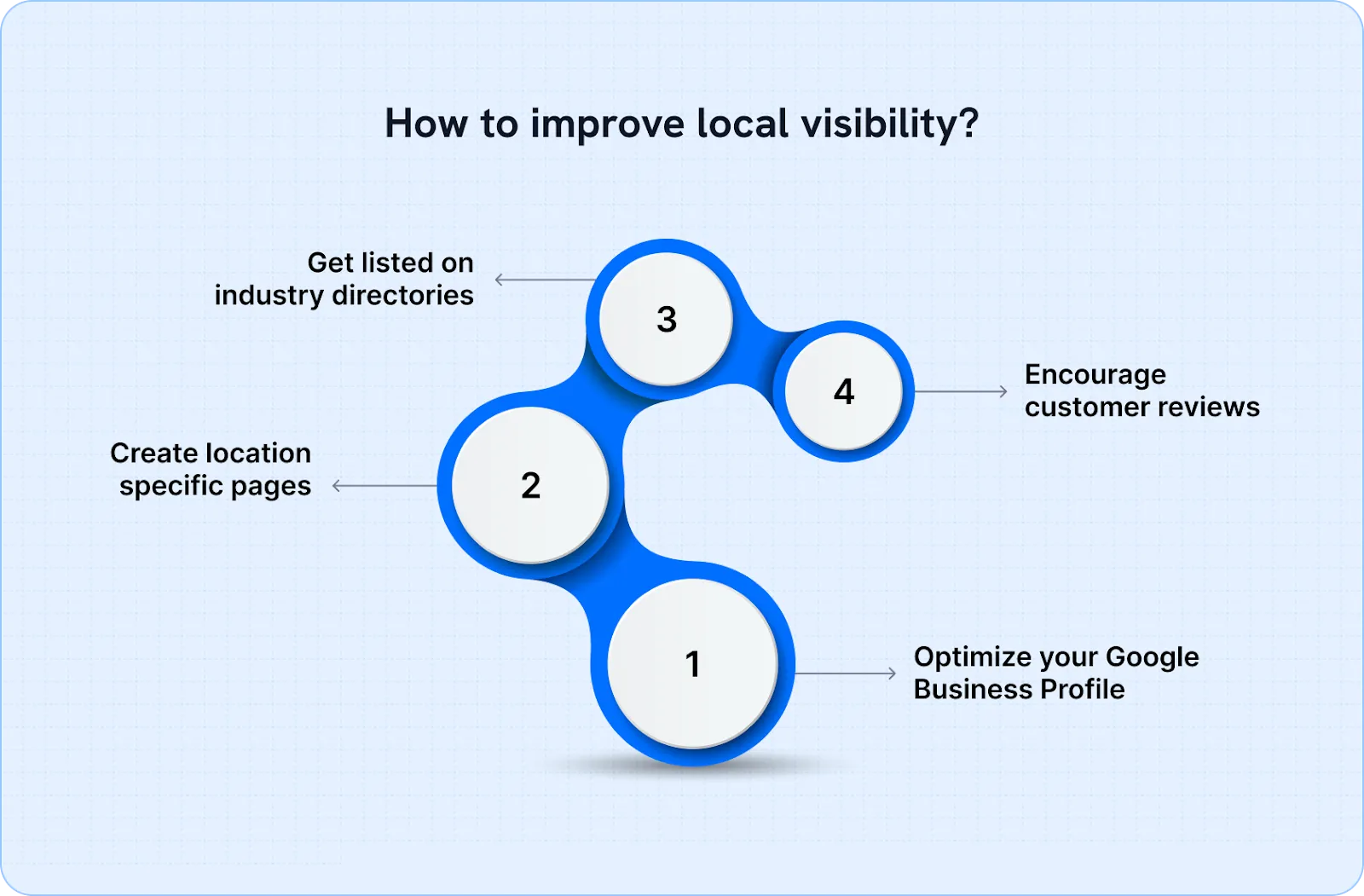
- Optimize your Google Business Profile so buyers find you when searching locally
- Create location-specific landing pages for each branch or dealership
- Get listed on industry directories and high-authority equipment marketplaces
- Encourage customer reviews to build trust and improve your rankings
Local SEO ensures your dealership shows up exactly when buyers are searching for equipment in their area—bringing in qualified leads instead of generic traffic.
3. Create Educational Content
Heavy equipment buyers don’t make decisions overnight. They move through three key stages: awareness, consideration, and decision. Your content should guide them at every step.
Awareness Stage:
- Blog idea: “How to Choose the Right Excavator for Your Project”
- Goal: Capture buyers early in their research phase
- SEO impact: Builds brand visibility and positions your dealership as a trusted resource
Consideration Stage:
- Create buying guides, comparison blogs, and case studies
- Examples:
- “Excavator vs. Backhoe: Which One Should You Buy?”
- “Case Study: How XYZ Contractor Reduced Costs by 15% Using [Your Brand] Equipment”
- Goal: Help buyers evaluate options and see why your dealership is the right fit
Decision Stage:
- Offer lead magnets to close the sale faster
- Examples: downloadable spec sheets, ROI calculators, and pricing guides
- Optimize CTAs: “Request a Quote,” “Book a Demo,” or “Download Product Brochure”
Create Equipment-Focused Content
Develop content that answers buyer questions and supports confident purchasing decisions.
Strengthen Content Strategy
When you create content for every stage, you educate buyers, build trust, and move them naturally toward purchase.
4. Develop Technical SEO
Even the best content won’t work if your website frustrates users. A smooth, fast, and mobile-friendly experience directly impacts lead generation and conversions.
Key technical SEO priorities:
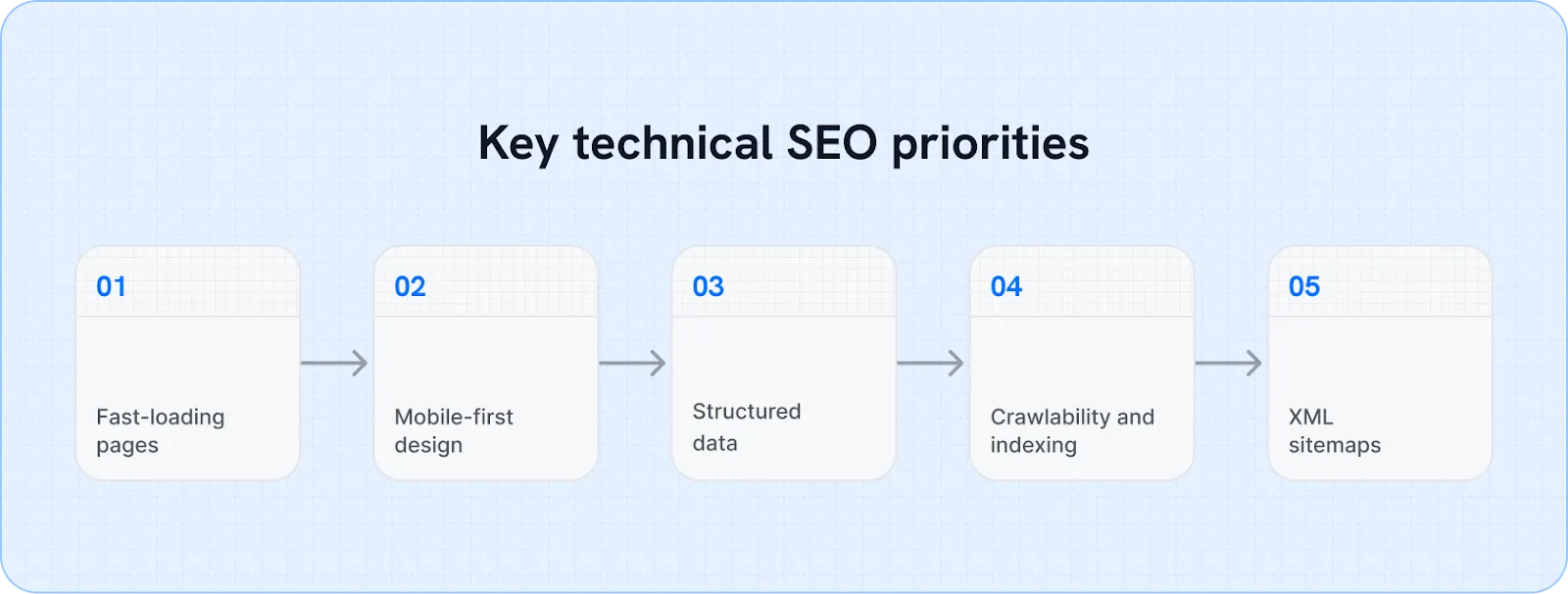
- Fast-loading pages: Optimize your equipment listings and catalogs to reduce bounce rates
- Mobile-first design: Most buyers research equipment on phones or tablets, especially on-site
- Structured data: Add schema for specs, pricing, and availability to boost rich snippets in search results
- Crawlability and indexing: Ensure search engines can find and rank your pages easily
- XML sitemaps: Keep them updated to improve discoverability for new product listings
A well-optimized website makes it easier for buyers to find you and gives them a seamless experience that keeps them engaged.
5. Create an On-Page SEO Strategy
Your product and category pages are often the first impression buyers have of your dealership. Optimizing them helps you rank higher in search results and convert more visitors into leads.
How to improve on-page SEO:
- Optimize titles, meta descriptions, and headers: Include relevant keywords naturally so buyers instantly know what you sell
- Use schema markup for pricing and availability: Let search engines display key information directly in search results
- Build strong internal links: Connect product pages to buying guides, comparison blogs, and related equipment
- Use engaging visuals: Add videos, 360° images, and equipment walkarounds to increase user engagement and dwell time
A well-optimized on-page structure makes your listings more visible, informative, and conversion-ready.
Reinforce Your SEO Strategy
Improve your search visibility with a structured approach built for heavy equipment markets.
Enhance Your SEO Approach
6. Optimize Off-Page SEO and Authority Building
Your dealership’s credibility depends on more than just what’s on your website. Off-page SEO builds trust and authority by improving how others see your business online.
How to strengthen off-page SEO:
- Acquire high-quality backlinks: Partner with equipment marketplaces, construction industry blogs, and online directories
- Collaborate with manufacturers: Co-create content and leverage their brand authority to boost your own rankings
- Leverage PR opportunities: Announce new equipment launches, branch openings, or certifications through online publications
- Engage in industry communities: Participate in forums and LinkedIn groups where contractors and buyers interact
By boosting your online reputation and credibility, you position your dealership as a trusted leader and stay ahead of competitors in search results.
7. Leverage Video SEO
Video has become one of the most powerful ways to attract buyers, build trust, and rank faster in search results. For heavy equipment dealers, video content provides a competitive edge by showcasing products and expertise visually.
How to use video effectively:
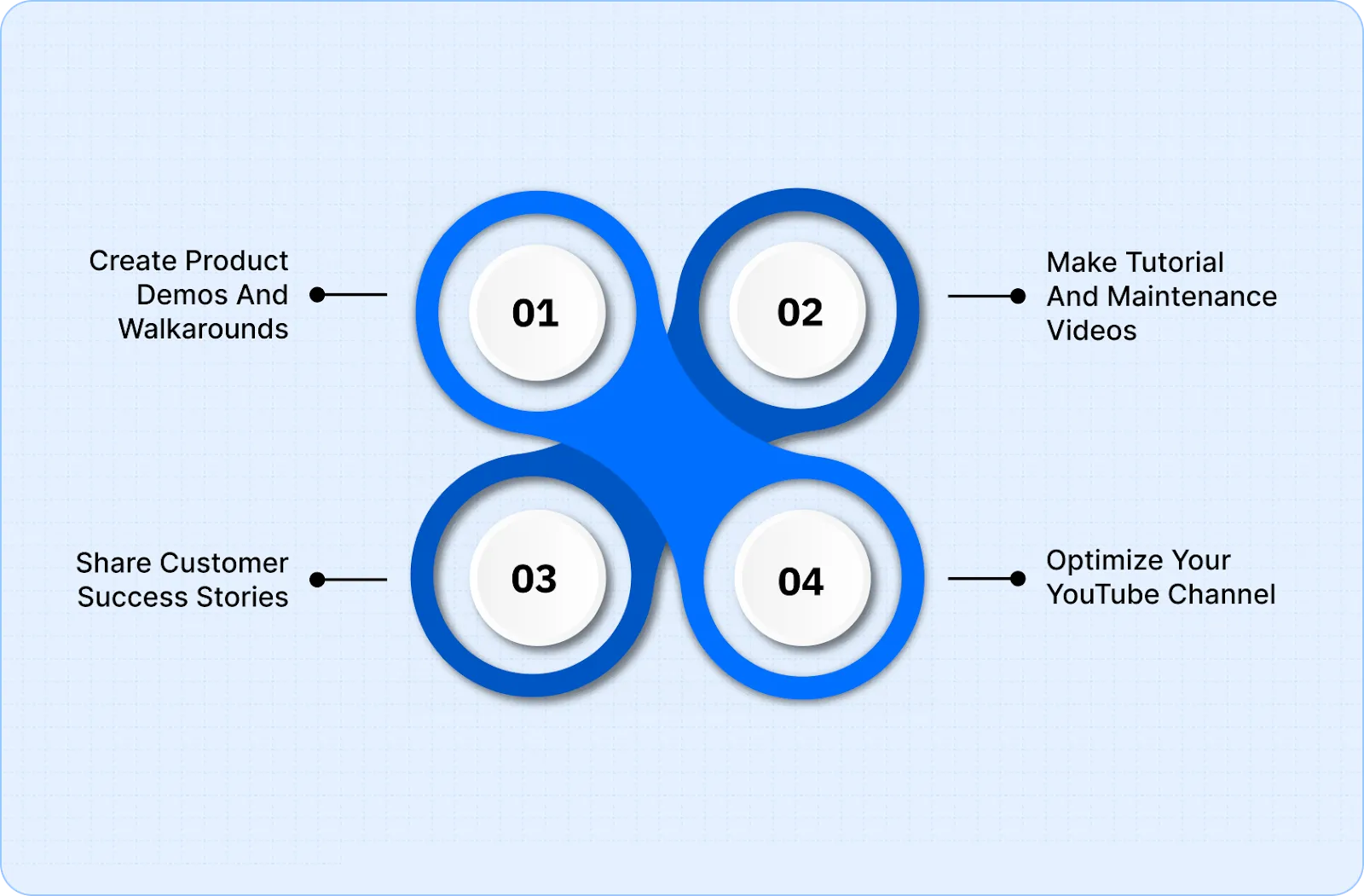
- Create product demos and walkarounds: Show buyers exactly what they’re getting before they call
- Make tutorial and maintenance videos: Help contractors understand how to get the most out of their equipment
- Share customer success stories: Highlight real-life contractors who achieved better results with your machines
- Optimize your YouTube channel: Use relevant titles, descriptions, and tags, then embed videos on your product pages
Videos improve user engagement, increase dwell time, and help you rank faster in both Google and YouTube search results.
8. Paid Search + SEO
Relying only on organic SEO takes time, especially in a competitive market like heavy equipment sales. Combining paid search (PPC) with your SEO strategy helps you dominate search results and capture leads faster.
How to combine PPC and SEO for better results:
- Target high-value competitive keywords: Use Google Ads for searches like “buy Caterpillar dozer” where competition is high
- Retarget previous visitors: Show ads to buyers who visited your website but didn’t convert the first time
- Use PPC insights to improve SEO: Analyze which ad keywords drive conversions and use them to strengthen your organic strategy
A hybrid approach ensures you capture both short-term and long-term opportunities, balancing quick wins with sustainable growth.
9. Measuring SEO Success
An SEO strategy only works if you measure the right metrics. Tracking performance helps you understand what’s working, what needs improvement, and where to invest more resources.
Key metrics to monitor:
- Organic traffic growth: Track how many qualified visitors come from search engines
- Keyword rankings: Monitor performance for high-intent keywords like “Caterpillar dozer for sale”
- Lead quality vs. quantity: Focus on inquiries that come from decision-ready buyers, not just raw traffic
- Google Business Profile insights: Measure visibility, clicks, and calls from local searches
- Conversion rate: Track how many visitors turn into leads or sales
Recommended tools: Google Analytics, Google Search Console, SEMrush, Ahrefs
10. Best Practices for Heavy Equipment SEO
Here’s a quick reference to keep your SEO strategy on track:
Following these best practices ensures your dealership stays visible, trusted, and competitive in a crowded market.
Key SEO Challenges in the Heavy Equipment Industry
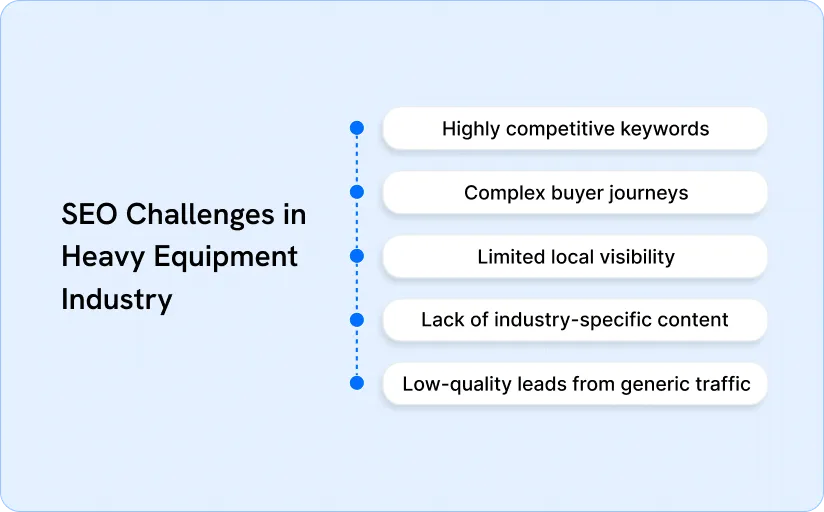
For heavy equipment dealers and distributors, SEO isn’t straightforward. The industry has unique hurdles that make it harder to generate consistent, high-quality leads online:
- Highly competitive keywords: Everyone wants to rank for terms like “excavator for sale” or “wheel loader dealers,” making it difficult to stand out without a focused strategy
- Complex buyer journeys: Purchasing heavy equipment involves multiple decision-makers, long consideration cycles, and bigger financial commitments compared to most industries
- Limited local visibility: Many dealerships operate across multiple locations but don’t optimize for “near me” searches or set up location-specific landing pages. This leads to missed opportunities with local buyers
- Lack of industry-specific content: Most competitors rely on generic information instead of creating helpful, relevant content that addresses buyers’ real challenges
- Low-quality leads from generic traffic: Without targeting high-intent keywords, dealers often get traffic that doesn’t convert into inquiries or sales
Understanding these challenges is the first step to fixing them. A tailored SEO strategy helps you overcome these obstacles, reach decision-ready buyers, and capture more qualified leads.
How Gushwork Accelerates SEO Success for Heavy Equipment Sales
At Gushwork, we help heavy equipment sellers get discovered online, rank higher, and generate qualified leads consistently. Our strategies are designed for dealerships and distributors who want to grow without replacing their traditional sales methods.
Why Gushwork Is the Right Partner:
- We understand the unique challenges of heavy equipment sales and create tailored SEO strategies that drive results
- We focus on high-intent keywords to attract buyers who are ready to make a purchase
- We combine content marketing, local SEO, Ads, website, technical optimization and CRM to build long-term visibility and credibility
How We Help Heavy Equipment Sellers Win:
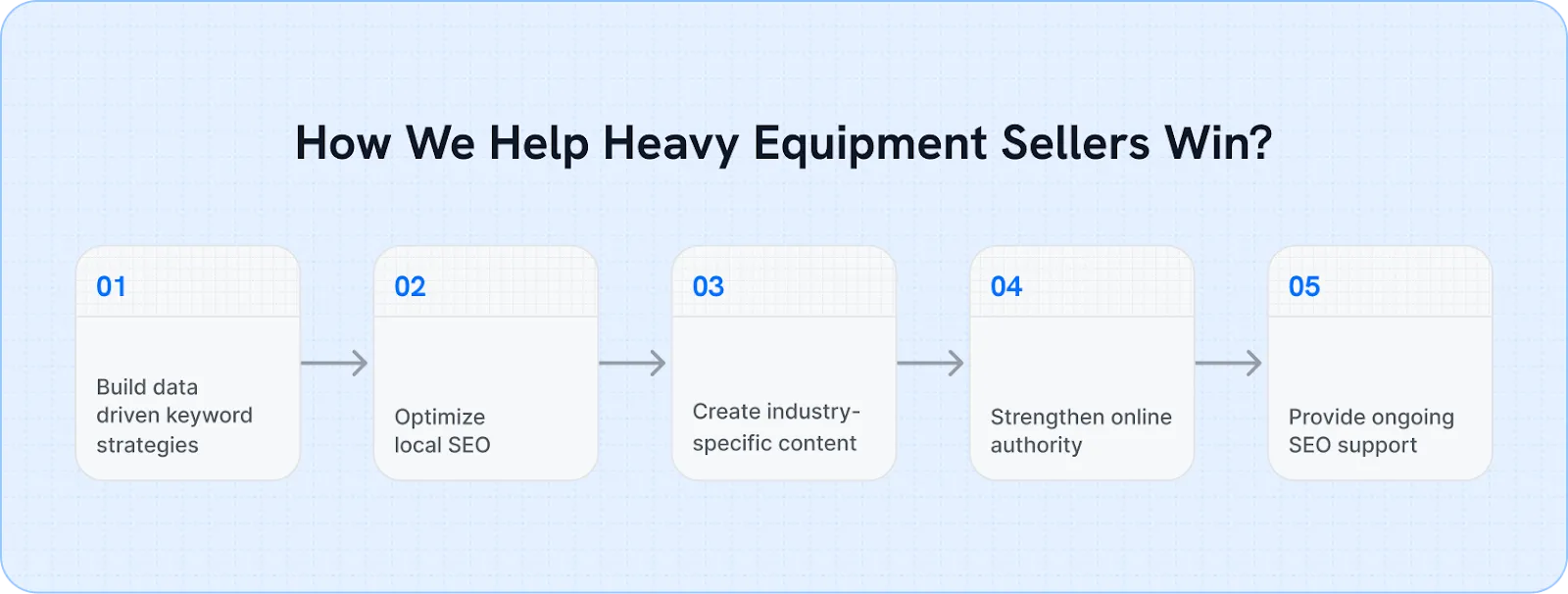
- Build data-driven keyword strategies: Attract buyers actively searching for your equipment
- Optimize local SEO: Ensure your dealership shows up in “near me” searches and Google Business listings
- Create industry-specific content: Educate and guide buyers with blogs, case studies, and buying guides
- Strengthen online authority: Get your dealership featured on industry directories, equipment marketplaces, and construction blogs
- Provide ongoing SEO support: Track performance, adjust strategies, and keep your rankings growing
With Gushwork, your dealership moves from relying only on trade shows or cold calls to building a predictable, scalable pipeline of online leads.
Conclusion
In today’s competitive heavy equipment market, buyers start their journey online long before contacting a dealer. Without a solid SEO strategy, you risk losing high-value leads to competitors who appear first in search results.
A structured, data-driven SEO plan helps your dealership attract qualified buyers, outrank competitors, and build long-term trust and visibility. Gushwork helps you achieve this by combining industry-specific strategies, local optimization, and content that converts.
Ready to increase leads and outrank competitors? Start optimizing your heavy equipment SEO strategy today with Gushwork and turn online searches into consistent sales opportunities.
Ready to Strengthen Your SEO
Get expert guidance on building an SEO strategy that aligns with your heavy equipment sales goals.
Book A Consultation

Digital Marketing
Aug 29, 2025
5 mins
ABM Framework USA Manufacturers Are Using to Reclaim Target Accounts
Batul Beawarwala
Your biggest competitor just landed a $500K contract with a company you didn't even know was looking for suppliers. While you were waiting for the next trade show, they were already having conversations with your perfect customers.
The buyers who need exactly what you make are out there right now, researching suppliers and making decisions.
The question is: are they finding you, or are they finding everyone else first?
Account-based marketing or ABM ensures they find you first; not your competitors.
TL;DR
- ABM helps manufacturers avoid wasting resources on unqualified leads by targeting top-fit accounts.
- Prioritizing the right manufacturing companies builds stronger, more profitable relationships.
- Aligning marketing and sales ensures consistent engagement with key decision-makers.
- Modern ABM strategies generate steady leads beyond trade shows, ads, or generic outreach.
- 99% of companies with an ABM team reported higher ROI than with traditional marketing.
- Even small manufacturing teams can run focused ABM programs for predictable, high-value growth.
What ABM Really Means (It's Not Just "Better Targeting")
Most manufacturers think ABM is just fancy talk for "targeted marketing." It's not.
Traditional marketing spreads your message to a broad audience through emails, ads, or generic campaigns and hopes someone responds. ABM flips that completely.
You pick the companies first. Then you create everything specifically for them.
Here's what that looks like: Instead of a website that just says, "We make industrial equipment," you have content that shows up when someone searches "stainless steel tanks for dairy processing" with a detailed example of how you helped a dairy company reduce contamination risk and improve production efficiency.
The buyer doesn't see another generic supplier. They see the supplier who's already solved their exact problem.

This means the time and money you put into ABM turns into actual purchase orders from companies that can afford what you're selling, instead of getting wasted on tire-kickers who were never going to buy anyway.
Why You Need Account-Based Marketing Now More Than Ever
Let's be honest about what selling manufacturing products actually looks like in 2025:
The process takes months, not days. Multiple people weigh in on decisions. Engineering wants technical specs, procurement wants competitive pricing, operations wants proven reliability, and finance wants ROI justification. Oh, and they're all researching online before they ever talk to a salesperson.
If your marketing strategy is still stuck in 2015, you're invisible when it matters most.

Here's what ABM does for your manufacturing business:
- Builds trust with the right buyers: When you speak directly to the companies that matter, they see you understand their needs. Trust grows fast, and buyers are more likely to choose your products over others.
- Strengthens relationships with decision-makers: Instead of speaking to anyone who answers the phone, connect with the engineers, operations managers, and procurement leaders who actually sign purchase orders.
- Focuses on bigger, faster deals: Your time isn’t wasted on leads that won’t buy. You target accounts that are ready to make larger orders, so deals close sooner.
The Must-Have ABM Pre-Launch Checklist: Get It Right from Day One
Starting ABM without proper preparation is like showing up to a critical customer meeting without knowing what they actually make. You might stumble through it, but you're not going to win the deal.
Most manufacturers rush straight to tactics: "Let's start sending personalized emails!" But without the foundation, you're just doing expensive direct mail with a fancy name.
Here's how to avoid that mistake:
- Team alignment and training: Get your sales, marketing, and operations teams on the same page. Everyone needs to understand which accounts matter and how to approach them.
- Target Account List (TAL) preparation: This isn't just "companies we'd like to work with." Pick companies that match your ideal customer profile (ICP): right industry, right size, right budget, right timing.
- Messaging and content development: Instead of talking your capabilities, start talking about their problems. Create messages and materials that show you understand their specific challenges and have proven solutions.
- Tech stack and data management: You need systems to track accounts, personalize outreach, and keep customer information organized. It doesn't have to be complex, but it has to work consistently.
- Integration with existing efforts: ABM works best when it amplifies your current sales and marketing activities. Plan how it connects with your trade show strategy, website content, and existing campaigns.
- Measurement plan and KPIs: Decide what success looks like before you launch. Are you measuring account engagement, pipeline velocity, deal size, or win rates? Know this upfront.
- Campaign planning and roadmap: Map out your first 90 days. Which accounts will you target first? What messages will you test? Which channels will you use? A clear plan keeps everyone focused.
Get these basics right, and your ABM program becomes a growth engine instead of another marketing experiment.
4 Steps to Start Your ABM Journey: How to Find, Engage, and Win the Best Customers

Your best sales rep just heard about a company that could become your biggest customer, but only if you approach them the right way. They've been burned by suppliers who overpromised and underdelivered, so they're skeptical of anyone new.
How do you go from unknown vendor to trusted partner? Here's the systematic approach that works:
Step 1: Find the Best Companies to Target
Don't make the classic mistake of trying to sell to everyone. You now know the drill. Start by identifying companies that match your ICP.
Look for companies that are growing, investing in new equipment, or dealing with the exact problems your products solve. These become your TAL.
Critical point: It's better to focus deeply on 50 right accounts than spread thin across 500 mediocre ones.
Step 2: Understand Your Customer’s Path
Now think about how each company makes buying decisions.
Most manufacturing purchases follow a predictable path:
- Problem Recognition: "Our current system isn't meeting demand"
- Solution Research: "What options are available to solve this?"
- Vendor Evaluation: "Which supplier can actually deliver what they promise?"
- Decision: "Let's move forward with this partner"
Your job is to be visible and helpful at each stage with the right content and messaging.
Ask your current customers: "How did you find suppliers before working with us?" Their answers tell you exactly what searches you should show up for.
Step 3: Make Plans That Speak Directly to Each Company
With your TAL in hand and a clear picture of their path, you can create messages that actually matter. Think about each company’s specific challenges and show exactly how your product solves them.
- Use channels they actually pay attention to: email, calls, meetings, or even targeted online ads.
- Make it easier for your sales team to reach decision-makers.
- Keep them interested with reminders and multi-channel follow-ups.
By tailoring your approach, you’re making it simple for the right people to say yes. This is exactly how ABM makes your marketing smarter than generic campaigns.
Step 4: Keep Building Strong Relationships Over Time
ABM isn't just about landing the first deal. Share helpful content like product tips, industry updates, and training. Use consistent touchpoints to stay engaged between projects. Building loyalty turns first-time buyers into repeat customers and referrals.
Tools That Make ABM Easier for You (Even If You’re Not a Marketing Pro)
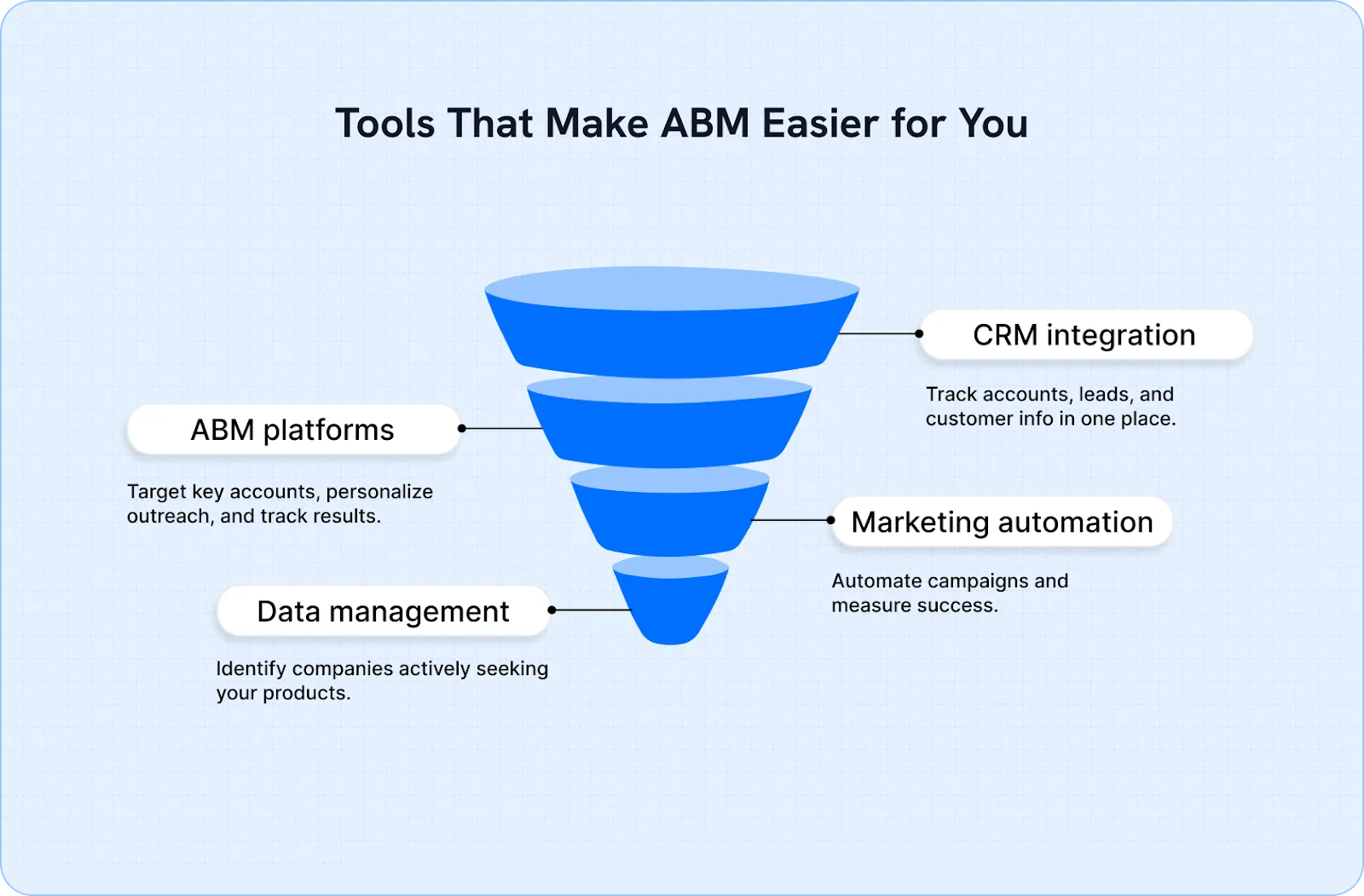
You don’t need a marketing degree to run ABM. But you do need the right systems to manage accounts, track engagement, and personalize outreach at scale.
- CRM integration: This is where you keep track of every account and lead. You can see who’s engaged, score opportunities, and keep all customer info in one place. It’s like having a digital filing cabinet for your sales team.
- ABM platforms: These tools focus on the accounts that matter most. They help you target specific companies, personalize your messages, run campaigns, and track results. Think of it as the dashboard for your entire ABM strategy.
- Marketing automation and reporting tools: Send emails, run campaigns, and measure what’s working without doing everything manually. Some ABM platforms include these, but standalone tools can help if you want extra flexibility.
- Data management and intent data solutions: These give you insights into which companies are actively looking for products like yours. That way, you know who to reach and when, instead of guessing.
With the help of these tools, you don't have to manage endless spreadsheets or follow up with leads that go nowhere.
Is Your Account Based Marketing Paying Off? What Manufacturers Should Track
You’ve set up your ABM program and started reaching the right companies. Now, how do you know it’s working?
Focus on metrics that show business impact, not just marketing activity:
1. Pipeline Health Metrics
- Track how quickly leads move through each stage from first contact to purchase.
- See which accounts are engaging with your content and which ones need more attention.
- Example: If an account downloads your product sheets but hasn’t requested a quote, your follow-up strategy might need adjusting.
2. Revenue Outcome Metrics
- Look at deal sizes and the speed of closing orders. Are targeted accounts placing bigger orders faster than before?
- Measure win rates for your priority accounts versus others.
- Example: Compare how quickly a target account moves from interest to purchase compared with non-targeted accounts.
3. Customer Expansion Metrics
- Track repeat orders, cross-sell, or upsell opportunities from existing customers in your TAL.
- See which accounts are giving you more business over time, not just the first sale.
- Example: An account that initially bought one product now orders multiple product lines. Your ABM efforts helped build that relationship.
Metrics are useful, but numbers alone won’t grow your business.
You need execution that turns insights into actual conversations with qualified buyers.
With Gushwork, manufacturers move beyond those dashboards and spreadsheets.
We help you use the data you’ve collected to reach the right buyers at the right time, creating predictable, high-value sales opportunities.
Wrapping Up: You Shouldn’t Ignore ABM if You Want to Grow
ABM isn’t just another marketing tactic but a smarter way to grow. The accounts that matter most? You already know who they are. The challenge is getting their attention at the right moment, guiding them from curiosity to conversation, and then to a real order.
If you want a hand turning your ABM insights into measurable growth, Gushwork can help
Book A Consultation Today
Your ABM Questions Answered: What Manufacturers Really Want to Know
1. How is ABM different from the marketing we might already be doing?
Traditional B2B marketing in manufacturing often treats every lead the same: run ads, send emails, post LinkedIn updates, hope someone bites. ABM flips that. Instead of chasing everyone, you focus on the companies that can bring in the biggest orders. You map their decision-makers, understand exactly what challenges they face like reducing downtime on a bottling line or improving yield in a fabrication process and guide them with targeted messages at every stage. It’s precision over volume.
2. Can ABM work for manufacturers like me who may not have a big marketing team or budget?
Yes. ABM doesn’t require a large team it requires focus. For example, instead of sending dozens of LinkedIn ads, you pick 20–30 accounts that match your ideal customer, map the key stakeholders in each, and deliver content or outreach that answers their exact concerns. A small team can manage this because every action is tied to a high-value account. You’re not doing more; you’re doing the right things for the right companies.
3. How do I find which companies to target in ABM if I don’t have much market data?
Start with your best customers. Look at the companies that already buy from you, what they make, their size, and who makes buying decisions. Then, identify others in the same industry or with similar challenges like food processing plants that need new packaging lines or factories expanding their automation. Industry associations, trade directories, and LinkedIn filters help you discover these accounts. Even without a huge dataset, you can build a precise target list.
4. Can ABM be automated or does it require a lot of manual work?
It’s a mix. You can automate account tracking, engagement scoring, and follow-up emails, but the core work figuring out which accounts to target, mapping stakeholders, tailoring messaging is human. For example, you can set up automated emails showing a case study on reducing line stoppages, but someone still decides which plants get the case study and when to escalate a call. Automation handles repetitive tasks; humans handle judgment calls.
5. How long does it usually take to see results from ABM?
Manufacturing buying cycles are slow. A plant manager or engineer may take weeks to evaluate suppliers because downtime is costly and multiple departments weigh in. That said, if you focus on the right accounts and deliver content that answers their real problems like a case study showing how you cut production errors by 30%, you’ll start seeing engagement within a few weeks. Real revenue impact, like signed orders, usually happens in 2-4 months. The key is consistent, relevant touchpoints, not sporadic outreach.
Digital Marketing
Aug 29, 2025
5 mins
Manufacturers Who Create And Send These Email Marketing Campaigns Outperform Everyone Else
Batul Beawarwala
Manufacturing sales move in cycles. One month you’re busy with trade shows and inquiries, the next you’re waiting on calls to be returned or ads to deliver leads. That stop-and-go rhythm makes it difficult to stay visible to buyers consistently.
Email changes that. It works quietly in the background, steady, low-cost, and always on, so your company remains present even when other channels pause.
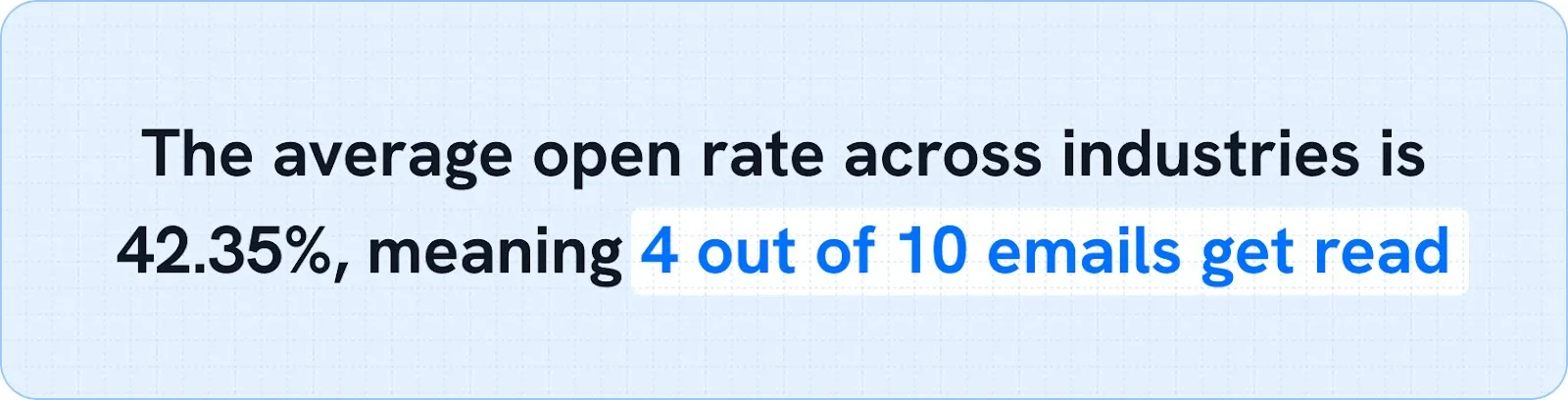
TL;DR:
- Email provides year-round visibility. Unlike trade shows, calls, or ads that spike and fade, email keeps your company present during long decision cycles.
- Manufacturing buyers already rely on email. From procurement schedules to technical updates, it’s where they expect to receive timely information from suppliers.
- Performance is proven. Average open rates reach 42.35% across industries and 34.48% in manufacturing, showing that B2B email consistently gets read.
- ROI outpaces other channels. Email delivers about $36 for every $1 spent with an 85.7% delivery rate, making it both cost-effective and dependable.
- Consistency builds trust. Regular, useful touchpoints compound over time, positioning your company as the supplier buyers remember when decisions are made.
What Does Email Marketing Actually Mean for Manufacturers?
Email marketing is just a way to stay in touch with the people who matter to your business: buyers, distributors, and prospects. Instead of waiting for the next trade show or hoping a phone call gets through, you can send simple, useful updates straight to their inbox. That might be news about a new product, a reminder when it’s time to reorder, or a short tip that helps them use your equipment better.
Because these emails go to people who already know your company or have shown interest, they’re not random or spam. They’re part of the same sales process you already follow, only supported by email.
And just like your sales process, email marketing also moves through a few clear stages:
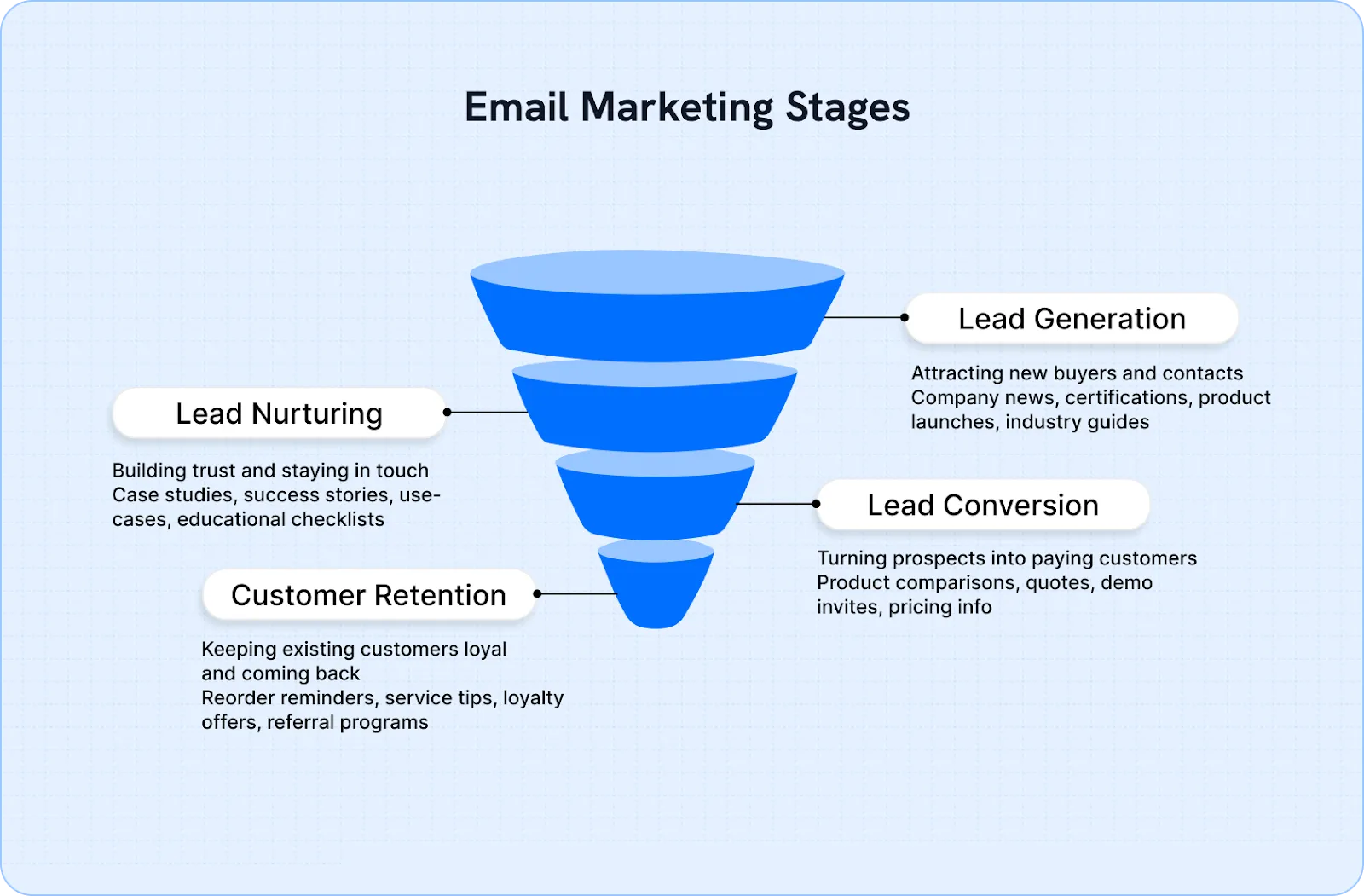
Think about it like a steady nudge; email helps buyers remember you without needing constant follow-ups from sales.
The Biggest Myths About Email as a Marketing Channel
Many manufacturers hesitate with email marketing because of a few common misconceptions. Let’s break them down.
Myth 1: Email is only for consumer brands
Not true. Distributors, procurement teams, and plant managers all rely on email every day. If anything, B2B buyers expect to see updates in their inbox, stock availability, delivery schedules, or product specifications are all things they’d rather get by email than chase by phone.
Myth 2: It takes too much time to manage
Modern tools make it manageable. Once set up, routine emails like reorder reminders, thank-you notes, or product updates can run automatically, saving your sales team hours of repeated follow-up.
Myth 3: Customers don’t read emails
The numbers tell a different story. Email delivers an average ROI of $36 for every $1 spent, making it the highest-performing marketing channel by return. And with an average delivery rate of 85.7%, most of those messages reliably reach the inbox, proof that buyers are opening and acting on them.

Myth 4: You need fancy designs or a marketing team
In reality, most effective B2B emails are plain and straightforward. Buyers care about clear information, not graphics. A short update with the right subject line is often more powerful than a polished template.
Myth 5: Buyers only want calls
Calls still matter, but they’re hard to scale. Research shows that only about 2% of cold calls result in a meeting. Email gives you a more reliable way to reach buyers; they can open it on their own time and refer back when they’re ready.
Myth 6: It’s too complicated to start
For many manufacturers, email feels like one more task in an already stretched day. But when it’s built around real needs, specifications, compliance updates, and reorder cycles, it stops feeling like ‘marketing’ and becomes a natural extension of sales.
With the right setup, it becomes one of the easiest ways to keep buyers engaged. The difference comes from designing around how the industry actually works: long cycles, distributor networks, and technical requirements.
Most of these myths fade once you look at how buyers actually behave. Email is already part of their day, which makes it a practical tool for manufacturers to use.
Why Email Fits Right Into Manufacturing Sales
Most manufacturers rely on a familiar mix of channels: trade shows, cold calls, and paid ads. Each has its place, but each also comes with limits:
- Trade shows bring visibility and connections, but they’re seasonal; you can’t rely on them year-round.
- Cold calls can work, but they depend on sales reps’ time. Research shows it takes an average of 209 calls to secure a single appointment or referral, a hard number to scale.
- Paid ads bring quick leads, but the moment you pause the budget, the leads disappear.
Put together, these channels create short bursts of activity, not the steady growth manufacturers need.
Email works differently.

- Reaches buyers directly — your message lands in their inbox, ready when they are.
- Costs less than most other lead-generation methods.
- Keeps your company remembered during long decision cycles.
For manufacturers, that consistency is critical. Sales cycles are long, buyers evaluate multiple suppliers, and decisions can take months. Without steady touchpoints, it’s easy to be forgotten. Email fills that gap, working quietly in the background so that when buyers are ready to move forward, your name is still top of mind.
Everyday Industrial Sales Challenges—and How Email Helps

Industrial sales cycles are long and complex, and common challenges continue to slow progress. Email may not replace other channels, but it provides a structured way to reduce these pressures.
1. Pipeline gaps
Interest from inquiries or events is often uneven, leaving stretches with little buyer interaction. Email maintains continuity by providing timely updates, such as certifications, specification changes, or industry insights, that keep your company present between direct touchpoints.
2. Sales teams are stretched thin
Most manufacturing sales teams are small, balancing prospecting, distributor management, and technical support. Automated emails handle routine communication, order reminders, thank-you notes, or meeting follow-ups, so staff can focus on the discussions that move opportunities forward.
3. Leads going cold
Promising contacts frequently stall when buyers are occupied with other priorities. Regular, useful touchpoints, maintenance tips, product updates, or case studies keep your business visible and relevant until buyers are ready to continue the conversation.
4. Rising marketing costs
Traditional channels such as events or advertising remain important but require significant and recurring budgets. Email, by contrast, scales efficiently: reaching one hundred or ten thousand buyers carries nearly the same cost, making it a practical way to sustain visibility.
These challenges are well known in manufacturing. Email helps by providing consistency: a channel that stays active in the background, ensuring that when buyers are ready to decide, your company has remained part of the conversation.
Read: Digital Marketing Guide for B2B Manufacturers & Industrial Companies
Three Core Strategies for Effective Email Campaigns
Email marketing for manufacturers isn’t about mass promotions or decorative mailers. What makes it effective is an approach that mirrors how buyers actually make decisions: carefully, with attention to detail, and over time.
That means structuring emails to match the way they research, evaluate, and purchase, rather than relying on generic marketing patterns.
1. Segment buyers by how they interact with your business

No distributor, direct customer, or prospect should receive the same message. Their expectations are different, and so are the decisions they make:
- Distributors look for stock availability, pricing updates, and marketing resources they can pass downstream.
- Direct customers need reorder reminders, service notices, and clear technical documentation.
- Prospects—especially engineers and procurement teams—respond better to educational material like case studies, certifications, or side-by-side comparisons.
Segmentation ensures you’re not speaking into the void. It shows buyers you understand their role, and that makes them far more likely to read and act on what you send.
2. Keep emails concise, but purposeful
Inboxes in manufacturing are full of quotes, specifications, and supplier updates. Lengthy marketing emails get ignored. Clarity wins:
- A subject line that signals value immediately (“Spec update: [Product Name]”).
- Two or three short sentences that explain what’s changed, why it matters, and what to do next.
- Attachments or links only when they save time—like a PDF spec sheet, an updated drawing, or a maintenance checklist.
Often, a plain-text note written like a business email outperforms a designed template. Buyers aren’t judging your design; they’re scanning for the information that helps them do their job.
3. Automate what’s routine, but don’t lose the human element
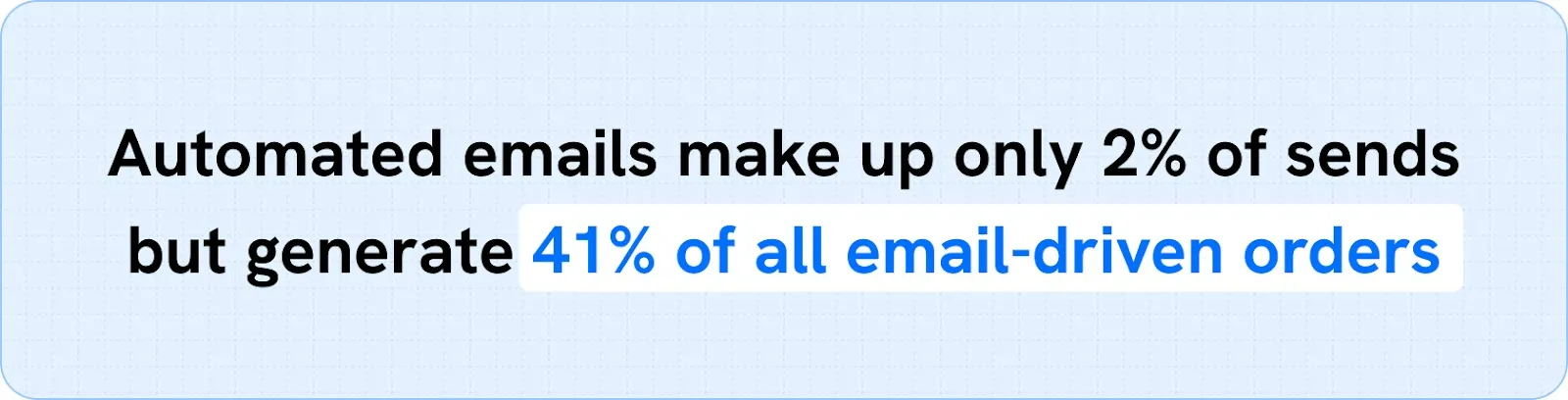
Sales teams in manufacturing already stretch across technical calls, distributor coordination, and long negotiations. Adding manual follow-ups for every inquiry is unsustainable. Automation helps by handling what repeats: reorder reminders, thank-you emails after a meeting, or follow-ups post-trade show. But automation doesn’t mean impersonal.
Use simple cues, like referencing a previous order or addressing the buyer’s specific role, to keep it relevant. For strategic opportunities, layer in personal outreach on top of automated workflows. Done well, this combination keeps leads warm, ensures no touchpoint is missed, and still leaves space for sales teams to focus on high-value conversations.
Giving Buyers a Reason to Share Their Email
Buyers rarely share their email address without a clear reason. Their inbox is already crowded with quotes, supplier updates, and compliance notices. To earn a spot there, your offer needs to be useful enough to cut through the noise.
The strongest incentives are practical resources that support their work:
- Maintenance checklists that help engineers prevent downtime.
- Invitations to demos, webinars, or plant visits that let prospects see your expertise in action.
- Technical guides or comparison charts that make procurement decisions faster and easier.
These resources are not promotional; they are tools buyers actively need to perform their roles. When positioned as part of your email program, they do more than collect addresses; they build a list of engaged contacts who enter with intent and are more likely to convert into qualified opportunities.
What You Can Expect When You Start Using Email
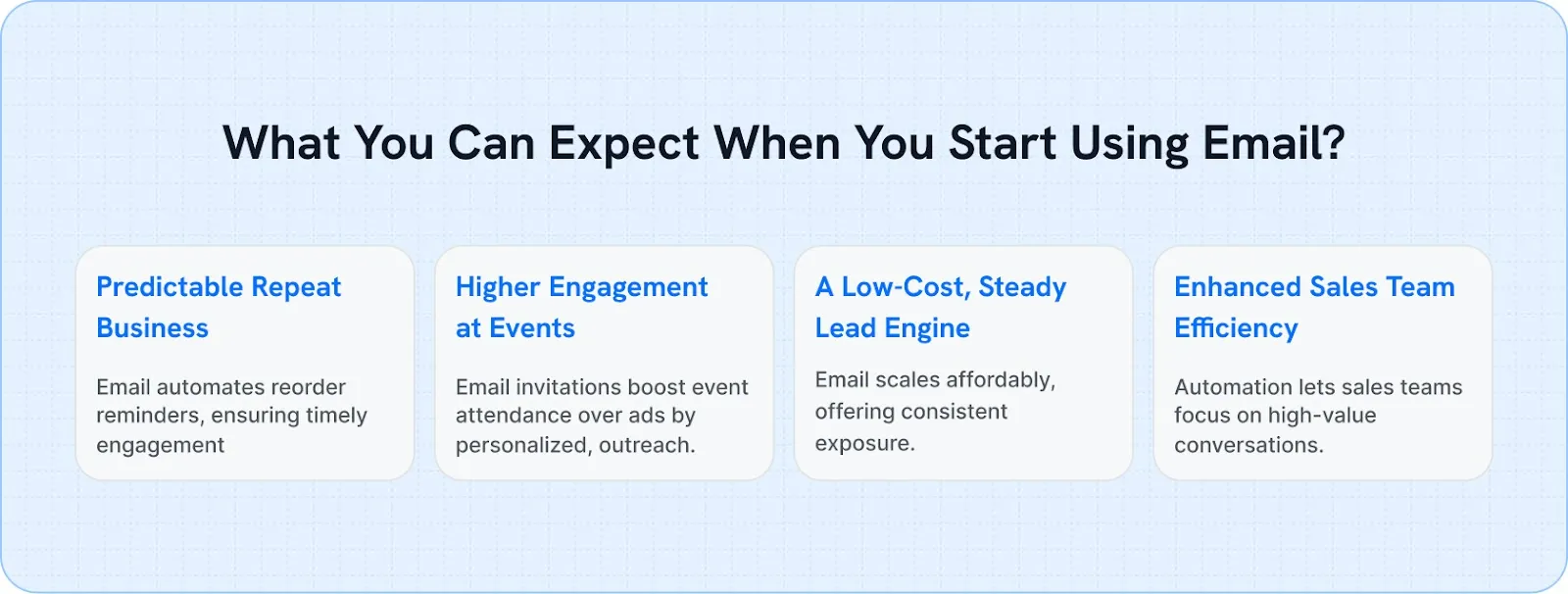
When you begin using email consistently and thoughtfully, the impact becomes clear, and it emerges sooner than you'd expect.
1. Predictable Repeat Business
Automating reorder reminders and service updates lands your brand in the inbox at the exact moment buyers are most open to purchasing again. You're not chasing orders; you're showing up when they’re already interested.
2. Higher Engagement at Events
Invitations sent by email outperform generic leads generated from ads or word-of-mouth. Structured, informative email outreach encourages real-world attendance, whether at trade shows, webinars, or plant tours.
3. A Low-Cost, Steady Lead Engine
The financial efficiency of email is hard to beat: reaching 1,000 buyers costs nearly the same as sending to ten. Compared to trade shows or digital ads, email scales affordably while delivering consistent exposure.
4. Enhanced Sales Team Efficiency
With automated nurture sequences and timely updates, sales teams spend less effort chasing lukewarm leads and more time in conversations that matter. It’s not about replacing the sales process; it’s about strengthening it behind the scenes.
Email delivers early wins, but its real value is consistency. Over time, it builds a steady rhythm of engagement that supports every stage of the sales cycle.
Easy Tools Manufacturers Can Use Right Away
Getting started with email doesn’t require a heavy investment. Beginner-friendly platforms like Mailchimp, HubSpot, or ActiveCampaign can manage the basics, organizing contacts, sending routine updates, and tracking open or click rates.
The specific tool matters less than how you use it. A clean contact list, consistent follow-ups, and emails that address real buyer needs will do more for sales than any advanced feature. Think of these platforms as support in the background; the real impact comes from the relevance of the content you deliver.
Getting Your First Email Campaign Off the Ground
The most difficult part of email marketing is often the first step. Once a simple foundation is in place, momentum builds quickly. A practical starting campaign might look like this:
- Build a clean contact list. Export addresses from your CRM, inquiry forms, and past customer records into one place. A reliable list matters more than size.
- Add a sign-up option to your website. Even a basic form gives interested buyers a direct path to hear from you.
- Offer something useful in return. A product guide, updated spec sheet, or maintenance checklist makes the exchange worthwhile for the buyer.
- Reconnect with past customers. A short “re-introduction” email with an update or product highlight is often enough to restart conversations.
- Check how it looks on mobile. Most buyers will read your message on their phone; clarity there is non-negotiable.
- Set a steady rhythm. Even one email per month is a start; the key is consistency, not volume.
- Review the results. Opens, clicks, and replies are signals that show what caught attention and where to adjust next time.
The first campaign doesn’t have to be perfect. What matters is building a process you can repeat and refine. That’s the real strength of email marketing for manufacturers: consistency compounds into long-term results.
Tracking What Works
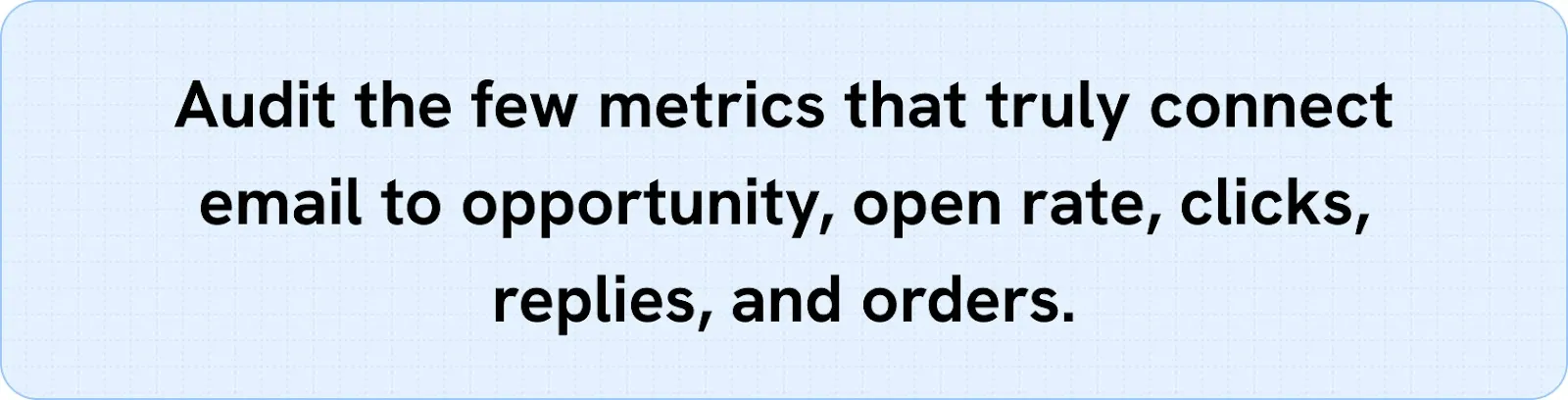
Email only creates value if you can see whether it’s working. For manufacturers, that doesn’t mean monitoring dozens of dashboards; it means focusing on the handful of signals that tie directly to sales outcomes.
- Open rate indicates if your subject lines are strong enough to break through a crowded inbox.
- Clicks highlight which content buyers find most relevant—whether it’s a spec sheet, a case study, or a reorder link.
- Replies show when an email has moved beyond marketing and started a real conversation.
- Orders—or formal Requests for Quotation (RFQs)—confirm the direct link between your email campaigns and revenue.
The point of tracking isn’t to collect numbers; it’s to identify what moves buyers closer to a decision, and refine your emails around that.
Ready to Make Your First Campaign Count?
Launching an email program is easier when you have a clear process, but building one that consistently delivers qualified leads takes experience. That’s where we guide manufacturers every day.
At Gushwork, we’ve worked with equipment makers, component suppliers, distributors, and contract manufacturers to design email systems that:
- Nurture inquiries from trade shows and convert them into active opportunities.
- Keep distributors engaged with tailored updates they actually use.
- Support sales teams with automated follow-ups that free them to focus on high-value deals.
For many of our clients, the first campaign was just the starting point. What made the difference was setting up email as a dependable channel that worked quietly in the background, month after month.
If you’re planning your first campaign or ready to strengthen what you’ve started, we can help you design it the right way. Start with a free lead audit to see exactly where opportunities are being missed, and how a structured email system can capture them.
Email Challenges Manufacturers Face
Even well-planned email programs encounter challenges. The difference between wasted effort and measurable results often comes down to how you address them:
1. Emails that read like sales pitches
Overly promotional messages are quickly dismissed. Instead, focus on updates that demonstrate value, such as new certifications, practical maintenance tips, or customer case studies that highlight real outcomes.
2. Low engagement from distributors
Distributors manage multiple supplier relationships, and generic emails are easy to ignore. Tailored updates on pricing, stock availability, or co-marketing resources make your message relevant to their priorities.
3. Technical buyers not opening emails
Engineers and procurement teams are unlikely to open emails with vague subject lines. Specific, need-based subjects, like ‘Reduce downtime with [Product]’ or ‘Updated spec sheet for [Component]’—make it clear why the email matters and are far more likely to get attention.
4. Inconsistent follow-up after trade shows or inquiries
Leads collected at events often go cold without timely outreach. A simple automated sequence, thank-you, resource share, and next steps, keeps your company present while interest is still high.
5. Data scattered across teams
When sales, marketing, and operations keep separate contact lists, accuracy suffers. Centralizing data into a single database and refreshing it every three to six months ensures emails reach the right audience.
These problems are not unique, and they are not insurmountable. With structured fixes, email shifts from a channel of missed opportunities to one of steady, reliable growth.
Bringing It All Together: Where Email Fits in Manufacturing Sales
Email creates a rhythm that other channels rarely sustain. Routine updates, spec changes, service tips, reorder reminders, keep your company present without overwhelming sales teams. Over time, those steady touchpoints build familiarity and trust, which often proves decisive when buyers finalize their shortlist.
Want to Learn More?
If this guide gave you ideas, explore our other resources on manufacturing lead generation, distributor engagement, and industrial marketing strategies. The more you understand how buyers behave, the easier it becomes to build consistent growth.
Frequently Asked Questions
1. What are the 4 P’s of email marketing?
The 4 P’s are: Personalization (make emails relevant), Precision (keep the message clear and concise), Persistence (send consistently to stay visible), and Performance (track results like opens, clicks, and replies to refine future campaigns).
2. How often should manufacturers send marketing emails?
Most manufacturers see results starting with one email per month. The key is consistency; emails should provide updates that buyers value, such as certifications, product launches, or event invites. Frequency can increase over time, but quality and relevance should always come before volume.
3. Do technical buyers really read marketing emails?
Yes—when the content is relevant. Engineers and procurement teams often skip broad promotions but open emails with specific value, like spec sheet updates, maintenance checklists, or technical comparisons. Precision in subject lines and content makes a big difference in engagement.
4. What kind of results can manufacturers expect from email marketing?
Email usually delivers quick wins like repeat orders and higher event turnout. Over time, it creates consistent visibility in long buying cycles, making your company more likely to stay on the shortlist. It’s not just about leads, it’s about being remembered when decisions are made.
5. How to do marketing for a manufacturing business?
Successful manufacturing marketing blends traditional channels (trade shows, referrals, distributor networks) with digital channels like email, SEO, and educational content. The goal isn’t short bursts of visibility but steady engagement that builds credibility and keeps your company top of mind all year.

SEO
Dec 8, 2025
5 mins
Don’t Miss These Manufacturing SEO Companies Driving Growth in 2026
Percy Brown
The manufacturing industry today is more competitive than ever, and generating consistent quality leads has become a significant challenge.
With long sales cycles, technical products, and buyers who research for months, small- to medium-sized manufacturers often struggle to keep their pipelines full. Relying on cold calls, referrals, seasonal trade shows, or scattered marketing efforts isn’t enough anymore.
To grow predictably, you need a partner who understands manufacturing and prioritizes qualified leads, not vanity SEO.
To help you choose the right partner, here are the top 15+ manufacturing SEO companies for 2025–26, reviewed for their industrial expertise, lead-generation capabilities, and proven results.
Ask These Questions Before You Choose The SEO Companies
Choosing an SEO partner is difficult, especially when many agencies offer generic, one-size-fits-all services. Use these questions to filter out agencies that don’t understand industrial markets:
Ask your SEO companies the following questions:
~47,000 manufacturing searches happen daily. Are you visible?
15+ Manufacturing SEO Companies Right Now
#1. Gushwork
Best for: Small to mid-market manufacturers who need consistent lead generation beyond trade shows and referrals.
Why Gushwork: They are an end-to-end content engine that ranks your pages, attracts traffic, and converts buyers. They create informative web pages with high-value content designed for real buyer intent. With multi-source visibility, your brand pulls attention from diverse channels, not just search. They are conversion-focused, turning traffic into qualified leads and measurable growth.
Typical client profile: Manufacturing companies across all industrial sectors, component suppliers, industrial equipment manufacturers, contract manufacturers, fabricators, distributors, food manufacturers, and specialty manufacturers who need predictable monthly lead generation, or businesses planning major website changes with better search traffic.
Core strengths:
- Manufacturing-specific content strategy: Create technical content that answers the specific questions engineers ask during problem-solving, not generic "manufacturing SEO services" pages.
- Qualified lead focus: Measures success by leads, not vanity metrics like total traffic or clicks.
- Custom websites & landing pages: Designs and builds websites and landing pages from scratch.
- Speed and Accuracy: Gushwork’s AI SEO agents can generate 400+ SEO optimized pages in 4-6 weeks. So you start getting leads by Month 3.
- Tools and data: Gushwork’s AI SEO agents provide the best SEO tools for manufacturers, with real-time data (available anytime) and lead-tracking options.
Proven results: 17 leads in 30 days
Founded: 2023 | Team size: 51-200 employees | Pricing: $699/month onwards | Location: Global (HQ - Delaware, US)
#2. Searchbloom
Best for: Manufacturers needing high-performance technical SEO, strong PPC programs, and ROI-focused campaigns.
Typical client profile: Industrial companies, e-commerce manufacturers, and engineering-led product firms.
Core strengths:
- Excellent technical SEO: They fix website issues like broken links, slow pages, and poor structure. This ensures your site ranks higher on Google and attracts more relevant traffic.
- Conversion optimization: They design content and web pages to guide visitors toward taking action. This helps turn casual visitors into qualified leads for your business.
- Transparent reporting: They provide reports showing traffic, leads, and campaign performance. You always know what’s working and where to improve.
- Custom strategies: They create SEO and PPC plans tailored to your company’s goals and industry. This ensures every effort drives measurable growth and ROI.
Proven results: 161% Increase in Revenue
Founded: 2014 | Team size: 50–100 | Pricing: $100–$149/hr | Location: Draper, Utah
#3. SmartSites
Best for: Manufacturers who need fast execution, strong SEO foundations, and data-driven paid advertising to accelerate lead generation.
Typical client profile: Small-to-mid-sized manufacturers, component suppliers, fabrication shops, industrial distributors, and engineering-led businesses looking for SEO + PPC + website optimization under one roof.
Core strengths:
- SEO + PPC synergy for broader visibility: SmartSites offers tightly integrated SEO and paid search campaigns, helping manufacturers dominate competitive keywords and capture buyers at multiple stages of the evaluation cycle.
- Fast, conversion-focused website development: Their team specializes in building clean, responsive industrial websites optimized for RFQ submissions, catalog browsing, and technical content consumption.
- Data-driven approach with transparent reporting: Every campaign includes detailed tracking dashboards showing traffic quality, keyword movement, conversion paths, and cost-per-lead — ideal for manufacturers who need measurable ROI.
- Strong experience in industrial B2B sectors: SmartSites has delivered results for machining companies, industrial e-commerce brands, metalworking suppliers, and heavy-equipment distributors.
Founded: 2011 | Team size: 300+ | Pricing: From $2,000–$3,500/month | Location: Paramus, NJ
Proven Results: 110% Increase in Site Organic Traffic
#4. Outerbox
Best for: Manufacturers who need a potent combination of SEO, PPC, and e-commerce experience.
Typical client profile: B2B manufacturing brands, industrial e-commerce shops, and equipment suppliers.
Core strengths:
- Strong SEO for product-heavy sites
- Website development + UX
- E-commerce-first approach
- Proven results in technical industries
Founded: 2004 | Team size: 80–150 | Pricing: $150–$199/hr | Location: Copley, Ohio
Proven results: 105% Increase in Organic Revenue
#5. First Page Sage
Best for: Large manufacturers who want to build industry authority and credibility over time. They create content that positions manufacturing companies as experts in their field.
Typical client profile: Established manufacturers. Their clients often supply Fortune 500 companies and need to demonstrate expertise to justify premium positioning in competitive markets.
Core strengths:
- Manufacturing-specific content expertise: They hire writers who understand manufacturing processes and pair them with SEO strategists experienced in technical keyword research
- Thought leadership positioning: Focus on establishing clients as industry authorities, not just generating traffic
Founded: 14 years in business | Team size: 100-250 employees | Pricing: Custom (not publicly listed) | Location: San Francisco, CA
Proven Results: 5x Improvement in Visitor-to-Lead Conversion Rate
#6. Outpace

Best for: Automotive and aviation manufacturers who need technical SEO expertise and data-driven results. They combine computer science expertise with marketing strategy.
Typical client profile: Manufacturing companies in automotive and aviation that operate in regulated industries where accuracy is important.
Core strengths:
- Technical precision: Computer scientists on staff who understand search algorithms and can adapt strategies with time
- Measurable results: Focus on concrete metrics like keyword rankings and click-through rates rather than vanity metrics
- Continuous optimization: They test and refine strategies based on performance data, not assumptions
Founded: 2020 | Team size: 11-50 employees | Pricing: From $2,500/month | Location: Oklahoma City, OK
Proven Results: 142% Increase in Non-branded Clicks
#7. WebFX
Best for: Mid- to large-sized manufacturers that need a full-service SEO and a PPC partner with strong reporting and enterprise-level execution.
Typical client profile: Industrial brands, component makers, and B2B companies needing scalable SEO and paid acquisition.
Core strengths:
- Strong SEO + PPC integration: Their campaigns blend organic and paid strategies, which helps manufacturers dominate high-intent SERPs.
- Proprietary tech suite for reporting and ROI tracking: WebFX uses a custom platform called MarketingCloudFX that gives manufacturers real-time visibility into lead sources, ROI attribution, call tracking, and keyword performance.
- Large in-house team for complex industrial websites: With 500+ specialists, they can handle large-scale SEO executions — including multi-location manufacturing, product catalogs, CNC/machining sites, ERP-integrated sites, and highly technical pages.
- Proven manufacturing track record: WebFX has extensive experience with metal fabrication companies, industrial manufacturers, material suppliers, and B2B OEMs.
Founded: 1996 | Team size: 500+ | Pricing: From $3,000/month | Location: Harrisburg, PA
Proven Results: 60% increase in Quote Requests
#8. Windmill Strategy
Best for: Established manufacturers who need complete digital marketing solutions, not just SEO services. They handle multiple aspects of digital marketing, including SEO, web design, and marketing automation.
Typical client profile: Mid-to-large manufacturing companies ($10M+ revenue) in automotive, industrial automation, and robotics who want to overhaul their entire digital marketing approach.
Core strengths:
- Manufacturing-specific expertise: Windmill has built its content and digital strategies based on real engineering workflows, such as problem-solving queries, compliance considerations, application-based searches, and long evaluation cycles typical in industrial buying.
- Holistic digital strategy: Instead of isolated SEO tasks, Windmill aligns SEO, web design, UX, and marketing automation into a single conversion-focused system.
- High-performance website rebuilds: They are known for turning outdated industrial websites into modern, technically strong platforms with improved navigation, better product categorization, and content structures that match how engineers research solutions.
- Deep understanding of niche industrial markets: Windmill works with robotics, automation, aerospace components, testing equipment, SaaS for industrials, and manufacturing sub-industries where technical accuracy is critical.
Founded: 2006 | Team size: 11-50 employees | Pricing: From $4,500/month | Location: Global (HQ - Minneapolis, MN)
Proven Results: 63% Increase in Form Submissions
#9. Victorious

Best for: Manufacturers who want an SEO specialist agency with award-winning processes and measurable results.
Typical client profile: High-growth B2B manufacturers, industrial tech companies, and technical product makers.
Core strengths:
- Award-winning SEO methodologies
- Strong link-building and content optimization
- Transparent workflows
- Enterprise-level execution
Founded: 2013 | Team size: 100–200 | Pricing: From $5,000/month | Location: Louisville, Colorado
Proven Results: Search Visibility to Leads
#10. SALT.agency
Best for: Global manufacturers with complex website problems or international SEO needs. SALT.agency specializes in fixing technical SEO problems.
Typical client profile: Large manufacturers with websites in multiple countries, companies that have lost search traffic.
Core strengths:
- Proprietary diagnostic tools: They've developed specialized tools like Hreflang Checker and Server Log File Analyzer that identify technical issues other agencies miss
- Crisis management expertise: Specialists in Google penalty removal and fixing traffic drops that can devastate manufacturing companies
- International SEO mastery: Expert at managing complex multi-country SEO for manufacturing companies with global operations
- Large-scale technical projects: Proven ability to handle website migrations while maintaining search rankings
Founded: 2014 | Team size: 11-50 employees | Pricing: Custom (not publicly listed) | Location: Leeds, UK, with London and Boston offices
Proven Results: 44% Increase in User Registrations
#11. Sixth City Marketing
Best for: Mid-market manufacturers whose websites get visitors but don't generate enough leads. They focus on improving website conversion rates alongside SEO.
Typical client profile: Engineering and industrial companies with websites that receive traffic but struggle to convert visitors into qualified leads.
Core strengths:
- Hands-on conversion optimization: They analyze which pages convert and optimize the entire buyer journey
- Manufacturing-specific user experience: Understanding that industrial buyers need detailed technical information presented in a logical, searchable format
- Proven lead generation results: Demonstrated success with companies like TYKMA Electrox, where they drove significant increases in inbound leads from organic search
Founded: 2010 | Team size: Not specified | Pricing: From $5,000/project | Location: Cleveland, OH
Proven Results: 314% Improvement in Monthly Leads
#12. Thrive Agency
Best for: Manufacturers looking for a balanced SEO, PPC, and website design solution with hands-on support.
Typical client profile: Small to mid-market manufacturing and industrial service companies needing digital marketing.
Core strengths:
- SEO and PPC campaigns designed for industrial buyers
- Strong website design capabilities
- Multi-channel approach (SEO, PPC, social)
- Clear communication and client onboarding
Founded: 2005 | Team size: 200+ | Pricing: $100–$149/hr | Location: Arlington, Texas
Proven Results: 11K+ New Website Users
#13. Kula Partners
Best for: B2B manufacturers with complex offerings who need premium content, SEO, and high-performance websites.
Typical client profile: Mid-market and enterprise manufacturers, engineering firms, and industrial product companies.
Core strengths:
- Deep B2B manufacturing expertise
- Well-structured content and SEO programs
- Strategic website redesigns
- Strong alignment with complex sales cycles
Founded: 2004 | Team size: 25–50 | Pricing: Custom | Location: Halifax, Nova Scotia
Proven Results: Qualified Leads through targeted marketing
#14. Industrial Strength Marketing
Best for: Traditional manufacturers who need branding + integrated marketing along with digital SEO services.
Typical client profile: OEMs, industrial suppliers, component manufacturers, and companies with outdated marketing systems.
Core strengths:
- Strong industrial branding + positioning
- Integrated marketing across digital and offline
- Sales enablement + marketing automation
- Experience with complex B2B industrial workflows
Founded: 2003 | Team size: 30–60 | Pricing: Custom | Location: Nashville, Tennessee
Proven Results: 200% Growth in Revenue in 1 year
#15. Skale
Best for: Manufacturing companies with complex websites that have technical SEO problems. They focus on SEO and technical issues rather than just creating content.
Typical client profile: Mid-to-large manufacturers (typically $10M+ revenue) with sophisticated websites, extensive product lines, and technical SEO challenges that require expertise.
Core strengths:
- Technical website optimization: They excel at cleaning up the messy technical issues that slow down complex manufacturing websites with thousands of product pages
- Strategic link building: In manufacturing, backlinks are about establishing authority. Skale focuses on earning links from credible industry sources that actually matter to your buyers
- Strategy-first execution: They don't just hand you a list of fixes and disappear. They work with you to implement, test, and adapt their recommendations
Founded: 2020 | Team size: 51-200 employees | Pricing: From $4,500/month | Location: Global (London, UK - HQ)
Proven Results: 86% Increase in Revenue in 18 Months
#16. Brandpoint
Best for: Manufacturers who need strong content marketing, PR, and brand storytelling integrated with SEO.
Typical client profile: Manufacturing companies prioritizing thought leadership, PR visibility, and content-driven branding.
Core strengths:
- High-quality content creation
- PR + media amplification
- Graphic design + branded assets
- Strong for top-of-funnel visibility
Founded: 1996 | Team size: 100–150 | Pricing: Custom | Location: Hopkins, MN
Proven Results: Sustainable B2B Thought Leader
#17 Gorilla 76
Best for: Manufacturers who need a full-service, industrial-market savvy agency that blends content, web, and demand-generation marketing tailored for complex B2B sales.
Typical client profile: Mid-sized B2B manufacturers like, OEMs, custom machine builders, robotics integrators, contract manufacturers and other industrial firms selling customized or complex solutions.
Core Strengths:
- High-impact industrial content & messaging
- Website design & full-funnel web infrastructure
- Demand generation & target-account marketing
- Outcome-driven, ROI-focused campaigns
Founded: 2006 | Team Size: 100-150 | Pricing: $10,000/per month | Location: St. Louis, MO, USA
Proven Results: 92 Qualified Leads in 1 year
#18 SEO.COM
Best for: Businesses (including B2B and industrial firms) that want a full-service SEO + digital marketing partner with deep experience, data-driven approach and a track-record in generating real revenue.
Typical client profile: Companies seeking scalable, performance-oriented SEO/digital marketing — from SMBs to larger enterprises — who value measurable ROI, comprehensive SEO (on-page, off-page, technical), and marketing automation rather than one-off fixes.
Core strengths:
- Full-spectrum SEO (technical, on-page, off-page)
- Strong data + analytics foundation
- Transparent reporting and clear deliverables
- Integrated digital marketing beyond SEO
Founded: 1995 | Location: Harrisburg, PA | Pricing: Custom
Proven Results: 131% More Form Submissions
#19. Straight North
Best for: Businesses (B2B or B2C) that want a full-service, data-driven digital marketing agency focused on generating qualified leads and revenue — not just traffic.
Typical client profile: Small to mid-market and mid-sized firms (including manufacturers) looking for transparent, ROI-focused SEO, PPC, web design and lead-generation support.
Core strengths:
- Full-spectrum SEO (local, national, e-commerce, enterprise)
- Proprietary lead-tracking and real-time reporting
- Integrated services across SEO, PPC, and web design
- Customized strategies tailored to industry and revenue goals
Founded: 1997 | Location: Downers Grove, IL | Pricing: Custom
Proven Results: 160% Organic Leads
How to Evaluate a Manufacturing SEO Company
Before you pick an agency, use the Reddit example below as a reference; this is the level of clarity, honesty, and practicality you should expect from the US SEO companies you hire.
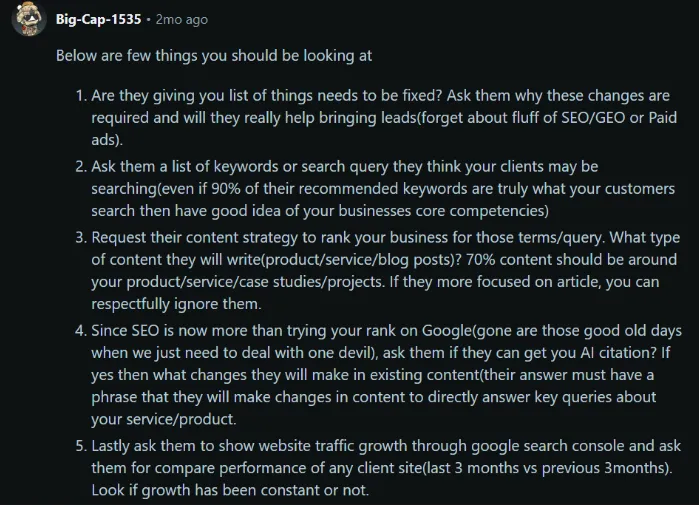
Any SEO company for manufacturers that struggles to answer these questions isn’t the right partner for your business.
Here’s a practical checklist, based on real buyer experience, to help you separate true Manufacturing SEO specialists from generic SEO vendors.
How to Choose the Right Manufacturing SEO Company in 2026
Not every manufacturing SEO company offers the same depth of expertise. Many industrial SEO agencies label themselves as full-service or best-rated, but manufacturers should evaluate them differently from SaaS or ecommerce brands.
Manufacturing SEO focuses on complex buyer journeys, technical specifications, distributor searches, and long sales cycles. A generic SEO agency for manufacturing may handle rankings, but a true manufacturing marketing agency understands:
- Industrial search behavior
- Product-driven and application-based keywords
- B2B lead qualification through content and site structure
This distinction sets manufacturing SEO experts apart from general SEO optimization companies.
What Manufacturing SEO Services Should Actually Include
When reviewing industrial marketing services, look for:
- Search engine optimization for manufacturing companies and industrial products
- Content built for engineers, procurement teams, and plant managers
- Manufacturing search engine optimization tied to revenue, not traffic
- Experience across industries like industrial equipment, components, or food manufacturing
A strong manufacturing SEO strategy matters more than claims like "number one SEO company" or "top-rated SEO."
A top SEO agency list is available, helping manufacturers compare manufacturing SEO agencies, industrial SEO marketing agencies, and SEO consultants side by side.
Instead of chasing the No. 1 SEO company, focus on fit: industry experience, process clarity, and measurable outcomes.
Why “Best SEO Agency” Lists Exist in the Market?
“Best SEO agency” lists exist because SEO buyers, especially manufacturing companies, face high information risk. Most manufacturers don’t run SEO in-house, so these lists act as a shortlisting tool, not a final decision-maker.
For manufacturers, evaluating SEO services upfront is challenging. Results take time, terminology is technical, and agency offerings often sound similar. Lists help reduce uncertainty by grouping agencies by experience, industry focus, and visible outcomes.
In the manufacturing space, these lists also serve a second purpose: industry filtering. A general best SEO agency may not understand industrial buying cycles, distributor-driven demand, or technical product content. Lists focused on manufacturing or industrial SEO help buyers identify firms that specialize in these areas.
Finally, such lists exist because “best” is subjective. The right SEO agency depends on company size, sales complexity, geography, and growth stage. These rankings provide market context, while manufacturers still need to assess fit, process, and long-term alignment.
Why Manufacturing SEO Is Different From Regular SEO
Manufacturing buyers don’t search like everyday consumers. That’s why the best manufacturing SEO agencies use a very different approach compared to generic SEO vendors.
- Buyers search with technical intent: Engineers and procurement teams use precise terms — materials, tolerances, processes, certifications. Effective manufacturing SEO focuses on these low-volume, high-intent keywords that bring real projects.
- SEO content must speak to engineers: A good SEO agency for manufacturers knows how to turn capabilities, machine lists, and case studies into clean, technical pages. No fluff. No generic blogs. Just practical information buyers trust.
- The research cycle is long and detailed: Manufacturing customers compare specs, past work, and capacity before submitting a form. Strong SEO strategy supports this journey with clear service pages, real examples, and accurate capabilities.
- Success is measured in leads, not traffic: High traffic means nothing if the right people don’t convert. Great SEO for industrial companies tracks qualified leads, quote requests, consultation bookings, or sample requests.
- Industry fluency matters: Generic agencies don’t understand procurement behavior or technical search patterns. Specialized seo agencies for manufacturing know what engineers expect and optimize your site accordingly.
Common SEO Problems Manufacturers Face (And How To Fix Them)
Most manufacturers run into the same SEO problems, mainly because generic agencies don’t understand how engineers, plant managers, or procurement teams actually search. A specialized SEO agency for manufacturing solves these issues with industry-specific strategies.
- Targeting the wrong keywords: Manufacturers often rank for broad, useless terms that bring unqualified traffic. A good SEO strategy focuses on technical, buyer-ready keywords tied to capabilities and RFQs.
- Weak or generic service pages: Most pages don’t explain tolerances, materials, machine lists, or industries served. Strong manufacturing SEO turns these into detailed, engineer-friendly pages that build trust quickly.
- No proof of capability: Buyers want case studies, certifications, and clear examples of past work. The right SEO agency helps you showcase real projects, not generic “portfolio” pages.
- Poor technical structure: Slow pages, confusing navigation, missing schema, and no internal linking are common. Experienced manufacturing SEO agencies clean this up so Google and buyers can find the right information instantly.
- Tracking the wrong metrics: Most manufacturers watch traffic instead of RFQs or qualified leads. Streamlined SEO for manufacturers sets up tracking for quote requests, calls, submissions, and buyer-ready actions.
What You Should Expect in the First 30–60 Days With a Manufacturing SEO Partner
A strong manufacturing SEO agency doesn’t waste your time with long audits or fluffy presentations. The first 30–60 days are about fixing foundations and building assets that actually bring RFQs.
- A technical audit with clear fixes: You should get a simple breakdown of what’s slowing your site down — missing pages, thin content, speed issues, broken links. Good marketing strategies for b2b manufacturers include fixes, not just a report.
- Capability-driven keyword research: Instead of chasing broad terms, your agency maps keywords to your services, tolerances, materials, certifications, and industries served. This is the core of real SEO for manufacturing companies.
- Rewriting your main service pages: The agency will rebuild your CNC machining, fabrication, molding, packaging, or other suchcapability pages to be detailed and buyer-friendly. This is where a true SEO agency for manufacturing makes the biggest early impact.
- Creating “conversion assets”: Expect new pages like
- Industries served
- Case studies
- Machine list page
- Certifications
- Accurate lead tracking setup: In the first month, your agency should set up tracking for RFQs, forms, calls, and quote requests. Good SEO agencies prioritize leads, not traffic numbers.
From 0 to 17 Leads in 30 Days: How a Packaging Manufacturer in the US Pulled It Off
The Challenge: John Maye was a trusted industry expert, but their outdated, brochure-style website made them invisible in today’s Google-first buying journey. Potential buyers were actively searching for their exact solutions but had no way to discover them.
This digital invisibility costs them qualified opportunities every single day while competitors capture the demand.
The Approach:
- AI-powered digital rebuild: Complete website overhaul + lead capture system to turn their online presence into a conversion engine.
- High-intent SEO strategy: Identified 2,262 keyword opportunities and used just 22 clusters to generate 17 qualified leads.
- Authority-building content: Expert, search-aligned content positioned John Maye as the go-to packaging equipment provider.
Measurable Results:
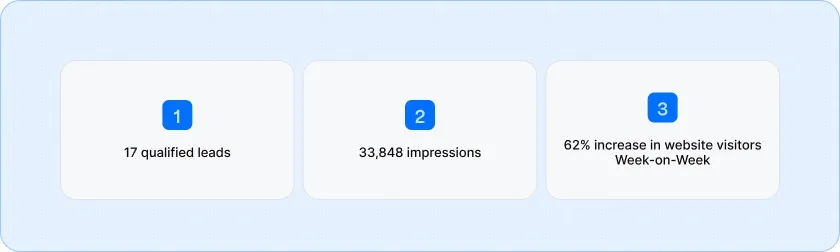
- 17 qualified leads generated in the first month.
- 100% High-intent prospects, as every lead was a genuine inquiry for packaging equipment.
- Consistent, 24/7 lead flow, operating continuously to capture prospects who were previously invisible.
Business Impact:
- Increased Sales Efficiency: The sales team was no longer wasting time on unqualified prospects.
- Competitive Advantage: Their professional online presence sets them apart from competitors.
- Wider Market Reach: The system started attracting leads from new areas within its service region.
Read the full case study here…
Check How Many Sales You Missed Today
Reveal Lost Customers
Your next big customer is researching solutions right now. Make sure they find you first.

