


Home

Resources
Blogs
Blog
Get insights on AI, productivity, and the future of work.


Thank you! Your submission has been received!
Oops! Something went wrong while submitting the form.

Digital Marketing
Jan 7, 2026
5 mins
3D Printing Business Marketing Strategies That Turn Capability Into Confidence Using 13 Strategies
Ishani Mitra
You can turn an idea into a physical part in a day. Selling that part reliably is where most 3D printing businesses get stuck. The gap is in how you package what you make, who you show it to, and which steps you automate, so interest becomes orders.
Marketing for a 3D printing company is therefore about designing messages that align with real use cases, building evidence that your process works at scale, and creating repeatable touchpoints that turn curiosity into requests for quotes.
In this blog, we break down practical, modern marketing strategies that help 3D printing businesses position themselves clearly, attract the right buyers, and support long sales cycles.
What Is 3D Printing Business Marketing?
3D printing business marketing is the structured approach to attracting, educating, and converting the right customers.
Customers usually come in with a problem. A prototype that needs to move faster. A part that is no longer available. A tool that needs to be customized without expensive tooling.
3D printing business marketing is the work of translating your capability into something that feels immediately useful to that buyer.
Understanding the 3D Printing Market Before Marketing It
Before you write content, run ads, or redesign a website, there is one step that matters more than all the rest. You need to be clear about who you are actually trying to reach.
This is where most 3D printing marketing efforts quietly fall apart.
Why “Everyone” Is Not Your Target Customer?
It is tempting to say you serve everyone. After all, 3D printing can be used across industries, products, and use cases. But the moment your marketing tries to speak to everyone, it stops speaking clearly to anyone.
Broad targeting creates three major problems:
- Your messaging becomes vague because it tries to appeal to too many use cases at once.
- Your website and content fail to rank because search intent remains unclear.
- Sales conversations drag on since buyers do not immediately see relevance.
Not all 3D printing buyers think the same way.
There is also a clear difference between buyer types:
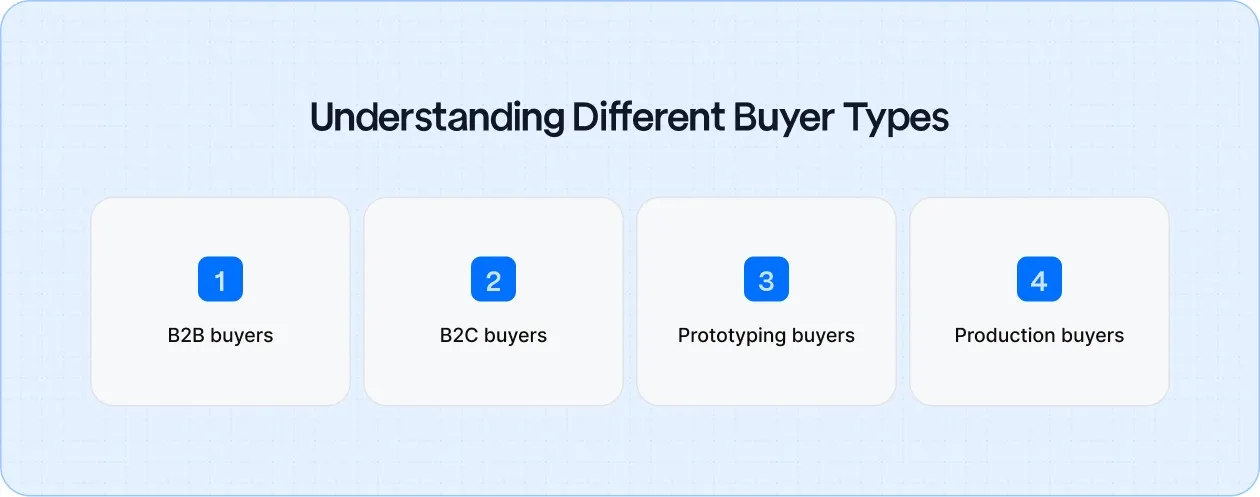
- B2B buyers care about reliability, repeatability, compliance, and long-term cost.
- B2C buyers focus on design, customization, price, and delivery speed.
- Prototyping buyers want speed, iteration, and design support.
- Production buyers want consistency, volume handling, and quality control.
These differences shape how people search, what they respond to, and how they make decisions.
Best 3D Printing Business Marketing Strategies for 2026
A lot of 3D printing businesses sound identical online because they describe the process, not the outcome. In 2026, the brands that win are the ones that make it easy for buyers to understand what you’re best at, who you’re built for, and why your shop is a safe choice.
1. Defining Your Unique Selling Proposition (USP)
Your USP is a business promise that helps buyers feel confident about awarding work to you. However, your answer should align with how real engineering, product, and manufacturing decisions get made.
To define your USP clearly and practically:
- Industry-specific expertise
- Make it obvious which industries you understand.
- Mention things like regulatory expectations, tolerance expectations, environmental exposure, and QC needs for fields like automotive, aerospace, medical, consumer hardware, and manufacturing tooling.
- When buyers see their world reflected, you gain instant credibility.
- Material specialization
- Buyers buy outcomes like strength, heat resistance, chemical durability, cosmetic finish, or biocompatibility.
- Call out core materials you’re confident in and explain why they matter.
- This prevents price-only conversations and positions you as a technical partner.
- Volume capability
- Buyers want to know whether you’re a prototype-only shop, low-volume bridge production partner, or full production-capable manufacturer.
- Write about typical batch sizes, order types, turnaround expectations, and your reliability under repeat demand.
- This filters the right customers to you and reduces mismatched leads.
- Design-to-delivery support
- If you help with DFM, file repair, tolerance guidance, orientation decisions, or finishing advice, say so clearly.
- Explaining your support level signals that working with you feels easier and safer.
Brand Consistency Across Website, Listings, and Sales Calls
Good positioning fails if your story changes depending on where someone sees you. Consistency builds reliability, and reliability builds trust. This part is about making sure your brand feels stable, aligned, and professional everywhere.
Ensure brand consistency by focusing on:
- Messaging alignment
- Use the same “what we do best” framing across your homepage, capability pages, Google Business Profile, listing platforms, and outbound emails.
- Repetition builds memory, and memory builds trust.
- If a buyer can summarize you in one sentence after browsing, you’ve done it right.
- Visual consistency
- Use real work photos instead of generic machine images or AI visuals.
- Show prints, finishing processes, QA checks, packaging, and real application environments.
- Consistency in imagery makes your business feel tangible rather than theoretical.
- Tone and trust signals
- Keep your tone confident, human, and clear. Avoid jargon that only makes content sound “technical” without meaning.
- Add signals like certifications, industries served, turnaround reliability statements, repeat client mentions, and quality proof.
2. Content Marketing That Educates and Converts Buyers
Great content removes uncertainty, speeds decision-making, and helps someone feel ready to send a request:
Types of Content That Work Best for 3D Printing Businesses
Not all content performs equally. Some formats directly influence buying confidence because they match how decision-making actually works. These are the pieces that broadcast you as a helpful tool.
Strong content formats include:
- Use-case pages
- Build pages around real applications of 3D printing procedures.
- Examples: jigs & fixtures, end-use functional housings, rapid prototype series, low-volume bridge production.
- Industry-specific blogs
- Write around constraints and problem-solving, not buzzwords.
- Discuss tolerances, material performance, finishing expectations, and production realities.
- This shows you understand real-world engineering constraints.
- Comparison guides
- Help buyers decide between options without sounding biased.
- For example: SLA vs SLS, MJF vs FDM, Nylon vs PETG, printing vs injection molding at various volumes.
- These guides position you as a trusted advisor rather than a vendor.
- Design and material explainers
- Practical, actionable explainers work best here.
- Include what to avoid, what drives costs higher, and what helps lead times.
Turn Capabilities Into Clarity
Create content that explains how your 3D printing services solve real engineering and production problems.
Build Sales-Ready Content


Sales-Focused Content That Supports Long Buying Cycles
3D printing projects often stall not because of a lack of interest, but because buyers need internal approval. Great sales content prevents deals from dying slowly and helps prospects justify decisions.
Support your sales cycle with:
- Case studies
- Show problem → approach → solution → measurable outcome.
- Include constraints like timeline compression, failure reduction, or improved performance.
- FAQs
- Address the friction points that slow RFQs: file types, tolerances, prep steps, finishing, MOQs, pricing structure, and lead times.
- Technical resource pages
- Offer checklists and simple guides. These quietly say: “We know how to make this process easier for you.”
3. SEO Strategies for Long-Term Visibility in 3D Printing
Manufacturing SEO only works when it focuses on buyer intent. Most serious customers search based on the part, the constraint, the application, or their industry.
Keyword Strategy for 3D Printing Businesses
A layered keyword strategy helps you capture both research-phase users and high-intent buyers. This means, it has to target terms that actually signal a solving mindset.
Build around three layers:
- Core service keywords: These are your foundational commercial terms like “3D printing service,” “additive manufacturing service,” and “rapid prototyping company.”
- Industry-specific keywords: Combine service with verticals like “medical prototyping partner,” “aerospace additive manufacturing,” or “automotive custom component printing.”
- Problem-based search terms: These signal real purchase behavior. Examples include “heat-resistant prototype housing,” “lightweight structural bracket alternative,” or “low-volume production replacement part.”
If you sell consumer products, lead with the product benefit. Customers buy what it does, not how it was made.
Attract the Right Buyers
Identify which industries, use cases, and search terms bring RFQs that are worth pursuing.
Map My ICP and Keywords
Website and Technical Strategies That Keep You Competitive
For 3D printing businesses, the website is a technical validation layer. Buyers use it to check credibility, capabilities, and whether you can meet their exact requirements before they ever speak to sales.
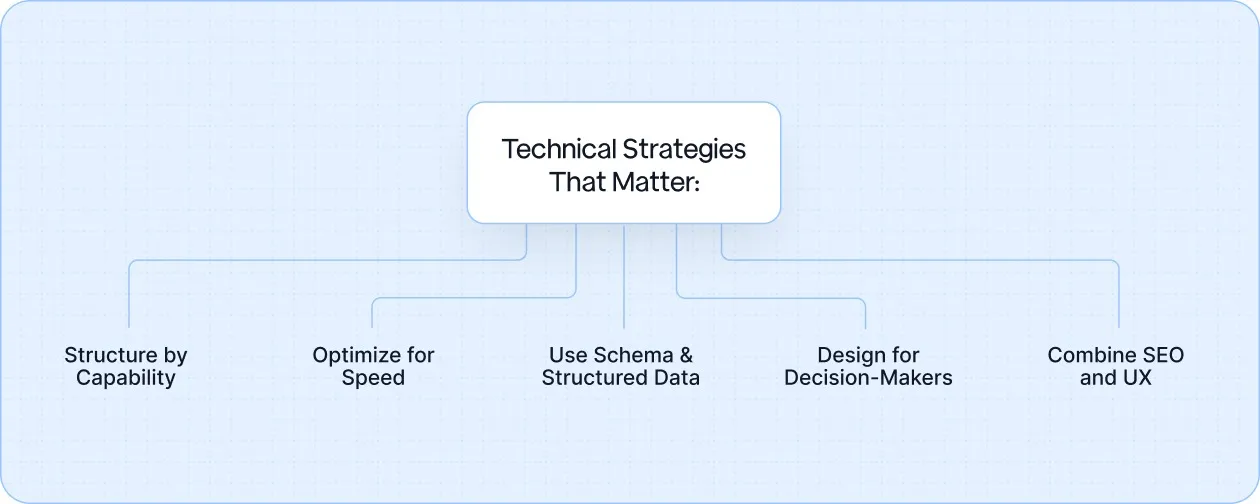
Technical strategies that matter:
- Structure pages by capability: Create dedicated pages for processes, materials, tolerances, industries, and volume ranges so search engines and buyers clearly understand where you fit.
- Optimize for speed and technical clarity:
- Compress heavy CAD visuals and videos
- Avoid bloated animations that slow load times
- Ensure pages load cleanly on mobile and tablets used in factory or office settings
- Use schema and structured data where relevant: Implement Service, Product, FAQ, and Organization schema to help search engines interpret technical offerings and improve visibility for long-tail searches.
- Design pages for decision-makers: Include:
- Clear specs and constraints
- Downloadable one-pagers or spec sheets
- Straightforward CTAs like “Request Quote” or “Discuss Design”
- Treat SEO and UX as one system: Internal linking between materials, processes, and use cases helps buyers self-educate and keeps them engaged longer, which also strengthens search performance.
4. PPC and Paid Search for 3D Printing Businesses
Paid search works best for 3D printing businesses when it’s treated as a demand-capture channel. The goal is to intercept buyers who already know what they need and are actively comparing suppliers, timelines, and pricing.
Well-run PPC fills pipeline gaps, shortens sales cycles, and gives you control over lead flow while SEO compounds in the background.
How to approach PPC the right way:
- Bid on buying intent: Focus on keywords that signal readiness, such as “SLS 3D printing service,” “custom ABS parts manufacturer,” or “rapid prototyping for medical devices.” Avoid broad terms like “what is 3D printing,” which attract researchers rather than buyers.
- Structure campaigns by application or industry: Separate campaigns for automotive, medical, consumer products, or tooling reduce wasted spend and allow messaging to stay highly specific. Buyers convert faster when ads reflect their exact use case.
- Send traffic to intent-matched landing pages: Never send paid traffic to a generic homepage. Each ad should lead to a page that clearly answers:
- What you make
- For whom
- With what materials or tolerances
- How fast and how reliably
- Use ads to qualify leads: Strong ad copy should filter out poor-fit inquiries by mentioning:
- Minimum order quantities
- Industries served
- Materials or processes supported
This lowers lead volume but improves RFQ quality.
5. Social Media Marketing for 3D Printing Businesses
Social media is about credibility and familiarity. Buyers feel safer working with companies they’ve seen repeatedly doing real work.
Platforms That Actually Work
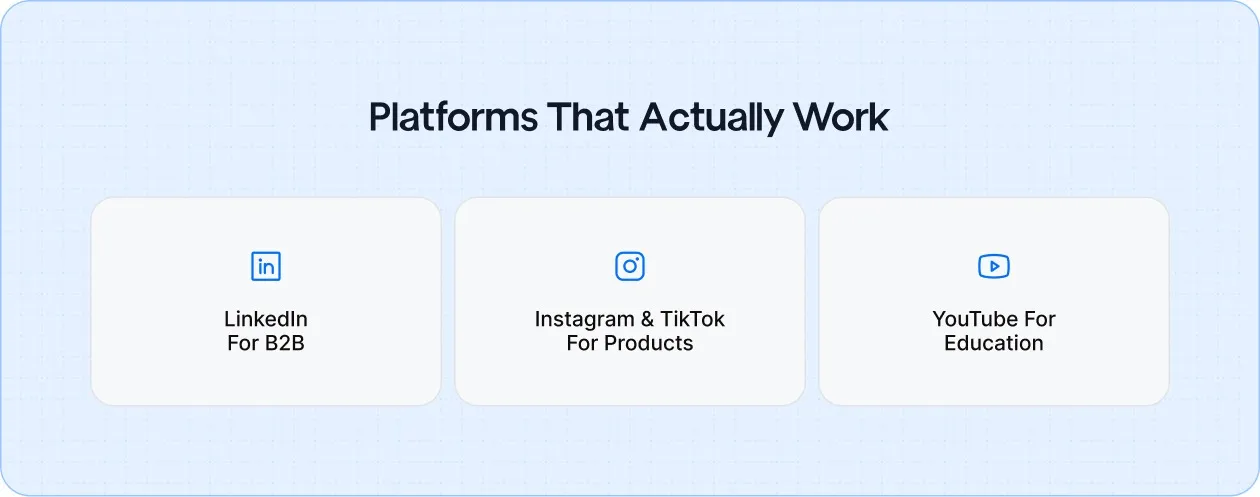
Different platforms serve different purposes. Focus where your buyers spend time.
- LinkedIn for B2B
- Best for engineers, procurement teams, founders, and manufacturing leaders.
- Great for case studies, insights, and credibility.
- Instagram & TikTok for product-facing or consumer brands
- Useful when visuals spark curiosity and inspiration.
- Good for shop visibility and approachability.
- YouTube for education and discovery
- Videos continue ranking over time.
- Perfect for explainers, walkthroughs, and capability demonstrations.
6. Email Marketing That Supports RFQs and Repeat Orders
Email works best for 3D printing businesses when it supports long buying cycles, repeat production runs, and ongoing engineering conversations.
How to use email marketing effectively:
- Segment your list by buyer type such as engineers, procurement teams, startups, or product designers so messages stay context-specific.
- Build short, functional email sequences around RFQs. For example, design confirmation, material availability, lead time updates, and post-delivery follow-ups.
- Share updates that matter operationally, like new materials, tighter tolerances, faster turnaround, or capacity expansion.
- Use email to re-engage dormant leads with practical prompts like “New material now available for [use case]” or “Faster turnaround for low-volume prototyping.”
- Keep emails clean, technical, and skimmable. One purpose per email, one clear next step.
7. Networking and Partnerships That Drive Real Business
Referrals remain powerful in manufacturing and product environments. In many niches, being “the trusted name people recommend” outperforms ads.
Industry Events, Trade Shows, and Online Communities
These work when approached deliberately.
Focus on:
- Attending the right places: Go where your customers and decision-makers gather, not only 3D printing conferences.
- Strong follow-ups: Send useful next steps, examples, or capability matches quickly. Actionable follow-ups win.
Partnering with Designers, Engineers, and OEMs
Partnerships compound over time, creating steady deal flow.
Strengthen this by:
- Building referral systems: Provide simple tools partners can share when recommending you.
- Doing co-marketing: Joint case studies, shared webinars, or collaborative educational content positions you as dependable collaborators.
8. Ship Early, Learn Faster, and Compound What Works
In 3D printing, momentum beats perfection every time. The businesses that grow, get into the market early, learn from genuine buyers, and refine based on actual demand.
A website, positioning statement, or marketing funnel does not need to be flawless to start generating value. It needs to be visible, understandable, and usable.
Once you are live, improvement should be driven by usage.
Focus on:
- Reviewing RFQs to identify repeated confusion or hesitation
- Updating pages, emails, or one-pagers to answer those gaps clearly
- Using lost deals as insight, not failure, to refine messaging or qualification
Every iteration should remove friction from the buying process.
Scale Marketing Without Creating Complexity
Many 3D printing businesses stall after initial traction by adding too many channels, tools, or initiatives at once. Complexity creates chaos and slows execution.
A more reliable scaling order entails:
- Strengthening high-impact fundamentals first
- Website clarity around services, materials, industries, and capabilities
- A frictionless RFQ or inquiry experience
- Proof assets such as case studies, sample parts, or process visuals
- One consistent acquisition channel that actually brings qualified leads
- Delaying low-impact distractions
- Full rebrands before demand exists
- Spreading content thin across every platform
- Marketing assets that look good but don’t support buying decisions
When the basics are working, scaling becomes a matter of amplification. You increase volume, refine messaging, and expand channels only after the core system proves it can convert interest into revenue.
Advanced Digital Strategies 3D Printing Companies Use to Scale
Basic marketing helps you get noticed. Advanced marketing helps you win real deals, shorten sales cycles, improve perceived expertise, and create predictable leads.
Below are advanced growth strategies top-performing 3D printing businesses use:
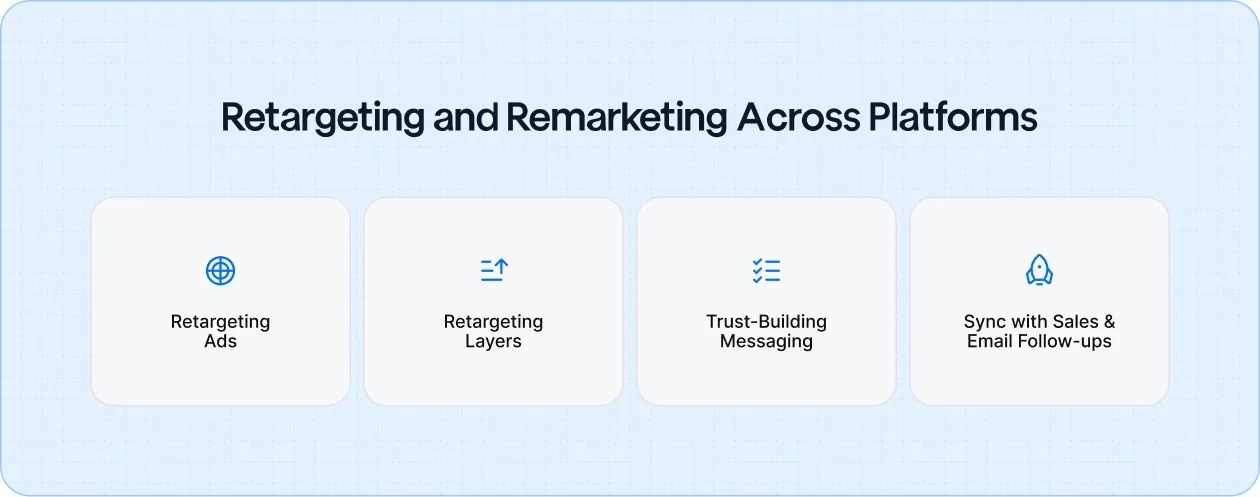
Retargeting and Remarketing Across Platforms
Most buyers don’t convert on their first visit. Retargeting keeps your brand visible during long cycles, so you’re not forgotten when they’re finally ready to request a quote.
- Use Google Display, LinkedIn, and Meta retargeting to show ads only to people who’ve already engaged with your site or content, ensuring budget is spent on warm prospects.
- Build multiple retargeting layers, such as website visitors, quote page viewers, PDF downloaders, and email subscribers, so you can tailor messaging to how close each segment is to buying.
- Focus messaging on trust-building rather than pressure selling; highlight reliability, accuracy, certifications, turnaround time, and real project examples.
- Sync retargeting campaigns with sales calls and email follow-ups so prospects receive reminders and proof of capability, reinforcing conversations.
Video Marketing as a Long-Term Asset
3D printing buyers evaluate proof of competence. Video is one of the strongest ways to demonstrate capability because buyers can literally see workflows, machines, materials, and outputs as they would in a factory walkthrough.
- Create evergreen educational videos such as “how 3D printing for aerospace prototyping works,” “SLS vs SLA vs FDM explained,” or “how tolerance and strength testing work in production environments,” which attract ongoing search visibility.
- Use YouTube not as entertainment but as a technical credibility library, ranking inside Google search results for niche industrial queries your competitors rarely invest in.
- Position your engineers, technicians, or founders as subject-matter experts by speaking on-camera, which builds human trust far beyond stock website claims.
- Reuse every video asset across your ecosystem. Embed them in service pages, RFQ pages, emails, case studies, and social feeds to multiply value without additional production cost.
Automation, CRMs, and Follow-Up Systems
Interest does not equal buying readiness. Many 3D printing leads go silent simply because nobody follows up consistently, or inquiries get lost when volume increases. A structured CRM and automated follow-up system ensures every lead is nurtured professionally.
- Use a CRM built for manufacturing and B2B workflows (like HubSpot, Zoho, or industry-specific platforms) to centralize quotes, conversations, project stages, and historical context in one place.
- Build automated workflows for first-response emails, follow-up reminders, quote reminders, post-delivery check-ins, and re-engagement campaigns so leads don’t slip away after initial contact.
- Humanize automation with thoughtful messaging, reference application type, industry, requirements discussed, or urgency level instead of generic copy-paste templates.
- Segment leads by buyer type (engineers, procurement teams, hobbyists, startups, OEMs, educational institutions) and tailor nurturing sequences so each group receives relevant communication.
Account-Based Marketing (ABM) for High-Value Industrial Buyers
Many 3D printing businesses want larger, repeat clients rather than one-off orders. ABM focuses marketing only on companies worth winning, so your efforts are precise and strategic.
- Identify high-potential industries such as aerospace, automotive R&D, medical device manufacturing, industrial tooling, or electronics, then build tailored outreach campaigns specifically for these segments.
- Create customized landing pages, proposals, videos, or email content showing industry-specific capability.
- Engage multiple decision-makers inside target organizations, engineers, procurement managers, and design teams, because real contracts usually require multi-level buy-in.
- Combine email outreach, LinkedIn engagement, targeted ads, and sales calls into one coordinated strategy rather than isolated tactics.
Building Authority Through Thought Leadership and PR
In technical industries, decision-makers choose vendors who know what they’re talking about. Authority content, expert commentary, and visibility in credible industry platforms elevate your perceived expertise far beyond smaller competitors.
- Pitch insights, case studies, or expert commentary to engineering blogs, manufacturing magazines, tech publications, and industry podcasts to earn mentions and visibility.
- Showcase participation in standards bodies, certifications, or industry associations as credibility anchors.
- Turn real customer projects into documented stories (with permission) showing before-and-after impact, engineering challenges solved, and real business outcomes.
Conclusion
Marketing for a 3D printing business should be treated like a product iteration cycle: launch something measurable, learn from real buyers, and improve what matters.
If you walk away with one idea, let it be this: focus on making your best product story obvious and easy to buy. Do the basics, clear niche positioning, sales-ready content, and a simple follow-up flow, then build from steady wins. Small, consistent improvements beat occasional marketing spectacles every time.
Ready to Market With Focus?
Build a marketing system that attracts better-fit projects and supports long-term growth.
Book A Consultation

SEO
Jan 7, 2026
5 mins
Most SEO for Gardening Falls Apart Without These 11 Strategies
Ishani Mitra
Most gardening businesses spend their days outdoors solving very real, hands-on problems. Overgrown lawns, unhealthy soil, drainage issues, seasonal planting. Online marketing often feels abstract by comparison, disconnected from the actual work. As a result, SEO is either ignored or treated as a one-time checklist task.
But search engines don’t reward businesses for being online. They reward clarity. Clear services. Clear locations. Clear proof that you know what you’re doing. For gardening companies, SEO becomes less about promotion and more about translating real-world expertise into signals search engines can recognize and trust.
In this blog, we break down how SEO actually works for gardening businesses, from local visibility and seasonal keywords to content, technical foundations, and conversion tactics that turn search traffic into booked work.
What SEO Actually Does for Gardening Businesses?
Most gardening businesses already do good work. SEO decides whether that work compounds into steady inbound leads or stays invisible outside referrals.
Centrally, SEO turns your services, expertise, and past work into an always-on acquisition channel that works even when you’re not actively marketing.
- SEO as a Demand Stabilizer: Gardening demand is uneven. Weather, seasons, and local competition all affect how busy a business feels month to month. SEO helps smooth those fluctuations by ensuring your business appears whenever intent arises. This makes SEO more about the landscaping’s operational predictability.
- SEO as a Credibility Filter in a Crowded Local Market: Most homeowners cannot easily judge the quality of a gardener before hiring. They rely on digital signals to make that decision. SEO strengthens those signals. In competitive areas, SEO often decides who gets shortlisted and who never gets considered.
- SEO as a Long-Term Asset: Unlike ads or promotions, SEO builds value over time. Every optimized page, review, and backlink adds to a growing footprint that competitors cannot easily copy. This is why SEO behaves more like infrastructure than marketing spend.
Why Gardening SEO Is Different from Other Local Services?
Gardening, as a niche business, sits at the intersection of design, maintenance, and local conditions. Generic local SEO frameworks often fall short here.
- Services vary widely even within the same city.
- Search intent changes by season, not just by location.
- Visual proof and project depth matter more than generic claims.
Effective SEO for gardening needs to reflect that complexity.
SEO Strategies That Actually Grow Gardening Businesses
SEO for gardening businesses works best when it mirrors how the work itself happens.
The strategies below focus on building visibility where homeowners actually look, earning trust before the first call, and turning search demand into booked jobs:
Why Local SEO Matters For Gardeners
Gardening and landscaping services are inherently local. Customers' search is based on whether a provider understands local soil conditions, climate, and property types. Local SEO ensures your business appears where these decisions are actually made.
Key local SEO priorities include:
- Optimizing for map and local pack visibility so your business appears when homeowners search for services nearby
- Aligning your website and listings with specific service areas rather than broad city-level targeting
- Reinforcing proximity and credibility signals that Google uses to rank local service providers
Core Local SEO Elements
Local SEO has a few non-negotiable building blocks. If these are solid, every other effort works better.
- Google Business Profile (GBP) setup: Claim your profile, pick the right primary category, and list all core services like garden maintenance, hedge trimming, or planting. Add your service area, opening hours, and contact details.
- Local keywords and region tags: Use regional phrases in your titles, headings, and body copy. This helps Google match you with local searches.
- Service area and city pages: Create focused pages for key towns or districts you serve. Include local photos, nearby projects, and references to parks, streets, or neighborhoods.
- Citations and directory consistency: Add your business to trusted home-service and gardening directories. Make sure your name, address, and phone number match across every listing.
- NAP hygiene: If you change your phone number or move, update it everywhere. Inconsistent details confuse both people and search engines.
Reviews And Reputation Signals
For gardening, reviews are often the deciding factor. People want proof that you show up on time, protect their property, and leave things clean.
- Treat reviews as ranking and trust fuel: Frequent, recent reviews help your map listing win more visibility and clicks.
- Collect reviews in the right places: Focus first on Google. Then add platforms that rank for your service, such as Yelp or trusted trade sites in your region.
- Benchmark against local competitors: Search “gardener near me” or “garden maintenance + city” and count how many reviews top competitors have. Aim to match and then pass that number slowly.
- Make reviews part of your process: Request a review after a tidy job, and send a direct link. Mention specific services so keywords appear naturally in the review text.
Keyword Strategy For Gardening SEO
Keyword strategy determines whether your site attracts casual readers or real buyers. For gardeners, this means aligning keywords with seasonality, service intent, and local demand.
A strong keyword approach focuses on:
- Capturing demand when homeowners are actively planning work, not just researching
- Balancing informational content with service-driven searches that lead to bookings
- Assigning each keyword group to a clear page purpose instead of overlapping topics
Five-Keyword Optimization Strategy
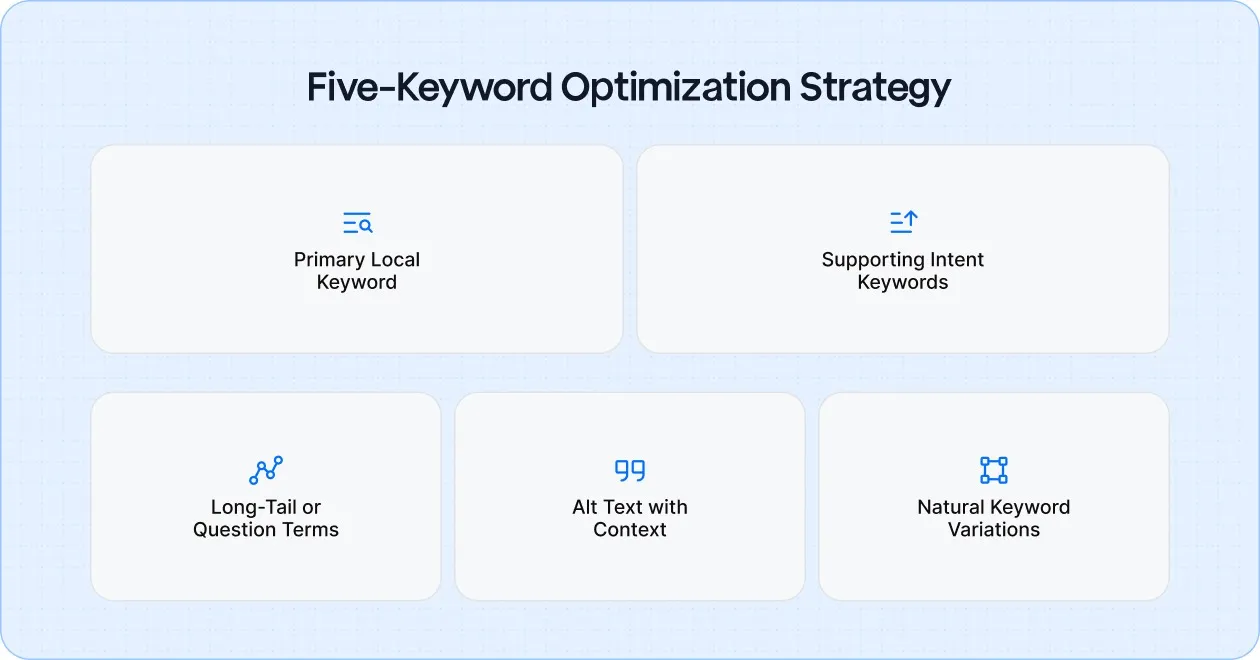
Every important service page can work with a small, focused keyword set rather than random phrases.
- Pick one primary local keyword: Use something like “garden maintenance in Austin” as the main focus. Place it in the title tag, H1, and early in the text.
- Add two or three supporting intent keywords: Include phrases like “regular garden tidy ups,” “planting and pruning service,” or “lawn edging and mulching.”
- Include one or two long-tail or question terms: Add lines that cover questions such as “how often should I book garden maintenance” or “do you remove green waste.”
- Write alt text for images with real context: Describe photos as “backyard planting project in East Austin with new beds and mulch” instead of generic labels.
- Use natural variations: Sprinkle related phrases like “yard care,” “garden cleanups,” or “hedge shaping” so content reads like a human conversation, not a keyword list.
Long-Tail And Buyer-Driven Keywords
Short keywords like “gardener” bring mixed traffic. Longer phrases show clearer intent and often convert better.
- Problem-driven questions: Build content around searches like “how to fix waterlogged garden soil” or “how often to prune hydrangeas.” Add clear calls to book help if they feel stuck.
- Match keywords to pages: Give each main service and city its own cluster of long-tail keywords. Avoid trying to rank one page for every topic.
Know What Homeowners Search
Identify the services, seasons, and local phrases that actually bring gardening leads.
Build My Keyword Map
On-Page Optimization That Actually Supports Gardening SEO
On-page SEO is where most gardening websites quietly lose ground. Search engines read structure, clarity, and intent. Visitors read confidence, relevance, and ease.
Strong on-page optimization does both at the same time.
Decision Flow
One overlooked factor is decision flow. A strong page guides the reader from recognition to reassurance without friction. That means structuring content around progression.
Here’s what that looks like in practice:
- Objection-aware copy placement: Weave answers to common doubts directly into the page where hesitation usually happens.
- Service boundaries stated clearly: Pages that perform well explain what the service does and does not include. Clear boundaries reduce mismatched enquiries and improve conversion quality.
- Trust signals embedded mid-page: Reviews, credentials, or short proof points placed near decision moments tend to work better than badges stacked in the footer.
- Conversion cues without pressure: Gentle prompts like “this is usually needed when…” or “most homeowners contact us after…” help normalize action.
Effective on-page optimization for gardening SEO is about alignment.
Technical On-Page Elements
Small technical details on each page affect how fast it loads and how easily it gets indexed.
- Improve load speed: Compress photos, use modern formats, and avoid heavy sliders. Faster pages rank and convert better, especially on phones.
- Make pages mobile-friendly: Use readable fonts, simple layouts, and buttons that are easy to tap.
- Keep clean, descriptive URLs: Use addresses like /garden-maintenance-austin instead of long, cryptic strings. It helps both users and search engines understand the topic.
Content That Builds Long-Term Gardening SEO Authority
Gardening SEO rewards consistency and usefulness more than volume. The goal is to become the site people return to when they’re unsure about a decision.
Blogging And Evergreen Content Strategies
Blog posts and guides can drive traffic for years if they answer timeless questions.
- Use “People Also Ask” questions: Search your main services and note the questions Google shows. Build detailed posts that answer those with photos and examples.
- Write how-to and seasonal guides: Topics can include “how to plan a low-maintenance garden,” “spring yard checklist,” or “best shrubs for privacy in small yards.”
- Cover soil, tools, and plant choices: Explain differences between soil types, basic tools every homeowner needs, and plant choices for shade, sun, or drought.
- Group FAQs smartly: Create FAQ pages for each service with short, direct answers. This also helps you target question-based searches.
Becoming An Information Hub
Instead of random posts, build topic clusters so search engines see clear depth around your main services.
- Pick core topics aligned with services: Examples are “lawn care,” “hedge and shrub care,” “garden design,” and “seasonal maintenance.”
- Create pillar pages with supporting posts: Write a broad guide on “complete garden maintenance,” then link out to focused posts on mowing, pruning, mulching, and watering.
- Link between related articles: Internal links help users read more and help search engines understand page relationships.
Video SEO Integration
Video works very well for gardening, because people like seeing results and processes.
- Embed short videos on key pages: Add clips showing before-and-after cleanups, planting days, or pruning techniques. This keeps visitors on your site longer.
- Post how-to videos on YouTube: Optimize titles with phrases like “how to prune roses in spring” plus a city tag when relevant. Add links back to your site in descriptions.
- Use video on service pages: A simple walkthrough where you explain your process can raise trust and conversion rates.
Turn Expertise Into Visibility
Create service and seasonal content that shows real gardening knowledge and builds homeowner trust.
Create Gardening SEO Content
Off-Page SEO And Authority Signals For Gardeners
Search engines look beyond your site to decide whether it should rank. For gardening businesses, authority often comes from proximity, reputation, and industry alignment.
Earning Relevant Links
Not all backlinks help equally. Gardeners benefit most from links tied to real-world credibility.
- Partner with local businesses: Swap links or features with nurseries, garden centers, hardware stores, or home organizers. Offer to write short tips for their blogs.
- Join gardening and home-service directories: Add listings on respected local sites, trade associations, and gardening groups. Check which directories rank for your service keywords.
- Study competitor accreditations: Look at badges or memberships on competitor sites. Many accreditation bodies include a member profile with a link back to your site.
Digital PR for Gardening Visibility
You can build authority by sharing expert input where your audience already reads. You must try social media for that.
- Pitch seasonal stories to local media: Suggest pieces to neighborhood news sites or radio stations.
- Write guest advice posts: Offer simple “how to pick a gardener” or “low water yard ideas” articles to home and garden blogs.
- Share before-and-after transformations: Strong visual project stories often interest local lifestyle outlets.
Technical SEO Essentials
Technical SEO is like irrigation for your site. If it fails, nothing grows well, no matter how good the content is.
Crawlability, Indexing, And Sitemaps
You want search engines to find, read, and index every important page quickly.
- Maintain a clean XML sitemap: Include only live, important pages. Submit it in Google Search Console and refresh it after major site changes.
- Use robots.txt wisely: Block only pages that should stay private, such as admin areas. Avoid blocking sections you want to rank.
- Avoid duplicate content issues: Use canonical tags correctly when similar pages exist, for example across nearby towns with similar service descriptions.
Core Web Vitals And UX Signals
Google now measures key user experience metrics that influence rankings.
- Watch Largest Contentful Paint (LCP): Ensure the main content loads quickly by compressing images and avoiding heavy scripts.
- Keep layout stable: Prevent elements from jumping around as the page loads by setting image sizes and avoiding sudden banner insertions.
- Test regularly: Use tools like PageSpeed Insights and Search Console reports to track issues.
Schema Markup That Speaks Search Engines’ Language
Schema markup adds extra tags to your HTML that explain what each page and section means. With correct schema, you can qualify for rich results like review stars, FAQ boxes, and better local panels.
Recommended Schema Types
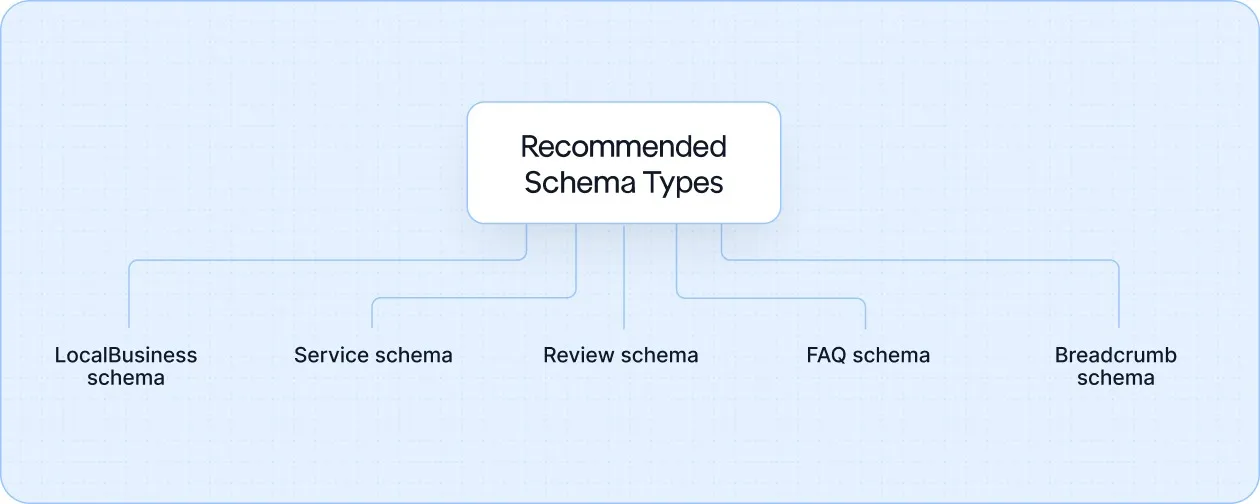
Focus on simple, high-impact schema first.
- LocalBusiness schema: Mark up your business name, address, phone, opening hours, and service area so search engines read them clearly.
- Service schema: Tag pages for services like lawn care, hedge trimming, or garden design, including descriptions and pricing ranges.
- Review schema: Mark up reviews you host on your site so stars may appear in search results.
- FAQ schema: Add schema to FAQ sections for a chance to appear directly in “People Also Ask” style views.
- Breadcrumb schema: Help search engines understand how your pages relate in your site structure.
Crucial technical implementation can be:
- Using generators or plugins: Many CMS tools can add basic schema without coding. Always test output.
- Validating with Google’s tools: Run pages through rich result testing tools to confirm that schema is valid and readable.
Measuring SEO Performance For Gardening Businesses
SEO only works when it’s measured consistently.
Metrics That Reflect Real Progress
Gardening SEO should be evaluated based on:
- Organic traffic to key pages: Watch visits to your home page, main service pages, and location pages.
- Local rankings for priority keywords: Track how often you appear in the top results for “gardener + city” and similar terms.
- Click-through rates (CTR): If impressions rise but clicks stay flat, improve titles and descriptions.
- Conversions: Count calls, contact form submissions, and quote requests from organic visitors.
Tools For Tracking
Start with free tools, then add more only if needed.
- Google Analytics: Measures how visitors arrive, which pages they view, and which actions they complete.
- Google Search Console: Shows which queries bring impressions and clicks, and flags indexing or technical issues.
- Rank trackers: Use simple tools to monitor your main keywords by city over time.
Advanced Gardening SEO Tactics
Once your basics run well, you can push for stronger authority and visibility.
Competitor Benchmarking
You do not need to guess where you stand in your market.
- Check domain strength: Use SEO tools to compare your domain rating with local competitors. This shows how big the gap is.
- Study backlink differences: Identify sites that link to competitors but not to you. These are outreach targets.
- Find content gaps: Look for questions and topics competitors cover that you do not. Decide which ones make sense to add.
Video and Visual Content Optimization
Gardening is visual, which gives you an advantage.
- Optimize YouTube channels: Use clear titles, descriptions, and tags with local phrases and service names.
- Embed video smartly: Place videos near calls to action on service pages to build trust and keep people engaged.
- Use strong visuals in galleries: Compress images for speed but keep them sharp. Add captions with neighborhoods and service types.
Accreditations and High Authority Signals
Third-party trust badges help both visitors and search engines.
- Join gardening or trade bodies: Apply to local or national gardening groups that list members on their sites.
- Show badges clearly: Place accreditation logos near reviews and guarantees so visitors see them fast.
Seasonal SEO Planning For Gardeners
Gardening is not flat across the year. Search interest rises and falls with the seasons.
Seasonal Content Calendars
Plan content and promotion around predictable seasonal peaks.
- Spring: Focus on planting, bed preparation, and full yard cleanups. Publish and promote content early, before demand peaks.
- Summer: Cover watering, mowing schedules, weed control, and pest issues. Refresh service pages with current photos.
- Fall: Push leaf removal, pruning, and winter preparation. Share checklists and before-and-after fall cleanups.
- Winter prep and planning: Use slower months to publish design ideas, garden planning tips, and book early projects for spring.
Flexible Keyword Mapping by Season
Keywords do not stay constant. You should:
- Track seasonal search shifts: Use keyword tools and Search Console to see when “spring clean up” or “fall pruning” starts rising.
- Adjust internal links and promos: During each season, feature relevant services higher on your home page and menus.
Conversion Optimization
SEO brings visitors. Conversion optimization turns those visitors into booked jobs.
High-Performing Landing Page Elements
A good gardening page should make it very easy to decide and act.
- Clear primary call to action: Use one main action, such as “Request a garden quote” or “Call for a visit,” repeated in several spots.
- Visible proof and trust badges: Add review snippets, star ratings, and badges from trade bodies or local awards.
- Strong before-and-after photos: Show clear project transformations. Mention city or neighborhood in captions to build local trust.
Chat And Lead Capture Add-Ons
Small tools can help catch visitors who would otherwise leave.
- Simple chat or message widgets: Allow quick questions without a phone call. Keep responses short and human.
- Short, focused forms: Ask only for name, contact info, location, and a brief description. Longer forms often drop completion rates.
- Nudge messages and follow-ups: Use gentle reminders like “Got questions about your yard?” instead of aggressive pop-ups.
These strategies together give gardening businesses a clear, practical road map. You build visibility, authority, and trust step by step, then refine based on real data instead of guesswork.
What To Expect From SEO?
SEO is powerful for gardening businesses, but it is not instant. It behaves more like growing a healthy garden than switching on a light. The more consistent, strategic, and patient you are, the stronger and more predictable the results become:
3–6 Months
The first few months of SEO focus on building foundations: fixing technical issues, optimizing service and location pages, strengthening Google Business Profile, and creating useful content. During this stage, Google learns who you are, what you do, and whether you can be trusted to rank.
What typically happens in this phase:
- Improved Google Business Profile visibility: More impressions in the local map pack, more views on your listing, and increased discovery searches for your services.
- Early engagement signals: More website visits, higher click-through rates, and customers spending longer on pages instead of bouncing away quickly.
- Initial conversion lift: Calls, form fills, and quote requests start increasing gradually, especially in the areas where you have strong local optimization.
This stage is about momentum. You may not dominate rankings yet, but you should feel clearer visibility and more qualified inquiries.
6–12 Months
Once the basics stabilize and search engines consistently recognize your brand, SEO shifts from “getting noticed” to “becoming a trusted local authority.” This is where compounding benefits begin to take shape.
What businesses typically see in this window:
- Stable first-page and map pack rankings: For your main city and highest-value services, rankings become steadier instead of fluctuating.
- Growth beyond your primary location: Service area pages begin performing, helping you attract leads from surrounding towns and neighborhoods.
- Authority signals strengthening: More organic backlinks, more reviews, better engagement metrics, and clearer brand trust cues.
- Consistent organic lead flow: Instead of unpredictable surges, you start seeing steady inquiries from organic search, often reducing dependency on paid ads.
By this stage, SEO becomes a real revenue engine rather than a marketing experiment.
Show Up When Demand Hits
Strengthen local SEO so your gardening business appears when homeowners are ready to book.
Strengthen My Gardening SEO
Benchmarks And Realistic ROI Expectations
SEO should always be judged on business impact. Rankings matter, but only because they lead to profitable work. A realistic measurement mindset keeps decisions grounded.
What to track and expect:
- Keyword rankings: Aim for top-3 positions for priority local terms over time, not just page one visibility.
- Organic traffic growth: A steady upward trend matters more than sudden spikes. Seasonal gardening demand will create natural waves.
- Meaningful engagement: Higher click-through rates, longer time on page, repeat visits, and users viewing multiple pages indicate that your content is working.
- Conversions and lead quality: Calls, quote requests, bookings, and messages should rise. Focus on the quality of leads.
- Cost efficiency compared to ads: As SEO matures, the cost per lead usually drops significantly compared to PPC or paid directories, and leads feel “warmer” and more trust-driven.
- ROI window: Most gardening businesses see clear financial returns within 6–12 months when SEO is done consistently, with results strengthening every season thereafter.
In simple terms, SEO starts as visibility, matures into authority, and ends as a dependable source of ongoing work. With realistic expectations, disciplined execution, and patience, it becomes one of the most valuable long-term marketing assets a gardening business can build.
Conclusion
SEO for gardening isn’t a campaign you launch and move on from. It’s an operating system that quietly supports every part of your business. Your services become easier to understand. Your location becomes easier to trust. Your expertise becomes easier to find.
Once those foundations are in place, SEO stops feeling like marketing. It becomes infrastructure. Something that compounds as your reputation grows, your portfolio expands, and your local authority deepens.
The sooner it’s treated that way, the harder it becomes for competitors to catch up.
Ready to Grow Consistently
Build an SEO system that supports steady demand across seasons and service types.
Book A Consultation

Digital Marketing
Jan 6, 2026
5 mins
11 Industrial Lead Magnet Ideas SMBs Need to Grab the Right Attention
Batul Beawarwala
Running an industrial business with a small team and limited resources can make marketing feel like a major challenge. You want to connect with the right people, those who truly need your services, but high costs and complex strategies often get in the way.
Industrial lead magnets solve this problem. By offering something valuable in exchange for attention, you can start building relationships with potential customers who are already looking for solutions like yours.
This article will help you discover 11 practical lead magnet ideas that reach the right people and grow your business without the need for a big budget.
What is an Industrial Lead Magnet?
An industrial lead magnet is a targeted resource that helps SMBs in the industrial sector capture qualified leads by offering something valuable in exchange for their attention.
You need to provide a solution to a problem your potential customers face, making it easier for them to engage with your business.
These lead magnets can be:
- Guides: Step-by-step instructions on improving operations or complying with regulations.
- Tools: Calculators or cost-saving tools that provide immediate value.
- Checklists: Simple, actionable lists for maintaining safety or optimizing workflows.
- Templates: Editable resources to streamline common industrial processes.
- Reports: Research or insights into trends affecting the industry.
By offering these resources, you not only attract the right prospects but also demonstrate your expertise, building trust along the way.
11 Types of Lead Magnets and How to Create Them
When it comes to attracting the right customers in the industrial space, lead magnets can be your most valuable tool. They help you provide immediate value and address the real needs of your target audience.
Here are 11 lead magnet ideas that can set you up for success, plus simple steps to create them.
1. ROI Calculators & Cost-Saving Tools
An interactive tool that helps potential customers calculate their return on investment or savings when using your product or service.
How to create it:
- Use simple tools like Google Sheets or Ucalc to create interactive ROI calculators or cost-saving tools.
- Allow users to input their own data to calculate potential savings or returns.
- Provide immediate, personalized value by showing how your solution benefits their specific situation.
- Make the tool easy to use and accessible for potential customers to engage with right away.
ROI Formula:
To help industrial businesses understand the impact of your product or service, use this formula to calculate ROI:

- Net Profit = Revenue from investment - Investment Cost
- Investment Cost = Total amount spent on the investment
Example: If you spend $5,000 on a piece of equipment that generates $7,500 in new revenue, your ROI would be 50%. Simple, actionable insights like this attract leads who are looking to make smart, data-driven decisions.
2. Case Studies of Successful Applications
Case studies offer real-world examples that show the effectiveness of your solution and help build trust. They show your product's value and its tangible impact on your clients.
How to create it:
- Identify customers who have seen measurable results from your solution.
- Highlight their challenges, how your product solved them, and the measurable outcomes.
- Make sure the case study mirrors your target audience’s challenges for relatability.
Why it works: Case studies demonstrate the real-world impact of your solutions, helping prospects connect the dots between their pain points and the benefits you offer. It's proof that your product works in scenarios similar to theirs.
3. Compliance Checklists and Industry Templates
Regulatory hurdles are a common challenge in industrial sectors. Offering checklists or templates helps businesses navigate compliance requirements easily, saving them time and avoiding errors.
How to create it:
- Research key industry regulations and focus on areas where businesses often face compliance issues.
- Create simple, easy-to-follow checklists or editable templates in accessible formats like PDF or Excel.
- Provide clear instructions to make sure users can apply them right away.
Why it works: By offering downloadable and customizable resources, you position your business as a trusted advisor, and your lead magnet becomes a tool they can use immediately, helping you build strong relationships.
4. Cost Comparison Calculator for Industrial Solutions
Buyers love a clear breakdown of how your product stacks up against competitors. A cost comparison calculator gives them a quick, visual way to see the advantages of your solution.
How to create it:
- Develop a calculator that compares your product's cost, efficiency, and longevity against competitor offerings.
- Use tools like Google Sheets or specialized software to create an easy-to-use interface.
- Ensure the comparisons are clear, with side-by-side visuals that highlight the value of your solution.
Why it works: A cost comparison calculator makes the decision process simpler, providing your prospects with a concrete reason to choose your solution based on value.
5. Interactive Learning Experiences (Webinars, Live Demos, Product Trials)
Engage prospects with live demonstrations and webinars that allow them to experience your product’s benefits firsthand and ask real-time questions.
How to create it:
- Webinars & Live Demos: Plan live sessions on relevant topics, hosted on platforms like Zoom or YouTube Live.
- Product Trials: Follow up with trials to allow users to experience your solution’s benefits themselves.
Why it Works: Interactive learning experiences offer prospects a tangible understanding of your product and its benefits, fostering deeper trust.
6. Interactive Industry Assessments & Supplier Evaluation Tools
Allow prospects to assess their current situation and provide personalized feedback or recommendations.
How to create it:
- Self-Assessments: Create a questionnaire using tools like Typeform or SurveyMonkey to gather key pain points from your audience.
- Supplier Evaluation Tool: Develop a simple tool for evaluating suppliers based on factors like cost, quality, and timeliness.
Why it works: These tools give your audience immediate value while positioning your brand as an expert who understands their specific challenges.
7. Workforce Training Resources & Certification
Continuous training is key in industrial sectors. Offering online training resources and certifications can position your business as a knowledge leader and add value to your clients’ workforce.
How to create it:
- Build online training modules that focus on practical, industry-relevant skills.
- Use platforms like Teachable or Thinkific to offer certification upon completion.
- Focus on real-world applications, making sure the training is directly relevant to your audience’s needs.
Why it works: Providing workforce training positions your brand as an expert in the field, while helping your clients stay competitive through skill development.
8. Industry Research Reports & Market Insights
Providing valuable insights into industry trends and emerging technologies positions you as an authority. These reports help businesses stay informed and make smarter decisions.
How to create it:
- Gather data from reputable sources such as industry reports, surveys, and studies.
- Present the information in a concise, easy-to-read report format.
- Highlight actionable insights and how businesses can apply this information to stay ahead.
Why it works: Research reports are an effective way to add value while demonstrating your expertise. Providing timely insights makes you a trusted source for critical industry knowledge.
9. "Behind-the-Scenes" Factory or Production Line Virtual Tour
Transparency is key in building trust. A virtual tour allows prospects to see your production process and quality standards firsthand, strengthening your credibility.
How to create it:
- Use platforms like Google 360 or YouTube to create an immersive virtual tour of your production facility.
- Focus on the key processes, safety standards, and quality control measures in place.
- Highlight your commitment to quality, transparency, and safety.
Why it works: A behind-the-scenes look builds trust and shows that your business values transparency and high-quality production, creating a stronger connection with prospects.
10. Exclusive Networking Events or Masterminds
Networking and collaboration create valuable opportunities for professionals in your industry. Exclusive events help prospects connect with others facing similar challenges, fostering relationships that can turn into business.
How to create it:
- Host virtual mastermind sessions or networking events on platforms like Zoom or Slack.
- Focus on a clear topic or agenda that addresses a current industry challenge.
- Keep the group small and intimate to encourage meaningful discussions.
Why it works: Networking events allow prospects to engage with industry peers, offering them real value beyond your product. This builds your reputation as a connector in the industry.
11. Future Trends or Emerging Tech Reports
Position your business as forward-thinking by providing insights into new technologies and trends shaping the industry.
How to create it:
- Research emerging technologies such as automation, IoT, AI, or other innovations affecting your industry.
- Present this information in an accessible, research-driven format.
- Highlight how businesses can leverage these new trends to stay competitive.
Why it works: This type of lead magnet keeps your audience informed about the future and demonstrates that you’re staying ahead of the curve, adding long-term value to your relationship.
The best lead magnets solve problems instantly.
Improve how your lead magnets attract the right audience through stronger SEO and content strategy.
Improve Lead Magnet Visibility
Optimize Your Lead Magnets for Search
SEO plays a crucial role in helping your lead magnet reach the right prospects at the right time. By applying the right strategies, you can make sure your valuable content is found and used by potential customers who need it.
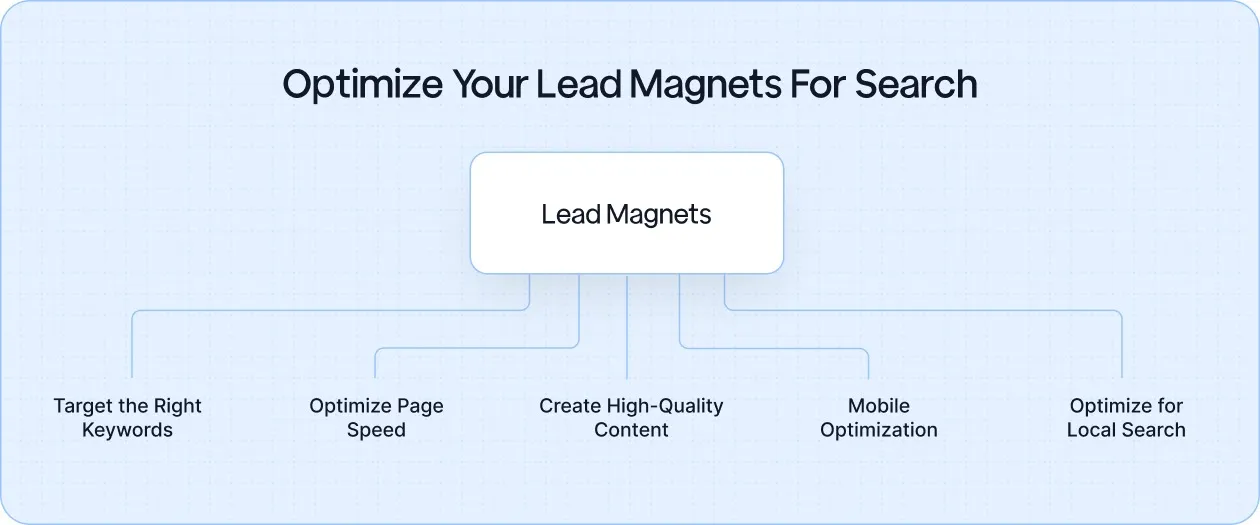
Let’s dive into some simple yet effective SEO tips that will improve your lead magnet’s visibility and bring in the right audience:
1. Target the Right Keywords
The first step in optimizing your lead magnet is making sure it’s discoverable by the right people. By focusing on specific keywords that your ideal customers are searching for, you can get your lead magnet in front of them exactly when they need it.
How to do it:
- Use tools like Google Keyword Planner or Ubersuggest to identify relevant keywords.
- Focus on long-tail keywords that are highly specific to your industry. These keywords often have less competition and are more likely to attract high-quality prospects.
- Integrate these keywords naturally into your landing page title, description, and within the content itself.
Must Read: 8 Industrial Manufacturing Marketing Moves Most Ignore
2. Optimize Page Speed
If your landing page takes too long to load, potential customers will lose interest before they even get a chance to see your lead magnet. Page speed is a ranking factor for Google, so optimizing it improves user experience and helps with your search engine ranking.
How to do it:
- Compress images using tools like TinyPNG to reduce file sizes without sacrificing quality.
- Minimize JavaScript and CSS files to streamline page load times.
- Use a reliable hosting provider that offers fast loading speeds.
3. Create High-Quality Content
Google loves content that provides real value to users. By offering actionable and relevant content that addresses the needs of your target audience, you increase your chances of ranking higher in search results.
How to do it:
- Write content that answers your audience’s most pressing questions or challenges.
- Use clear, concise language and avoid jargon.
- Include testimonials or case studies to build credibility and demonstrate real-world success.
4. Mobile Optimization
With more people browsing on mobile devices, your lead magnet landing page must be mobile-friendly. Google also prioritizes mobile-first websites in its rankings.
How to do it:
- Use a responsive design so that your page adjusts to different screen sizes.
- Test your page on multiple devices to ensure that it displays correctly.
5. Optimize for Local Search
If your industrial business serves a specific region, local SEO can be a game-changer. Make sure your lead magnet pages are optimized to show up for location-based searches.
How to do it:
- Include location-specific keywords (e.g., “industrial packaging solutions in Chicago”).
- Add your business to Google My Business to improve local search visibility.
Let’s look at a real-world example to see how these strategies work.
Case Study: John Maye Gets 17 Leads in The First 30 Days of Adopting AI SEO
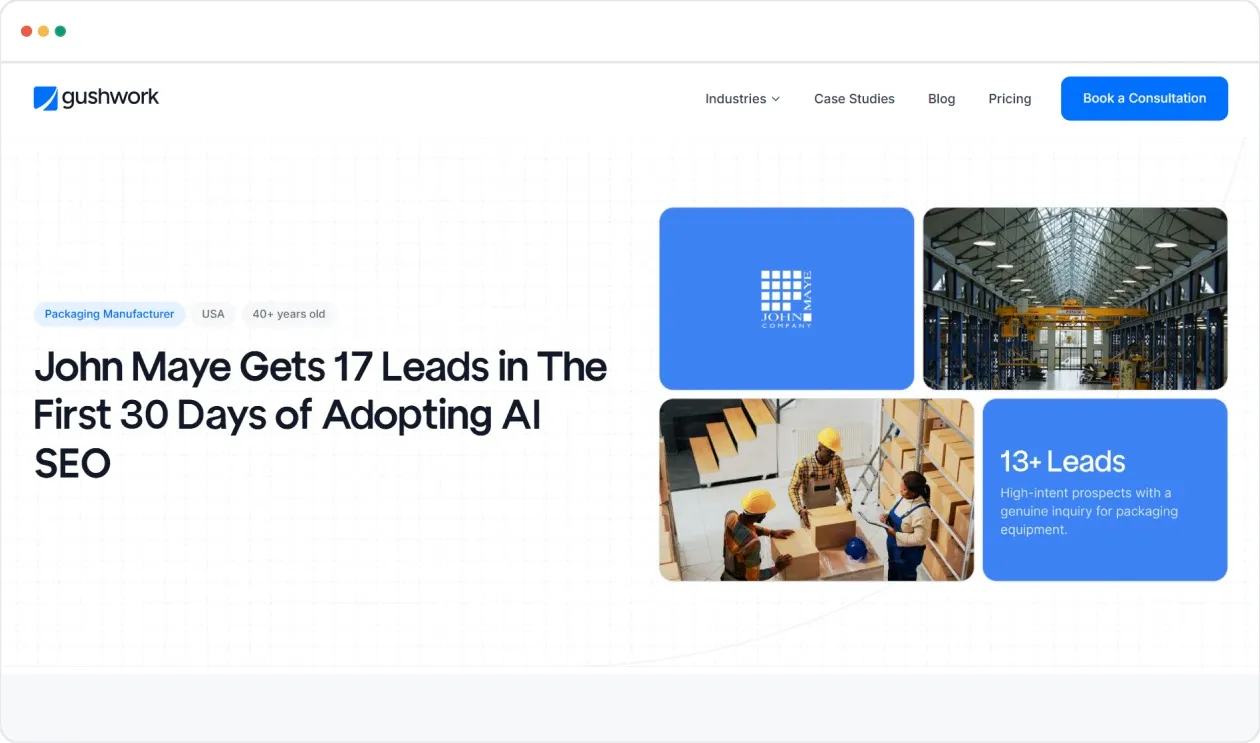
John Maye, a well-established packaging equipment supplier, was struggling with a lack of online visibility, despite their years of industry experience.
After implementing AI-powered SEO strategies, including optimizing their website for the right keywords and improving page speed, John Maye saw immediate results. In just 30 days, they generated 17 qualified leads, all from organic search.
What they did:
- Targeted high-intent keywords related to packaging equipment.
- Overhauled their website to improve load speed and mobile responsiveness.
- Integrated a lead capture system to manage the influx of new leads.
Your Next Step to Attracting the Right Leads
Building a successful lead magnet requires providing real value and solving the specific problems of your target audience.
By following the tips we’ve covered, you can create a resource that captures attention and helps you build lasting relationships with your ideal prospects.
Here’s a quick recap to guide your lead magnet creation journey:
- Understand Your Audience: Know their pain points and offer solutions that resonate.
- Make it Actionable: Provide something your audience can use immediately to see real results.
- Optimize for Visibility: Leverage simple SEO strategies and ensure your lead magnet is easy to find.
- Keep It Relevant: Personalize your lead magnet to the needs of your specific industry or niche to maximize impact.
To create your lead magnet, remember that it's important to start conversations and build trust, which requires expert help and guidance. It could be a valuable guide, a case study, or an interactive tool; offering something of real worth will set you apart.
Create your first lead magnet and attract the right audience.
Gushwork’s SEO and content optimization services are designed to help you refine your approach and reach your target customers more effectively.
Book a Free SEO Consultation

SEO
Jan 6, 2026
5 mins
Tree Service Marketing That Delivers: Grow Your Business 50% Faster with These Proven Strategies
Batul Beawarwala
You’re out there, chainsaw in hand, turning your passion for tree care into a thriving business. You know your craft, but getting the right people to notice you can be a whole different challenge. Tree service marketing requires you to ensure your business is the first one people think of when they need help.
Neighbors in need of routine pruning and property managers with bigger projects will find your name when the right marketing strategy is in place.
Let’s break down the simple steps you can take to get your business in front of more potential clients.
Top 9 Tree Service Marketing Strategies That Actually Work
A strong marketing strategy is the backbone of any successful tree service business. Without a clear plan, you risk wasting valuable time and resources.
Setting clear goals, understanding your target market, and measuring ROI ensure your efforts are calculated to bring consistent growth.
Quick Steps to Get Started
It’s time to focus on the basics. Here are quick steps to ensure your marketing efforts are headed in the right direction:
- Define your ideal customer: Homeowners? Property managers? Make sure you're focusing on the right group.
- Set measurable goals: Know exactly what you're trying to achieve. Increased inquiries? More repeat customers?
- Choose the right marketing channels: Focus on local SEO, referral programs, and social media; these are key for tree services.
1. Build a Professional Brand That Speaks for Itself
Branding is your first opportunity to show potential clients that you’re trustworthy and professional. Your brand speaks before you do. It's the first impression your clients will have.
Ways to Build a Strong Tree Service Brand
- Choose a memorable name: Pick something easy to remember, and that reflects what you do.
- Design a professional logo: A clean, simple logo enhances your credibility.
- Maintain clean, branded equipment: Your trucks, uniforms, and gear should all reflect your professionalism.
- Develop an easy-to-navigate website: Make sure it’s user-friendly, with all the info potential clients need.
- Focus on customer service: Excellent customer service builds long-term trust and word-of-mouth referrals.
2. Dominate Local SEO for Tree Service Businesses
Local SEO is essential for ensuring that your business shows up when people search for tree services in your area. Without it, you might be invisible to potential customers.
Steps to Optimize Your Local SEO for Tree Services
- Claim and optimize your Google Business Profile: It’s a simple but powerful tool to help local customers find you.
- Leverage Apple Business Connect: Don’t forget about iOS users who rely on Apple Maps.
- Get reviews and testimonials: Positive reviews increase your credibility and visibility.
- Ensure accurate NAP (Name, Address, Phone) data: Keep your contact information consistent across platforms.
- Optimize your website for location-based keywords: Include local keywords like “tree removal in Boston” on your pages.
Must Read: Landscaping SEO Made Easy: 15 Steps to Improve Visibility and Get More Calls
Local SEO helps your business appear when people search for tree services nearby.
Optimize your online presence to ensure potential clients can easily find your business in local searches.
Start SEO Optimization
3. Content Marketing That Attracts Clients
Content marketing helps you build credibility and provide value to your customers. Through informative content, you become an authority in tree care, which naturally attracts clients.
Content Ideas for Tree Service Marketing
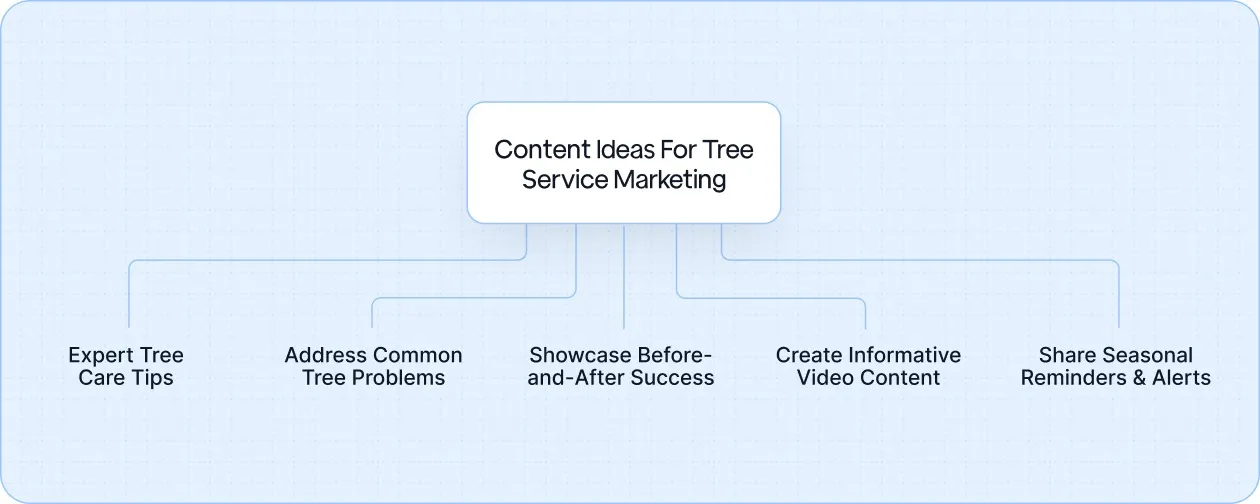
- Offer Expert Tree Care Tips: Educate your audience by providing valuable seasonal tree care advice. For example, how to properly prune trees in early spring, tips for protecting trees from winter damage, or preventing common diseases like oak wilt and root rot.
This not only demonstrates your expertise but also builds trust with potential clients who may need your services.
- Address Common Tree Problems You Solve: Help potential customers understand the full scope of issues you can handle. Focus on challenges like storm damage, which requires immediate attention to prevent further harm to the property, or overgrown trees that pose safety hazards and interfere with power lines.
Use real-life examples and explain how your solutions can restore safety and aesthetics to their property.
- Showcase Before-and-After Success Stories: Capture your work by sharing before-and-after photos that highlight the impact of your services. Whether it's removing a large, dangerous tree or trimming overgrown branches to enhance a landscape, these visual testimonials show the quality of your work and offer proof of your expertise.
Be sure to include customer feedback or testimonials alongside the images to build credibility.
- Create Informative Video Content: Videos are an excellent way to engage your audience and demonstrate your skills. Consider creating "how-to" videos on basic tree maintenance, like how to identify signs of disease or how to properly mulch around trees.
You could also show the process of tree removal or stump grinding to give potential clients an idea of what to expect.
Share Seasonal Reminders and Alerts: Help your audience stay on top of important tree care tasks with seasonal reminders. For example, in the fall, share tips on preparing trees for winter weather or cleaning up fallen leaves to prevent pests. This positions your business as an ongoing resource, not just a one-time service provider.
Content connects you with clients, but visibility drives real impact.
By improving your content strategy, you can attract the right customers and build your authority in the tree service industry.
Enhance Your Content Strategy
4. Social Media Strategies to Increase Your Presence
Social media is a great way to connect with your community, showcase your work, and interact with potential customers.
Social Media Tips for Tree Services
- Post before-and-after photos: These tell your story without needing words.
- Run seasonal promotions: Use social media to promote discounts or special offers during peak seasons.
- Use geo-tags: Highlight the local areas you serve, making it easier for local customers to find you.
- Share tree care tips: Position yourself as an expert by sharing helpful advice.
- Engage with followers: Respond to comments and questions to build relationships.
Must Read: Your Social Media Marketing for Landscaping and Lawn Care is Slacking - Let’s Fix That
5. Paid Ads That Work for Small and Medium Tree Service Businesses
Paid ads can quickly get your business in front of the right people, especially when you're in a pinch or need extra visibility.
Tips to Make Paid Ads Work for Your Tree Service Business
- Set up Google Local Services Ads: These ads put your business right in front of people searching for tree services near you.
- Optimize your budget for specific services: Focus on targeted services like tree trimming or emergency tree removal.
- Run Facebook ads for seasonal services: Promote special offers or remind customers about necessary seasonal tree care.
- Track ad performance: Analyze and adjust your ads to ensure the best return on investment.
6. Referral and Review Systems for More Clients
Satisfied clients are your best marketers. Creating a simple system for collecting reviews and encouraging referrals can lead to a steady stream of new business.
Ways to Generate Referrals and Reviews
- Offer incentives for referrals: Reward your customers for sending new clients your way.
- Ask for reviews right after the job: Don't wait, reach out to clients soon after completion to collect feedback.
- Display Google Reviews on your website: Make it easy for potential customers to see your positive reviews.
- Set up a review collection system: Automate review requests with follow-up emails after jobs.
- Reward top referrers: Show appreciation to clients who bring in the most business.
7. Traditional Advertising Strategies to Strengthen Your Local Reach
Even in a digital world, traditional marketing methods still play a key role in local visibility and brand awareness.
Local Radio, Billboards, and Print Publications
- Local radio: Advertise on stations that target homeowners and local businesses, especially during key tree care seasons.
- Billboards & print ads: Place ads in strategic locations like near parks, shopping areas, or neighborhoods with many trees.
Lawn Signs, Vehicle Wraps, and Promotional Mails
- Lawn signs: Leave a sign at the job site after a successful project to draw attention from neighbors.
- Vehicle wraps: Turn your service trucks into moving advertisements as you travel around the community.
- Promotional mail: Send postcards or flyers to homeowners reminding them of seasonal tree care needs.
8. Operational Excellence: Training & Industry Recognition
A well-run operation is crucial for growth. Equip your team with the right skills and establish credibility within your industry.
Train Your Field Technicians to Sell Using the LAER Model
- L: Listen: Understand what the customer is saying and what they're not saying.
- A: Acknowledge: Show empathy for their concerns.
- E: Explore: Ask questions and suggest solutions.
- R: Respond: Provide a clear and confident recommendation.
Register with Industry Authorities
Becoming a member of professional organizations such as the Tree Care Industry Association (TCIA) and the International Society of Arboriculture (ISA) demonstrates your commitment to industry best practices and professionalism.
These certifications add credibility to your business and assure customers that they are working with trusted experts.
Additionally, getting Certified Treecare Safety Professional (CTSP) accreditation ensures that safety is always a priority.
Local and State Certifications Matter Too
Many areas require specific certifications for tree care services, like pest management or tree removal. Being compliant with local or state certifications can further set you apart from the competition.
Having these certifications and memberships elevates your business's profile and provides opportunities for continued education, networking, and growth.
9. The Power of Partnerships in Tree Service Marketing
Partnerships with other local businesses can provide a valuable source of leads and grow your network.
Ways to Form Successful Partnerships
- Co-market with landscapers: Bundle your services for a comprehensive yard care package.
- Partner with real estate agents: Offer tree assessments for properties on the market.
- Build referral networks: Create a system where both businesses refer clients to each other.
Take Action and Grow Your Tree Service Business with Local SEO
You've learned the most effective marketing strategies, and now it's time to take action. With the right approach, you'll see your business grow in no time.
It's time to put everything into action to grow your tree service business.
Attract local customers with Gushwork’s personalized SEO services and improve your online visibility.
Book Your Free SEO Consultation

SEO
Jan 6, 2026
5 mins
Mining Equipment SEO: Get Found, Get Results, No Holding Back!
Batul Beawarwala
You've got the equipment, the experience, and the drive to serve the mining industry, but when people search online, your business is nowhere to be found. Frustrating, right?
SEO for mining equipment manufacturing is the key to making sure your company shows up when potential customers are looking for the equipment you provide. You just need simple, smart steps to help people find you at the right time.
If you're ready to get your business in front of the right audience, SEO is the tool that'll make it happen. Let's explore how these strategies can connect your company with the people who need your products most.
Why SEO is Essential for Mining Equipment Manufacturers?
SEO plays a crucial role in helping mining equipment manufacturers stand out in a crowded market. As competition intensifies, businesses must adapt to digital strategies that attract the right customers at the right time.
Here’s how SEO helps mining companies gain visibility and stay competitive:
Maximizing Digital Visibility
The majority of customers now begin their search for mining equipment online. If your business isn’t easily found, you're missing out on valuable opportunities. SEO ensures your business shows up in relevant search results, increasing the chances of connecting with potential customers when they need you most.
- Better rankings equal better visibility: SEO places your business front and center for customers actively searching for mining equipment.
- Reach more markets: SEO helps expand your reach beyond local customers to a global audience, connecting your business with people in different regions who need your products.
Attracting the Right Customers with Limited Resources
For SMBs, budget constraints are a constant challenge. However, SEO offers an affordable way to target the right customers. By optimizing your website, you ensure that your marketing dollars work harder, driving traffic from those actively seeking your services.
- Focused outreach: SEO helps you target customers specifically searching for mining equipment, meaning your marketing efforts are more effective.
- Long-term, cost-effective results: Once SEO is implemented, it keeps driving traffic and visibility, saving you from paying for continuous ads.
Staying Ahead of Competitors
In a market where companies are vying for attention, SEO provides a clear competitive advantage. Well-executed SEO increases your site’s visibility and helps build customer trust. The more you rank, the more likely potential clients are to choose your business over the competition.
- Capture more opportunities: Higher rankings allow you to capture more customer interest, turning visibility into business growth.
- Build credibility: A well-optimized site not only ranks better but also makes your business appear more professional, increasing customer confidence.
Making the Shift from Traditional to Digital Marketing
Mining equipment manufacturers must pivot from traditional marketing strategies to digital methods to stay competitive. SEO is a vital tool for connecting with customers who rely on online search to make decisions.
The Shift Toward Digital Marketing in Mining Equipment
Traditional marketing tactics like trade shows and print ads still have their place, but they no longer offer the reach or cost-effectiveness of digital marketing. SEO connects your business with a broader audience, allowing you to stay visible 24/7, even when customers aren’t actively looking for you.
- Broader reach: Digital platforms give you the ability to connect with customers all over the world.
- Always visible: With SEO, your business can be found by potential customers at any time, improving the chances of being discovered when needed most.
How Digital Methods Like SEO Reach More Customers at a Lower Cost
One of the key benefits of digital marketing is its ability to reach a large audience at a fraction of the cost of traditional methods. SEO allows mining equipment manufacturers to connect with customers who are already searching for their products, enabling targeted marketing with a minimal budget.
- Cost-effective lead generation: SEO attracts high-quality leads without the high costs associated with paid ads or direct mail campaigns.
- Sustainable results: SEO is a long-term investment. Once optimized, your site continues to drive traffic without the need for additional investment.
Why SEO is Crucial for Small and Medium-Sized Businesses Looking to Scale?
Scaling a small or medium-sized business can be a challenge, especially when competing with larger companies. SEO is an equalizer that allows SMBs to improve visibility and compete effectively in the market without large advertising budgets.
- Smarter use of resources: With SEO, you can target the right customers at the right time, making the most of your marketing budget.
- Sustainable growth: SEO provides a foundation for long-term visibility and brand recognition, making it easier for SMBs to scale their businesses.
Looking to scale your business faster?
With the right digital strategy and content, you can reach more customers without overspending.
Maximize Your Reach
How SEO Can Improve Online Visibility for Mining Equipment Manufacturers
In an industry as specialized as mining equipment manufacturing, building online visibility is crucial. SEO helps position your business as the trusted choice when potential customers search for equipment.
Here’s how SEO can enhance your online presence:
Building Trust and Authority
Trust is key in the mining equipment business. SEO helps you build credibility by improving your site’s authority and ensuring that potential customers see your business as reliable and professional.
- Quality content: Publish detailed, well-researched content that addresses your customers' pain points, establishing you as an expert in the field.
- Backlinks: Acquiring backlinks from trusted industry sites boosts your site’s credibility and improves rankings.
- Clear online presence: A clean, user-friendly website design helps customers navigate and trust your business more than competitors with poorly optimized sites.
Must Read: Implement 2 of 5 Sales Enablement Ideas to Beat Old-School Manufacturing Competition
Achieving Visibility with Limited Resources
As an SMB, every marketing dollar counts. SEO allows you to target specific leads without the need for expensive ads, ensuring that your business is visible to the right audience at the right time.
- Targeted reach: SEO helps you connect with customers actively searching for mining equipment, leading to more conversions.
- Long-term results: Unlike PPC, SEO provides ongoing visibility without continuous investment, helping you generate consistent leads without extra costs.
By using these strategies, mining equipment manufacturers can grow their online visibility without blowing their budget.
Need help finding the perfect keywords?
A detailed keyword strategy is about understanding what your customers are searching for and how you can deliver it.
Find Keywords That Work
9 Key SEO Strategies to Increase Your Online Presence
Mining equipment manufacturers must adopt smart, effective SEO strategies to ensure the right audience sees them. The right SEO tactics make it easier for customers to find your business and drive long-term success without requiring an extensive marketing budget.
Let’s break down some of the most crucial strategies that will help you stand out and attract quality leads.
1. Targeted Keyword Research
Effective keyword research is foundational to any SEO strategy. For mining equipment manufacturers, it’s crucial to focus on industry-specific terms that reflect the unique needs of your customers. Here's a more in-depth look at how to approach this:
- High-value, industry-specific keywords
Your target audience is searching for very specific equipment, parts, or services. Instead of going after generic terms, focus on long-tail keywords and niche terms that align with the mining industry.
For example, use terms like "mining equipment for hard rock mining" or "heavy-duty excavators for surface mining". These keywords are more likely to attract qualified leads who are looking for exactly what you offer.
- Understanding search intent
Search intent is critical for keyword research. Are potential customers looking for information, product comparison, or to make a purchase? Conduct research around commercial intent keywords like "buy mining drills" or informational intent like "how to maintain mining equipment."
Understanding these differences will allow you to tailor your content and optimize for the right types of searches.
- Using tools for keyword discovery
Tools like Google Keyword Planner, Ahrefs, and SEMrush can help you discover high-value keywords and track how competitive they are.
Start with broad mining equipment terms, then narrow them down using these tools to identify low-competition, high-conversion keywords specific to your offerings.
2. On-Page Optimization
On-page SEO is about creating an experience that’s both search-engine and user-friendly. To make your product pages and technical specs really stand out, here are some in-depth techniques for on-page optimization:
- Optimizing product pages for search engines
Start with clear, well-structured product descriptions that include the most relevant keywords. Don’t just list features; explain how the product solves problems for your customers.
Incorporate high-quality images, technical specifications, and even videos to improve user engagement and retention. Be sure to add keywords naturally in the headers, meta descriptions, and product features.
- Using internal linking
Internal linking helps search engines understand the structure of your website and establishes authority within your site. Link related products, blogs, and case studies within your pages to guide visitors and keep them on your site longer.
For example, if you sell drilling equipment, link to related case studies or how-to guides on equipment maintenance.
- Improving the technical aspects
Ensure that all pages are optimized for fast load times and are mobile-friendly. Use tools like Google’s PageSpeed Insights to analyze load times and implement improvements.
Additionally, make your site easier to navigate by simplifying your site architecture with clear, concise menus and a logical page hierarchy.
3. Handling Technical SEO for Remote Locations
For mining equipment manufacturers targeting remote areas, optimizing your website to function smoothly even in low-connectivity regions is essential. This requires both technical and performance-focused SEO:
- Speed optimization
Website speed is critical in areas with limited internet connectivity. Compress large images, minimize JavaScript, and ensure you're using fast hosting services. Tools like GTmetrix can help you analyze your site speed and recommend improvements.
- Mobile-first design
With many users in remote areas relying on mobile devices to browse, having a mobile-optimized website is essential. Ensure your website design is responsive and that all content, images, and videos load correctly on mobile devices.
Google prioritizes mobile-friendly sites in search results, making it a win-win for both user experience and SEO.
- Use lightweight content
Ensure your site doesn’t rely on heavy elements that might cause slow load times, such as large images or complex interactive features. Focus on text-based content, optimized images, and lightweight HTML to reduce page load times without sacrificing important content.
- Geo-targeting for remote areas
For remote regions, target geo-specific keywords that focus on mining areas or regions where mining equipment is in demand. This helps your business appear in searches relevant to the local mining operations, even when those areas have slower internet speeds.
Tools like Google Search Console and Google My Business can help monitor and improve local SEO efforts.
Must Read: 8 Industrial Manufacturing Marketing Moves Most Ignore
4. Content That Connects with Your Audience
Creating content that resonates with your audience is at the heart of a successful SEO strategy. When your content directly addresses your customers’ challenges, it attracts them to your website and builds trust.
- The Importance of Content Marketing
Valuable content helps position your business as an authority in the mining equipment field. Focus on creating informative articles, how-tos, and industry insights that cater to your audience's needs.
- Focusing on educating your audience through clear, relevant content
Offering educational resources like product guides, maintenance tips, or troubleshooting advice helps build credibility. Customers appreciate content that helps them make informed decisions.
- Types of Content That Attract Customers
- Case Studies: Showcase real-world examples of how your equipment has helped customers.
- Technical Guides and Whitepapers: Offer in-depth information that demonstrates your expertise.
- Videos: Show the benefits of your equipment in action, giving potential customers a clearer understanding.
- Sharing Content on Platforms Your Audience Uses
Distribute your content on platforms like LinkedIn, YouTube, and Instagram to engage with a broader audience. Each platform has its own strengths, so personalize your content accordingly to connect with users effectively.
Content is the bridge between you and your potential clients.
Engaging content that speaks to your audience’s needs builds lasting trust and authority.
Create Engaging Content
5. Local SEO: Reaching Mining Markets in Specific Regions
Local SEO is a vital part of any strategy for businesses that cater to specific regions or serve local communities. By optimizing for local search, your mining equipment business can stand out in its target area and increase foot traffic or service inquiries.
- Optimizing Local Listings
Ensure your Google Business Profile and Apple Business Connect profiles are complete and up-to-date, allowing local customers to find your business quickly.
- Geo-Targeted Keyword
Implementing location-based keywords helps you target customers in specific regions. These keywords drive traffic from searches for mining equipment in your service areas.
- The Importance of NAP (Name, Address, Phone number) Consistency for Local SEO
Make sure your business’s NAP is consistent across all directories and platforms. This consistency helps improve your local search rankings and builds trust with both search engines and customers.
- Building Local Authority Through Reviews
Encourage customers to leave positive reviews. Reviews help build local credibility and can also improve your rankings in local search results.
You know your local market, but does Google?
Local SEO ensures that potential customers in your area can find you at the right moment by optimizing your online presence for location-specific search.
Increase Local Visibility with SEO
6. PPC Advertising for Immediate Visibility
While SEO builds long-term results, PPC (Pay-Per-Click) advertising can help you get immediate visibility for high-priority keywords. By using PPC alongside SEO, you can capture leads in the short term while working toward sustained success.
- Why Use PPC Alongside SEO?
PPC campaigns can immediately place your business at the top of search results for your target keywords, offering quick visibility as your organic SEO efforts build over time.
- Creating Targeted PPC Campaigns
Focus your ads on high-intent keywords that align with customer needs. Create your PPC campaigns to reach leads who are ready to take action, increasing the likelihood of converting them into customers.
- Optimizing Landing Pages for Conversions
Ensure that your PPC landing pages are designed to convert visitors. They should be clean, simple, and focused on the CTA, offering exactly what the ad promised.
7. Tracking SEO Success and Refining Your Approach
Tracking your progress is key to ensuring that your SEO efforts are paying off. Without data, it’s difficult to determine which areas need improvement.
- Measuring Traffic and Performance
Track key metrics like organic traffic, keyword rankings, and user behavior to understand which strategies are working and where adjustments are needed.
- Understanding Conversions
Monitor what actions visitors are taking on your site, such as filling out a form, making a purchase, or requesting a quote. These actions help you gauge the effectiveness of your SEO strategy.
- Adjusting Your Strategy for Ongoing Success
Search engines constantly evolve, and so should your SEO strategy. Regularly assess and adapt to keep up with changes and stay ahead of the competition.
8. Optimizing Your Website for Better SEO Performance
A well-optimized website is the cornerstone of any successful SEO strategy. Here’s how to ensure your website is working hard for you:
- Site Speed and Mobile Experience
Ensure your website loads quickly and is mobile-friendly. Google rewards fast websites with higher rankings, and customers expect a seamless experience on all devices.
- Enhancing User Experience
A simple, user-friendly design helps keep visitors engaged and ensures they can easily find the information they need. This improves your site’s SEO and lowers bounce rates.
Must Read: We Analyzed 25+ Top Manufacturing Websites - The Winners Follow These Simple Steps
9. Building a Scalable SEO and Content Team
As your business grows, so should your SEO efforts. You may need to bring in experts to scale your content and SEO strategy effectively.
- When to Bring in SEO Experts
Recognize when your internal efforts need an upgrade. An expert partner can provide the insights and resources needed to take your SEO strategy to the next level.
- Choosing the Right SEO Partner
Look for agencies or experts who understand your industry, have a track record of success, and are aligned with your business goals. They’ll help scale your SEO efforts to meet growing demand.
How SEO Can Help Your Mining Equipment Business Grow
SEO is the key to getting your mining equipment business seen by the right people. It increases your visibility, connects you with customers, and puts you ahead of competitors. From targeted keywords to creating valuable content, each strategy helps you build a strong online presence that lasts.
Remember, SEO is an ongoing process. If you're ready to dive in yourself or need expert help to make the most of it, the next step is up to you.
Getting SEO right is a continuous journey.
If you want to see real results and build a sustainable online presence, expert guidance from Gushwork can help you implement long-term SEO strategies with minimal costs.
Book a Free Strategy Call

Digital Marketing
Jan 6, 2026
5 mins
Pest Control Lead Scoring: Focus on the Right Customers, Not the Noise!
Batul Beawarwala
When you're running a small pest control business, the flood of leads can be both exciting and overwhelming. The trick is figuring out which of these potential customers are actually looking for your help right now, and which ones might not be the right fit.
Pest control service lead scoring helps you sort through this mix by assigning a score to each lead based on its potential to convert into a paying customer.
By focusing on leads that are most likely to need your services, you can save time, energy, and resources, ensuring you’re reaching the right opportunities.
What Is Lead Scoring and Why Is It Essential for Pest Control?
Lead scoring is a system used to evaluate potential customers based on how likely they are to book your services. It assigns a score to each lead, helping you prioritize the most promising prospects.
Lead scoring works best when paired with optimized lead generation forms. These forms capture the critical details needed to assess a lead’s value, such as the type of pest, urgency, and location. By integrating these forms with your lead scoring system, you ensure the most relevant data is used to prioritize prospects."
Why Lead Scoring is Crucial for Pest Control?
In pest control, time is often critical. Many customers face urgent pest problems that need immediate attention. Lead scoring allows you to:
- Identify High-Urgency Leads: Quickly prioritize leads with urgent pest issues, ensuring faster response times.
- Save Time and Resources: Focus on the leads most likely to convert, avoiding time spent on less promising prospects.
- Improve Follow-Up Efficiency: Develop targeted strategies for different lead types (e.g., immediate calls for urgent cases and emails for lower-priority leads).
- Enhance Customer Satisfaction: Faster responses to urgent needs lead to better customer experiences, increasing the chance of repeat business and positive reviews.
Optimizing your lead generation forms is a great way to support your lead scoring efforts. Well-designed forms ensure you gather accurate information that allows for more effective scoring, helping you to act on the most urgent leads first.
For example, if a lead’s form response indicates a termite infestation, you can score that lead higher due to its urgency.
Top 3 Factors That Determine Lead Quality in Pest Control
To make the most out of your pest control leads, it’s essential to understand the factors that determine their quality. Here’s a breakdown of the key elements to watch for when evaluating leads:
1. Demographic Data
Understanding your lead’s background can tell you how likely they are to convert. Key factors include:
- Location: Leads within your service area have a higher likelihood of conversion. It's easier and more cost-effective to service nearby customers.
- Pest Type: Leads in need of urgent pest control (e.g., termites, rodents) are more likely to convert. These pests require fast action, making these leads high-priority.
2. Customer Engagement
How a lead interacts with your website and content can indicate how serious they are. Consider:
- Website Activity: Leads actively browsing your website, filling out forms, or requesting quotes are showing high interest. Their engagement is a good indicator of intent.
- Behavioral Insights: Monitoring their specific actions, like the pages they visit or how long they stay, can give you a clearer picture of their needs. A lead interested in emergency services is more likely to convert quickly than someone browsing for general information.
3. Urgency of the Lead
The quicker the issue, the higher the chance of a sale. Key points to evaluate:
Urgency-Based Scoring: Emergency pest issues should be prioritized over routine services.
For example, a rat infestation requires immediate attention, making these leads more likely to convert rapidly compared to non-urgent inquiries, like scheduled inspections.
The data captured in your lead generation forms directly ties into each of these factors. For instance, form fields asking for pest type, urgency, and location enable you to categorize leads accurately and assign appropriate scores based on their likelihood to convert. These forms act as a key input in determining the quality of the lead.
Must Read: 11 Proven SEO Strategies for Home Services to Increase Calls and Leads
How to Set Up Lead Scoring: A Step-by-Step Guide
Setting up lead scoring for your pest control business can streamline your sales process and help you focus on the leads most likely to convert. Here’s a simple step-by-step guide to getting started:
Step 1: Define Your Ideal Lead
Understanding who your best customers are is the foundation of lead scoring. Start by creating buyer personas that outline the key characteristics of these high-value leads. Consider:
- Type of Customer: Are you dealing with homeowners, businesses, or property managers?
- Pest Issues: What specific problems are they facing (termites, rodents, ants, etc.)?
- Demographics: Age group, income level, and geographic location can all impact a lead’s value.
As part of defining your ideal lead, focus on how your lead generation forms capture key data. Consider creating custom fields that capture the urgency of the pest issue and location, ensuring your forms directly contribute to the lead scoring process.
Step 2: Assign Lead Scores Based on Key Indicators
Once you know what makes a lead valuable, it’s time to set the rules. Your lead scoring system should be based on factors that indicate how likely the lead is to convert:
- Urgency: Immediate pest problems, such as infestations or structural damage, should get a higher score than non-urgent inquiries.
- Engagement Level: Leads who interact with your website or submit forms are showing a higher interest. These actions should add points to their score.
- Pest Type: Certain pests (e.g., termites or rodents) usually signal a more urgent need for service.
- Location: Leads within your service area should have a higher priority, as they are easier to service quickly.
When assigning scores, make sure to integrate data from your lead generation forms, e.g., a lead with a form indicating a serious rodent problem should automatically get a higher score than one requesting routine pest control.
Step 3: Automate the Process
Automating the form submission process ensures data is captured and fed directly into your lead scoring system. This not only saves time but also ensures accuracy in scoring, making sure high-priority leads are prioritized instantly
This automation means you don’t have to waste time manually sorting through leads; your system does it for you as soon as they come in.
Ever wondered how a personalized content strategy can amplify your lead generation?
Using lead scoring insights, you can create content that resonates with high-value prospects and drives better results.
Start Content Strategy
How Technology Helps SMB Pest Control Businesses with Lead Scoring
For small and medium-sized pest control businesses, technology is a powerful ally in optimizing lead scoring. With the right tools, businesses can automate processes, predict outcomes, and improve efficiency, all while saving time and resources.
Here's how technology is transforming lead scoring for SMB pest control companies.
AI-Driven Lead Scoring
AI and machine learning can significantly enhance the accuracy of lead scoring. By analyzing historical data, AI predicts which leads are most likely to convert, ensuring your team focuses on the highest-value prospects. This predictive analytics model helps SMBs to:
- Increase accuracy by identifying patterns that indicate high conversion potential.
- Streamline decision-making by automating the process of sorting and prioritizing leads.
- Save time by reducing manual guesswork and focusing efforts on leads most likely to convert.
With AI, pest control companies can make smarter decisions faster, improving overall sales efficiency.
CRM Integration
Integrating lead scoring with a CRM like Zoho or HubSpot ensures seamless communication between your sales and marketing teams. These tools allow businesses to:
- Automate follow-ups: Automatically assign follow-up tasks based on lead scores, ensuring timely responses.
- Align sales and marketing efforts: Share lead data in real time, so everyone is on the same page about which leads need attention.
- Track interactions: Monitor how leads engage with your website, emails, and other content, further refining the lead scoring process.
CRM tools simplify lead management, making it easier for SMB pest control businesses to stay organized and responsive without manual tracking.
Cost-Effective Automation
For SMBs with limited resources, cost-effective automation is key. Many CRM platforms offer affordable solutions that allow businesses to implement lead scoring without needing a large team. These benefits include:
- Scalable solutions: As your business grows, you can scale your lead scoring efforts without increasing overhead.
- No need for extra staff: Automate the tedious parts of lead management, freeing up your team to focus on closing deals.
- Affordable pricing: Many CRMs offer low-cost plans specifically designed for SMBs, allowing you to access powerful lead scoring features at a fraction of the cost of larger systems.
Technology-driven solutions like CRMs integrate seamlessly with your lead generation forms. By automating data capture and scoring based on form submissions, you can instantly assign lead scores, which helps in streamlining decision-making and increasing your conversion rates.
Looking for more efficient ways to turn leads into customers?
Connecting lead scoring with high-quality, SEO-driven content can directly impact your conversion rates.
Increase Lead Success
Best Practices for Optimizing Your Lead Scoring System
To make the most out of your lead scoring system, it’s essential to implement practices that ensure its effectiveness over time. Without proper setup and ongoing refinement, lead scoring can miss valuable opportunities.
Here are the best practices for creating a robust and efficient lead scoring system:
1. Data Consistency
The foundation of effective lead scoring lies in the quality of the data you collect. Consistency is key when gathering data across all customer touchpoints. If a lead interacts with your website, calls in for an inquiry, or fills out a form, make sure you track and organize all actions.
Each lead’s journey should be seamlessly recorded to ensure that no key information is overlooked.
- Tracking all touchpoints: From website visits and social media engagement to phone calls and email responses, ensure you're capturing every action.
- Centralized data collection: Use a CRM or similar tool to centralize lead data, making it easier to analyze and score effectively.
Ensure that your lead generation forms are consistent across all customer touchpoints. Whether a lead comes through your website, social media, or a phone call, the form responses should be uniform, helping to streamline data collection and improve scoring consistency.
2. Continuous Refinement
Lead scoring requires constant refinement. As your business grows and evolves, so should your lead scoring system. Regularly assess how well your lead scoring is performing by reviewing the outcomes of past leads and adjusting your criteria. What worked for one batch of leads may not work as effectively for the next.
- Analyze and adapt: Look at the conversion rates and behaviors of past leads to spot trends. Did a certain lead behavior correlate with faster sales? Refine your scoring to reflect these insights.
- A/B testing: Continuously experiment with different criteria for lead scoring and see which tweaks lead to better results.
Regularly assess your lead generation forms to ensure they are collecting the right data. For example, if your current forms don’t capture urgency effectively, refining them to include a checkbox for ‘immediate service needed’ will help prioritize urgent leads.
3. Aligning Sales and Marketing Teams
Effective lead scoring ensures that your sales and marketing teams are working in sync. If these teams aren’t aligned on what defines a high-quality lead, the system will falter. Both teams should use the same criteria to evaluate leads, ensuring seamless handoff and follow-up.
- Shared criteria: Make sure both teams understand the lead scoring system and agree on the characteristics of high-value leads.
- Collaboration between teams: Build communication between sales and marketing to continuously refine lead scoring based on feedback from both sides.
Ensure both teams use the same set of lead generation forms with clearly defined fields that are aligned with your lead scoring model. This will create seamless handoffs from marketing to sales, ensuring high-value leads get immediate attention.
Must Read: 15 Smart Marketing Moves to Drive Growth for Your Home Services Business
Measuring the Success of Your Lead Scoring System
Track how your lead generation forms are performing in terms of capturing high-quality data. By analyzing form submission patterns, you can identify which fields most accurately predict conversions, allowing you to refine your lead scoring model and focus on the right prospects.
Here’s how to effectively evaluate the success of your lead scoring system:
Key Metrics to Track
- Conversion Rates: Track how many leads with higher scores are converting into actual customers. A strong lead scoring system should improve your ability to predict which leads are most likely to convert, making this metric essential.
If the leads with the highest scores consistently convert, it’s a sign that your scoring system is on track.
- Lead-to-Customer Ratio: This ratio compares the number of leads you generate to the number of customers who make a purchase or book a service. A healthy lead-to-customer ratio indicates that you’re successfully attracting high-quality leads that turn into business.
If this ratio is skewed towards low-quality leads, it may be time to adjust your lead scoring criteria.
- Lead Quality Over Time: Track the evolution of lead quality by measuring the characteristics of leads that convert and those that don’t.
This will help you refine your criteria, ensuring that your system adapts as market conditions or customer behaviors change.
Data-Driven Optimization
A successful lead scoring system is built on continuous improvement. To ensure you're making the most of your efforts:
- Regularly Review Performance: Constantly assess how your lead scoring system is performing. Analyze the data to identify trends and patterns, then refine your scoring model based on what's working and what's not.
If certain lead behaviors predict higher conversion rates, adjust your system to prioritize these actions.
- Refine Scoring Criteria: As you gather more data, update your scoring model to reflect the latest insights. For example, if you notice that engagement with certain types of content correlates with higher conversion rates, tweak your system to give more weight to those interactions.
- A/B Testing: Experiment with different scoring methods to see which ones lead to the best results. Testing different criteria and making adjustments based on outcomes will help you keep your system optimized for success.
Review and refine your content to align with your lead scoring efforts.
SEO-driven content targeting high-value leads ensures you get the most from your marketing budget.
Get Results with SEO
Optimize Your Lead Management to Drive Growth
Lead scoring is a powerful tool for SMB pest control businesses, enabling them to focus on high-value leads and improve conversion rates while using minimal resources. By prioritizing the right prospects, you can make your sales process more efficient and drive growth without needing a large team.
To maximize the effectiveness of your lead management, pair lead scoring with optimized lead generation forms. By capturing detailed data and automatically scoring leads, you ensure your team is focusing on the most promising prospects, streamlining your sales process and accelerating business growth.
Tired of managing overwhelming customer inquiries?
Focus on the most promising prospects and simplify your process with a targeted content strategy. Gushwork will help you drive real results.
Book a Free Consultation

Digital Marketing
Jan 6, 2026
5 mins
Wallpaper Installation Marketing: Build Partnerships, Shape Your Brand, and Grow Strong!
Batul Beawarwala
Growing your wallpaper installation business doesn’t have to be complicated or expensive. If you’re working with a small team and limited resources, partner marketing is the solution you’ve been looking for.
By teaming up with businesses like interior designers, home improvement stores, and real estate agents, well-known SEO platforms, you can tap into new clients and build lasting connections.
This guide will show you how to build strong partnerships that drive real growth for your business.
What is Wallpaper Installation Partner Marketing?
Partner marketing is about teaming up with businesses that share your target audience but offer different services. For wallpaper installation, this means collaborating with interior designers, retailers, or real estate agents to reach new clients without spending heavily on advertising.
By working together, both businesses can offer more value and attract customers who need your expertise.
Why It Matters?
- Cost-Effective: Partnering with other businesses helps reduce marketing costs by sharing resources and networks.
- Expands Reach: These partnerships connect you to new customer bases that might not have found you otherwise.
- Builds Trust: Recommendations from trusted businesses add credibility and encourage new clients to choose your services.
The 6 Key Strategic Partnerships for Wallpaper Installers
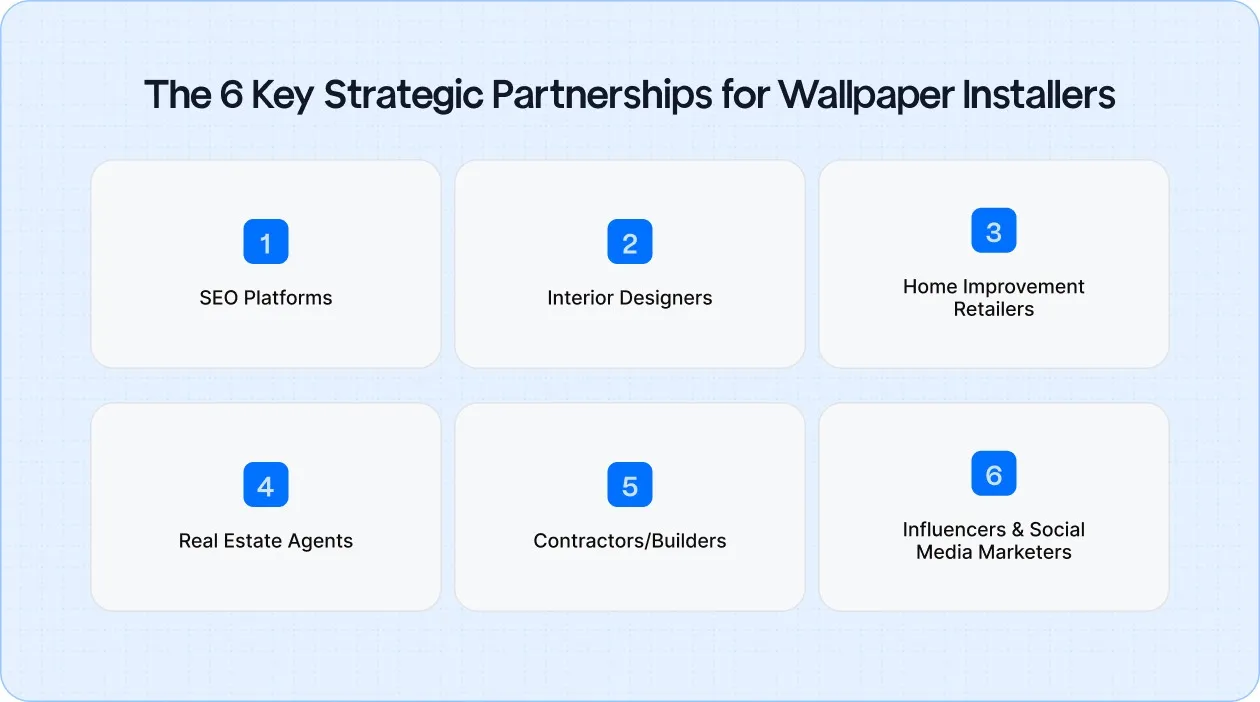
Forming the right partnerships can significantly expand your business reach and bring in new clients. Here are six key partnerships every wallpaper installer should consider:
1. SEO Platforms
Partnering with SEO platforms such as Gushwork helps you increase visibility online and attract more clients. With the right SEO strategy, your business can rank higher in search results, driving targeted traffic to your site and ensuring customers find you when they need your services most.
Why it matters: This partnership directly drives increased visibility and inquiries, helping your business get found online by customers who need your services.
Make sure clients find you when they need you.
Optimize your website for SEO to make it easier for people to discover your services.
Improve Your Visibility
2. Interior Designers
Teaming up with interior designers opens doors to high-end residential and commercial projects. They’re always in need of trusted installers for custom designs, and a strong partnership can lead to ongoing referrals.
Why it matters: Interior designers bring in consistent high-value work and help build a steady stream of referrals, giving your business a competitive edge in premium markets.
3. Home Improvement Retailers
Partnering with home improvement stores allows you to offer installation services alongside their wallpaper sales, providing customers with a one-stop solution and ensuring a steady flow of work.
Why it matters: Retail partnerships give you direct access to customers at the point of purchase, leading to immediate work and higher conversion rates from product sales.
4. Real Estate Agents
Collaborating with real estate agents during property renovations or staging helps you access time-sensitive projects and gain exposure in the property market, where first impressions matter.
Why it matters: Collaborating with real estate agents allows you to access time-sensitive, high-volume projects while benefiting from their trusted connections in the housing market.
5. Contractors/Builders
By working with contractors and builders on larger renovation projects, you can secure consistent work and ensure your services are included in high-volume projects.
Why it matters: Partnerships with contractors provide a consistent pipeline of work, ensuring that your services are integrated into high-profile construction projects with long-term opportunities.
6. Influencers & Social Media Marketers
Home decor influencers can help you reach a younger, design-conscious audience. Showcasing your work on social media platforms builds credibility and increases brand visibility in a competitive market.
Why it matters: Social media exposure helps build brand recognition among a wide, engaged audience, leading to increased client inquiries and word-of-mouth recommendations.
These partnerships help your wallpaper installation business expand its reach, gain steady work, and reduce marketing costs by leveraging others' customer bases.
Must Read: Home Improvement SEO Strategies That Will Get Your Phone Ringing Nonstop
How to Approach and Build Strong Relationships with Partners
Building strong partnerships requires creating value for both parties.
Here’s how to approach the right partners and ensure your relationship drives growth for your wallpaper installation business:
1. Research the Right Partners
Identify businesses that share your target audience but offer complementary services, such as interior designers, contractors, and home improvement retailers. Look for partners with a solid reputation and a customer base that aligns with your ideal clients.
2. Create a Value Proposition
When approaching potential partners, highlight how the collaboration will benefit both sides. Offer joint marketing opportunities, special discounts, or additional services that add value to their business and yours. Make sure it’s a win-win.
3. Communicate Professionally
Clear communication is key. Be upfront about what you bring to the table and what you expect in return. Set clear expectations for timelines, roles, and deliverables to ensure a smooth working relationship from the start.
4. Showcase Your Work
Present a strong portfolio, client testimonials, and before-and-after photos to demonstrate the quality and reliability of your services. Show potential partners why your business is trustworthy and professional.
Effective Marketing Strategies for Wallpaper Installation Partnerships
Building strong partnerships requires marketing together to maximize visibility and drive new clients. Here are some strategies that can help make your partnerships more effective:
1. Co-Branding and Joint Campaigns
Co-branding allows you to team up with your partners for joint marketing efforts that highlight the strengths of both businesses. This could be through special offers, promotions, or even joint advertisements.
For example, you could collaborate with a home improvement retailer to offer a discount on wallpaper installation with every wallpaper purchase.
Why it works:
- Drives mutual sales
- Amplifies visibility for both businesses
- Adds value for customers with a comprehensive service offering
2. Referral Programs
Referral programs incentivize existing clients or partners to refer your services to potential clients. You can create a referral system where partners (such as interior designers or retailers) earn benefits for recommending your installation services, or give discounts to clients who refer you to others.
Why it works:
- Builds trust and credibility through word-of-mouth
- Incentivizes active participation from partners and clients
- Generates ongoing leads at minimal cost
3. Content Marketing for Partners
Content marketing is a powerful tool for strengthening your partnerships. Work with your partners to create shared content that highlights your collaboration.
This can include blog posts, social media updates, or even case studies of successful projects you’ve worked on together. For example, you could co-write a blog post with an interior designer showcasing how a custom wallpaper design transformed a space.
Why it works:
- Improves SEO by linking both businesses
- Builds trust and showcases your expertise
- Educates potential clients on the value of your combined services
Also Read: 10 Must-Know Content Marketing Hacks: Make Your Home Services Impossible to Overlook
Content is a key tool for building stronger partnerships.
Create meaningful, shared content that highlights your collaborations and showcases your expertise to attract new clients.
Strengthen Your Content Strategy
4. Social Media Engagement
Social media is an essential tool for visibility and engagement. Platforms like Instagram and Pinterest are great for showcasing before-and-after photos, project updates, or behind-the-scenes looks at your work.
Regularly collaborating with partners on these platforms, such as sharing each other’s posts or featuring joint projects, helps expand both of your audiences.
Why it works:
- Increases engagement and keeps your brand top-of-mind
- Strengthens relationships with existing clients and partners
- Expands your reach to a broader audience interested in home decor
Maximize Your Online Presence for Partner Marketing
Your online presence is crucial for attracting the right partners. Here’s how to optimize it for success:
1. SEO for Local Visibility
Optimize your website for local SEO by using location-based keywords. This helps you show up in local search results, making it easier for potential clients and partners to find you.
2. Content Creation
Create valuable content like blog posts and videos to showcase your expertise and highlight successful partnerships. This helps potential partners see the value you bring.

Build dedicated partner pages on your website to showcase your collaborations. Highlight key partners, share joint project successes, and feature testimonials to build trust and credibility.

4. Google Business Profile, Apple Business Connect & Local Directories
Ensure your business is listed on Google Business Profile, Apple Business Connect and local directories to improve local search visibility and make it easier for partners to find you.
Measure Success in Partner Marketing
Success in partner marketing is measuring how those partnerships drive real results for your business. Tracking performance allows you to adjust your strategies and maximize growth over time.
Here’s how to measure your success and make sure your efforts are paying off:
1. Key Performance Indicators (KPIs)
To evaluate the effectiveness of your partnerships, focus on key metrics that align with your business goals. Some important KPIs to track include:
- Referrals: How many new clients are coming through your partners?
- Client Acquisition: Are these referrals converting into long-term customers?
- Sales Conversions: What percentage of referred leads turn into completed projects?
These KPIs will provide a clear view of your partnerships' effectiveness and highlight where adjustments are needed.
Why it matters: Tracking these metrics allows you to assess which partnerships are most effective and helps you make data-driven decisions.
2. Customer Feedback
Gathering feedback from referred clients is invaluable in improving your partner marketing efforts. After completing a project, ask customers about their experience, including:
- How did they hear about you?
- What stood out about your service?
- Were they satisfied with the work and the partner who referred you?
This feedback will help you understand the impact of your partners and give insights into how to refine your approach for better future collaborations.
Why it matters: Understanding client satisfaction allows you to fine-tune your services and ensure partners are delivering value while building stronger relationships.
3. Adjusting Campaigns
As you track KPIs and gather feedback, it’s important to refine your approach. If a partnership is yielding excellent results, you may want to increase your efforts with that partner. If not, it may be time to rethink the strategy or find a different type of partnership. Regularly review data to:
- Identify trends and adjust marketing tactics
- Focus on high-performing partners and optimize low-performing campaigns
By continuously tweaking your campaigns, you can ensure your efforts are always aligned with business goals.
Why it matters: Regularly adjusting based on real data ensures that your marketing efforts are always moving in the right direction and delivering the best possible results.
Take Action and Start Building Strong Partnerships
Partner marketing offers wallpaper installation businesses a powerful way to expand their reach and grow sustainably without heavy reliance on traditional advertising. From co-branding campaigns to referral programs, the strategies shared in this blog can help you maximize your marketing efforts and drive real business results.
Now it’s time to put these strategies into action. Start forming partnerships today and use the insights shared here to grow your business.
Remember, every great partnership begins with a conversation, reach out to potential partners, build trust, and offer mutual value.
Content that resonates can make all the difference.
Gushwork helps you optimize your content strategy with SEO and improve your visibility to form lasting partnerships.
Book a Free Consultation

Digital Marketing
Jan 6, 2026
5 mins
Hunting for More Leads? 7 Smart Strategies for Home Services That Actually Deliver!
Batul Beawarwala
As a home services business owner, you know your work is top-tier. The difficulty lies in getting the right customers to notice and trust you.
Lead generation for home services helps you connect with people who need your expertise and are ready to trust you with their home. It's about standing out from the crowd, building real connections, and making sure your name is the one they call when something goes wrong.
With the right strategies, you can fill your schedule with homeowners who value your service and keep coming back for more.
1. Local SEO Mastery
Local SEO is the foundation for home services businesses. Homeowners don’t browse random listings; they search specifically for local experts.
Ensure your business shows up in local searches to make you the first service they reach out to when they need help, building trust and improving your chances of closing the deal.
Actionable Steps:
- Optimize for Local SEO: Make sure your website is mobile-friendly, fast, and optimized for location-based searches. This will ensure you appear when homeowners need you most.
- Google Business Profile & Apple Business Connect: These tools are crucial for local visibility. Keep your information up-to-date, add customer reviews, and regularly update services to maintain your competitive edge.
- Content Marketing: Consistently create high-quality blog posts that address common questions and provide solutions. This will help improve your search rankings organically.
Must Read: 10 Must-Know Content Marketing Hacks: Make Your Home Services Impossible to Overlook
Want to be the first service homeowners see when they need help?
Optimize your website for local searches and keep profiles accurate to ensure your business appears at the right time to attract quality inquiries.
Improve Local Visibility
2. Build a Foundation of Trust through Referrals
Referrals are a home service business's most trustworthy and reliable lead source. When customers actively recommend you to others, it signals quality work and trust.
Make referrals part of your business strategy to secure long-term clients and keep your pipeline full without spending extra on advertising.
Actionable Steps:
- Create a Referral System: Ask your satisfied customers for referrals regularly. Set up an incentive program to reward clients who refer others to you.
- Leverage Local Professionals: Network with professionals like home inspectors, interior designers, and other tradespeople who interact with homeowners and could recommend your services.
- Stay in Touch with Past Clients: Don’t let relationships fade after a project ends. Reconnect periodically to check on the work done and ask if they know anyone else who needs your services.
3. Execute High-Converting Paid Advertising
Paid ads can give your home services business the visibility it needs to reach potential clients right when they’re searching for help. But focusing on qualified leads is key to ensuring that you’re not just paying for random traffic.
With the right strategy, paid advertising can be a highly efficient way to generate high-intent leads that are ready to hire.
Actionable Steps:
- Use Facebook Instant Forms: Capture leads directly within Facebook to prevent potential clients from leaving the platform.
- Qualify Leads in Your Ad Forms: Add specific questions that help qualify leads (e.g., "Do you need emergency service?"), ensuring you're only speaking to high-intent prospects.
- Humanize Your Ads: Personal ads featuring you or your team build trust much faster than generic, polished advertisements.
- Geographic Targeting: Pinpoint your ads to specific service areas and exclude regions that fall outside your operational reach.
4. The Power of Personal Outreach in Your Neighborhood
Sometimes the most valuable leads are found just outside your front door. Personal outreach and building relationships in your local community can be a game-changer.
Door-to-door introductions and engaging with social media communities help build more meaningful, long-term business than purely digital efforts.
Actionable Steps:
- Introduce Yourself to Neighbors: When you're working on a job, knock on the doors of nearby homes. Introduce yourself, leave a business card, and offer your services.
- Leverage Social Media for Lead Discovery: Use platforms like Reddit or LinkedIn to find active leads discussing their needs.
- Use Lead Magnets: For complex services, offer small samples (e.g., mock-up designs or quotes) as a personalized way to start a conversation with prospects.
Suggested Read: 10 Simple Steps That Helped a Cabinet Manufacturer Increase Qualified Leads By 42% In 60 Days
5. Avoid the "Lead Reseller" Trap
While lead resellers like HomeAdvisor and Angi promise a quick influx of leads, the truth is they often sell the same leads to multiple contractors, leading to price wars and reduced profit margins.
To ensure sustainable growth, you should build your own lead generation system to attract exclusive, high-quality leads without relying on middlemen.
Actionable Steps:
- Build Your Own Lead Generation System: Focus on SEO, content marketing, and referrals to generate leads organically and independently.
- Stop Competing on Price: Lead resellers often pit businesses against each other based on price. Build a marketing system that doesn’t rely on price competition.
Stop paying for the same leads your competitors are using!
By investing in SEO and content, you can generate your own leads and avoid relying on costly middlemen.
Build Your Own Leads
6. Nurture Leads to Maximize Conversion
Lead generation doesn’t end when you collect the contact information. Nurturing your leads is critical to turning a potential prospect into a long-term, loyal customer. Regular follow-ups and value-driven content keep your business top-of-mind and increase the likelihood of conversion when they’re ready to hire.
Actionable Steps:
- Follow Up Regularly: Set up automated follow-up emails to stay in touch with leads. Personalize the emails to make them feel valued.
- Offer Value Over Time: Send helpful, relevant content that addresses their concerns or provides solutions to keep them engaged
- Be Persistent: Continue engaging with leads even if they don’t convert immediately. Persistence keeps your business top of mind.
Have leads that haven’t converted yet?
Engage with your prospects consistently through valuable content to keep them interested and ready to take action when the time comes.
Start Nurturing Leads
7. Build Long-Term Success: Combine Organic and Paid Strategies
The most successful home service businesses understand that organic SEO and paid ads work best when combined. Organic SEO builds long-term trust, while paid ads provide quick visibility during moments when you need to attract leads fast.
Actionable Steps:
- Combine Organic SEO with Paid Ads: Organic SEO builds credibility and trust, while paid ads can quickly drive immediate visibility to your services.
- Measure ROI: Regularly track which marketing strategies are generating the best return on investment (ROI) to fine-tune your efforts for maximum effectiveness.
Top 5 Lead Generation Platforms for Home Services Businesses
Lead generation platforms can significantly impact the growth of your home services business. Each platform offers different features, but understanding what works best for your unique needs is key.
Below are five leading platforms:
1. Gushwork
Gushwork is a content-driven SEO platform designed for businesses that want to build their own long-term lead pipeline. Unlike lead resellers, Gushwork empowers home service businesses by helping them generate organic traffic and quality leads over time through strategic content marketing and SEO.
Why It Works: Gushwork helps you own your lead generation system. By focusing on organic growth via SEO and targeted content, Gushwork gives you control over your marketing efforts and eliminates the need for third-party paid ads or resellers.
With this platform, you can attract high-quality, qualified leads that are more likely to convert, without the dependency on external platforms.
Why It’s Ideal for Home Services?
- Long-term, sustainable growth by building organic traffic and authority through content.
- Reduces dependence on paid ads and middlemen like lead resellers, giving you full control over your lead pipeline.
- Gushwork provides customized solutions tailored to your business goals, ensuring high-quality leads that match your service offerings.
2. Yelp
Yelp is a highly trafficked review and local business discovery platform where homeowners actively search for trusted service providers in their area. It combines user reviews, detailed business profiles, and local search visibility to help service professionals get found by homeowners seeking quality work.
Why It Works: Yelp’s strength lies in its review‑driven discovery. People trust the experiences of others when choosing a contractor, and Yelp places businesses prominently in local search results when they have strong ratings.
Why It’s Ideal for Home Services:
- Acts as a local discovery engine, helping homeowners find you based on location and reviews.
- High visibility for businesses with excellent ratings and frequent customer feedback.
- Integrates with search engines and mobile searches, making it a valuable source of organic inbound inquiries.
- Works well for a wide range of services, from electricians and plumbers to landscapers and cleaners, because homeowners often use Yelp for local service searches.
3. Porch
Porch is a comprehensive platform designed to connect homeowners with home service professionals. It provides businesses with leads while also offering tools for business management, project tracking, and customer reviews.
Why It Works: Porch integrates lead generation with business management tools, helping contractors manage client relationships, reviews, and project tracking. Homeowners can browse your business profile to make informed decisions based on project quality and past reviews, ensuring you attract high-intent leads.
Why It’s Ideal for Home Services:
- Broad service coverage, including home improvement, repairs, and renovations.
- Client relationship management tools to nurture leads and increase customer satisfaction.
- Ability to integrate with Google reviews, helping improve visibility and customer trust.
4. Yardbook
Yardbook is an all‑in‑one business management and lead generation platform built specifically for service businesses such as landscaping, lawn care, cleaning, handyman services, and other home services. It combines online presence, lead capture, and customer communication tools to help small and medium service providers attract and convert more clients.
Why It Works: Yardbook helps businesses generate leads by making it easy for homeowners to find, contact, and book services directly through the platform. It includes features like online booking, customer messaging, quotes and invoicing, and a business directory listing that drives inbound inquiries.
Why It’s Ideal for Home Services
- Lead Capture Tools that allow homeowners to request quotes or book services directly.
- Business Directory Presence that improves visibility in local search for users looking for specific services.
- Client Communication Features, such as automated messaging and booking reminders, help nurture leads.
- Management Tools for quotes, job tracking, and billing, reducing friction between lead capture and closing the sale.
- Specialized for Service Businesses rather than a broad marketplace, making it more tailored than general directories.
5. Houzz
Houzz is a great platform for home improvement contractors who want to showcase their portfolio and visually appeal to design-focused clients. It’s particularly effective for businesses in the remodeling and interior design sectors.
Why It Works: Houzz allows contractors to create visually compelling profiles, making it an essential tool for attracting design-savvy homeowners. It’s a platform where potential clients come to explore creative ideas and connect with contractors who can bring those ideas to life.
Why It’s Ideal for Home Services?
- Best for high-visual services like remodeling and design.
- A visual-first platform where clients are actively looking for inspiration and service providers.
- Allows businesses to display their portfolio and attract design-oriented clients.
Must Read: 15 Smart Marketing Moves to Drive Growth for Your Home Services Business
Put Your Lead Generation Plan into Action
Now that you have a clear roadmap, it's time to turn these strategies into results. From building a solid referral system to mastering local SEO and executing targeted paid ads, you have everything you need to attract high-quality leads.
But the journey doesn’t stop there; nurturing those leads and consistently refining your approach will ensure long-term success and business growth.
The strategies outlined in this blog are designed to make your home services business stand out and thrive in a competitive market.
Applying these methods will help you build a steady pipeline of leads, allowing you to grow your business without the constant stress of chasing them down.
Ready to see real, organic growth for your business?
Gushwork helps you implement strategies that build a sustainable pipeline, driving long-term success, without the need for expensive paid ads.
Book Your Free Strategy Session

Digital Marketing
Jan 5, 2026
5 mins
Turn ‘Just Browsing’ Into ‘Book Me Now’: Lead Generation Services for HVAC Manufacturers That Work
Batul Beawarwala
For HVAC manufacturers, finding the right leads is critical to growth. Lead generation services for HVAC manufacturers help you connect directly with businesses in need of your products, such as HVAC equipment and furnace installation and repair.
These services focus on reaching decision-makers actively seeking solutions. By targeting B2B HVAC contractors and businesses ready to purchase, you can ensure that every lead is a potential opportunity.
This approach streamlines your sales process, allowing you to focus on building relationships that drive long-term success.
5 Effective Lead Generation Strategies for HVAC Manufacturers
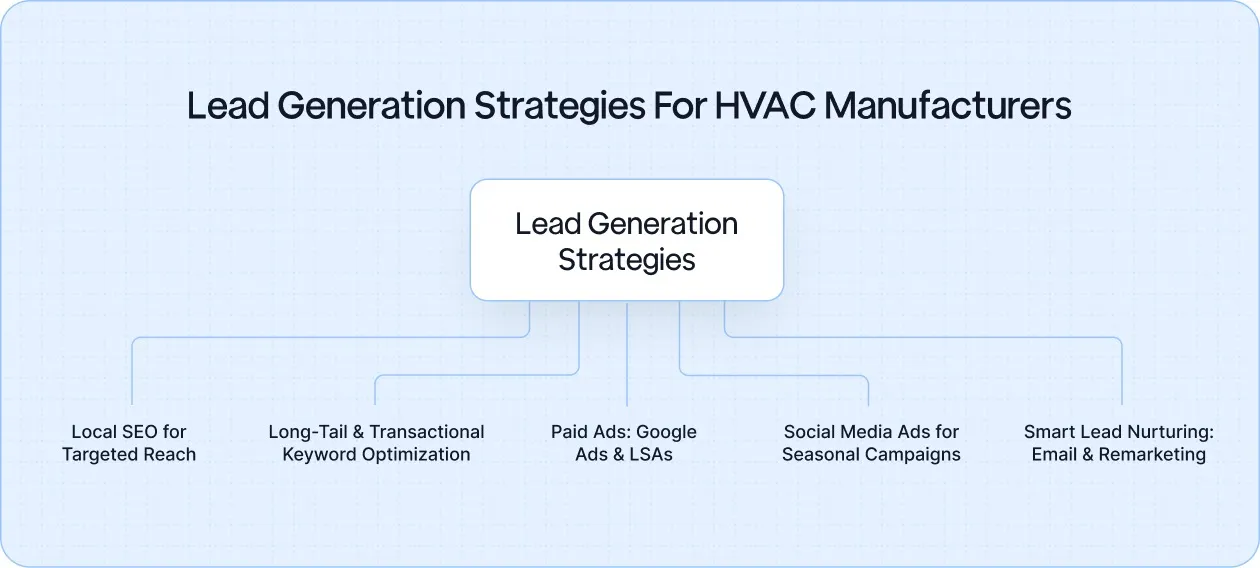
Attracting the right leads for your HVAC business doesn't need to be a complex process. It’s all about reaching the right people with the right approach at the right time.
Let’s dive into effective lead generation strategies designed specifically for HVAC manufacturers and how you can turn these strategies into consistent results.
1. Local SEO for Targeted Reach
When a potential customer needs HVAC services, their first stop is usually Google. But how can you ensure they find you? The answer lies in local SEO. By optimizing your Google Business Profile and Apple Business Connect, you can ensure your business is visible when customers are looking for HVAC services nearby.
You could be offering exactly what a customer needs, but if they can't find you online, your business remains invisible. Optimizing for local SEO makes sure your contact details, services, and location are easy to find.
Key benefits of optimizing these profiles:
- Show up in local searches when customers need immediate service.
- Increase trust with Google Verified status, especially with LSAs.
- Highlight customer reviews, making your business stand out as a top choice.
Must Read: HVAC SEO for Manufacturers: 15 Tips to Improve Visibility & Leads
What if your HVAC business could show up first in local searches every time a potential lead needs you?
Optimize your profiles for hyperlocal SEO to put you in front of customers right when they need you the most.
Enhance Your Local SEO
2. Long-Tail Keywords & Transactional Search Optimization
Not all keywords are created equal. While general terms like “HVAC” are important, transactional keywords are your key to attracting customers who are ready to take action.
By focusing on long-tail keywords like “HVAC installation near me” or “furnace repair services,” you can capture customers who are actively seeking your HVAC services.
Why long-tail and transactional keywords work:
- They attract high-intent customers: People searching these terms are looking to buy.
- Better conversion potential: These customers know what they need and are ready to make a decision.
By targeting these specific searches, HVAC manufacturers can attract leads who are more likely to convert into paying clients.
3. Paid Advertising to Maximize Google Ads and Local Services Ads
Google Ads and Local Services Ads (LSA) are invaluable tools for generating leads quickly. With LSAs, your business shows up at the top of search results, making it easier for customers to find you.
Plus, the Google Verified badge gives your company added credibility, increasing trust among potential customers.
Here’s how to make the most of paid ads:
- Google Ads: Reach customers across the web with targeted search ads, paying only when people click.
- LSA: Show up in high-visibility spots with a “verified” trust signal, helping you stand out in local searches.
4. Social Media Ads for Seasonal Campaigns on Facebook, Instagram, TikTok, and Pinterest
Seasonal campaigns on social media platforms like Facebook, Instagram, and even TikTok can give HVAC businesses the visibility they need when demand spikes.
Summer AC tune-ups and winter furnace inspections create a perfect opportunity to target customers during peak demand times.
- Facebook & Instagram Ads: Reach customers for tune-ups, repairs, and seasonal services.
- TikTok & Pinterest: Share quick tips, customer testimonials, or HVAC maintenance hacks to engage younger, design-focused homeowners.
These platforms let you engage customers with short, impactful content that directs them to your services.
Must Read: 10 Content Marketing Services That Fuel Brand Reach and Sales for HVAC Manufacturers
5. Smart Lead Nurturing for Email Marketing and Remarketing
Lead generation doesn’t end once a customer expresses interest. Lead nurturing ensures that potential clients stay engaged until they’re ready to purchase.
Through automated email marketing and remarketing campaigns, you can continue to reach out to leads who have shown interest in your services but haven’t yet converted.
- Email campaigns: Send personalized content, offers, and reminders to customers at the right time.
- Remarketing ads: Engage customers who visited your website but didn’t take action.
This approach keeps your HVAC services top of mind and builds trust over time, turning warm leads into solid sales.
7 Top Platforms & Tools for HVAC Lead Generation
Finding the right tools to fuel your HVAC lead generation efforts can make all the difference.
Let’s take a closer look at some of the most effective platforms that can help HVAC manufacturers connect with qualified leads, increase visibility, and streamline their processes.
1. Gushwork
Gushwork is AI-driven and designed to help HVAC manufacturers optimize their content and improve visibility. The platform is perfect for businesses that want to enhance keyword research, optimize content, and improve local SEO, all without the need for a big marketing team.
Key Features of Gushwork:
- AI-powered keyword research: With thorough research identifies high-intent, transactional keywords specific to HVAC businesses.
- Content optimization: Enhances existing content to increase visibility and attract the right leads.
- Improves local SEO: Ensures your HVAC business ranks higher in local searches, helping you get noticed by the right customers in your area.
How about letting SEO bring in the leads while you focus on your customers?
AI-driven SEO content optimization can help you reach qualified leads faster without overburdening your team.
Discover SEO’s Potential
2. Google Local Services Ads (LSA)
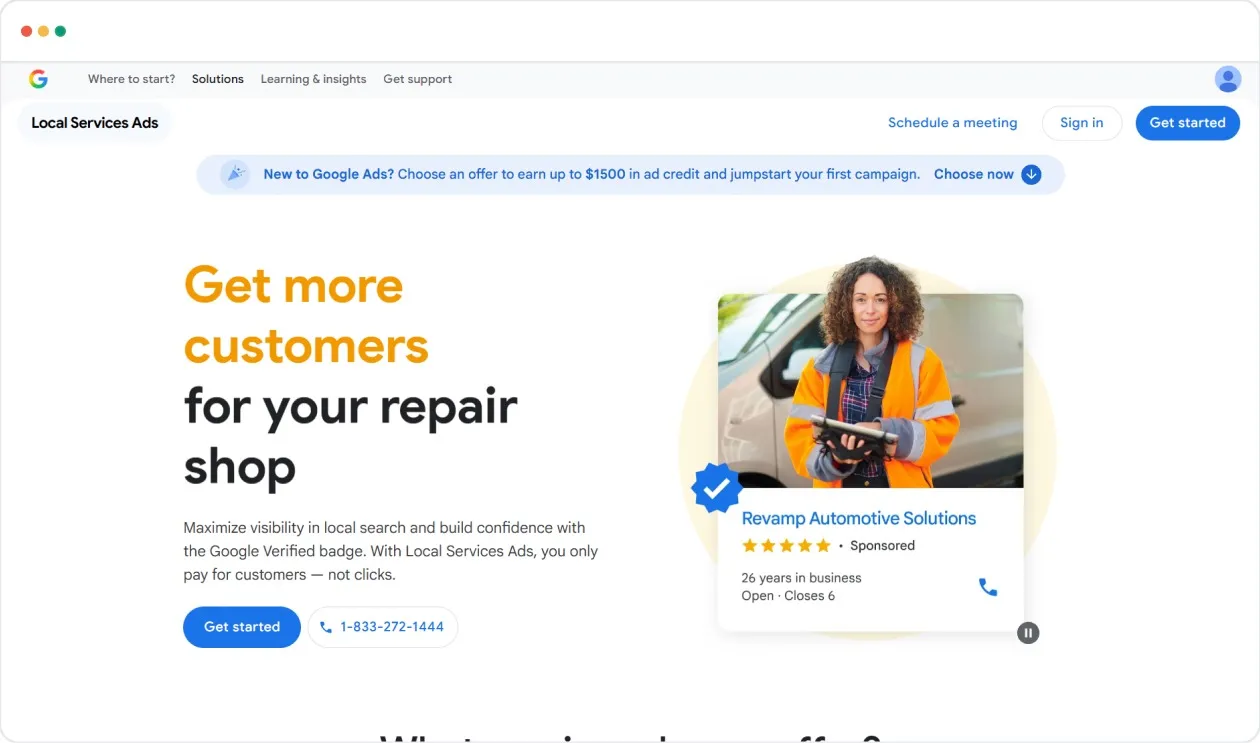
Want to be seen by customers actively searching for HVAC services? Google Local Services Ads (LSA) can make it happen. These ads appear at the very top of Google search results, ensuring your business gets maximum exposure in local searches. Plus, you only pay for actual leads.
Key Features of LSA:
- Top of search results: LSAs ensure your HVAC business shows up first in relevant local searches.
- Pay-per-lead model: Only pay for genuine leads, which means better ROI.
- Google Verified: This trust badge builds credibility and improves conversions.
3. Phonexa
Once you have those leads, you need a way to manage and distribute them effectively. Phonexa helps HVAC businesses track, manage, and optimize leads with real-time analytics and advanced routing.
Key Features of Phonexa:
- Lead tracking: Monitors and measures how each lead progresses through your system.
- Optimized routing: Ensures leads are sent to the right sales rep or team member at the right time.
- Real-time analytics: Provides up-to-the-minute data, helping you adjust your strategy and increase conversion rates.
4. 33 Mile Radius
33 Mile Radius is a pay-per-click (PPC) platform designed to capture geo-targeted leads. With this tool, HVAC manufacturers can zero in on the areas that matter most, ensuring they’re reaching customers who need their services.
Key Features of 33 Mile Radius:
- Geo-targeted PPC campaigns: Reach customers within specific areas for more relevant, high-quality leads.
- Pay-per-lead pricing: Only pay for the leads you actually receive, making it a cost-effective solution.
- High-quality lead generation: Focuses on bringing in leads that are more likely to convert.
5. LinkedIn Ads
For B2B lead generation, especially in the commercial sector, LinkedIn Ads are essential. This platform allows HVAC businesses to directly reach decision-makers who need large-scale HVAC services.
Key Features of LinkedIn Ads:
- Target decision-makers: Reach commercial property managers, real estate developers, and other key players in the industry.
- Focused advertising: Personalize your ads specifically to the commercial HVAC market.
- Professional environment: Ads on LinkedIn feel more authoritative and trusted, making them ideal for B2B connections.
6. Facebook & Instagram Ads
Social media platforms like Facebook and Instagram are perfect for reaching out to residential customers during peak seasons like summer and winter. Seasonal ads can drive immediate demand, particularly when customers need urgent HVAC services.
Key Features of Facebook & Instagram Ads:
- Seasonal targeting: Promote services like AC tune-ups or heating checks during peak demand periods.
- Visual appeal: Use engaging visuals to grab the attention of homeowners looking for HVAC services.
- Geo-targeting: Focus on specific areas to attract local customers.
7. CRM Integration Like HubSpot and Zoho
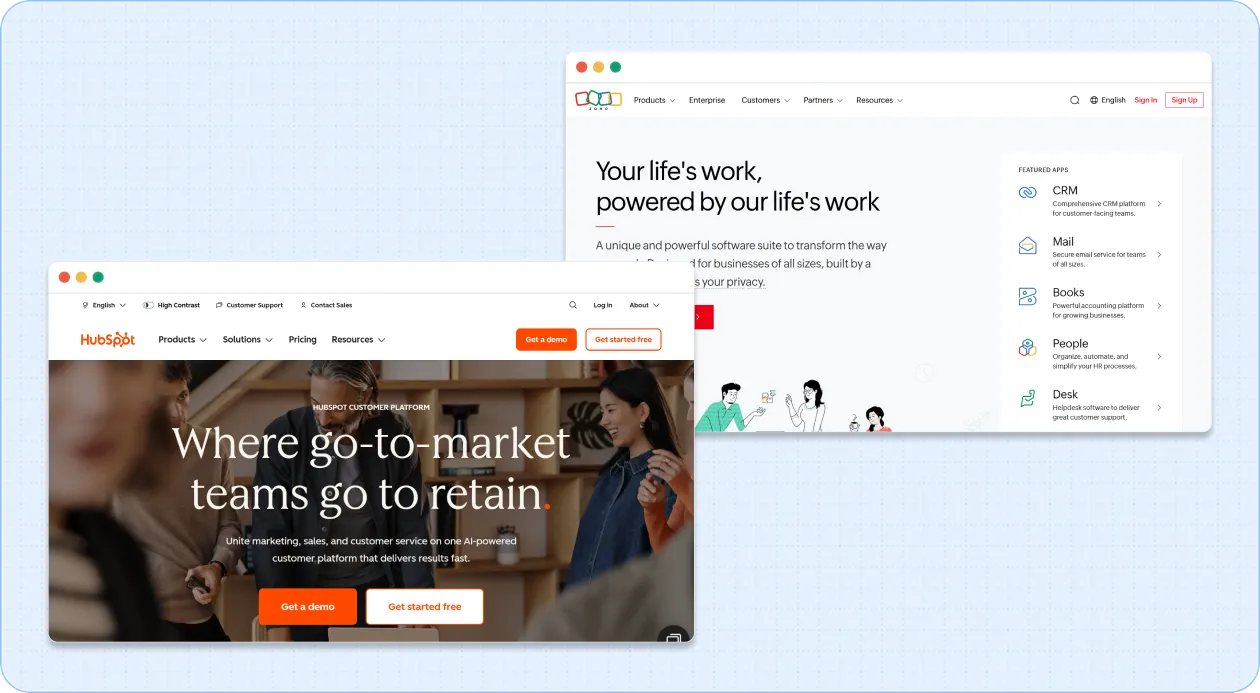
Once you’ve captured leads, it’s crucial to manage them effectively. Integrating a CRM tool like HubSpot or Zoho helps HVAC businesses streamline their lead tracking and follow-ups.
Key Features of CRM Integration:
- Automated follow-ups: Send timely emails to keep leads engaged.
- Customer segmentation: Segment leads based on their needs and position in the buyer’s journey.
- Seamless lead tracking: Keep tabs on lead progress, ensuring nothing slips through the cracks.
Must Read: If Your Lead Flow Is Dry, Partnering With These 5 Businesses Is The Fastest Way To Fix It
Build a Personalized Lead Generation Strategy
Now that you have a comprehensive overview of the top strategies and tools for HVAC lead generation, it’s time to take action. From local SEO and AI-driven content optimization to seasonal social media campaigns and paid ads, you have the tools to attract and convert the right leads.
Every HVAC business is different, and what works for one may not work for another. That's why it’s important to experiment and adapt.
Actionable Next Steps:
- Start with one strategy from this blog and test it. Optimize your Google Business Profile or dive into LinkedIn Ads for B2B outreach, choose the approach that fits your business best.
- Evaluate different platforms and track your results. Try a few tools and platforms to see which ones drive the best results for your HVAC business.
Ready to see how AI-powered SEO can grow your HVAC business?
With Gushwork’s AI-driven content optimization, you’ll connect with the right customers faster and more efficiently.
Book a Free Consultation

“For the first time, we’re proud to add SEO services. Six months in, impact evident.”
Read Case Study

In Conversation with

Abhijith HK
Founder & CEO of Codewave
Want us to do the same for your business?
Talk to an Expert
.svg)
.svg)

