









You can turn an idea into a physical part in a day. Selling that part reliably is where most 3D printing businesses get stuck. The gap is in how you package what you make, who you show it to, and which steps you automate, so interest becomes orders.
Marketing for a 3D printing company is therefore about designing messages that align with real use cases, building evidence that your process works at scale, and creating repeatable touchpoints that turn curiosity into requests for quotes.
In this blog, we break down practical, modern marketing strategies that help 3D printing businesses position themselves clearly, attract the right buyers, and support long sales cycles.
What Is 3D Printing Business Marketing?
3D printing business marketing is the structured approach to attracting, educating, and converting the right customers.
Customers usually come in with a problem. A prototype that needs to move faster. A part that is no longer available. A tool that needs to be customized without expensive tooling.
3D printing business marketing is the work of translating your capability into something that feels immediately useful to that buyer.
Understanding the 3D Printing Market Before Marketing It
Before you write content, run ads, or redesign a website, there is one step that matters more than all the rest. You need to be clear about who you are actually trying to reach.
This is where most 3D printing marketing efforts quietly fall apart.
Why “Everyone” Is Not Your Target Customer?
It is tempting to say you serve everyone. After all, 3D printing can be used across industries, products, and use cases. But the moment your marketing tries to speak to everyone, it stops speaking clearly to anyone.
Broad targeting creates three major problems:
- Your messaging becomes vague because it tries to appeal to too many use cases at once.
- Your website and content fail to rank because search intent remains unclear.
- Sales conversations drag on since buyers do not immediately see relevance.
Not all 3D printing buyers think the same way.
There is also a clear difference between buyer types:
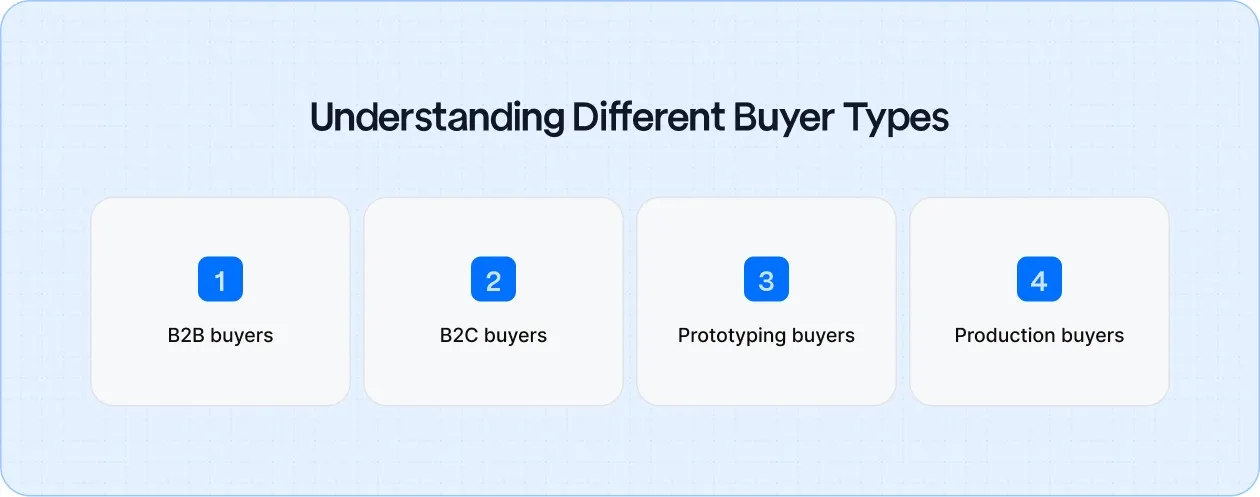
- B2B buyers care about reliability, repeatability, compliance, and long-term cost.
- B2C buyers focus on design, customization, price, and delivery speed.
- Prototyping buyers want speed, iteration, and design support.
- Production buyers want consistency, volume handling, and quality control.
These differences shape how people search, what they respond to, and how they make decisions.
Best 3D Printing Business Marketing Strategies for 2026
A lot of 3D printing businesses sound identical online because they describe the process, not the outcome. In 2026, the brands that win are the ones that make it easy for buyers to understand what you’re best at, who you’re built for, and why your shop is a safe choice.
1. Defining Your Unique Selling Proposition (USP)
Your USP is a business promise that helps buyers feel confident about awarding work to you. However, your answer should align with how real engineering, product, and manufacturing decisions get made.
To define your USP clearly and practically:
- Industry-specific expertise
- Make it obvious which industries you understand.
- Mention things like regulatory expectations, tolerance expectations, environmental exposure, and QC needs for fields like automotive, aerospace, medical, consumer hardware, and manufacturing tooling.
- When buyers see their world reflected, you gain instant credibility.
- Material specialization
- Buyers buy outcomes like strength, heat resistance, chemical durability, cosmetic finish, or biocompatibility.
- Call out core materials you’re confident in and explain why they matter.
- This prevents price-only conversations and positions you as a technical partner.
- Volume capability
- Buyers want to know whether you’re a prototype-only shop, low-volume bridge production partner, or full production-capable manufacturer.
- Write about typical batch sizes, order types, turnaround expectations, and your reliability under repeat demand.
- This filters the right customers to you and reduces mismatched leads.
- Design-to-delivery support
- If you help with DFM, file repair, tolerance guidance, orientation decisions, or finishing advice, say so clearly.
- Explaining your support level signals that working with you feels easier and safer.
Brand Consistency Across Website, Listings, and Sales Calls
Good positioning fails if your story changes depending on where someone sees you. Consistency builds reliability, and reliability builds trust. This part is about making sure your brand feels stable, aligned, and professional everywhere.
Ensure brand consistency by focusing on:
- Messaging alignment
- Use the same “what we do best” framing across your homepage, capability pages, Google Business Profile, listing platforms, and outbound emails.
- Repetition builds memory, and memory builds trust.
- If a buyer can summarize you in one sentence after browsing, you’ve done it right.
- Visual consistency
- Use real work photos instead of generic machine images or AI visuals.
- Show prints, finishing processes, QA checks, packaging, and real application environments.
- Consistency in imagery makes your business feel tangible rather than theoretical.
- Tone and trust signals
- Keep your tone confident, human, and clear. Avoid jargon that only makes content sound “technical” without meaning.
- Add signals like certifications, industries served, turnaround reliability statements, repeat client mentions, and quality proof.
2. Content Marketing That Educates and Converts Buyers
Great content removes uncertainty, speeds decision-making, and helps someone feel ready to send a request:
Types of Content That Work Best for 3D Printing Businesses
Not all content performs equally. Some formats directly influence buying confidence because they match how decision-making actually works. These are the pieces that broadcast you as a helpful tool.
Strong content formats include:
- Use-case pages
- Build pages around real applications of 3D printing procedures.
- Examples: jigs & fixtures, end-use functional housings, rapid prototype series, low-volume bridge production.
- Industry-specific blogs
- Write around constraints and problem-solving, not buzzwords.
- Discuss tolerances, material performance, finishing expectations, and production realities.
- This shows you understand real-world engineering constraints.
- Comparison guides
- Help buyers decide between options without sounding biased.
- For example: SLA vs SLS, MJF vs FDM, Nylon vs PETG, printing vs injection molding at various volumes.
- These guides position you as a trusted advisor rather than a vendor.
- Design and material explainers
- Practical, actionable explainers work best here.
- Include what to avoid, what drives costs higher, and what helps lead times.
Turn Capabilities Into Clarity
Create content that explains how your 3D printing services solve real engineering and production problems.


Sales-Focused Content That Supports Long Buying Cycles
3D printing projects often stall not because of a lack of interest, but because buyers need internal approval. Great sales content prevents deals from dying slowly and helps prospects justify decisions.
Support your sales cycle with:
- Case studies
- Show problem → approach → solution → measurable outcome.
- Include constraints like timeline compression, failure reduction, or improved performance.
- FAQs
- Address the friction points that slow RFQs: file types, tolerances, prep steps, finishing, MOQs, pricing structure, and lead times.
- Technical resource pages
- Offer checklists and simple guides. These quietly say: “We know how to make this process easier for you.”
3. SEO Strategies for Long-Term Visibility in 3D Printing
Manufacturing SEO only works when it focuses on buyer intent. Most serious customers search based on the part, the constraint, the application, or their industry.
Keyword Strategy for 3D Printing Businesses
A layered keyword strategy helps you capture both research-phase users and high-intent buyers. This means, it has to target terms that actually signal a solving mindset.
Build around three layers:
- Core service keywords: These are your foundational commercial terms like “3D printing service,” “additive manufacturing service,” and “rapid prototyping company.”
- Industry-specific keywords: Combine service with verticals like “medical prototyping partner,” “aerospace additive manufacturing,” or “automotive custom component printing.”
- Problem-based search terms: These signal real purchase behavior. Examples include “heat-resistant prototype housing,” “lightweight structural bracket alternative,” or “low-volume production replacement part.”
If you sell consumer products, lead with the product benefit. Customers buy what it does, not how it was made.
Attract the Right Buyers
Identify which industries, use cases, and search terms bring RFQs that are worth pursuing.
Website and Technical Strategies That Keep You Competitive
For 3D printing businesses, the website is a technical validation layer. Buyers use it to check credibility, capabilities, and whether you can meet their exact requirements before they ever speak to sales.
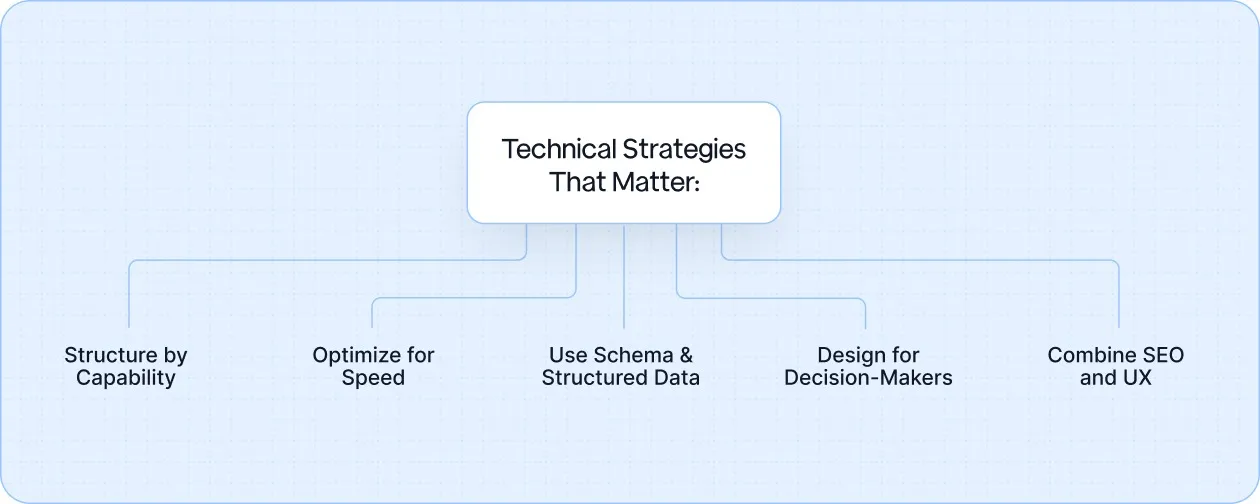
Technical strategies that matter:
- Structure pages by capability: Create dedicated pages for processes, materials, tolerances, industries, and volume ranges so search engines and buyers clearly understand where you fit.
- Optimize for speed and technical clarity:
- Compress heavy CAD visuals and videos
- Avoid bloated animations that slow load times
- Ensure pages load cleanly on mobile and tablets used in factory or office settings
- Use schema and structured data where relevant: Implement Service, Product, FAQ, and Organization schema to help search engines interpret technical offerings and improve visibility for long-tail searches.
- Design pages for decision-makers: Include:
- Clear specs and constraints
- Downloadable one-pagers or spec sheets
- Straightforward CTAs like “Request Quote” or “Discuss Design”
- Treat SEO and UX as one system: Internal linking between materials, processes, and use cases helps buyers self-educate and keeps them engaged longer, which also strengthens search performance.
4. PPC and Paid Search for 3D Printing Businesses
Paid search works best for 3D printing businesses when it’s treated as a demand-capture channel. The goal is to intercept buyers who already know what they need and are actively comparing suppliers, timelines, and pricing.
Well-run PPC fills pipeline gaps, shortens sales cycles, and gives you control over lead flow while SEO compounds in the background.
How to approach PPC the right way:
- Bid on buying intent: Focus on keywords that signal readiness, such as “SLS 3D printing service,” “custom ABS parts manufacturer,” or “rapid prototyping for medical devices.” Avoid broad terms like “what is 3D printing,” which attract researchers rather than buyers.
- Structure campaigns by application or industry: Separate campaigns for automotive, medical, consumer products, or tooling reduce wasted spend and allow messaging to stay highly specific. Buyers convert faster when ads reflect their exact use case.
- Send traffic to intent-matched landing pages: Never send paid traffic to a generic homepage. Each ad should lead to a page that clearly answers:
- What you make
- For whom
- With what materials or tolerances
- How fast and how reliably
- Use ads to qualify leads: Strong ad copy should filter out poor-fit inquiries by mentioning:
- Minimum order quantities
- Industries served
- Materials or processes supported
This lowers lead volume but improves RFQ quality.
5. Social Media Marketing for 3D Printing Businesses
Social media is about credibility and familiarity. Buyers feel safer working with companies they’ve seen repeatedly doing real work.
Platforms That Actually Work
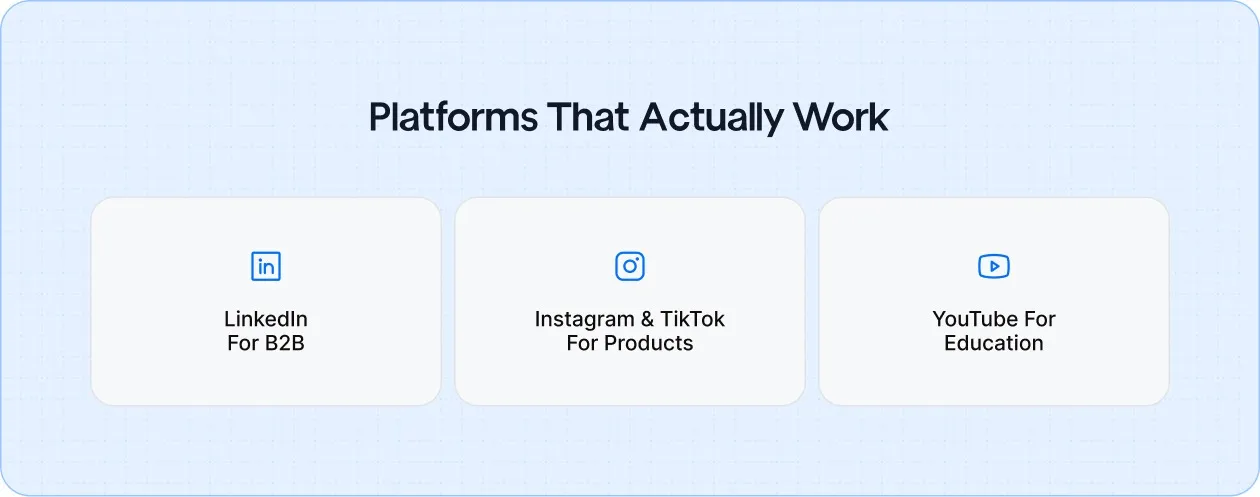
Different platforms serve different purposes. Focus where your buyers spend time.
- LinkedIn for B2B
- Best for engineers, procurement teams, founders, and manufacturing leaders.
- Great for case studies, insights, and credibility.
- Instagram & TikTok for product-facing or consumer brands
- Useful when visuals spark curiosity and inspiration.
- Good for shop visibility and approachability.
- YouTube for education and discovery
- Videos continue ranking over time.
- Perfect for explainers, walkthroughs, and capability demonstrations.
6. Email Marketing That Supports RFQs and Repeat Orders
Email works best for 3D printing businesses when it supports long buying cycles, repeat production runs, and ongoing engineering conversations.
How to use email marketing effectively:
- Segment your list by buyer type such as engineers, procurement teams, startups, or product designers so messages stay context-specific.
- Build short, functional email sequences around RFQs. For example, design confirmation, material availability, lead time updates, and post-delivery follow-ups.
- Share updates that matter operationally, like new materials, tighter tolerances, faster turnaround, or capacity expansion.
- Use email to re-engage dormant leads with practical prompts like “New material now available for [use case]” or “Faster turnaround for low-volume prototyping.”
- Keep emails clean, technical, and skimmable. One purpose per email, one clear next step.
7. Networking and Partnerships That Drive Real Business
Referrals remain powerful in manufacturing and product environments. In many niches, being “the trusted name people recommend” outperforms ads.
Industry Events, Trade Shows, and Online Communities
These work when approached deliberately.
Focus on:
- Attending the right places: Go where your customers and decision-makers gather, not only 3D printing conferences.
- Strong follow-ups: Send useful next steps, examples, or capability matches quickly. Actionable follow-ups win.
Partnering with Designers, Engineers, and OEMs
Partnerships compound over time, creating steady deal flow.
Strengthen this by:
- Building referral systems: Provide simple tools partners can share when recommending you.
- Doing co-marketing: Joint case studies, shared webinars, or collaborative educational content positions you as dependable collaborators.
8. Ship Early, Learn Faster, and Compound What Works
In 3D printing, momentum beats perfection every time. The businesses that grow, get into the market early, learn from genuine buyers, and refine based on actual demand.
A website, positioning statement, or marketing funnel does not need to be flawless to start generating value. It needs to be visible, understandable, and usable.
Once you are live, improvement should be driven by usage.
Focus on:
- Reviewing RFQs to identify repeated confusion or hesitation
- Updating pages, emails, or one-pagers to answer those gaps clearly
- Using lost deals as insight, not failure, to refine messaging or qualification
Every iteration should remove friction from the buying process.
Scale Marketing Without Creating Complexity
Many 3D printing businesses stall after initial traction by adding too many channels, tools, or initiatives at once. Complexity creates chaos and slows execution.
A more reliable scaling order entails:
- Strengthening high-impact fundamentals first
- Website clarity around services, materials, industries, and capabilities
- A frictionless RFQ or inquiry experience
- Proof assets such as case studies, sample parts, or process visuals
- One consistent acquisition channel that actually brings qualified leads
- Delaying low-impact distractions
- Full rebrands before demand exists
- Spreading content thin across every platform
- Marketing assets that look good but don’t support buying decisions
When the basics are working, scaling becomes a matter of amplification. You increase volume, refine messaging, and expand channels only after the core system proves it can convert interest into revenue.
Advanced Digital Strategies 3D Printing Companies Use to Scale
Basic marketing helps you get noticed. Advanced marketing helps you win real deals, shorten sales cycles, improve perceived expertise, and create predictable leads.
Below are advanced growth strategies top-performing 3D printing businesses use:
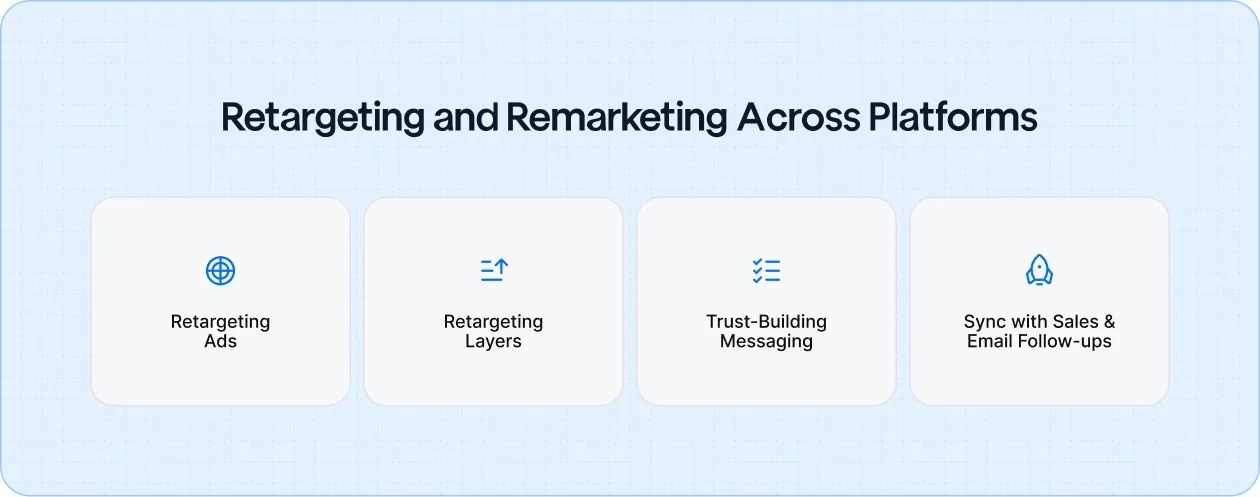
Retargeting and Remarketing Across Platforms
Most buyers don’t convert on their first visit. Retargeting keeps your brand visible during long cycles, so you’re not forgotten when they’re finally ready to request a quote.
- Use Google Display, LinkedIn, and Meta retargeting to show ads only to people who’ve already engaged with your site or content, ensuring budget is spent on warm prospects.
- Build multiple retargeting layers, such as website visitors, quote page viewers, PDF downloaders, and email subscribers, so you can tailor messaging to how close each segment is to buying.
- Focus messaging on trust-building rather than pressure selling; highlight reliability, accuracy, certifications, turnaround time, and real project examples.
- Sync retargeting campaigns with sales calls and email follow-ups so prospects receive reminders and proof of capability, reinforcing conversations.
Video Marketing as a Long-Term Asset
3D printing buyers evaluate proof of competence. Video is one of the strongest ways to demonstrate capability because buyers can literally see workflows, machines, materials, and outputs as they would in a factory walkthrough.
- Create evergreen educational videos such as “how 3D printing for aerospace prototyping works,” “SLS vs SLA vs FDM explained,” or “how tolerance and strength testing work in production environments,” which attract ongoing search visibility.
- Use YouTube not as entertainment but as a technical credibility library, ranking inside Google search results for niche industrial queries your competitors rarely invest in.
- Position your engineers, technicians, or founders as subject-matter experts by speaking on-camera, which builds human trust far beyond stock website claims.
- Reuse every video asset across your ecosystem. Embed them in service pages, RFQ pages, emails, case studies, and social feeds to multiply value without additional production cost.
Automation, CRMs, and Follow-Up Systems
Interest does not equal buying readiness. Many 3D printing leads go silent simply because nobody follows up consistently, or inquiries get lost when volume increases. A structured CRM and automated follow-up system ensures every lead is nurtured professionally.
- Use a CRM built for manufacturing and B2B workflows (like HubSpot, Zoho, or industry-specific platforms) to centralize quotes, conversations, project stages, and historical context in one place.
- Build automated workflows for first-response emails, follow-up reminders, quote reminders, post-delivery check-ins, and re-engagement campaigns so leads don’t slip away after initial contact.
- Humanize automation with thoughtful messaging, reference application type, industry, requirements discussed, or urgency level instead of generic copy-paste templates.
- Segment leads by buyer type (engineers, procurement teams, hobbyists, startups, OEMs, educational institutions) and tailor nurturing sequences so each group receives relevant communication.
Account-Based Marketing (ABM) for High-Value Industrial Buyers
Many 3D printing businesses want larger, repeat clients rather than one-off orders. ABM focuses marketing only on companies worth winning, so your efforts are precise and strategic.
- Identify high-potential industries such as aerospace, automotive R&D, medical device manufacturing, industrial tooling, or electronics, then build tailored outreach campaigns specifically for these segments.
- Create customized landing pages, proposals, videos, or email content showing industry-specific capability.
- Engage multiple decision-makers inside target organizations, engineers, procurement managers, and design teams, because real contracts usually require multi-level buy-in.
- Combine email outreach, LinkedIn engagement, targeted ads, and sales calls into one coordinated strategy rather than isolated tactics.
Building Authority Through Thought Leadership and PR
In technical industries, decision-makers choose vendors who know what they’re talking about. Authority content, expert commentary, and visibility in credible industry platforms elevate your perceived expertise far beyond smaller competitors.
- Pitch insights, case studies, or expert commentary to engineering blogs, manufacturing magazines, tech publications, and industry podcasts to earn mentions and visibility.
- Showcase participation in standards bodies, certifications, or industry associations as credibility anchors.
- Turn real customer projects into documented stories (with permission) showing before-and-after impact, engineering challenges solved, and real business outcomes.
Conclusion
Marketing for a 3D printing business should be treated like a product iteration cycle: launch something measurable, learn from real buyers, and improve what matters.
If you walk away with one idea, let it be this: focus on making your best product story obvious and easy to buy. Do the basics, clear niche positioning, sales-ready content, and a simple follow-up flow, then build from steady wins. Small, consistent improvements beat occasional marketing spectacles every time.
Ready to Market With Focus?
Build a marketing system that attracts better-fit projects and supports long-term growth.


.webp)




.webp)


.svg)


