









As more people turn their homes into smart, connected spaces, the need for skilled wiring professionals has never been greater. But with so many businesses offering similar services, how do you stand out?
The answer lies in effective marketing. The right skills does get the job done. But it’s more about ensuring potential customers know you’re the one to trust for their smart home needs.
In this blog, we’ll explore practical marketing strategies to help your smart home wiring business build strong partnerships, attract the right clients, and position yourself as the go-to expert in this booming industry.
Understanding the Smart Home Technology Industry
The smart home technology industry operates at the intersection of innovation and trust. Buyers are often interested but cautious, evaluating solutions based on reliability, integration, and long-term value rather than novelty alone.
This makes marketing less about awareness and more about helping prospects understand where a solution fits, how it works in real environments, and why it’s a safe decision.
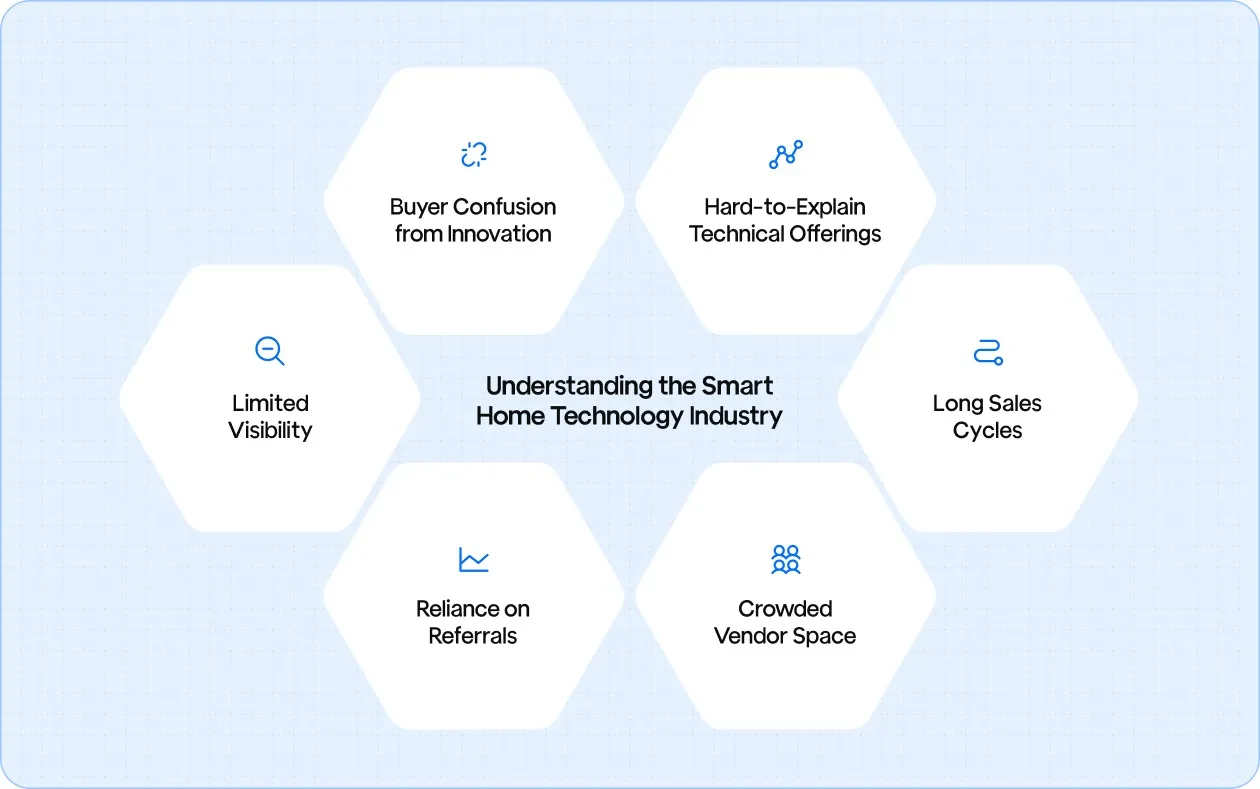
Below are the manufacturing marketing challenges most smart home technology companies face:
- Rapid Innovation Creates Buyer Confusion: New protocols, devices, and standards appear constantly. It overwhelms buyers who struggle to understand the differences between systems, integrations, and long-term viability.
- Highly Technical Offerings Are Hard to Explain: Smart home solutions are not impulse purchases. They involve wiring, infrastructure, compatibility, and future-proofing. Without clear positioning, technical depth becomes a barrier instead of an advantage.
- Long, Multi-Stakeholder Sales Cycles: Decisions often involve builders, electricians, integrators, property owners, and end users. Each stakeholder has different priorities, which slows adoption when messaging is unclear or inconsistent.
- Crowded Vendor and Partner Ecosystems: Manufacturers, installers, and integrators often compete for the same projects. Many offer similar capabilities, making it difficult for buyers and partners to distinguish one provider from another.
- Strong Reliance on Referrals and Relationships: The industry still depends heavily on word-of-mouth and existing networks. While effective, this limits scale and creates unpredictable revenue pipelines.
- Limited Visibility Beyond Immediate Networks: Without proactive visibility, even capable smart home businesses remain unknown outside their current partner circle, missing opportunities earlier in the decision process.
How Can Marketing Solve These Challenges?
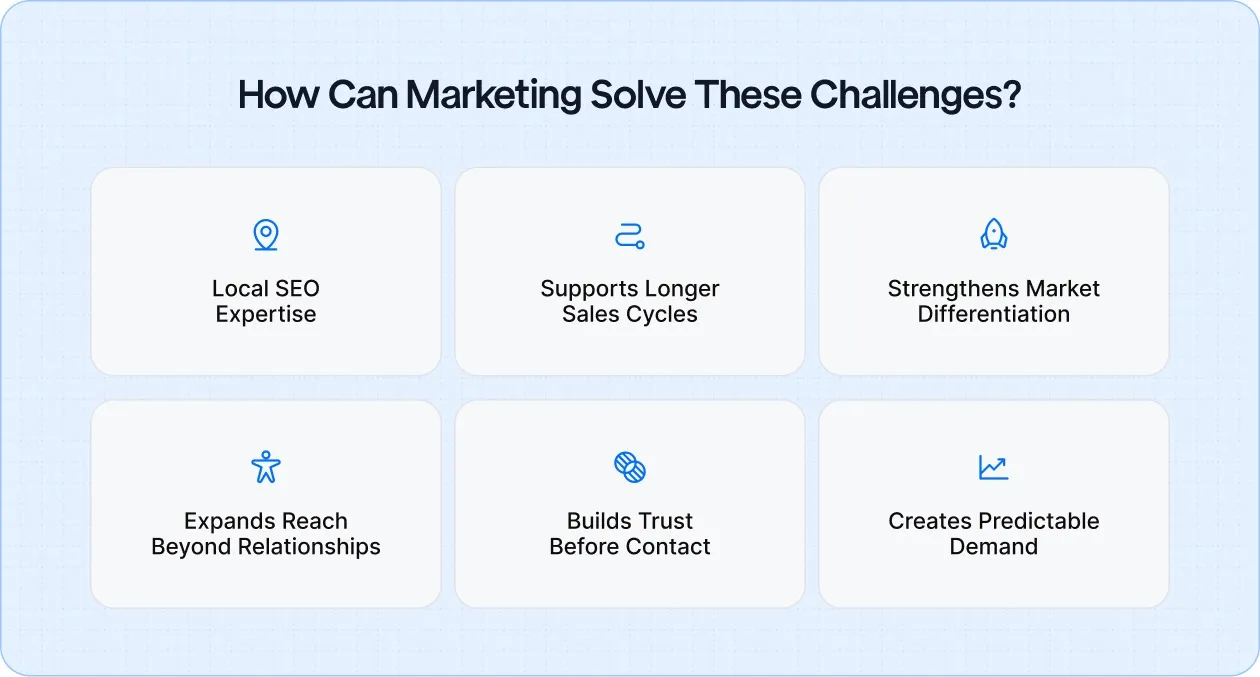
- Clarifies Complex Offerings for Different Audiences: Structured messaging helps explain technical capabilities in a way each stakeholder can understand, reducing friction in the sales process.
- Supports Longer Sales Cycles With Consistent Visibility: Marketing and SEO keep businesses present throughout research and planning stages, not just at the point of purchase.
- Strengthens Differentiation in Competitive Markets: Clear positioning and proof-driven content make it easier for buyers and partners to see what sets one provider apart.
- Expands Reach Beyond Existing Relationships: Marketing introduces smart home businesses to new builders, integrators, and property owners before referrals would typically occur.
- Builds Trust Before Direct Contact Happens: Educational content, case studies, and visibility across channels establish credibility before conversations begin.
- Creates Predictable Demand Over Time: Marketing supports a more consistent and scalable growth pipeline.
This shift allows smart home technology businesses to grow without disrupting how projects are sold or delivered, while staying competitive in this industry.
14 Proven Strategies to Promote Smart Home Technology
Smart home services sit at the intersection of electrical expertise and modern home improvement. Promoting them effectively requires a mix of education, visibility, and trust-building, especially in a market where most customers are still learning what’s possible.
The strategies below reflect how businesses can market smart home wiring and setup services to align with buyer intent in the home improvement services market.
1. Target the Right Customers for Smart Home Services
Smart home technology is best marketed to people who are already thinking about improving their homes. Targeting the wrong audience leads to confusion and wasted effort.
- Focus on homeowners already planning upgrades: These are people already planning renovations, new builds, or system upgrades. They are more open to smart home discussions because they are already making decisions about their home’s future.
Best practices:- Prioritize renovation and remodeling inquiries
- Look for new home buyers or recent movers
- Pay attention to customers asking about security, lighting control, or energy efficiency
- Match your message to their main motivation: Different customers care about different outcomes. Your messaging should reflect why smart home technology matters to them, not how advanced it is.
Steps to apply:- Plan the high-intent keywords to determine their customer journey
- Frame one discovery question around it (“What made you consider smart home options?”)
- Decide recommendations based on their answer
- Avoid introducing features they didn’t ask for
Reach the Right Smart Home Buyers
Identify who is actively searching for smart home wiring and what they are typing into Google before they call anyone.


2. Website Optimization and SEO for Smart Home Services
Your website should clearly explain your smart home services in simple terms. SEO, at its core, is about making sure people can find those explanations when they search online.
- Create dedicated pages for smart home services: Smart home wiring should be clearly separated from general electrical services so visitors understand it’s a specialized offering.
Best practices:- One page per smart home service type
- Simple explanation of what’s included
- Clear “Who this is for” section
- Make it easy for local customers to find and contact you: Most people search for services near them. Mentioning your service areas and keeping your business information consistent helps your site appear in local searches.
Steps to follow:- Mention cities and service areas naturally on the page
- Place phone number and booking button near the top
- Keep contact details consistent everywhere online
Get Found When Decisions Start
Show up in local searches where homeowners and builders compare smart home wiring options.
3. Showcase Detailed Smart Home Project Case Studies
Case studies replace uncertainty with proof. They show customers what smart home work actually looks like in real homes.
- Walk through real projects step by step: Walk readers through what the customer needed, how you approached the wiring or setup, and what the final result looked like.
Structure to use:- What the homeowner wanted
- What wiring or setup was required
- What the final result enabled
- Highlight practical benefits: Focus less on technical features and more on how the installation improved daily life.
Focus on:- Easier control of lighting or devices
- Improved security or monitoring
- Homes ready for future upgrades
4. Social Media and Paid Ads for Smart Home Wiring
Social media and ads are most effective when they show real work and stay educational rather than promotional.
- Use social media to show real installs: Regular posts help people recognize your business and understand what smart home work looks like.
Best practices:- Short videos explaining what’s happening
- Before-and-after photos
- Simple captions that explain value
- Use paid ads to stay visible during research: Ads are most effective when they support learning, not pressure decisions.
Steps to apply:- Promote consultations or video guides instead of hard sales
- Retarget people who visited smart home pages
- Keep ad copy benefit-focused and simple
5. Create Educational Content That Builds Trust
Most smart home objections come from uncertainty. Educational content helps remove that uncertainty before the sales conversation starts.
- Explain smart home concepts in everyday language: Content should answer basic questions without assuming technical knowledge.
Topics to cover:- What smart home wiring enables
- Why planning early saves money later
- How systems can expand over time
- Use content during sales conversations: Educational articles and guides can be shared during consultations to reinforce what you explain verbally.
Best practices:- Share links after consultations
- Use guides as follow-up resources
- Answer common objections proactively
Turn Expertise Into Demand
Create content that explains smart home wiring clearly and builds trust before the first conversation.
6. Collect and Leverage Customer Feedback
When customers talk about their experience, it carries more weight than any marketing message.
- Request reviews focused on smart home work: Specific feedback builds more confidence than generic praise.
How to ask:- Request reviews shortly after project completion
- Suggest mentioning what changed in their daily life
- Use testimonials where decisions happen: Visibility matters more than volume.
Places to feature:- Smart home service pages
- Quotes in proposals
- Highlighted social posts
7. Partner With Smart Device Manufacturers for Co-Marketing
Manufacturer partnerships make your services feel safer and more credible to customers unfamiliar with smart home technology.
- Align with brands customers recognize: Familiar names help reduce perceived risk and make recommendations easier to accept.
Best practices:- Display partner logos on service pages
- Explain compatibility clearly
- Create simple bundled offers: Bundles help customers understand value without complexity.
Examples:- Wiring plus device setup
- Starter packages with upgrade options
8. Link Building
Link building strengthens search visibility by showing search engines where your business fits in the smart home ecosystem.
- Earn links from builder, contractor, and integrator partner sites
- Get listed in industry associations and trade directories
- Contribute guest content to construction or smart home blogs
- Focus on links that align with your services and markets
9. International Marketing
International SEO and marketing apply when your services or partnerships extend across regions or countries. The goal is controlled expansion, not broad global reach.
- Create region-specific pages and keyword targeting
- Adapt messaging to local standards, regulations, and terminology
- Highlight certifications and compatibility clearly
- Build partnerships with regional builders or distributors
10. Offer Free Consultations and Live Demonstrations
Seeing and discussing options in person helps customers feel confident in their decisions.
- Use consultations as planning sessions: Free first conversations build trust.
Steps to follow:- Walk through the home
- Explain immediate and future options
- Recommend phased setups
- Demonstrate when possible: Showing systems in action builds confidence faster than explanations.
11. Run Targeted Digital Advertising Campaigns
Marketing works best when it explains benefits clearly and speaks to real-life situations.
- Focus messaging on benefits: Customers relate to how technology improves life. Run ads based on:
- Convenience and control
- Peace of mind
- Future flexibility
- Keep ads simple and relatable: Avoid technical language that creates doubt.
12. Digital PR
Digital PR helps smart home wiring businesses build visibility and trust in places partners and buyers already pay attention to. The focus is on credibility.
- Get featured in construction, real estate, and smart home publications
- Share expert insights on wiring standards, future-ready homes, or retrofit planning
- Publish data-backed stories from real projects or installations
- Support SEO by earning authoritative, context-relevant mentions
13. Host Webinars and Educational Workshops
Workshops allow customers to learn without feeling pressured to buy.
- Teach fundamentals clearly: Explain how your systems are set up, how they work together and why wiring matters.
- Use audience questions as insight: Questions reveal what customers struggle to understand. The questions people ask help refine future messaging and content. Use these questions to frame and improve your delivery.
14. Implement an Online Booking System
Interest drops quickly when scheduling is difficult. When a buyer tries to reach out to you, you must ensure every path is simple for them.
- Make scheduling easy and immediate: Online booking captures intent when it’s highest.
Best practices:- Mobile-friendly booking
- Clear confirmation and follow-up
Measuring the Success of Your Smart Home Technology Promotion
Smart home marketing only delivers value when performance is tied back to real outcomes. Visibility alone is not enough. What matters is whether interest turns into inquiries, projects, and long-term clients.
The focus should be on how promotion efforts translate into qualified leads, completed installations, and repeat work.
Key metrics to monitor:
- Inquiry-to-consultation rate: Shows how many website visits or ad clicks turn into actual discovery calls or site assessments.
- Lead quality by channel: Helps identify which platforms bring serious buyers versus early-stage researchers.
- Cost per qualified lead: More useful than cost per click when evaluating campaign efficiency.
- Project conversion rate: Measures how many consultations result in approved wiring or automation projects.
- Customer lifetime value: Indicates whether marketing attracts one-time installs or long-term upgrade clients.
Tools and Resources for Effective Smart Home Marketing
Smart home marketing becomes easier to manage and scale when the right tools and partners are in place. The goal is to use the tools that directly support lead quality and loyalty returns.
The focus should be on tools that help attract the right prospects and clearly measure what each channel delivers.
Lead generation partners to consider:
- Industry-specific lead providers: Services that focus on home services or smart technology tend to deliver more relevant inquiries than broad marketplaces.
- Local lead generation platforms: These often perform better for installation and wiring services tied to specific service areas.
- Performance-based partners: Prioritize vendors that offer clear reporting and accountability for lead quality.
If you want a partner that covers all of this without the usual guesswork, Gushwork combines industry-specific targeting, local demand capture, and performance-driven reporting to deliver SEO that is built to convert.
SEO and PPC tools that support optimization:
- SEMrush or Ahrefs to track keyword rankings, competitor performance, and backlink opportunities
- Google Keyword Planner to identify demand, seasonality, and cost estimates for paid campaigns
- Google Analytics to evaluate traffic behavior and conversion paths
- Google Search Console to monitor search visibility, indexing issues, and page performance
Using these tools consistently helps identify what’s working, where gaps exist, and which efforts deserve more focus. Over time, this creates a clearer, more efficient smart home marketing system.
Conclusion
The smartest growth in smart home wiring comes from earning placement.
When your business is woven into the way projects are planned, discussed, and handed off, marketing stops feeling like work. You’re not convincing people you’re capable. Your name comes up because it belongs there.
You don’t need to be everywhere. You need to be in the right rooms, with the right people, at the right moment. Build those connections well, and your business stops reacting to demand and starts shaping it.
Ready to Grow With Clarity
Get a clear plan to attract better smart home projects without relying only on referrals.


.webp)




.webp)


.svg)


