
Industrial sales leads disappear because buyers make up their minds without you.
By the time someone reaches out, they’ve already compared suppliers, checked credibility, and quietly ruled out the ones that felt vague, outdated, or hard to trust. No calls. No emails. Just silent elimination.
That’s the uncomfortable truth of how industrial buying works today.
Winning industrial sales leads now means showing up before the first conversation, in the places buyers use to sanity-check decisions. It’s about answering the questions they hesitate to ask, showing proof that feels real, and making it easy to move with conviction.
In this blog, we break down how industrial sales leads are actually formed, where most companies lose them, and what to fix if you want fewer dead ends and more serious enquiries.
What Is Lead Generation in an Industrial Context?
Lead generation in the industrial world involves identifying companies that genuinely need a new supplier or have an upcoming project. These buyers move slower than consumers and usually involve several people in the decision. They care about your capabilities, certifications, tolerances, and whether you can support them long term.
In this space, a lead is a buyer with a real technical need, a timeline, and the authority to move a project forward. Effective lead generation helps these buyers discover your capabilities early, understand what you can handle, and trust you enough to start a conversation or issue.
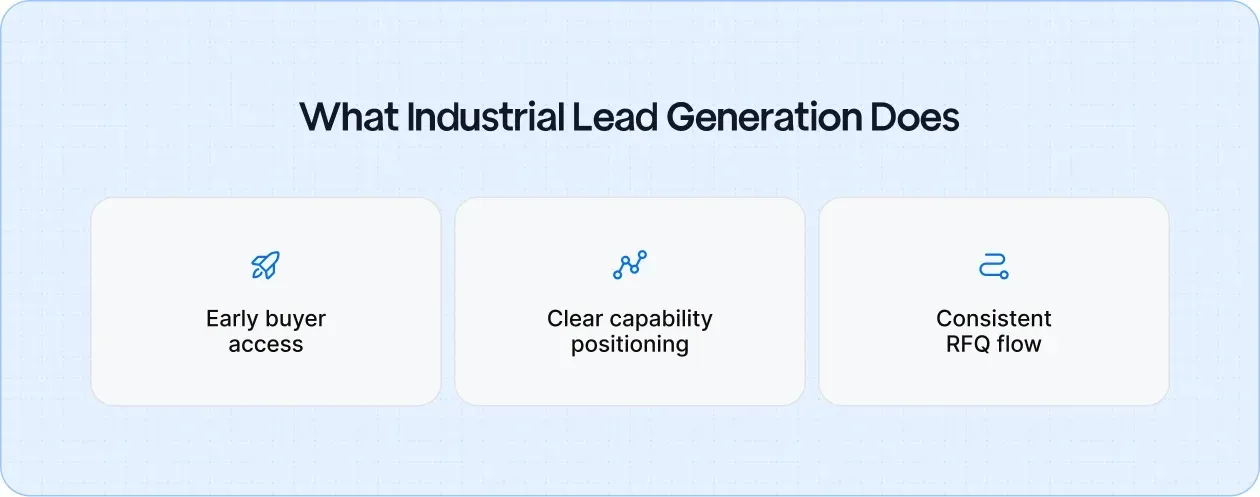
Industrial lead generation does three things for you:
- Gets you in front of buyers before competitors do, especially when sourcing cycles reopen or new programs begin.
- Position your technical capabilities clearly, so buyers know whether you can meet their tolerances, volumes, materials, and compliance requirements.
- Builds a steady, predictable flow of RFQs, helping you reduce dependency on word-of-mouth or seasonal demand swings.
12 Practical Ways to Generate Qualified Industrial Sales Leads
Below are the methods that consistently attract the right kind of leads, the ones with defined needs and a high chance of becoming repeat customers.
1. Turn Your Product Pages Into Lead Drivers
Most industrial companies already have a product catalog or capabilities brochure. The problem is that it often sits as a static PDF, buried three clicks deep on the website.
To make your catalog generate leads:
- Put it online in a searchable, filterable format so visitors can find parts by material, size, tolerance, or application.
- Add simple calls to action next to each product or family: “Request quote,” “Ask an engineer,” or “Check stock.”
- Offer gated access to CAD models, STEP files, or spec sheets in exchange for basic details like company, role, and project type.
- Track which products and families are viewed most, and pass these signals into your CRM so sales can prioritize follow-up.
When your catalog is easy to search and tied to RFQ or enquiry forms, it becomes a continuous source of qualified industrial sales leads, not just a reference document.
2. Make Your Website a Buyer’s Research Hub
Industrial buyers and engineers spend a lot of time researching before they ever speak to sales. Your website should help them do that work.
Useful content that supports lead generation:
- Application notes that show how your components or assemblies work in specific end uses.
- Design guides that explain acceptable tolerances, materials, finishes, and design-for-manufacture guidelines.
- Case studies that connect your capabilities to cost savings, reliability, or faster launches for customers like them.
The more your website answers real technical questions, the more often you’ll earn contact from serious buyers.
Want a quick health check on your website? Drop it into our AI Analyzer and get instant insights to help turn more visitors into paying customers.
3. Use Video to Reach Technical Buyers
Video remains underused in manufacturing, yet engineers and buyers watch videos to understand processes, compare suppliers, and validate capabilities.
What to create:
- Short process walkthroughs (machining, fabrication, finishing, QA steps).
- Engineering explainers (tolerances, materials, manufacturability guidance).
- “Inside the factory” videos that demonstrate equipment, certifications, and capacity.
- Customer success stories with real ROI or performance improvements.
Video builds trust faster than text. Seeing your machines, people, and process reduces perceived risk, especially for buyers sourcing a new supplier.
4. Create Enquiry Forms That Qualify Leads
A generic “Contact us” form attracts everything from students to one-off prototype requests. Quotation forms and project enquiry forms let you qualify leads earlier.
To make forms work for you:
- Ask for the few details that really matter: part type, annual volume band, required certifications, target timeline, and whether drawings are available.
- Add simple dropdowns that flag poor fit early (for example, volume ranges below your minimum).
- Route form submissions directly into your CRM with tags for process, material, or product family.
A focused prospect form helps your team decide which leads to call first and which to park or decline politely.
5. Target Engineers Where They Research
Industrial buyers rarely start on social media. They start on channels built for engineering and sourcing. Your job is to show up there with clear, technical information.
Places to consider:
- Industry directories and sourcing platforms that your ideal customers already use.
- Engineering communities where CAD models, reference designs, or application notes are shared.
- Niche trade portals for your specific sector (electronics, fabricated metals, plastics, process equipment, etc.)
If you invest time or budget in these channels, make sure your listings:
- Show your core capabilities and certifications accurately.
- Link back to your best-performing pages and RFQ forms.
- Include clear contact options for both engineering and purchasing.
Treat each platform as a feeder into your own website and sales process, not as a disconnected listing.
6. Keep Your Google Business Profile Updated
GBP is one of the most overlooked sources of high-intent industrial sales leads, especially for regional manufacturers, fabrication shops, job shops, and machining companies.
What to do:
- Add photos of equipment, facility, and sample parts.
- Update service descriptions with specific processes (e.g., 5-axis machining, TIG welding, PCB assembly).
- Post updates monthly: certifications, new machines, project highlights.
- Collect reviews from long-term customers who can speak to quality, communication, and on-time delivery.
A strong GBP helps you appear when local engineers and buyers search things like “metal fabrication near me”, “precision machining supplier”, or “custom PCB assembly shop”.
7. Use Email for Focused Technical Outreach
Email still works in manufacturing, as long as it respects the receiver’s time and context.
Two main use cases:
- Nurturing existing contacts: share application notes, new capabilities, or design tips tied to their industry and past enquiries.
- Targeted outreach: carefully researched messages to specific accounts with a clear reason for contact (for example, capacity in a process they are known to outsource).
To keep email effective:
- Segment by industry, role, and past behaviour (quotations or contact, downloads, webinars).
- Focus on one useful topic per email, with a clear next step (“Send your drawing,” “Reply with your current supplier challenges,” etc.)
- Avoid generic newsletters that try to speak to everyone; industrial recipients tune those out quickly.
Email becomes a lead generation tool when each message connects a real problem to a specific capability you can offer.
8. Align Sales and Marketing on Target Accounts
In manufacturing, a single account can represent years of revenue. That makes account-based thinking more practical than chasing random leads.
To align around key accounts:
- Agree on a short list of priority companies in each segment and region.
- Map who is involved in decisions (engineering, procurement, quality, plant operations).
- Coordinate touches across channels: digital marketing, email, LinkedIn outreach, invites to facility tours or webinars.
- Track activity for these accounts in your CRM to see when interest is building.
The goal is not just more names in the database, but deeper engagement inside the companies that matter most to your growth.
9. Run Technical Events and Webinars for Leads
Trade shows and webinars are expensive if they only deliver business cards. They are valuable if they feed into a structured follow-up process.
To make events generate industrial sales leads:
- Design session topics around specific production problems or design challenges your ideal clients face.
- Collect meaningful information during registration (industry, role, primary process interest).
- Offer post-event resources like slide decks, calculators, or checklists in exchange for permission to follow up.
- Within a few days, pass the attendee list through a simple qualification filter and prioritize outreach to those who match your ICP.
Think of events as concentrated lead generation moments. The real value is harvested in the weeks after, not only during the trade show marketing.
10. Enable Distributors with Lead-Ready Materials
If you sell through distributors, reps, or integrators, they are also a source of industrial sales leads. But they need more than a logo and a price list.
Give partners tools that directly support lead generation:
- Co-branded datasheets and landing pages so buyers see a unified offer.
- Short technical training sessions so reps can spot where your product is a better fit.
- Simple checklists to qualify opportunities before they reach you (volume, application, regulatory requirements).
When partners are equipped to explain where you fit best, you receive cleaner, better-qualified opportunities instead of mismatched requests.
11. Adopt a Multi-Channel Outreach Strategy
Industrial purchasing rarely depends on one person. Engineers, procurement, quality, and operations all influence decisions. A multi-channel approach ensures your brand shows up at different stages of their process, even when they’re researching quietly.
How to use it effectively:
- Combine search (SEO + PPC), email outreach, industry directories, LinkedIn, and trade media placements.
- Repurpose the same technical insight across channels to stay consistent while reducing workload.
- Track which channels bring the most engaged companies and shift budget accordingly.
Multi-channel doesn’t mean “be everywhere.” It means showing up where your specific buyers already look for suppliers.
12. Measure Performance with Analytics
Without measurement, it’s easy to over-invest in channels that generate “activity” rather than revenue.
At a basic level, track:
- Which pages and resources are most viewed before forms are submitted.
- Which channels (search, directories, email, events) lead to qualified opportunities in your CRM.
- How long it takes for different types of leads to become quotes and orders.
You don’t need a complex dashboard to start; a simple monthly review with sales is enough to see what is bringing in leads worth quoting and what is not.
How to Spot a Qualified Industrial Sales Lead?
Not every enquiry deserves the same amount of time. Clear qualification criteria help your team focus on leads that can become profitable, repeat business.
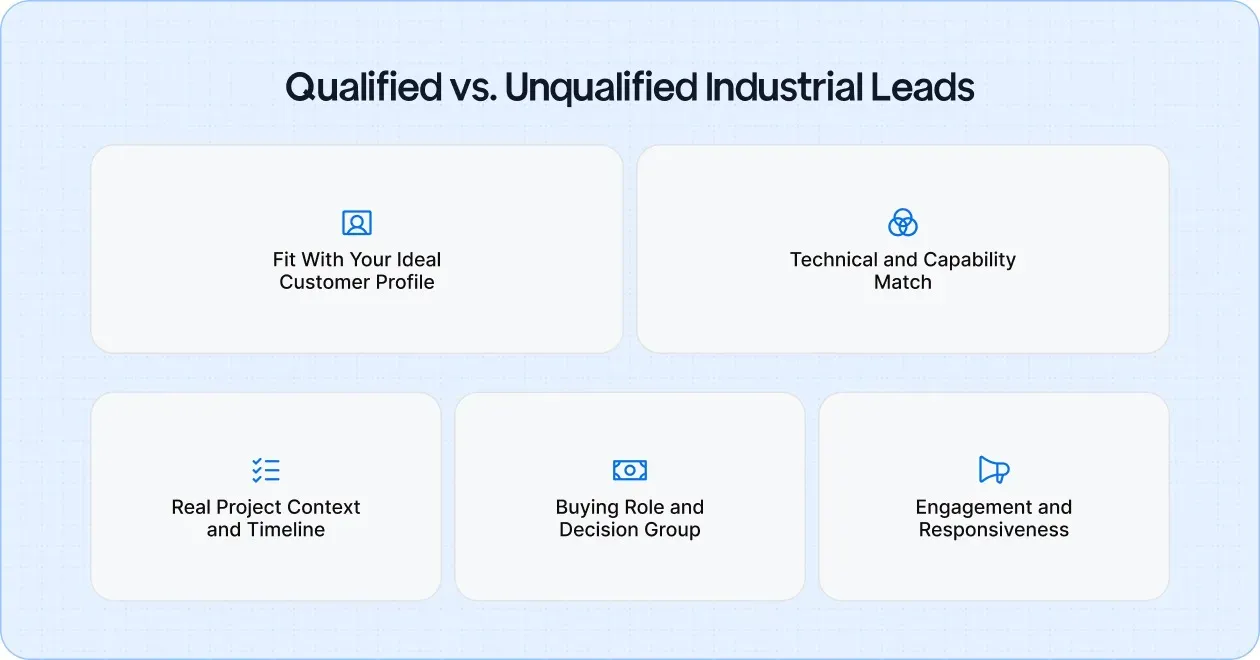
1. Match to Your Ideal Customer Profile (ICP)
A qualified lead usually:
- Operates in industries you understand and can support.
- Orders at volumes and frequencies that suit your equipment and capacity.
- Is located in regions you can ship to reliably and competitively.
Non-qualified leads often sit outside your target sectors or require project sizes that are too small (or occasionally too large) for you to serve well.
2. Technical Fit and Capability Alignment
Check whether:
- The required materials, tolerances, and processes are ones you already run successfully.
- The product type fits with your existing tooling, certifications, and quality systems.
- There are special compliance or regulatory needs you can meet.
If a lead needs something you have never done, or that would disrupt your core production, it may be better to decline or refer.
3. Clear Project Need, Timeline, and Budget Signals
Qualified industrial sales leads usually come with a clear context:
- A defined project or program, even if early-stage.
- A rough timeline for sampling, validation, and production.
- A sense of annual volume or spend.
Red flags include vague timing (“sometime next year”), no clear use case, or a request that appears purely exploratory with no identified project behind it.
4. Correct Stakeholders and Buying Authority
In B2B manufacturing, the person who contacts you may be:
- A design engineer exploring options.
- A buyer comparing suppliers.
- A project manager gathering information.
All can be valuable, but a qualified lead usually has visibility into the broader decision group or is willing to involve others. If a contact cannot explain who approves suppliers, who signs off on specs, or how sourcing decisions are made, treat it as early-stage until that clarity is gained.
5. Engagement Level and Response Quality
Lead quality also shows up in behaviour:
- Do they respond promptly to clarifying questions?
- Do they share drawings, specs, and constraints when asked?
- Are they open about what they are trying to solve?
If a prospect goes silent for weeks, refuses to share basic information, or only asks for “your best price” without dialogue, they may be more interested in price shopping than true partnership.
Get Industrial Sales Leads That Are Quote-Ready
Most industrial companies have a problem with lead quality and clarity.
Sales chases, engineering gets pulled in too early, and good-fit deals get slowed down by the same avoidable back-and-forth.
Gushwork fixes that by building a full lead system. We help manufacturers show up for the right searches, explain capability in a way technical buyers trust, and turn the website into a qualification layer that makes enquiries cleaner and easier to close.
What You Get With Gushwork?
1) Lead-Intent SEO That Pulls Buyers In
- We target searches tied to real industrial demand, such as process capability, material and tolerance needs, compliance requirements, and service-area intent.
- We build pages that win “shortlist” keywords, not just early research terms.
- We structure internal linking so buyers naturally move from problem → capability → proof → enquiry without dropping off.
2) Content That Qualifies Leads Before Your Team Even Replies
- Capability pages that explain what you do, what you don’t, and what “fit” looks like in plain technical language.
- Application content that answers the exact questions buyers use to vet suppliers (without sounding like fluff).
- Comparison and decision-support assets that reduce “shopping-around” behaviour and push serious prospects closer to RFQ.
3) A Website Built to Convert Industrial Leads With Context
- Clear conversion paths for different intents: RFQ, technical consultation, drawing uploads, urgent turnaround enquiries.
- Forms designed to screen for fit (materials, volumes, timelines, certifications) without feeling like a barrier.
- Trust signals placed where they matter: near service pages and enquiry points, not buried on an “About” page.
4) Ongoing Execution Without Internal Bottlenecks
- Publishing cadence that keeps your site fresh and your visibility rising, without you having to constantly coordinate freelancers.
- Content production and optimization that align with real-world review workflows and engineering teams.
- Regular improvements across SEO, structure, conversion, and clarity so your lead system compounds over time.
What Changes When This Is Done Right?
- Leads come in with a clear project intent.
- Your sales team gets fewer dead-end calls and more serious industrial leads ready for quoting.
- Engineering spends less time re-explaining basics and more time supporting real opportunities.
- Your website starts functioning like a quiet, always-on pre-sales rep.
Conclusion
The companies that grow steadily are the ones that make it easy for the right buyers to understand what they do, see proof that it works, and start a focused conversation.
If you turn your catalog into a working asset, build flows that filter instead of flood, show up in the channels your buyers already use, and agree internally on what “qualified” really means, lead generation stops being guesswork. It becomes another well-run process in your operation, measured, improvable, and tied directly to the kind of business you want more of.
If you want that system built properly, Gushwork can help. We create the content, SEO, and conversion structure that attracts better-fit industrial sales leads and turns your website into a real enquiry engine.