









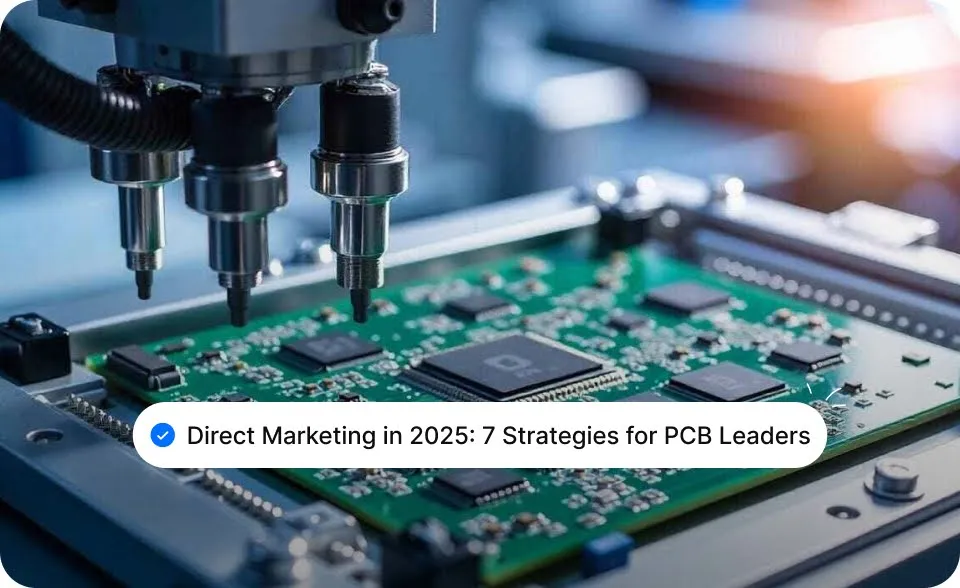
If you’ve ever handled PCB sales, you know the real fight is never on your website; it's in someone else’s inbox. Buyers don’t browse casually for PCB suppliers the way consumers shop for sneakers. They already have long-standing vendor relationships and approved supplier lists that dictate who gets a PO.
So when RFQs slow down, waiting for “organic demand” is the fastest way to watch production lines sit idle and machines collect dust. The shops winning today are the ones actively positioning themselves inside engineering inboxes, LinkedIn DMs, and procurement channels before a buyer even knows they need a second source.
That’s where printed circuit boards direct marketing changes the game. It lets you control who sees your expertise, when the right decision makers meet you, and how quickly casual interest turns into qualified RFQs.
In this blog, you’ll learn about what direct marketing actually means for PCB manufacturers, the components of a high-performing direct strategy, and how to reach engineering and procurement buyers without being ignored.
What Is Direct Marketing for PCB Manufacturers?
Direct marketing is a targeted, one-to-one communication approach in which you reach out to potential PCB buyers rather than waiting for them to find you through search or ads.
Unlike broad advertising or generic catalogs, direct marketing speaks to a specific person, at a specific company, with a specific need. The goal is to start meaningful conversations, share real manufacturing value, and turn interest into qualified RFQs.
How Direct Marketing Helps PCB Businesses?
Direct marketing is especially effective in electronics manufacturing because PCB purchasing decisions are complex, high-stakes, and highly relationship-based. It gives you the ability to:
- Reach buyers before they begin vendor research and influence spec decisions early.
- Show technical credibility through samples, case studies, tolerances, and capabilities.
- Build trust with consistent follow-ups, rather than waiting for rare inbound inquiries.
- Shorten sales cycles by speaking directly to decision-makers instead of gatekeepers.
- Increase repeat business through proactive communication and value-driven updates.
Ready to Increase High-Intent Traffic?
Put your PCB manufacturing capabilities in front of engineers and buyers actively searching for solutions.


Printed circuit boards direct marketing is about relevance and timing. If you deliver the right capability proof to the right engineer or sourcing lead at the moment they need a board revision or production run, you’re already ahead of competitors still relying on passive marketing.
Key Components of a Successful Printed Circuit Boards Direct Marketing Strategy
Effective printed circuit boards direct marketing is about speaking to the right roles with the right level of technical detail, at the exact stage they’re in: design, sourcing, NPI, or cost-down. Here are the core components that make a PCB direct marketing strategy actually work:
1. Clear ICP and Role-Based Targeting
Before you write a single email, you need absolute clarity on who you’re talking to and what they care about.
In PCB, the “buyer” is rarely just one person. You’re selling into a buying group:
- Hardware / Design engineers care about stack-ups, DFM feedback, impedance control, and build reliability.
- Sourcing / Supply chain care about pricing stability, lead times, on-time delivery, and risk diversification.
- Ops / Program managers care about launch dates, flexibility, and how fast you can respond when things go wrong.
If your message tries to talk to everyone at once, it resonates with no one.
2. A Differentiated Technical Positioning
Your direct marketing needs a sharp technical hook buyers can remember and repeat internally.
Buyers are comparing factories constantly. You become memorable when you’re the shop that’s best at:
- Complex HDI builds or high-layer-count with via-in-pad.
- Quick-turn proto with strong DFM feedback loops.
- Specific certifications (e.g., automotive, aerospace, medical) plus traceability.
- Tight impedance control for RF / high-speed digital.
3. Targeted, Helpful Email Sequences
Cold email still works in PCB, if it’s relevant, respectful, and technically useful.
You stand out by:
- Mentioning their actual industry or product type.
- Sharing something that helps them make a better board or hit a tighter deadline.
- Keeping the ask small (e.g., “Can I send you our stack-up and capability table?” instead of “Give us all your business”).
4. Content That Feels Like Pre-Sales Engineering
In PCB, your best “ad” is often a clear, technical explanation that makes a buyer’s job easier.
Design engineers and buyers are juggling: controlled impedance, stack-ups, cost targets, DFM constraints, and supplier reliability.
A strong printed circuit board content strategy helps align technical content with buyer stages, boosting both PCB content marketing and overall sales outcomes.
5. Tight Integration with RFQ and CRM Workflows
Direct marketing only pays off if responses and RFQs are captured, qualified, and followed up systematically.
PCB buyers move fast; your internal process needs to match it.
Speed = Perceived reliability.
6. Multi-Channel Touches (Email + LinkedIn + Events)
Most PCB relationships still start with email, but multiple, light-touch channels reinforce them.
Serious buyers get hit from many angles: trade shows, distributor reps, LinkedIn messages, Google, referrals. When they see your name in more than one place, you jump from “cold vendor” to “available option.”
7. Continuous List Cleaning, Feedback, and Refinement
Direct marketing for printed circuit boards works best when you treat it like an ongoing engineering experiment.
What this means and why it helps:
Markets shift: some segments slow down, others surge. Job titles, companies, and programs change. Your list and message must adapt.
Stop Being Invisible Online
If competitors show up first on Google, they win the project. Let’s change that.
Direct Marketing Strategies for PCB Manufacturers
Once you know who you’re targeting and what matters to them, the real work begins:
1. Build Tight, Account-Based “Shortlists”
Most PCB revenue comes from a relatively small group of good-fit accounts: EMS providers, OEMs, and design houses that reorder regularly. Treat them as named targets.
What this looks like
- Segment your ideal accounts by:
- Vertical (EV, industrial controls, medical, aerospace, IoT, consumer)
- Volume type (prototype, mid-volume, mass)
- Geography and logistics constraints
- Map real people inside those accounts: sourcing managers, PCB designers, hardware leads, NPI engineers, etc.
How to execute
- Build 30–100 “Tier 1” accounts and research each one: current suppliers, required certifications, and likely pain points (e.g., long lead times, via-in-pad issues, HDI constraints).
- Create account-specific outreach sequences:
- Email 1: short intro + one relevant proof (case study or capability that clearly matches their world).
- Email 2: technical resource (DFM checklist, stack-up template, impedance guide).
- Email 3: invite to review a single pilot job or second-source a problem board.
- Align sales and marketing so all touchpoints (email, LinkedIn, calls) share the same context.
2. Lead With Engineer-Grade Content
PCB buyers and designers bookmark practical, technical answers they can use in their day-to-day work.
What this looks like
- DFM guides for specific technologies (e.g., “DFM for 8–10 Layer HDI,” “Aluminum PCB thermal design basics”).
- Capability cheat sheets (minimum drill, aspect ratio, copper weights, stack-up libraries).
- Failure-analysis stories (“How we rescued a warped 10-layer board before launch”).
How to execute
- Turn your process engineers into co-authors: interview them once a month and turn that into:
- A PDF guide you can attach in outreach.
- A landing page you link to in emails.
- Short LinkedIn posts your sales team can share.
- Use these assets as the core offer in direct marketing:
- “We put together a quick DFM guide for impedance-controlled 8-layer boards. Want a copy?”
- Gate only the high-value pieces (e.g., calculator, checklist) behind short forms to generate warm leads.
3. Design Smarter RFQ & Sample Offers
Busy buyers are buried by vendors who claim they can quote everything. Stand out by offering one specific, low-friction next step.
What this looks like
- “Free manufacturability review on one complex board per account.”
- “Parallel quote on your next 4-layer production build with a lead-time guarantee.”
- “Prototype + small-run bundle for new designs.”
How to execute
- Choose 1–2 flagship offers that align with your strengths: quick-turn protos, thick copper, RF boards, rigid-flex, etc.
- Build a lightweight RFQ intake flow:
- Dedicated landing page for that offer.
- Required fields tuned to your process (layer count, material, thickness, expected annual volume, target lead time).
- Use email + LinkedIn outreach that points to that specific offer.
- Track uptake and close rate per offer; kill the ones that generate lots of noise but few repeat orders.
4. Use LinkedIn Like a Targeted Conference
Your buyers and engineers are on LinkedIn, but they’re not scrolling looking for vendors. They’re checking peers, tech updates, and job news. You need to fit into that context.
What this looks like
- Sales and technical leads with strong profiles that look like expert partners.
- Regular, short posts that show you understand real design & sourcing problems.
How to execute
- Have 2–3 people at your company commit to:
- Posting 2–3x per week (DFM tips, photos from the line, quick “how we fixed X issue” stories).
- Commenting meaningfully on posts from hardware founders, EMS buyers, and electronics communities.
- Use LinkedIn search and filters to build lists (job title + keywords + region), then:
- Connect with a short, relevant note (e.g., “We help IoT teams solve thermal issues on small form-factor boards”).
- After connection, share one genuinely useful asset (no hard pitch).
- Retarget visitors who hit your key PCB capability pages with sponsored posts featuring case studies or event invites.
- Use printed circuit boards retargeting ads on LinkedIn or Google to reinforce direct outreach and improve printed circuit boards advertising ROI.
5. Engineer-Led Email Sequences
Generic newsletters get archived. Short, surgical sequences that solve real board problems get forwarded internally.
What this looks like
- 3–5 email “micro-series” around a topic:
- “Avoiding warpage on large-format boards”
- “Checklist before moving from proto to production”
- “What to send your PCB fab for fewer CAM questions”
How to execute
- For each priority vertical (e.g., medical, EV, industrial), build a dedicated sequence:
- Email 1: quick problem story + 2–3 concrete tips.
- Email 2: DFM or stack-up resource.
- Email 3: offer a review of one existing design or a brief call with your CAM/pre-production engineer.
- Write from a named engineer or technical account manager within the business, not “Marketing@”.
- Segment by behaviour:
- If they clicked on HDI content, send them the HDI sequence.
- If they visited your certifications page, follow up with content on quality systems, traceability, and audit readiness.
- Pair your engineer‑led email sequences with marketing automation tools and CRM workflows to trigger personalized outreach, track behavior, and improve PCB marketing automation results.
6. Use Events, Samples, and Plant Tours As Content Engines
Trade shows, factory tours, and sample kits are expensive if they’re one-off. They’re highly effective when treated as content creation moments that fuel your direct marketing for months.
What this looks like
- Short videos of line walkthroughs, AOI/X-ray in action, or stack-up discussions.
- Physical sample kits that showcase material variety, controlled-impedance examples, and microvia structures.
- Post-event follow-ups that are hyper-specific to what was discussed at the booth or tour.
How to execute
- Before an event:
- Build a target list of accounts attending and let them pre-book timeslots (“Bring your toughest board; we’ll review it live.”).
- During the event:
- Capture mini case-study stories and photos (with permission) for later use in emails and on LinkedIn.
- After the event:
- Send each contact a tailored email: “You mentioned via reliability at high temp. Here’s a short note from our process engineer + a stack-up suggestion.”
- Offer sample kits as a core direct-marketing asset:
- Promote them via email and LinkedIn (“Want to feel our HDI and heavy copper builds? We’ll mail a small kit.”).
- Follow up with a call/email to discuss where those technologies might fit into the recipient’s roadmap.
7. Close the Loop With Pipeline-Level Tracking
The biggest mistake in direct marketing for printed circuit boards is judging campaigns by opens and clicks. In PCB land, the true metric is qualified RFQs that turn into repeat orders.
What this looks like:
- Clear definition of a “good lead”: right role, right company type, realistic volume and tech fit.
- Unified view of:
- What content did they observe.
- Which offer did they respond to.
- Which boards did they actually send (and if you won them).
How to execute
- Connect your email / marketing tools to your CRM or ERP:
- Tag leads by campaign, vertical, and offer.
- Track RFQs and won jobs back to their first touch.
- Review monthly:
- Which sequences generated profitable accounts?
- Which verticals show the highest repeat order rate?
- Which engineers or buyers should move into a higher-touch, account-based program?
- Share these insights with your engineering and ops teams so they know which capabilities to highlight or expand next.
- Track campaign performance across platforms to evaluate PCB marketing platform effectiveness, from email opens to ad campaign ROI.
Closing Notes
In PCB manufacturing, you don’t win by waiting. Direct marketing is disciplined, technical, and consistent. When you show up with real expertise, proof, and fast response times, you become the supplier people think of when something goes wrong, or when they’re ready to scale.
And once that trust is built, lead flow stops feeling unpredictable.
If you want support in building a direct outreach system that brings real buyers, Gushwork can help set up the engine so your team can focus on closing.
Let’s build a pipeline that doesn’t rely on luck.
Turn Capability Into Demand
Stand out with data-driven direct marketing that highlights your engineering strength, capacity, and reliability.


.webp)






.webp)



.svg)


