









A paving company can finish solid work, leave a clean site, and still get fewer calls than expected. The reason is often simple. When people look up paving services online, they see a short list of businesses. Some names appear again and again. Others never show up at all.
That gap is where search engine optimization for paving companies comes in. It shapes how your services, locations, and past work appear when someone searches for asphalt or paver services near them.
This guide explains how that process works, what search engines pay attention to, and how paving businesses can build pages that match what customers are actually looking for, without turning your website into a wall of jargon.
How Google Interprets a Paving Business Online
Before any paving company appears in search results, Google has to decide one thing: what kind of work this business is actually known for. That decision is not based on claims or length. It is based on clarity.
Google forms its understanding by observing how services are described across a site. When each type of paving work is explained clearly and consistently, Google can connect the business to specific searches. When services are blended or described in vague terms, that connection weakens.
How Google Determines What Services You Provide
Google looks for patterns. It notices which services appear repeatedly, how clearly they are described, and how often each type of work is given its own focus. Pages that stay centered on one service help Google understand where that page fits. Pages that try to represent everything at once leave room for uncertainty.
This interpretation happens before anyone visits your website. By the time a search is made, Google already has a sense of which pages clearly represent specific paving services and which do not.
Why Service Relevance Is Treated Differently From General Content?
Content that explains paving in general terms gives background. Content that explains a specific service gives direction. Google values direction more when a search involves hiring a contractor.
Pages that focus on one service, one job type, and one outcome give Google fewer decisions to make. That clarity makes it easier for those pages to appear when someone searches for paving work.
Why Unclear Pages Reduce Visibility?
When a page tries to cover multiple services without separation, Google hesitates. Instead of choosing the wrong page, it often chooses none. Clear focus removes that hesitation.
This interpretation step sets the foundation for everything that follows. Once Google clearly understands what your business does, other efforts begin to work together instead of pulling in different directions.
3 SEO Signals That Matter Most for Paving Companies
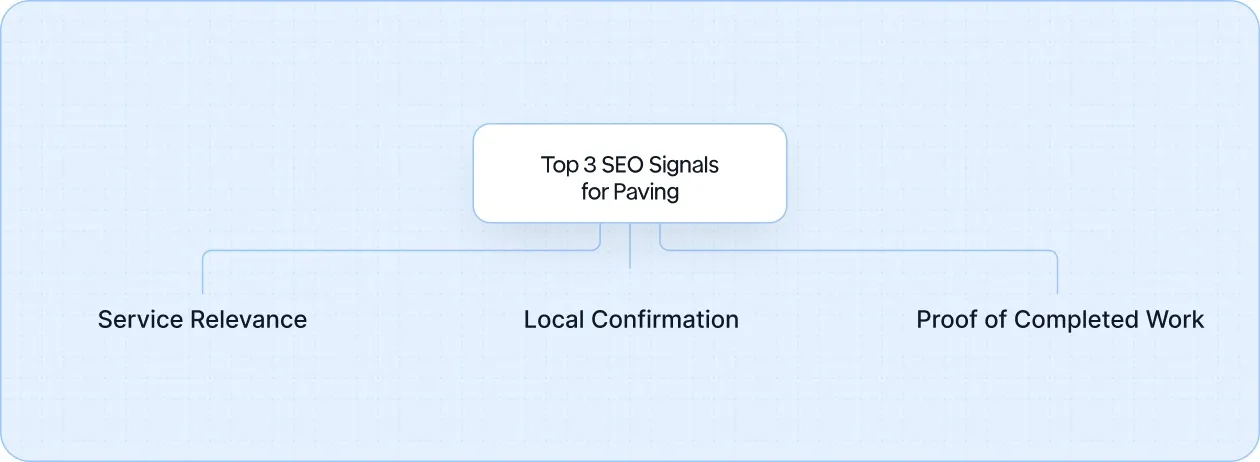
Once Google understands what kind of work your business does, it still needs a reason to show your pages consistently. For paving companies, that decision usually comes down to three signals. These signals work together, and none of them is strong enough on its own.
1. Service Relevance
Service relevance is about how clearly a page matches a specific type of paving work. When someone searches for a paving service, Google prefers pages that stay focused on one job rather than pages that speak broadly about many services at once.
A page that clearly explains one service helps Google feel confident about when to show it. A page that tries to represent everything at once makes that decision harder. This signal is less about volume and more about precision.
2. Local Confirmation
Local confirmation tells Google that your business is connected to a real place where the work happens. Paving is inherently local, and Google looks for consistency when deciding which businesses belong in local results.
This signal comes from how often your business is tied to the same locations across the web and how clearly those locations relate to your services. Even strong service-focused pages lose impact if Google cannot confidently place the business in a specific area.
3. Proof of Completed Work
Proof of completed work shows that a paving business has real experience, not just descriptions. Google pays attention to evidence that work has been done and documented.
This proof helps separate companies that explain paving from companies that actively perform it. It also reduces uncertainty when Google has to choose between similar businesses offering the same services.
How These Signals Work Together
These signals reinforce each other rather than competing. Service relevance tells Google what kind of work a page represents. Local confirmation anchors that work in a real area. Proof of completed work builds confidence that the service is genuine.
When all three are present, Google has fewer decisions to make. When one is missing, hesitation increases. A clear service without local context feels incomplete. A local business without service clarity feels vague. Proof without focus lacks direction.
Must Read: Why Construction Companies That Master SEO Get More Projects: 8 Key Strategies to Get Started
Structure a Paving Website So Search Engines Understand It
Once service relevance, local confirmation, and proof of work are in place, structure becomes the deciding factor. Structure is how those signals are organised so search engines can connect them without confusion.
A paving website is not judged as a single page. It is judged as a set of connected pages that either support each other or compete with each other.
Why Combining Services on One Page Limits Visibility?
When multiple services live on the same page, search engines are forced to choose what that page represents. A page that talks about driveways, parking lots, repairs, sealcoating, and pavers all at once does not clearly answer any single service search.
This does not mean the content is poor. It means the intent is mixed. Mixed intent creates hesitation, and hesitation leads to fewer appearances. Search engines prefer pages that have one clear job rather than pages that try to explain everything at once.
How Separating Services Improves Search Understanding
When each service has its own page, search engines can map intent more cleanly. One page answers one type of search. Another page answers a different one. Instead of guessing, search engines can match pages with confidence.
Separation also prevents pages from competing with each other. Each page supports the others by covering a distinct piece of work, which helps the entire site feel more organised and reliable.
Core Pages That Create Structural Clarity
A paving website does not need dozens of pages to be understood. It needs the right ones, each with a clear role.
- Homepage: Acts as an overview of the business and connects visitors and search engines to specific services and locations.
- Individual service pages: Each page represents one type of paving work and explains it clearly.
- Project gallery
Shows completed work and reinforces service credibility through real examples. - Location or coverage pages: Clarify where services are offered and connect work to real areas.
- Contact page: Confirms business details and provides a clear next step.
Together, these pages form a system rather than a collection of disconnected content.
Structure decides visibility. When service pages, project proof, and location context are planned as a connected system, search engines can understand what a business offers and where that work applies.
Make every page count for search clarity.
Teams that plan service pages and supporting content as a connected system make it easier for search engines to understand what they offer and where.


Design Service Pages That Match How Customers Search
When someone looks for paving services online, they are rarely searching out of curiosity. They are reacting to a problem that needs to be fixed, replaced, or planned. Service pages work best when they reflect that mindset instead of starting with company descriptions or generic explanations.
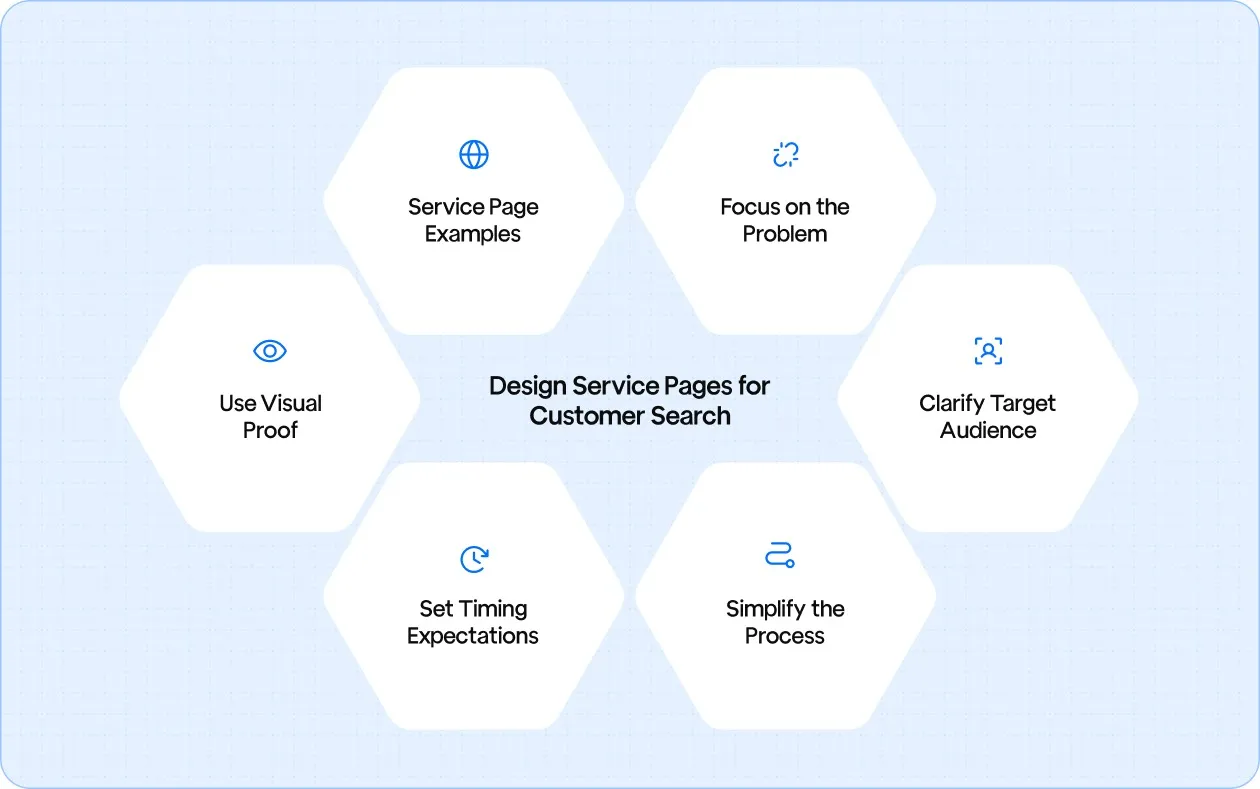
A strong service page feels like it was written for someone who already knows what they want done and is trying to decide who should do it.
1. Start With the Problem Being Solved
Every paving service exists because something is broken, worn out, unsafe, or overdue. Customers usually search with that situation in mind, not with industry terms.
A service page becomes easier to understand when it clearly answers:
- What situation leads someone to look for this service
- What changes after the work is done
This framing helps search engines and readers reach the same conclusion at the same time.
2. Clarify Residential or Commercial Relevance Early
Many paving services overlap, but the context does not. A homeowner and a property manager are looking for different outcomes, timelines, and levels of disruption.
Service pages should make it clear who the service is for. This clarity prevents confusion and helps the page align with the right type of search. It also avoids forcing one page to speak to two very different audiences.
3. Explain the Process Without Overloading Detail
People searching for paving services want reassurance that the work is organised and predictable. They do not need every technical step, but they do want a clear sense of how the job progresses.
A simple process overview helps answer unspoken questions about preparation, execution, and finish without turning the page into a manual.
4. Address Timing Expectations
Timeline concerns often drive searches, especially for repairs and resurfacing. Even a general sense of how long a job typically takes helps people decide if a service fits their situation.
Acknowledging timing shows awareness of real-world constraints and reduces uncertainty for the reader.
5. Reinforce the Page With Visual Proof
Visual proof gives weight to everything else on the page. Photos of completed work help confirm that the service described is work the business has actually done.
This proof supports confidence for readers and reinforces relevance for search engines.
6. Common Service Page Examples
Most paving businesses cover a familiar set of services. Each one deserves its own page because each one answers a different type of search.
- Asphalt driveway paving often relates to replacement, wear, or property improvement
- Parking lot paving is usually tied to safety, compliance, or appearance
- Asphalt repair is connected to urgency and damage
- Sealcoating relates to maintenance and protection
- Paver installation often involves design and long-term use
When each service page is shaped around how customers think about that specific work, the entire site becomes easier to understand.
Must Read: 15 Proven Construction Industry Marketing Strategies for Business Growth
Use Project Galleries as a Ranking Asset
Service pages explain the work you offer. Project galleries show how that work turns out. For paving companies, this distinction matters because search engines look for confirmation that services described on a site reflect real, completed jobs.
A well-built gallery acts as supporting evidence. It connects service descriptions to visible outcomes, helping search engines and readers understand that the work presented on your site is based on experience, not assumptions.
How Galleries Support Service Validation
When project galleries are aligned with specific services, they strengthen those services without repeating their content. A driveway paving service feels more grounded when nearby projects show finished driveways. Repair services feel more credible when projects illustrate visible fixes.
This alignment helps search engines confirm that service pages represent work the business actually performs.
What Makes a Project Gallery Effective?
A gallery works best when its elements are clear and intentional:
- Projects are grouped by service type, so each set of images supports a specific kind of work
- Each project includes a short description that explains the nature of the job and the setting
- Images are named and described clearly, reflecting the work shown rather than using generic labels
These elements help turn galleries into structured proof rather than loose collections of photos.
Project galleries serve one purpose: confirmation. They do not replace service pages or location pages. They support them by showing consistent, repeatable work across different jobs.
Location Pages That Reflect Real Service Coverage
When someone searches for paving services, location is often the deciding factor. They are not just looking for a service; they are looking for that service in a place they recognise. Location pages exist to bridge that gap between what you do and where you actually do it.
These pages work best when they reflect real service coverage instead of trying to stretch visibility across places the business does not meaningfully serve.
Coverage Areas vs City Pages
A coverage area describes where a business is willing to work. A city page explains how a business serves a specific place. Search engines treat these very differently.
Coverage areas are broad by nature and help set expectations. City pages are specific and work only when there is a clear connection between the business and that location. When a page is titled after a city, search engines expect local relevance, not just a name swap.
When a City Page Makes Sense?
A city page earns its place when there is substance behind it. That substance usually comes from repeated work in the area, familiarity with local conditions, or visible projects nearby.
If a business regularly completes jobs in a city, a dedicated page helps search engines associate those services with that location. If work in the area is rare or incidental, a city page adds little value and can weaken clarity across the site.
Why Generic Location Pages Fail?
Generic location pages often look complete but say very little. They repeat the same service descriptions, change the city name, and offer no local detail. Search engines recognise this pattern quickly.
When many pages say the same thing about different places, it becomes harder for any of them to stand out. Instead of improving visibility, they create internal competition and reduce confidence.
What Does a Strong Location Page Include?
Effective location pages focus on relevance rather than reach. They typically include:
- Local context, such as the type of properties or environments commonly served
- Services actually provided in that area, not a full list copied from elsewhere
- Nearby or representative projects, even if referenced briefly
- Area-specific questions, reflecting what customers in that location tend to ask
These elements help search engines and readers connect services to a real place instead of a generic map pin.
Location pages work best when they reflect reality. When they do, they strengthen local understanding without needing to overextend coverage or repeat content already explained elsewhere.
Find Search Terms That Indicate Service Intent
Before someone lands on a paving website, they usually start with a situation. A cracked driveway. A parking lot that needs work. A surface that no longer holds up. Search terms reflect those situations the most.
Finding the right terms starts with recognising the difference between curiosity and intent.
Research Searches vs Service Searches
Research searches are exploratory. They focus on learning, comparison, or general understanding. Service searches are practical. They signal that someone wants work done.
A search like “how long does asphalt last” reflects planning. A search like “asphalt driveway repair near me” reflects action. Pages built for service intent work best when they align with the second type, without ignoring the context set by the first.
Residential and Commercial Wording Patterns
Homeowners and property managers describe problems differently. Even when they want similar work, their language points to different priorities.
Residential searches often mention:
- Driveways
- Appearance
- Property value
- Longevity
Commercial searches tend to focus on:
- Parking lots
- Safety
- Scheduling
- Compliance
Recognising these patterns helps ensure that pages speak to the right audience instead of trying to address both at once.
Common Service-Intent Groups
Most paving searches fall into a few clear categories:
- Immediate service searches, where the work feels urgent
- Repair-related searches, tied to damage or failure
- Comparison searches, where options are being weighed
- Maintenance and lifespan searches, focused on upkeep and planning
Each group reflects a different stage of decision-making. Pages perform better when they are shaped around one group instead of trying to cover them all.
Search intent shapes every page. Teams that plan content around how people describe problems, decisions, and timing create pages that feel relevant without needing to overexplain.
Align content with how customers search online
Search-focused teams plan content around how customers describe services, decisions, and comparisons, then publish with that structure in mind.
Place Search Terms Without Disrupting Page Clarity
Once intent is clear, placement becomes a matter of balance. Search terms should support understanding, not interrupt it. The goal is to help search engines and readers arrive at the same conclusion without forcing language into places where it does not belong.
Search terms carry the most weight when they appear naturally in areas that define what a page is about. These areas quietly guide interpretation without drawing attention to themselves:
- Titles and headings, which set expectations for the page
- URLs, which signal focus before a page is even opened
- Image descriptions, which connect visual proof to services
- Internal links, which reinforce meaning through context
When placement feels forced, pages become harder to read. When placement feels natural, pages remain clear while still being interpreted correctly. Clarity always comes first; placement exists to support it, not compete with it.
Local Profiles and Search Result Appearance
Not every paving search leads directly to a website. Many decisions begin and end on a results page that shows businesses, photos, and basic details side by side.
Local profiles play a major role in these moments. Google Business Profile influences how a paving company appears in Maps and local results, while Apple Business Connect helps maintain consistency across Apple devices and search surfaces.
These profiles shape first impressions through a small but important set of signals:
- Listed services, which define relevance at a glance
- Photos, which suggest recent and real activity
- Reviews, which signal reliability and experience
Search results often mix website pages and local profiles. When both tell the same story about services and scope, the business feels easier to trust and easier to choose. When they feel disconnected, uncertainty increases before a click ever happens.
Off-Site Signals That Confirm Your Paving Business
Beyond your own website and profiles, search engines look for confirmation from the wider web. These signals answer a simple question: Does this business appear consistent and recognised outside its own pages?
Consistency matters most here. When business details align across directories and mentions, confidence increases. When details conflict, that confidence weakens.
Off-site confirmation usually comes from a small set of predictable places:
- Relevant directories, where paving businesses are expected to appear
- Consistent business details, such as name, address, and service areas
- External mentions, including local references or industry-related listings
These signals do not create visibility on their own. They quietly support everything else by reducing doubt and reinforcing legitimacy across the web.
Every online mention strengthens your business credibility
Many growing businesses rely on structured content programs to keep service pages, location pages, and decision-stage content aligned over time.
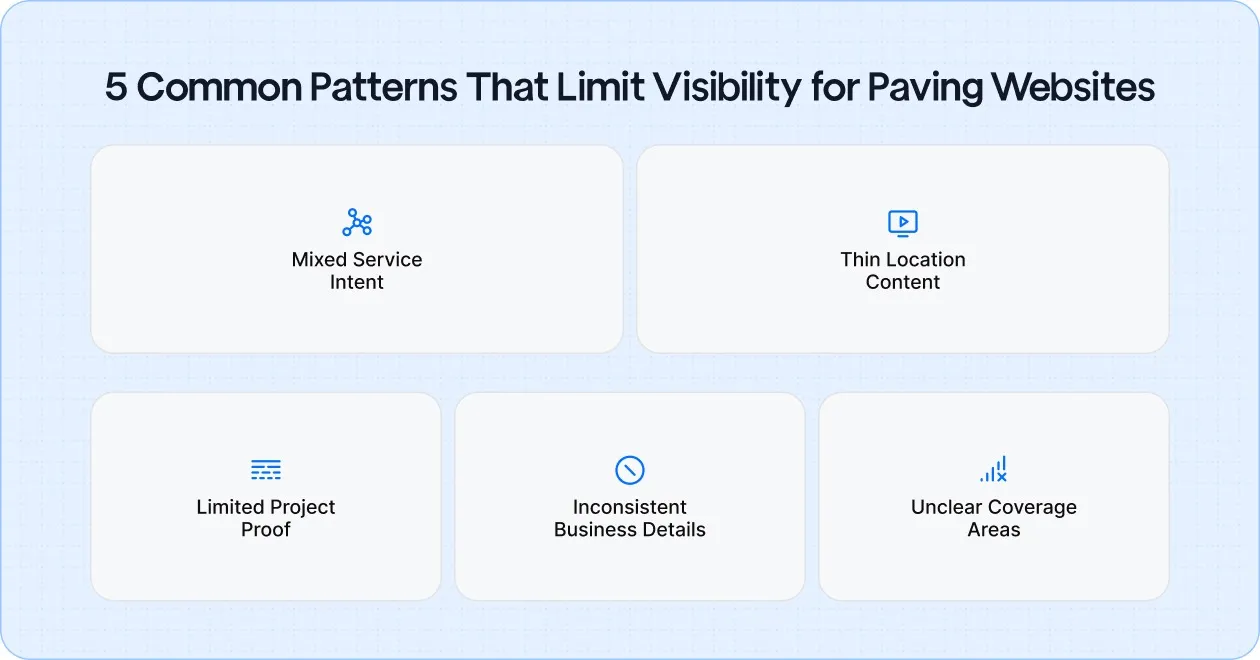
5 Common Patterns That Limit Visibility for Paving Websites
Most paving websites do not disappear from search results because something is broken. They fade because a few small patterns create uncertainty. Search engines tend to step back when signals feel mixed, incomplete, or inconsistent.
Do paving companies really need separate pages for each service?
These patterns are easy to miss because they often come from good intentions.
1. Mixed Service Intent Pages
Pages that try to represent too many services at once often feel thorough but end up unclear. When driveway paving, parking lots, repairs, and sealcoating are all explained together, search engines struggle to decide when that page should appear.
Instead of one strong match, the page becomes a weak match for many searches. Over time, visibility drops not because the content is poor, but because the intent is diluted.
2. Thin Location Content
Location pages fail when they exist in name only. Pages that repeat the same service text and swap out city names offer little local meaning.
Search engines look for signs that work actually happens in a place. Without local context, these pages feel disconnected and rarely earn consistent visibility.
3. Limited Project Proof
When a site describes services without showing completed work, uncertainty increases. Search engines prefer confirmation over explanation.
A lack of visible projects does not imply a lack of experience, but it does remove a key signal that helps search engines trust what the site claims.
4. Inconsistent Business Details
Small mismatches in business information create bigger problems than most people realise. Differences in addresses, service areas, or names across platforms make it harder for search engines to form a stable picture of a business.
When details conflict, confidence drops quietly, and visibility follows.
5. Unclear Coverage Areas
Some sites try to appear everywhere without clearly explaining where they actually work. Others list coverage areas without connecting them to real services or projects.
When coverage is vague, search engines hesitate. Clear boundaries are easier to trust than broad but unsupported claims.
When Visibility Problems Are Structural, Not Technical
Most paving websites don’t fall short because of effort. They fall short when small gaps add up and create uncertainty.
Throughout this guide, one idea shows up again and again: clarity. Clear services, clear locations, and clear proof of working together instead of competing. When those signals align, search engines don’t need to guess.
That alignment comes from treating content as a connected system, not a collection of isolated pages.
Keep your content system working for you
Structured service pages, project proof, and location clarity create lasting visibility. Gushwork helps teams implement this content-led SEO system effectively.


.webp)







.webp)


.svg)


