










Ask any architect where most of their time goes, and the answer rarely includes “marketing.” It goes into drawings, revisions, site visits, coordination, and problem-solving. The work is demanding, and rightly so.
The problem is that your future clients do not see any of that.
What they see is a website, a few pages in search results, and a handful of firms that appear to “fit” their project. That first impression decides who gets shortlisted and who never hears back.
Architect SEO exists in that narrow gap. The space between the quality of your work and how clearly it shows up online.
In this blog, we unpack how SEO works specifically for architects, what actually influences visibility in search, how to structure your website and content for long-term relevance, and what changes as AI reshapes how clients discover architecture firms.
Understanding SEO for Architects and Architecture Firms
SEO is the quiet word-of-mouth that actually shows up in online searches. It does the slow, patient work of making sure the right people find your studio while they are still trying to understand what they need.
Most people who hire an architect do not call the first firm they see. They compare portfolios, check locations, read about the process, and only then reach out. SEO helps your firm be part of that journey at every step.
When someone searches online, they are looking for answers.
- Who designs homes like this?
- Who has handled a similar project?
- Who works in this city and understands local constraints?
When that clarity exists, your website starts working like a filter that attracts the right enquiries and screens out the wrong ones.
Key Components of Architect SEO
A concise checklist of the SEO elements architects must get right to be found, understood, and shortlisted by clients.
- Technical foundation
- On-page SEO
- Local SEO & Google Business Profile
- Project and service pages
- Content that answers buyer intent
- Structured data
- Image and media optimization
- Internal linking and site architecture
- Authoritative backlinks
- Conversion paths and UX
- Measurement by business signals
Show Up During Shortlisting
Strengthen SEO so your firm appears when clients research, compare, and narrow down architects.


Core 11 SEO Strategies for Architecture Firms
Once you understand what SEO means for an architecture firm, the next step is execution.
The strategies below work best when they are treated as connected parts of the same framework. Each one supports the other, and together they build long-term visibility:
Strategy 1: Keyword Research for Architecture Firms
Keyword research shapes who discovers your firm and what they expect when they land on your site. For architects, the goal is not to attract large volumes of traffic, but to attract the right type of visitor.
- Service-based, location-based, and branded keywords: Service-based keywords capture intent tied to architectural offerings, while location-based keywords establish where your firm operates. Branded keywords become important later in the decision cycle, when clients begin verifying your firm after initial discovery.
- Long-tail keywords for architecture firms: Long-tail keywords reflect specific project requirements and usually indicate higher intent. Although search volume is lower, these keywords often align better with qualified inquiries and should be prioritized.
- Evaluating keyword intent instead of search volume: A keyword with high volume but unclear intent often brings unqualified traffic. Keywords should be assessed based on whether the searcher is researching a project, comparing firms, or simply gathering general information.
- Tools and methods to identify relevant keywords: Keyword tools can surface ideas, but manual filtering is essential. Reviewing search results, related queries, and competitor pages helps identify keywords that attract real clients rather than students or job seekers.
- Common keyword research mistakes to avoid: Targeting broad industry terms, ignoring geographic intent, or choosing keywords that do not reflect actual services often leads to low engagement and poor conversions.
Attract the Right Clients
Identify the project types, locations, and search terms that serious architecture clients actually use.
Strategy 2: On-Page SEO for Architecture Websites
On-page SEO ensures that each page communicates its purpose clearly while supporting strong visual design. For architecture firms, clarity and presentation must work together.
- Meta titles that clearly define page focus: Meta titles should state what the page offers and include relevant keywords naturally. Clear titles improve click-through rates and help search engines understand relevance.
- Meta descriptions that guide user expectations: Descriptions should explain what the visitor will find on the page and why it is useful, without sounding promotional or vague.
- Page heading structure across key pages: Headings should follow a consistent hierarchy that helps users scan content easily while signaling importance to search engines.
- Natural keyword placement within content: Keywords should support readability and context. Overuse or forced placement weakens trust and disrupts the user experience.
- Image alt text for architectural visuals: Alt text should describe images accurately, supporting accessibility and helping search engines interpret visual content without compromising aesthetics.
- Maintaining balance between design and SEO: On-page optimization should enhance clarity and performance without undermining the visual identity of the firm.
- Conversion-focused SEO elements that support enquiries: On-page SEO should also guide visitors toward the next step. Add clear CTAs on service and project pages, keep forms short, and place contact options where clients naturally look after reviewing work.
- Reducing friction for shortlisted visitors: Many visitors arrive already interested. Make it easy for them to confirm fit quickly with fast-loading pages, a clear “what we do” summary, and a simple path to request a consult or start a conversation.
Strategy 3: Content Strategy for Architectural SEO
Content allows architecture firms to demonstrate expertise and build trust before direct contact. A strong strategy ensures content supports visibility and credibility together.
- Service pages that establish clarity: Service pages should explain what the firm does, who the service is for, and how it fits into broader project needs. Clear language helps visitors quickly assess relevance.
- Portfolio pages that act as proof: Portfolios should combine visuals with context, explaining the project scope, challenges, and outcomes.
- Team and process content that reduces buyer uncertainty: A strong “team” and “process” layer helps clients understand how you work. Credentials, roles, and a clear project approach often influence shortlisting as much as visuals.
- Project descriptions that support authority: Descriptions should include location context, design intent, and constraints. This helps search engines understand relevance while reinforcing expertise.
- Project proof that shows scope and responsibility: Strengthen project pages with clear context like location, role, constraints, and outcomes. Buyers trust firms faster when they see how decisions were made.
- Blog content that reflects real-world experience: Blogs should focus on topics tied to process, regulations, planning considerations, and client questions rather than generic design commentary.
- Using content to support long-term keyword goals: Each piece of content should play a role in reinforcing service or location visibility over time.
- EEAT signals that shorten evaluation time: Architecture buyers look for credibility cues. Include awards, certifications, press mentions, and professional associations where they naturally support service and project pages.
Turn Projects Into Proof
Create service and project content that shows how your firm thinks, works, and delivers real outcomes.
Strategy 4: Conversion and Trust Signals for Architect SEO
SEO helps clients find your firm. Conversion happens when your website makes it easy to trust you and take the next step.
- Design your pages for scanning, not reading: Use short intros, clear subheads, and “at-a-glance” sections so buyers can confirm fit in under a minute.
- Turn every key page into a decision page: Add a “Best fit for” and “Not a fit for” line on service pages to qualify leads and build confidence through specificity.
- Move credibility to where decisions happen: Don’t hide proof on an Awards page. Pull it into service and contact moments through small callouts, logos, and short credibility lines.
- Make enquiry steps feel low-risk: Offer a softer first action like “Share your project basics” or “Request availability” before asking for long forms or commitments.
- Use project navigation that supports trust: Add filters by project type, location, and scope so visitors can quickly find work that matches what they need.
- Add expectation-setting micro-details: Mention what happens after they reach out, when they’ll hear back, and what you typically ask for first. These details quietly increase response rate.
- Reduce ‘dead-end’ pages: Ensure project pages and blogs always lead somewhere useful (relevant services, related projects, contact) so interest doesn’t drop off.
Strategy 5: Site Architecture and Content Organization
Site architecture is one of the most overlooked SEO levers for architecture firms, yet it quietly influences everything from rankings to user trust. A well-structured site helps search engines understand what your firm does and helps visitors find the information they need without friction.
- Designing a logical website hierarchy: Your site should reflect how a client thinks, not how your internal team is organized. Core services, portfolios, and insights should be clearly separated and easy to reach. Visitors should understand your focus areas within seconds of landing on the site.
- Ensuring crawlability and efficient indexing: Search engines rely on internal structure to discover and prioritize pages. Clean navigation, consistent internal links, and clear page relationships help ensure important service and portfolio pages are indexed correctly and revisited regularly.
- Managing content depth: Pages buried four or five clicks deep often lose visibility and engagement. High-value pages such as core services or flagship projects should remain close to the homepage so both users and search engines can access them easily.
- Using content silos to reinforce topical relevance: Content silos group related pages under a shared theme, such as residential services or commercial projects. This helps search engines understand your expertise in specific areas and prevents unrelated content from diluting focus.
- Building topic clusters around core services: Topic clusters allow supporting content, such as blogs or insights, to strengthen main service pages. When supporting pages link back contextually, authority compounds instead of spreading thinly across the site.
- Choosing categories over tags for clarity: Categories should define how content is grouped and discovered. Tags often create duplicate or low-value pages and should only be used when they serve a clear structural or ranking purpose.
Strategy 6: Technical SEO Essentials for Architects
Technical SEO creates the foundation that allows content, structure, and authority to perform consistently. For architecture firms, technical decisions often have an outsized impact due to image-heavy layouts and custom design elements.
- Optimizing page speed for visual-heavy pages: Architecture websites rely heavily on imagery, but unoptimized visuals slow load times. Compressing images, using modern formats, and managing scripts ensures pages load quickly without compromising presentation.
- Ensuring strong mobile performance across devices: Many clients research firms on phones and tablets. Responsive design, readable layouts, and touch-friendly navigation ensure the site functions properly regardless of screen size.
- Handling images without sacrificing quality: Image compression should reduce file size while preserving detail. Lazy loading and proper sizing prevent unnecessary performance issues on project and portfolio pages.
- Maintaining clean and consistent URLs: URLs should clearly reflect page purpose and structure. Avoid unnecessary parameters or inconsistent naming that can confuse search engines and users alike.
- Managing canonical signals and duplicate risks: Canonical tags help search engines understand which version of a page should be prioritized, especially when similar content exists across portfolios or service variations.
- Using structured data to improve understanding: Structured data helps search engines interpret services, projects, and business information more accurately, supporting richer visibility over time.
- Indexation control for portfolio-heavy sites: Architecture sites often generate duplicate or low-value pages through galleries, tags, or thin location pages. Use indexation rules intentionally so Google prioritizes your strongest service and project content.
- Redirect and site-change hygiene: Design refreshes and portfolio updates often break URLs. Maintain clean redirects, prevent 404 build-up, and protect high-performing pages during site updates to avoid sudden ranking drops.
Strategy 7: Internal Linking and Authority Flow
Internal linking determines how authority, relevance, and attention move across your website. It also shapes how visitors discover deeper content and understand your expertise.
- Passing authority from strong pages to key services: Pages that attract traffic or backlinks should be used strategically to support core service and portfolio pages, strengthening their ranking potential.
- Linking blogs, services, and portfolios: Links should reflect natural relationships, such as a blog discussing renovation challenges linking to a residential service page or relevant project.
- Avoiding excessive or random internal links: Over-linking reduces clarity and weakens topical focus. Each link should have a clear purpose for both users and search engines.
- Using internal links to reinforce topical depth: Thoughtful linking strengthens thematic connections, helping search engines recognize depth rather than scattered relevance.
Strategy 8: Local SEO for Architects
Local SEO for architects is less about walk-in traffic and more about credibility during research. Clients want to confirm where you operate, whether you understand local constraints, and whether you’ve delivered projects in similar contexts.
Optimizing Google Business Profile: Your profile should accurately reflect architectural services, not generic business categories. Service descriptions, project photos, and updates should reinforce your specialization and the type of work you actually do. This helps Google understand relevance and helps clients validate credibility.
Win Local Visibility
Optimize your Google Business Profile to support credibility, discovery, and local intent searches.
- Aligning services with geographic relevance: Local SEO works best when services and locations align clearly. If your firm works across multiple cities or regions, this should be reflected intentionally rather than vaguely. Avoid listing locations where you cannot realistically take on projects.
- Creating location-specific service pages: Location pages should explain how your firm serves that area, including project types, local constraints, or planning considerations. Thin pages that only swap city names weaken trust and rarely perform well.
- Building and managing local citations: Citations should come from reputable directories, industry platforms, and local publications. Consistency in name, address, and service descriptions reinforces reliability and avoids confusion.
- Using reviews as both trust and visibility signals: Reviews influence rankings, but more importantly, they influence decision-making. Encouraging honest feedback from real clients strengthens both local SEO and client confidence.
- Competing locally through relevance: Local SEO favors firms that demonstrate genuine connection to an area. Depth of presence consistently outperforms broad but shallow coverage.
Strategy 9: Backlinks and Off-Page Authority Building
For architecture firms, backlinks are less about aggressive outreach and more about professional recognition. The goal is to reflect real-world authority online.
- Identifying backlink sources: Design publications, architecture blogs, award features, and industry platforms provide relevance that generic SEO links cannot replicate.
- Using project visibility to earn links: Completed projects often attract attention from collaborators, developers, or media outlets. Making project information accessible increases opportunities for organic mentions.
- Leveraging partnerships for authoritative mentions: Builders, engineers, consultants, and developers you work with can provide context-rich backlinks that reflect real collaboration.
- Avoiding low-quality backlinks: Links from unrelated or spam-heavy sites weaken trust and can harm long-term performance. Authority building should be selective and aligned with brand positioning.
Strategy 10: Measuring and Improving SEO Performance
SEO performance for architects should be measured against clarity and intent, not just numbers. The goal is to understand whether the right people are finding the right pages.
- Tracking metrics that reflect real progress: Traffic volume alone is misleading. Metrics like qualified sessions, engagement on service pages, and return visits provide better insight into SEO effectiveness.
- Monitoring keyword visibility with intent context: Keywords should be tracked based on services and locations tied to business goals, not generic rankings that do not influence inquiries.
- Evaluating behavior on service and portfolio pages: Time spent, scroll behavior, and navigation paths reveal whether content answers client questions and supports decision-making.
- Using Search Console to identify gaps: Search data highlights which pages appear in results but fail to attract clicks, helping refine titles, descriptions, and content focus.
- Improving SEO through iteration: Performance improves when insights are applied steadily. Small refinements to structure, content, and linking compound over time.
- Aligning SEO performance with business outcomes: The most important signal of success is whether SEO contributes to better-fit inquiries and stronger client conversations.
Strategy 11: Make Your Firm AEO and GEO Ready for AI Search
AEO (Answer Engine Optimization) and GEO (Generative Engine Optimization) are about one thing: making it easy for search engines and AI tools to confidently reference your firm. Instead of ranking a page, these systems try to pull the “best answer” or recommend a short list of firms:
- Build an Answer Hub per service: A single landing page that lists the 8–10 real questions clients ask and gives a one-line answer plus a 1–2 sentence clarification for each. Keep answers factual and unambiguous so they’re easy to surface in snippets.
- Publish Project Data Cards: Add a small, consistent facts table on every project page (project type, location, your role, timeline, key constraint, outcome). Machines and humans both read tables fast. Keep the same fields across projects.
- Add structured data using standard schema types: Restructure key facts via JSON-LD using standard schema.org types, validate the markup, and avoid inventing unsupported “project” schema types unless you can map them cleanly to existing ones.
- Write short lead answers at the top of each page: One crisp sentence that answers the most likely question someone would ask about that page. Follow it with a 2–3 sentence expansion. These short leads are the text AI models prefer to quote.
- Cite sources: When you reference planning constraints, material specs, or standards, link to the original documents, reports, or local planning pages. Clear citations improve the trustworthiness of any AI summary that references you.
- Create a lightweight QA and update log: Treat answer hubs and project cards as living assets. Record what changed and when so you can prove freshness. Generative answers degrade quickly if sources are stale.
- Test with real queries: Once a month, prompt an LLM or use a search preview tool with a few client questions and your site URL. See what text the model pulls and tweak the source phrasing until answers are accurate and concise.
- Make retrieval simple for bots: Avoid burying key facts inside long image galleries or scripts. Keep machine-readable facts near the top or in plain HTML so they do not get lost behind interactive elements.
What to Expect from SEO as an Architecture Firm?
SEO for architects tends to feel slow at the start, then quietly becomes one of the most reliable sources of qualified enquiries.
Here’s what a realistic 12-month SEO outcome looks like for architecture firms, broken into quarters:
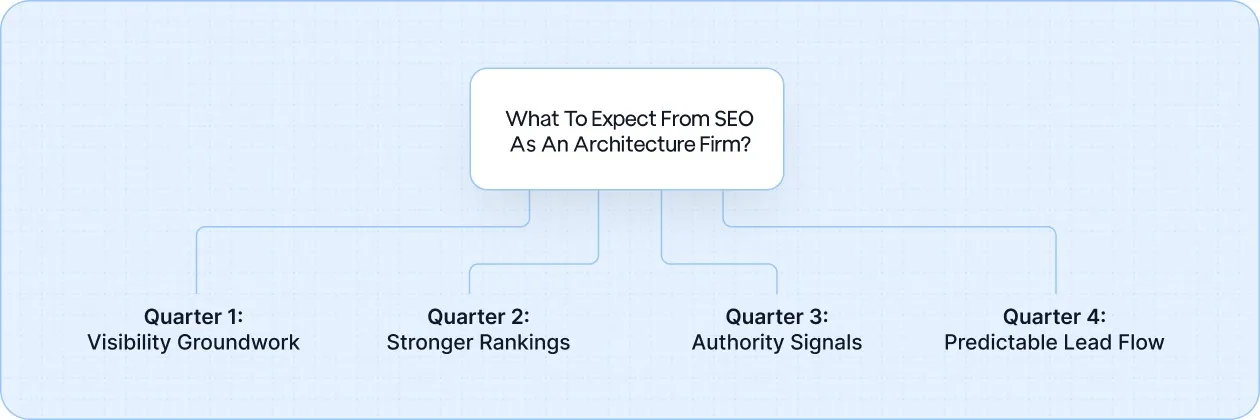
Quarter 1 (Months 1–3)
In the first few months, results are more “signal” than volume. You’ll start seeing signs that search engines are understanding your firm better, even if leads haven’t surged yet.
What you can expect:
- Your website pages begin appearing for more relevant search terms, especially branded searches and early service queries.
- Local visibility starts improving through your Google Business Profile, meaning you may show up more often for “architect near me” or “architect in [area]” searches.
- Traffic becomes slightly more targeted, with visitors spending longer on key service and portfolio pages.
- Enquiries may remain steady, but you’ll often notice better-fit prospects because the site is clearer about what you do.
Quarter 2 (Months 4–6)
This is where momentum starts becoming noticeable. Search engines have had time to crawl, index, and test your pages, and your firm begins appearing more often in meaningful searches.
What you can expect:
- Service pages start moving higher for priority terms like “residential architect in [city]” or “commercial architect for [project type].”
- Your portfolio and project pages begin driving discovery, especially for searches tied to style, location, and project type.
- You may start receiving more “informed” enquiries, where clients reference a specific project or service page they found.
- Website traffic becomes more stable rather than coming in small bursts.
Quarter 3 (Months 7–9)
By this stage, SEO starts working less like visibility and more like positioning. You’re not just being found, you’re being evaluated and shortlisted.
What you can expect:
- Your firm begins ranking for more competitive local searches, including project-specific and style-driven queries.
- You’ll see more mid-to-high intent searches bringing visitors in, such as “architect for home extension [area]” or “modern house architect [city].”
- Enquiries become more aligned with your ideal work, because your visibility is improving in the exact categories you want to be known for.
- Referral-style trust increases, where prospects already feel familiar with your work before the first call.
Quarter 4 (Months 10–12)
This is when SEO starts compounding. You are no longer dependent on constant posting or short-term boosts. Your website becomes a consistent entry point for new client conversations.
What you can expect:
- More consistent enquiries month to month, including clients who are ready to discuss timelines, budgets, and next steps.
- Better quality leads overall, with fewer “price shoppers” and more serious project enquiries.
- Increased branded search demand as more people look up your firm by name after discovering you through SEO.
- Your portfolio begins acting like an asset that keeps bringing in leads long after a project is complete.
Common SEO Mistakes to Avoid
Most SEO problems don’t come from doing nothing. They come from doing the wrong things consistently, usually because they look productive on the surface.
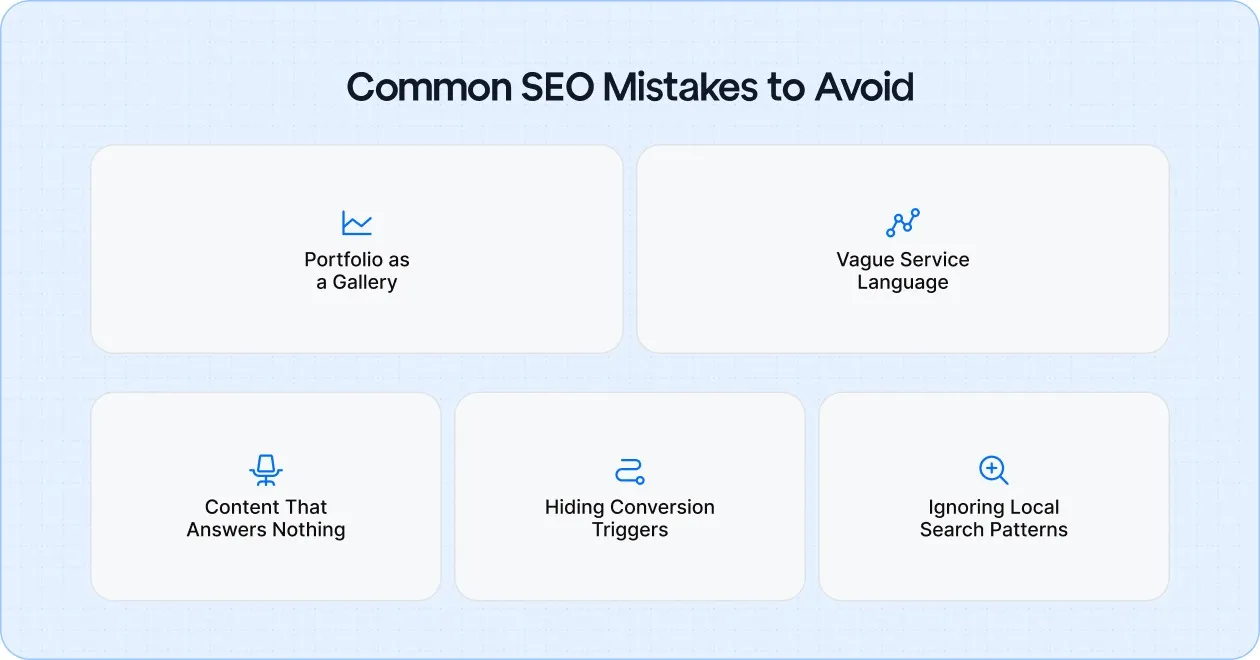
These mistakes are especially common in architecture websites:
Treating The Portfolio Like A Gallery
A beautiful grid of images may impress visitors, but search engines need context. If your projects have no written detail, Google has very little to rank.
What goes wrong:
- Project pages stay invisible because there’s no text to understand the work
- You miss out on searches tied to project type, style, and location
- Your best work never contributes to organic discovery
Using Vague Service Language
Many architecture sites rely on broad phrases like “design excellence” or “tailored solutions.” These don’t help SEO, and they don’t help clients choose you either.
What goes wrong:
- Visitors can’t quickly tell what you actually specialise in
- Your site fails to connect with high-intent searches
- Enquiries become random instead of aligned with your ideal work
Publishing Content That Sounds Smart But Answers Nothing
Thought leadership only works when it is useful. Blog posts that stay abstract or opinion-heavy rarely earn rankings, links, or enquiries.
What goes wrong:
- Pages get no traction because intent is unclear
- Readers leave without learning anything concrete
- Content becomes something you “have,” not something that performs
Hiding Conversion Triggers Behind Minimal Design
Many architecture sites prioritise minimal layouts so heavily that it becomes hard to take action. If someone is ready to reach out, they should not have to search for how.
What goes wrong:
- Strong-fit prospects drop off before enquiring
- You lose leads to firms with simpler contact paths
- Site traffic rises without improving business outcomes
Ignoring How People Actually Search For Architects Locally
Clients rarely search for “award-winning studio.” They search by location, project type, and urgency.
What goes wrong:
- Your site attracts visitors who are curious but not ready
- You miss local discovery opportunities
- Competitors with less impressive work but clearer location relevance win visibility
Conclusion
SEO, when done well, becomes part of how an architecture firm grows into its next phase.
It creates continuity. Past projects keep working for you. Service pages stay relevant as markets shift. New clients arrive already familiar with your approach, because they found clarity.
Over time, this changes the quality of conversations you have. Architect SEO is about building a presence that reflects the depth of your work and supports steady, sustainable growth, even as search behavior and technology continue to evolve.
Ready to Get Found With Clarity
Build an SEO system that reflects your work, supports referrals, and attracts better-fit projects.


.webp)








.webp)



.svg)


