If you’ve been thinking about starting a junk removal business, the first question that usually comes up is simple: “How much does it actually cost to get started?”
And it’s a fair question, because the numbers you see online can range from a few hundred dollars to tens of thousands, depending on who you ask.
The truth is, you don’t need a huge budget or a brand-new truck to enter this industry. What you do need is a clear understanding of the real costs, the optional costs and the hidden costs that most beginners only discover the hard way.
In this blog, you’ll learn the complete cost breakdown for starting a junk removal business, the price differences between lean and full-setup launches and the most efficient ways to spend and save your money in your first few months.
What Is a Junk Removal Business?
A junk removal business is a service that helps people clear out unwanted items quickly and responsibly. This includes old furniture, appliances, yard waste, renovation debris, garage clutter, estate cleanouts and anything else a homeowner or business can’t move or dispose of on their own.
These companies handle the heavy lifting, sorting, hauling and proper disposal or recycling. For customers, it’s a simple solution to reclaim space without dealing with the physical work, transport or local disposal rules.
A junk removal business sells convenience, speed and relief, and that’s why it continues to grow as more people look for fast, stress-free cleanouts.
Why Do You Need A Plan Before Starting A Junk Removal Business?
Starting a junk removal business might look simple, but without a plan, it quickly becomes chaotic and expensive.
Here’s why it matters:
- You understand your local demand. You’ll know who needs your service and how often.
- You avoid overspending on equipment. A plan stops you from buying tools or vehicles you don’t need yet.
- You set clear prices. Pricing becomes easier when you know your costs and competitors.
- You prepare for disposal rules. Every city has its own dump fees and recycling requirements.
- You stay profitable from day one. A plan helps you track expenses and protect your margins.
- You grow with purpose. You know what services to add, when to hire and how to scale properly.
Understanding 7 Essential Junk Removal Business Startup Costs
Launching a junk removal business requires understanding every cost you’ll face before your first job. These expenses don’t just determine your initial investment, but they shape your pricing, profitability, and how fast you can grow.
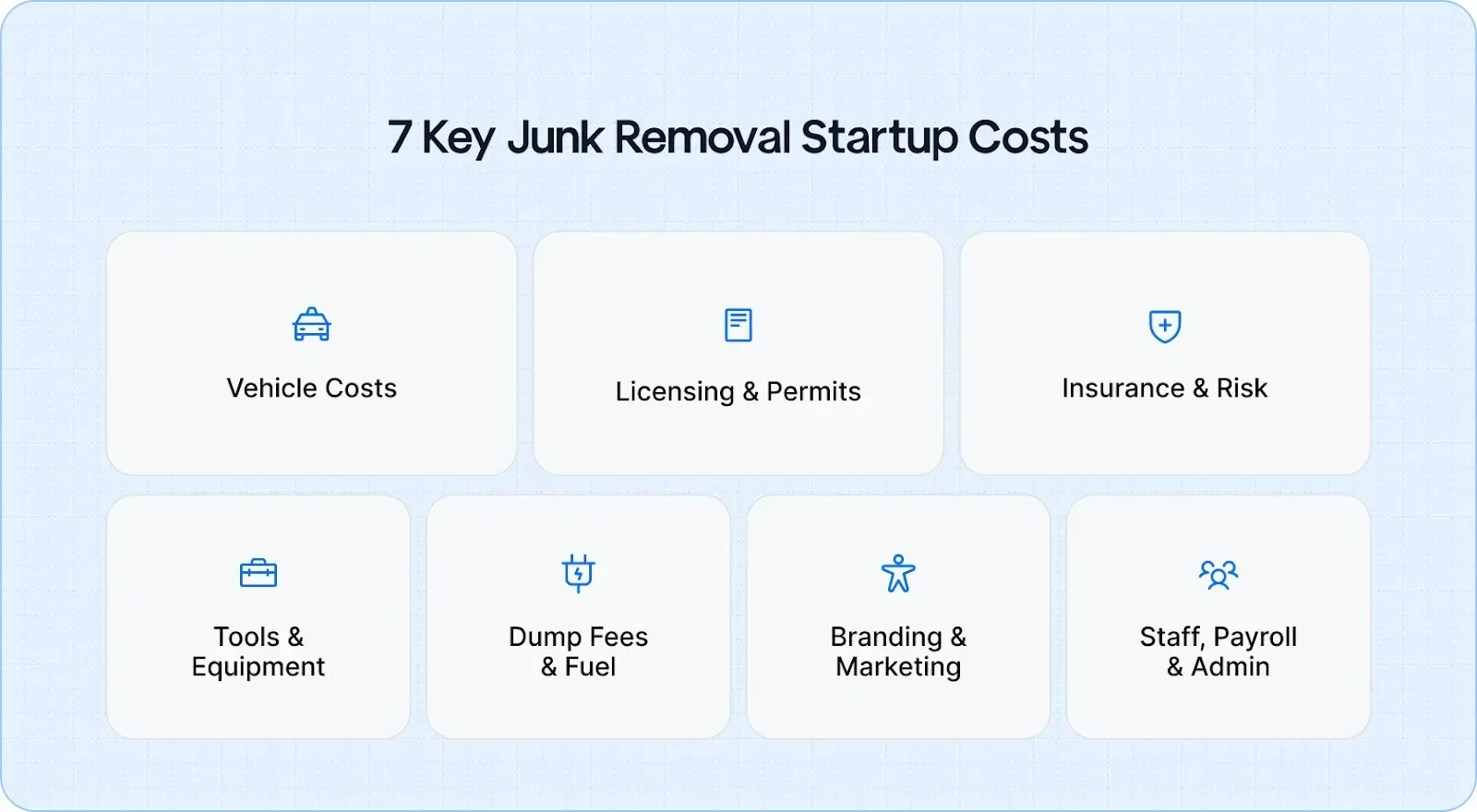
This section breaks down each core startup cost in simple, practical terms so you can budget confidently and avoid surprises:
1. Vehicle Costs
Your vehicle is your office, billboard, and revenue engine.
What you might spend
- Used pickup or cargo van: $5,000–$20,000 depending on age, mileage, and condition.
- New or nearly new truck: $30,000+ (commonly financed).
- Trailer (if you already have a tow vehicle): $1,500–$5,000 for a decent utility or dump trailer.
Sources aimed at junk hauling show the truck/vehicle alone often sits around $20,000–$30,000 in a “typical” startup budget, before tools or branding.
What You Can Do:
- Start with a reliable used truck and plan to upgrade; avoid anything that constantly needs repairs.
- Consider a trailer + existing truck combo if your current vehicle can safely tow.
- Wraps can wait. Begin with magnetic door signs and simple branding, then upgrade to a full wrap once cash flow is stable.
2. Licensing, Permits, And Legal Setup
You need to be legal and insurable from day one.
You Will Need:
- Business Registration (LLC, etc.): $100–$500 depending on your state and whether you use a filing service.
- Local Business License / Hauling Permit: $50–$500 (varies by city/county).
- Waste disposal permits or accounts with local transfer stations/landfills: sometimes free, sometimes a few hundred dollars a year.
One recent guide estimates permits and licences around $3,500 for a more formal setup, though many solo operators pay less if they keep it lean and local.
What You Can Do:
- Talk to your county/city solid waste department and landfill/transfer station about requirements before you spend.
- Choose a legal structure (often an LLC in the US) that protects personal assets once you start hauling heavy loads into people’s driveways.
3. Insurance And Risk Protection
Junk removal touches people’s homes, driveways, and sometimes hazardous materials. One bad incident can wipe out your savings if you’re uninsured.
Common policies
- General liability: Often $500–$2,000/year to start, depending on coverage and location.
- Commercial auto insurance: Typically, more than a personal policy, budget $1,500–$3,000/year per vehicle for planning.
- Workers’ comp: Required if you hire employees; costs vary by state and payroll size.
Put combined liability + auto insurance in the $300–$800/year “starter” range for very lean setups, but expect to pay more as revenue, staff, or risk grows.
Points to Remember:
- Get quotes from multiple brokers who understand contractor/home-service risks.
- Make sure your policy covers loading/unloading and customer premises, not just driving.
4. Tools, Safety Gear, And Basic Equipment
You don’t need a warehouse full of gear to start, but you do need enough to work safely and efficiently.
Core gear list:
- Dollies and hand trucks
- Furniture sliders and moving blankets
- Straps, tarps, and tie-downs
- Shovels, rakes, brooms
- Basic tool set (drills, wrenches, etc.)
- PPE: gloves, masks/respirators, eye protection, steel-toe boots, high-visibility vests
For basic tools, you will need $600–$1,000, but for heavier equipments, it can go $6,000 plus, if you’re setting up more industrial or multi-service operations.
Budget range to plan:
- Lean setup: $500–$1,500
- Pro one-truck setup with extra gear: $2,000–$5,000
5. Dump Fees, Fuel, And Early Operating Costs
Even in month one, you’ll pay to get rid of junk and keep your truck moving.
What To Expect:
- Dump/landfill fees: Often charged per ton or per load; plan $200–$600 for initial jobs.
- Fuel: Depends on your market, but budgeting $250–$500 for the first month is reasonable if you’re active.
- Basic maintenance: Oil changes, tire checks, minor fixes, set aside at least $100–$200/month.
Treat these as startup working capital, cash you keep in the bank so you can run jobs without stressing over every dump ticket.
6. Branding, Website, And Marketing
A small, focused marketing budget up front can be the difference between a truck that sits and a truck that stays booked.
Key Requirements:
- Logo and Basic Brand Kit: $150–$1,000 (agency help, or DIY + future upgrade).
- Simple Website: $0–$2,000+, depending on whether you build it yourself or hire someone.
- Google Business Profile: Free, but you’ll want good photos and a process to collect reviews.
- Initial Ads and Local Promotion: $300–$2,500+ depending on how aggressive you want to be.
One detailed junk removal cost breakdown suggests $2,500 for initial marketing in a more fully built launch, while ultra-lean setups sometimes start with $50–$200 on basic promotion and scale as revenue comes in.
7. Staff, Payroll, And Admin
If you’re starting solo, this section might be small at first, but don’t ignore it if you plan to grow.
Startup Considerations:
- Helpers/crew: You may pay per job or hourly; budgeting $12,000 or more per year for early staffing isn’t unusual for a more serious operation.
- Admin tools: Phone line, accounting software, invoicing, booking tools, often $50–$200/month combined.
- Office or yard space: Many new operators work from home and rent storage later; more established operations spend $700–$2,000/month on office/yard space.
Start lean, then build systems and people into your cost structure once revenue is predictable.
Three Example Junk Removal Startup Budgets
To make all of this less abstract, here are three simplified example scenarios. These aren’t quotes, just planning lenses to help you decide where you fit.
Scenario A: Ultra-Lean Solo Operator
You already own a truck, work from home, and do most jobs yourself.
- Legal and licences: $3500
- Insurance (basic liability + upgraded auto): $500 to $5,000
- Tools & PPE: $500–$1,000
- Dump/fuel starter fund: $400–$800
- Basic branding + DIY website + low-budget ads: $500–$1,500
Estimated startup range: roughly $2,500–$6,000 cash needed to get moving.
Good fit if you want to test the market, keep your day job initially, or stay very local.
Scenario B: Professional One-Truck Brand
You’re committed to full-time, buying a decent used truck, and want to look established from day one.
- Used truck: $15,000–$25,000
- Legal, licences, permits: $3,500
- Insurance (liability + commercial auto): $500 to $5,000
- Tools & equipment: $500–$2,000
- Initial marketing (website, logo, photos, ads, signage): $2,500
- Working capital for dump fees, fuel, small repairs: $1,500–$3,000
Estimated startup range: Often $22,000–$40,000, depending on vehicle cost and how polished you go on branding.
Good fit if you want to compete seriously with the established players in your city.
Scenario C: Growth-Oriented Multi-Truck Launch
You’re launching with staff, more than one vehicle, and dedicated yard/office space.
- Two vehicles (used or new mix): $40,000–$80,000+
- Legal, licences, expanded permits: $3,500
- Insurance for multiple trucks and crew: $3,000–$8,000
- Tools & equipment for multiple crews: $4,000–$10,000
- Office/yard setup (first few months of rent, utilities): $3,000–$10,000
- Strong marketing push (brand, site, SEO, PPC, offline ads): $5,000–$20,000+
- Payroll buffer and working capital: $10,000–$30,000
Estimated startup range: Easily $60,000–$150,000+, similar to some of the higher-end estimates you’ll see in industry guides that quote up to $300,000 for fully built-out multi-location operations.
This path is for operators with capital, experience, or backing, often aiming to own a whole region, not just a neighborhood.
Recurring Costs You Should Plan For
When you think “startup cost,” it’s easy to only count what you spend before your first job. But some costs kick in fast and need to be baked into your planning:
- Card processing and software fees (5–10+ tools over time)
- Website hosting and domain renewals
- Recurring ads (Google, Facebook, local directories)
- Increased insurance premiums as revenue and vehicles grow
- Vehicle wear and tear (tires, brakes, suspension get abused in junk work)
- Disposal fees that spike when you land larger cleanouts or construction debris jobs
The simplest safeguard: keep 1–3 months of operating expenses in reserve if you can. That cushion turns a broken alternator or slow month into an inconvenience, not a crisis.
5 Tips on How To Keep Junk Removal Startup Costs Under Control
You want to look professional without overspending. A few practical rules:
- Go used and reliable on the truck. Avoid both extremes: don’t buy a clunker that lives at the mechanic, and don’t over-stretch on a brand-new truck if revenue is unproven.
- Phase your marketing. Start with: Google Business Profile, simple website, reviews, and a small PPC budget. Add more channels (SEO, mailers, local sponsorships) once your core offer and pricing are dialed in.
- Rent or borrow rarely used tools. For specialized jobs (heavy equipment, certain demolition tools), rent until you know you’ll use them often.
- Build repeat and referral systems early. A simple follow-up text/email after each job, plus a review request, can generate a pipeline of low-cost repeat work, which keeps your cost per lead down.
- Track everything. Even in a simple spreadsheet, record: jobs, revenue, dump fees, fuel, ads, and profit. Within a few months, you’ll see what you can increase, cut, or renegotiate.
Conclusion
Starting a junk removal business doesn’t require franchise-level capital, but it does require clear eyes about the real costs. For your junk removal business startup cost will be shaped by the truck you choose, how polished you want to look on day one, and how fast you plan to grow.
Start with the numbers. Decide which launch level fits you. Then build a business that’s as solid and dependable as the service you plan to offer.