









Trailer manufacturers don’t struggle because demand is missing. They battle because growth is uneven. One quarter is strong, the next slows down. One dealer performs, another goes quiet. One product line moves fast, while others sit longer than expected. Over time, this unpredictability limits scale, planning, and investment.
Marketing is what brings structure to that chaos. Not by pushing promotions, but by creating consistent visibility, predictable demand signals, and clearer feedback from the market.
In this blog, we’ll break down how marketing for trailer manufacturers actually works today, which channels influence demand and sales, and what a modern marketing system looks like when growth is the goal.
Understanding the Trailer Manufacturing Market Before You Market It
Marketing works best when it reflects how the market actually functions. Trailer manufacturing is not a fast-turn, impulse-driven industry. In reality, the trailer industry is fragmented, relationship-driven, and shaped by purchasing behavior that doesn’t follow standard B2C or even typical B2B patterns.
Understanding these dynamics is critical before deciding how, where, or why to market:
Trailer Buyers Are Not a Single Audience
The trailer market includes multiple buyer types who evaluate products very differently. A landscaping contractor, a fleet operator, a dealer, and a municipal buyer may all purchase trailers, but they do not respond to the same messaging or marketing signals.
Key distinctions that affect marketing:
- Owner-operators often prioritize durability, financing, and immediate availability
- Fleet buyers focus on consistency, serviceability, and long-term cost
- Dealers care about margin, sell-through speed, and brand reliability
- Institutional buyers look for compliance, documentation, and vendor stability
Long Buying Cycles Shape How Demand Is Captured
Trailer purchases are rarely impulsive. Even when urgency exists, buyers often research weeks or months in advance, compare options repeatedly, and return to the same brands multiple times before making contact.
What this means for marketing:
- Visibility matters long before the buyer is ready to convert
- Repetition builds familiarity, which reduces perceived risk
- Education and clarity often matter more than persuasion
Dealers Influence Demand More Than Many Manufacturers Realize
For manufacturers with dealer networks, marketing doesn’t stop at lead generation. Dealers often become the face of the brand, influencing how products are presented, explained, and compared.
Market realities to account for:
- Inconsistent dealer messaging can weaken brand perception
- Manufacturers often compete indirectly with their own dealer listings
- Dealer success depends on how well marketing supports sell-through
Pricing Sensitivity Is Contextual
Trailer buyers are price-aware, but price is rarely the only factor. Perceived value is shaped by use case, risk tolerance, and downtime costs.
This affects marketing by:
- Shifting emphasis toward reliability, build quality, and application fit
- Reducing over-reliance on discounts as a primary hook
- Highlighting cost-of-ownership rather than upfront price
Geography and Regulation Quietly Shape Demand
Regional conditions play a larger role in trailer purchasing than many manufacturers account for. Climate, terrain, regulations, and local industry mix all influence what sells and how it’s evaluated.
Examples include:
- Different specs required across states or regions
- Regulatory compliance affecting purchasing timelines
- Regional industries driving demand for specific trailer types
Marketing that reflects these realities feels more relevant and credible to buyers.
13 Marketing Channels That Drive Growth for Trailer Manufacturers
Growth comes from combining multiple digital marketing channels that support long buying cycles, dealer networks, and product-specific decision-making.
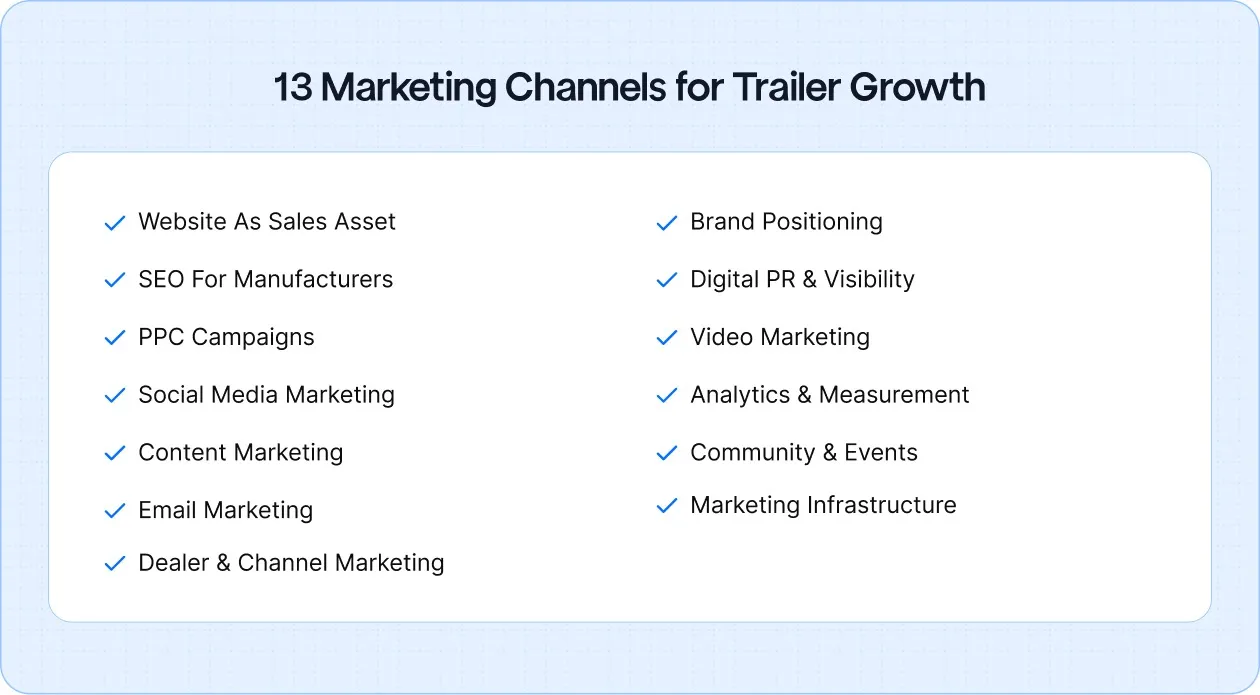
Each channel below plays a distinct role in how demand is generated, evaluated, and converted:
Website as a Sales and Positioning Asset
For trailer manufacturers, the website plays a far more active role than a catalog. It is often the first place buyers, dealers, and partners go to validate fit, understand use cases, and assess whether a manufacturer is credible enough to shortlist.
- Structure the site around how buyers evaluate trailers: Organize products by trailer type, industry application, and real-world use cases rather than internal product codes or model names.
- Translate technical specifications into practical outcomes: Specs matter, but only when buyers understand what they mean for durability, payload, compliance, or maintenance. Use plain explanations alongside technical details to avoid overwhelming non-technical decision-makers.
- Define the primary conversion path clearly: Decide whether the website’s main goal is dealer referral, direct inquiries, or a hybrid approach.
- Dealer locator flows for distributed sales networks
- Direct inquiry or quote requests for manufacturer-led sales
- Clear guidance so buyers know what happens after they submit a form
- Use the website to reinforce positioning: Messaging should make it clear who the trailers are built for, what problems they solve best, and where the brand sits in the market.
Make Your Website Work Harder
Turn your site into a clear sales and dealer-support asset instead of a static product catalog.


SEO for Trailer Manufacturers
SEO supports trailer manufacturers throughout long research and comparison cycles. Buyers rarely search once and convert.
- Build visibility for all searches: Buyers may search for your brand name, but many start with generic terms tied to trailer type, load capacity, or industry use.
- Create product and category pages: Pages should reflect how buyers search, not how products are named internally. Clear category structures help search engines and buyers understand your offering.
- Support dealer discovery through SEO architecture: Location-aware pages, internal links, and structured navigation help buyers find the right dealer without friction.
- Invest in technical SEO to support scale and complexity
- Crawlable product and category pages
- Clean, consistent URLs across models and variations
- Structured data for products, manufacturers, and locations to improve search clarity
- Use Google Business Profile: Maintain accurate profiles for headquarters, plants, and dealer locations to capture local intent searches. Align GBP categories, services, and descriptions with how buyers search for trailer types and use cases.
Show Up Earlier in the Buying Cycle
Capture research-stage demand from buyers comparing trailer types and manufacturers.
Paid Advertising and PPC Campaigns
Paid advertising allows trailer manufacturers to capture demand when buyers are actively comparing options. It works best when used selectively and strategically.
- Use search ads for high-intent queries: Focus on terms tied to specific trailer types, applications, or buying scenarios where intent is clear.
- Segment campaigns to maintain relevance: Separate campaigns by trailer category, buyer type, or industry use case to avoid generic messaging and wasted spend.
- Apply geo-targeting where dealer networks exist: Ads should support the dealer ecosystem by directing buyers to relevant regions or partners.
- Support long buying cycles with retargeting
- Re-engage visitors who viewed products but didn’t inquire
- Reinforce brand presence across search, display, and video during evaluation phases
Social Media Marketing for Trailer Brands
Social media supports trailer marketing by building familiarity and reinforcing credibility over time. It is not a direct sales engine, but it influences perception, recall, and trust in a visually driven industry.
- Share real builds and real-world applications: Content performs best when it shows finished units, in-use trailers, and practical scenarios. Application-focused content helps buyers visualize how it fits within their own operations.
- Maintain presence between buying cycles: Regular, grounded content keeps the brand recognizable when demand eventually arises.
- Choose platforms based on buyer behavior
- Visual platforms for showcasing products and builds
- Professional platforms for dealer relationships, partnerships, and B2B visibility
Content Marketing and Trailer Sales Content
Content marketing helps trailer manufacturers explain complexity before a sales conversation ever happens. It shortens evaluation timelines and improves the quality of inbound inquiries.
- Publish content that answers buyer questions early: Address common concerns around specifications, compliance, use cases, and comparisons.
- Use content to support both SEO and sales conversations: Sales teams and dealers should be able to reference content during follow-ups.
- Break down complexity without dumbing it down: Explain differences, trade-offs, and applications clearly so buyers feel informed, not sold to.
- Match content formats to buyer intent
- Blogs and guides for early research
- Comparison pages for mid-funnel evaluation
- Walkthroughs and demos for decision confidence
Educate Before You Sell
Create content that explains use cases, specs, and trade-offs before sales conversations begin.
Email Marketing and Lead Nurturing
Email marketing supports decision-making by staying relevant during long, multi-stakeholder buying cycles.
- Support dealer and distributor follow-ups: Consistent, branded communication improves continuity across touchpoints.
- Reduce drop-off by delivering useful information: Emails should provide clarity and updates.
- Use email for practical, timely communication
- Product availability or lead times
- Financing or pricing updates
- New configurations, upgrades, or compliance changes
Dealer, Partner, and Channel Marketing
Trailer manufacturers grow faster when dealer and partner marketing is aligned, consistent, and easy to execute.
- Maintain brand consistency across third-party channels: Listings, descriptions, and visuals should reinforce the same everywhere.
- Support sell-through without undercutting partners: Marketing should strengthen dealer confidence, not compete with them.
- Enable partners through structured support
- Co-branded assets
- Centralized portals or asset libraries
- Clear guidelines on messaging and positioning
Brand Positioning and Market Differentiation
In trailer manufacturing, many products compete in crowded categories where buyers struggle to tell meaningful differences at a glance. Effective positioning helps buyers quickly understand what your trailers are designed for, why they exist, and whether they are the right fit for their application.
- Define the exact buyer and use case your trailers serve: Be explicit about industries, workloads, terrain, or usage patterns. Just as important, clarify scenarios where your trailers are not the right choice.
- Translate features into real-world advantages: Explain how design choices impact durability, safety, maintenance, or total cost of ownership. Focus on the differences buyers actually care about after purchase.
- Maintain consistent positioning across all channels: Website messaging, dealer materials, ads, and sales conversations should reinforce the same value narrative.
- Use positioning to simplify decisions: Strong positioning narrows choices for buyers instead of overwhelming them. Clear positioning helps prospects self-select faster and move confidently toward purchase.
Define What You’re Known For
Define exactly who your trailers are built for and why they win in real-world use.
Digital PR and Industry Visibility
Digital PR extends credibility beyond your own marketing channels by placing your brand within trusted industry conversations. For trailer manufacturers, this matters because buyers often rely on third-party validation when evaluating long-term equipment investments.
- Earn visibility in industry-specific publications: Focus on trade media, transport publications, manufacturing outlets, and niche vertical platforms. Coverage should highlight expertise, innovation, or operational insight.
- Support SEO through earned authority: High-quality mentions and backlinks reinforce topical authority for competitive keywords. Industry relevance carries more weight than general media exposure.
- Use third-party validation to strengthen trust: Buyers place more confidence in brands referenced by respected external sources. This validation often influences dealer confidence as much as end buyers.
- Prioritize relevance over reach: A mention in a niche trade outlet often outperforms broad but generic exposure. Focus on where your actual buyers and partners pay attention.
Video Marketing and Product Visualization
Video helps reduce uncertainty by showing how products are built, how they perform, and how they are used in real conditions.
For manufacturers, video is as much a sales enablement tool as a marketing one.
- Use walkaround videos to explain configurations: Show options, variations, and use cases clearly. Address common buyer questions.
- Share factory and production footage: Highlight build quality, materials, welding, and quality checks. This reinforces manufacturing credibility and process control.
- Create reusable assets for dealers and sales teams: Videos should support dealer listings, sales calls, and follow-ups. Consistent visual assets improve message accuracy across channels.
Analytics, Tracking, and Performance Measurement
Marketing decisions in trailer manufacturing should be driven by evidence. Because sales cycles are long and involve multiple touchpoints, tracking must extend beyond surface-level metrics.
The goal is to understand which efforts contribute to real demand and revenue.
- Track performance across the full buyer journey: Measure how prospects move from awareness to inquiry to sale. Identify which channels influence early research versus final decisions.
- Connect marketing data with sales outcomes: Integrate CRM data to understand lead quality and conversion. This prevents over-investing in channels that generate volume but not revenue.
- Identify drop-off points in long sales cycles: Understand where prospects disengage and why. Use this insight to refine messaging, follow-up, or channel mix.
- Use insights to guide budget allocation: Shift spend toward channels that consistently support qualified demand. Reduce or refine efforts that do not influence actual sales.
Community, Events, and Offline-to-Online Marketing
Despite digital growth, trailer manufacturing remains relationship-driven. Trade shows, expos, and regional events still play a major role in visibility, trust, and partnership building.
The key is connecting offline exposure to ongoing digital engagement.
- Use events as brand visibility accelerators: Trade shows and dealer events introduce your brand to high-intent audiences. They support credibility in ways digital-only channels often cannot.
- Repurpose offline activity into digital content: Capture photos, videos, and conversations during events. Extend the impact through social media, email, and website content.
- Bridge offline interactions with digital follow-up: Ensure leads collected offline enter your digital funnel. Consistent follow-up reinforces professionalism and recall.
- Leverage local sponsorships strategically: Regional involvement strengthens presence in niche markets. These efforts support both brand recognition and dealer relationships.
Marketing Infrastructure and Technology
As trailer manufacturers grow, marketing complexity increases. Without proper systems, lead handling, dealer coordination, and reporting quickly become fragmented.
Infrastructure determines whether growth remains manageable.
- Use CRMs to centralize lead management
- Track inquiries across direct sales and dealer networks
- Maintain visibility into lead ownership and follow-up status
- Integrate inventory and marketing platforms
- Align available products with active marketing efforts
- Reduce friction between promotion and fulfillment
- Apply automation where it improves consistency
- Automate follow-ups, routing, and reporting where possible
- Avoid over-automation that removes human judgment from high-value interactions
- Maintain clear reporting and visibility
- Centralized dashboards help leadership evaluate performance
- Transparency prevents blind spots as volume scales
Common Challenges Trailer Manufacturers Face Without a Marketing System
When marketing is treated as optional or reactive, trailer manufacturers don’t usually notice the impact right away. The issues show up slowly, in missed opportunities, stalled growth, and increasing dependence on price to compete.
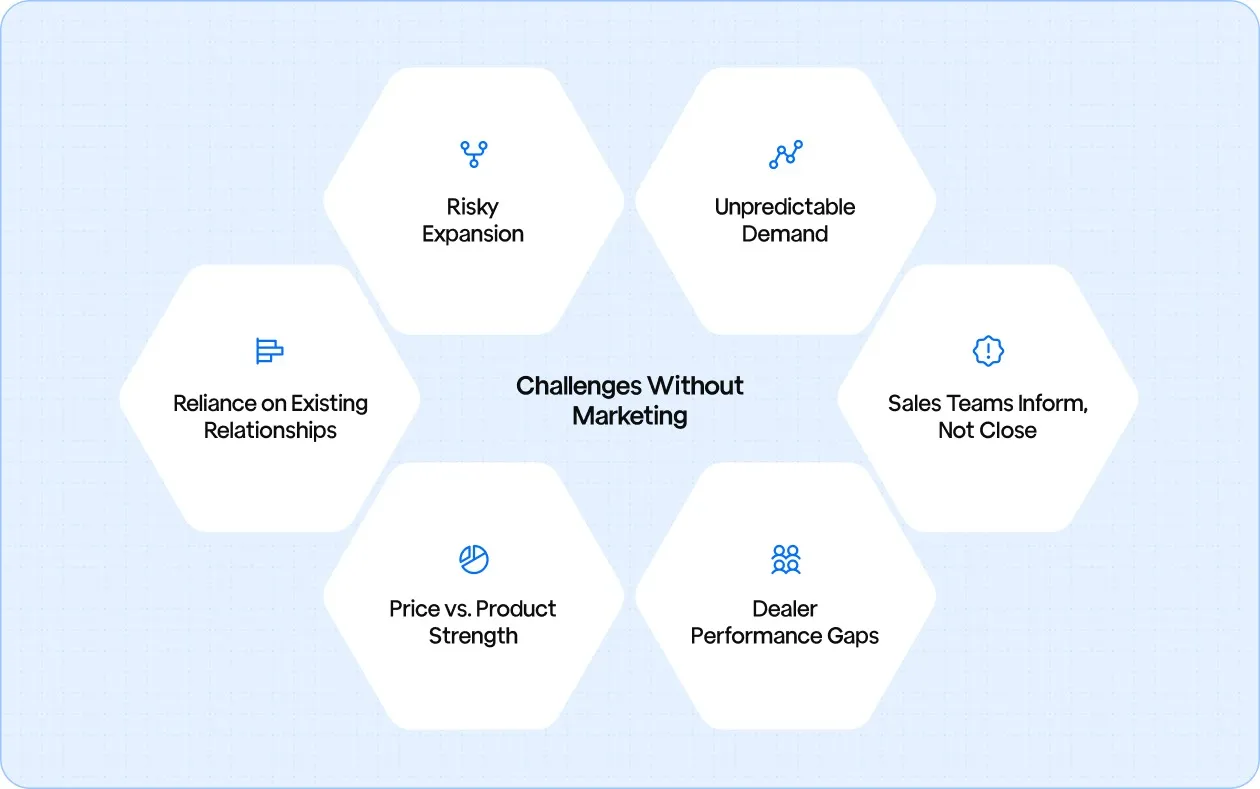
These marketing challenges stem from how the business is seen, understood, and remembered in the market:
Demand Becomes Unpredictable and Hard to Plan Around
Without marketing, demand tends to spike and stall without warning. This makes it difficult to:
- Plan production schedules confidently
- Forecast revenue beyond the short term
- Decide when to hire, expand, or invest
Marketing creates steadier demand signals. Without it, growth becomes reactive instead of intentional.
Sales Teams Spend Time Informing Instead of Closing
When marketing isn’t doing its job upfront, sales conversations start too early in the buyer’s understanding.
That usually means:
- Long calls explaining basic differences between trailer types
- Repeating the same explanations to every prospect
- Fewer conversations reaching serious buying intent
Marketing should handle early education so sales can focus on fit, pricing, and next steps.
Dealer and Partner Performance Varies Widely
In the absence of structured marketing, dealer success often depends on individual effort rather than system support.
This leads to:
- Inconsistent brand presentation across regions
- Some dealers outperforming while others stagnate
- Friction when manufacturers try to enforce standards later
Strong marketing creates alignment. Without it, performance gaps widen over time.
Product Strengths Get Lost in Price Comparisons
When buyers don’t clearly understand what makes one trailer different from another, price becomes the easiest comparison point.
This results in:
- Margin pressure during negotiations
- Difficulty justifying premium builds or options
- Customers choosing “good enough” alternatives
Marketing exists to frame value. Without it, differentiation collapses.
Growth Depends Too Heavily on Existing Relationships
Many trailer manufacturers rely on referrals, repeat buyers, or long-standing dealer ties. While valuable, this can quietly limit growth.
Over time, this creates:
- Exposure gets lost if a few large relationships slow down
- Difficulty entering new markets or regions
- Growth ceilings that aren’t obvious until they’re hit
Marketing reduces dependence on a small circle and opens new demand channels.
Expansion Feels Riskier Than It Should
Without clear market feedback from marketing channels, expansion decisions rely on instinct.
This makes it harder to:
- Validate new trailer types or configurations
- Enter new geographic markets confidently
- Test pricing or positioning changes safely
Marketing provides signals. Without those signals, expansion feels like guesswork.
Conclusion
The manufacturers that grow are not necessarily the ones with the biggest budgets. They are the ones that invest in clarity, consistency, and systems that support demand over time. Strong positioning, well-chosen channels, and aligned dealer marketing create momentum that compounds instead of resetting every quarter.
When marketing is treated as a business function, it stops being a cost center and starts becoming a growth lever. One that helps trailer manufacturers stand out, scale responsibly, and compete on more than just price.
Ready to Build Predictable Growth
Get a clear marketing system that supports dealers, sales teams, and long-term demand.


.webp)







.webp)


.svg)


