









Most heavy equipment companies already use email. Very few use it well.
Inbox messages are sent regularly, but they often feel disconnected from how equipment is actually purchased, serviced, and replaced.
When email marketing works for heavy equipment, it doesn't feel like marketing at all. It feels like continuity.
In this blog, we break down how email marketing should function in the heavy equipment industry, which strategies support sales, service, and lifecycle growth, and how email integrates with the rest of your marketing stack.
Understanding Email Marketing in the Heavy Equipment Industry
Email plays a very specific role in heavy equipment marketing. Its value lies in maintaining continuity across long gaps between awareness, evaluation, budgeting, and action.
Purchase cycles are long, decisions involve multiple stakeholders, and most recipients are not looking to buy immediately. Email here is not a closing channel. It is a timing, relevance, and relationship channel.
Understanding this role is essential before choosing tools, formats, or campaigns. Without that clarity, email efforts often feel busy but disconnected from real outcomes.
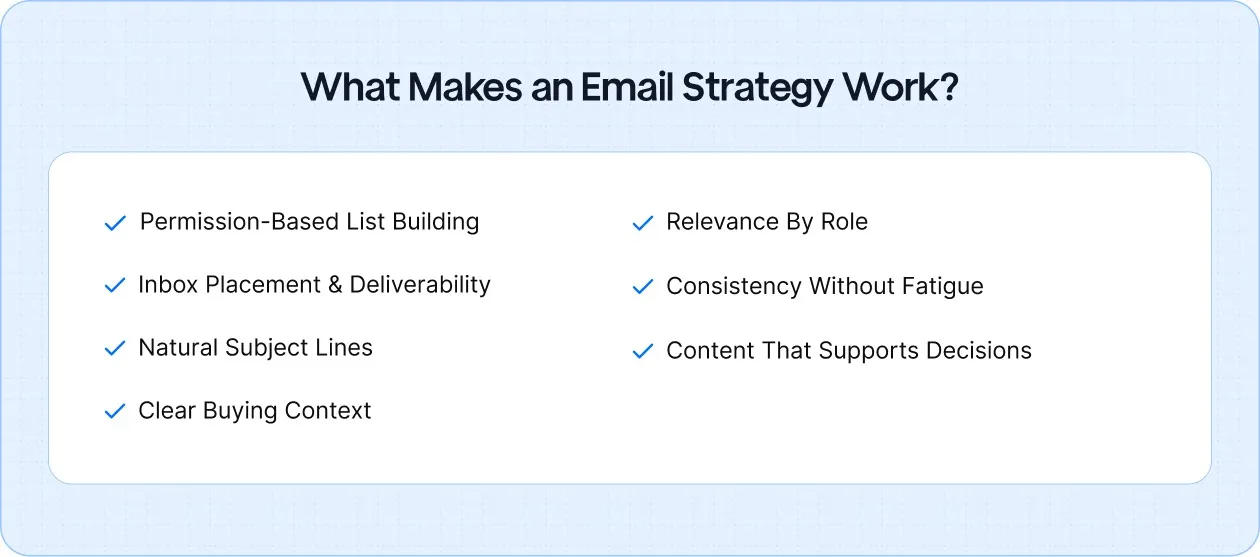
What Makes an Email Strategy Work?
An effective email strategy in heavy equipment is built on discipline, restraint, and alignment with how buyers actually behave.
- Permission-based list building
Only email people who explicitly opted in through demos, enquiries, downloads, rentals, service interactions, parts enquiries, or events. In industrial categories, trust and deliverability break fast when the list is not earned.
- Inbox placement and deliverability basics
Even “good” emails fail if they land in spam. Treat deliverability like shop maintenance:
- Authenticate your domain (SPF, DKIM, DMARC)
- Keep list hygiene tight (remove hard bounces, suppress inactive contacts)
- Avoid spam-trigger subject lines and overhyped claims, especially in the subject line
- Natural Subject lines
Heavy equipment buyers open emails that feel relevant, specific, and useful. Overhyped subject lines trigger distrust and spam filters. Your subject line should read like a professional note.
- Clear buying context
Write as if the reader is researching, maintaining, budgeting, or planning, not impulse shopping. Heavy equipment decisions move through evaluation windows, internal approvals, and timing constraints.
- Relevance by role
Owners, fleet managers, operators, procurement, and service managers care about different outcomes. Segment by role instead of sending one message to everyone.
- Consistency without inbox fatigue
Email should arrive predictably and infrequently enough to remain welcome. Sporadic blasts followed by silence weaken recall, while over-sending leads to disengagement.
- Content that supports real decisions
Effective emails provide useful input: maintenance guidance, product updates, comparisons, regulatory changes, or operational insights. Emails that exist only to promote offers lose attention quickly.
Send Emails Worth Opening
Create content that supports maintenance planning, lifecycle decisions, and real operational needs.


- One clear CTA
Make the next step obvious (request a quote refresh, schedule service, check availability). Avoid multi-CTA emails that create indecision.
- Measurement tied to follow-up
Opens and clicks only matter if they lead to enquiries, service bookings, quote progression, or sales conversations. Track what happens after engagement and build a follow-up rule for non-opens, high-click accounts, and repeat readers.
When these principles are in place, email becomes a stabilizing layer in the marketing stack.
Core 7 Email Marketing Strategies for Heavy Equipment Growth
Email marketing in heavy equipment succeeds when it is treated as an operational system rather than a campaign channel. Growth here depends on sustained relevance across long sales cycles, multiple buyer roles, and complex product and service combinations.
The strategies in this section focus on supporting real sales, service, and lifecycle outcomes instead of short-term activity:
Strategy 1: Build A Qualified List (Earned Intent Only)
Heavy equipment email only performs when the list is earned through genuine interest and real interactions. That list quality is what makes newsletters, nurture, and lifecycle sequences work in practice.
- Lead Source Standards: Define which lead sources are allowed into marketing emails. Only add contacts from quote requests, demo requests, events, trade shows, service appointments, parts enquiries, gated resources, and account-based outreach that includes explicit permission.
- High-Intent Opt-Ins: Offer opt-ins that match equipment decision-making. Use spec checklists, maintenance calendars, “rental vs buy” calculators, application fit guides, financing and warranty explainers, and jobsite productivity templates as the value exchange.
- CRM First Capture: Route every opt-in into the CRM, not just the email tool. Require basic fields that support routing and relevance (role, location/territory, primary equipment category, ownership intent: buy/rent/service/parts). Avoid long forms that block submissions.
- List Hygiene Rules: Set minimum standards for keeping contacts marketable. Merge duplicates, fix incomplete records, and tag the original source so you can trace performance back to acquisition channels later.
Strategy 2: Segment Like an Equipment Business
Segmentation improves relevance and reduces wasted sends, but in heavy equipment, it needs to reflect role, lifecycle stage, and product category.
- Role Segmentation: Split the list by decision influence. Separate owners, fleet managers, operators, procurement, and service managers because each group cares about different proof, risks, and timelines.
- Lifecycle Segmentation: Create segments for where the account sits in the cycle. Use stages like new lead, active opportunity, customer, lapsed customer, service-only customer, rental-only customer, and parts-only customer.
- Product and Application Segmentation: Organize by equipment type and use case. Break by category (excavators, compact equipment, cranes, attachments, power systems) and by application (earthmoving, utilities, roadwork, quarry, agriculture), so email content stays specific.
- Dealer and Territory Segmentation: Respect how the business sells. Segment by dealer territory or sales region to keep offers, inventory, and service messaging accurate and avoid creating conflicts across areas.
Strategy 3: Use Three Core Campaign Types That Map to How Buyers Decide
SERP patterns cluster around newsletters, drip sequences, and nurture campaigns. The strategy is to build each type around a defined job and audience.
- Newsletter Strategy: Run a newsletter that earns attention, not one that fills a calendar. Keep it predictable and brief. Include 1–2 useful items (maintenance insight, application guidance, cost-of-downtime angle), plus one clear next step (request a spec consult, book service, view inventory) instead of multiple competing CTAs.
- Drip Strategy: Build drip campaigns around a single buyer question. Create short sequences that resolve one decision point over time, such as “what to inspect before buying used,” “how to choose the right attachment,” or “how to plan maintenance intervals.” Drip works because it maintains continuity without constant manual follow-up.
- Lead Nurture Strategy: Design nurture for long-cycle movement, not constant selling. Use nurture to move contacts from curiosity to readiness by sharing proof (field performance stories, application examples, comparison logic, financing/warranty clarity) and by prompting low-friction actions (book a call, request a quote refresh, schedule a demo).
Strategy 4: Build Lifecycle Sequences That Drive Revenue After the Sale
Heavy equipment email gets most profitable when it supports service, parts, and repeat purchases. This is where most companies leave money on the table because they treat email as “pre-sale only.”
- Post-Sale Onboarding: Set expectations and reduce early regret. Send a short sequence that covers warranty registration steps, service scheduling norms, recommended initial inspections, and operator resources. Include a single service contact path tied to a region or dealer.
- Service and Maintenance Pull-Through: Turn maintenance into a predictable motion. Trigger reminders based on time-in-service milestones (30/90/180 days) or usage bands when that data is available. Keep the message operational: what to check, what failure looks like, and how to schedule.
- Parts Repeat and Consumables: Build reorder behaviour into the system. Segment by equipment category and send parts reminders that align with typical wear intervals. Make ordering paths direct, with SKU guidance or “talk to parts” CTAs, not generic product promos.
- Reactivation for Lapsed Accounts: Re-open conversations without discounts as the default. Trigger reactivation for accounts with no service or parts activity in a defined window. Lead with operational value (inspection offer, seasonal checklist, uptime audit) before introducing pricing incentives.
Strategy 5: Make Email Sales-Usable With Simple Rules on Content and CTAs
Industrial inboxes reward clarity and punish fluff. A good strategy makes emails easy to scan and easy to act on, while staying credible to technical buyers.
- One Email, One Outcome: Choose a single intent per send. If the email is meant to drive a demo request, remove secondary offers. If it is meant to drive service bookings, do not dilute it with inventory announcements.
- Proof Over Claims: Show specifics instead of adjectives. Use performance context (application conditions, jobsite constraints, uptime implications) and customer outcomes rather than “best-in-class” language.
- CTA Discipline: Use one primary CTA and one fallback. Primary CTA should match the stage (request quote, schedule service, check availability). Fallback CTA can be “reply to this email” for high-consideration segments where direct conversation converts better.
Strategy 6: Align Brand Email With Dealer, Inventory, and Service Reality
Email breaks trust fastest when it promises something the business cannot fulfill. In heavy equipment, that usually happens through inventory mismatch, territory overlap, or service capacity disconnect.
- Inventory and Availability Sync: Do not email offers that sales cannot honor. Establish a simple weekly sync with sales or dealers on what can be promoted: available units, rental capacity, service lead times, and parts constraints.
- Dealer Enablement Versioning: Create dealer-ready variants of core campaigns. Maintain a brand template and allow dealer inserts for local proof, contact points, and territory-specific offers, so the message stays consistent without becoming inaccurate.
- Routing Rules: Decide where leads go before you hit send. Every campaign needs a defined handoff: which form routes to which rep, what qualifies as urgent, and what SLA the recipient should expect.
Strategy 7: Monetization and Optimization Beyond Direct Equipment Sales
Email delivers the most value in heavy equipment when it supports what happens after the sale. For dealers and OEM-linked service businesses, your list should drive parts, service, and lifecycle retention, not constant inventory pushes.
- Use email to grow parts and service revenue: Send maintenance reminders, inspection prompts, seasonal readiness checks, and upgrade guidance tied to lifecycle needs.
- Use partner ecosystems carefully: Keep partnerships job-site relevant (attachments, telematics, safety training, maintenance tools). Anything off-niche reduces trust.
- Keep segmentation dynamic: Segment by equipment type, lifecycle stage, service history, rental vs purchase behaviour, and role (fleet manager, operator, procurement) so messages stay relevant.
- Optimise for real outcomes: Run small A/B tests focused on clarity, then measure what matters—service bookings, parts enquiries, demo requests, and sales conversations. Opens and clicks only matter if they drive these outcomes.
Integrating Email with the Broader Equipment Marketing Stack
In heavy equipment marketing, no channel operates in a straight line. Buyers move back and forth between search, ads, content, sales conversations, dealer interactions, events, and referrals, often over long periods of time.
Each channel introduces information at a different moment and from a different angle:
How Email Works Alongside Search and Content Marketing
SEO strategies and content marketing introduce buyers to problems, options, and positioning. Email ensures that exposure does not reset every time the buyer returns.
- Carry forward the same decision logic introduced through search. If search content establishes how a buyer should think about application fit, operating cost, or risk, email should reinforce that same framework over time instead of introducing new angles.
- Reduce cognitive overload created by deep content libraries. Websites often present many parallel resources. Email helps sequence ideas so buyers absorb information gradually rather than encountering everything at once.
- Maintain thematic consistency across multiple touchpoints. Email prevents situations where a buyer reads authoritative content on-site but receives unrelated or generic messaging afterward.
Capture Demand Before the Inbox
Strengthen SEO so high-intent buyers find you before email nurtures the relationship.
How Email Supports Paid Media Without Competing With It
Paid media captures attention at specific moments. Email gives those moments longevity.
- Absorb short-lived paid attention into longer consideration cycles. Email allows interest generated through ads to persist beyond the initial click, without requiring constant re-exposure through paid spend.
- Stabilise messaging across acquisition bursts. When paid campaigns change frequently, email acts as the steady channel that keeps positioning consistent for known prospects.
- Reduce repetition fatigue across channels. Email prevents buyers from seeing the same acquisition messages repeatedly by carrying the conversation forward instead of restarting it.
How Email Aligns With Sales Conversations Over Time
Sales interactions in heavy equipment are episodic. Email fills the gaps between them.
- Preserve context between conversations. Email helps buyers remember what was discussed previously, reducing the need to re-establish understanding in every interaction.
- Support internal buyer alignment. Buyers often share emails internally. Email provides a reference that helps stakeholders stay aligned without sales being present.
- Prevent regression in decision stages. Without reinforcement, buyers often backslide into earlier questions. Email helps maintain forward momentum between sales touchpoints.
How Email Complements Dealer Networks and Field Activity
Dealer and field interactions introduce local variability. Email provides consistency.
Anchor local execution to a shared narrative. Email ensures that regional activity aligns with overarching brand positioning, even when execution differs locally.
Support Local Trust Signals
Optimize your Google Business Profile to reinforce credibility across dealers, service locations, and territories.
- Extend the lifespan of offline interactions. Events, demos, and site visits are time-bound. Email maintains continuity after those interactions end.
- Reduce dependency on memory-based follow-ups. Email supports recall and clarity without relying solely on manual sales or dealer outreach.
Conclusion
When email is set up correctly in a heavy equipment business, something subtle changes.
Sales conversations start closer to the point. Service teams deal with fewer misunderstandings. Dealers receive leads that make sense for their territory and inventory. Internally, there is less confusion about who has seen what and why a conversation is happening now.
Heavy equipment companies that approach email this way become a part of how the business stays aligned over long cycles, supports real decisions, and grows without adding friction.
Ready to Build Long-Term Continuity?
Create a marketing system that supports long buying cycles, service revenue, and repeat relationships.


.webp)




.webp)


.svg)


