










Manufacturing teams are sitting on years of production data, maintenance logs, design files, and operational notes, yet most of it never shapes daily decisions. Design changes still take weeks, machine issues surface after downtime begins, and critical insights remain scattered across disconnected systems.
Generative AI changes this reality by turning existing operational data into usable outputs. For small and medium manufacturers, this matters because meaningful AI adoption no longer depends on large engineering teams or long deployment cycles.
This article breaks down where generative AI is delivering measurable value for manufacturers right now, with real use cases and examples that map directly to day-to-day operations.
What is Generative AI and Why is It So Important for Manufacturers?
Generative AI helps produce drafts, recommendations, summaries, and design options that teams can act on directly. Data like machine logs, maintenance records, drawings, and planning notes often sit unused across systems. Generative AI connects these inputs and converts them into clear, execution-ready outputs.
In manufacturing environments, generative AI is commonly used to:
- Create and refine product designs by evaluating material, cost, and performance constraints early
- Support production workflows by summarizing operational signals and suggesting adjustments
- Improve decision clarity by condensing large data sets into action-ready summaries
- Automate documentation such as work instructions, service manuals, and technical explanations
Large language models (LLMs) and natural language processing (NLP) enable these systems to work with the same technical language that manufacturers already use. This reduces interpretation effort and helps teams move faster without changing how they work.
Generative AI is not a replacement for core manufacturing systems, engineering judgment, or operator expertise. Its value lies in summarizing information, prioritizing actions, and supporting execution, not in taking control away from people or systems.
Must Read: How Generative Optimization Enhances AI Search Visibility
Financial Potential for SMBs
Generative AI delivers financial impact in manufacturing well before large-scale automation or capital-heavy upgrades come into play. For SMBs, the most immediate gains come from reducing inefficiencies that quietly drain time, budget, and attention across daily operations.
On the operational side, AI reduces avoidable costs by automating work that traditionally relies on manual intervention:
- Lower operational waste by identifying inefficiencies in production workflows and material usage earlier.
- Fewer unplanned expenses through predictive maintenance and early fault detection.
- Reduced manual overhead in documentation, reporting, and technical communication.
Beyond operations, AI improves decision quality by turning production data, maintenance logs, and planning inputs into clear, actionable summaries. Teams spend less time interpreting information and more time acting on it, reducing delays and costly missteps.
Yet much of the financial leakage for SMB manufacturers occurs before production even starts. Poor content visibility, unclear buyer intent, and manual marketing execution often result in missed opportunities or underqualified inquiries, pulling sales teams into low-value work.
AI-assisted content and search systems help align inbound demand with operational capacity, cutting wasted effort across sales, marketing, and leadership.
Most manufacturers lose time and money before production even starts.
See where AI can reduce effort fastest in your business.


Top 6 High-ROI Use Cases for Generative AI in Manufacturing
Generative AI in manufacturing use cases are producing ROI because they turn existing data into actions teams can use immediately. For SMBs, these wins show up without major system changes or large internal teams.
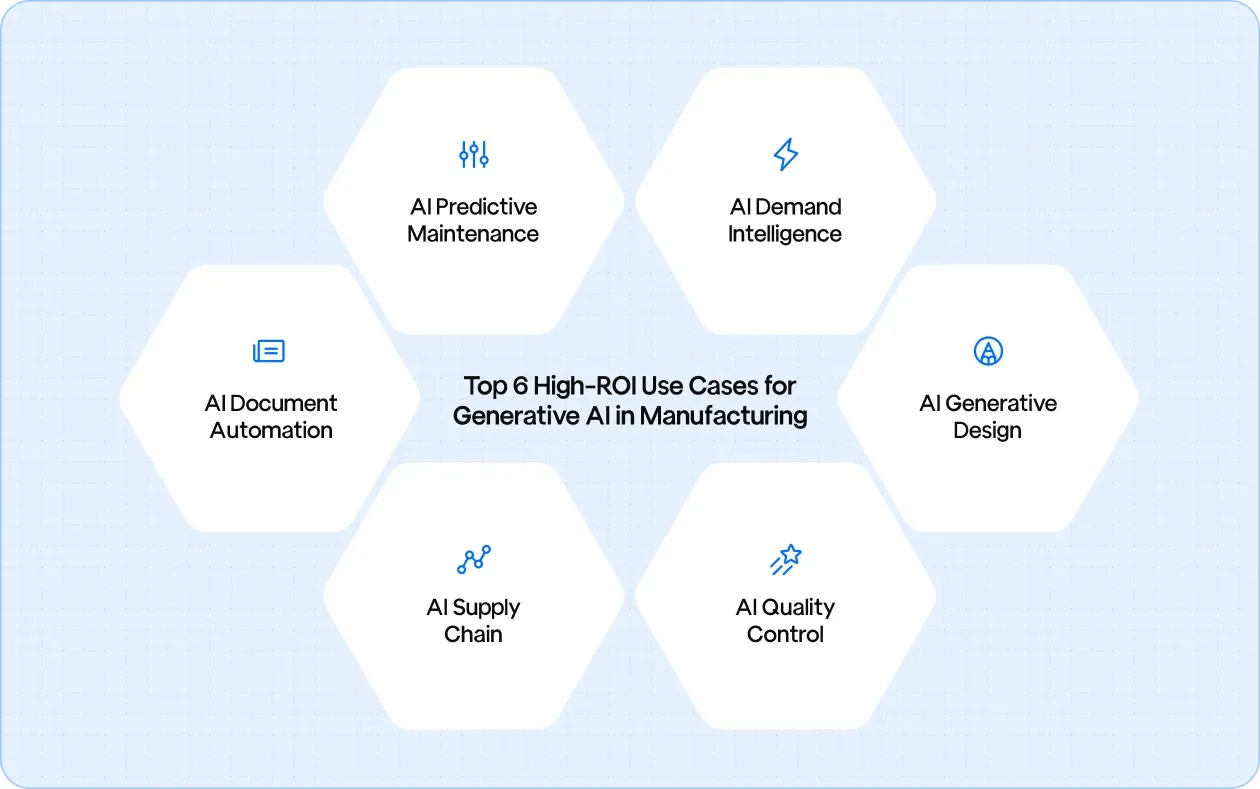
Here are the high-ROI use cases reshaping the industry.
1. Predictive Maintenance
Traditional maintenance models depend on fixed schedules or reactive repairs after failures occur. This often results in over-servicing healthy equipment or dealing with sudden breakdowns that disrupt production.
Generative AI changes this approach by evaluating multiple data sources together and surfacing issues earlier, with clearer context.
How generative AI improves maintenance planning
- Analyzes historical maintenance records alongside live sensor data and operating conditions
- Identifies emerging failure patterns before performance drops or breakdowns occur
- Generates plain-language summaries that explain risk, cause, and urgency instead of raw alerts
Rather than flooding teams with disconnected warnings, generative models help maintenance teams quickly understand which machines need attention, what is driving the risk, and how soon intervention is required.
Why does this matter for SMB manufacturers?
- Maintenance teams can focus their efforts where they are actually needed
- Unplanned downtime is reduced without increasing inspection frequency
- Equipment lifespan improves through timely, targeted intervention
- Production schedules remain more stable without adding maintenance headcount
Over time, predictive maintenance powered by generative AI leads to lower repair costs, better asset utilization, and more predictable operations.
2. AI-Assisted Content & Demand Intelligence
Generative AI is increasingly being used beyond the factory floor to understand how manufacturing buyers research and make decisions.
Manufacturing purchases involve long, technical evaluation cycles. Buyers search for specifications, applications, comparisons, and implementation details long before contacting sales. When manufacturers fail to appear during this research phase, demand quietly shifts elsewhere.
What generative AI enables?
- Analyzes buyer search behavior and recurring technical queries
- Identifies high-intent topics across different buying stages
- Generates technically accurate, buyer-aligned content instead of generic messaging
Rather than producing broad marketing material, manufacturers can use generative AI to create application-specific pages, technical explainers, and comparison content that matches how engineers and procurement teams actually search.
Why does this matter for SMB manufacturers?
- Brings higher-intent prospects into the pipeline earlier
- Reduces reliance on outbound and trade-show-only demand
- Improves sales conversations by pre-educating buyers
- Builds long-term visibility without adding sales headcount
No visibility during research means fewer sales conversations.
See where your content is missing and how AI can close the gaps.
3. Generative Design
Traditional design cycles in manufacturing are slow and constrained by limited iterations. Engineers often settle on workable designs early because exploring alternatives takes time, tooling, and coordination.
Generative AI changes this by rapidly producing multiple design options based on defined constraints such as strength, material limits, cost, and manufacturing feasibility. Instead of starting from scratch each time, teams review AI-generated options that already meet core requirements.
What changes in practice?
- Faster design iteration without increasing engineering workload
- Reduced material usage through optimized geometries
- Shorter time between concept and manufacturable design
For SMB manufacturers, this means better designs without expanding design teams or extending development timelines.
4. AI-Powered Quality Control
Manual inspection and rule-based quality checks struggle to keep up with production speed and variation. Subtle defects are easy to miss, and inconsistencies often surface only after products reach customers.
Generative AI-supported quality systems analyze images, sensor outputs, and historical defect data together. Instead of flagging isolated anomalies, they summarize patterns and surface likely defect causes early.
What changes in practice?
- More consistent defect detection without increasing inspection staff
- Earlier intervention before defects propagate downstream
- Fewer rework cycles and customer-facing quality issues
For SMBs, this improves quality and reliability without slowing production or adding inspection layers.
5. Supply Chain Optimization
Supply chain decisions are often made using fragmented data: historical demand in one system, supplier lead times in another, and planning assumptions stored manually. This leads to overstocking, shortages, or reactive purchasing.
Generative AI brings these inputs together and produces summarized demand and procurement guidance. Instead of raw forecasts, teams receive clearer signals on where risk is rising and where adjustments are needed.
What changes in practice?
- Better inventory balance without constant manual recalculation
- Fewer surprises from demand swings or supplier delays
- More confident procurement decisions with limited planning staff
For SMB manufacturers, this reduces working capital strain while keeping production schedules stable.
6. Document Synthesis
Technical documentation is essential in manufacturing, but producing it manually is slow and error-prone. Quotes, service manuals, and work instructions often rely on copying information across systems, increasing risk and rework.
Generative AI automates document creation by pulling from existing specifications, historical documents, and structured data. Instead of starting from blank pages, teams review ready drafts aligned with current products and processes.
What changes in practice?
- Faster turnaround for customer quotes and internal documentation
- More consistent technical accuracy across documents
- Less time spent on repetitive writing tasks
For SMBs, this frees skilled teams to focus on production and customer decisions instead of paperwork.
AI solutions are key to improving your operations.
Use AI-assisted content systems to bring in inquiries that match your real capacity.
Key Generative AI Trends That Are Shaping Modern Manufacturing
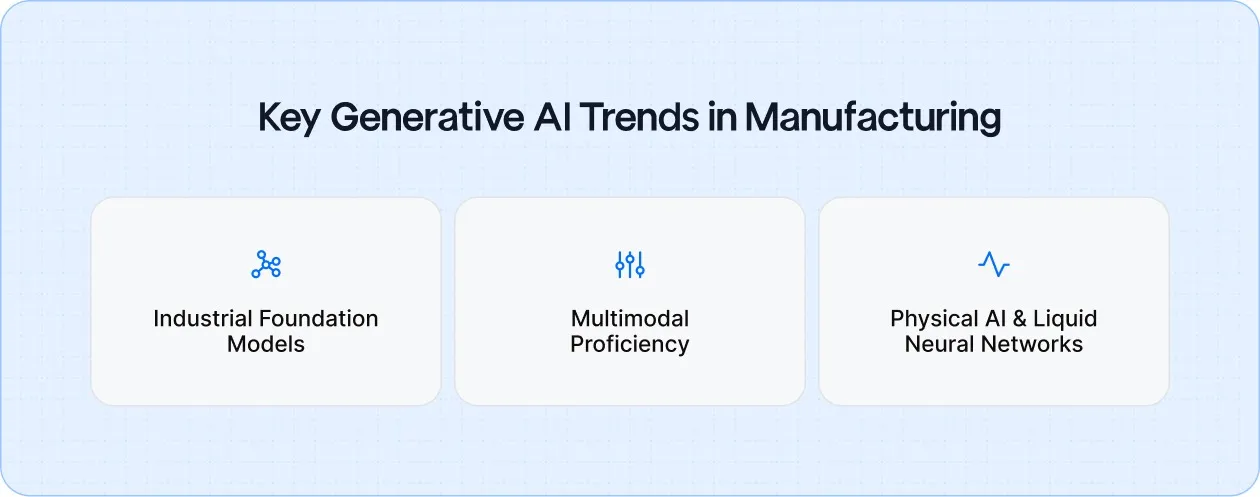
New tools do not define the future of smart production, but by how quickly insights turn into action. The trends below show where generative AI is reducing lag between data, decisions, and execution. Here are key trends transforming the industry:
Industrial Foundation Models (IFMs)
Industrial Foundation Models (IFMs), trained on manufacturing-specific data, prioritize actionable insights over additional dashboards. They reduce cognitive load by surfacing execution-ready recommendations, allowing teams to act faster without adding overhead.
Example: A model that reads downtime logs and suggests the next three maintenance checks.
Multimodal Proficiency
Multimodal AI connects diverse data sources (logs, images, sensor readings) to provide summarized, actionable insights automatically, eliminating manual data stitching and speeding decision-making.
Example: AI correlates vibration, thermal images, and alarm history to predict bearing failure.
Physical AI & Liquid Neural Networks
Physical AI adapts to real-time conditions, optimizing production by adjusting processes based on immediate feedback. Liquid neural networks support this adaptability by continuously adjusting systems without manual intervention.
Example: Adaptive tuning in robotics when material properties vary.
Real-Life Examples of Generative AI in Action
These manufacturing generative AI case studies highlight how manufacturers are using AI beyond the factory floor to improve visibility, inbound demand quality, and sales efficiency, without adding headcount or reworking internal systems.
Rather than focusing only on production gains, these companies applied AI where buying decisions start: research, discovery, and early intent signals.
Medium and Small-Scale Manufacturers
Small and mid-sized manufacturers are already using AI-driven execution to influence demand earlier in the buying cycle.
Here’s how smaller manufacturers are making AI work for them:
- John Maye: John Maye, a packaging equipment manufacturer with over 40 years in the industry, struggled with limited online visibility despite strong operational expertise. By applying AI-driven SEO and content execution, the company secured 17 qualified inbound inquiries within 30 days.
The shift reduced dependence on cold outreach and replaced it with demand already aligned to their product and capacity. Sales conversations started further down the funnel, with buyers arriving informed and intent-driven.
This kind of outcome is increasingly driven by AI-assisted SEO and content execution that aligns buyer intent with operational reality.
- Paniflex: Paniflex, a closet door distributor, faced a similar challenge: strong offerings but minimal discoverability. By using AI to expand technical content coverage and align it with buyer search behavior, Paniflex began appearing in more than 2,700 buyer searches within 6 months.
This resulted in 113 new buyers without expanding the sales team or increasing outbound activity. Visibility scaled, but execution overhead did not.
These results are increasingly tied to AI-assisted content systems that convert search behavior into consistent inbound demand.
Large-Scale Manufacturing Leaders
Global manufacturers are already incorporating Generative AI technologies to gain a competitive edge by optimizing efficiency, improving quality, and scaling operations. Here's how the biggest names in manufacturing are incorporating AI into their processes:
- BMW: BMW has implemented AI-driven quality control systems that use machine learning to detect defects earlier in the production process. This helps them reduce rework, maintain consistency, and enhance overall product quality.
- Rolls-Royce: In the aerospace sector, Rolls-Royce uses predictive maintenance powered by AI to monitor the health of aircraft engines. By analyzing real-time data from sensors, the AI predicts when an engine part might fail, allowing for proactive repairs.
- Hyundai: Hyundai has integrated AI-based factory automation to streamline its production lines. This AI technology helps optimize robot coordination, manage production schedules, and enhance workflow efficiency.
- General Electric: GE has incorporated AI in its supply chain management systems to enhance forecasting, inventory management, and raw material planning. By using AI to predict demand more accurately and ensure the right materials are available at the right time, GE has improved its delivery reliability and reduced shortages.
By adopting AI, manufacturers of all sizes can enhance their operations and create more efficient, scalable processes, driving growth and staying competitive.
How SMB Manufacturers Can Start Using Generative AI
For small and mid-sized manufacturers, the biggest mistake with generative AI is trying to “start everywhere.”
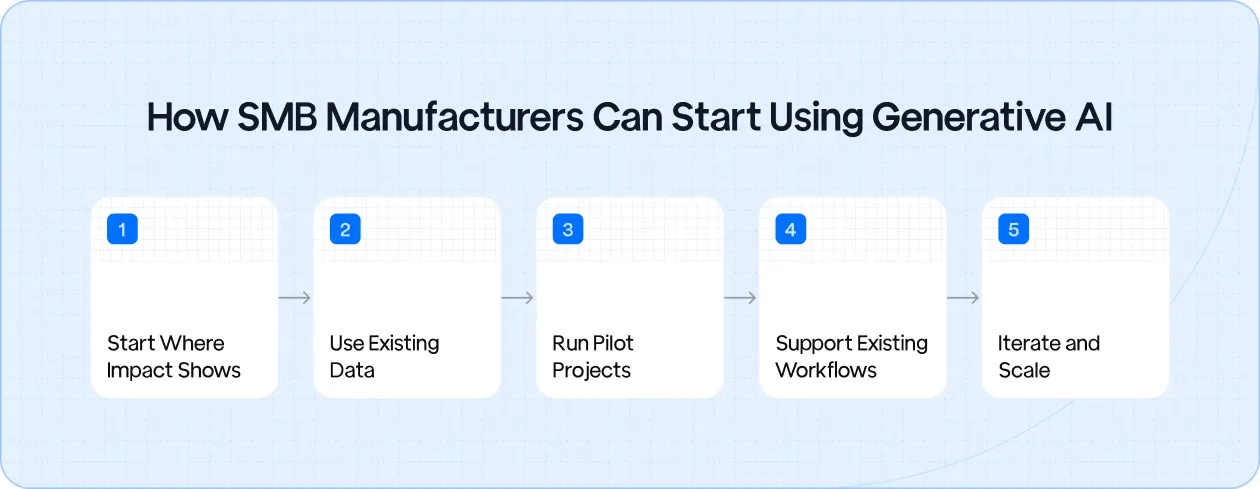
Here’s a practical way to approach adoption without adding internal strain.
Step 1: Start Where Impact Shows Up First
Many SMBs begin by applying AI outside the plant floor. Improving inbound demand quality, technical content coverage, and search visibility often delivers earlier signals than deeper operational AI initiatives. These areas are closer to revenue, easier to measure, and faster to adjust.
Generative AI can be used to:
- Identify high-intent buyer queries
- Expand technical content coverage aligned to real searches
- Improve how manufacturers show up during early research stages
This creates immediate visibility into whether AI is contributing to pipeline quality, not just internal efficiency.
Why does this work?
- No dependency on production systems
- Clear before-and-after metrics
- Faster feedback loops
Early wins here build confidence and internal buy-in for broader AI adoption later.
Step 2: Activate Data You Already Have Access To
Production data often requires cleanup, integration, and governance before AI can be applied meaningfully. Content and demand data do not.
Search queries, page performance, and buyer behavior are already structured signals. Generative AI can analyze this data to generate content that aligns with how manufacturing buyers actually research solutions.
AI-assisted content systems can:
- Turn search demand into technical content priorities
- Close coverage gaps across products, applications, and industries
- Maintain consistency without manual effort
This allows SMBs to extract value from AI early, without waiting on data engineering or system upgrades.
Step 3: Run Pilot Projects
Once early momentum is established, manufacturers can test AI in targeted operational areas such as maintenance summaries, documentation support, or planning insights.
The goal here is validation, not scale.
- Keep pilots narrow
- Measure outcomes clearly
- Maintain human oversight
This reduces risk while building internal confidence.
Step 4: Support Teams Without Changing Their Workflow
Successful adoption avoids asking teams to “learn AI.”
Instead, AI outputs should arrive as:
- Clear summaries
- Actionable recommendations
- Ready-to-use drafts
When AI fits into existing workflows, adoption happens naturally.
Step 5: Iterate and Expand
Start small, but think big. Once your team is comfortable with AI tools, start expanding them into other areas like quality control or design optimization. This iterative approach ensures that each new tool integrates smoothly without overwhelming your team.
Continuous support and expert insights will help refine the process, ensuring that the AI adoption journey evolves with your business needs.
Getting started with AI does not have to be expensive and complicated.
Focus on improving your content strategy first, and see immediate results.
3 Key Challenges When Implementing Generative AI in Manufacturing
While the potential of Generative AI in manufacturing is vast, its implementation comes with its own set of challenges. SMBs looking to employ this technology must be prepared to address common obstacles that could hinder smooth adoption.
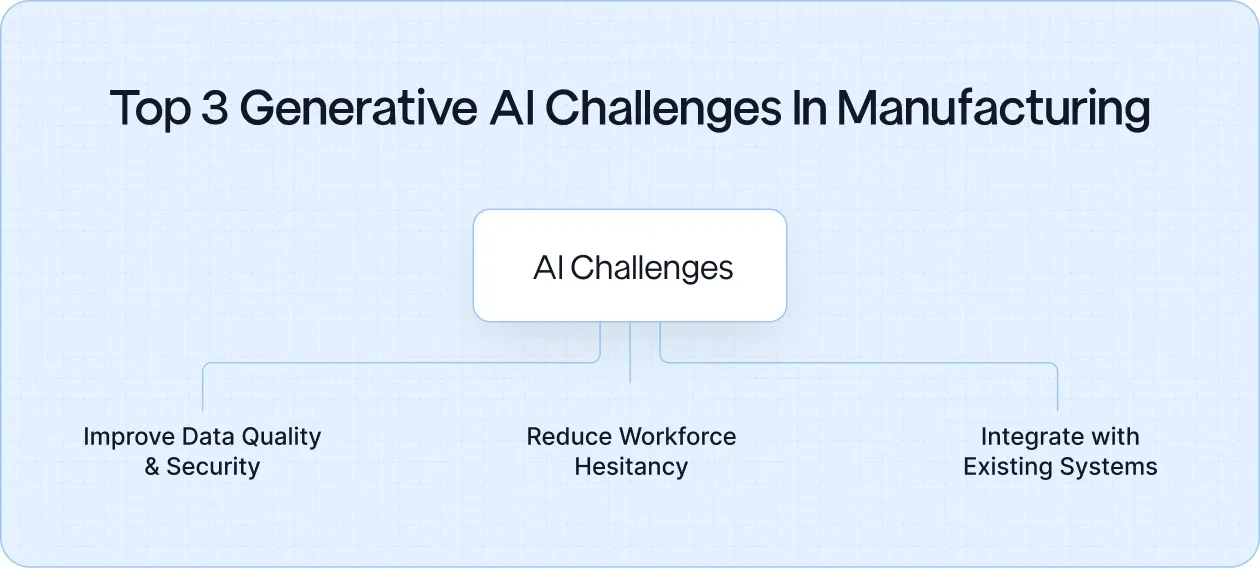
Here’s a look at some of these challenges and how to overcome them effectively.
1. Address Data Quality and Security Risks
Many manufacturers assume they need massive, perfectly structured datasets before AI can deliver value. In reality, most already sit on years of usable data across production logs, machine reports, documents, and customer interactions.
AI performs best when it works on:
- Curated, purpose-specific datasets
- Clearly defined inputs and outputs
- Guardrails that prevent hallucinated or unsafe responses
What works in practice?
- Start with narrow, high-confidence data sources instead of “everything at once.”
- Use AI systems that reference existing documents and operational records, rather than generating answers blindly
- Apply access controls so sensitive data stays protected
By grounding AI outputs in verified internal data, manufacturers reduce risk while improving trust in results. This makes AI usable for real decisions, not just experimentation.
Outcome: AI becomes a reliable support system instead of an unpredictable black box.
2. Overcome Workforce Hesitancy Without Adding Complexity
For many SMB manufacturers, AI hesitation has less to do with fear of job loss and more to do with bandwidth. Teams are already stretched across production, operations, sales, and customer support.
The practical solution is not asking internal teams to become AI experts. Instead, successful SMBs adopt AI through guided systems and managed execution models that deliver outcomes.
What works in practice?
- AI outputs are delivered in familiar formats like summaries, recommendations, or ready-to-use content
- Clear guardrails that prevent incorrect or misaligned AI usage
- Human-in-the-loop review to ensure accuracy and relevance
- Execution handled externally while internal teams focus on decision-making
By separating AI capability from AI execution, manufacturers gain the benefits of AI without forcing teams to change how they work day-to-day.
Outcome: Reduces resistance, shortens adoption timelines, and prevents common pitfalls like tool sprawl, misuse, or low-quality outputs.
3. Integrate AI with Existing Systems
Legacy systems are common in manufacturing. ERP platforms, MES tools, and documentation systems were not built with generative AI in mind. Full system overhauls are expensive and risky, especially for SMBs.
What works in practice?
- Introduce AI in isolated workflows where outputs are easy to validate
- Keep AI advisory at first, not fully autonomous
- Expand only after the value is proven
For example, AI can generate maintenance summaries, draft technical documents, or surface operational insights without touching core systems initially. This avoids disruption while building confidence.
Outcome: AI adoption progresses steadily without breaking existing operations.
AI adoption is way easier with the right help.
Let experts guide you in integrating AI into your content and workflow efficiently.
Long-Term Impact of Generative AI on the Manufacturing Industry
Generative AI requires creating smarter, more sustainable ways to operate and ensuring that manufacturers can meet future demands in a rapidly evolving world.
The Role of Generative AI in Sustainability
Sustainability is becoming a top priority for manufacturers, and AI is here to help in a big way. Here’s how:
- Reducing Waste: Generative AI helps manufacturers design products that use fewer materials while maintaining performance. By optimizing production schedules and workflows, it also ensures that resources are used efficiently, reducing waste.
- Energy Efficiency: Manufacturing can be energy-intensive, but AI can help manage energy use in real time. By predicting energy needs and adjusting production schedules, AI ensures that factories use only what they need, reducing both energy consumption and costs.
- Sustainable Practices: With Generative AI, manufacturers can simulate the environmental impact of different production methods and make decisions that help reduce their carbon footprint. AI helps businesses align with sustainability goals while driving operational efficiency.
Generative AI is helping to make manufacturers greener, contributing to a more sustainable future.
How AI Will Shape the Future of Manufacturing Operations
The future of manufacturing looks a lot smarter, thanks to AI. Here’s what to expect:
- Smarter Operations: Generative AI will optimize production lines in real time. Instead of waiting for problems to occur, AI will predict and solve issues before they happen, making manufacturing processes smoother and more reliable.
- Automating with Intelligence: Automation is getting smarter. AI learns, adapts, and optimizes. This means machines will figure out how to improve processes as they go along.
- The Digital Factory: AI is the backbone of the digital factory, where everything is interconnected. Imagine having digital twins, AI models, and IoT devices all working together to simulate and optimize production.
This interconnected system will give manufacturers deep insights, making it easier to improve every part of their operation.
- The Changing Workforce: As more tasks become automated, human workers will take on more strategic roles, working alongside AI to solve complex problems and make key decisions. AI will make workers more valuable, allowing them to focus on creativity, innovation, and problem-solving.
Generative AI is going to make manufacturing more agile, sustainable, and efficient, creating a future where companies are leading the way in innovation and sustainability.
How Generative AI Delivers ROI for Manufacturing Businesses
Generative AI delivers value when it helps manufacturers make better decisions, reduce wasted effort, and focus teams on work that actually moves the business forward.
On the factory floor, this shows up as fewer surprises, clearer maintenance priorities, and steadier output. Outside the plant, it shows up as better visibility, clearer technical messaging, and inquiries that match real production capacity. For SMB manufacturers, these gains matter more than adopting advanced systems all at once.
The most effective way to start is where results appear early, and risk stays low. Improving how buyers find you, understand your capabilities, and reach out with clear intent often delivers faster impact than deeper operational AI projects.
For manufacturers taking this approach, Gushwork provides a practical entry point. It helps manufacturers use AI-assisted SEO and content systems to attract qualified demand consistently, without expanding internal teams or changing how work gets done.
Generative AI delivers ROI when it reduces wasted effort and improves execution.
With Gushwork’s AI-assisted SEO solutions, you can optimize your content strategy and improve your digital footprint 10x.


.webp)







.webp)



.svg)


