










Most CNC companies do excellent work, but very few explain it well online. Precision machining, tight tolerances, and specialized capabilities are hard to communicate on a website, especially when most buyers only give you a few seconds of attention.
That gap between what your shop can do and how it appears in search results is where many CNC businesses lose opportunities without realizing it.
SEO for CNC companies exists to close that gap.
In this blog, we break down how SEO works specifically for CNC companies, what’s changed in the way search works today, and how manufacturers can build long-term visibility that supports real business growth.
Understanding SEO for CNC Companies
Search engines rely on signals. They read your pages, analyze how information is organized, and compare your site with others offering similar services. SEO for CNC companies essentially focuses on clearly defining services, processes, and expertise so that both search engines and buyers can understand them.
Because CNC buyers search based on process, precision, industry requirements, and trust signals, SEO for most manufacturing companies has shifted along with how those buyers evaluate suppliers.
The Changing SEO Landscape
As a result, SEO now operates across multiple layers, each aligned with how and where buyers search at different stages.
SEO for CNC Companies Works at More Than One Search Level
SEO for CNC companies operates differently depending on how the business sells. Some shops focus on local or regional visibility where proximity supports logistics or collaboration. Others compete nationally, supplying parts across states to buyers they may never meet. Advanced CNC manufacturers often work globally, attracting international buyers searching for specific processes, materials, or certifications.
Generative Engine Optimization (GEO) is Reshaping Search
GEO refers to optimizing your content so it can be understood, referenced, and recommended by generative AI tools such as ChatGPT and Google’s AI Overviews. This is one of the biggest changes SEO has seen in years.
The Rise of a Split SEO Strategy
CNC SEO has become split by intent. Informational content supports AI-driven research and early evaluation, while bottom-of-funnel pages are still responsible for converting high-intent buyers into quote requests. Both layers are required to move deals forward.
For CNC companies, this shift is an opportunity.
15+ SEO-Driven Content Strategies for CNC and Manufacturing Companies
Your content strategy should do two things: help real manufacturing buyers find your business online, and give them clear, useful answers so they take the next step with you.
Here are 15+ proven SEO practices tailored for your audiences:
1. Focus on Buyer Needs
To craft effective SEO content for machine shops and manufacturers, it’s crucial to prioritize buyer needs over simply targeting keywords. When your content speaks directly to buyer pain points and goals, it’s more likely to convert visitors into leads.
- Create Buyer-Focused Content: Rather than only targeting high-volume keywords, focus on the specific problems your ideal buyers face. For example, instead of focusing solely on "CNC machining," write content that explains how CNC machining solves production issues, like improving part accuracy or reducing operational costs.
- Provide Solution-Oriented Information: Prospective clients are seeking solutions. Create blog posts, landing pages, or FAQs that clearly outline how your services address their challenges, such as “Reducing Lead Times with Precision CNC Milling” or “Improving Product Consistency with Automated Machining.”
- Segment Your Content by Buyer Persona: Tailor your content for different buyer personas, such as engineers, procurement managers, and production managers, each of whom will have distinct questions and needs.
2. Target the Right Intent Keywords
Effective keyword targeting is a vital component of any successful SEO strategy. For CNC companies, using the right long-tail, buyer-intent keywords will help you attract more qualified leads who are actively searching for your services.
- Conduct Thorough Keyword Research: Use tools to find keywords with high search volume and strong buyer intent. Look for long-tail keywords like “precision CNC machining for aerospace parts” or “custom CNC parts suppliers near me.” These terms often have lower competition and target users who are closer to making a purchase decision.
- Use Keywords in Context: Integrating keywords naturally is important. Avoid stuffing your content with keywords. Instead, use them in a way that flows with the content.
- Track Keyword Performance: Continuously monitor the performance metrics of your keywords using analytics tools. Adjust your strategy based on which keywords drive the most qualified traffic and result in conversions.
Build a Keyword Strategy That Converts
Map keywords to how real decision-makers search, compare, and shortlist CNC suppliers.


3. Optimize Every Page Beyond the Homepage
Optimizing individual pages on your website helps maximize your chances of ranking for a variety of terms, making your entire site work harder to attract leads.
- Optimize Service Pages for Specific Keywords: Every service page should focus on a unique keyword or set of keywords. For example, if you offer both CNC milling and CNC turning, create dedicated pages for each service, optimized for their respective keywords.
- Ensure Each Page is Fully Optimized: Each page should have:
- Unique title tags that include the page’s target keyword
- Meta descriptions that summarize the content and encourage clicks
- Header tags (H1, H2, H3) to structure content for both readers and search engines
- Internal links to related pages within your website, guiding users to other valuable content
4. Create Educational Content
Machine shops and manufacturers need to show their expertise and build trust. Educational content allows your business to position itself as an authority while helping potential customers solve problems they face.
- Develop How-To Guides and Tutorials: Include beginner-level how-to content on your website to capture early-stage research queries and introduce buyers to your capabilities without overwhelming them. These guides should explain fundamentals clearly and position your shop as a reliable, knowledgeable partner.
Examples of beginner-friendly how-to guides to publish:
- How CNC Machining Works: A Simple Overview for Buyers
- How to Choose the Right Material for CNC Machined Parts
- How to Prepare a Design File for CNC Manufacturing
- How Tolerances Affect Cost and Lead Time in CNC Machining
- How to Decide Between CNC Milling and CNC Turning
- Address Common Industry Challenges: Offer insights into common manufacturing problems and how your services can resolve them.
- Create Case Studies and Success Stories: Share real examples of how your machining services helped previous clients overcome significant challenges.
Turn Expertise Into Demand
Build content that explains your capabilities clearly, earns trust from engineers, and supports AI and search visibility.
5. Use Internal Linking
Internal linking is one of the most important SEO practices to improve website navigation and increase the chances of ranking for a variety of keywords. Properly executed internal linking enhances both user experience and search engine crawling.
- Link Related Service Pages: If a user is reading about CNC turning, provide links to other related services like CNC milling or CNC prototyping.
- Use Anchor Text that Reflects Relevant Keywords: Instead of using generic phrases like "click here," use descriptive anchor text that includes relevant keywords.
For instance, “Learn more about our precision CNC machining services” will help users understand what the linked page offers while improving keyword relevance.
- Link to Blog Posts and Resource Pages: Linking from service pages to blog posts or resource sections can keep users engaged and improve your website’s overall SEO. It also gives you an opportunity to target long-tail keywords.
6. Speed Up Your Website
Fast-loading pages reduce bounce rates and increase time on site. From an SEO standpoint, page speed also influences how search engines evaluate user experience.
Key actions to improve site speed:
- Optimize images without compromising clarity: Machine photos, part images, and diagrams should be compressed while maintaining detail. This reduces load times without affecting credibility.
- Reduce unnecessary scripts and assets: Remove unused plugins, third-party scripts, and heavy animations that slow down page rendering.
- Enable browser caching: Caching allows returning visitors to load pages faster by storing key assets locally.
- Use tools like Google PageSpeed Insights or GTMetrix to track performance trends over time. Speed optimization works best as an ongoing process rather than a one-time fix.
7. Make Your Website Mobile-Friendly
Search engines prioritize mobile-first indexing. This means your mobile site is the primary version evaluated for rankings, not the desktop version. A mobile-friendly site improves crawlability, engagement, and conversion potential.
Best practices for mobile optimization
- Responsive layouts that adapt naturally: Content should resize and reorganize smoothly across devices without breaking layouts.
- Simple navigation and readable content: Menus, headings, and text should be easy to scan without zooming or excessive scrolling.
- Accessible CTAs and forms: RFQ buttons and contact forms must be easy to tap and complete on smaller screens.
- Using Google’s Mobile-Friendly Test: Review updates after design changes to ensure mobile usability remains consistent.
8. Build High-Quality, Relevant Backlinks
Backlinks are one of the most important ranking factors for search engines. The quality and relevance of the websites linking to your content can improve your domain authority and increase your site’s chances of ranking higher.
- Guest Blogging on Industry Websites: Contributing guest posts to reputable manufacturing or CNC-related websites can help build backlinks to your site. Aim for high-quality publications that are relevant to your industry to get the best results.
- Collaborate with Suppliers and Partners for Backlinks: Ask your suppliers, business partners, or clients to link back to your content from their websites. Industry-related backlinks are valuable for improving your SEO ranking.
- Submit Your Website to Trusted Directories: Listing your business on trusted manufacturing directories like ThomasNet or Maker’s Row provides high-quality backlinks and increases visibility.
- Monitor Competitor Backlinks: Use tools like Ahrefs or SEMrush to analyze where your competitors are earning backlinks. Find opportunities to secure similar links from authoritative websites.
9. Optimize for Local SEO
Local SEO is critical for machine shops and manufacturers that serve specific geographic regions. Optimizing your website for local search will help you attract nearby industrial leads and stand out in a competitive marketplace.
- Claim and Optimize Google My Business: Claiming and optimizing your Google My Business profile is essential for local SEO. Add accurate business details such as your address, phone number, hours of operation, and services offered.
- Use Local Keywords: Add location-based keywords like “CNC machining in [City]” or “Custom parts manufacturing in [Region]” to your website’s content. These keywords will help improve your rankings for local searches.
- Encourage Reviews from Local Clients: Positive reviews on platforms like Google or Yelp help boost your business’s credibility and visibility in local search results. Encourage satisfied customers to leave reviews, especially if they are based locally.
- Build Local Citations: Get listed in local directories and local business associations. Local citations improve your website’s trustworthiness in search engines and help with local rankings.
Make SEO Work Like a System
Align technical SEO, structure, and authority so your CNC business shows up where buyers actually research vendors.
10. Harness Video and Multimedia to Boost Engagement
Videos and multimedia content can significantly improve engagement, increase time on page, and help rank higher in search engine results. Visual content also helps explain complex manufacturing processes in an easily digestible format.
- Create Explainer Videos for Your Services: Video content like “How It Works” or product demos can help visitors better understand your services.
- Show Behind-the-Scenes Manufacturing Processes: Give your audience a glimpse into your production process with behind-the-scenes videos. Show how your CNC machinery operates or highlight your quality control process.
- Use Video Testimonials: Video testimonials from satisfied clients can be more persuasive than written ones. Show potential clients how your services have solved real-world problems for others in the industry.
11. Strengthen Internal SEO and Site Structure
Having a well-structured website is critical to providing a good user experience and optimizing for search engines. A clear site structure helps both users and search engines find relevant content quickly.
- Create Clear Navigation and Categories: Group similar content together under clear categories, such as Services, Industries We Serve, and Case Studies.
- Use Descriptive, Keyword-Rich URLs: Ensure your URLs are short, descriptive, and keyword-rich. For example, instead of “example.com/page1,” use “example.com/precision-cnc-milling-services.”
- Optimize Your Website’s Breadcrumbs: Breadcrumbs provide a clear path for users to follow and help search engines understand the structure of your website.
- Audit Your Site Regularly for Technical SEO Issues: Use tools like Screaming Frog or Google Search Console to find and fix issues like broken links, missing meta tags, and duplicate content that could negatively affect your SEO.
12. Optimize for Featured Snippets to Capture More Visibility
Featured snippets occupy a prime position in search results, often appearing at the very top. These "Position Zero" results offer a significant opportunity for visibility. To improve your chances of being featured, structure your content in a way that search engines can easily extract for snippets.
- Answer Questions Clearly and Concisely: Featured snippets often pull answers directly from content that provides brief, clear answers to specific questions.
For example, for the query “What is CNC machining?” offer a precise and simple answer at the top of the content: “CNC machining is a computer-controlled manufacturing process used to create precise parts from a variety of materials.”
- Use Lists and Tables to Organize Information: Snippets are more likely to pull data from content organized into bullet points, numbered lists, or tables.
- Format Content for "How-to" Snippets: Google often selects “how-to” content for snippets. If your service involves processes or methods, use step-by-step instructions formatted with numbered lists.
13. Improve Technical SEO for Better Indexing and Ranking
Technical SEO ensures that search engines can crawl and index your website efficiently, which directly impacts your search rankings. By addressing technical SEO aspects, you improve the chances of your content being indexed correctly and ranked higher.
- Ensure Proper Site Structure and Navigation: Organize your website’s content into a logical structure using clear categories and subcategories. This helps both search engines and users find relevant pages.
- Improve Site Speed: Slow websites frustrate users and search engines. Compress images, reduce the number of HTTP requests, and minify CSS/JavaScript files to improve loading speed.
- Fix Crawl Errors and Redirect Issues: Identify crawl errors, broken links, or any URLs that return 404 errors. Fixing these ensures that search engines can access all important pages on your site, improving both indexing and user experience.
14. Prioritize for International SEO to Reach Global Buyers
International SEO ensures that your content is visible to potential customers worldwide. If your CNC company serves clients across various regions, it's important to tailor content for local languages, cultures, and market needs.
- Use Hreflang Tags for Multi-Language Websites: If your website serves multiple languages or regions, implement hreflang tags to indicate to search engines which version of the page should be shown to users based on their language and region. For example, hreflang="en-US" for the U.S. and hreflang="fr-FR" for French-speaking regions.
- Localize Content for Different Audiences: Tailor your content to meet the cultural and practical needs of different regions. For instance, if you're targeting European buyers, you might focus on EU regulations for precision manufacturing.
- Target Country-Specific Domains or Subdomains: For large-scale international expansion, consider using country-specific domains (like example.co.uk) or subdomains (like uk.example.com) for better localization and targeting in specific countries. This helps improve rankings in those regions.
15. Optimize for Image Search to Drive Product Inquiries
Image search is a growing channel for product discovery. By optimizing your images for search engines, you can drive traffic and product inquiries directly from visual search results.
- Use Descriptive Filenames for Images: When naming images, include relevant keywords that describe the content of the image. Instead of naming an image “IMG001.jpg,” use “cnc-machining-part.jpg” or “precision-machined-aluminum-parts.jpg”. This helps search engines index your images accurately.
- Add Descriptive Alt Text: Alt text describes images for both search engines and visually impaired users. Use keyword-rich, descriptive alt text for each image that matches the content of the page. For example, “custom CNC parts for aerospace” is more effective than just “machining parts.”
- Create High-Quality, Relevant Images: Make sure your images are high-quality and relevant to the services you offer. High-resolution images showcasing your CNC parts, equipment, or processes will stand out in image search results and attract more product inquiries.
- Use Structured Data for Product Images: Implement structured data markup for your product images. This helps search engines understand the context of the images and improves the chances of your products appearing in rich results or Google Shopping.
16. Repurpose Existing Content to Expand Your Reach
Repurposing content allows you to extend the reach of your best-performing material. By transforming existing content into different formats or across platforms, you can attract new audiences and keep your content fresh.
- Turn Blog Posts into Videos or Webinars: If you have a popular blog post, turn it into a video or webinar. This way, you can engage users on platforms like YouTube or LinkedIn, where visual content performs well. Videos can also rank in Google’s video search results, further increasing visibility.
- Convert Webinars into Blog Posts or Infographics: After hosting a webinar, write a blog post summarizing the key points or create an infographic to highlight important statistics. This makes your content more shareable and accessible to a wider audience.
- Update Older Content with New Insights: Regularly revisit old blog posts or guides and add updated information or new examples. This keeps your content relevant, improves SEO rankings, and ensures visitors are getting the latest information.
- Use Quotes and Key Takeaways for Social Media: Repurpose important quotes, facts, or statistics from your content and share them on social media platforms like Twitter, Facebook, or Instagram. This drives traffic back to your site while giving your content new life across different channels.
17. Use AI-Generated Content Strategically
AI-generated content tools can assist with the content creation process, but it’s essential to ensure that the content remains authentic, valuable, and aligned with your brand’s voice. Here’s how you can use gen AI strategically.
- Assist with Content Outlines and Drafts: Use AI tools to help generate content outlines or first drafts. This speeds up the process, but always refine the output with your expertise to ensure it meets your audience’s needs and maintains your brand's credibility.
- Generate Ideas for Long-Tail Keywords: AI tools can help identify related long-tail keywords or content ideas. These ideas can serve as inspiration for blog posts, service pages, and FAQs that answer buyer questions and drive targeted traffic.
- Repurpose AI-Generated Content with a Human Touch: AI can handle repetitive tasks or simple content, but adding a human touch ensures the content stays relevant and resonates with readers. Use AI-generated drafts as a starting point, but always ensure accuracy and authenticity in the final output.
Common SEO Mistakes Manufacturing Companies Should Avoid
Even companies that invest time and money into SEO often struggle to see results. In most cases, the issue is not effort, but misaligned execution. Manufacturing SEO has its own pitfalls, especially when strategies are copied from consumer or generic B2B playbooks.
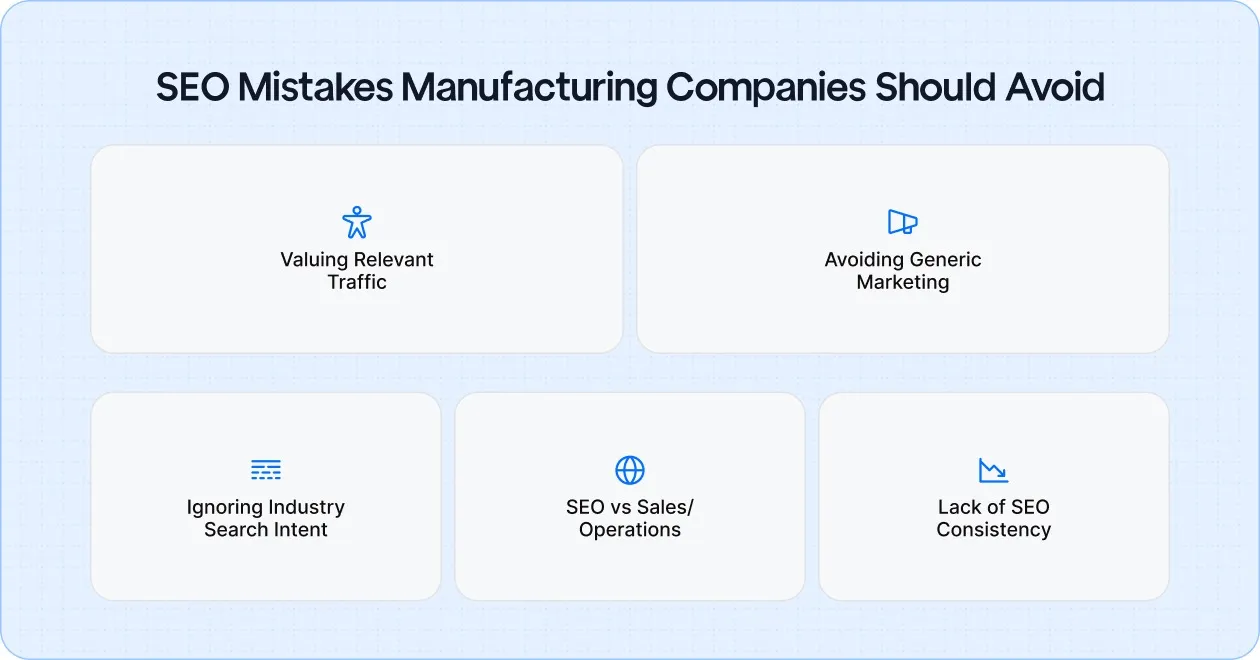
Below are common mistakes that quietly limit visibility, rankings, and lead quality for manufacturing and CNC businesses.
Treating All Traffic as Valuable Traffic
One of the most frequent mistakes is chasing traffic volume instead of buyer relevance. Manufacturing websites often rank for broad or informational terms that bring visitors who will never request a quote.
This leads to inflated traffic numbers with no commercial impact. SEO should prioritize searches tied to real purchasing intent.
Relying on Generic Marketing Language
Manufacturing buyers expect precision. When websites use vague claims or recycled marketing phrases, trust erodes quickly.
Search engines also struggle to understand pages that lack clear, specific context about processes, capabilities, and applications.
Ignoring Industry-Specific Search Intent
Manufacturing search behavior is highly specialized. Many companies fail by assuming buyers search the same way across industries.
Engineers, procurement teams, and operations managers use different terminology, specifications, and qualifiers when searching.
Separating SEO from Sales and Operations
SEO often lives in isolation, disconnected from sales teams and production realities. This creates content that ranks but fails to convert because it does not reflect real-world capabilities.
Alignment ensures accuracy, relevance, and better lead quality.
Expecting SEO Results Without Consistency
Manufacturing SEO is not a short-term tactic. Companies that abandon efforts after a few months rarely see meaningful results.
Search visibility builds gradually through consistent execution and refinement.
Conclusion
For CNC businesses that invest in getting this right, SEO does more than improve visibility. It reduces friction in the sales process, improves lead quality, and positions your shop as a serious, reliable supplier in a crowded market.
If you want your CNC company’s expertise to be easier to find, easier to understand, and easier to choose, it starts with a focused SEO strategy built for how manufacturing search actually works.
Ready to Apply This Strategically
See how these SEO principles fit your CNC business, market, and growth goals without guesswork.


.webp)







.webp)



.svg)


