









Construction equipment marketing usually fails for a boring reason: the work is spread across too many places, with no single system holding it together.
One person runs ads. Someone else posts on social. The website has a few product pages. A PDF brochure exists somewhere. Sales does its own follow-ups. None of it is “wrong”, but it’s disconnected. So even when marketing is active, it doesn’t compound.
The brands that win don’t necessarily do more. They do fewer things, but they connect them properly. Every channel supports the next step. Every asset has a job. And nothing exists just to look present.
In this blog, we’ll break down what a real construction equipment marketing system looks like, how to structure your channels and content so they support each other, and what to prioritize if you want consistent inbound leads.
What is Construction Equipment Marketing?
Construction equipment marketing sits at the intersection of high-cost assets, operational risk, and time-sensitive decisions.
Buyers are trying to avoid downtime, missed deadlines, and costly mistakes. That makes marketing here less about persuasion and more about removing uncertainty. The challenge is that the rules have changed, while many tactics have not.
What’s Changed in the Construction Equipment Market?
Even five years ago, a strong dealer network, repeat relationships, and word-of-mouth could carry most heavy equipment businesses.
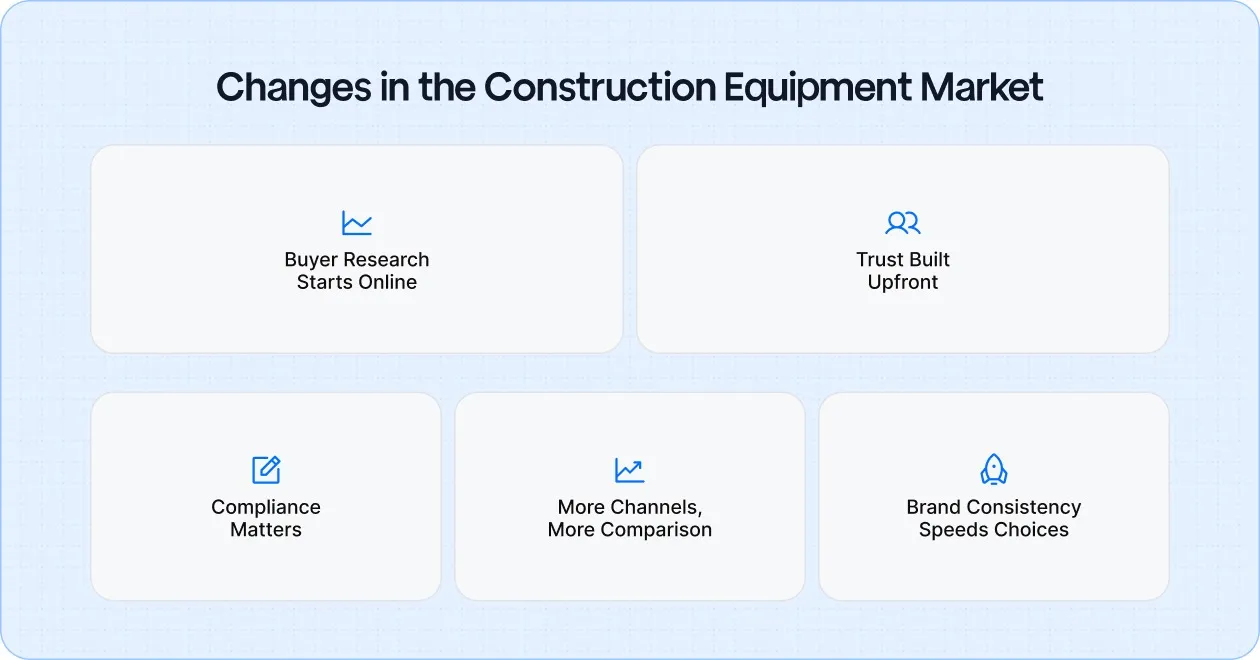
The market today has changed in ways that force brands to market like modern operators:
- Buyer research starts digitally. Search, maps, reviews, and inventory pages are often checked long before a call is made. If your online presence is thin or outdated, you may never enter the shortlist.
- Trust is evaluated upfront. Buyers look for visible proof like recent reviews, real equipment photos, clear inventory status, and how quickly you respond to enquiries. Silence or vague pages signal risk.
- Compliance and liability matter more. Safety standards, warranty terms, certifications, and contract clarity influence who gets contacted. Marketing that skips these details feels unsafe.
- More channels, more comparison. Buyers encounter brands through search, ads, marketplaces, social content, and dealer networks. Inconsistency across these touchpoints creates doubt.
- Brand consistency affects speed. When suppliers look similar on paper, buyers move faster with the one that feels organised, current, and dependable everywhere they look.
What Construction Equipment Buyers Actually Need Before They Enquire?
Most equipment brands think enquiries come from “interest.” In reality, enquiries come when the buyer feels confident enough to risk a conversation. Your marketing has to deliver that confidence early, using the details that matter in real purchase decisions.
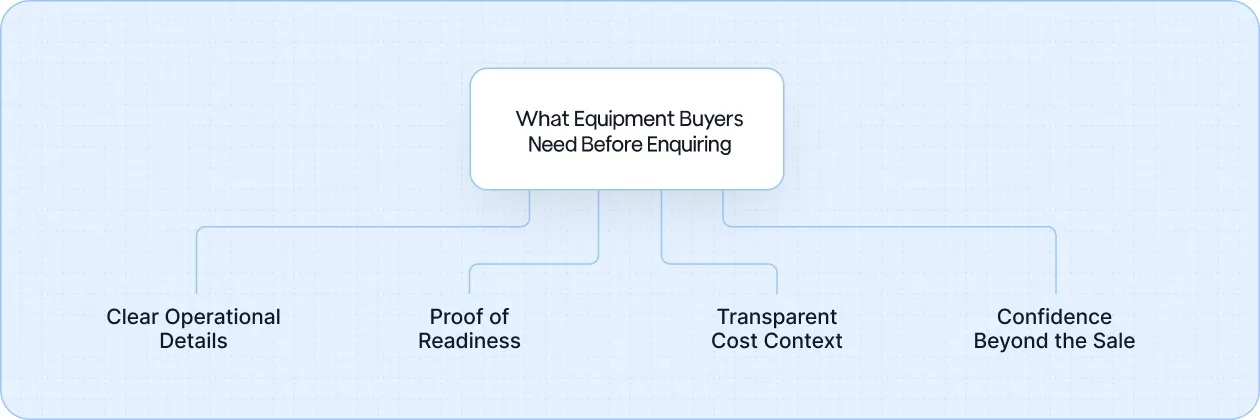
- Clear operational details. Availability, lead times, delivery coverage, and service scope should be obvious. Buyers should not have to ask basic questions.
- Proof of readiness. Evidence of uptime support, field service capability, maintenance processes, and jobsite experience reduces perceived risk.
- Transparent cost context. While final pricing may vary, buyers want to understand rental terms, service inclusions, parts availability, and what typically drives cost changes.
- Confidence beyond the sale. Support after delivery matters. Marketing should signal reliability after handover.
When construction equipment marketing addresses these needs directly, it starts functioning as decision support. That is what moves buyers from research to enquiry.
10 Best Construction Equipment Marketing Strategies
The construction equipment industry does not reward vague awareness campaigns or generic “lead gen.” Buyers move fast when a machine is down, and they move cautiously when the purchase is expensive.
The strategies below focus on clarity, intent, and credibility, so marketing supports real revenue instead of surface-level visibility:
1. Define Your Ideal Buyer + “Equipment Fit”
A lot of equipment marketing underperforms because the business is trying to sell to everyone. The fastest way to improve outcomes is to define exactly who you want, what you want them to buy, and what “fit” looks like in the real world.
- Segment by business model first. Decide if the core growth comes from sales, rentals, servicing, parts, or fleet partnerships. Each model has a different urgency level, decision cycle, and trust requirement.
- Build buyer avatars based on buying behaviour. A contractor buying for a project behaves differently from a fleet manager optimising uptime or procurement sourcing multiple vendors. Map content and offers to their decision style.
- Match messaging to the real purchase driver. Uptime, compliance, cost control, delivery speed, and service coverage matter more than brand story. Pick one driver per buyer type so you don’t dilute the message.
- Align marketing to future jobs. If you want more rentals for earthmoving equipment or more service contracts for heavy machinery, your website and content should reflect that direction clearly.
2. Positioning That Makes Buyers Choose You
In construction equipment, buyers don’t choose the loudest brand. They choose the supplier that feels dependable under pressure. Positioning should reduce perceived risk.
- Make your category focus obvious. Buyers should instantly understand whether you sell, rent, service, or supply parts. When all offerings are blended together, the site feels like a generalist, and trust drops.
- Lead with differentiators that matter on a jobsite. Inventory depth, turnaround time, field service availability, parts readiness, and response speed are the real decision triggers. Bring these forward early.
- Use trust language that sounds operational. Avoid big claims. Write in the language of reliability: dispatch windows, service coverage, inspection standards, typical lead times, and what happens after the call.
- Build urgency-based offers that match real situations. Breakdown support needs a fast-contact flow. Short-term rentals need availability clarity. Fleet agreements need confidence, process, and long-term service proof.
Know Who You’re Selling To
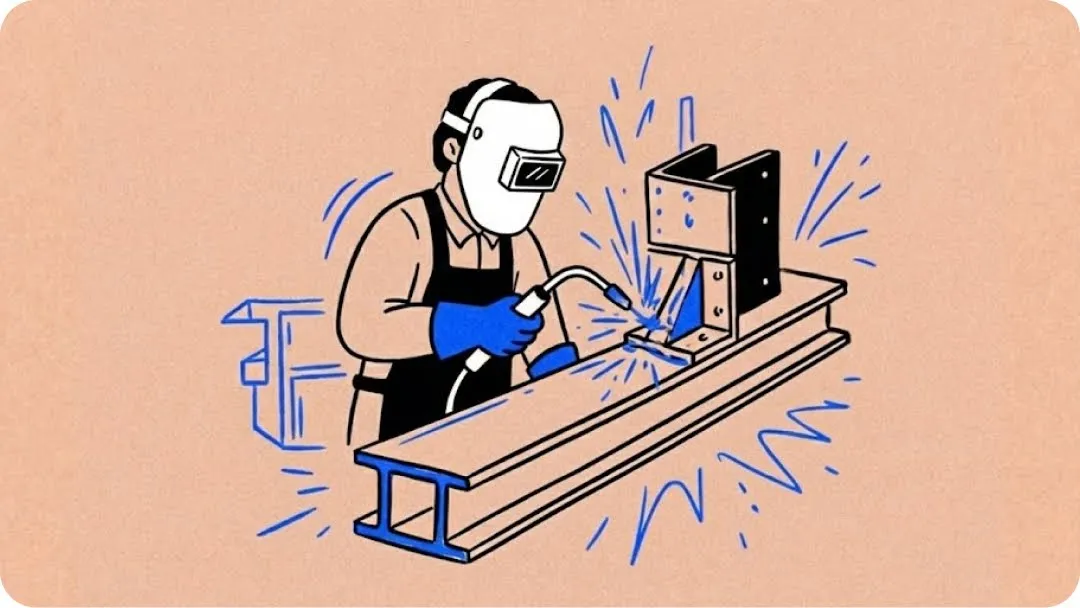
Map the exact buyer types, equipment categories, and high-intent searches that lead to real calls, rentals, and RFQs.


3. Search Visibility That Captures High-Intent Demand
Search is where high-intent buyers show up when they need equipment, service, or answers quickly. The goal is not traffic. The goal is to rank for searches that lead to calls, bookings, and quotes.
- Target “ready-to-buy” searches that signal action. Build pages for model + rental, “price,” “availability,” “near me,” and “delivery.” These searches convert because the buyer already has intent.
- Treat local SEO as the backbone. Service radius, dispatch zones, and branch locations should be built into your site structure. If you operate across regions, create location-specific hubs that match real coverage.
- Use Google Business Profile as a living proof asset. Post recent jobs, inventory snapshots, service work, and team photos. Keep it current, because buyers treat it like a credibility check before calling.
- Create comparison pages that help shortlisting. Buyers compare before they enquire. Pages like “new vs used,” “rental vs purchase,” and “model vs model” earn trust because they answer the question buyers are already asking.
- Capture service intent properly. Pages like “equipment repair + brand + location” or emergency support pages should make response time, service scope, and booking frictionless.
Get Found When It’s Urgent
Rank for equipment, rental, parts, and service searches that signal a buyer is ready to act, not just browse.
4. Paid Demand Generation That Budgets Urgency
Paid marketing works in this category when it targets urgent intent and removes friction. If your campaigns send people to generic pages, the cost per lead rises fast.
- Use PPC where urgency is highest. Rentals, urgent repairs, and parts replacement are the fastest-converting categories because need is immediate and measurable.
- Separate campaigns by intent level. Emergency searches should route to fast-call pages. Research searches should route to comparison or capability pages. Long-term procurement searches should route to trust-heavy pages with deeper proof.
- Match landing pages to the ad promise. If the ad says “same-week rental,” the page must show availability logic, delivery radius, and next-step CTAs. Misalignment kills conversion.
- Retarget for repeat visits and delayed decisions. Even urgent buyers often compare 2–3 suppliers. Use retargeting to stay visible with proof content.
5. Website Strategy for Construction Equipment Marketing
A strong equipment website does three jobs at once: it proves operational readiness, guides buyers to the right solution fast, and makes enquiry frictionless when urgency is high.
What an effective construction equipment website must do:
- Make your role obvious within seconds. Buyers should instantly know whether you sell, rent, service, or supply parts, and which equipment categories you specialise in.
- Surface availability and service coverage early. Delivery zones, service areas, response timelines, and support scope should be visible without forcing a call.
- Structure pages around real buying intent. Separate pages for rentals, sales, service, parts, and emergency support help buyers land exactly where they need to, especially during breakdown or time-sensitive situations.
- Use inventory and capability pages as proof. Equipment pages should show condition, inspection process, maintenance standards, and typical use cases.
- Design for mobile-first urgency. Most high-intent visits happen on phones. Tap-to-call, quick quote forms, and messaging options should be easy to find and fast to use.
- Guide visitors toward the next step. Every page should answer “what do I do now?” with one clear action, whether that’s calling, requesting availability, or booking service.
6. Content That Builds Trust in a Risk-Heavy Industry
Content marketing for equipment brands is not for “engagement.” It’s decision support that reduces the fear of choosing wrong. The best-performing content answers what buyers hesitate about.
- Write content around real buyer risk. Downtime impact, wrong machine selection, service reliability, warranty clarity, and part availability are the issues buyers quietly worry about. Build content that addresses them directly.
- Publish jobsite-proof content that demonstrates capability. Show how you inspect machines, maintain fleets, deliver safely, and respond to breakdowns. Practical proof builds trust faster than long explanations.
- Use comparison content to help buyers decide. “Versus” articles and decision guides work well because they match the evaluation process. They also attract high-intent traffic that converts better than general awareness posts.
- Write case studies with operational outcomes. Don’t frame them like marketing wins. Frame them like jobsite wins: reduced downtime, faster turnaround, smoother delivery, improved availability, or better maintenance response.
Turn Proof Into Demand
Create jobsite-first content that answers buyer questions fast and builds trust before they ever talk to sales.
7. Social and Mobile Marketing That Drives Real Leads
Construction equipment buyers spend time on social, but they don’t want polished content. They want reality. Social works best when it proves presence, capability, and responsiveness.
- Use social to stay familiar between buying cycles. Most buyers don’t purchase daily. Social helps your brand stay remembered when the next urgent need hits.
- Post short-form content that feels jobsite-real. Walkarounds, delivery drops, inspections, teardown clips, before-after service work, and quick comparisons outperform branded “corporate videos.”
- Use employee visibility strategically. Feature technicians, operators, and service teams. Then encourage them to share. This works because people trust people more than logos.
- Make mobile conversion frictionless. Tap-to-call, WhatsApp, and quote forms should be the default. Most urgent searches happen on phones, and buyers won’t fight your website to enquire.
- Use native lead capture for fast response categories. Facebook lead forms and click-to-message are useful for rentals and services because they remove steps and speed up conversion.
8. Email Marketing for Equipment Dealers, Rentals, and Service Providers
Email works in equipment marketing when it feels useful and relevant. It’s how you stay top-of-mind, bring repeat customers back, and turn quotes into closed deals.
- Segment by buying relationship. Contractors, fleet buyers, procurement, and repeat renters should not get the same emails. Their decision triggers are different.
- Send newsletters with operational value. Inventory updates, availability drops, service reminders, seasonal preparedness, and local project updates get read because they feel relevant.
- Build nurturing sequences that follow real deal flow. Enquiry → quote follow-up → scheduling → delivery → repeat cycle. The goal is to remove drop-offs and keep communication consistent.
- Use seasonal hooks that match equipment reality. Monsoon readiness, winter maintenance, end-of-quarter fleet planning, and local infrastructure seasonality give email a reason to exist.
9. Trade Shows, Events, and Offline Marketing
Events still matter in this industry, but only when you treat them as lead systems. Brand presence alone doesn’t pay for the booth.
- Design events around capture and follow-up. Every conversation should have a next step: QR scans, quick forms, demo scheduling, quote requests, or follow-up calls booked on the spot.
- Automate event follow-up into your CRM. Speed matters. If follow-up happens two weeks later, the lead has moved on.
- Repurpose event content immediately. Turn it into recap videos, product highlights, team clips, and social proof posts so the event keeps working after it ends.
- Equip sales with decision tools. Bring spec sheets, comparison guides, inspection checklists, and service capability sheets. These are what buyers take back to their team.
10. Partner and Dealer Network Marketing (Cross-Promoted Growth)
Partnerships work well in equipment marketing because buying decisions often involve ecosystems: builders, contractors, OEMs, safety vendors, and service networks.
- Co-market with adjacent partners who share the same buyers. Contractors, builders, safety vendors, and OEM partners help you reach decision-makers with built-in trust.
- Design referral programs that reward operational value. Prioritised service slots, fleet perks, or faster dispatch create a stronger referral loop than discounts.
- Create cross-promoted educational content. Joint jobsite checklists, safety readiness guides, maintenance planning resources, and “equipment selection” sessions build credibility for both partners.
- Use local partnerships to strengthen trust in specific regions. Region-based credibility matters. A known partner’s association can reduce buyer hesitation quickly.
Common Mistakes in Construction Equipment Marketing
Below are the mistakes that quietly kill performance, even when teams are “doing marketing,” and what to do instead.
1) Treating equipment like a product, not a service experience
Buyers don’t only choose a machine. They choose delivery reliability, responsiveness, uptime support, parts availability, and the headache factor of working with you.
How to avoid it: Build your messaging around the ownership and operations experience. Show what happens after the sale or rental starts: installation, site readiness, maintenance support, breakdown handling, and escalation paths.
2) Hiding commercial clarity behind “contact us”
Many equipment websites force buyers to call just to learn basic details. That slows down decision-making and creates frustration, especially for urgent needs.
How to avoid it: Publish practical clarity upfront: service coverage, typical lead times, delivery regions, documentation needed, and how fast you respond. You don’t need to reveal every price, but you do need to remove uncertainty.
3) Using generic marketing copy that sounds interchangeable
“Trusted,” “reliable,” “best service,” and “quality equipment” reads like every other supplier. Buyers ignore it because it doesn’t help them evaluate anything.
How to avoid it: Replace generic claims with specifics buyers can validate. Mention actual capabilities, constraints, response windows, supported brands, supported job types, and operational proof points that a competitor can’t copy overnight.
4) Relying on old brochures and outdated inventory presentation
Construction equipment buyers assume outdated information means slow operations. Even if your business is solid, stale digital presence signals poor execution.
How to avoid it: Keep your core pages current. Update inventory visibility, refresh jobsite photos, retire old promos, and replace low-quality images with real equipment visuals. A “current” brand feels safer to buy from.
5) Not building marketing around seasonality and project cycles
Demand for construction equipment is cyclical. Many businesses market the same way year-round and miss the moments when buyers are actively planning.
How to avoid it: Plan campaigns around real triggers: infrastructure cycles, monsoons/winter readiness, project ramp-up periods, budget closures, and peak rental seasons. Your best leads often come from timing.
6) Speaking to the wrong buyer in the same message
A contractor, a fleet manager, and procurement don’t react to the same language. If your messaging is broad, no one feels like it’s meant for them.
How to avoid it: Write for one decision-maker at a time. Use dedicated sections or pages that speak directly to their priorities: job completion, operating cost, compliance, or vendor reliability.
7) Measuring activity instead of business impact
Posting more, running more ads, or getting more impressions can feel productive while revenue stays flat. The gap comes from tracking the wrong outcomes.
How to avoid it: Tie marketing to pipeline movement. Track what leads to real enquiries, quoted jobs, bookings, and repeat work. If the metric can’t influence a commercial decision, it’s not worth prioritising.
8) Copying “good marketing” from unrelated industries
Construction equipment marketing is not SaaS, not retail, not lifestyle ecommerce. Borrowing those playbooks usually creates content that looks polished but doesn’t convert.
How to avoid it: Anchor everything in operational reality. Buyers want useful proof, decision clarity, and supplier confidence. Build your marketing to answer what can go wrong, and how you prevent it.
Popular Trends in Construction Equipment Marketing
Once the basics are in place, the next competitive edge comes from how fast marketing is adapting to new formats, new buyer expectations around proof, and new ways equipment brands are being evaluated online.
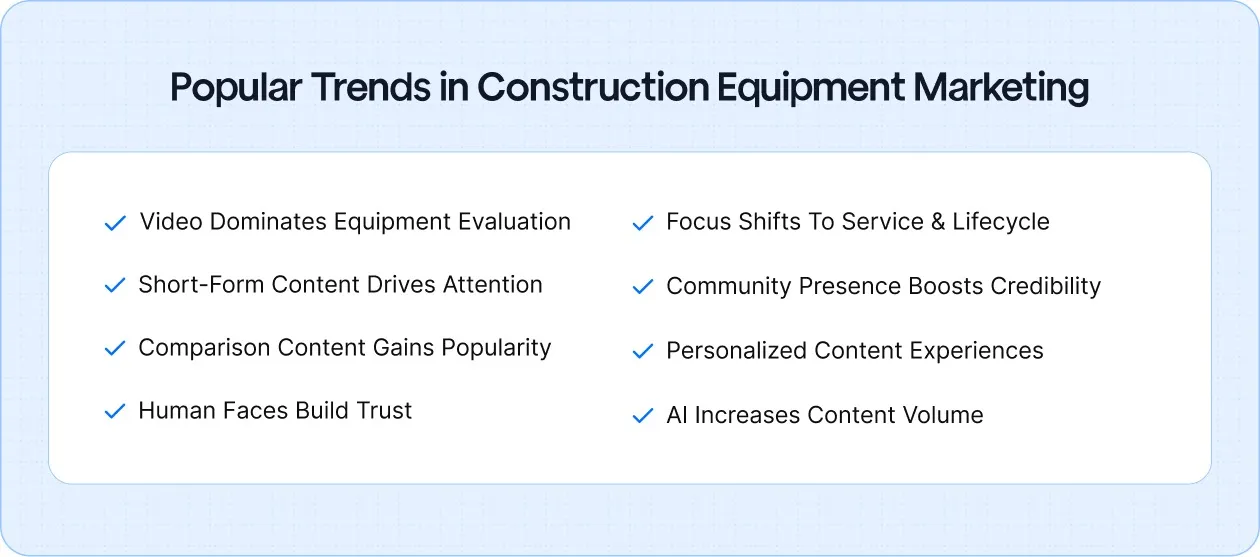
1) Video is becoming the default format for equipment evaluation
Equipment is hard to judge through text alone. The market is leaning heavily into walkarounds, real jobsite footage, and visual demonstrations because they help buyers assess size, condition, controls, and usability faster than specs ever can.
2) Short-form content is doing the top-of-funnel heavy lifting
Snackable clips are now carrying early attention. A 20–40 second video showing equipment in action often travels further than a brochure-style post, especially on mobile-first platforms.
3) Comparison-style content is gaining traction in high-intent research
More buyers want help choosing between options. Content framed around comparisons, trade-offs, and selection criteria is increasingly shaping shortlists, especially for common category decisions.
4) The “human face” of equipment businesses is becoming a differentiator
Brands are moving away from purely product-led communication and leaning into people: technicians, operators, service teams, and delivery crews. In a trust-heavy industry, buyers respond strongly to signals of competence and real operational depth.
5) Marketing is moving closer to service and lifecycle support narratives
Attention is shifting toward long-term equipment outcomes: uptime, maintenance readiness, parts support, inspections, and field responsiveness. Even when a buyer’s primary interest is acquisition, lifecycle confidence is shaping their supplier preference.
6) Community presence is becoming a credibility channel
Construction equipment brands are tying themselves more visibly to local projects, contractor communities, and regional activity. This is not “branding for the sake of it.” It’s becoming a signal of seriousness and real-world involvement.
7) Personalisation is showing up in content experiences
Instead of one generic message, brands are moving toward content tailored by equipment category, job type, or buyer profile. This trend is strongest in multi-branch and multi-category suppliers who need clarity at scale.
8) AI-assisted content production is increasing content volume
More brands are publishing frequently using AI tools, which is making “basic content” less competitive. The gap is widening between content that looks generated and content that feels field-informed, experience-backed, and commercially useful.
Build a Construction Equipment Marketing System That Compounds
If your marketing feels busy but unpredictable, it’s usually because the work is scattered. Ads run in one corner, the website sits untouched, social posts go out when someone remembers, and sales follow-ups happen with no repeatable flow.
Gushwork fixes that by building one connected system where every channel supports the next step and every asset has a job.
What Gushwork Helps You Execute:
- High-intent SEO that captures buyers when urgency hits: We target searches tied to rentals, repairs, parts, and availability so you show up when someone actually needs equipment.
- Website and landing pages built to convert fast: Clear inventory pathways, tap-to-call actions, frictionless quote forms, and pages that answer the questions buyers ask before they reach out.
- Content that reduces buyer hesitation: Walkarounds, comparison pages, inspection/process proof, and jobsite-ready explainers that support decisions and shorten sales cycles.
- Local visibility that makes you the obvious nearby option: Strong Google Business Profiles, service-area coverage, location hubs, and trust signals that help you win map pack clicks.
- Paid campaigns that match urgency and route to the right pages: Rentals and service ads go to fast-action pages, not generic homepages. Research traffic goes to comparison and capability pages.
What You Get Without Building a Whole Internal Team:
- A clean channel plan that fits how equipment gets bought
- Consistent execution across SEO, content, website, and local
- Faster lead handoffs with fewer “unqualified” enquiries
- A marketing engine that stays current, not one-off campaigns
If you’re ready to stop running disconnected tactics and start generating consistent inbound enquiries, Gushwork can build and run your construction equipment marketing engine.
Conclusion
The real win is momentum. When your best pages keep ranking, your ads point to the right inventory and service offers, and your content answers the same questions your sales team hears every week, lead quality improves without constant rework.
If you want help building that kind of marketing engine, Gushwork can take it off your plate. We help construction equipment brands turn inventory, service capability, and local visibility into a steady flow of qualified enquiries, with content, SEO, and conversion-focused execution that actually matches how this industry sells.
Build a Marketing System That Compounds
If your ads, content, and local visibility aren’t working together, leads stay inconsistent. Let’s fix the engine, not just the output.


.webp)




.webp)


.svg)


