









Most electricians don’t struggle because customers aren’t interested. They struggle because once the job is done, the relationship quietly fades. No follow-up. No reminder. No reason for the customer to think of you again until something goes wrong, and by then, they’re searching from scratch.
Email marketing changes that dynamic by creating a steady line of communication that keeps your business familiar, credible, and easy to return to.
In this blog, we break down how electricians can use email marketing strategically. From what to send and when, to automation, segmentation, and measurement, you’ll learn how email fits into a practical marketing system that supports real business growth.
What is Email Marketing for Electricians?
Email marketing for electricians is the structured use of email to stay connected with past customers, nurture potential clients, and convert interest into booked jobs.
Unlike one-time ads or passive website visits, email gives you a direct communication channel with people who already showed intent, trust, or curiosity at some point.
For electricians, email is about being present when customers aren’t actively searching for home services, guiding them when they don’t understand electrical risks, and reminding them when maintenance, upgrades, or safety checks are due.
Where Email Marketing Fits In The Electrician's Industry?
Email marketing sits alongside your other marketing channels as the engine that keeps conversations alive long after the first interaction. While SEO, ads, referrals, and offline marketing help bring people to you, email helps you stay relevant so they don’t forget you when they actually need service.
Supporting SEO, PPC, Referrals, And Offline Work
SEO and PPC drive discovery. Referrals drive trust. Offline branding drives familiarity. Email strengthens everything by nurturing those contacts:
- It follows up on leads SEO and ads helped you capture, instead of letting them go cold.
- It supports referrals by reinforcing credibility with helpful, value-driven communication.
- It keeps offline contacts warm by turning business cards and job records into ongoing relationships.
Make Every Channel Work Together
Align content, SEO, and visibility so email supports a system customers already trust.


Staying Visible Between Service Needs
Electrical services are not daily purchases. People may go months or years without calling an electrician. Email keeps your brand top-of-mind during these long gaps:
- Gentle maintenance reminders keep you relevant without pushing.
- Educational content builds awareness of risks and upgrades people often ignore.
- Occasional updates ensure customers remember your name when a real problem happens.
Reducing Reliance On Paid Lead Platforms
Platforms like Angi, Thumbtack, HomeAdvisor, and shared lead services can be expensive and competitive. Email helps you build your own audience so you don’t depend on them forever:
- It turns one-time customers into repeat customers.
- It reduces the constant pressure to “buy leads” to fill your schedule.
- It increases lifetime value from every job you complete.
In short, email marketing strengthens marketing efforts and makes every lead you earn more valuable.
How Electricians Can Build a High-Impact Email Marketing System?
Email marketing works for electricians when it stops sounding like “marketing” and starts functioning like a dependable communication engine that educates, reminds, reassures, and converts. Customers want safety, reliability, quick help in emergencies, and clarity on costs, and an email system delivers exactly that.
Here’s how to build one:
1. Build The Right Lists For Residential And Commercial
You don’t talk to a homeowner the same way you talk to a property manager. Your email list should reflect that.
Start with clean, separate lists
- Create at least two main groups: Residential customers and Commercial/industrial contacts like facility managers, builders, and property managers.
- Collect email plus name, phone, zip code, and basic service type (repairs, installs, maintenance) so you can send relevant messages.
Use soft opt-ins for residential
- Add a simple checkbox on your booking form: “Email me updates, maintenance tips, and occasional offers.”
- After each job, ask if the customer wants reminders for inspections, safety checks, or annual maintenance, then add them to your list when they say yes.
Use targeted sourcing for commercial
- Build commercial lists from local business parks, office buildings, HOAs, and industrial parks, focusing on decision-makers like operations, facilities, or property managers.
- Keep a spreadsheet or CRM to tag contacts by building type and potential contract size so you know where to focus follow-ups.
2. Use Cold Email Only For High-Value Commercial Work
Cold email can work well when you go after fewer, bigger clients like office buildings, schools, or warehouses, not homeowners.
Protect your main domain
- Buy one or two alternate domains (for example, yourelectricalco.co or yourelectricalco.net) and send cold emails from those, not from your main website address.
- “Warm up” those domains with a tool that sends small volumes of generic emails for a couple of weeks, so you don’t end up in spam on day one.
Keep lists clean and targeted
- Use a verifier tool on any scraped or purchased list to remove risky addresses before sending.
- Only keep contacts that match your ideal profile, such as facilities managers in your region, so you’re not wasting sends on people who will never hire you.
Send short, honest sequences
- Write sequences of three to five short emails, each about one specific benefit such as fewer outages, faster response, or safety compliance.
- Stop the sequence automatically when someone replies or books a call, so they don’t keep receiving follow-up emails after they are already engaged.
3. Set Up Simple Automation For Existing Residential Customers
Once a homeowner trusts you, a good email system keeps that relationship alive without you having to remember every follow-up.
Create a “new customer” follow-up sequence
- Week 1: Send a thank-you email confirming what you did and how to contact you if issues arise.
- Week 2: Share one or two simple safety or energy tips related to their job, such as breaker panel safety or lighting efficiency.
- Week 3: Ask for a review with a direct link to Google or your main review platform.
- Week 4: Send a light check-in to confirm everything is working well and gently remind them about reviews if they haven’t left one yet.
Add yearly reminders for safety and maintenance
- Schedule annual emails for things like panel checks, surge protection reviews, or rental property inspections.
- Offer a small recurring discount or “existing customer priority booking” so clients feel rewarded for staying with you.
4. Write Emails People Actually Want To Open
Electricians stand out in the inbox by being clear, human, and helpful.
Focus on strong, simple subject lines
- Aim for lines that answer “Why should I care?” in one second, such as “Quick check on your breaker panel” or “Is your rental up to code this year?”.
- Avoid clickbait; if the subject mentions a benefit, make sure the email delivers it.
Keep messages short and scannable
- Use short paragraphs, clear headings, and bold key phrases so people can skim and still get the point.
- End with one clear next step such as “Reply to book a slot,” “Click here to schedule,” or “Call this number for emergencies.”
Lead with value, then mention services
- Start with something useful such as a safety checklist, a quick energy-saving tip, or a common issue you are seeing in your area.
- Then explain how you can help if they want you to handle it, instead of opening with a sales pitch.
Give Customers a Reason to Remember You
Create clear, helpful content that electricians can reuse in emails to stay top of mind between jobs.
5. Re-Activate Old Contacts And Missed Opportunities
A lot of work hides inside “quiet” contacts who liked you once but haven’t booked again.
Segment your inactive list
- Identify customers who have not opened emails or booked any job in six to twelve months.
- Exclude obviously cold contacts, such as bounced emails or people who asked to stop receiving messages.
Send simple “are you still okay?” campaigns
- Use short reactivation emails like “Do you still need help with electrical work at [street or area]?” with a clear “Yes, I might” button.
- Offer a light re-engagement incentive such as a safety inspection or small discount for bookings made within a short timeframe.
Clean your list regularly
- Remove contacts that never open or respond after several attempts, so your open rate improves and spam risks stay low.
- Keep your list focused on people who genuinely know your brand or could realistically hire you again.
6. Combine Email With Other Channels Instead Of Running It Alone
Email works best when customers see your brand in more than one place.
Sync email with ads and social
- Upload your email lists to platforms that support custom audiences, so your best contacts also see you in local social ads.
- Use the same message across email, ads, and your website, so the experience feels connected rather than random.
Tie the email into your CRM
- Store email engagement data in your CRM, such as opens, clicks, and replies, so you know who is warming up.
- Prioritize follow-up calls to people who open important messages or click on high-intent links like maintenance plans or quote requests.
Measure what actually drives work
- Track simple numbers: emails sent, opens, replies, booked jobs, and revenue from email-sourced work.
- Keep what brings actual jobs and quietly cut what only brings empty metrics like opens with no calls.
7. Respect Inbox Rules And Build Long-Term Trust
A healthy email system depends on trust with both your customers and email providers.
Stay compliant and transparent
- Always include a clear unsubscribe link and a postal address or legitimate business details in every email.
- Avoid sending marketing messages to people who never agreed to receive them, especially on the residential side.
Protect your sender reputation
- Keep bounce rates low by cleaning lists and using verifiers for cold outreach.
- Avoid spammy wording, excessive punctuation, and huge image-only emails that can trigger filters.
Think like a long-term partner
- Use email to build familiarity and peace of mind, not constant discount offers.
- Aim for customers who think, “These are my electricians,” not “These people email me nonstop.”
Done this way, email becomes a quiet but consistent engine, keeping you in front of the right people, at the right time, with the right message that turns into real booked work.
Best 8 Strategies for Email Marketing for Electricians
Here are eight practical strategies that go beyond the basics and actually help you book more paid jobs.
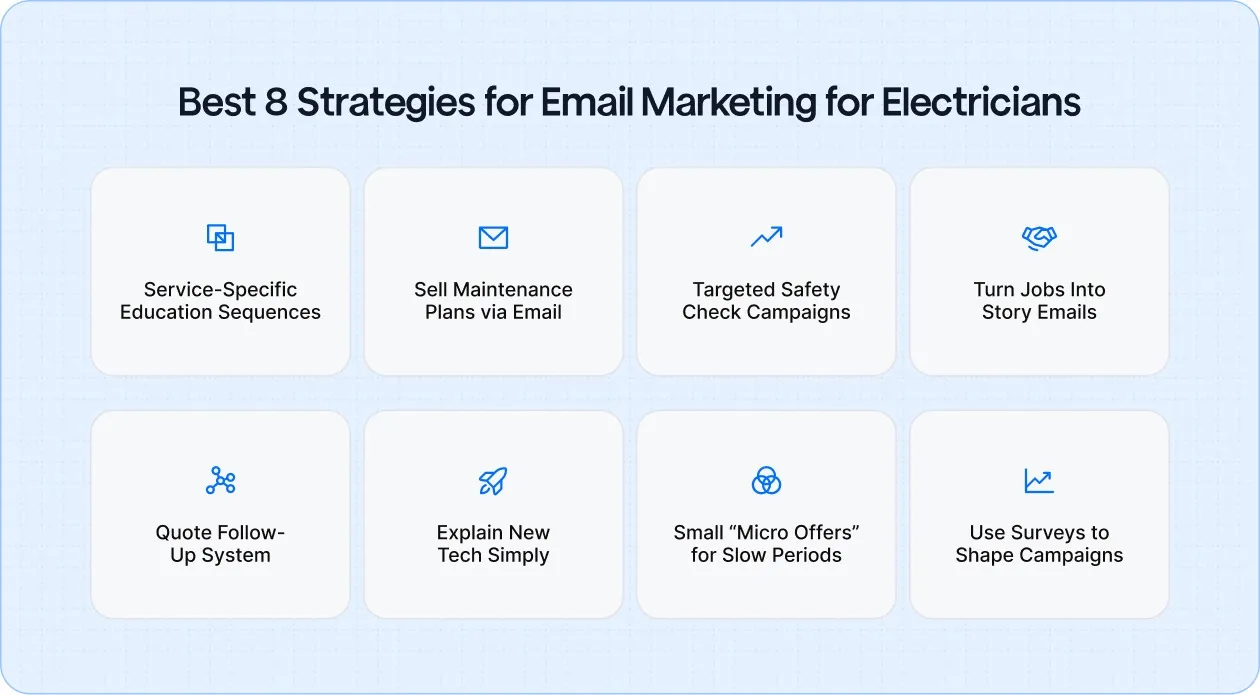
1. Build Service-Specific Education Sequences
Not every subscriber needs the same advice. A landlord, a new EV owner, and a restaurant manager care about different risks and upgrades.
How to set this up:
- Tag each contact by the main service they used or asked about, such as EV chargers, panel upgrades, lighting, or commercial work.
- Create short three to four email sequences per tag, focused on safety tips, common issues, and simple upgrade ideas for that specific service.
- Include one clear “If you want us to handle this for you” call to action in each email.
2. Use Email To Sell Maintenance Plans And Service Agreements
Email is perfect for explaining the value of maintenance plans without rushing the conversation on-site.
How to approach this:
- Send a simple “Here’s what a yearly check includes” email with bullets and plain pricing.
- Explain the benefits in customer language: fewer surprise outages, faster response, and clear records for insurance or compliance.
- Offer a small perk for plan members, such as priority booking or a discounted yearly plan for 2 to 3 services.
3. Run Targeted “Safety Check” Campaigns By Home Or Building Type
Electrical issues feel abstract until they match a real risk. Safety campaigns make those risks concrete without scaring people.
How to target these:
- Segment by rough home age or type if you collect that data, such as older homes, rentals, or small businesses.
- Send short campaigns about specific risks: overloaded panels, old wiring, or unprotected surge points.
- Offer a fixed price “safety visit” with clear scope, so it feels like a decision, not an open invoice.
4. Turn Finished Jobs Into Simple Story Emails
People remember stories better than features. Use past work to show what you do.
How to build story emails:
- Pick one job each month and write a short “Problem → Work done → Result” summary with one or two photos.
- Remove technical jargon. Focus on how it helped the customer: no more outages, quieter lighting, safer panel.
- Add a line like “If your setup looks similar, reply and we’ll take a look.”
5. Create A Quote Follow-Up System Based On Job Size
A small outlet repair and a full panel upgrade do not need the same follow-up rhythm.
How to structure this:
- Group open quotes by value bands, such as under $500, $500–$3,000, and above that.
- For small jobs, send one short reminder after a few days, then close the loop politely.
- For larger quotes, plan several touches, such as one check-in, one “questions you might have” email, and one final deadline reminder.
6. Use Email To Explain New Technologies In Plain Language
New products, such as smart panels or advanced surge protection, confuse many customers. The electrician who explains them simply often wins the work.
Ways to do this:
- Send occasional “plain English” explainers on one topic only, like EV charging, whole-home surge protection, or LED conversions.
- Answer basic questions: what it does, who needs it, what a typical job looks like, and rough price ranges.
- End with a soft “Want us to see if this fits your home or building?” invite.
7. Build Small “Micro Offers” For Slow Periods
Instead of blasting discounts at random, time small offers to help fill slower weeks without training customers to wait for deals.
How to use micro offers:
- Identify months or days when your schedule often has gaps.
- Email a limited, clear offer to a small segment, such as existing customers in a close radius or past repair clients.
- Keep offers simple, like a fixed price safety check or a small discount on one upgrade, and make the end date clear.
8. Use Surveys And Quick Polls To Shape Future Campaigns
Your list can tell you what to sell next, if you ask the right questions.
How to collect insight:
- Send one or two question polls a few times a year, such as “What worries you most about your electrical setup?".
- Ask which topics they want help with, like saving on bills, safety checks, or smart home service upgrades.
- Use the answers to design your next campaigns, offers, and education sequences so they match real demand.
Final Thoughts
Email marketing doesn’t replace good service, referrals, or local visibility. It supports them. For electricians, its real value shows up over time. In fewer dropped leads. In customers who come back without being reminded. In jobs that get approved faster because trust has already been built.
The difference between email that gets ignored and email that works comes down to intent and structure. When emails are written with purpose, timed around real customer behavior, and measured against actual outcomes, they stop feeling like marketing and start feeling like part of how the business runs.
Ready to Build Repeat Business
Get a practical marketing system that supports steady work without relying only on ads or lead platforms.


.webp)




.webp)


.svg)


