










Most contractors win work because someone nearby noticed them at the right moment. That moment is almost always a local search. A homeowner types “roof repair near me” at 10 p.m., a property manager searches for “commercial HVAC service [city],” or a facilities lead checks reviews while shortlisting vendors. If your business does not show up there, those jobs go to someone else.
Local SEO is simple in idea and fiddly in practice. It is about the small signals that prove you are nearby, reliable, and ready to respond.
In this blog, we break down how local SEO works for contractors, what actually influences local rankings, where most businesses go wrong, and how to build steady local visibility that brings in better-fit enquiries.
Understanding Local SEO for Contractors
Local SEO is how your business shows up when someone nearby needs work done now. It’s a system that proves to Google and to people that you are real, relevant, and ready to help their particular job.
For contracting firms, good local SEO delivers the right kind of leads: phone calls, booked estimates, and urgent service requests. That happens when your online presence answers the two questions every buyer has in the first 30 seconds: can they do this job, and can they do it soon?
How Google Chooses Which Contractors to Recommend?
Google weighs three core signals and dozens of supporting signals to decide which contractors to show for a local search.
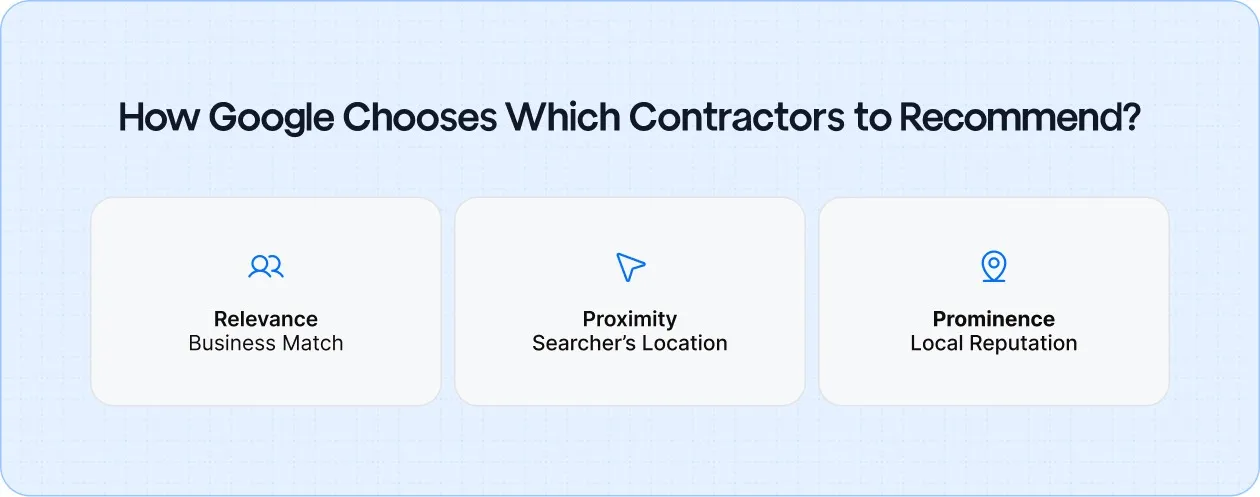
1) Relevance — Does your business match the search?
Google looks for a clear match between what the searcher wants and what you offer. That means your categories, service descriptions, and website copy must use the language real customers use: “fence installer,” “sump pump repair,” “commercial concrete.”
2) Proximity — How close are you to the searcher?
Distance still matters. For many local searches Google prioritizes businesses physically near the searcher. But proximity is not only street-to-street distance.
3) Prominence — How trustworthy and known are you locally?
Prominence is how Google estimates your real-world reputation. It pulls evidence from on-site SEO and the wider web. Signals of prominence include:
- Business profile completeness.
- Structured data and schema.
- Mobile experience and page speed.
- Verified ownership and responsiveness.
- Entity signals.
10+ Core Local SEO Strategies for Contractors
Local SEO for contractors works when every piece of your online presence backs up the same story: what you do, where you do it, and why home service customers should trust you with the job.
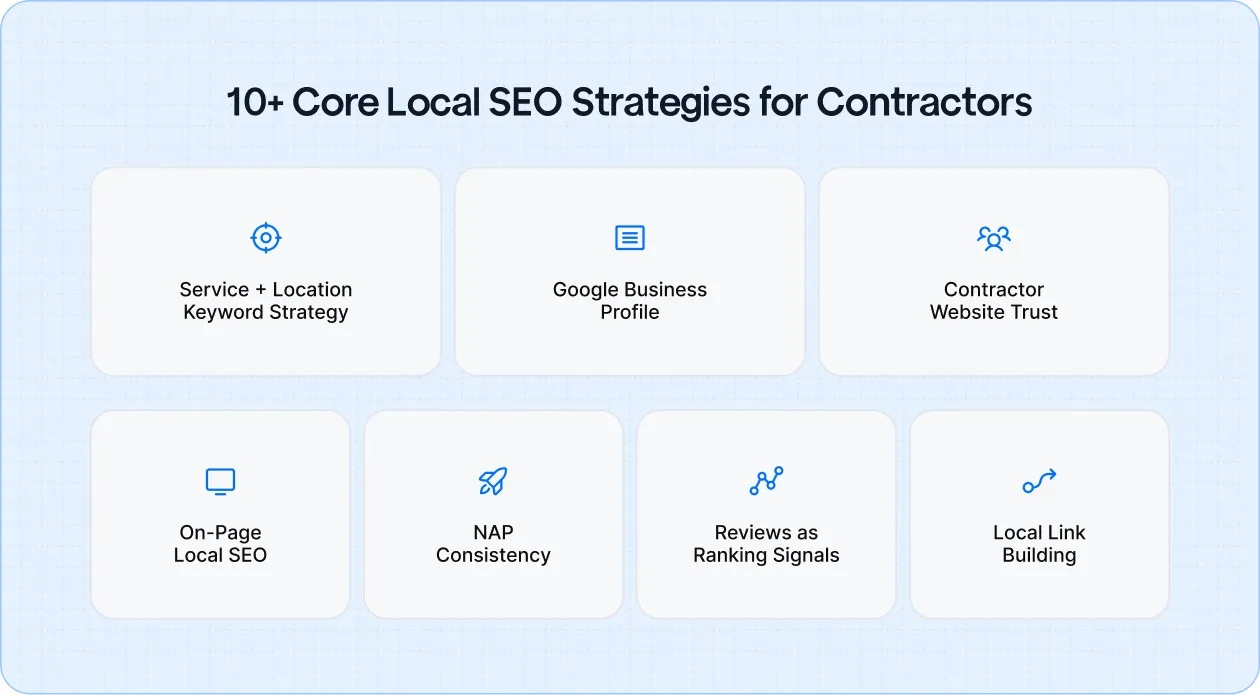
This section breaks local SEO into practical pillars you can actually execute:
Nail Your Service + Location Keyword Strategy
Contractor searches are rarely generic. People search in the exact moment they need help, usually with location and urgency baked in. Your keyword strategy should reflect how real homeowners speak, not how contractors describe their services internally.
- Start with how people search when they are ready to hire: Homeowners search using combinations like service + city, service + “near me”, or problem + urgency. That pattern tells you what matters to them: speed, trust, and relevance.
- Target four keyword buckets that drive local jobs: Build your SEO around keywords that directly map to revenue-generating work:
- Service-based keywords like “roof replacement” or “bathroom remodel”
- Location-based keywords like “HVAC repair in Austin”
- Service-area keywords like neighborhoods, suburbs, and zip codes
- Problem-based keywords like “leaking ceiling repair” or “foundation crack fix”
- Prioritise intent over volume every time: A keyword with lower search volume often produces better leads because it signals real urgency. “Cost to replace a roof in [city]” usually converts better than “roofing.”
- Use real data sources: Pull keywords from:
- Google Business Profile search queries (what people typed before they found you)
- Search Console (what you already show up for)
- Competitor service pages (how they structure and position)
- Tools like Semrush/Ahrefs to identify gaps and variations
- Don’t build content for services you don’t want to sell: If you try to rank for everything, you attract the wrong jobs and dilute relevance. Build visibility around services that are profitable, repeatable, and operationally realistic.
Target the Right Local Jobs
Identify the exact services, neighborhoods, and “urgent intent” searches that bring in serious enquiries.


Your Google Business Profile Is the Core Asset
For most contractors, your Google Business Profile is the main engine behind local calls. It shapes whether you show up in the map pack, and it heavily influences trust before anyone even visits your website.
- Set up the profile to match how customers choose contractors: Choose the right primary category, add accurate service areas, set hours properly, and write your business description in plain customer language. Avoid internal terms and focus on what homeowners want solved.
- Use content that proves you do real work locally: Upload photos that show you are active and legitimate:
- Jobsite photos with real conditions, not staged stock images
- Before-after photos that tell a story, not just visuals
- Team, trucks, and uniforms that reinforce professionalism
- Short job notes that explain what was fixed and where
- Post weekly updates that keep you “alive” in Google’s eyes: Small, consistent updates work: seasonal reminders, recent jobs, service highlights, or availability changes. This keeps your profile active and relevant.
- Treat interactions as ranking signals: Calls, direction requests, website clicks, and messages matter. Your profile should make these actions easy.
- Multi-location needs separate credibility: If you expand into a new city, it needs its own local proof. Each profile should show local job photos, reviews, service focus, and accurate service areas.
Win the Local Map Pack
Optimize your Google Business Profile, reviews, and local signals so you show up when homeowners search fast.
Build a Contractor Website That Google and Customers Trust
Your website is the proof layer behind everything people see on Google. If it feels unclear or generic, visitors bounce and rankings drop over time.
- Make the homepage do the heavy lifting immediately: Within seconds, the homepage should clarify:
- What you do
- Where you work
- Why you are trusted
- How to request a quote or call
This matters because local traffic often lands on your homepage first.
- Create service pages that answer real hiring questions: Every core service should have its own page, built around buyer concerns: scope, process, time required, pricing factors, and what happens next. Include FAQ blocks because homeowners always hesitate at the same points.
- Build service area pages only when you can do them properly: City pages can help when you truly serve those areas and can add real local context. A good location page includes neighborhood references, local job examples, and service specifics. Thin template pages that only swap city names usually hurt more than they help.
- Use project pages as conversion assets: Strong case studies explain: the problem, the constraints, the work done, and the result. These pages win hesitant buyers because they show competence without sounding salesy.
- Design for mobile-first behaviour: Most contractor searches are on phones. Your site must make it easy to call, request a quote, and understand your services without pinching, zooming, or hunting for info.
On-Page Local SEO That Drives Shortlisting
Contractor on-page SEO removes doubt. It helps Google understand your page and helps homeowners quickly decide whether they should contact you.
- Write titles and headings that signal local fit: Use “service + location + trust cue” in a natural way. A title like “Deck Repair in Raleigh | Licensed & Insured” works because it matches the search and builds confidence.
- Add local proof where it feels natural: Mention real service areas, job contexts, and local references inside service pages. Include review snippets where they support credibility, not as decoration.
- Build internal linking as guided navigation: Your website should guide people logically:
- Blog posts → relevant service pages
- Service pages → related service areas
- Project pages → the service they provide
This keeps people moving instead of bouncing.
- Optimise images as local proof: Rename files clearly, write useful alt text, and compress images for speed. Add context in captions or surrounding copy so Google understands what and where the work was.
- Use schema that supports contractor visibility: LocalBusiness, Service, FAQ, and Review schema help search engines interpret your business details and page intent more clearly, which supports rankings and click-throughs.
Local Citations and NAP Consistency
Citations are how Google verifies you are real across the web. If your details vary from site to site, it creates doubt, and doubt hurts local rankings.
- Treat citations like identity verification: Consistent listings reinforce your legitimacy: same business name, phone number, categories, and location details everywhere.
- Lock down your NAP rules and follow them strictly: The smallest variations create confusion: “Street” vs “St.”, two different phone numbers, or slightly different business names. Standardise and apply across every platform.
- List your business where local buyers and Google trust it: Focus on:
- Local directories and chamber listings
- Industry platforms and supplier directories
- Trusted community sites and trade bodies The goal is quality and consistency, not volume.
- Clean up old information proactively: If you moved locations, changed phone numbers, or rebranded, outdated listings can quietly damage trust. Fix these before scaling content.
- Service-area businesses need extra care: If you hide your address, your service areas and business details must be clean and consistent. Otherwise, Google struggles to place you correctly.
Reviews Are a Ranking Signal and a Deal Closer
Reviews do two things at the same time: they help you rank, and they help you get hired. For contractors, they may be the strongest trust lever you have.
- Understand what makes reviews powerful locally: Google looks at recency, quantity, sentiment, and detail. Homeowners look at proof, language, and consistency. You need both.
- Ask for reviews using timing that feels natural: The best time is right after a job is completed and the client is satisfied. Make it simple: one direct link, one clear request, no complicated process.
- Respond to every review like it matters: Replies show professionalism and reinforce service relevance. A short response that references the service and location strengthens trust signals without sounding forced.
- Use reviews across your website strategically: Don’t hide reviews on one page. Place testimonials on service pages, location pages, and near quote forms, where they influence decisions.
- Tools can support scale: Reputation management tools help collect and organise reviews, but they don’t replace real follow-through and good service.
Local Link Building That Contractors Can Actually Do
Local link building is about showing up as a real part of your community and industry, online and offline.
- Build links through relationships you already have: You can earn links through:
- Builders, suppliers, and subcontractors you work with
- Realtors and property managers you collaborate with
- Local associations, trade bodies, and memberships
- Sponsor local events that come with real visibility: Sponsorships work when they include online mentions: community events, sports teams, charity drives, or local trade programs.
- Use projects as linkable proof: Publish case studies and job spotlights that other businesses want to reference. These earn links naturally because they are useful, local, and specific.
- Avoid junk links that harm credibility: Paid spammy backlinks might look like “SEO,” but they dilute trust. Local SEO is built on reputation signals.
How to Use This Section?
Before you try advanced local SEO tactics, make sure your foundation is in place. Contractors get the fastest wins by tightening the basics that directly impact calls and quote requests.
- Optimize your Google Business Profile (services, photos, posts, hours, service areas)
- Build consistent reviews and reply to them regularly
- Publish 1–2 core service pages that target your highest-demand jobs
- Then layer in advanced tactics once the basics are stable and performing
Advanced Local SEO for Contractors
Once the basics are solid, local SEO becomes a game of refinement: making your information easy to extract by machines, easy to act on by people under pressure, and uniquely local:
Voice Search and Conversational Query Optimization
Homeowners speak differently than they type. Voice queries are question-driven and often include context like urgency or location.
What to do:
- Write conversational FAQ blocks that answer full questions people ask aloud (“Who does emergency sump pump repair near me?”).
- Use natural-language headings and short, direct answers (one to two sentences) that can be read aloud by assistants.
- Add time-sensitive phrases and availability info (“open now,” “same-day service”) where true; voice assistants surface these.
- Include local landmarks and neighborhood names in answers — voice queries often use landmarks (“near the stadium”) rather than exact addresses.
Answer What Buyers Ask First
Create service and location content that reduces doubt, builds trust, and improves call quality.
AI-Answer Readiness: Make Your Pages Quotable
AI overviews and answer engines pull and summarise content. You want to be the source they quote, not an anonymous page they ignore.
What to do:
- Structure content into small, clearly titled blocks (definition, steps, pros/cons, quick checklist).
- Use short, literal sentences and include bullet lists or tables for extraction.
- Add concise one-line answers at the top of FAQ entries or how-to blocks that an AI can lift verbatim.
- Keep technical accuracy high — contradictions across pages reduce the chance AI will use you as a source.
Entity-Based SEO: Build a Local Identity
Google builds knowledge graphs from real-world signals. Your objective is to be a clearly defined local entity that connects to people, places, and institutions.
What to do:
- Ensure consistent, rich profiles for business owners, managers, and lead technicians (LinkedIn, supplier sites, association directories).
- Publish local partnerships and sponsorships with clear online citations that tie your brand to community or industry entities.
- Create authoritativeness around specific services by owning terms tied to local needs (e.g., “Seattle seismic foundation retrofit — [Your Company]”).
- Keep a short, factual team/owners page with bios that link to public profiles and association memberships. These human links strengthen the entity signal.
Multi-Location Scaling Without Cannibalization
Growing into new cities requires local proof for each location — not cloned pages.
What to do:
- Give each location unique, localised content: local project pages, staff photos, testimonials from that area, and locally relevant FAQ.
- Use a location hub page that aggregates links to each neighbourhood’s proof; avoid templated city pages that only change the name.
- Implement canonical and hreflang-like rules for service variants to prevent index competition. Keep technical metadata unique per location.
- Automate but curate: use templates for structure, but require manual local proof (one job photo, one review) before a location page goes live.
Hyperlocal Content and Neighborhood Relevance
Big-city pages are noisy. Hyperlocal pages win attention from homeowners who search with neighborhood or landmark references.
What to do:
- Create problem-solution pages for neighbourhoods (e.g., “Basement waterproofing for [neighborhood] row houses”) that include local conditions, common property types, and one nearby project example.
- Publish micro-guides about permit processes, seasonal problems, or local building quirks in each area — these are highly linkable by community sites.
- Use local data (flood zones, soil type, weather patterns) to make pages uniquely valuable and defensible.
Behavioural Signal Optimization and Microconversions
Google watches actions: calls, clicks, direction requests, booking starts. Optimize pages to generate the right signals.
What to do:
- Add intent-specific CTAs: “Request Same-Day Quote,” “Upload Drawing / Photo,” or “Check Truck Availability.” These encourage meaningful clicks.
- Implement lightweight microforms and click-to-call buttons above the fold for mobile visitors.
- Track microconversions (click-to-call, booking-start, download spec) and prioritise pages that drive them when optimising content.
- Use UTM-tagged local campaigns (ads, posts) to prove locality and push behavior that boosts map visibility.
Local PR, Partnerships and Crisis Preparedness
Real-world events move online quickly. Local PR coverage, partnerships and a crisis playbook create durable trust and protect visibility when things go wrong.
What to do:
- Maintain a simple press page with local mentions, awards, and community work; link these to partner sites for authoritative citations.
- Build an alert list of local media and trade outlets and offer expert commentary on safety, weather-related damage, or regulation changes to earn mentions.
- Prepare templated responses and a updates protocol for service interruptions or safety incidents so you can post rapid, accurate information that Google can index.
Common Local SEO Mistakes to Avoid for Contractors
Most contractor local SEO problems don’t come from “not doing SEO.” They come from doing the right things in the wrong way.
Here are the most common mistakes contractors make, and what to do instead:
Stuffing Keywords Into Your Business Name
Adding extra keywords like “Best Roofing Contractor Dallas” inside your business name might feel like a shortcut, but it often backfires.
- Google treats this as spammy behaviour and can suppress visibility or trigger profile edits.
- It also creates inconsistency across listings, which weakens trust signals.
- Keep your name exactly as it appears on signage, invoices, and legal documents. If you want to rank for services, do it through categories, services, and strong service pages.
Publishing Thin “Template” Location Pages
Contractors often create dozens of city pages by swapping names and repeating the same content. Google usually sees through it.
- These pages don’t offer real local relevance, so they rarely rank well.
- Worse, they can dilute your site’s credibility because the content feels repetitive and low-effort.
- Only create location pages when you can make them specific: actual service availability, local projects, neighborhood mentions, and job-focused FAQs.
Targeting Too Many Services You Don’t Want to Sell
Trying to rank for everything pulls you into low-quality jobs and wastes your SEO focus.
- If you include services you don’t really want, your leads become messier and harder to close.
- It also weakens clarity in your Google Business Profile and website structure.
- Focus on core services you can deliver profitably and repeatedly, then expand slowly once those pages perform.
Uploading Stock Photos Instead of Real Job Proof
Stock images make your business look generic. Real photos make it believable.
- Google Business Profile performance improves when your visuals show real work.
- Homeowners trust contractors more when they see actual teams, trucks, projects, and results.
- Use jobsite photos, before-after shots, and short job descriptions that tie visuals to services.
Conclusion
Local SEO for contractors pays off in fewer cold calls and more conversations that matter. When your listings, pages, and reviews line up with how people search, you stop competing on price and start competing on trust and availability. That means less chasing and more work that fits your schedule and margins.
Start with the basics: claim your profiles, tidy your NAP data, and make service pages that answer the exact questions clients ask. Then layer in reviews, local content, and measurement so you can see what improves enquiries. Do that consistently, and search stops being random. It becomes a dependable source of qualified local leads
Ready for Better Local Leads?
Build a system that brings in qualified enquiries without relying only on referrals or ads.


.webp)








.webp)


.svg)


