









You fix things for a living, yet finding new people to call you often feels harder than the jobs themselves. One week, the phone rings non-stop, the next it goes quiet and leaves you wondering where the work went.
Most handymen don’t have time to chase enquiries; they want steady calls without paying for ads or learning complicated systems. Free handyman leads are possible, and you don’t need fancy tools to get them.
This guide walks you through simple ways to get noticed, get called, and keep your schedule active without extra stress.
Top 7 Ways Handyman Businesses Attract Local Work With Little to No Budget
Getting enquiries without pouring money into ads is less about luck and more about being visible where people already look, sounding credible, and delivering messages that build confidence.
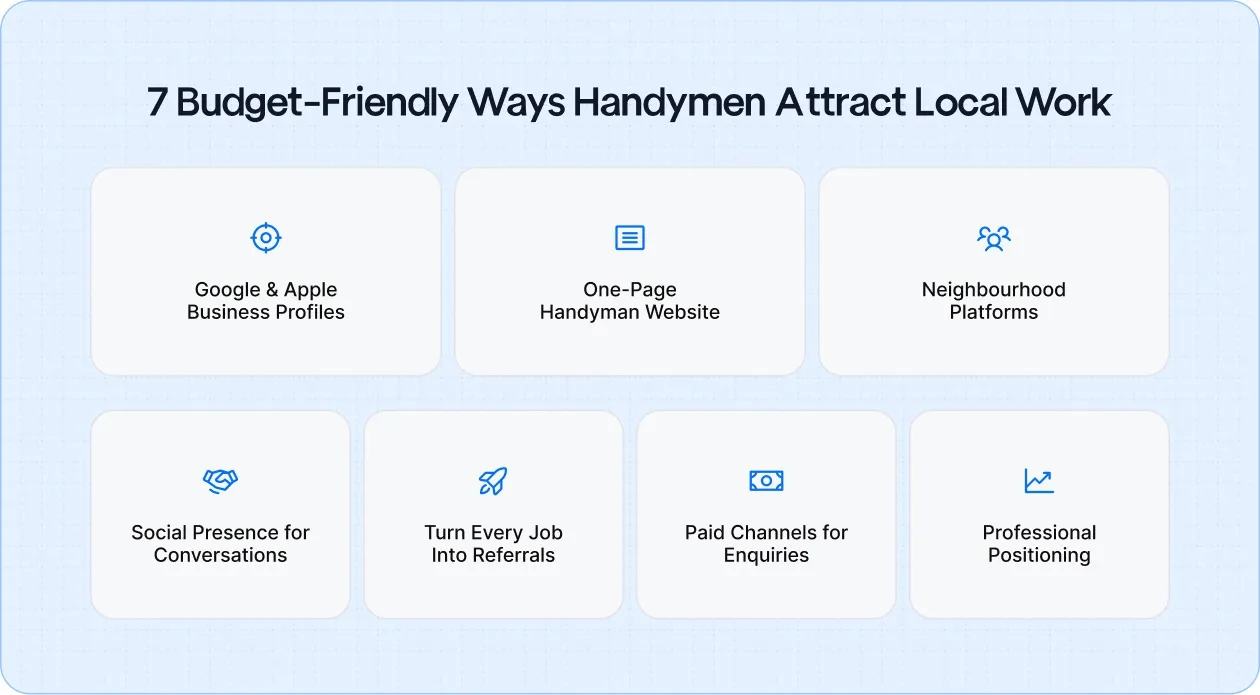
These seven approaches work because they rely on presence, proof, and simple communication, instead of complicated marketing systems.
1. Google Business Profile + Apple Business Connect
Homeowners searching for “handyman near me” rarely scroll far before choosing someone. Google Business Profile (GBP) is one of the first places they’ll look, making it crucial for local visibility.
At the same time, Apple Business Connect is rising fast, especially among iPhone users who default to Apple Maps. Many handymen ignore this, which gives you a simple, early advantage.
Why do these profiles matter?
They appear before your website, control local visibility, and shape first impressions. If these listings look incomplete, unclear, or weak, customers scroll past, even if your skills are excellent.
What actually helps you rank higher?
- Use the words people actually search for: Include “Handyman” in your business name and site content. People search for “handyman,” not vague terms like “improvement specialist.”
- Choose the right primary category everywhere: Set “Handyman” as your primary category on Google Business Profile and Apple Business Connect so platforms can correctly match search intent.
- Optimize photos like micro-ads: Rename image files before uploading with clear, keyword-rich names (e.g., James-Hill-Handyman-Sacramento-deck-repair.jpg instead of IMG00319.jpg).
- Drive reviews with minimal friction: Share your Google Business Profile short review link after every job. Fewer clicks lead to more reviews.
- Keep business information identical across platforms: Ensure your phone number, hours, services, and city match exactly on Google Business Profile, Apple Business Connect, Yelp, Facebook, and LinkedIn. Mismatches cause confusion and hurt visibility.
Your visibility depends on what you say about your business online.
Tap into support that turns local listings into visitor-pulling assets without learning SEO yourself.


2. A One-Page Handyman Website
Top-ranking service sites keep it simple, because homeowners are comparing.
A single, well-structured page can outperform five scattered ones when it:
- Answers what you fix
- Shows where you work
- Proves you’re trustworthy
- Invites someone to call
What does your home screen show?
At first glance, someone should know:
- The cities you cover
- What you repair
- How to reach you
- Why should they trust you
Where do most handymen lose enquiries?
- They hide phone numbers, fail to mention location, or sound generic. Messaging matters.
- Strong service pages speak directly to the reader:
- “Handyman in Dallas fixing drywall, taps, fixtures, and trim with same-day support.”
Elements that help your page convert
- Before/after visuals
- Short testimonials
- Promise of responsiveness
- A clear call to action like: “Call now for a quick estimate. We answer.”
This simple clarity outperforms design-heavy pages every time.
Your pages can spark action when written with purpose.
If putting the right messages on a service page is difficult, expert-written pages can help you attract enquiries without needing an in-house writer.
3. Neighbourhood Platforms Where People Already Ask for Help
Local groups are modern bulletin boards. You’ll find repair requests pouring in across:
- Facebook Groups
- Marketplace
- Nextdoor
- Instagram neighbourhood pages
- TikTok geo-tagged community content
What separates people who get enquiries from those who get ignored?
Helpful presence beats sales pitches. Post examples that perform well:
- “Fixed a sagging cabinet door for a neighbour today, message if you need help.”
- “Weather’s cooling, check outdoor taps. If you want someone to take a look, I’m around.”
On LinkedIn, sharing before-and-after shots or maintenance tips can attract property managers, realtors, and landlords, audiences often ignored by ranking blogs.
4. Social Presence Designed for Conversations
You are not building a brand, you are building trust at glance speed.
Simple content themes work across platforms:
- Before and after project shots
- Short write-ups of “just repaired this today.”
- Quick tips homeowners can use
- City-specific hashtags to get discovered locally
Which platform does what for handymen?
- Instagram and TikTok earn visual authority
- Facebook increases local referrals
- LinkedIn helps attract commercial contacts
5. Turn Every Job Into the Next Three
Most handymen complete a job and move on. The best ones use that job to create a pathway to the next.
Do this by:
- Texting your review link
- Explaining why reviews matter
- Asking for simple referrals
The wording of follow-ups influences results; this is where messaging expertise quietly shapes outcomes.
Must Read: Home Improvement SEO Strategies That Will Get Your Phone Ringing Nonstop
6. Paid Channels That Help While Organic Enquiries Build
Some top-ranking blogs either oversell or dismiss paid sources; reality is nuance.
- HomeAdvisor works if you track contact attempts and request refunds
- Home Depot Pro Referral is useful for credibility
- Thumbtack and TaskRabbit differ in audience behaviour
The hidden risk
- Some platforms dump vague repair requests into “handyman bins.”
- Knowing which enquiries to avoid matters as much as knowing where to sign up.
7. Professional Positioning That Raises Perceived Value
Many people associate “handyman” with informal work, which means that owning the title professionally gives you an advantage.
People often decide whether to call you before they call you, based entirely on clarity, tone, and perceived competence.
That is why expert messaging quietly becomes the difference between “they might pick you” and “you are the obvious one.”
Position yourself as a pro to lead more high-value clients.
Clear, confident messaging communicates professionalism and trustworthiness; expert-written content makes the difference between good and great.
A 30-Day Free Lead Sprint That Produces Work Fast
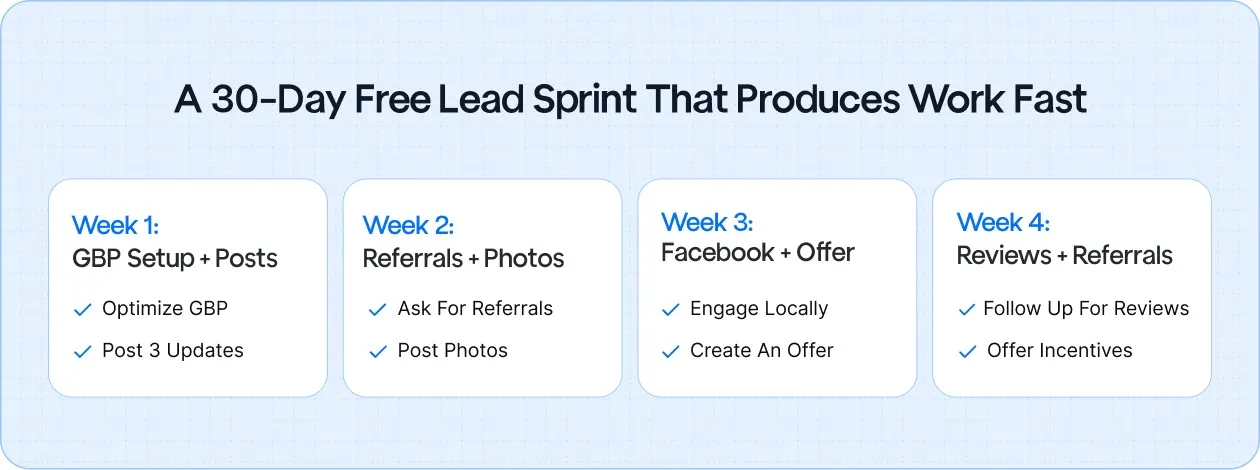
In just 30 days, you can generate consistent enquiries and fill your schedule without relying on paid ads. Here’s a straightforward, week-by-week approach that gets results quickly.
Week 1: Google Business Profile (GBP) Setup + 3 Local Posts
Action Plan:
- Set up and optimize your Google Business Profile (GBP), focusing on the “Handyman” keyword and accurate service areas.
- Post 3 local updates on GBP, like seasonal tips or project highlights, to increase your profile’s visibility.
Result: By the end of Week 1, your GBP will be optimized, giving you a stronger chance of appearing in local searches.
Week 2: Referrals + Photos
Action Plan:
- Ask recent clients for referrals; a simple request can lead to more work.
- Post before-and-after photos of completed jobs on social media or local platforms to demonstrate your skills.
Result: Week 2 will generate new leads from your existing customer base and showcase your work to a wider audience.
Week 3: Facebook Presence + Micro-Offer
Action Plan:
- Join and engage in local Facebook groups and neighbourhood platforms like Instagram or Nextdoor. Share useful tips or showcase a recent job.
- Create a micro-offer, like a discount or free estimate, to encourage immediate inquiries.
Result: Week 3 helps build a local reputation while creating a sense of urgency with your micro-offer.
Week 4: Review Follow-Ups + Referral Trigger
Action Plan:
- Follow up with clients for reviews and share a direct link to make it easy for them to leave feedback.
- Offer a small incentive for each new referral (discount on next service or similar).
Result: By Week 4, you should start seeing repeat business, positive reviews, and new referrals rolling in.
Tracking What Works
Action Plan:
- Track the sources of your leads, GBP, social media, referrals, etc.
- Use a simple CRM or spreadsheet to monitor lead status and follow-ups.
Result: Tracking allows you to refine your strategy and focus on the methods that work best for your business.
Want results without the paid ad spend.
By combining local SEO optimization and referrals, this simple, structured approach will quickly get you the enquiries you need.
Comparison Snapshot: Free Leads vs Paid vs Referrals vs SEO
Understanding how different lead sources perform in both the short-term and long-term is key to building a sustainable strategy for your handyman business. Each approach offers distinct advantages depending on your current needs, budget, and growth stage
Here's a breakdown of how free, paid, referral, and SEO-driven leads stack up.
Why SEO Stands Out for Long-Term, Sustainable Growth?
While paid ads and referrals can bring quick results, SEO is the most powerful strategy for sustainable growth. Paid ads can quickly burn through your budget without long-term benefits, while referrals rely heavily on your existing network.
In contrast, SEO offers lasting visibility on search engines, ensuring your handyman business stays visible to the right audience over time, without continuous investment. By focusing on organic ranking and high-quality SEO-backed content, you can ensure consistent, low-cost leads that accumulate steadily over the long run.
Getting expert help to optimize your SEO strategy ensures that your content reaches the right people, generating qualified leads consistently.
Why Clear Messaging and SEO-Backed Content Matter for Free Leads?
The key to attracting free leads lies in visibility, trust, and clear messaging. When your business is easy to find, and your value is clearly communicated, potential clients are more likely to choose you over competitors.
Growth begins when your content resonates with the right audience. If you want to increase local enquiries without the burden of a large marketing team, partnering with experts who can create compelling, SEO-optimized content is the way forward.
This ensures you consistently bring in the qualified leads that fuel long-term growth.
Growth starts when your content speaks to the right audience.
Gushwork’s expert-written content helps your handyman business attract local enquiries without a big marketing team.


.webp)








.webp)


.svg)


