


Home

Resources
Blogs
Blog
Get insights on AI, productivity, and the future of work.


Thank you! Your submission has been received!
Oops! Something went wrong while submitting the form.
Digital Marketing
Jan 5, 2026
5 mins
The Remodeling Contractor’s Toolbox: 9 Digital Marketing Strategies You MUST Know!
Batul Beawarwala
As a remodeling contractor, you need clients to find your business. Digital marketing makes that possible.
- It helps increase your online presence.
- It allows you to connect with potential clients.
- It builds trust before you interact with them.
With the right digital marketing strategy, you can reach more clients and grow your business. Let’s look at how to make it work.
1. Create a Strong Digital Foundation: Website & Local Listings
To make a lasting impression, your digital presence must be rock solid. A professional website and SEO optimized local listings will help clients easily find you and build trust right away.
- Professional Website Essentials: Your website is the cornerstone of your online presence. It must be easy to navigate, mobile-friendly, and contain clear contact information. Focus on offering a user-friendly experience and clear calls to action, like “Request a Quote” or “Get a Free Consultation,” to prompt visitors to take action.
- Optimize Google Business Profile & Apple Business Connect: Claim and optimize your Google Business Profile and Apple Business Connect to make sure clients can find you on Google Maps and Apple Maps.
With accurate business information, photos, and regular updates, these tools help you gain local visibility and improve the chances of clients finding you through a simple search.
- Local SEO Tips: Get specific with local SEO, use location-based keywords like “kitchen remodeling in Dallas” to help clients find your services in their area.
Keep your NAP consistency (Name, Address, Phone number) uniform across all platforms and update your information regularly to ensure accurate listings.
Must Read: 15 Contractor Marketing Strategies That Actually Bring You More Clients
Want clients to find you easily?
Strengthen your digital presence by ensuring your online details are accurate and visible across local platforms with SEO-friendly listings.
Optimize Your Local SEO


2. Focus on the Right Message: Shift from Features to "Finish Line Language"
Clients care more about how your services will impact their lives than the technical aspects. Shift your marketing focus to show them the result and how their homes will improve after your work.
- Emphasize the Outcome: Instead of describing what you do, explain how your work improves your clients’ daily lives. Focus on the outcome, how a new kitchen increases their family’s comfort or how a remodeled basement transforms their space.
- Sell Benefits, Not Features: Show what your work offers: freedom, more space, and a better lifestyle. For example, instead of saying “kitchen remodeling,” emphasize how you’ll create a kitchen that fits their needs, improving functionality and design.
- Problem-Cause-Solution-Benefit Framework: This simple structure can help you communicate clearly:
- Problem: The client has an issue (e.g., cramped kitchen).
- Cause: They need more space or functionality.
- Solution: Your remodeling services.
- Benefit: A beautiful, functional space that enhances their daily life.
Is your message connecting with clients?
Shift your messaging to highlight the real impact of your work and improve your visibility through well-crafted, SEO-focused content.
Refine Your SEO Message
3. Own Your Leads: Build a Sustainable Lead Generation System
The best leads are the ones you generate yourself. Creating your own system for finding and nurturing leads puts you in control and helps ensure that you’re working with the right clients.
- Avoid Lead-Reselling Middlemen: Platforms like HomeAdvisor or Angie’s List sell the same leads to multiple contractors, often leading to price wars and wasted time. Focus on building direct relationships with clients so you can own your leads and ensure you’re attracting the right ones.
- Implement the "CASE" Funnel: The CASE Funnel helps you attract, qualify, and convert leads into clients:
- C - Attract Clients: Use SEO and social media to get the right people to visit your website.
- A - Opt-in: Capture leads by offering a valuable resource like a free consultation or remodeling guide.
- S - Build Trust (Video): Use video content to establish trust and showcase your expertise through client testimonials and project walkthroughs.
- E - Convert: Make it easy for qualified leads to book a consultation or request an estimate.
- Invest in Long-Term SEO: SEO isn’t a quick fix. By investing in local SEO and consistently optimizing your website, you’ll ensure that potential clients can find you when they need remodeling services, keeping your business visible and accessible long-term.
4. Build Personal Branding & Social Proof: Establish Trust and Relationships
Trust is the foundation of every remodeling project. Building a personal brand and consistently showcasing your work through social proof will help your clients feel confident choosing you for their projects.
- Use Personal Strengths for Content Creation: Create content that plays to your strengths. If you’re comfortable on camera, share project updates, behind-the-scenes footage, or client success stories. If you prefer one-on-one interactions, highlight your client relationships and networking efforts.
- Storytelling to Stand Out: Share specific stories from past clients. Show how your work solved a real problem, such as creating more space, improving home functionality, or transforming a dated design. These personal stories make your business more relatable and memorable.
- Systematize Reviews: Customer reviews act as powerful social proof. Encourage clients to leave reviews on Google, Yelp, or your website after completing each project. Positive reviews strengthen trust and improve your local SEO, making it easier for new clients to find you.
Also Read: 7 Most Powerful Lead Gen Platforms Every Construction Manufacturer Should Be Using
5. Target Your Ideal Client: Build a Customer Avatar
Narrowing your focus and targeting a specific audience allows you to connect more deeply with potential clients. It also helps you focus your marketing efforts and stand out in a crowded space.
- Focus on a Specific Niche: Specializing in high-end kitchen remodeling or basement finishing allows you to focus on a niche, helping you stand out as an expert in that area. Clients will recognize your specialized knowledge and be more likely to trust you with their projects.
- Personalize Content to Your Niche: Once you’ve identified your ideal client, adjust your content to appeal directly to them. Use before-and-after photos of similar projects, write blog posts about common challenges in your niche, and speak to their specific needs.
6. Grow Email Marketing for Long-Term Engagement
Email marketing provides a direct line of communication to your clients, helping you maintain a long-term relationship. It’s a powerful tool for staying in touch and keeping your business at the forefront of your clients’ minds.
- Build and Nurture Your Email List: Start collecting email addresses from interested visitors through your website or consultations. Offer valuable resources like free remodeling guides or project checklists to encourage sign-ups and begin building a list of leads.
- Use Email Automation for Timely Follow-ups: Set up automated email sequences to follow up with leads who may not be ready to start a project yet. Seasonal offers, project reminders, and helpful tips can keep them engaged and interested in your services.
Suggested Read: 15 Proven Construction Industry Marketing Strategies for Business Growth
7. Engage on Social Media for Consistent Visibility
Social media is an essential tool for engaging with potential clients and staying top-of-mind. By sharing your work regularly and interacting with your audience, you create consistent visibility for your business.
- Showcase Projects on Popular Platforms: Use Instagram, Facebook, Pinterest, and TikTok to showcase your completed projects, share client testimonials, and offer a glimpse into your remodeling process. Visual platforms are ideal for attracting home improvement clients.
- Engage Regularly with Followers: Respond to comments, create polls, and share updates to stay connected with your audience. By interacting with followers, you build stronger relationships and increase the likelihood of them considering you for their next project.
8. Track & Measure Your Digital Marketing Efforts
Measuring the success of your marketing efforts is key to knowing what works and where to improve. By tracking key metrics, you can ensure your time and resources are being used efficiently.
- Key Metrics to Monitor: Focus on how many leads are coming from each marketing channel. Track how well your online content is performing and how often it leads to new consultations or estimates.
- Use Analytics to Adjust Strategies: Tools like Google Analytics and social media insights can provide valuable data about your audience's behavior. Use this data to tweak your strategy and improve results.
Must Read: How a Building Material Supplier Cut Lead Costs 42% - The Digital Marketing Strategy You Can Use
9. Scale Marketing Efforts for Growth
As your business grows, your marketing strategy should scale accordingly. Producing more content, expanding your ad budget, or using automation tools all help scale your efforts and maintain consistent growth.
- Create a Scalable Strategy: As your business grows, make sure your marketing plan evolves with it. Invest in expanding content, increasing your marketing budget, and finding new ways to reach clients to maintain your momentum.
- Outsource & Automate for Efficiency: As your business expands, consider outsourcing tasks like content creation or using automation tools to manage lead follow-ups. This will free up your time and help you keep marketing consistent.
Take Action and Elevate Your Remodeling Business
To move forward with your remodeling business, it's crucial to start with the basics: a professional website and an optimized Google Business Profile.
These elements ensure clients can find and trust you from the start. From there, implement strategies like personalized content, lead generation funnels, and building strong social proof to nurture your client relationships.
The key to success is consistency; continue refining your strategy over time to keep growing your business.
Ready to take your remodeling business to the next level?
Let Gushwork help you with effective SEO and content strategies to drive quality leads and long-term growth.
Schedule a Free Consultation

Digital Marketing
Jan 5, 2026
5 mins
Tired of Dead-End Handyman Leads? Try These 7 Proven Strategies
Batul Beawarwala
You fix things for a living, yet finding new people to call you often feels harder than the jobs themselves. One week, the phone rings non-stop, the next it goes quiet and leaves you wondering where the work went.
Most handymen don’t have time to chase enquiries; they want steady calls without paying for ads or learning complicated systems. Free handyman leads are possible, and you don’t need fancy tools to get them.
This guide walks you through simple ways to get noticed, get called, and keep your schedule active without extra stress.
Top 7 Ways Handyman Businesses Attract Local Work With Little to No Budget
Getting enquiries without pouring money into ads is less about luck and more about being visible where people already look, sounding credible, and delivering messages that build confidence.
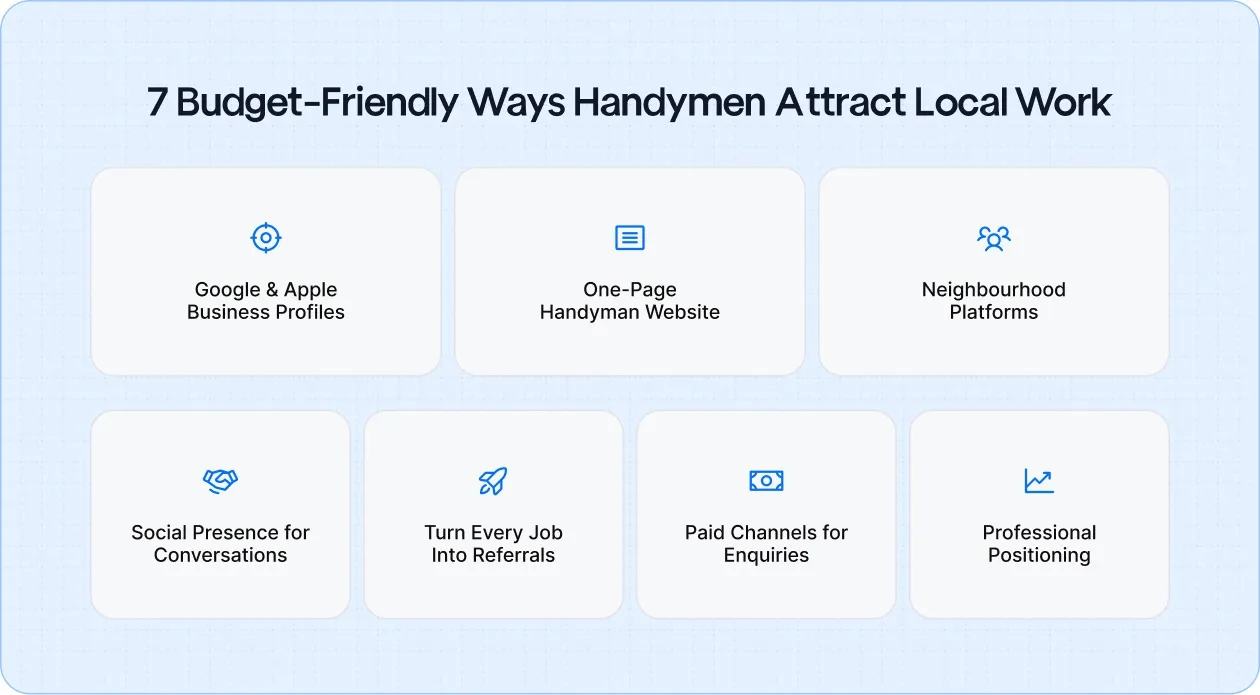
These seven approaches work because they rely on presence, proof, and simple communication, instead of complicated marketing systems.
1. Google Business Profile + Apple Business Connect
Homeowners searching for “handyman near me” rarely scroll far before choosing someone. Google Business Profile (GBP) is one of the first places they’ll look, making it crucial for local visibility.
At the same time, Apple Business Connect is rising fast, especially among iPhone users who default to Apple Maps. Many handymen ignore this, which gives you a simple, early advantage.
Why do these profiles matter?
They appear before your website, control local visibility, and shape first impressions. If these listings look incomplete, unclear, or weak, customers scroll past, even if your skills are excellent.
What actually helps you rank higher?
- Use the words people actually search for: Include “Handyman” in your business name and site content. People search for “handyman,” not vague terms like “improvement specialist.”
- Choose the right primary category everywhere: Set “Handyman” as your primary category on Google Business Profile and Apple Business Connect so platforms can correctly match search intent.
- Optimize photos like micro-ads: Rename image files before uploading with clear, keyword-rich names (e.g., James-Hill-Handyman-Sacramento-deck-repair.jpg instead of IMG00319.jpg).
- Drive reviews with minimal friction: Share your Google Business Profile short review link after every job. Fewer clicks lead to more reviews.
- Keep business information identical across platforms: Ensure your phone number, hours, services, and city match exactly on Google Business Profile, Apple Business Connect, Yelp, Facebook, and LinkedIn. Mismatches cause confusion and hurt visibility.
Your visibility depends on what you say about your business online.
Tap into support that turns local listings into visitor-pulling assets without learning SEO yourself.
Improve Listings with SEO
2. A One-Page Handyman Website
Top-ranking service sites keep it simple, because homeowners are comparing.
A single, well-structured page can outperform five scattered ones when it:
- Answers what you fix
- Shows where you work
- Proves you’re trustworthy
- Invites someone to call
What does your home screen show?
At first glance, someone should know:
- The cities you cover
- What you repair
- How to reach you
- Why should they trust you
Where do most handymen lose enquiries?
- They hide phone numbers, fail to mention location, or sound generic. Messaging matters.
- Strong service pages speak directly to the reader:
- “Handyman in Dallas fixing drywall, taps, fixtures, and trim with same-day support.”
Elements that help your page convert
- Before/after visuals
- Short testimonials
- Promise of responsiveness
- A clear call to action like: “Call now for a quick estimate. We answer.”
This simple clarity outperforms design-heavy pages every time.
Your pages can spark action when written with purpose.
If putting the right messages on a service page is difficult, expert-written pages can help you attract enquiries without needing an in-house writer.
Improve My Pages
3. Neighbourhood Platforms Where People Already Ask for Help
Local groups are modern bulletin boards. You’ll find repair requests pouring in across:
- Facebook Groups
- Marketplace
- Nextdoor
- Instagram neighbourhood pages
- TikTok geo-tagged community content
What separates people who get enquiries from those who get ignored?
Helpful presence beats sales pitches. Post examples that perform well:
- “Fixed a sagging cabinet door for a neighbour today, message if you need help.”
- “Weather’s cooling, check outdoor taps. If you want someone to take a look, I’m around.”
On LinkedIn, sharing before-and-after shots or maintenance tips can attract property managers, realtors, and landlords, audiences often ignored by ranking blogs.
4. Social Presence Designed for Conversations
You are not building a brand, you are building trust at glance speed.
Simple content themes work across platforms:
- Before and after project shots
- Short write-ups of “just repaired this today.”
- Quick tips homeowners can use
- City-specific hashtags to get discovered locally
Which platform does what for handymen?
- Instagram and TikTok earn visual authority
- Facebook increases local referrals
- LinkedIn helps attract commercial contacts
5. Turn Every Job Into the Next Three
Most handymen complete a job and move on. The best ones use that job to create a pathway to the next.
Do this by:
- Texting your review link
- Explaining why reviews matter
- Asking for simple referrals
The wording of follow-ups influences results; this is where messaging expertise quietly shapes outcomes.
Must Read: Home Improvement SEO Strategies That Will Get Your Phone Ringing Nonstop
6. Paid Channels That Help While Organic Enquiries Build
Some top-ranking blogs either oversell or dismiss paid sources; reality is nuance.
- HomeAdvisor works if you track contact attempts and request refunds
- Home Depot Pro Referral is useful for credibility
- Thumbtack and TaskRabbit differ in audience behaviour
The hidden risk
- Some platforms dump vague repair requests into “handyman bins.”
- Knowing which enquiries to avoid matters as much as knowing where to sign up.
7. Professional Positioning That Raises Perceived Value
Many people associate “handyman” with informal work, which means that owning the title professionally gives you an advantage.
People often decide whether to call you before they call you, based entirely on clarity, tone, and perceived competence.
That is why expert messaging quietly becomes the difference between “they might pick you” and “you are the obvious one.”
Position yourself as a pro to lead more high-value clients.
Clear, confident messaging communicates professionalism and trustworthiness; expert-written content makes the difference between good and great.
Create Content That Converts
A 30-Day Free Lead Sprint That Produces Work Fast
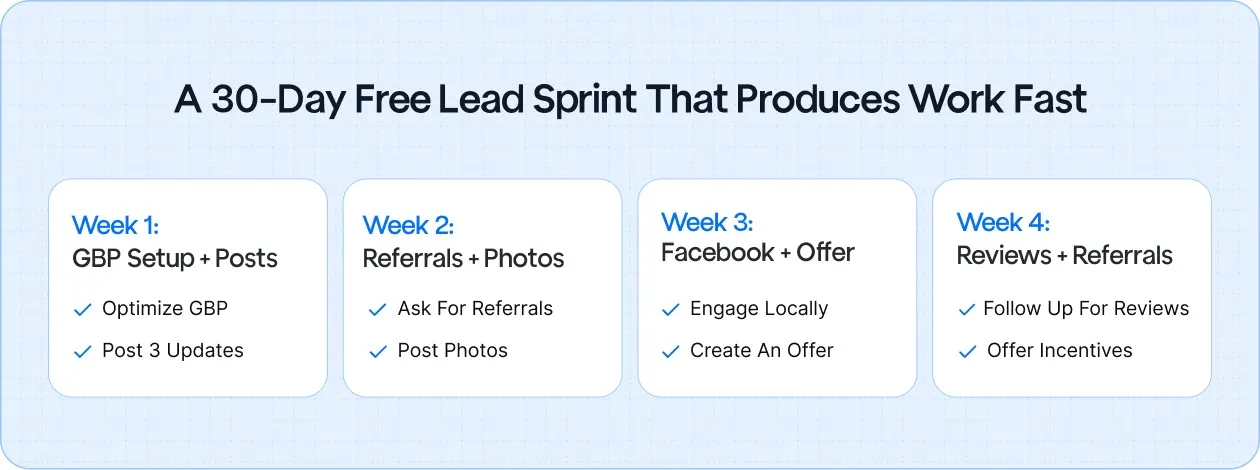
In just 30 days, you can generate consistent enquiries and fill your schedule without relying on paid ads. Here’s a straightforward, week-by-week approach that gets results quickly.
Week 1: Google Business Profile (GBP) Setup + 3 Local Posts
Action Plan:
- Set up and optimize your Google Business Profile (GBP), focusing on the “Handyman” keyword and accurate service areas.
- Post 3 local updates on GBP, like seasonal tips or project highlights, to increase your profile’s visibility.
Result: By the end of Week 1, your GBP will be optimized, giving you a stronger chance of appearing in local searches.
Week 2: Referrals + Photos
Action Plan:
- Ask recent clients for referrals; a simple request can lead to more work.
- Post before-and-after photos of completed jobs on social media or local platforms to demonstrate your skills.
Result: Week 2 will generate new leads from your existing customer base and showcase your work to a wider audience.
Week 3: Facebook Presence + Micro-Offer
Action Plan:
- Join and engage in local Facebook groups and neighbourhood platforms like Instagram or Nextdoor. Share useful tips or showcase a recent job.
- Create a micro-offer, like a discount or free estimate, to encourage immediate inquiries.
Result: Week 3 helps build a local reputation while creating a sense of urgency with your micro-offer.
Week 4: Review Follow-Ups + Referral Trigger
Action Plan:
- Follow up with clients for reviews and share a direct link to make it easy for them to leave feedback.
- Offer a small incentive for each new referral (discount on next service or similar).
Result: By Week 4, you should start seeing repeat business, positive reviews, and new referrals rolling in.
Tracking What Works
Action Plan:
- Track the sources of your leads, GBP, social media, referrals, etc.
- Use a simple CRM or spreadsheet to monitor lead status and follow-ups.
Result: Tracking allows you to refine your strategy and focus on the methods that work best for your business.
Want results without the paid ad spend.
By combining local SEO optimization and referrals, this simple, structured approach will quickly get you the enquiries you need.
Free Leads with SEO
Comparison Snapshot: Free Leads vs Paid vs Referrals vs SEO
Understanding how different lead sources perform in both the short-term and long-term is key to building a sustainable strategy for your handyman business. Each approach offers distinct advantages depending on your current needs, budget, and growth stage
Here's a breakdown of how free, paid, referral, and SEO-driven leads stack up.
Why SEO Stands Out for Long-Term, Sustainable Growth?
While paid ads and referrals can bring quick results, SEO is the most powerful strategy for sustainable growth. Paid ads can quickly burn through your budget without long-term benefits, while referrals rely heavily on your existing network.
In contrast, SEO offers lasting visibility on search engines, ensuring your handyman business stays visible to the right audience over time, without continuous investment. By focusing on organic ranking and high-quality SEO-backed content, you can ensure consistent, low-cost leads that accumulate steadily over the long run.
Getting expert help to optimize your SEO strategy ensures that your content reaches the right people, generating qualified leads consistently.
Why Clear Messaging and SEO-Backed Content Matter for Free Leads?
The key to attracting free leads lies in visibility, trust, and clear messaging. When your business is easy to find, and your value is clearly communicated, potential clients are more likely to choose you over competitors.
Growth begins when your content resonates with the right audience. If you want to increase local enquiries without the burden of a large marketing team, partnering with experts who can create compelling, SEO-optimized content is the way forward.
This ensures you consistently bring in the qualified leads that fuel long-term growth.
Growth starts when your content speaks to the right audience.
Gushwork’s expert-written content helps your handyman business attract local enquiries without a big marketing team.
Book a Free Content Call

Digital Marketing
Jan 2, 2026
5 mins
Digital Marketing for Solar Panels with 13 Strategies That Make Complex Choices Simple
Ishani Mitra
Selling solar is a long-term bet: lower bills, cleaner energy, and the confidence that a complicated investment will actually pay off. That makes solar marketing part financial education, part technical proof, and part human reassurance, all rolled into one.
That makes solar marketing less about persuasion and more about clarity. Winning businesses are the ones that clearly explain the investment, demonstrate their expertise early, and reduce uncertainty at every step of the decision-making process.
Digital marketing for solar panels is about guiding that decision journey.
In this blog, you’ll learn how digital marketing works specifically for solar panel companies, which channels matter most, how to align them with buyer behavior, and how to build a system that turns attention into installs.
Understanding Digital Marketing In The Solar Panel Industry
Digital marketing in the solar industry doesn’t work like typical “home services” marketing. Solar purchases involve high cost, long commitment, heavy regulation, and emotional hesitation. Most buyers don’t convert after one ad, one search, or one conversation.
Instead, they move through research, skepticism, comparison, and financial justification before agreeing to anything. A strong digital strategy acknowledges this behavior and supports buyers through each step.
How Solar Buyers Actually Research And Decide?
Understanding that journey is the foundation of effective solar marketing:
Residential Vs Commercial Solar Decision Paths
Residential buyers care about bills, savings, reliability, and home value. Commercial buyers focus on ROI, compliance, stability, and financial justification. Home decisions are quicker; commercial decisions take months. Residential marketing needs reassurance. Commercial marketing needs proof.
Research Mode Vs Buying Mode
Most prospects start in learning mode, searching:
- Is solar worth it?
- What does it cost?
- How much will I save?
Once confident, they move to comparison mode, evaluating companies, systems, warranties, and financing. Marketing must guide them from curiosity → clarity → contact.
Role Of Education And Validation
Solar buyers are cautious, and for good reason. Education helps them understand costs, savings, and trade-offs, while validation reassures them that your claims are real.
Years of aggressive telemarketing, misleading “free solar” offers, and poor installations have made buyers skeptical. Today, solar companies earn trust by being clear about pricing, realistic about outcomes, and transparent about how projects actually work.
Put simply, in solar energy marketing, the company that explains the process best and backs it up with proof usually wins the sale.
Be the Safer Choice
Clarify what makes your solar company credible, transparent, and reliable in a skeptical market.
Clarify My Positioning
Core Digital Marketing Channels For Solar Panel Companies
Solar marketing works best when every channel plays a specific role: some attract attention, some build trust, and some close the deal.

Below are the core digital channels that actually move homeowners from curiosity to consultation in today’s market:
Website As A Conversion And Education Engine
Your website is the core of your solar marketing. Before calling any brand, people want to understand cost, savings, credibility, and risk. If your site explains these well, you win trust. If it doesn’t, they hit back and go to your competitor.
A strong solar website should:
- Prioritize mobile-first design, because homeowners research solar on their phones while talking to family or scrolling through options.
- Ensure fast loading so visitors don’t drop.
- Make CTAs visible instantly.
- Keep reading effortless with short, structured sections.
- Explain systems, pricing expectations, and process clearly, so decision-making feels simpler instead of overwhelming.
- Share typical cost ranges with realistic context like rebates, incentives, and financing.
- Explain installation steps, inspection timelines, warranties, and maintenance expectations.
- Answer fear-based questions like roof damage, reliability, and service support.
- Use focused landing pages built to convert interest into action, instead of dumping users on generic pages.
- Dedicated pages for quotes, consultations, solar calculators, financing pages, and savings estimates.
- Position short forms with simple requested details strategically.
- Clear “What happens next” explanation after form submission.
- Show visible trust signals professional buyers look for, because credibility matters in high-ticket decisions. Some great examples are:
- Certifications, accreditations, brand partnerships.
- Warranty statements and guarantees.
- Authentic testimonials, case studies, and installed project photos.
- Clear local service coverage areas.
Your website should turn curiosity into confidence and confidence into real leads.
Turn Research Into Confidence
Build a solar website that explains costs, savings, and next steps clearly enough for buyers to move forward.
Improve My Solar Website
Search Engine Optimization (SEO) For Solar Panel Companies
SEO is your long-term, lowest-cost lead engine when built correctly. SEO keeps generating traffic and inquiries even when budgets slow down. But for solar, SEO only works when it targets how real people search and think about solar.
What effective solar SEO looks like:
- Ranking for high-intent solar keywords.
- Focus on “near me,” “cost,” “best installers,” “quotes,” and “savings” phrasing.
- Include intent-focused modifiers like “for my home,” “worth it,” “2026 incentives,” etc.
- Prioritize keywords that bring homeowners ready to decide, not just researchers.
- Strengthening local SEO for installers and service regions, because most solar buyers want nearby installers. You can create:
- Dedicated service area pages.
- Location-specific content.
- Structured address and local trust relevance signals.
- Balancing educational SEO content with sales pages, so you attract both early interest and ready buyers.
- Educational guides: “Is solar worth it?”, “How much do panels save?”, “How solar incentives work.”
- Decision-stage content: financing, comparisons, installation breakdowns.
- Service pages built for conversion.
- Treating SEO as a compounding investment.
- SEO builds authority month after month.
- Organic leads cost less over time.
- Visibility increases even when paid competitors burn budget.
Done right, SEO positions your solar company as the trusted expert.
Show Up Early in the Decision
Strengthen SEO so your solar business appears when buyers research cost, savings, and local installers.
Strengthen My Solar SEO
Google Business Profile And Local Trust Signals
For local solar installers, Google Business Profile acts like your digital storefront. It influences how often you appear in maps, how frequently customers call, and whether people trust you before ever visiting your website.
To make it work as a true growth tool:
- Use reviews as a primary credibility driver. You must:
- Aim for consistent review growth, not random spikes.
- Encourage reviews that mention savings, professionalism, communication, and installation experience.
- Reply to reviews so your profile looks active and real.
- Continuously update your profile, so Google sees an engaged, operational business.
- Add fresh installation photos.
- Update service offerings and coverage.
- Post helpful updates during peak solar seasons.
- Strengthen relevance signals, because proximity alone is not enough.
- Choose correct categories.
- Use solar-focused descriptions, not generic contractor wording.
- Answer customer Q&A thoughtfully.
Google decides trust visually and your profile needs to make you look like the company homeowners can confidently call.
Paid Advertising For Solar Lead Generation
Paid ads can drive a lot of solar leads, but without filters you end up with curious clickers instead of serious buyers. The goal is not “more form fills,” it is qualified homeowners who can actually go solar.
Use each ad platform for a specific job
- Run Google Search Ads for high-intent phrases like “solar installer near me” or “home solar quote [city],” because these users already want to talk to someone.
- Use YouTube and Display for education and remarketing, so people who visited your site keep seeing your brand while they research.
- Use Facebook and Instagram to reach homeowners by area, demographic, and home-ownership signals, then send them to clean, focused landing pages.
Filter out people who will never buy
- Exclude renters and apartments where roof control is unlikely, so sales teams don’t waste time on impossible deals.
- Ask simple qualifying questions in your forms like “Do you own your home?” or “Average monthly power bill?” to screen interest.
- Use negative keywords for terms like “DIY,” “job,” or “free panels” if you’re not offering those options at all.
Protect your budget with tight targeting
- Limit your geo targeting to areas where crews can install profitably.
- Set ad schedules so your ads only run when someone can answer calls or respond quickly.
- Review search term reports weekly, then trim out irrelevant queries that keep draining spend.
Send paid traffic to pages built for solar decisions
- Send ads to a solar-specific landing page, not your homepage, so users see exactly what they searched for.
- Keep the page simple: one main offer, clear benefits, social proof, and a short form with name, contact details, and ZIP code.
- Test different offers such as “bill review,” “free roof and shade check,” or “solar savings estimate” to see what attracts the best buyers.
Organic And Paid Social Media Marketing
Solar decisions build slowly, and social media keeps you in the picture while people think, research, and talk to family. The aim is to stay familiar.
Focus on teaching concepts
- Break down confusing topics like tax credits, net metering, and battery storage using plain language and simple visuals.
- Post short explainers answering common questions such as “What happens on installation day?” or “Can solar work on older roofs?”
- Share honest pros and cons so people see you as a guide or expert.
Show real projects and real outcomes
- Post before-and-after roof shots with brief notes on system size and location.
- Share actual bill reduction examples, even if savings are moderate and not dramatic.
- Capture short customer clips talking about why they went solar and what changed.
Use paid social to support your funnel
- Promote your best educational posts and videos to lookalike audiences of existing customers.
- Run lead forms only when you can follow up fast, since delayed responses kill interest.
- Retarget website visitors with soft offers such as “Download the 5-step solar homeowner checklist” instead of “Book now” in every ad.
Stay present during long buying cycles
- Post on a predictable schedule, even if it is just a few times a week, so your brand always feels active.
- Tie content to local context such as energy rate changes, heatwaves, or grid issues, which make solar more relevant.
- Keep the visual style consistent, so your posts feel like they come from one clear, trustworthy company.
Email Marketing And Lead Nurturing For Solar Companies
Most solar leads do not sign a contract on the first call. Email helps you stay in touch while people collect quotes, compare systems, and get comfortable with the investment.
Map emails to the stages of the decision
- Start with welcome emails that confirm the inquiry, set expectations, and share a simple overview of your process.
- Follow up with educational emails that explain savings, financing, and roof requirements without pressure.
- Send late-stage content like installation day checklists and comparison guides once prospects show serious interest.
Share value and expertise
- Share clear examples of payback period and savings for typical homes in your service area.
- Explain how incentives, rebates, and tax credits work in simple steps instead of long policy text.
- Use short stories from real customers to show what life looks like after installation.
Personalize based on what you already know
- Segment emails by stage (new lead, quote sent, pending decision, installed customer) instead of blasting everyone with the same content.
- Adjust messages based on roof type, system size interest, or financing preferences where you can.
- Send reminder emails tailored to actions taken, such as “You started a savings estimate but didn’t finish it.”
Automate follow-up without losing the human feel
- Use automated sequences for standard steps, like quote follow-up or post-visit thank you, so no one falls through the cracks.
- Keep tone conversational and signed by a real person, not just “The Solar Team,” to build trust.
- Review and refresh sequences every few months, so messages stay accurate as offers and incentives change.
Content Marketing That Builds Trust In Solar Sales
Content is where you answer the hard questions people do not always want to ask a salesperson. Done right, it reduces fear, cuts down on objections, and makes your consultations easier.
Explain the money side clearly
- Publish simple ROI and payback guides using real numbers, assuming conservative savings rather than extreme cases.
- Break down a typical solar quote into parts, so homeowners see what they are paying for and why.
- Compare solar payments to average electric bills over time to make the decision more concrete.
Clarify technical details
- Create guides that explain panel types, inverters, and batteries with diagrams and everyday analogies.
- Write short posts about topics like roof orientation, shading, and structural checks in plain language.
- Use FAQs to answer quick questions such as “What happens during a power outage?” or “How long do panels last?”
Use stories to make solar feel real
- Turn past installs into case studies that show the starting problem, the solution, and the outcome.
- Highlight different customer types such as young families, retirees, or rural homeowners, so readers see themselves.
- Capture quotes that address common fears, such as “We were nervous about roof damage, but here’s how the team handled it.”
Mix formats to meet people where they are
- Turn written guides into short videos or slide posts for social and email.
- Use simple calculators or quizzes on your site, such as “Is your roof ready for solar?” to drive engagement.
- Update older content when regulations, rates, or incentives shift, so you do not send mixed signals.
Educate Before You Sell
Create content that answers real solar questions and reduces hesitation long before a sales call happens.
Create Solar Content That Builds Trust
Conversion Rate Optimization (CRO) For Solar Websites
Traffic alone does not grow a solar business. CRO makes sure more of those visitors turn into booked calls, site visits, and signed contracts.
Clear paths for every type of visitor
- Give ready buyers a fast action, such as “Call now” or “Book a consultation,” visible on every page.
- Provide softer options for early-stage visitors such as “Download a savings guide” or “Estimate your bill reduction.”
- Keep forms short and framed around value, not just “Contact us,” so people see why they should share details.
Reduce friction and doubt on key pages
- Add short process diagrams that explain discovery call, site survey, design, permit, and install steps.
- Use reviews, certifications, and warranty statements near forms and buttons, not buried on separate pages.
- Remove distractions like unrelated links or long menus on landing pages where you want a single action.
Test small changes instead of redesigning everything
- Run A/B tests on headlines, CTAs, and hero images to see what improves form submissions or calls.
- Track how many visitors scroll, click, or abandon key pages so you can fix weak sections.
- Repeat winning patterns across other pages, so your whole site benefits from improvements.
Marketing Automation Basics For Solar Companies
Automation keeps follow-up consistent as lead volume grows. It helps your team handle more opportunities without letting inquiries sit untouched for days.
Automate the first responses
- Trigger instant confirmation emails and texts when someone fills out a form or requests a quote.
- Include basic next steps, such as expected response time and a link to a short video or guide.
- Route new leads to the right salesperson or coordinator based on ZIP code or source.
Build simple, stage-based workflows
- Create different sequences for new leads, quoted prospects, and past customers due for check-ins.
- Use time-based triggers like day two, day five, and day ten follow-ups instead of manual reminders.
- Pause or shift automation when someone books a call, so they do not keep receiving “Are you still interested?” emails.
Keep the system clean and realistic
- Regularly remove or cool off leads that never open or reply, so your list stays healthy.
- Tag leads by interest level, location, or system type to support more targeted campaigns later.
- Document your workflows so new team members can understand how leads move from first contact to closed deal.
Measuring Performance In Solar Digital Marketing
Solar marketing must prove that it brings profitable customers. Clear measurement gives you the confidence to invest more in what works.
Track beyond clicks and impressions
- Watch how many qualified leads each channel produces, not just total leads.
- Monitor cost per qualified lead and cost per acquisition, so you see the real price of each new customer.
- Compare closing rates by source, since some channels may bring fewer leads but better buyers.
Use the right tools correctly
- Set up goals and conversion tracking inside Google Analytics for forms, calls, and booked visits.
- Use Google Search Console to monitor search queries, click-through rates, and pages that gain or lose visibility.
- Supplement with an SEO tool and a simple CRM, so you can connect traffic sources with revenue and system size.
Review performance on a predictable rhythm
- Hold monthly reviews to see which campaigns, pages, or offers pulled in the best leads.
- Adjust budgets quarterly, shifting spend toward channels that consistently produce profitable jobs.
- Keep one or two tests running at all times so you are always learning and improving rather than guessing.
Advanced Digital Strategies Solar Companies Use To Scale
Once the basics of web presence, SEO, and ads are in place, real growth comes from systems that deepen trust, keep prospects engaged over long buying cycles, and ensure no qualified lead slips away:
Retargeting And Remarketing Across Platforms
Retargeting exists because most homeowners do not convert on their first visit. Smart remarketing keeps your brand visible during that research phase without feeling pushy or repetitive.
How strong solar companies approach remarketing:
- Retarget visitors who viewed quote pages, savings tools, or system details, and build separate remarketing for people who watched your videos or engaged with social posts.
- Rotate ads that educate instead of repeating “Get a Quote.” Highlight financing clarity, real install examples, FAQs, and short explainer clips to build trust.
- Use different remarketing layers: educational content for early researchers, offer-driven ads for quote viewers, and testimonial-based ads for price-comparing prospects.
- Run remarketing across Google Display, YouTube, Facebook, Instagram, and even Performance Max, so prospects keep seeing you in natural digital environments.
- After a consultation or quote presentation, remarketing reinforces the conversation so your salesperson isn’t competing alone against other bids.
Video Marketing And Youtube As A Long-Term Asset
Video marketing is one of the most powerful tools in solar because it removes confusion, humanizes your company, and provides visual proof of results.
How leading solar companies use video effectively:
- Build evergreen videos explaining installation timelines, payback periods, maintenance, warranties, and local incentives, so homeowners feel informed and safe.
- Record walkarounds of real installs, breakdowns of panel layouts, shading discussions, inverter setups, and battery storage integration so prospects see competence.
- Feature real team members answering questions calmly and clearly. Familiarity reduces hesitation when prospects later speak with that same person.
- Embed videos on landing pages, email nurturing, proposals, remarketing ads, and FAQs to increase comprehension, reduce objections, and shorten decision cycles.
CRM and Follow-Up Systems
Strong automation and CRM systems keep your pipeline organized, communication consistent, and team focused on the right opportunities.
How scalable solar brands structure their systems:
- Use a CRM built for solar or service industries to track every inquiry, stage, quote, and follow-up instead of spreadsheets or inboxes.
- Build workflows that trigger instant confirmations, appointment reminders, quote follow-ups, and educational drip email sequences automatically.
- Use friendly language, real names, and clear expectations in automated messages so communication feels personal.
- Separate homeowners who are just curious, seriously evaluating, or ready for installation, then adjust communication tone, content, and timing accordingly.
- Support replies via text, call, or email, because fast response options dramatically improve close rates, especially when prospects compare multiple installers.
Conclusion
The solar market will continue to grow, but growth alone does not guarantee visibility.
Digital marketing gives solar businesses that advantage when it’s done with structure and intent.
If your goal is consistent demand, stronger trust, and long-term growth, digital marketing isn’t an add-on anymore. It’s the foundation that everything else builds on.
Ready to Build Demand the Right Way
Get a structured digital marketing system that supports long buying cycles and real installs.
Book A Consultation
SEO
Jan 2, 2026
5 mins
Crack the Code of Local Automotive SEO Strategies and Fix Visibility with 8 Core Strategies
Ishani Mitra
Most car buyers don’t start their journey on a dealership lot anymore. They start with a search. Sometimes it’s for a specific model. Sometimes it’s for reviews, financing options, or the closest dealership they can trust.
What matters is this: the dealerships that show up early and often are the ones that stay in the buyer’s consideration set.
Local automotive SEO is about making sure your dealership appears at the exact moments buyers are comparing, shortlisting, and deciding where to visit.
In this blog, we break down practical local automotive SEO strategies that help dealerships improve visibility, attract qualified local buyers, and support sales across the buying journey.
What is Local SEO for the Automotive Industry?
Local SEO for the automotive industry connects your inventory, services, and location to how people actually look for vehicles, repairs, or dealerships in their area. Unlike general SEO, local automotive SEO is tightly tied to geography, timing, and buyer readiness, so it must support all stages of the decision-making journey.
Local SEO builds three core outcomes for automotive brands:
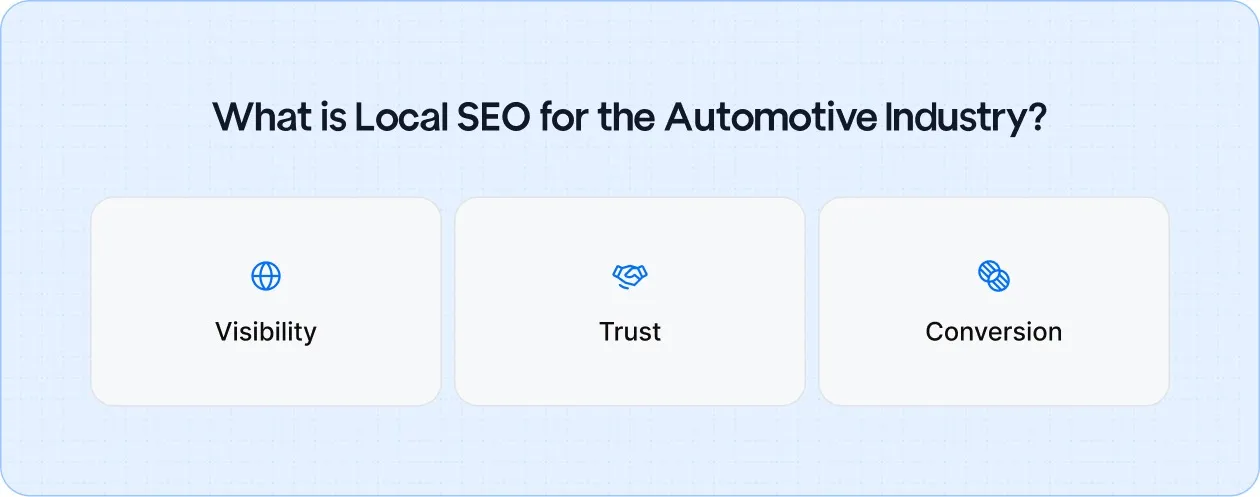
- Visibility: You consistently appear where customers are searching
- Trust: Reviews, content, and authority signals reassure buyers
- Conversion: Clear information, strong UX, and credibility convert searches into appointments, test drives, and bookings
And most importantly, it helps you win high-intent, local customers before they ever see your competitors.
SEO Across The Automotive Customer Journey
Local SEO is most effective when it aligns with the actual journey automotive customers follow, from awareness, to research, to decision. Structuring SEO content and strategy around this funnel ensures you're visible, relevant and persuasive at every stage.
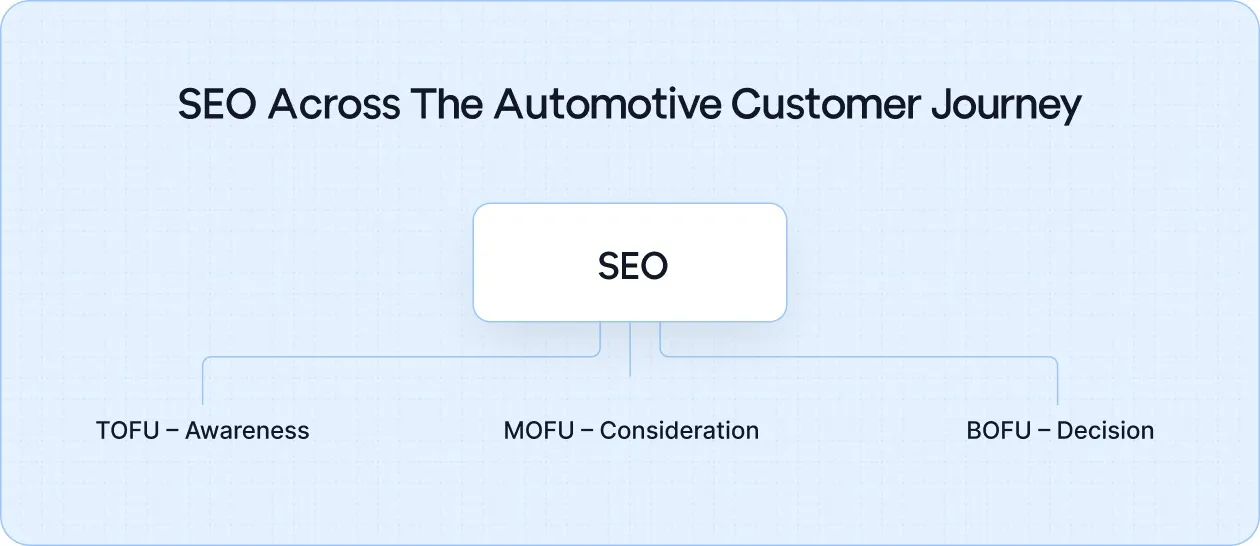
TOFU – Awareness
At the top of the funnel, customers aren’t always ready to book. They’re identifying a problem, learning, and gathering information. Here, the goal is to educate, attract, and position your brand as knowledgeable and trustworthy.
This stage builds brand familiarity so when the problem becomes urgent, your name is already in their head.
MOFU – Consideration
Here, the customer knows they need help. They’re actively researching solutions, comparing providers, and deciding who they can trust. Your job is to prove capability, reliability, and relevance.
This stage moves customers from considering providers → shortlisting your business.
BOFU – Decision
Now urgency is high. The customer wants help now. This is where Local SEO converts interest into appointments, calls, test drives, and service bookings.
This is where Local SEO stops being “marketing” and becomes revenue-driving, appointment-generating, real-world business impact.
Be Easy to Choose
Clarify what your dealership is known for so buyers understand why you’re the right option locally.
Clarify My Dealership Positioning
8 Core Local Automotive SEO Strategies
Core local automotive SEO strategies are the foundation that determines whether your dealership shows up when real buyers are actively searching for vehicles or service nearby. Here are our 8 strategies:
Google Business Profile
Your Google Business Profile (GBP) is the single most important local SEO asset for any automotive business. It drives the majority of calls, direction requests, and dealer visits because shoppers rarely scroll past the map section when they’re ready to act.
How to make GBP work like a demand engine:
- Complete every GBP field with intent-focused detail, including primary category, secondary services, dealership types, service offerings, financing options, and accessibility details. This helps Google match you to more search variations.
- Upload real dealership and service photos frequently, including service bays, showroom, inventory lots, technicians, and customer delivery moments. Visual freshness signals activity, trust, and real-world proof.
- Use GBP Posts strategically to promote specials, seasonal service offers, event announcements, EV service, and featured inventory. Posting regularly strengthens relevance signals and gives customers reasons to click.
- Actively collect and respond to reviews because review count, frequency, recency, and tone influence map pack rankings. Meaningful responses also increase trust and can push hesitant buyers to visit.
- Ensure your NAP (Name, Address, Phone) is consistent everywhere so Google confidently associates online mentions with your dealership, improving ranking stability.
A strong GBP does not just get seen. It consistently converts high-intent local searchers into phone calls, walk-ins, and booked service jobs.
Integrating Local SEO With Paid Media
SEO and paid media reinforce one another. When aligned, they improve market share, reduce wasted spending, and accelerate results.
Using SEO Data To Improve Paid Campaigns
SEO uncovers how buyers search naturally. That intelligence makes PPC smarter, cheaper, and more effective.
Practical ways to use SEO insights in paid strategy:
- Identify highest-converting organic queries, then duplicate them in PPC with optimized messaging.
- Focus ad spend where SEO is weakest, instead of blindly advertising everywhere.
- Use high-ROI pages discovered via SEO, as landing destinations for paid campaigns.
- Test messaging alignment, ensuring consistency between organic listings, ads, and landing pages.
- Reduce PPC waste, using SEO data to avoid irrelevant or weak-intent keywords.
SEO teaches PPC how to win profitably.
Google Vehicle Ads And Local Search Synergy
Vehicle ads place inventory directly in front of active shoppers. When combined with SEO, they dominate both awareness and action.
When and how to use Vehicle Ads effectively:
- Run vehicle ads for competitive segments, like trucks, EVs, SUVs, or high-turnover models.
- Ensure inventory feeds are accurate, with clean pricing, photos, VINs, and availability. Poor data kills performance.
- Use paid ads to accelerate early demand, while SEO builds long-term organic strength.
- Align creative with your SEO messaging, reinforcing brand recognition rather than fragmenting it.
Paid exposure accelerates what good SEO already sets up.
Website Relevance For Local Search
Even when buyers start on GBP, ads, or third-party listings, most eventually land on your site to validate credibility and explore options. Google also evaluates relevance using your website content.
How to make your website work effectively for local automotive SEO:
- Align inventory, service, and dealership pages into one connected system, not isolated silos. This helps both Google and buyers understand your dealership structure and services quickly.
- Create separate, well-built pages for each key offering, including New Inventory, Used Inventory, Finance, Service, and each major repair category. The more precisely you map services, the more queries you qualify for.
- Show proof that you serve your local community, using city names, real photos, customer stories, and references to local driving habits or climate conditions that impact vehicle ownership.
- Make calls-to-action clear and consistent, such as Book Service, Schedule Test Drive, Get Pre-Approved, and Contact Sales. Confusing CTAs reduce conversion, even if rankings are strong.
- Ensure structured internal linking, connecting inventory to trims, trims to finance, service pages to related maintenance guides, and city pages to relevant services. This improves crawlability and user experience at the same time.
When your website reflects real buyer behavior and local needs, Google interprets it as highly relevant and ranks it accordingly.
Turn Searches Into Visits
Build a dealership website that clearly guides buyers from research to test drive or service booking.
Improve My Dealership Website
On-Page Local SEO Strategies
On-page SEO ensures Google understands exactly what each page offers and who it serves. When structured well, it also improves user clarity, reducing bounce rates and increasing inquiries.
Local Keyword Targeting That Matches Buyer Intent
Keyword strategy should mirror how real car shoppers and service customers think. Automotive buyers search based on model interest, needs, and geography.
How to target the right local automotive keywords:
- Balance branded and non-branded searches, such as “Toyota dealership near me” and “best used trucks in Dallas.” Both drive valuable traffic but with different intent types.
- Prioritize long-tail, decision-driven searches, like “certified pre-owned Honda CR-V Dallas financing” or “same-day brake repair Austin.” These increase purchase intent and drive faster conversion.
- Include service-specific keyword targeting, like “oil change near me,” “EV battery service [city],” and “wheel alignment [city],” instead of one generic service page.
- Map keywords to the correct stage of the buyer journey, ensuring informational phrases go to content pages, while purchase-intent phrases go to inventory, finance, or booking pages.
When your keywords genuinely reflect buyer thought patterns, ranking quality and conversion both rise.
Optimizing Inventory And Service Pages For Local Visibility
Inventory and service pages must be more than placeholders. Google evaluates depth, uniqueness, and helpfulness when ranking these highly competitive pages.
How to strengthen inventory and service SEO:
- Avoid thin, duplicate descriptions from templates. Add localized insight, actual vehicle conditions, package highlights, and lifestyle relevance.
- Create individual service pages for major repairs, such as brakes, tires, diagnostics, AC repair, EV services, inspections, transmission, and general maintenance.
- Include pricing transparency where appropriate, or at least explain pricing logic clearly to build trust.
- Use structured FAQ sections, addressing common objections about timing, warranty, parts, service process, and convenience.
- Include local proof elements, such as images of your technicians, real vehicles serviced, and satisfied local customers.
These pages should feel written for humans first. Search engines reward that naturally.
Show Up When Buyers Decide
Strengthen local SEO so your dealership appears during high-intent searches across sales and service.
Strengthen My Local SEO
Technical SEO Strategies
Technical SEO ensures your automotive website is fast, accessible, crawlable, and structurally clear so Google can confidently index and rank it. Automotive sites are often large, dynamic, and inventory-heavy, so small technical issues can quietly hurt visibility and conversions if left unchecked.
Mobile-First Optimization For Dealership Websites
Most automotive research now happens on mobile, searching for cars, checking service options, comparing pricing, and booking appointments. If your mobile experience isn’t smooth, Google demotes you, and buyers leave.
How to ensure the mobile UX really works:
- Prioritize fast, friction-free navigation, so users can browse inventory, services, and financing without endlessly scrolling or dealing with clutter.
- Design mobile inventory views that load fast, showing key info first: price, mileage, condition, monthly estimate, and availability.
- Minimize intrusive pop-ups, especially those blocking inventory content. They hurt experience and rankings.
- Test mobile UX regularly using real devices, not just emulators, because real behavior exposes issues analytics won’t.
Mobile usability directly influences both SEO rankings and lead generation performance.
Page Speed, Core Web Vitals, And Crawl Efficiency
Automotive websites often struggle with speed because of large inventory images, tracking scripts, third-party widgets, and heavy design elements. Google uses Core Web Vitals to judge whether your site delivers a comfortable browsing experience.
How to improve speed and crawl performance:
- Compress and optimize inventory photos, since high-resolution images are often the biggest cause of slow load times.
- Reduce unnecessary scripts and third-party plugins, which slow interaction and delay useful content from loading.
- Use lazy loading for media, so images and videos load only when users scroll to them, not all at once.
- Ensure stable layouts to prevent content shifting while loading. This improves perceived quality and ranking.
- Improve crawl paths with clean linking, so Googlebot can efficiently discover pages, especially constantly changing inventory and offers.
Speed helps you rank higher, convert better, and reduce visitor frustration.
Schema Markup For Automotive Businesses
Schema markup helps Google understand your dealership better, making your listings richer, more visible, and more trustworthy in search results.
Essential schema to implement correctly:
- LocalBusiness schema to define dealership identity, service areas, location accuracy, and core visibility signals.
- Vehicle schema to help Google better understand inventory listings, which supports richer search appearance and relevance for specific model searches.
- Review schema to display rating information, helping click-through rates and confidence in competitive markets.
- Service schema for major offerings like repairs, maintenance, diagnostics, EV servicing, and inspections.
- Offers schema when promoting special pricing, financing deals, or seasonal campaigns.
Schema makes your dealership easier for Google to trust, which directly improves local SEO performance.
Local Authority Building
Authority tells Google that your dealership is real, reliable, and embedded in the local community. Strong local authority improves map rankings, credibility, and brand preference before a visitor ever lands on your site.
Local Citations And Directory Consistency
Citations are mentions of your dealership name, address, and phone number across the web. Accurate, consistent listings across trusted platforms signal stability and legitimacy.
How to build useful citation authority:
- Prioritize automotive-specific directories, like Cars.com, Autotrader profiles, dealer associations, and industry portals, to strengthen relevance.
- Claim dealership profiles wherever they exist, even if you didn’t create them. Ownership prevents errors and helps trust.
- Keep hours, services, and branding updated, especially during seasonal schedule changes or relocations.
- Audit and clean outdated listings regularly, especially if the business has rebranded, changed phone numbers, or relocated historically.
Consistency removes doubt, and doubt is the biggest ranking killer in local SEO.
Review Strategy As A Ranking Lever
Reviews are a ranking signal, a conversion trigger, and proof of experience. Automotive decisions require trust, and Google heavily weighs both review quality and review behavior.
How to build a review engine that strengthens SEO:
- Focus on continuous review flow. Google values frequency and recency.
- Encourage keyword-rich, experience-focused reviews that mention services, locations, or vehicles when natural.
- Respond to every review thoughtfully, because engagement signals reliability and improves click confidence.
- Develop structured review requests, via service staff, drip emails, SMS reminders, and post-purchase automation.
- Address negative reviews correctly, showing accountability and professionalism. Google values this behavior.
More than visibility, reviews turn visibility into belief.
Local Backlinks And Industry Mentions
Local backlinks prove that your dealership is part of the regional ecosystem. They strengthen domain trust and improve map pack competitiveness.
How to earn meaningful local authority links:
- Build partnerships with local businesses and organizations, such as sports teams, charities, and community events.
- Collaborate with local media, submitting dealer news, EV education pieces, safety guides, or economic contribution stories.
- Engage in sponsorships and community involvement, ensuring proper mentions and website links.
- Strengthen connections with manufacturer associations, OEM listings, dealer networks, and industry press mentions.
- Publish content that others naturally reference, like buyer guides, seasonal maintenance insights, or market insights.
Backlinks are not about volume. They’re about relevance and authenticity.
Content Strategies
Content marketing for the automotive industry shows Google what you know and shows buyers why they should trust you. The right content strategy supports rankings, nurtures interest, and shortens decision time.
Content For Each Stage Of The Buyer Journey
Automotive buying isn’t instant. Buyers research, compare, validate, and only then convert. Your content should guide them through every phase instead of expecting immediate action.
How to map content to real buyer behavior:
- Top-of-funnel educational content, like first-time buyer guides, EV safety explanations, maintenance timelines, financing basics, and local driving advice.
- Mid-funnel comparison and evaluation content, including model comparisons, feature breakdowns, cost-of-ownership explanations, and “which vehicle is right for you?” content.
- Bottom-of-funnel conversion content, such as inventory pages, service pages, local offers, finance pre-approval content, and dealership differentiators.
When content mirrors the journey, buyers feel informed.
Answer Buyer Questions Early
Create content that helps local buyers research, compare, and trust your dealership before they show up.
Create Buyer-Focused Content
Video And Visual Content For Local Search
In automotive, people want to see, not just read. Video and imagery build realism, reduce uncertainty, and strengthen local trust in ways text alone can’t.
How to use visuals effectively for SEO:
- Create walkaround and feature videos to help buyers imagine ownership before stepping into the dealership.
- Publish educational service videos, explaining repairs, maintenance needs, and EV care, building authority.
- Use short-form clips strategically, for social proof, delivery moments, and community involvement.
- Optimize video metadata, including locations, models, services, and dealership brand markers for better discovery.
- Embed video intelligently on key pages, increasing dwell time and engagement, which indirectly strengthens SEO.
Visual proof builds emotional confidence and search performance benefits naturally.
Location-Based Content Without Keyword Stuffing
Expanding service reach requires geographic relevance, but poorly executed “city pages” create duplication problems and harm rankings. The goal is meaningful local relevance, not artificial repetition.
How to build strong geographic coverage:
- Create useful nearby-city pages, focusing on real driving relevance rather than duplicate templates with swapped city names.
- Tie content to real local context, climate effects on vehicles, seasonal behavior, driving environments, local regulations, and buyer habits.
- Include genuine signals, such as regional testimonials, local photos, and community involvement.
- Link these pages naturally. Let them support the main structure rather than overshadow it.
Location relevance should feel authentic, not manufactured.
Measuring The Success Of Local Automotive SEO
A profitable demand measures success. Automotive SEO should always be measured in impact on calls, showroom visits, service bookings, and car sales.
SEO Metrics That Matter For Dealerships
Not all metrics are useful. Dealership SEO success should directly connect to business outcomes.
Focus on what actually reflects success:
- Quality of organic traffic, not just volume. Are visitors relevant? Are they engaging with inventory and service pages?
- Lead actions, such as calls, form submissions, service bookings, test drive requests, and finance pre-approvals.
- Map pack performance, since GBP plays a massive role in real-world dealership traffic.
- Engagement depth, including dwell time, return visits, and multi-page journeys, showing buyer seriousness.
- Revenue influence, where possible, tying leads to deals and service orders.
If a metric can’t help a dealership make a better decision, it doesn’t matter.
Tools For Tracking And Optimization
Good measurement requires the right tools, configured correctly. Automotive businesses must go beyond basic analytics.
Core SEO tools worth using properly:
- Google Analytics, to monitor user behavior, engagement quality, and conversions.
- Google Search Console, for query insights, indexing performance, click behavior, and technical health.
- Professional SEO platforms, such as SEMrush, Ahrefs, or Moz, can be used to analyze competition, ranking trends, and backlink strength.
- Call tracking software is necessary because many dealership conversions happen by phone, not form.
- Heatmaps and session recording tools, to see where friction occurs and where users hesitate.
Benchmarking Against Local Competitors
Automotive SEO is a competition against nearby dealers, used car lots, and large dealer groups. Understanding where you stand determines where to push harder.
How to benchmark intelligently:
- Compare domain authority and backlink health, understanding who Google currently trusts more.
- Study competitor GBP performance, including review profile strength, posting activity, and engagement.
- Analyze ranking coverage, seeing which dealers own which keywords: inventory, service, branded, and location-based.
- Identify gaps and untapped opportunities, such as missing service content, underserved nearby towns, or ignored EV niches.
Great SEO strategies don’t just improve your site, they strategically outperform everyone else.
Preparing Your Dealership For The Next Phase of Local Search
Local search is entering a new phase where discovery is driven less by traditional keywords and more by understanding, context, and intent.
Dealerships that prepare now will adapt smoothly as search shifts toward AI-powered results, conversational interactions, and entity-based trust signals.
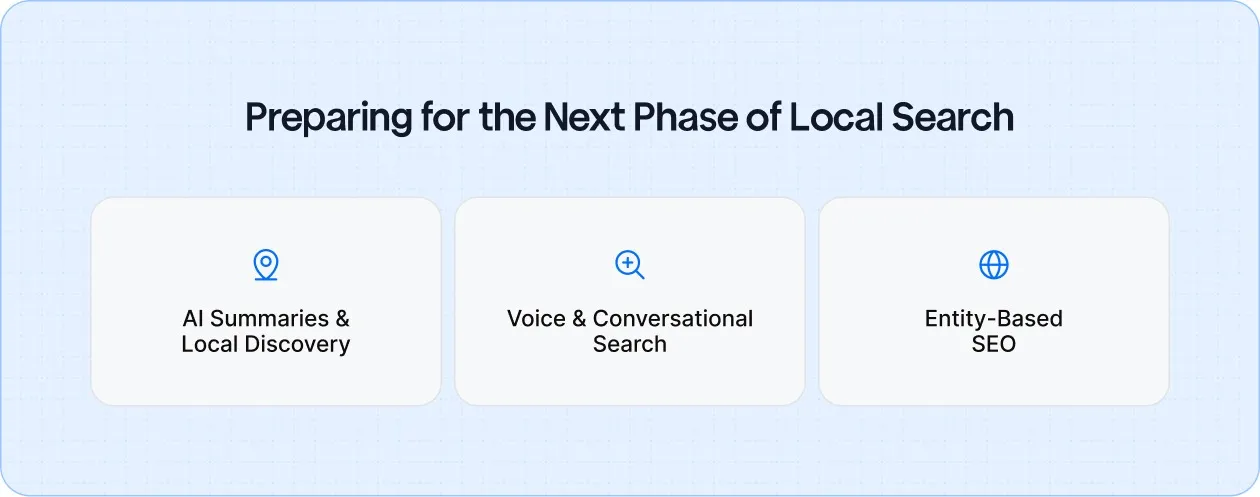
AI Summaries And Local Discovery
AI-driven search results are already reshaping how buyers see dealership information. Instead of listing websites, search engines are summarizing answers, comparing options, and recommending providers directly within results.
What this means for dealerships:
- Content clarity matters more than volume, because AI surfaces businesses that provide the clearest, most structured answers.
- Well-structured service, inventory, and “why choose us” content increase your chance of being included in AI-generated overviews.
- Local credibility signals like reviews, consistency, and expertise heavily influence which dealerships AI selects as “trusted results.”
Dealers that communicate clearly and consistently will appear more often when AI serves the answer before a user clicks.
Voice And Conversational Search For Dealerships
As voice assistants and conversational interfaces grow, customers are using more natural, question-based search behaviors.
To prepare for that shift:
- Write content in natural, problem-based language, reflecting how real customers ask questions.
- Add FAQ structures across key pages, covering buying, financing, servicing, EV support, and brand-related questions.
- Ensure local signals are strong, so conversational systems can confidently recommend your dealership.
Being conversational-ready helps you stay visible as search becomes more human.
Increasing Importance Of Entity-Based SEO
Google is shifting from ranking pages to understanding entities, businesses, brands, locations, and credibility relationships. For dealerships, that means Google cares more about who you are than just what you publish.
How to strengthen entity trust:
- Ensure your dealership identity is consistent everywhere, across GBP, citations, manufacturer listings, and auto directories.
- Build strong connections between your brand and your services, such as EV expertise, certified servicing, financing reliability, or specialty vehicle categories.
- Invest in real-world authority signals, like media mentions, manufacturer recognition, community partnerships, and high-quality reviews.
Entity strength helps Google “know” your dealership.
Conclusion
Local automotive SEO is an ongoing advantage that compounds when your dealership consistently answers buyer questions, appears in local searches, and builds trust through accurate information and strong signals.
When local SEO is treated as a core growth strategy rather than a marketing add-on, it becomes one of the most reliable ways to stay competitive in an increasingly digital automotive market.
Ready to Compete Locally?
Build a local SEO system that supports visibility, trust, and real showroom and service traffic.
Book A Consultation

SEO
Jan 2, 2026
5 mins
Search Engine Optimization for Paving Companies: Why Some Businesses Show Up First?
Batul Beawarwala
A paving company can finish solid work, leave a clean site, and still get fewer calls than expected. The reason is often simple. When people look up paving services online, they see a short list of businesses. Some names appear again and again. Others never show up at all.
That gap is where search engine optimization for paving companies comes in. It shapes how your services, locations, and past work appear when someone searches for asphalt or paver services near them.
This guide explains how that process works, what search engines pay attention to, and how paving businesses can build pages that match what customers are actually looking for, without turning your website into a wall of jargon.
How Google Interprets a Paving Business Online
Before any paving company appears in search results, Google has to decide one thing: what kind of work this business is actually known for. That decision is not based on claims or length. It is based on clarity.
Google forms its understanding by observing how services are described across a site. When each type of paving work is explained clearly and consistently, Google can connect the business to specific searches. When services are blended or described in vague terms, that connection weakens.
How Google Determines What Services You Provide
Google looks for patterns. It notices which services appear repeatedly, how clearly they are described, and how often each type of work is given its own focus. Pages that stay centered on one service help Google understand where that page fits. Pages that try to represent everything at once leave room for uncertainty.
This interpretation happens before anyone visits your website. By the time a search is made, Google already has a sense of which pages clearly represent specific paving services and which do not.
Why Service Relevance Is Treated Differently From General Content?
Content that explains paving in general terms gives background. Content that explains a specific service gives direction. Google values direction more when a search involves hiring a contractor.
Pages that focus on one service, one job type, and one outcome give Google fewer decisions to make. That clarity makes it easier for those pages to appear when someone searches for paving work.
Why Unclear Pages Reduce Visibility?
When a page tries to cover multiple services without separation, Google hesitates. Instead of choosing the wrong page, it often chooses none. Clear focus removes that hesitation.
This interpretation step sets the foundation for everything that follows. Once Google clearly understands what your business does, other efforts begin to work together instead of pulling in different directions.
3 SEO Signals That Matter Most for Paving Companies
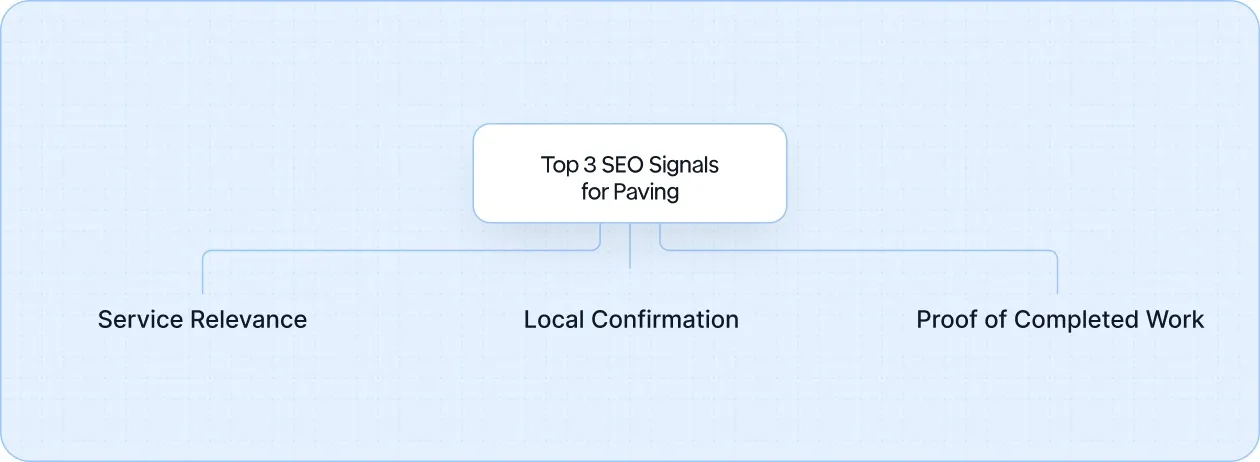
Once Google understands what kind of work your business does, it still needs a reason to show your pages consistently. For paving companies, that decision usually comes down to three signals. These signals work together, and none of them is strong enough on its own.
1. Service Relevance
Service relevance is about how clearly a page matches a specific type of paving work. When someone searches for a paving service, Google prefers pages that stay focused on one job rather than pages that speak broadly about many services at once.
A page that clearly explains one service helps Google feel confident about when to show it. A page that tries to represent everything at once makes that decision harder. This signal is less about volume and more about precision.
2. Local Confirmation
Local confirmation tells Google that your business is connected to a real place where the work happens. Paving is inherently local, and Google looks for consistency when deciding which businesses belong in local results.
This signal comes from how often your business is tied to the same locations across the web and how clearly those locations relate to your services. Even strong service-focused pages lose impact if Google cannot confidently place the business in a specific area.
3. Proof of Completed Work
Proof of completed work shows that a paving business has real experience, not just descriptions. Google pays attention to evidence that work has been done and documented.
This proof helps separate companies that explain paving from companies that actively perform it. It also reduces uncertainty when Google has to choose between similar businesses offering the same services.
How These Signals Work Together
These signals reinforce each other rather than competing. Service relevance tells Google what kind of work a page represents. Local confirmation anchors that work in a real area. Proof of completed work builds confidence that the service is genuine.
When all three are present, Google has fewer decisions to make. When one is missing, hesitation increases. A clear service without local context feels incomplete. A local business without service clarity feels vague. Proof without focus lacks direction.
Must Read: Why Construction Companies That Master SEO Get More Projects: 8 Key Strategies to Get Started
Structure a Paving Website So Search Engines Understand It
Once service relevance, local confirmation, and proof of work are in place, structure becomes the deciding factor. Structure is how those signals are organised so search engines can connect them without confusion.
A paving website is not judged as a single page. It is judged as a set of connected pages that either support each other or compete with each other.
Why Combining Services on One Page Limits Visibility?
When multiple services live on the same page, search engines are forced to choose what that page represents. A page that talks about driveways, parking lots, repairs, sealcoating, and pavers all at once does not clearly answer any single service search.
This does not mean the content is poor. It means the intent is mixed. Mixed intent creates hesitation, and hesitation leads to fewer appearances. Search engines prefer pages that have one clear job rather than pages that try to explain everything at once.
How Separating Services Improves Search Understanding
When each service has its own page, search engines can map intent more cleanly. One page answers one type of search. Another page answers a different one. Instead of guessing, search engines can match pages with confidence.
Separation also prevents pages from competing with each other. Each page supports the others by covering a distinct piece of work, which helps the entire site feel more organised and reliable.
Core Pages That Create Structural Clarity
A paving website does not need dozens of pages to be understood. It needs the right ones, each with a clear role.
- Homepage: Acts as an overview of the business and connects visitors and search engines to specific services and locations.
- Individual service pages: Each page represents one type of paving work and explains it clearly.
- Project gallery
Shows completed work and reinforces service credibility through real examples. - Location or coverage pages: Clarify where services are offered and connect work to real areas.
- Contact page: Confirms business details and provides a clear next step.
Together, these pages form a system rather than a collection of disconnected content.
Structure decides visibility. When service pages, project proof, and location context are planned as a connected system, search engines can understand what a business offers and where that work applies.
Make every page count for search clarity.
Teams that plan service pages and supporting content as a connected system make it easier for search engines to understand what they offer and where.
Plan Out Content Well
Design Service Pages That Match How Customers Search
When someone looks for paving services online, they are rarely searching out of curiosity. They are reacting to a problem that needs to be fixed, replaced, or planned. Service pages work best when they reflect that mindset instead of starting with company descriptions or generic explanations.
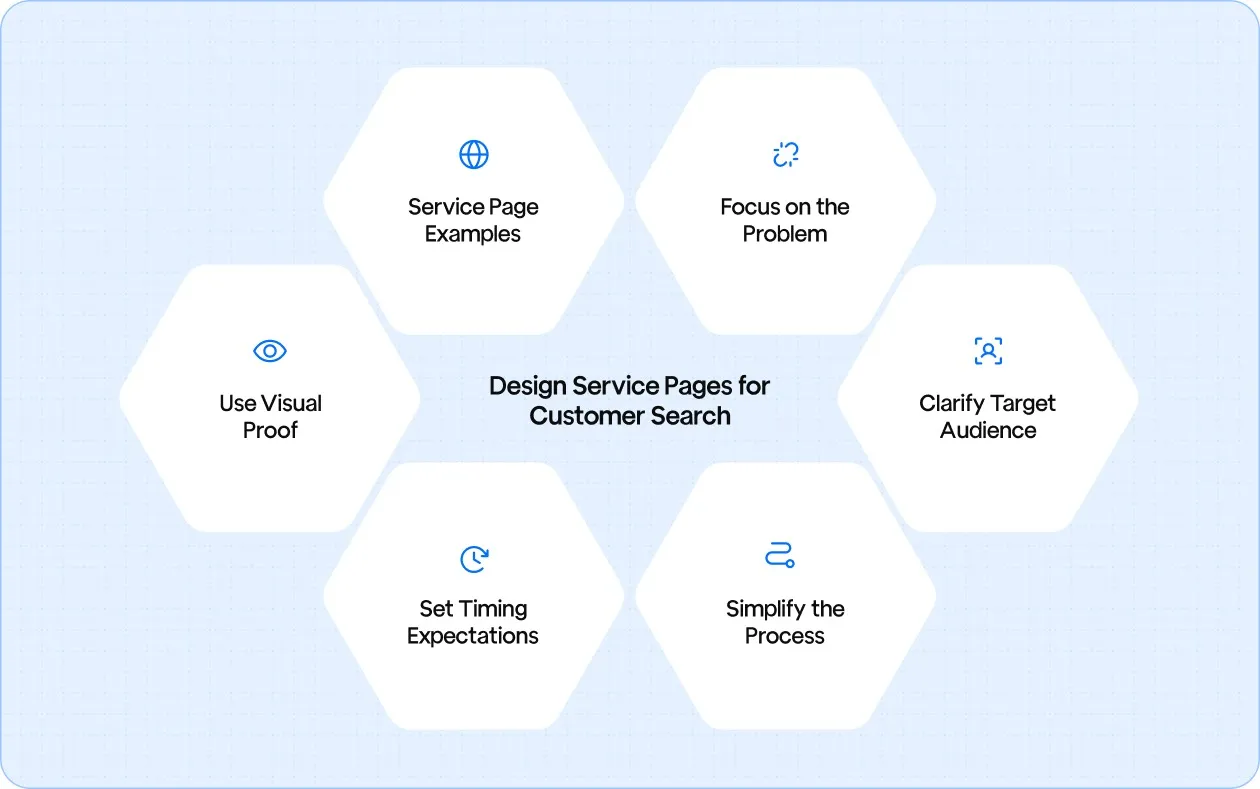
A strong service page feels like it was written for someone who already knows what they want done and is trying to decide who should do it.
1. Start With the Problem Being Solved
Every paving service exists because something is broken, worn out, unsafe, or overdue. Customers usually search with that situation in mind, not with industry terms.
A service page becomes easier to understand when it clearly answers:
- What situation leads someone to look for this service
- What changes after the work is done
This framing helps search engines and readers reach the same conclusion at the same time.
2. Clarify Residential or Commercial Relevance Early
Many paving services overlap, but the context does not. A homeowner and a property manager are looking for different outcomes, timelines, and levels of disruption.
Service pages should make it clear who the service is for. This clarity prevents confusion and helps the page align with the right type of search. It also avoids forcing one page to speak to two very different audiences.
3. Explain the Process Without Overloading Detail
People searching for paving services want reassurance that the work is organised and predictable. They do not need every technical step, but they do want a clear sense of how the job progresses.
A simple process overview helps answer unspoken questions about preparation, execution, and finish without turning the page into a manual.
4. Address Timing Expectations
Timeline concerns often drive searches, especially for repairs and resurfacing. Even a general sense of how long a job typically takes helps people decide if a service fits their situation.
Acknowledging timing shows awareness of real-world constraints and reduces uncertainty for the reader.
5. Reinforce the Page With Visual Proof
Visual proof gives weight to everything else on the page. Photos of completed work help confirm that the service described is work the business has actually done.
This proof supports confidence for readers and reinforces relevance for search engines.
6. Common Service Page Examples
Most paving businesses cover a familiar set of services. Each one deserves its own page because each one answers a different type of search.
- Asphalt driveway paving often relates to replacement, wear, or property improvement
- Parking lot paving is usually tied to safety, compliance, or appearance
- Asphalt repair is connected to urgency and damage
- Sealcoating relates to maintenance and protection
- Paver installation often involves design and long-term use
When each service page is shaped around how customers think about that specific work, the entire site becomes easier to understand.
Must Read: 15 Proven Construction Industry Marketing Strategies for Business Growth
Use Project Galleries as a Ranking Asset
Service pages explain the work you offer. Project galleries show how that work turns out. For paving companies, this distinction matters because search engines look for confirmation that services described on a site reflect real, completed jobs.
A well-built gallery acts as supporting evidence. It connects service descriptions to visible outcomes, helping search engines and readers understand that the work presented on your site is based on experience, not assumptions.
How Galleries Support Service Validation
When project galleries are aligned with specific services, they strengthen those services without repeating their content. A driveway paving service feels more grounded when nearby projects show finished driveways. Repair services feel more credible when projects illustrate visible fixes.
This alignment helps search engines confirm that service pages represent work the business actually performs.
What Makes a Project Gallery Effective?
A gallery works best when its elements are clear and intentional:
- Projects are grouped by service type, so each set of images supports a specific kind of work
- Each project includes a short description that explains the nature of the job and the setting
- Images are named and described clearly, reflecting the work shown rather than using generic labels
These elements help turn galleries into structured proof rather than loose collections of photos.
Project galleries serve one purpose: confirmation. They do not replace service pages or location pages. They support them by showing consistent, repeatable work across different jobs.
Location Pages That Reflect Real Service Coverage
When someone searches for paving services, location is often the deciding factor. They are not just looking for a service; they are looking for that service in a place they recognise. Location pages exist to bridge that gap between what you do and where you actually do it.
These pages work best when they reflect real service coverage instead of trying to stretch visibility across places the business does not meaningfully serve.
Coverage Areas vs City Pages
A coverage area describes where a business is willing to work. A city page explains how a business serves a specific place. Search engines treat these very differently.
Coverage areas are broad by nature and help set expectations. City pages are specific and work only when there is a clear connection between the business and that location. When a page is titled after a city, search engines expect local relevance, not just a name swap.
When a City Page Makes Sense?
A city page earns its place when there is substance behind it. That substance usually comes from repeated work in the area, familiarity with local conditions, or visible projects nearby.
If a business regularly completes jobs in a city, a dedicated page helps search engines associate those services with that location. If work in the area is rare or incidental, a city page adds little value and can weaken clarity across the site.
Why Generic Location Pages Fail?
Generic location pages often look complete but say very little. They repeat the same service descriptions, change the city name, and offer no local detail. Search engines recognise this pattern quickly.
When many pages say the same thing about different places, it becomes harder for any of them to stand out. Instead of improving visibility, they create internal competition and reduce confidence.
What Does a Strong Location Page Include?
Effective location pages focus on relevance rather than reach. They typically include:
- Local context, such as the type of properties or environments commonly served
- Services actually provided in that area, not a full list copied from elsewhere
- Nearby or representative projects, even if referenced briefly
- Area-specific questions, reflecting what customers in that location tend to ask
These elements help search engines and readers connect services to a real place instead of a generic map pin.
Location pages work best when they reflect reality. When they do, they strengthen local understanding without needing to overextend coverage or repeat content already explained elsewhere.
Find Search Terms That Indicate Service Intent
Before someone lands on a paving website, they usually start with a situation. A cracked driveway. A parking lot that needs work. A surface that no longer holds up. Search terms reflect those situations the most.
Finding the right terms starts with recognising the difference between curiosity and intent.
Research Searches vs Service Searches
Research searches are exploratory. They focus on learning, comparison, or general understanding. Service searches are practical. They signal that someone wants work done.
A search like “how long does asphalt last” reflects planning. A search like “asphalt driveway repair near me” reflects action. Pages built for service intent work best when they align with the second type, without ignoring the context set by the first.
Residential and Commercial Wording Patterns
Homeowners and property managers describe problems differently. Even when they want similar work, their language points to different priorities.
Residential searches often mention:
- Driveways
- Appearance
- Property value
- Longevity
Commercial searches tend to focus on:
- Parking lots
- Safety
- Scheduling
- Compliance
Recognising these patterns helps ensure that pages speak to the right audience instead of trying to address both at once.
Common Service-Intent Groups
Most paving searches fall into a few clear categories:
- Immediate service searches, where the work feels urgent
- Repair-related searches, tied to damage or failure
- Comparison searches, where options are being weighed
- Maintenance and lifespan searches, focused on upkeep and planning
Each group reflects a different stage of decision-making. Pages perform better when they are shaped around one group instead of trying to cover them all.
Search intent shapes every page. Teams that plan content around how people describe problems, decisions, and timing create pages that feel relevant without needing to overexplain.
Align content with how customers search online
Search-focused teams plan content around how customers describe services, decisions, and comparisons, then publish with that structure in mind.
Check Intent Strategy
Place Search Terms Without Disrupting Page Clarity
Once intent is clear, placement becomes a matter of balance. Search terms should support understanding, not interrupt it. The goal is to help search engines and readers arrive at the same conclusion without forcing language into places where it does not belong.
Search terms carry the most weight when they appear naturally in areas that define what a page is about. These areas quietly guide interpretation without drawing attention to themselves:
- Titles and headings, which set expectations for the page
- URLs, which signal focus before a page is even opened
- Image descriptions, which connect visual proof to services
- Internal links, which reinforce meaning through context
When placement feels forced, pages become harder to read. When placement feels natural, pages remain clear while still being interpreted correctly. Clarity always comes first; placement exists to support it, not compete with it.
Local Profiles and Search Result Appearance
Not every paving search leads directly to a website. Many decisions begin and end on a results page that shows businesses, photos, and basic details side by side.
Local profiles play a major role in these moments. Google Business Profile influences how a paving company appears in Maps and local results, while Apple Business Connect helps maintain consistency across Apple devices and search surfaces.
These profiles shape first impressions through a small but important set of signals:
- Listed services, which define relevance at a glance
- Photos, which suggest recent and real activity
- Reviews, which signal reliability and experience
Search results often mix website pages and local profiles. When both tell the same story about services and scope, the business feels easier to trust and easier to choose. When they feel disconnected, uncertainty increases before a click ever happens.
Off-Site Signals That Confirm Your Paving Business
Beyond your own website and profiles, search engines look for confirmation from the wider web. These signals answer a simple question: Does this business appear consistent and recognised outside its own pages?
Consistency matters most here. When business details align across directories and mentions, confidence increases. When details conflict, that confidence weakens.
Off-site confirmation usually comes from a small set of predictable places:
- Relevant directories, where paving businesses are expected to appear
- Consistent business details, such as name, address, and service areas
- External mentions, including local references or industry-related listings
These signals do not create visibility on their own. They quietly support everything else by reducing doubt and reinforcing legitimacy across the web.
Every online mention strengthens your business credibility
Many growing businesses rely on structured content programs to keep service pages, location pages, and decision-stage content aligned over time.
See how teams publish
5 Common Patterns That Limit Visibility for Paving Websites
Most paving websites do not disappear from search results because something is broken. They fade because a few small patterns create uncertainty. Search engines tend to step back when signals feel mixed, incomplete, or inconsistent.
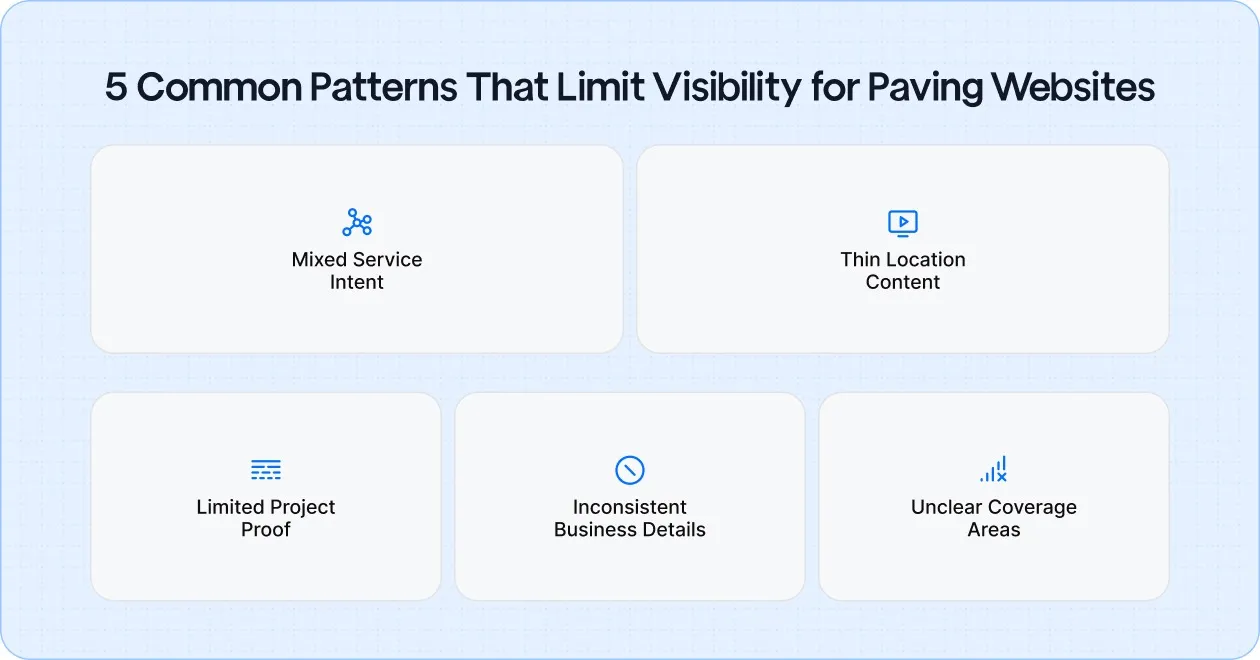
Do paving companies really need separate pages for each service?
These patterns are easy to miss because they often come from good intentions.
1. Mixed Service Intent Pages
Pages that try to represent too many services at once often feel thorough but end up unclear. When driveway paving, parking lots, repairs, and sealcoating are all explained together, search engines struggle to decide when that page should appear.
Instead of one strong match, the page becomes a weak match for many searches. Over time, visibility drops not because the content is poor, but because the intent is diluted.
2. Thin Location Content
Location pages fail when they exist in name only. Pages that repeat the same service text and swap out city names offer little local meaning.
Search engines look for signs that work actually happens in a place. Without local context, these pages feel disconnected and rarely earn consistent visibility.
3. Limited Project Proof
When a site describes services without showing completed work, uncertainty increases. Search engines prefer confirmation over explanation.
A lack of visible projects does not imply a lack of experience, but it does remove a key signal that helps search engines trust what the site claims.
4. Inconsistent Business Details
Small mismatches in business information create bigger problems than most people realise. Differences in addresses, service areas, or names across platforms make it harder for search engines to form a stable picture of a business.
When details conflict, confidence drops quietly, and visibility follows.
5. Unclear Coverage Areas
Some sites try to appear everywhere without clearly explaining where they actually work. Others list coverage areas without connecting them to real services or projects.
When coverage is vague, search engines hesitate. Clear boundaries are easier to trust than broad but unsupported claims.
When Visibility Problems Are Structural, Not Technical
Most paving websites don’t fall short because of effort. They fall short when small gaps add up and create uncertainty.
Throughout this guide, one idea shows up again and again: clarity. Clear services, clear locations, and clear proof of working together instead of competing. When those signals align, search engines don’t need to guess.
That alignment comes from treating content as a connected system, not a collection of isolated pages.
Keep your content system working for you
Structured service pages, project proof, and location clarity create lasting visibility. Gushwork helps teams implement this content-led SEO system effectively.
Book a Free Consultation

Digital Marketing
Jan 2, 2026
5 mins
Digital Marketing for Tile Contractors Isn’t Random: Here’s the Structure That Works!
Batul Beawarwala
Most tile projects are decided long before the first call is made. Homeowners scroll through photos, check reviews, compare services, and quietly narrow their options.
Digital marketing for tile contractors plays a role in those early moments, shaping how a business appears during that research.
When services are clearly explained, projects are easy to understand, and local presence feels consistent, it becomes easier for homeowners to move from browsing to reaching out.
What Digital Marketing Means for Tile Contractors?
Digital marketing, for tile contractors, focuses on how clearly your work shows up while homeowners are comparing options. It shapes how services are explained, how finished projects are presented, and how comfortable someone feels before making contact.
At this stage, homeowners are not looking for marketing. They are looking for reassurance. That usually comes from a few simple signals:
- Clear descriptions of the tile services you handle
- Real project photos that show finish, detail, and scale
- Straightforward ways to understand what happens next
When these pieces are easy to find, the decision feels simpler. Digital marketing supports that process by keeping information organised, visible, and consistent, so early interest turns into genuine enquiries without confusion.
How Homeowners Search for Tile Contractors
Homeowners rarely start by searching for “tile contractor.” They start with the room, the problem, or the finish they want, and they use search as a shortlisting tool. One search turns into five. One photo turns into a comparison. By the time someone reaches out, they often have two or three names in mind.
Here’s what that search journey usually looks like:
- Room-first searches: “bathroom tile installer,” “kitchen backsplash installation,” “shower tile repair.”
- Problem-first searches: “cracked tile fix,” “grout repair,” “water damage tile replacement.”
- Finish-first searches: “subway tile installation,” “herringbone layout,” “large format tile installer.”
- Local intent baked in: “near me,” “in Boston,” “best tile installer Seattle.”
Most of this happens on a phone. People tap map results, skim photos, scan reviews, and look for signs that you do the kind of job they need. The contractors who get contacted tend to make three things easy to spot: what services they handle, what their work looks like, and what someone should do next.
Search patterns matter more than most pages admit.
Most tile contractor sites miss decision-stage searches because their content lacks a clear structure around how homeowners compare and shortlist services.
Fix Content Gaps
Local Search Visibility for Tile Contractors
Once homeowners move past browsing, they usually narrow their options using maps. This is where local listings quietly decide who gets considered and who gets skipped. These listings act like a public snapshot of your business, showing your services, recent work, and responsiveness at a glance.
Google Business Profile as the Primary Local Signal
Google Business Profile shapes how your tile business appears when someone searches nearby or scans map results. It gives homeowners quick answers without requiring them to visit a website.
What matters most here is accuracy and relevance:
- Categories that clearly reflect tile installation, repair, and related services
- Service details that explain the type of work you actually take on
- Recent project photos that show finishes, patterns, and scale
- Active reviews and clear responses that show attentiveness
- Call and direction data that reflects real customer interest
A well-maintained profile makes it easier for homeowners to recognise your work as a match for their project before moving any further.
Apple Business Connect as a Supporting Local Discovery Channel
Apple Business Connect plays a similar role across Apple Maps, Siri, and Spotlight search. For many iPhone users, these surfaces guide navigation and local lookups by default.
Its value comes from consistency:
- Accurate business details that mirror Google listings
- Service categories that match how homeowners phrase requests
- Project images that appear during map views and searches
- Showcases that highlight recent work or specific services
While Apple Business Connect does not replace Google Business Profile, keeping both aligned helps ensure your tile business appears reliable and familiar across devices, searches, and directions.
Must Read: How a Building Material Supplier Cut Lead Costs 42% - The Digital Marketing Strategy You Can Use
Website Pages That Turn Visits Into Enquiries
Once a homeowner clicks through from a map listing or search result, the website takes over the conversation. At this stage, people are not exploring broadly. They are checking the fit. They want to confirm that you handle their type of work and that reaching out feels straightforward.
The most effective tile contractor sites guide this process quietly, using a small set of pages that each serve a clear purpose.
Core Pages Tile Contractor Sites Need
- Homepage: Acts as a quick orientation. It should confirm what services you offer, show real project proof, and make it obvious how to get in touch.
- Service pages: These explain specific work, such as installation, repair, waterproofing, or specialty layouts. Each page helps a homeowner decide if you handle their exact need.
- Service area pages (where applicable): These clarify where you work and help local visitors feel confident that you actually serve their location.
- Project or gallery pages: These provide context around your work, showing finishes, patterns, and real environments rather than isolated photos.
- Contact or estimate request page: This is where interest turns into action. The process should feel simple, clear, and predictable.
Service Page Structure That Encourages Enquiries
Strong service pages do not try to cover everything. They focus on helping homeowners answer a few practical questions:
- What does this service include?
- Have you completed similar work before?
- What should I expect after I reach out?
This clarity usually comes from:
- A clear description of the service scope
- Project images tied directly to that service
- Short review excerpts from similar jobs
- A direct, visible enquiry path without distractions
When each page does one job well, the site feels easier to use and more trustworthy.
Pages work best when each one has a clear job.
Service and location pages bring consistent enquiries when they are planned as a connected system and written to answer real buying questions.
Build Service Pages
SEO Strategy for Tile Contractors
SEO, at its core, is about helping search engines connect the dots between your services, your work, and the questions homeowners are asking. For tile contractors, this connection works best when content reflects real project needs rather than broad or generic topics.
Instead of chasing every possible phrase, effective SEO starts by grouping searches based on how close someone is to hiring.
Keyword Groups That Matter
Homeowner searches tend to fall into a few clear buckets:
- Installation-focused searches: These relate to full projects such as bathroom tile installation, kitchen backsplashes, or new flooring.
- Repair and maintenance searches: These include fixes, replacements, and updates like cracked tiles, grout repair, or water damage.
- Material-specific queries: Homeowners often search by tile type or pattern when they have a design in mind.
- Location-based variations: Searches that combine services with city or area names signal local intent and urgency.
Organising content around these groups makes it easier for search engines to understand what you offer and when to surface your pages.
Must Read: Slow Results From Construction Equipment Marketing? Try These 7 Digital Hacks That Work
On-Page SEO Essentials
Once topics are clear, structure does the heavy lifting. Search engines rely on signals within each page to understand relevance and relationships.
That clarity usually comes from:
- Page titles and headings that reflect the exact service being discussed
- Internal links that connect services to related projects and explanations
- Image details that help galleries communicate context rather than decoration
This structure helps pages support one another instead of competing.
Content Topics That Attract Qualified Traffic
Beyond service pages, create supporting content that answers questions homeowners ask before making contact. These topics often include:
- How long do different tile projects usually take
- How to choose tiles based on room use and layout
- What sealing and grout maintenance involves
- Common tile problems and how they are typically addressed
When these topics link back to relevant services, they create a clear path from research to enquiry.
SEO improves when content follows a system.
Pages that perform well usually come from planned service content, clear internal linking, and steady publishing tied to how homeowners decide.
Plan SEO Content
Reviews and Reputation Signals
By the time homeowners reach this stage, they are no longer exploring options broadly. They are checking for reassurance. Reviews often serve as the final confirmation that a tile contractor delivers the kind of work shown elsewhere on the site.
What matters here is not volume alone, but recency, relevance, and tone.
- Review frequency and consistency: A steady stream of recent feedback tells homeowners that the business is active and trusted right now.
- Timing of review requests: Requests work best shortly after job completion, when the finished work is fresh, and satisfaction is clear. This timing often leads to more specific, useful feedback.
- Responding to feedback: Short, thoughtful replies show attentiveness and professionalism. Responses to both positive and critical reviews help set expectations and show how issues are handled.
- Using reviews across key pages: Placing relevant review excerpts on service pages and local listings helps homeowners connect feedback to the exact type of work they are considering.
Taken together, these signals help homeowners feel more comfortable moving forward. Reviews reinforce what service descriptions and project photos already suggest, making the decision feel supported rather than uncertain.
Paid Channels That Support Enquiry Flow
Paid channels play a supporting role for tile contractors. They help maintain visibility during periods of active demand and ensure your services appear when homeowners are already searching with intent.
These channels work best when they reinforce what your pages and listings already communicate, rather than introducing new messages.
Google Local Services Ads
Local Services Ads appear within local search results and map-based views. Their value lies in proximity and immediacy.
What matters most here is follow-through:
- Clear service categories that match the work you take on
- Prompt responses to enquiries while interest is high
- Consistent business details that match your listings
These ads rely less on persuasion and more on availability and clarity.
Google Search Ads
Search ads support service-specific visibility. They surface your pages for searches tied to particular types of tile work.
To stay effective:
- Campaigns should mirror real services, not broad promises
- Ads should point to pages that explain that service clearly
- Messaging should reflect what homeowners already see elsewhere
This alignment helps avoid confusion when someone clicks through.
Retargeting
Retargeting keeps your work visible after an initial visit. It acts as a reminder rather than a pitch.
The most effective retargeting focuses on:
- Completed projects that reflect real spaces
- Review excerpts tied to similar work
- Simple visuals that reinforce familiarity
Used sparingly, retargeting supports recall without overwhelming attention.
Social Media Use for Tile Contractors
For tile contractors, social media often plays a quiet but important role. It acts as a visual reference point that homeowners check when they want to see real work outside of a website or map listing. Many people visit social profiles after shortlisting a contractor, not before.
What matters most is how clearly your work speaks for itself.
- Platforms suited for visual proof: Image-first platforms help show finish quality, layout choices, and detail work in real spaces. Homeowners use these profiles to confirm style, consistency, and experience rather than to read long explanations.
- Posting patterns focused on completed work: Posts work best when they highlight finished projects with brief context. Showing the space, the tile choice, and the final outcome helps viewers understand the type of work you handle without extra explanation.
- Handling comments and messages: Simple, timely replies help guide interest toward the next step. Clear responses to questions about services, timelines, or availability reduce hesitation and keep conversations moving naturally.
Used this way, social media supports decision confidence. It reinforces what homeowners already saw through search and listings, helping your work feel familiar and reliable before contact.
Suggested Read: Most Ceramic Manufacturing Websites Skip At Least Two Of These 10 Basic SEO Steps…That Mistake Kills Rankings
Email and Enquiry Follow-Up
Once a homeowner reaches out, the work is not finished. This stage is about maintaining clarity and momentum without pressure. Many decisions fall apart here simply because the next steps feel unclear or too slow.
Effective follow-up keeps the conversation moving forward in a calm, predictable way.
- Confirmation messages after enquiries: A short confirmation sets expectations. It tells the homeowner their message was received and explains what happens next, removing uncertainty during the wait.
- Quote follow-ups that address common questions: Follow-ups work best when they focus on practical concerns homeowners usually have after seeing a quote. Timelines, scope clarity, and what is included often matter more than price explanations.
- Staying visible after site visits: A brief message after a visit helps keep details fresh. It reinforces professionalism and keeps the project from slipping into the background while comparisons continue.
Good follow-up does not push decisions. It supports them by making the process feel steady and organised.
Track What Matters
Tracking is not about watching every detail. For tile contractors, it’s about understanding which parts of the process lead to real conversations and scheduled work.
A small set of signals usually tells the full story:
- Calls and form enquiries: These show when interest turns into direct contact. Tracking volume and timing helps reveal which pages and listings prompt action.
- Booked site visits: This is often the clearest indicator of serious intent. It reflects how well information, proof, and communication align.
- Google Business Profile insights and basic analytics: These provide context around visibility and engagement without adding complexity. Patterns over time matter more than daily changes.
When tracked consistently, these signals help guide decisions about what to keep, what to refine, and where attention is best spent, without adding noise or distraction.
How Tile Contractors Turn Visibility Into Consistent Enquiries
For most tile contractors, results don’t come from a single channel or tactic. They come from alignment. When local discovery, clear service explanations, real project proof, and simple enquiry paths point in the same direction, homeowner decisions feel easier and more confident.
Long before contact happens, these signals quietly shape who gets shortlisted and who gets skipped. This is where execution makes the difference.
Good content works best when it’s built with intent.
Gushwork helps tile contractors execute content-led SEO through structured service pages, location coverage, and internal linking systems.
Book a Free Consultation

Digital Marketing
Jan 2, 2026
5 mins
Countertop Installation Native Advertising: Here’s How Buyers Research Before They Call
Batul Beawarwala
Most countertop installation projects begin long before a homeowner fills out a form or makes a call. They start with quiet research.
People scroll through photos, compare materials, read about timelines, and look for signs that an installer understands the work beyond surface claims. Countertop installation native advertising fits this research phase by placing useful content inside articles, guides, and sites that homeowners already trust.
Instead of interrupting the process, it stays present while questions are answered and options are compared. For installers and growing teams, this approach supports steady demand by matching content to how buyers actually choose who to contact.
What Native Advertising Looks Like for Countertop Installation?
Native advertising for countertop installation appears as content that fits naturally into the page a homeowner is already reading. It looks like an article or guide and focuses on materials, process, and finished results.
For countertop businesses, native ads usually lead to:
- Material comparisons
- Installation explainers
- Pricing factor breakdowns
- Visual project galleries
The aim is to stay visible during research and answer questions that shape decisions. Research shows native ads receive about 53% more views than classic display ads because they fit the content environment better.
Common native placements used for countertop installation content syndication
Native content appears in three formats:
- In-feed content units: Stories placed inside article feeds on home improvement or lifestyle sites.
- Content recommendation widgets: Links shown at the end of articles under sections like “More to read.”
- Sponsored article placements: Full articles hosted on publisher sites with room for detail and visuals.
How native ads differ from search ads within a countertop installation campaign
- Search ads appear when someone is close to contacting an installer.
- Native ads appear earlier, while homeowners are still comparing options.
Search responds to existing intent. Native supports understanding before the intent is fully formed.
Some installs win before the quote is even asked for.
If your content answers the same questions homeowners keep googling, your brand shows up earlier and feels familiar sooner.
Map Early-Stage Content
Understand the Countertop Installation Target Audience
Homeowners researching countertop installation are not all at the same stage. Some are still learning. Others are close to reaching out. Native advertising mostly reaches people in the earlier phase, when preferences are still forming.
In home services, 78% of local mobile searches lead to a purchase, and over 55% of consumers research providers online before scheduling an appointment, showing how early research matters.
Before contacting an installer, homeowners usually look for:
- Material comparisons in real spaces
- Typical installation timelines
- Pricing factors that affect final quotes
- Photos from completed projects
These questions shape confidence before any outreach happens.
Native advertising aligns with this behavior by placing answers inside articles and guides homeowners are already reading, allowing interest to build without pressure.
Build the Foundation Before Launching Ads
Before any countertop installation ads go live, the basics need to be clear. Native advertising works best when homeowners immediately understand what happens next and what to expect if they reach out.
Define the offer clearly
Homeowners hesitate when the next step feels vague. A clear offer removes that hesitation. This usually means spelling out:
- How measurement appointments work
- When quotes are shared after measurement
- What installation scheduling typically looks like
Clarity at this stage sets expectations and prevents confusion later.
Establish proof and credibility
Native ads often lead homeowners to read before they act. What they see during that time shapes trust. Strong foundations include:
- Before-and-after galleries from real installs
- Reviews that speak to workmanship and reliability
- Clear explanations of materials offered and how installation is handled
This information reassures readers that the installer understands the work in detail.
Set clear service area boundaries
Relevance matters as much as visibility. Ads should reflect where the business actually operates.
- ZIP-based targeting keeps exposure aligned with coverage
- Exclusion zones prevent wasted attention outside service areas
Clear boundaries protect countertop installation performance and ensure follow-up conversations stay relevant.
If the next step feels unclear, homeowners stop reading.
Clear pages, clear topics, and clear expectations give native ads a destination that makes sense.
Fix Content Gaps
Targeting Strategies That Match Countertop Research Behavior
Targeting countertop installation, native advertising works best when it reflects how homeowners actually research, not how advertisers want them to act. At this stage, relevance comes from context and behavior, not direct intent.
Core targeting layers
Effective targeting starts with narrowing exposure to situations where countertop planning is already top of mind.
- Geographic alignment with service coverage: Ads appear only where installation is realistically possible, keeping attention local and relevant.
- Contextual placements around renovation content: Native ads are shown alongside articles about home upgrades, kitchen planning, or remodel preparation, where countertop research naturally fits.
- Topic and keyword adjacency: Content appears near discussions about materials, layouts, or renovation costs, reaching readers already thinking through countertop decisions.
This approach keeps exposure focused without relying on personal data.
Audience refinement signals
As homeowners interact with content, additional signals help refine who continues to see follow-up messages.
- Content engagement depth: Readers who scroll, pause, or explore multiple sections show stronger interest.
- Time spent on page: Longer reading time often signals active comparison rather than casual browsing.
- Gallery and pricing page interaction: Views of images or cost-related sections indicate growing seriousness.
These signals help narrow attention to homeowners who are still researching but clearly engaged, without forcing action too early.
Must Read: How a Building Material Supplier Cut Lead Costs 42% - The Digital Marketing Strategy You Can Use
The 3-Step Native Advertising Funnel for Countertop Installation
A native advertising funnel for countertop installation works when each step respects how confidence builds over time. Homeowners do not move from reading to contacting in one jump. Each stage answers a different question in their mind.
Step 1: Content-first discovery
At this stage, the reader is not comparing installers. They are trying to understand the project itself. Content here removes uncertainty by covering topics such as:
- Quartz vs granite and where each works best
- Typical countertop installation timelines
- Pricing factors that influence final quotes
- Sink cutouts, edge profiles, and backsplash planning
- What usually happens on installation day
The focus stays on clarity, not persuasion. This forms the base layer of countertop installation sales content.
Step 2: Countertop installation retargeting campaign
After someone engages with content, their questions change. They already understand the basics. Now they want reassurance. Retargeting at this stage focuses on:
- Real installation examples that show finished work
- Reviews that reflect consistency and reliability
- Process explanations that reduce second-guessing
These countertop installation retargeting ads support decision confidence without repeating earlier information.
Step 3: Quote and measurement conversion

Once confidence is established, friction becomes the main risk. Conversion at this stage depends on:
- Short inquiry forms that feel quick to complete
- Clear click-to-call options
- Straightforward explanations of what happens after contact
Each step in the funnel narrows focus, from learning, to reassurance to action, without forcing homeowners forward before they feel prepared.
For real-world examples of how content-led native advertising has been executed in practice, the case studies linked here are worth reading.
Great ads don’t fix weak content.
When your guides, pages, and proof are planned like a system, the funnel stops feeling random.
Plan Content Strategically
Creative and Copywriting That Drives Engagement
Native ads succeed or fail based on how naturally they fit into the reading experience. For countertop installation, creative and copy need to feel informative first, promotional last.
Visual guidelines for native ads
Homeowners pause on visuals that help them judge quality. Effective native creatives usually share a few traits:
- Real project photography over stock images: Finished kitchens and bathrooms signal authenticity and workmanship more clearly than styled placeholders.
- Focus on surfaces and details: Edges, seams, cutouts, and transitions often matter more compared to wide room shots when someone is comparing installers.
- Minimal overlays and text: Clean images preserve the look of editorial content and prevent the ad from feeling disruptive.
These choices help the content blend in while still drawing attention.
Countertop installation copywriting principles
The copy surrounding native creatives works best when it mirrors how homeowners think during research.
- Plain, descriptive language: Clear explanations feel more trustworthy than polished sales phrasing.
- Clear outcomes without exaggeration: Readers want to understand what changes after installation, not promises that feel vague.
- Headlines framed around homeowner questions: Questions about materials, process, or planning naturally invite clicks because they match active curiosity.
Strong creative and copy do not push decisions. They hold attention long enough for understanding to grow.
Landing Pages Built for Native Traffic
Native traffic arrives with a different mindset. Homeowners click through expecting continuity, not a hard shift into sales mode. Landing pages need to respect the context that brought them there.
Content landing pages
These pages work best when they continue the story started by the ad. Key elements include:
- Ad-aligned headlines: The headline should echo the question or topic that earned the click, so visitors feel they landed in the right place.
- Visual examples placed early: Images from real projects help readers quickly connect the content to their own space.
- Clear explanations of pricing, process, or materials: Straightforward sections that explain what affects cost, how installation works, or how materials differ keep readers engaged.
- Soft transitions into contact options: Contact prompts appear as a natural next step, not an interruption.
Quote and measurement pages
When homeowners decide to reach out, simplicity matters most.
- Short forms with essential fields only: Fewer questions reduce hesitation.
- Visible service area confirmation: Clear location coverage reassures visitors before they submit.
- Proof placed near the form: Reviews, photos, or brief process notes reinforce confidence at the moment of action.
Landing pages for native traffic succeed when they continue the learning experience first, then make contact feel easy and predictable.
Measure Countertop Installation Ad Performance
Measuring native advertising for countertop installation is less about volume and more about signal quality. The goal is to understand which content attracts serious homeowners and which interactions lead to meaningful conversations.
Tracking setup essentials
Effective measurement starts with visibility across the full path, not just the first click.
- Campaign-level tracking: Shows which content themes and placements attract the right type of interest.
- Creative-level attribution: Helps identify which visuals and headlines draw deeper attention, not just clicks.
- Call and form tracking: Connects inquiries back to the content that started the interaction.
This structure ensures performance is reviewed in context, not in isolation.
Performance signals that matter
Native advertising success shows up through behavior, not surface metrics.
- Engagement quality: Readers who scroll, pause, or explore multiple sections signal genuine interest.
- Page interaction depth: Time spent with galleries, pricing sections, or process explanations indicates active consideration.
- Call and inquiry relevance: Conversations that reference materials, timelines, or specific questions reflect stronger alignment.
Tying outcomes back to the campaign
The most useful insights come from tracing outcomes to their origin. When installers can see which content influenced inquiries, future campaigns become more focused, consistent, and easier to refine.
Performance measurement, done well, turns native advertising into a learning system rather than a one-off effort.
30-Day Execution Plan
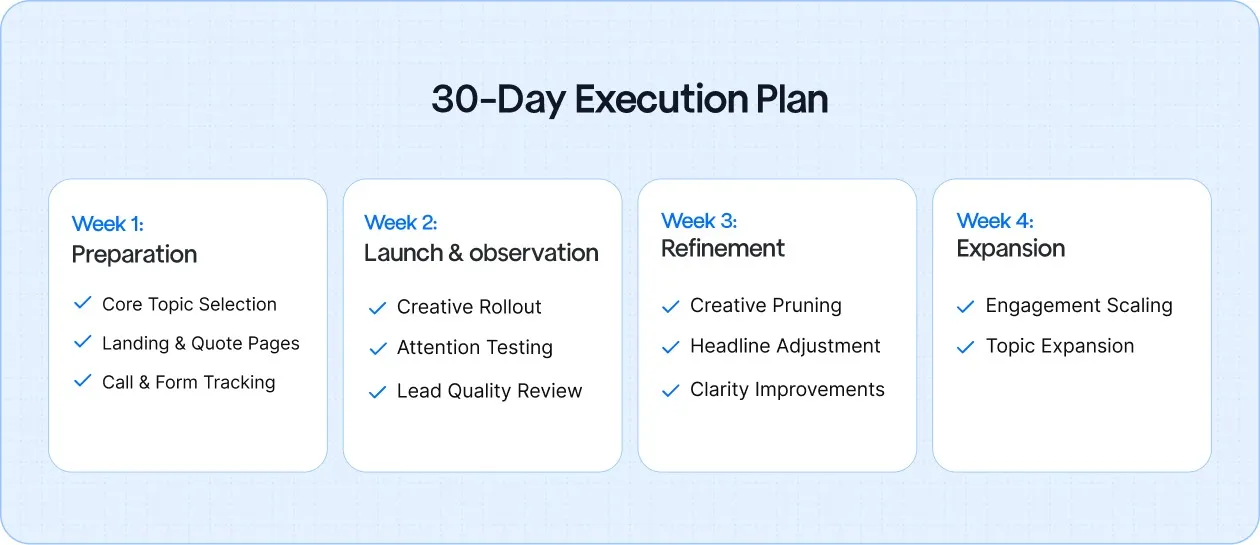
A 30-day rollout works best when each week has a clear purpose. The goal is not speed, but controlled learning that compounds over time.
Week 1: Preparation
The first week sets the direction for everything that follows. Decisions here should reduce uncertainty later.
- Select one core content topic tied to common homeowner questions
- Build one content-focused landing page and one quote or measurement page
- Set up call and form tracking so early signals are visible
This week is about clarity, not volume.
Week 2: Launch and observation
With the foundation in place, the focus shifts to watching how real homeowners respond.
- Launch multiple creatives across a small set of placements
- Observe which topics hold attention and which lose it quickly
- Review early inquiries for relevance and question quality
The goal is to learn, not to optimize yet.
Week 3: Refinement
Patterns usually start to emerge by the third week. This is where small changes create meaningful improvement.
- Pause creatives that fail to hold attention
- Adjust headlines or page sections that cause drop-offs
- Improve clarity where readers hesitate or exit
Refinement at this stage sharpens what already works instead of starting over.
Week 4: Expansion
The final week focuses on controlled growth.
- Increase exposure to content that drives deeper engagement
- Introduce new topics based on the questions homeowners asked during the month
Expansion works best when it follows evidence, not assumptions.
By the end of 30 days, the campaign shifts from setup mode to a repeatable system that can be extended with confidence.
How Native Advertising Supports Real Countertop Buying Decisions
Countertop installation decisions usually form over time. Homeowners read, compare, and look for proof before contacting an installer. What they learn during this phase often shapes who they reach out to later.
Native advertising supports this process by placing useful content where research already happens. It helps homeowners understand materials, timelines, and what to expect, without forcing action too early.
When this content appears consistently, conversations start with clearer expectations and more informed questions. That early clarity is what turns research into dependable demand.
Want your content to work before the first call?
Gushwork helps teams plan, write, and structure SEO content so buyers understand the work before they ever reach out.
Book a Free Consultation

SEO
Jan 2, 2026
5 mins
Pool Contractor Marketing Ideas: Turn Searches Into Signed Pool Projects
Batul Beawarwala
Pool contractor marketing often decides outcomes before any form is filled out or any call is placed.
Homeowners notice small signals first: how confident a business feels, how clear the work looks, and how easy it is to understand what happens next. These impressions form quietly and quickly, shaping trust long before pricing or timelines come into the conversation.
This article looks at pool contractor marketing from that early decision point, where perception is formed, and shortlists are created, setting the stage for the strategies that follow.
Pool Contractors vs Pool Cleaning Services
Pool contractor marketing is often grouped with marketing for pool cleaning services, even though the two businesses operate very differently. This overlap creates confusion for homeowners and leads to enquiries that are poorly aligned with what a contractor actually offers.
Pool contractors are usually contacted during a planning phase. Homeowners are considering a major investment, reviewing multiple options, and paying close attention to past work and reliability. These decisions take time, and the research phase often happens quietly.
Pool cleaning services, on the other hand, operate around repeat needs and ongoing schedules. A pool cleaning service strategy often centres on familiarity, convenience, and routine care rather than long-term comparisons.
Because of this difference, pool contractor marketing needs to focus on:
- Visible experience through completed projects
- Clear explanations of how work is planned and executed
- Signals that reduce uncertainty before contact is made
When contractor messaging borrows too much from marketing for pool cleaners, it feels rushed and incomplete. Clear separation helps homeowners understand exactly what kind of service they are evaluating.
Positioning That Attracts the Right Enquiries
Positioning shapes who reach out and who quietly move on. When homeowners land on a contractor's site, they are looking for signs that the business fits their situation. Vague descriptions or broad claims make that judgment harder.
Strong positioning often shows up in:
- Clear service descriptions that explain the scope
- Language that reflects planning and care rather than speed
- Real project examples instead of abstract promises
This is where contractor positioning differs clearly from pool cleaning service market positioning. Cleaning services often highlight availability and frequency. Contractors gain more trust by explaining the approach, decision points, and outcomes.
When positioning is clear, enquiries arrive with better context and fewer misunderstandings.
Many contractor sites feel familiar, for the wrong reasons.
Clear search visibility starts with pages written around how buyers compare options, not recycled claims pulled from other sites.
Get It Done
Website Structure That Converts Search Visitors Into Site Visits
A pool contractor website should feel organised and reassuring. Visitors are not looking to be sold to; they want to understand what you do and see evidence that you have done it well.
Most effective contractor websites share a simple structure:
- A primary page for pool construction
- Separate pages for remodels or upgrades, when offered
- A portfolio hub that links to individual project pages
- A clear contact or site visit request page
Portfolio pages deserve special attention because they often influence decisions. Strong portfolio pages usually include:
- The project location and context
- What the homeowner wanted to achieve
- Any constraints or challenges involved
- Clear visuals showing progress and final results
Trust signals support this structure quietly. Service areas, licensing information, warranty notes, and short explanations of what happens after someone reaches out all reduce hesitation.
Local Visibility That Produces Calls
Local visibility helps to create the first impression before a website visit even happens. When a contractor appears consistent and active in local listings, it signals reliability.
About 80% of U.S. consumers search for local businesses online at least once a week, and 32% search daily, showing how frequently buyers look for nearby services like pool contractors.
Well-maintained local profiles typically include:
- Accurate business details across platforms
- Recent photos from real projects
- Clear service descriptions
- Helpful answers to common questions
Reviews play a major role in this stage. The most helpful reviews mention specific experiences, such as communication during the build or how timelines were handled. These details help homeowners understand what working with the contractor feels like.
Location pages further support local visibility when written carefully. Pages that reference nearby work, local considerations, and common questions feel grounded and useful.
SEO for Pool Contractors With Purchase Intent
Search visibility works best when content supports real decisions. People searching for pool contractors are usually trying to understand what they are getting into before making contact.
Content that performs well for contractors often focuses on:
- Cost ranges and what affects pricing
- Typical project timelines
- Permit steps homeowners should expect
- Comparisons between design or material options
This approach differs from pool cleaning service content marketing, which often focuses on maintenance tips and general advice. Contractor-focused content works best when it prepares buyers for conversations rather than overwhelming them with information.
Effective pool contractor content creation helps to keep each page focused on one question, uses plain language, and connects naturally to relevant services or projects.
Traffic alone rarely changes the outcome
Search works when content is planned as a system that supports discovery, comparison, and decisions over time.
See How It Works
Paid Channels That Support Organic Growth
Paid promotion works best when it supports what visitors already see elsewhere. For pool contractors, paid channels are often used to maintain visibility during key periods or introduce services to new areas.
Consistency matters over volume. Ads should reflect:
- The same services are shown on the website
- The same locations are being served
- The same expectations are set in the content
Landing pages support this when they feel familiar rather than promotional. Real project photos, clear explanations, and straightforward next steps help visitors stay engaged instead of backing out.
Social Content That Reinforces Trust
Social content supports trust by adding familiarity. It rarely works as a standalone driver for contractor enquiries, but it plays an important supporting role.
Posts that resonate most often show:
- Build progress over time
- Finished projects with brief context
- Simple explanations of materials or design choices
This differs from pool cleaning service content creation, which often highlights routines or schedules. Contractor-focused social content benefits from showing movement, progress, and outcomes.
Must Read: 7 Most Powerful Lead Gen Platforms Every Construction Manufacturer Should Be Using
Partnerships That Generate Qualified Referrals
Partnerships tend to work best when audiences overlap naturally. Landscapers, outdoor kitchen installers, remodelers, and real estate professionals often speak with homeowners at similar planning stages.
Strong partnerships usually involve:
- Clear understanding of the ideal referral
- Simple methods for making introductions
- Mutual respect for timelines and communication
Tracking referrals does not need to be complex. Even basic notes help reveal which relationships lead to meaningful conversations.
Follow-Up That Turns Enquiries Into Booked Site Visits
Many enquiries lose momentum due to unclear follow-up rather than a lack of interest. A timely acknowledgement and clear explanation of next steps helps keep conversations moving.
Contractor follow-up differs from pool cleaning service sales tactics and pool cleaning service sales strategies. Instead of recurring reminders, the focus is on planning, clarity, and coordination.
Quotes tend to perform better when they:
- Clearly outline the scope
- Explain timelines in plain terms
- Set expectations around stages and payments
This clarity reduces uncertainty and shortens decision cycles.
Good leads stall when pages don't support the conversation
Content that answers cost, process, and timing questions upfront shortens follow-ups and improves close rates.
Find & Fix The Gaps
Measurement That Shows What Produces Signed Projects
Measurement helps identify patterns rather than chase perfection. Understanding where enquiries come from and how they progress offers valuable insight over time.
About 62% of consumers would avoid using a business if they found incorrect information online, reinforcing why consistent local listings and profile management are essential for contractors.
Contractors often benefit from tracking:
- Which pages are viewed before contact
- How many enquiries turn into site visits
- Which site visits lead to signed projects
This differs from pool cleaning service marketing automation, which often centres on repeat scheduling. Contractor measurement focuses more on understanding decision paths and improving clarity where it matters.
A Clear 90-Day Plan to Put This Into Motion
A strong pool contractor marketing system develops in stages. Each phase has a clear purpose, and skipping steps usually leads to uneven results.
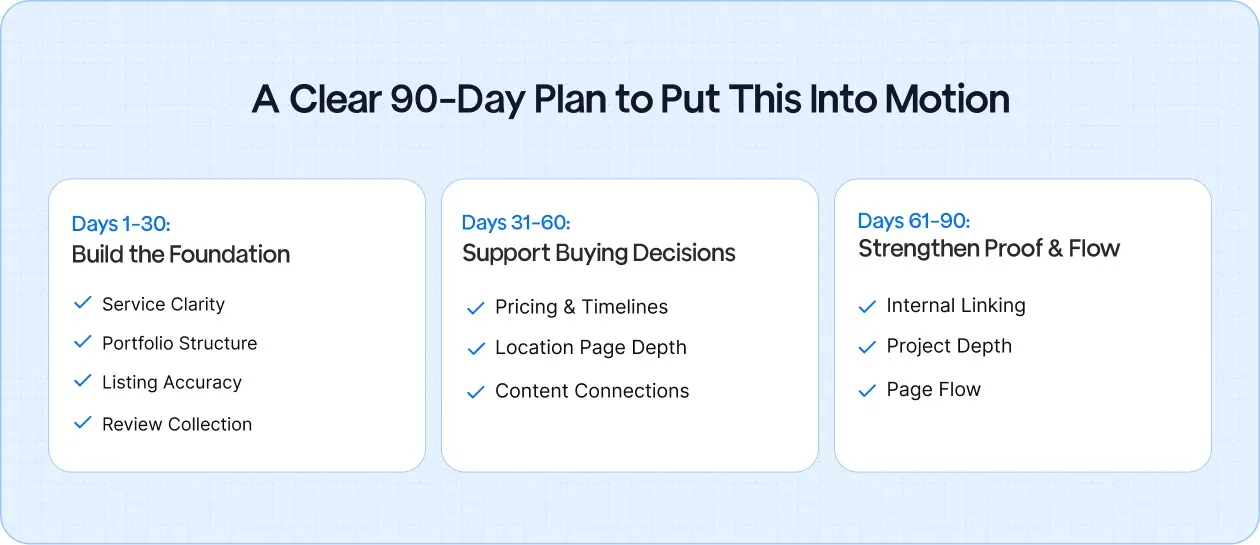
This 90-day framework focuses on building clarity first, supporting decision-making next, and then creating momentum through consistency.
First 30 Days: Create a Solid Base
The first month is about alignment and clean-up. Before adding new pages or content, it is important to make sure existing assets explain your work clearly and consistently.
Key priorities during this phase include:
- Refining core service pages so that scope, process, and expectations are easy to understand
- Organising portfolio content into a logical structure that highlights completed work clearly
- Reviewing local listings for accuracy, updated details, and recent project photos
- Setting up a simple review process to collect detailed client feedback regularly
By the end of this phase, homeowners should be able to understand what you offer, where you work, and what happens after first contact without needing additional explanation.
Days 31-60: Add Decision-Focused Depth
With the foundation in place, the next phase supports how homeowners compare options and prepare to reach out. This is where content begins to guide decisions more directly.
This stage typically focuses on:
- Publishing high-intent pages that address pricing ranges, timelines, and planning steps
- Strengthening priority location pages with specific service details and nearby project context
- Connecting new content to relevant services and portfolio examples
The goal here is not volume. It is to make sure the most common questions are answered clearly, reducing uncertainty before a conversation begins.
Days 61-90: Build Momentum With Proof and Flow
The final phase is about connection and reinforcement. Instead of adding isolated pages, attention shifts to how content works together across the site.
Key actions in this phase include:
- Expanding internal links so visitors can move naturally between related pages
- Adding deeper project breakdowns that explain challenges, decisions, and outcomes
- Improving page flow to reduce dead ends and encourage continued exploration
By the end of 90 days, the site functions as a connected system that supports discovery, comparison, and confidence at every step.
Must Read: 15 Contractor Marketing Strategies That Actually Bring You More Clients
Momentum comes from consistent publishing
Search growth compounds when content planning, writing, and optimisation follow a repeatable system.
Understand The Flow
What Separates Visible Pool Contractors From the Rest?
Pool contractor marketing works when every piece supports the next step a homeowner is already trying to take. Clear pages set expectations, real project proof builds confidence, and thoughtful follow-up keeps conversations moving instead of stalling.
When these parts align, marketing feels less like promotion and more like guidance. For contractors relying on SEO and content as a long-term growth channel, progress comes from consistent execution, not scattered tactics.
The businesses that see steady results are the ones that treat content as a system, refine it over time, and stay focused on how buyers actually choose.
What buyers see first shapes everything that follows.
Gushwork helps pool contractors build content-led SEO systems that support real buyer decisions and steady search visibility over time.
Book a Free Consultation

Digital Marketing
Jan 2, 2026
5 mins
Garage Door Repair PPC Done Right: When Searches Turn Into Service Calls
Batul Beawarwala
A garage door never breaks at a convenient time. A car gets stuck inside. A spring snaps late in the evening. The door refuses to close before work the next morning.
In moments like these, people don’t browse. They search, skim, and call the first business that feels local, clear, and reliable. That’s where garage door repair PPC plays a role, placing your service in front of homeowners right when the problem shows up.
This article explains how garage door repair PPC works in real repair situations, the types of ads that matter, how search intent shapes decisions, and why clear service pages affect results once ads are running.
What Garage Door Repair PPC Includes?
Garage door repair PPC is made up of a few paid placements that show up at different moments in a homeowner’s search for help. Each channel has a clear role. Problems start when all of them are treated the same or expected to do the same job.
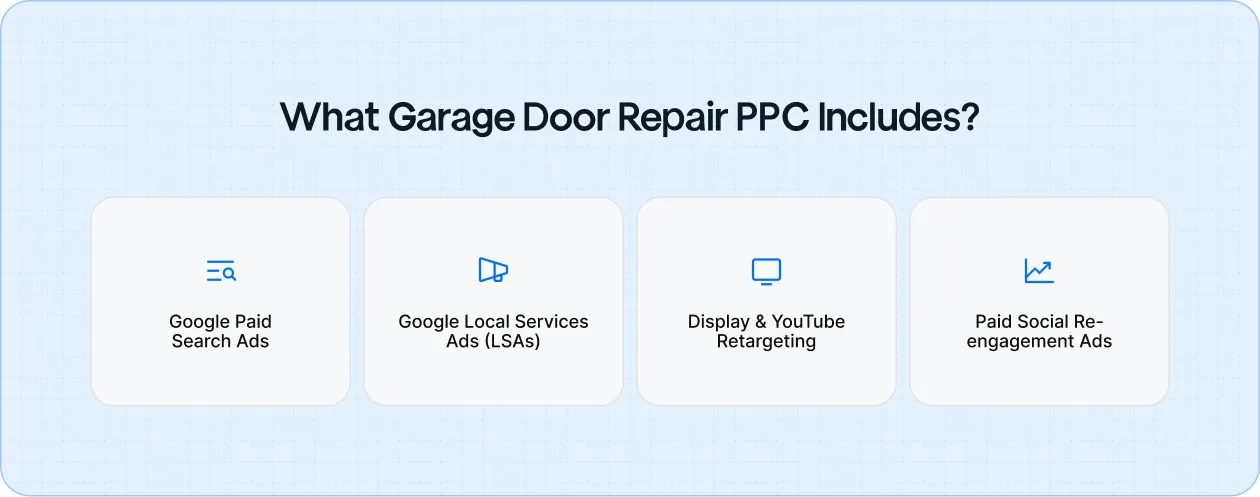
Main paid channels used by garage door companies are:
1. Garage door repair paid search ads on Google
These ads appear when someone types a specific repair problem into Google. The intent here is direct and time-sensitive. People searching for issues like a broken spring or a door that won’t close usually want help now.
Paid search ads work best when they quickly confirm relevance and make it easy to place a call without distractions.
2. Google Local Services Ads (LSAs)
LSAs appear above standard search ads and focus heavily on location and trust. Homeowners often look for nearby providers they can contact right away. These ads rely less on messaging and more on visibility, proximity, and responsiveness.
Clear SEO-optimized service content and complete business profiles strongly support LSA performance by reducing hesitation before contact.
3. Garage door repair retargeting campaigns using Display and YouTube
Some visitors leave without calling. Retargeting campaigns exist for those short gaps between the first visit and the final decision. These ads show up later and serve as reminders rather than explanations.
The goal is simple: Stay visible to people who already shown interest until they are ready to act.
4. Paid social ads for re-engagement
Paid social is usually used to re-engage people who already visited a site or interacted with a repair page. It is not meant to capture first-time repair searches. Instead, it helps maintain familiarity and reinforce trust during follow-up periods or seasonal demand.
What are these ads expected to produce?
While these channels appear in different places and serve different moments, their purpose is the same. Garage door repair PPC exists to support real service work.
- Phone calls from homeowners who need repair help
- Service requests through simple forms
- Booked estimates tied to specific issues
- Scheduled repair work within the service area
Suggested Read: Manufacturers Who Fail In PPC Are Wasting 90% Of Their Budget. Here’s How You Can Fix It
How Repair Intent Shapes a Strong Garage Door Repair Campaign
Not all garage door searches mean the same thing. Some signal urgency. Some signal comparison. Others signal trust checks before making contact. A strong garage door repair campaign starts by recognizing these differences instead of treating every search as equal.
The 4 types of searches that matter
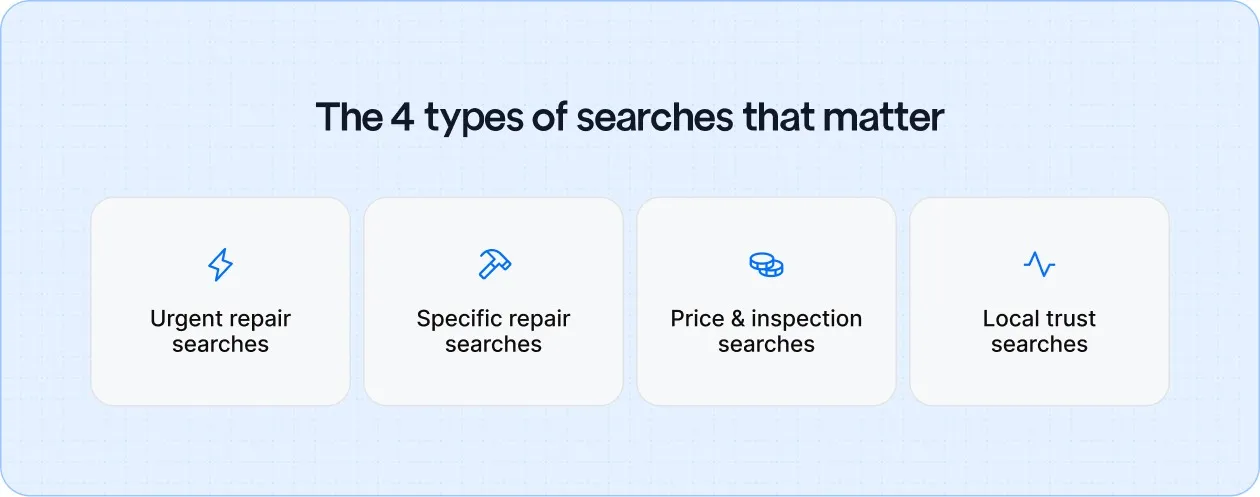
Each search type reflects a different mindset. Understanding this helps align the campaign with how people think during a repair situation.
1. Urgent repair searches
These searches appear when a problem stops normal use of the garage door and needs attention right away. Common examples include:
- Door stuck
- Broken spring
- Door not closing
- Emergency repair
In these moments, people are looking for fast confirmation that help is available. They are not researching options. They are trying to resolve a problem that disrupts their day.
2. Specific repair searches
These searches come from homeowners who already recognize the issue and want someone who handles that exact repair. Examples include:
- Spring repair
- Opener repair
- Off-track door
- Cable or roller problems
These searches signal clarity. The person knows what is wrong and wants reassurance that the service provider understands the issue and fixes it regularly.
3. Price and inspection searches
Some searches focus on cost or availability before any contact is made. Common examples:
- Service call cost
- Repair pricing
- Availability
These searches reflect caution, not delay. People want to understand expectations before reaching out, especially when the repair may not feel urgent yet.
4. Local trust searches
For many homeowners, trust checks don’t stop at the ad. Google Business Profile and Apple Business Connect listings often act as the final confirmation step. Clear service details, accurate locations, and recent reviews reinforce that the business behind the ad is real, nearby, and reachable.
People check who feels dependable and close enough to respond.
Why does intent affect every decision?
Repair intent influences how a campaign behaves at every step. It determines:
- Which words are used to match real problems
- What the ad emphasizes to confirm relevance
- Which page does the search lead to for clarity
- The next step points people toward a call or a service request
When intent is ignored, ads may still appear, but hesitation increases. When intent is respected, people move forward with more confidence.
Your ads can match intent. Your content should too.
Service page content written around real repair searches helps people trust what they see and feel confident calling without second-guessing.
Fix Content Gaps
Keyword Planning for Garage Door Repair Paid Search Ads
Keyword planning for garage door repair paid search ads is about setting clear boundaries. The goal is to make sure each search connects to the right repair problem and does not pull in people looking for something else. When keyword planning is loose, ads still show, but results become unpredictable.
Strong keyword planning starts by treating each repair issue as its own category, not as part of a general list.
a) Organizing keywords by repair type
Garage door repairs are problem-specific. Searches reflect that. Keyword groups should mirror how homeowners describe what is wrong. Common repair-based groups include:
- Spring repair
- Opener repair
- Off-track doors
- Cable and roller issues
- Panel damage
Each group represents a single repair problem. Keeping these separate allows searches to stay closely aligned with what the homeowner needs fixed. It also prevents one repair type from absorbing attention meant for another.
Avoid mixing multiple repair types in one group. When different repairs are bundled together, it becomes harder to respond clearly to the search. Separation keeps relevance intact and expectations clear.
b) Choosing match types carefully
Match types control how closely a search must resemble the repair being offered. This choice directly affects how focused the campaign remains.
- Exact and phrase match work best for clear repair problems. These match searches closely reflect real issues people are trying to solve and help maintain consistency.
- Limited broad use can be tested cautiously. Broad terms may reveal useful variations, but they require close review to ensure searches remain repair-focused and local in nature.
The objective is to capture genuine repair searches without opening the door to unrelated queries.
c) Preventing wasted clicks with exclusions
Exclusions are a protective layer. They prevent the campaign from showing up for searches that signal a different intent entirely.
Common exclusions to apply early include:
- DIY, parts, manuals, tools
- Jobs, careers, training
- Wholesale suppliers, used doors, non-service brands
These searches indicate research, employment, or purchasing materials, not repair help. Filtering them out keeps attention on people looking for service.
Why does keyword planning support consistency over time?
Keyword planning is not finished after launch. New search patterns appear, exclusions grow, and repair terms shift with seasons and usage. Clean keyword organization makes ongoing garage door repair campaign tracking more reliable by keeping signals clear and easy to interpret.
When keywords stay organized, it becomes easier to see which repair problems bring meaningful calls and which areas need refinement, without confusion or overlap.
How to Structure Garage Door Repair Ad Campaigns
A garage door repair ad account works best when different types of demand are separated, not blended. Structure determines which searches trigger which campaigns, how calls are handled, and how clearly performance can be understood later.
A clean structure does not add complexity. It removes confusion.
Recommended campaign layout
Each campaign should represent a distinct reason someone is searching.
a) Emergency repair campaign (call-focused)
This campaign is built for situations where the door has failed, and help is needed immediately. It should prioritize phone calls over form fills and keep the path to contact as short as possible. Emergency demand behaves differently from routine repairs and deserves its own space.
b) Repair-specific campaigns
Separate campaigns for common repair categories such as springs, openers, off-track doors, or cable issues. This keeps messaging, landing pages, and call expectations aligned with the exact problem being searched. Repair-specific campaigns help avoid one issue overpowering another.
c) Brand campaign
Brand campaigns capture searches from people who already know the business name. These searches usually come from referrals, repeat customers, or people double-checking details before calling. Keeping brand traffic separate prevents it from distorting the performance of repair campaigns.
d) Optional competitor campaign
Some businesses choose to appear when people search for other local providers. This campaign should remain optional and tightly controlled. It is best treated as a separate effort so it does not interfere with core repair demand.
e) Garage door repair retargeting campaign
Retargeting campaigns exist outside immediate search demand. Their role is to stay visible to people who already interacted with a repair page or ad but did not reach out. Keeping retargeting separate avoids mixing follow-up visibility with first-time search intent.
Service area control
Structure also defines where ads are allowed to show.
- Use tight location targeting that reflects actual service coverage
- Clearly exclude areas that are not served
- Maintain separate setups for single-location and multi-location businesses
- Target people physically located in the service area, not those showing general interest from elsewhere
Accurate service area control reduces misdirected calls and sets expectations correctly before contact.
Ad timing and call handling
The campaign structure should match when calls can realistically be handled.
- Run ads during hours when phones are answered
- Extend coverage to evenings or weekends only if intake is available
- Avoid sending calls to voicemail during emergency-heavy periods
Proper timing ensures that paid demand connects to a real response, not a missed opportunity.
Why does structure matter here?
Campaign structure determines where demand flows, not how ads are written or how performance is reviewed. When the structure is clear, later adjustments become easier and cleaner. When the structure is messy, even strong demand becomes hard to manage.
Paid Ad Formats That Work Best for Garage Door Repair
Paid ad formats work best when each one plays a specific role. In garage door repair, different formats support different moments in a homeowner’s decision, and mixing those roles creates confusion.
a) Search Ads
Search ads appear when someone is actively looking for help with a garage door issue.
They work well because:
- They match real repair problems as they happen
- They show up during high-urgency moments
- They support direct next steps, like calling
Search ads handle the first contact when the problem needs attention.
b) Local Services Ads (LSAs)
Local Services Ads sit above standard search ads and focus on reassurance. Their role is to:
- Confirm the business is local and available
- Reduce hesitation during comparison
- Support fast decisions with visible trust signals
c) Retargeting Ads
Some visitors leave without calling. Retargeting ads exist for that pause. They are used to:
- Remind people who already shown interest
- Maintain familiarity without pressure
- Support follow-up decisions
d) Social Retargeting
Social retargeting appears during everyday browsing, not repair searches. It helps by:
- Reinforcing recognition through reviews or reminders
- Keeping the business top-of-mind
- Supporting delayed or seasonal repair decisions
How these formats work together
Each format serves a clear purpose:
- Search ads address immediate needs
- LSAs confirm trust and location
- Retargeting maintains visibility
- Social retargeting reinforces familiarity
Together, they form a focused garage door repair paid media setup where each format supports the others.
Landing Pages That Turn Searches Into Service Requests
When someone clicks a garage door repair ad, the page they see decides what happens next. A good landing page confirms they’re in the right place and shows a clear next step. A weak one sends them back to search.
This page is not meant to explain everything. It is meant to resolve one repair problem.
What must appear immediately?
Within seconds, visitors should see:
- A repair-specific headline that matches the issue searched
- A click-to-call option that’s easy to find on mobile
- Service area confirmation to remove location doubt
- Reviews and ratings to establish trust
- License, insurance, and warranty proof to signal credibility
These elements work by being visible, not verbose.
Why dedicated repair pages matter?
Homepages describe a business. Repair pages address a problem.
A homepage covers many services and messages at once. A repair page stays focused on one issue and one next step. This focus reduces hesitation and keeps attention on action.
Paid ads perform best when the page reflects the exact repair being searched. These same pages continue working beyond ads by answering common repair questions people search for over time.
Matching pages to repair intent
Each repair search should land on a page built for that issue.
- Spring repair ads → spring repair pages
- Opener repair ads → opener repair pages
Sending all traffic to the homepage forces visitors to figure things out themselves. Many won’t.
Remove barriers to action
Even interested visitors leave when small obstacles appear. Common barriers to remove:
- Slow load times
- Long or unclear forms
- Unclear next steps
A strong repair page makes the next action obvious without distraction.
Most repair pages explain too much and answer too little.
Search-aligned service content helps people understand the problem and decide to call without confusion or extra steps.
Refine Service Page Content
Garage Door Repair Campaign Tracking That Reflects Real Work
Once ads are running and pages are aligned, the next question is simple: Are real repair conversations happening, or just activity?
Campaign tracking for garage door repair should focus on what actually leads to service, not surface signals that look busy but say very little.
What should be observed?
Tracking should follow the path of a real homeowner reaching out for help. Pay attention to:
- Calls coming directly from ads
- Calls coming after someone viewed a repair page
- Service request forms tied to specific repair issues
- Scheduled repair work, when that information is available
Each of these reflects increasing intent. Search patterns from ads often reveal gaps in service content, showing which repair explanations need to be clearer on the site.
How to judge call quality
Not every call carries the same weight. Quality comes from context, not volume.
Helpful signals include:
- Call length is long enough to discuss the issue
- Repair problem discussed, not general questions
- Service area match, confirming the caller can actually be served
- Whether the call led to a booking, even if scheduled later
These details show whether ads are attracting people who need help—or people who are only browsing.
Why does this approach matter?
Good garage door repair campaign tracking follows real repair conversations from first contact to next step. It avoids focusing on numbers that look impressive but do not reflect actual service demand.
When tracking mirrors how repair work happens in real life, decisions become clearer, and adjustments stay grounded.
Writing Ads That Encourage Calls
Garage door repair ads do not need to be clever. They need to be clear, reassuring, and specific enough that a homeowner feels comfortable picking up the phone.
At this stage, people are not comparing features. They are checking for fit.
a) Messages that resonate with homeowners
Effective ad messages answer unspoken questions quickly.
They tend to highlight:
- Same-day repair availability, when applicable
- Experienced technicians, not generic service claims
- Clear communication, so people know what to expect
- Warranty coverage, when it applies
- Local reviews, which signal real-world trust
These details reduce uncertainty. They do not persuade with hype; they reassure through familiarity.
b) Using the service and location language
Relevance matters over wording style. Ads work better when they:
- Match the specific repair type being searched
- Include the city or service area directly in the text
This helps people immediately confirm:
- “This service fits my problem.”
- “They serve my area.”
That quick confirmation lowers hesitation before calling.
c) Helpful ad additions that support action
Small additions often make the difference between reading and calling. Useful elements include:
- Call buttons that allow immediate contact
- Location details that confirm proximity
- Links to specific repair services for clarity
These additions guide attention without overwhelming it.
Ongoing Review and Improvement of Garage Door Repair Ad Campaigns
Once a garage door repair ad campaign is live, the work shifts from setup to observation. The goal is not constant change, but steady alignment with how people actually search, call, and decide.
Good review habits keep campaigns useful without overreacting to short-term noise.
a) Weekly checks
Weekly reviews focus on spotting early signals and removing friction. Key areas to watch:
- Search terms triggering ads, to confirm they still reflect real repair needs
- Location performance, ensuring attention stays within service areas
- Mobile call experience, since most repair searches happen on phones
- Simple message testing, adjusting wording only when clarity can be improved
These checks prevent small issues from turning into long-term drift.
b) Monthly checks
Monthly reviews are about direction, not fixes. This is where patterns become clearer:
- Shift attention toward repair types that consistently result in scheduled work
- Strengthen service content tied to searches that show clear repair intent
- Expand on search terms that repeatedly surface real conversations
- Review overlap between search ads and LSAs to keep roles distinct
Monthly reviews guide where effort deepens, not where it spreads.
A short example of search visibility supporting paid ads
A U.S.-based door manufacturer, Paniflex, faced a common issue: people searched for their products, but competitors appeared first.
After aligning their pages with how buyers actually searched, a few things changed:
- Paniflex began appearing for 2,700+ relevant buyer searches tied to real project needs.
- They gained visibility across 25+ high-intent product and specification queries.
- Pages structured around how buyers actually searched helped convert that visibility into 113 qualified buyer conversations within 6 months.
Paid ads helped surface demand quickly. Search-aligned pages helped carry that interest forward, giving buyers the clarity and confidence to follow through beyond the first interaction.
Why does this matter for garage door repair PPC?
Paid ads surface demand. Ongoing review ensures that demand leads somewhere meaningful.
When campaigns are reviewed with intent in mind and supported by clear service content, garage door repair PPC stays relevant, trusted, and effective beyond the first click. Learn more—>
Where Garage Door Repair PPC Delivers Real Outcomes
Garage door repair PPC works when ads align with real repair searches, campaigns are clearly structured, and service pages explain problems without friction. Paid ads surface demand quickly, and search-aligned SEO content keeps that demand working long after the click.
As campaigns grow, clarity matters over complexity. Full ownership of ad accounts, clear review routines, and visibility into scheduled repair work keep decisions grounded.
Avoiding lead marketplaces that resell the same request helps protect trust from the first interaction.
Ads bring people in. Clear pages get the call.
Gushwork helps garage door businesses strengthen SEO and service-focused content so paid search efforts are supported by clear, search-aligned pages.
Book a Free Consultation

“For the first time, we’re proud to add SEO services. Six months in, impact evident.”
Read Case Study

In Conversation with

Abhijith HK
Founder & CEO of Codewave
Want us to do the same for your business?
Talk to an Expert
.svg)
.svg)

