


Home

Resources
Blogs
Blog
Get insights on AI, productivity, and the future of work.


Thank you! Your submission has been received!
Oops! Something went wrong while submitting the form.

SEO
Nov 20, 2025
5 mins
6 SEO Strategies for Automotive Industry to Grow Dealerships
Ishani Mitra
Most buyers start their journey online. They search for models, compare prices, check inventory, and read reviews, often from their phones. For dealerships, that means being findable in the exact moments buyers are looking, and making each vehicle listing clear, useful, and trust-worthy.
SEO for the automotive industry is a marketing effort that makes your inventory, service pages, and dealership visible and impactful across search and map results. It’s the mix of local visibility, structured inventory data, strong on-page content, and technical hygiene that turns searches into showroom visits and phone calls.
In this blog, you’ll get hands-on steps for dealership SEO: what matters, how to structure it and the everyday checks that keep your leads steady and qualified.
What is SEO for Automotive Industry?
SEO for automotive industry means optimizing everything a buyer might encounter online: your website, vehicle listings, Google Business Profile, and third-party inventory channels. This is important, so that people searching for vehicles, parts, or services find your dealership and trust your offer.
For dealers, this breaks down into three practical goals:
- Be found for local searches.
- Present inventory clearly so searchers can judge value fast (price, mileage, condition).
- Convert interest into actions: calls, chat leads, showroom appointments, or Vehicle Description Pages to finance pre-approvals.
Why Automotive SEO Matters Right Now
Most buyers start on Google. They search for known keywords like “used Honda Civic near me” or “best truck deals in Dallas,” and expect to see real vehicles, with real prices, from nearby dealerships. That’s exactly what modern automotive SEO supports.
Here’s what makes it especially important today:
1. Google now connects buyers directly to your live inventory
Google’s vehicle ads and inventory listings let shoppers see your cars, make, model, price, mileage, right inside search results. But this only works if your inventory feed is accurate and up to date. The cleaner your data, the more often your vehicles appear in those high-intent searches.
2. Structured data helps search engines understand your vehicles
Adding “Vehicle schema” (a small code that labels your vehicle details for Google) helps search engines read your listings properly. That means your vehicles can show up with richer info, like price, availability, and photos.
3. Local visibility drives real showroom visits
Your Google Business Profile and local landing pages are what push your dealership into the map section of results. That’s where buyers click for directions, reviews, and calls. A strong local presence means you’re visible to people already ready to test-drive or buy.
Turn Online Searches Into Showroom Visits
Get a clean, optimized SEO setup that helps buyers find your dealership first, not your competitors.
Start My SEO Plan


These three realities make dealership SEO measurable.
SEO Strategies That Help Automotive Dealerships Grow
With the right SEO strategies, your dealership can show up where serious buyers are searching and convert clicks into customers. These proven approaches focus on visibility, trust, and consistent lead flow:
1. Local SEO
Local SEO is what puts your phone number, address, and reviews right in front of people ready to visit today. It turns nearby searchers into actual foot traffic.
If you sell cars in Austin, there’s no point showing up in Dallas searches. That’s why local SEO is the backbone of dealership marketing.
What to focus on:
- Google Business Profile (GBP): Claim it, verify it, and fill in everything. Add photos, business hours, services, FAQs, and posts. Keep your name, address, and phone (NAP) consistent everywhere.
- Apple Business Connect: Don’t overlook Apple users. Millions use Apple Maps to find nearby services. Claim and optimize your listing there, too. Add photos, opening hours, contact info, and special highlights.
- Local keywords: Use phrases like “motor cycle dealership in Dallas” or “auto repair near Tampa” naturally across your pages and metadata.
- Reviews: Ask for Google reviews after every sale or service and reply to each one. Reviews boost both ranking and trust.
- Local backlinks: Partner with local businesses, sponsor community events, or list in the local Chamber of Commerce directory to earn location-based links.
- Citations: Ensure your info is the same across Yelp, BBB, DealerRater, and other automotive directories.
Ready to Rank Higher in Local Searches?
Get found by in-market buyers through smarter SEO, better Google listings, and consistent local visibility.
Boost My Local SEO
Pro Tip: Keep your GBP updated monthly. Fresh photos, regular posts, and recent reviews signal to Google that your dealership is active and trustworthy.
2. On-Page SEO
Most dealership websites are cluttered: too many buttons, pop-ups, or generic “inventory” pages that all look the same. On-page SEO fixes that.
Key areas to improve:
- Keyword research: Use real-world searches buyers make: “used SUV under $20,000,” “same-day repair,” or “certified pre-owned [brand].” Free tools like Google Keyword Planner or Ubersuggest can help.
- Meta titles & descriptions: Each page should have its own descriptive meta title (around 60 characters) and meta description (around 150 characters).
Example: Title: “Used Toyota Camry for Sale in Austin | Affordable Certified Vehicles” Description: “Find certified pre-owned Toyota Camrys in Austin with financing options. Schedule a test drive today.” - Headings (H1, H2, H3): Use one clear H1 (main topic), then break up sections with H2 and H3 for better readability and SEO structure.
- Internal linking: Link related pages together (e.g., “Used Cars” → “Trade-In Value” → “Finance Options”). This helps both users and search engines understand your site better.
- Image optimization: Use descriptive file names and alt text and compress images for faster loading.
- Content clarity: Avoid jargon. Write short paragraphs and simple sentences that answer buyer questions (“Do you offer financing?” “Can I see vehicle history reports?”).
Pro Tip: Your Vehicle Description Pages (VDPs) should behave like product pages: include keywords, specs, price, mileage, photos, and an easy “Book Test Drive” button.
3. Technical SEO
If your website loads slowly, people leave. It’s that simple. Technical SEO ensures your site runs smoothly behind the scenes; no broken links, confusing URLs, or delays that make buyers hit “back.”
Key areas to check:
- Page Speed: Aim for under 3 seconds. Compress large images, enable browser caching, and use tools like Google PageSpeed Insights or GTmetrix to spot issues.
- Mobile-Friendly UX: Over 70% of buyers browse on their phones. Use large buttons, simple menus, and “tap-to-call” features.
- Secure connection (HTTPS): Always use SSL for trust and safety. Google penalizes unsecured (HTTP) sites.
- Sitemap: Create an XML sitemap and submit it through Google Search Console. This helps Google index all your key pages and inventory faster.
- Robots.txt file: Check that it’s not accidentally blocking important pages from being crawled.
- Canonical tags: Prevent duplicate content issues (especially if the same vehicle shows up under multiple URLs).
- Structured data (schema markup): Add Vehicle schema and LocalBusiness schema so Google understands your inventory details and business info.
Pro Tip: Even small improvements to speed and mobile usability can increase leads. Fast-loading pages = happier buyers and better SEO.
Build a Dealership Website That Drives Real Leads
We’ll create a fast, professional site from scratch, built to showcase your inventory, attract buyers, and turn every visit into a sales opportunity.
Create My Dealership Site
4. Content SEO
You don’t need 100 blog posts to succeed. You just need useful content that answers buyer questions. When your content helps people with buying tips, maintenance guides, or financing advice, they remember your dealership as the one that actually knows what it’s talking about.
Focus on:
- Guides and comparisons: For example, “Best used trucks for towing under $30k,” or “Certified vs Non-Certified: What’s the Difference?”
- Local content: Posts like “Top 5 Family Vehicles for Houston Roads” or “Best Used Hybrids for Phoenix Heat.”
- FAQs: Short, simple answers to real customer questions (“Do you take trade-ins?”, “Can I finance with bad credit?”).
- Visuals: Add short videos or before-and-after reconditioning photos to make pages more engaging.
What matters most:
- Consistency: publish once or twice a month.
- Simplicity: use short sentences and headings; avoid fluff.
- Local focus: mention your area and dealership name to boost local relevance.
Pro Tip: Each content piece should solve a real buyer question. That’s what makes readers trust you enough to visit or call.
5. Off-Page SEO
Google pays attention to what others say about your dealership too. That’s what off-page SEO is about: links, mentions, and reviews from other trusted sources that confirm you’re a real, reliable business.
How to build it:
- Link building: Get links from reputable auto blogs, local news, or manufacturer partner sites.
- Guest posts & collaborations: Share short tips or vehicle care blogs on local community or automotive sites and include a link back to your website.
- Local sponsorships: Support events or charities; get a mention (and link) on their websites.
- Social proof: Encourage customers to tag your dealership in their posts. It creates natural buzz and local recognition.
Pro Tip: Quality beats quantity. One local news mention or manufacturer link is worth more than 20 random directory links.
6. Analytics & Tracking
SEO only works when it’s measurable. Your numbers are your feedback loop.
Set up:
- Google Analytics 4 (GA4): Track visits, conversions, phone calls, and time spent on pages.
- Google Search Console: Monitor rankings, crawl errors, and which search terms bring traffic.
- Call tracking: Use unique phone numbers per ad or campaign to see what really converts.
- Lead tracking: Log every form submission or call into your CRM to trace back to source (SEO, PPC, GBP, etc.).
Pro Tip: Review analytics monthly. Focus on trends like “which pages get calls” and “where visitors drop off.” Those insights guide your next round of SEO improvements.
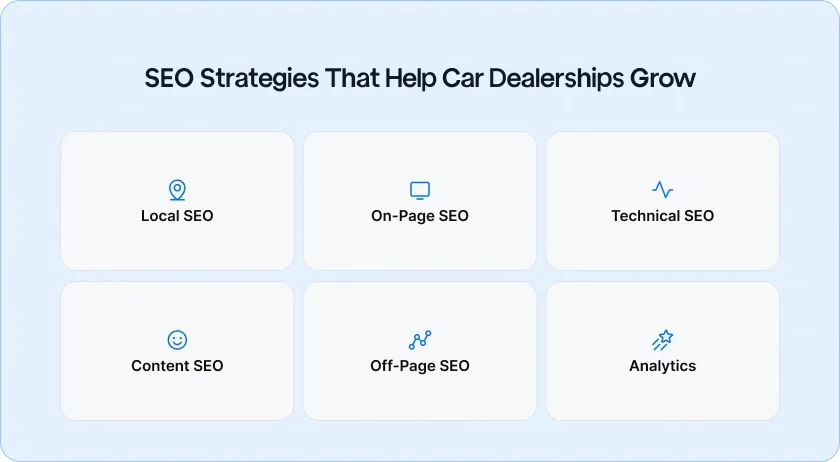
In short:
- Local SEO = get found in your area.
- On-Page SEO = make your site readable and relevant.
- Technical SEO = make your site fast and mobile-friendly.
- Content SEO = build trust and visibility with helpful info.
- Off-Page SEO = earn links and credibility.
- Analytics = measure and improve continuously.
These pieces work together like a sales funnel: visibility → trust → visits → leads.
Building Visibility That Brings Buyers In
When your website, listings, and local search results work together, you earn trust before the buyer even arrives. Small, steady improvements to these details create big shifts in how often buyers find and choose you.
If your dealership is serious about growth, your SEO should work as hard as your sales team. Optimize it once, maintain it consistently, and let it keep doing what it’s built for, bringing the right people straight to your lot.
Make Your Dealership the First Choice Online
Gushwork helps automotive businesses build search-ready websites, optimize inventory pages, and stay visible where real buyers are looking.
Get My Free SEO Audit
FAQs
Q1. What’s the difference between regular SEO and automotive SEO?
Automotive SEO focuses on dealership-specific elements like vehicle detail pages (VDPs), inventory feeds, and local service areas. It’s more structured than general SEO because it involves live data like prices, mileage, and vehicle availability.
Q2. How long does it take for automotive SEO to show results?
You’ll typically see early visibility improvements in 60–90 days, but stronger organic leads build over 4–6 months. The more consistent your updates and data accuracy, the faster results compound.
Q3. Should I invest in SEO if I already run ads or Google Vehicle Ads?
Yes, SEO complements your paid campaigns. PPC brings instant traffic, while SEO builds long-term trust and visibility that continues even when ads are paused. Together, they improve lead quality and reduce cost-per-acquisition over time.
Q4. How often should I update my website for SEO?
At least once a month. Add new vehicles, post local updates, refresh your photos, and update pricing or hours. Regular updates signal activity to Google, helping maintain and improve rankings.
Q5. What’s the most common SEO mistake dealerships make?
Neglecting their Google Business Profile or letting duplicate inventory pages confuse search engines. Keeping your GBP active and your site clean, fast, and consistent will outperform heavy ad spend in the long run.

Digital Marketing
Nov 20, 2025
5 mins
20+ Plumbing Lead Strategies That Get You Found, Booked, and Paid
Ishani Mitra
You might be providing reliable, honest plumbing work every day, yet the phone still isn’t ringing as often as it should. It’s not usually a problem with your service. It’s that people in your area aren’t finding you when they’re searching online for help.
When someone has a leak, a broken water heater, or a sudden plumbing issue, they search quickly for the first trusted business they can contact. If your business doesn’t show up in those local search results, the job goes to someone else before you even have a chance to talk to them. That gap between your quality of work and your online appearance can directly affect your bookings.
This guide focuses on closing that gap. We’ll walk through practical SEO steps that help your plumbing business show up locally, build trust faster, and make it simple for homeowners to reach you when they need help right away.
What Counts as Plumbing Leads?
When we talk about plumbing leads, we’re referring to people or businesses who have expressed interest in plumbing services and could become paying customers. These leads are potential clients who require drain cleaning, pipe repair, water heater installation, or any other plumbing service and are actively seeking someone to hire.
Here’s what defines good plumbing leads:
- They’re locally relevant: someone in your service area who needs plumbing work now or soon.
- They’re action‑ready: the searcher is looking for a solution, such as “emergency plumber near me” or “water heater repair [city]”.
- They’re contactable: you can receive a call, a form submission, or another concrete message from them.
By clearly understanding what plumbing lead generation is and what makes them good, you can refine your marketing efforts, tailor your messaging, and build systems that bring in leads that convert into real work.
Maximize Your Plumbing Leads Today
Start getting noticed by the right customers when they need you the most. Optimize your online presence and watch the leads flow in!
Get Started Now
20+ Proven Methods to Secure More Plumbing Leads in 2025
Generating high‑quality plumbing leads in 2025 means combining smart, modern tactics with consistent, well‑executed effort.
Given the average lead conversion rate of 10% to 12%, the goal is to achieve 20% or higher. This is because a high conversion rate means your cost per lead will be lower than that of competitors, even if they spend more.
Keeping that in mind, here are 20+ strategies plumbers can use to attract customers and convert interest into jobs:
1. Local SEO
Local SEO helps your plumbing business appear in searches from people in your service area. Since most plumbing jobs come from local, urgent searches, showing up in the map pack and local organic results directly increases calls, bookings, and high-intent leads.
How to implement it:
- Build city and service-area pages so each suburb or neighborhood you serve is clearly represented on your website.
- Add location-focused keywords to titles, headers, and content in a natural way (for example, “water heater repair in Austin”).
- Ensure NAP consistency across your website, directories, and social profiles.
- Add local schema markup that tells Google where you operate, what services you provide, and who you serve.
- Earn locally relevant backlinks from community sites, chambers of commerce, suppliers, or neighborhood blogs.
2. Keyword Optimization
Keyword optimization ensures your site aligns with real homeowner search behavior. Plumbing searches often revolve around symptoms (“water heater leaking”), problems (“burst pipe repair”), or urgency (“plumber near me”). Targeting the right terms helps Google understand your services and match them to demand.
How to implement it:
- Research intent-based keywords that match real homeowner problems like leaks, clogs, broken water heaters, sewer issues, or fixture installs.
- Optimize each service page around one primary keyword and supporting terms so Google clearly understands what you offer.
- Use long-tail phrases such as “why is my water heater making noise” or “same-day drain cleaning in Dallas” to capture specific, high-intent queries.
- Start with tight keyword matching in ads. Avoid Broad Match when running new campaigns since it often triggers irrelevant searches (jobs, schools, competitors). Use Phrase Match and Exact Match to reach people who are actually ready to hire.
- Maintain a growing negative keyword list. Continually block irrelevant terms to prevent wasted spend. Many high-performing campaigns rely on hundreds or even thousands of negatives to keep clicks focused and conversion rates high.
- Refresh older pages by updating keywords, headings, and descriptions so they remain relevant as search trends shift.
- Group keywords by problem type (emergency, repair, installation, maintenance) so each page and campaign stays focused and avoids keyword dilution.
3. Google Business Profile
Your Google Business Profile is often the first thing a homeowner sees when searching “plumber near me.” A well-optimized profile can generate calls even if your website rankings aren’t strong yet. Visibility here is especially important for emergency plumbing and same-day service searches.
How to implement it:
- Fill out every section: services, categories, description, service areas, hours, and contact details.
- Add job photos regularly to show recent work, equipment, and before-after results.
- Use GBP updates and offers to highlight promotions, seasonal services, or emergency availability.
- Collect and respond to reviews to improve ranking and build trust.
- Enable messaging or call tracking to monitor how many leads come through your profile.
4. On-Page SEO
On-page SEO helps search engines identify what your pages are about. When each page is focused and structured well, Google can match your site to the right plumbing searches with far less confusion.
How to implement it:
- Use clear headings that reflect actual search intent. Each heading should describe a problem or service so both users and Google immediately understand the topic.
- Write concise, service-specific page content. Keep pages tightly aligned with one topic instead of mixing multiple plumbing services into one section.
- Add internal links that guide users deeper into your site. Link related pages together so both visitors and search engines can navigate logically.
- Optimize meta titles and descriptions for clarity. Include your primary keyword and location without trying to overstuff or complicate the message.
- Use alt text on images to strengthen topic signals. Describe the service or situation shown; this helps Google interpret visual content correctly.
- Check readability and formatting regularly. Short paragraphs, scannable bullet points, and simple wording help users stay engaged and reduce bounce rate.
5. Technical SEO
Technical SEO ensures your website loads fast, functions correctly, and is easy for search engines to crawl. A technically sound site helps all other SEO efforts perform better and prevents ranking drops caused by avoidable errors.
How to implement it:
- Ensure your site loads quickly on all devices. Check speed using PageSpeed Insights and minimize slow-loading elements like large images or unnecessary scripts.
- Fix crawl errors and broken links. Regularly scan your site so search engines don’t encounter dead ends that decrease trust and visibility.
- Add structured data where appropriate. Include LocalBusiness and Service schema so Google can clearly understand your service offerings.
- Maintain a clean site architecture. Use a simple hierarchy that avoids buried pages, unnecessary redirects, or duplicate content issues.
- Keep plugins and CMS tools updated. Outdated systems create security risks and slow site performance, which hurts rankings.
- Make sure your website is fully mobile-optimized. A large share of plumbing searches happen on mobile, so the user experience must remain smooth and fast.
6. Off-Page SEO
Off-page SEO increases your credibility by earning signals from outside your site. For plumbers, this includes listings, local mentions, and backlinks that tell Google your business is legitimate and trusted in your area.
How to implement it:
- Secure links from relevant local or industry websites. Aim for directories, partnerships, supplier pages, or local community sites that validate your business.
- Keep your NAP information consistent. Make sure your business name, address, and phone number appear the same across every directory listing.
- Encourage local press mentions or community features. Sponsoring small events or sharing expert advice can help earn valuable local citations.
- List your business on reputable home-service platforms. Profiles on Houzz, Angi, Thumbtack, or similar platforms strengthen off-page authority.
- Monitor your backlink profile regularly. Remove spammy or irrelevant links that could harm your trust signals.
- Create content others naturally want to cite. Strong how-to guides or problem-solving articles often earn organic backlinks over time.
7. Service Pages and Landing Pages
Service and landing pages are where homeowners decide whether to contact you. When each page covers one problem or service clearly, conversions improve because visitors don’t need to search for information.
How to implement it:
- Create a dedicated page for each core plumbing service. Pages like leak repair, drain cleaning, water heater repair, and emergency plumbing should stand alone.
- Use direct, symptom-based language. Homeowners search based on problems, so frame each page around the issue and your solution.
- Add trust-building visuals like before-and-after photos. These visuals help homeowners understand the quality of your work at a glance.
- Place CTAs strategically throughout the page. Encourage action early and repeat it as the reader scrolls without overdoing it.
- Write benefit-focused introductions. Explain the problem, why it matters, and how you fix it in a way that reduces homeowner uncertainty.
- Localize pages for the areas you serve. This helps you rank geographically and shows visitors you actually serve their location.
8. Google Ads
Google Ads help you appear at the top of results, where people with immediate plumbing needs are ready to act.
How to implement it:
- Run Search campaigns targeting emergency and repair keywords. These terms bring the highest urgency and conversion potential from homeowners.
- Use LSAs to reach people who need help now. LSAs show above all other ads and rely heavily on reviews to rank, so keep your profile strong.
- Write clear, urgency-driven ad copy. Focus on fast service availability, local coverage, and trusted expertise without making unrealistic claims.
- Align landing pages with ad intent. Make sure the page matches the keyword so the visitor sees exactly what they expect.
- Set location targeting to your actual service zones. Avoid wasting budget on areas you don’t serve.
- Track conversions using call tracking and form tracking. This helps you measure which campaigns produce real jobs instead of empty clicks.
9. Social Media Ads
Social media ads help you reach people who may not be searching yet but are likely to need plumbing services soon. These platforms allow precise local targeting and strong visual storytelling.
How to implement it:
- Use Meta ads to promote repairs, seasonal offers, or maintenance services. These formats work well for attracting attention and driving inquiries.
- Run YouTube ads for educational or problem-focused messaging. Short, clear videos explaining common plumbing issues build trust and awareness.
- Segment audiences based on location and homeowner demographics. Avoid broad national audiences that waste budget.
- Test simple visual formats like before-and-after clips. These build credibility quickly and appeal to homeowners comparing options.
- Create retargeting campaigns for non-converted website visitors. Reminding them of your services increases the chance they contact you later.
- Keep ad messaging local and familiar. Mention neighborhoods or common regional plumbing problems to make ads feel relevant.
10. Email Marketing
Email helps you stay connected with homeowners who aren’t ready to hire yet. It builds familiarity, showcases expertise, and turns warm leads into paying customers over time.
How to implement it:
- Send segmented emails based on service interest. Group contacts by the issue they searched for so each message feels relevant.
- Use personalized subject lines. Simple personal touches increase open rates and help remind homeowners of past interactions.
- Offer seasonal discounts or maintenance reminders. These prompts often nudge homeowners into booking routine jobs before issues get worse.
- Create automated follow-up sequences. When someone requests a quote, ensure they receive a series of helpful, concise touchpoints.
- Share quick plumbing tips or common problem explanations. This builds authority and positions you as a trusted local expert.
- Keep emails short and action-focused. Clear messaging prevents overwhelm and improves click-through rates.
11. Online Reviews
For plumbers, reviews are often the deciding factor between you and a competitor. Strong ratings signal reliability, quality, and local trust — all of which influence both rankings and conversions.
How to implement it:
- Ask for reviews immediately after a completed job. Timely requests yield better response rates because the experience is fresh.
- Provide customers with direct, friction-free review links. Remove barriers so it only takes a few seconds for them to share feedback.
- Respond to all reviews, even negative ones. Professional replies show potential customers that you’re accountable and service-oriented.
- Showcase reviews across your site. Feature highlights in headers, service pages, and landing pages to reinforce credibility.
- Use review insights to improve service quality. Recurring feedback themes help identify both strengths and operational gaps.
- Include photos in your Google reviews if possible. Visual proof strengthens trust signals for new homeowners comparing providers.
12. Website Optimization
This focuses on improving overall user experience beyond local elements. Even if you rank well, a slow or confusing website can make visitors leave before contacting you.
How to implement it:
- Optimize site speed across all devices. Compress images, reduce heavy scripts, and streamline plugins that slow performance.
- Make navigation intuitive and minimal. Keep menus simple so homeowners can find the right service within a few seconds.
- Use clear visual hierarchy. Headings, spacing, and simple layouts help visitors understand your message quickly.
- Make all CTAs easy to find and consistent. Buttons should be placed at predictable points throughout the page.
- Use mobile-first design. Most plumbing searches happen on phones, so prioritize mobile experience over desktop.
- Review heatmaps and session recordings. These tools show how users interact with your site and reveal friction points.
13. Social Media Marketing
Organic social media helps homeowners get to know you long before they need a plumber. It builds recognition, showcases your work, and reinforces trust.
How to implement it:
- Share before-and-after job photos regularly. These posts show tangible results and help people understand your quality.
- Post short videos explaining simple plumbing issues. Homeowners appreciate clarity, and helpful content keeps you memorable.
- Engage with community groups. Answering questions in local chats positions you as the go-to local expert.
- Use consistent brand visuals. A clean look builds recognition across platforms.
- Post team photos or behind-the-scenes updates. This adds humanity and builds comfort with your brand.
- Keep captions short and relatable. Straightforward wording increases engagement without overwhelming the reader.
14. Content Marketing
Content helps you attract leads at every stage of their decision-making process. When homeowners find helpful information from you online, they trust you faster.
How to implement it:
- Create blogs answering common plumbing questions. These attract searchers who need guidance before booking.
- Publish cost guides or repair timelines. Transparent information boosts trust and reduces hesitation.
- Write service-area focused FAQ pages. These help capture local long-tail searches and build relevance.
- Use short videos to explain quick fixes or warning signs. These often outperform written content on social platforms.
- Build topic clusters around your key services. A structured content ecosystem strengthens rankings and authority.
- Update old posts regularly. Refreshing content maintains visibility and keeps information accurate.
15. Local Directories
Listing your business across authoritative local directories helps Google validate your location, services, and legitimacy.
How to implement it:
- Claim listings on top directories. Yelp, Angi, Thumbtack, BBB, Houzz, and local chambers of commerce.
- Ensure alignment between all listings. Keep your name, address, and phone number identical everywhere.
- Upload recent photos and service descriptions. Complete profiles attract more engagement and conversions.
- Monitor listings for misinformation. Sometimes platforms autofill details incorrectly, which hurts SEO.
- Add your website to relevant categories only. Staying focused prevents irrelevant traffic and confusion.
- Encourage happy clients to review you on multiple platforms. This diversifies your online reputation.
16. Referrals
Word-of-mouth is still one of the strongest plumbing lead sources. A structured referral system multiplies its impact.
How to implement it:
- Create a clear referral incentive. Offer small discounts or service perks for clients who refer new homeowners.
- Remind customers about the referral option post-job. Simple reminders spark more participation.
- Partner with complementary businesses. Electricians, HVAC companies, or property managers can exchange referrals.
- Use follow-up emails to encourage referral sharing. A friendly check-in increases the chance they recommend you.
- Share referral success stories. Social proof encourages more homeowner participation.
- Track referral performance monthly. Knowing which sources send quality jobs helps you refine the program.
17. Retargeting & Remarketing
Most homeowners don’t hire on their first visit. Retargeting nudges them back when they’re closer to making a decision.
How to implement it:
- Run remarketing ads on Google Display and Meta. These ads remind visitors of your services after they leave your site.
- Segment by page type. Someone who viewed “water heater repair” needs different messaging from someone who viewed “drain cleaning.”
- Keep the messaging simple and urgent. Offer a quick estimate or highlight trust factors like reviews.
- Cap frequency so ads don’t feel intrusive. A balanced approach keeps your brand top-of-mind without overwhelming users.
- Use abandoned-form retargeting. Follow up with users who started filling out a form but didn’t complete it.
- Refresh creatives periodically. New images and copy keep CTR stable and prevent ad fatigue.
18. Paid Ads
Plumbing PPC puts you in front of homeowners who are actively searching for a plumber right now. When set up with the right structure, they deliver fast, predictable leads and help you dominate your local market.
How to implement it:
- Set your campaign objective to Lead generation. This ensures Google optimizes for calls and form submissions instead of generic traffic.
- Use Search campaigns as your primary format. Search ads match active demand and connect you with people already looking for plumbing help.
- Start with Manual CPC bidding for tighter control. This lets you set your own max cost-per-click and avoid overspending. If you prefer less hands-on effort, use Maximize Conversions or Maximize Clicks as your automated fallback.
- Calculate budgets using a clear monthly formula. Divide your monthly ad budget by the number of days you’ll run ads. A starting minimum of around $1,500 per month helps you gather enough data to make decisions.
- Run ads only when someone is available to answer calls. Limit ad schedules to business hours or times when an actual person can respond fast. Missed calls mean wasted spend.
- Write intent-driven ad copy. Focus on urgent needs like leaks, clogged drains, and water heater issues to match search behavior.
19. Business Networking Through Partnerships & Promotions
Local relationships often lead to steady, high-quality plumbing referrals. Networking makes your reach bigger than your marketing budget.
How to implement it:
- Connect with property managers and realtors. These professionals often need reliable plumbers on call.
- Attend local business meetups or trade events. These environments create natural referral pathways.
- Collaborate with HVAC, electrical, or remodeling companies. Shared clients make cross-referrals common.
- Offer a simple partner incentive. A structured program motivates consistent referrals.
- Provide printed referral cards or digital share links. Make it easy for partners to send you leads.
- Stay in touch with partners regularly. Consistent communication keeps relationships active.
20. Lead Magnets
Lead magnets help you engage homeowners who are researching but not ready to book yet. These early-stage contacts often turn into high-value customers.
How to implement it:
- Offer downloadable checklists or quick-fix guides. Simple tools appeal to homeowners diagnosing issues.
- Create cost calculators for plumbing repairs. Transparency builds trust and encourages conversions.
- Offer seasonal maintenance schedules. These help homeowners plan ahead while keeping you top-of-mind.
- Use short explainer videos as gated content. Video guides attract homeowners looking for clarity.
- Place lead magnets on high-traffic pages. This increases sign-ups without disrupting user experience.
- Create separate lead magnets for different services. Tailored resources improve segmentation and follow-up relevance.
21. Tracking Through CRM
A CRM helps you track leads from initial contact to closed job. For plumbers, it creates organization, speed, and clarity that manual tracking can’t match.
How to implement it:
- Add every new inquiry into the CRM immediately. This prevents leads from being lost or forgotten.
- Create pipelines for different services. Each service type should have clearly defined stages.
- Track response times and conversion rates. These metrics show where bottlenecks exist.
- Use automated reminders for follow-ups. This keeps leads warm and reduces missed opportunities.
- Review CRM data weekly. Patterns often reveal the highest-ROI channels and most profitable job types.
- Integrate the CRM with your website and ads. Automating data flow saves time and reduces errors.
22. Bonus: Hiring an Agency
Why Gushwork Makes This Easier?
Managing SEO, ads, content, and lead nurturing can overwhelm even seasoned plumbing teams. A specialized agency ensures you’re not guessing with your marketing but following proven systems built for service businesses.
How Gushwork helps:
- We build a complete lead generation system and dashboard. That means long-term, steady lead flow.
- We optimize your Google Business Profile and local SEO with precision. Most plumbers underuse these channels, leaving money on the table.
- We write content that matches homeowner intent instead of generic fluff. This improves rankings and conversions.
- We manage your ads with strict keyword control and negative keyword lists. This cuts wasted spend and increases job-ready leads.
- We track performance across all channels so you always know what’s working. No guessing, no wasted budget, no blind spots.
- We tailor strategies to your exact service area and business goals. Local success comes from local-specific planning.
Boost Your Visibility and Book More Jobs
Plumbing leads are just a click away. With the right SEO strategies, you’ll get in front of homeowners who need your services.
Learn How to Get More Leads
Different Types of Plumbing Leads by Customer Need
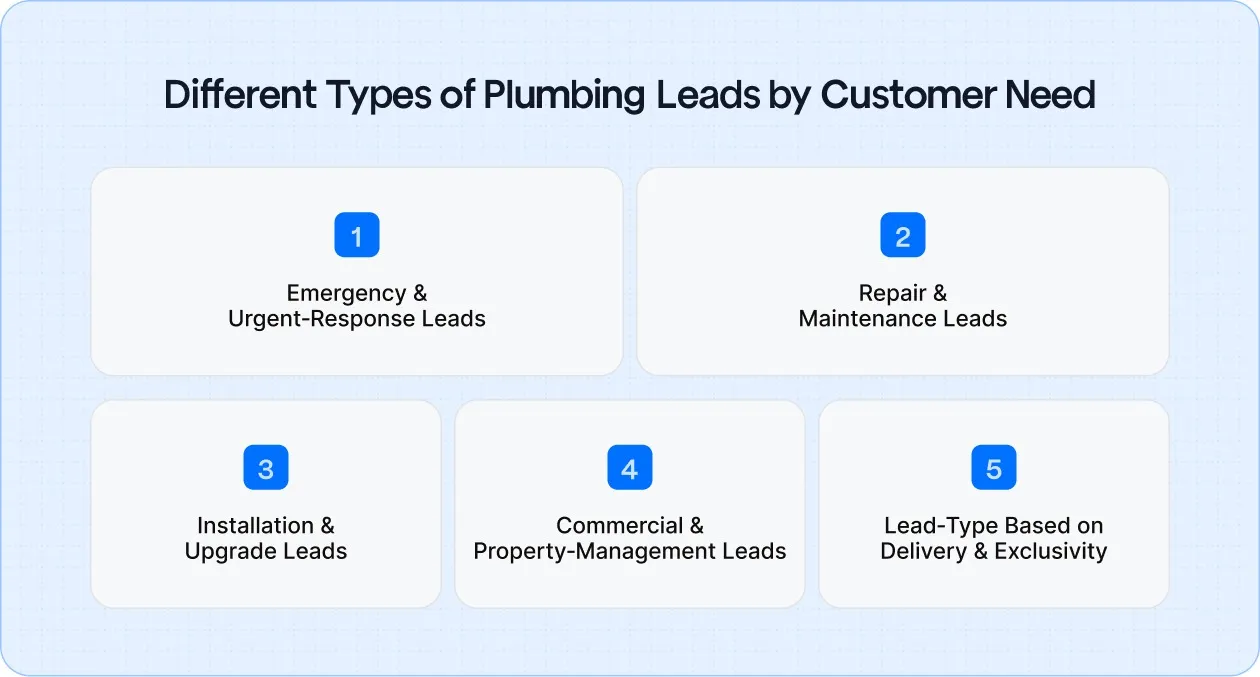
When you’re looking to attract plumbing leads, it’s important to recognise that not all leads are the same.
[image]
Let’s break down the main types of leads you’re likely to encounter:
1. Emergency & Urgent‑Response Leads
These are plumbing leads from homeowners who have an urgent issue: burst pipes, major leaks, non‑working water heaters, sewer backups. They’re ready to hire immediately.
2. Repair & Maintenance Leads
These plumbing leads come from homeowners needing a fix or tuning up of their plumbing system, not necessarily an emergency, but soon. Examples: clogged drains, dripping faucets, annual inspections.
Good marketing for these leads includes content showing you handle common problems, and offers of maintenance plans or inspections.
3. Installation & Upgrade Leads
These plumbing leads come from homeowners or property managers looking to add or upgrade plumbing systems: new bathrooms, kitchen remodels, pipe upgrades, smart plumbing installations.
These jobs often have higher ticket values and longer decision‑making cycles. To attract these leads, you’ll want to show project galleries, case studies, service pages for remodeling work, and strong trust signals.
4. Commercial & Property‑Management Leads
These plumbing leads originate from businesses, multi‑unit properties, or commercial buildings rather than individual homeowners. Their needs might include large‑scale plumbing installation, ongoing contract maintenance, or urgent commercial plumbing issues.
5. Lead‑Type Based on Delivery & Exclusivity
Beyond service need, plumbing leads also differ in how they’re acquired and shared: shared leads, exclusive leads, subscription lead‑services.
Understanding which type of leads you want (and can afford) is part of your lead generation strategy.
Turn Clicks into Clients
Ensure your plumbing business stands out in local searches. Let’s make your website work harder for you and attract more leads.
Optimize Your SEO
Why Knowing These Types Matters
By recognising the variety of plumbing leads, emergency, repair/maintenance, installation, commercial, and lead‑delivery types, you can:
- Create targeted marketing messages that match the intent behind each lead type.
- Budget and allocate marketing spend appropriately (for example, emergency leads cost more but convert higher).
- Develop follow‑up systems and service readiness aligned with lead urgency (e.g., quick response for emergencies, detailed quotes for installs).
- Set realistic expectations for conversion rates, job size, and lead‐acquisition cost depending on lead type.
Common Lead Generation Mistakes for Plumbers
Plumbers lose more opportunities than they realize, because of weaknesses in how leads are captured, handled, and qualified.
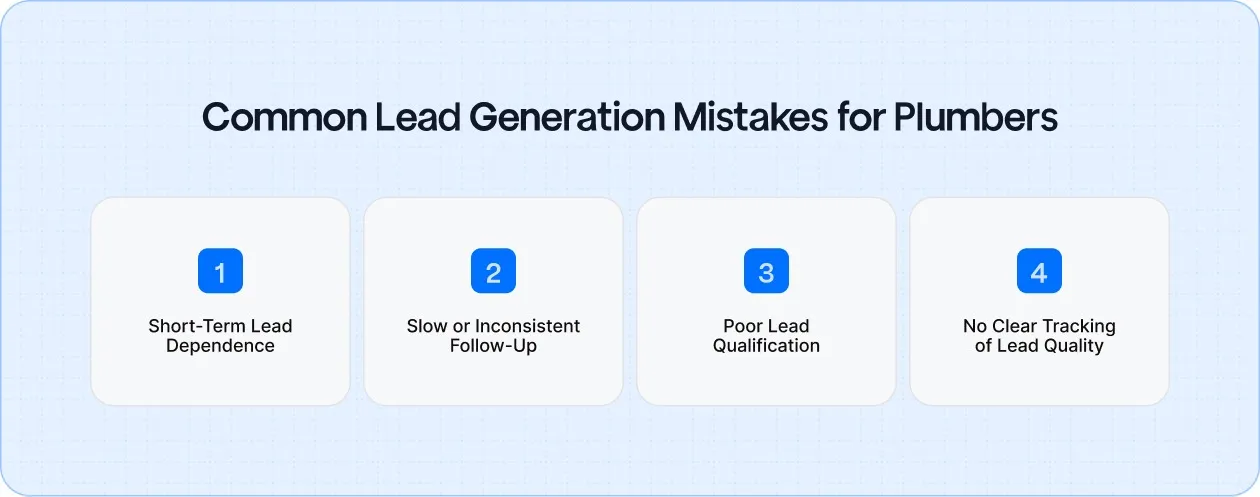
Below are the most common mistakes:
1) Treating Lead Generation Like Freelance Work
Many plumbers rely only on quick, short-term lead sources like paid directories or shared leads. This creates unstable demand and constant price chasing, leaving the business vulnerable when those channels dry up.
2) Slow or Inconsistent Follow-Up
Plumbing leads lose value fast, especially during emergencies. When calls or messages aren’t returned quickly, the prospect simply moves to the next plumber, leading to immediate revenue loss.
3) Accepting Every Lead Instead of the Right Leads
Chasing any inquiry, even for services you don’t offer, creates wasted time and frustration. Poor-fit leads crowd out genuine opportunities and lower your overall conversion rates.
4) No Clear Tracking of Lead Quality
Without knowing where your best leads come from, you can’t prioritize profitable channels. This leads to wasted budget and the false belief that “nothing works,” when the real issue is lack of visibility into performance.
Boost Your Plumbing Leads and Get Noticed Online
Attracting more plumbing leads isn’t just about being present; it’s about being found at the right time, in the right place. By applying the right strategies, you're setting your business up for sustainable growth and more clients.
It’s important to stay proactive and consistent with your approach to lead generation, but you don’t have to do it alone.
At Gushwork, we design to simplify the process of managing and growing your online presence, ensuring you stay visible to those who need your services. With the right strategy and support, you can drive more leads, build trust, and take your plumbing business to the next level. Let us help you get there!

SEO
Nov 20, 2025
5 mins
Your Landscaping Business Is Losing $10,000 A Month To Invisible SEO Mistakes. Here’s The Fix.
Ishani Mitra
A lot of landscaping businesses aren’t struggling because of the quality of their work. The real issue is that people nearby simply aren’t finding them when they search online. Someone in your area may be looking for lawn care or planning a new outdoor space right now, but if your business doesn’t show up, that opportunity passes quietly.
You feel that when the phone doesn’t ring as often as it should. Competitors get the first look simply because they appear higher in search results, not because they do better work. That can be frustrating, especially when you know you could give that customer a better experience.
This guide focuses on fixing that visibility problem. We’ll walk through straightforward SEO steps that help your landscaping business show up in local searches, build trust faster, and make it easier for people to contact you when they’re ready to move forward.
How Homeowners Search for Landscaping Services
Today’s homeowners are increasingly turning to their phones and computers to find reliable, local services. Knowing how they search and what they look for can help you optimize your online presence and attract the right clients:
1. "Near Me" Searches
A large share of searches include “near me.” Phrases like “landscaping services near me” or “lawn care near me” show just how local this industry is. Google uses location data to rank nearby businesses higher, which means an optimized Google Business Profile and strong local SEO can directly improve visibility.
2. Specific Service Searches
Many homeowners also search for specific services based on their exact needs—tree trimming, garden design, irrigation, or hardscaping. Queries like “garden design in [city]” or “tree removal near me” reveal intent. To show up for these, your website should feature dedicated service pages that clearly describe what you offer and where you operate.
3. Question-Based Searches
More homeowners are using voice search, asking Google questions like, "When should I schedule lawn care?" These queries are more conversational and show that homeowners are looking for direct answers.
4. Online Reviews and Recommendations
Many homeowners will rely on reviews to guide their decisions. They search for services like "best landscaping company in Albany" or “top-rated lawn care services near me” to find companies with good reputations.

5. Social Media and Visual Search
Some homeowners also turn to platforms like Instagram, Pinterest, or Facebook to find landscaping ideas or professionals. They might search for “landscaping ideas” or “backyard design inspiration,” and from there, they find businesses offering those services.
Get Found First, Rank Higher on Google!
Don't let your competitors take the lead. Optimize your SEO and watch your landscaping business grow with local clients!
Start SEO Today
But how does Google decide which landscaping companies appear at the top? Let’s take a look at the local ranking factors that impact how your business gets ranked.
How Google Ranks SEO for Landscapers?
For landscapers who serve local clients, this means focusing on the ranking factors that matter most in your area. According to Google, the primary local ranking factors boil down to relevance, distance, and prominence.
Here’s how these apply specifically to landscaping businesses and what you should focus on.
1. Relevance
Google prioritizes businesses that clearly match what users are looking for.
To boost relevance:
- Use service-specific, location-based keywords.
- List all main services on your Google Business Profile (GBP) like landscaping, garden design, patio installation, and more.
- Create dedicated service-area or service-type landing pages (e.g., “Residential Landscaping in Ohio).
2. Distance
Local search results favor businesses closest to the searcher’s location.
To strengthen this signal:
- Clearly define your service areas on your website and GBP (e.g., “Serving Albany and nearby suburbs”).
- Use geo-targeted keywords if you serve multiple towns.
- Keep your business address and service area consistent across all platforms.
3. Prominence
Prominence reflects how well-known and reputable your business is both online and offline.
To grow your prominence:
- Collect and respond to Google reviews regularly.
- Ensure your NAP (name, address, phone) is consistent across directories and listings.
- Earn quality local backlinks. For example, from local garden centers, contractors, or home-improvement blogs.
4. Technical & On-Page SEO
Google also rewards websites that are technically sound and optimized for local SEO.
Focus on:
- Fast loading speed and mobile-friendly design.
- Schema markup for local businesses to help Google read your site.
- On-page optimization, using clear service and location keywords in titles, headings, and meta descriptions.
5. Engagement Signals
Google measures how people engage with your business online. Things like clicks, calls, and how long they stay on your page.
Improve engagement by:
- Adding clear calls-to-action on your GBP (“Call Now”, “Get a Quote”, etc.).
- Keeping your listings and site updated with fresh photos, posts, and offers.
Boost Your Landscaping Business with Local SEO
Ready to attract more customers? Apply these proven SEO strategies and get your landscaping business to the top of local search results!
Start with SEO
By focusing on these ranking factors, relevance, distance, prominence, technical health, and user engagement, you increase your chance of ranking well for “seo for landscapers” in your local market. The goal isn’t just to appear, but to appear credibly, near enough, and ready to serve.
6 Proven Landscaping SEO Strategies for Landscapers
Boosting your visibility online as a landscaping business is about applying a smart SEO strategy that targets the right audience in the right place. Here’s a tailored set of actionable SEO tactics for landscapers, based on proven approaches but rewritten in a fresh, practical way.
1. Conduct Targeted Keyword Research for Landscapers
To show up in local searches, you must know exactly what your potential clients are typing into Google.
- Combine service + location terms.
- Include service variations and synonyms like “garden maintenance”, “backyard makeover”, or “sod installation” to cover different ways people describe what you do.
- Use long‑tail phrases with high intent, such as “best affordable landscaping company” or “when to irrigate lawn”. These have lower search volume but higher conversion chances.
2. Optimize Your Website Pages and On‑Page SEO
Your website must clearly reflect what services you offer and where. This helps both search engines and clients find and trust you.
- Make sure your homepage and each service page include your main services and target locations.
- Add dedicated service pages for each major offering, rather than lumping everything into a single, generic page.
- Use descriptive title tags, meta descriptions, proper headings (H1, H2…); use your keywords naturally, not forced.
- Include real project photos (before/after) with proper alt‑text to engage users and improve SEO.
- Add internal links between related pages to ensure visitors and search engines navigate smoothly.
- Use structured data (LocalBusiness schema) to help Google understand your business details: services, location, and reviews.
3. Claim and Manage Your Google Business Profile (GBP)
Your Google Business Profile is like a digital storefront for local clients.
- Claim and verify your GBP account. Ensure your business name, address, and phone number (NAP) are accurate and consistent with your website and other listings.
- Choose primary and secondary categories correctly.
- Upload high‑quality photos of your team, your ongoing work, and finished projects. Businesses with better imagery receive more clicks and calls.
- Post updates, offers, and project highlights regularly; respond to questions in the Q&A section and monitor your profile for comments.
- Encourage clients to leave reviews. Post‑job follow‑ups with a direct link to your review page make it easier. Respond to both good and bad reviews to show you’re active and care.
Optimize Your Google Business Profile (GBP)
Boost your visibility in local search results with a fully optimized Google Business Profile. Stand out to potential clients today!
Claim & Optimize Now
4. Strengthen Your Local SEO Footprint
Appearing local and trusted in your service area helps search engines recognize your relevancy, and, more importantly, helps local clients find you.
- Make sure your NAP details appear exactly the same in all online directories (Yelp, HomeAdvisor, local Chamber of Commerce). Even small differences (St. vs Street) can confuse Google.
- Build citations in relevant local directories and home‑services sites.
- Create city‑ or neighborhood‑specific landing pages if you serve several locations. Each page should highlight unique content (local projects, testimonials, photos) and mention the location.
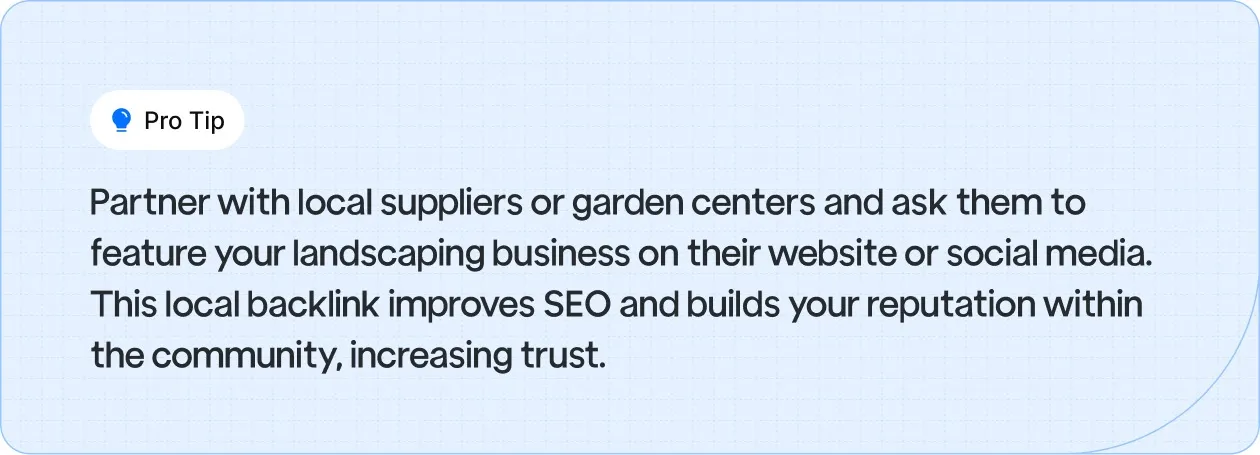
- Earn local backlinks: partner with nurseries, local home improvement blogs, or sponsor neighborhood events to get local mentions and links pointing back to your site.
5. Build Rich, Useful Content and Links
Quality content establishes your authority, builds trust with clients and search engines, and gives you more opportunities to rank.
- Write seasonal blog posts and guides like “Spring Lawn Cleanup Checklist”, “Best Fall Landscaping Ideas for Christmas” or “How Landscaping Adds Value to Homes”.
- Show transformation work: create before‑and‑after galleries, client stories, and project features. Visual content often performs very well.
- Use educational content to capture searchers who aren’t ready to hire yet but are researching (“When should I renovate my landscape?”).
Take the Lead in Your Area, Get More Landscaping Jobs
Local SEO is the key to getting noticed by homeowners in your area. Let’s put your landscaping business on the map.
Get Started with SEO
6. Track Your Results and Adjust Your Strategy
SEO is an ongoing process. Monitoring your progress allows you to invest time where it matters.
- Use tools like Google Analytics and Google Search Console to see how much traffic you’re getting, where it comes from, and which pages convert into leads.
- Use keyword‑tracking tools (SEMrush, Ahrefs, BrightLocal) to monitor rankings.
- Use call‑tracking or unique phone numbers on different campaigns to identify which keywords or pages drive the most calls or quotes.
- Identify your top‑performing pages and update them with newer photos or fresh content. For pages that don’t perform, revisit their keywords, CTAs, or updates.
- Benchmark your local competitors: see what keywords they rank for, which directories they are listed in, or which backlinks they have, and look for gaps you can fill.
Using these strategies consistently will position your landscaping business to show up where it matters, when local homeowners are actively searching. Focus on being visible, trusted, and memorable, and you’ll turn more clicks into calls and jobs.
Conclusion
Your landscaping business does great work, now it’s time to make sure it’s seen by the right people at the right time. SEO is the bridge between your service and the homeowner who’s already searching. When you focus on proven tactics, you're not just showing up; you’re standing out.
The market is already turning to search engines, and your competitors are making their move. Are you ready to step up and claim your place at the top of local search results? Let SEO drive the traffic, and watch those clicks turn into clients.
The opportunity is here, let’s get started.
FAQs
Q1: How can I measure the effectiveness of my landscaping SEO efforts?
To measure SEO success, track key metrics using tools like Google Analytics and Google Search Console. Look for improvements in organic traffic, keyword rankings, and lead conversions. Also, monitor click-through rates from local search results and calls or requests for quotes via your site.
Q2: Can SEO help my landscaping business if I only serve a small area?
Yes! SEO works for businesses of all sizes. By focusing on hyper-local SEO, you can rank for specific neighborhoods or towns and ensure you're visible to those who need your services in your immediate area.
Q3: What are the most effective ways to collect Google reviews for my landscaping business?
After completing a job, politely ask satisfied clients to leave a review on your Google Business Profile. Provide them with a direct link to make the process easy, and always respond to reviews to show engagement and build trust.
Q4: How important is mobile optimization for landscaping websites?
Mobile optimization is critical. Many homeowners search for landscapers on their phones, so a mobile-friendly, fast-loading website improves user experience, reduces bounce rates, and boosts your local SEO rankings.
Q5: Can I target multiple locations with my landscaping SEO strategy?
Yes, you can target multiple locations by creating location-specific landing pages. Focus on unique, local content for each city or neighborhood you serve, and ensure your business details (NAP) are consistent across all listings.

Digital Marketing
Dec 22, 2025
5 mins
11 Content Marketing Tactics That’ll Build Your Construction Business From the Ground Up!
Batul Beawarwala
In the construction business, standing out is all about how you connect with your audience. Content marketing for construction helps build trust, showcase your expertise, and address the specific needs of potential clients.
By sharing project successes and offering valuable insights, you can transform a casual visitor into a loyal customer, building long-term business growth.
This blog will explore the essential strategies that construction companies can use to harness the power of content marketing, build trust, and drive long-term success.
Why Content Marketing Matters for Construction Companies?
Content marketing allows your business to stand out by becoming a resource, educating your potential clients and addressing their concerns before they even reach out. It’s a way to showcase your expertise, demonstrate value, and build trust.
Here’s why content marketing is crucial for construction companies:
- Connecting with the Right Audience: Rather than casting a wide net, content marketing targets the clients who need your services.
By addressing their pain points, like dealing with regulations or understanding building processes, you create content that resonates with your ideal audience, driving quality leads who are more likely to convert into clients.
- Enhancing Online Visibility: Content that provides real value naturally attracts attention. By answering questions, solving problems, and offering solutions, your website becomes a resource for your audience and ranks higher on search engines.
- Establishing Expertise and Credibility: Consistently sharing informative content positions your company as an authority in the field.
When you educate your audience about construction-related topics, you demonstrate your knowledge and ability to tackle their challenges.
Must Read: 15 Proven Construction Industry Marketing Strategies for Business Growth
How to Build a Winning Content Strategy for Your Construction Business
A great strategy should capture the attention of potential clients, nurture relationships, and ultimately drive them to choose your services. Here’s how to create a content strategy that engages and converts.
1. Identify Your Target Audience
Understanding who you’re speaking to is the first step in building a content strategy that works. Every client type, including homeowners, property developers, architects, and project managers, has unique needs and interests.
- Audience Segmentation: Defining buyer personas is crucial. Personalize your content to meet the specific needs of each group. For example, homeowners may be focused on cost-effective solutions, while developers may prioritize timelines and scalability.
Understanding these nuances helps you create content that addresses their pain points.
- Market Research: To refine your content strategy, start by gathering insights into your audience’s behaviors, preferences, and challenges.
Tools like surveys, online forums, or even simple client interviews can reveal valuable information. This data allows you to create content that truly addresses their needs.
- Pain Points and Needs: Content should speak directly to your audience’s biggest challenges. Are they struggling with understanding building regulations, or need tips on managing construction budgets?
Identifying these concerns will help you create content that feels relevant and valuable to them.
2. Set Clear Content Marketing Goals for Your Construction Company
Well-defined goals keep your content marketing efforts focused and measurable; without them, it's easy to lose direction.
- Define Goals: Generate leads, increase brand awareness, and establish your company as an industry authority. Set specific goals to give your content marketing strategy a clear purpose.
Your goals should align with your business objectives to ensure that every piece of content contributes to your overall success.
- KPIs: Track key performance indicators (KPIs) like website traffic, social media engagement, and lead generation. These metrics help you measure the effectiveness of your content.
By monitoring KPIs, you'll know what's working and what needs improvement.
- Content Calendar: A content calendar is essential for maintaining consistency in publishing. By planning content around seasonal trends, industry events, or campaigns, you ensure that your construction business stays top-of-mind for potential clients. It also helps you align content with business goals, such as increasing brand awareness or generating leads.
For instance, your content calendar might look like this:
- January: Post a guide on winter construction best practices.
- March: Share a case study about a completed commercial project.
- June: Highlight a new local project with updates on progress.
Suggested Read: Content Marketing Strategies for Brick Manufacturers the Top 1% Use to Own Their Market
3. Create High-Quality Content That Resonates with Your Audience
Quality content is the heart of any marketing strategy. It’s about delivering value that informs and engages your audience.
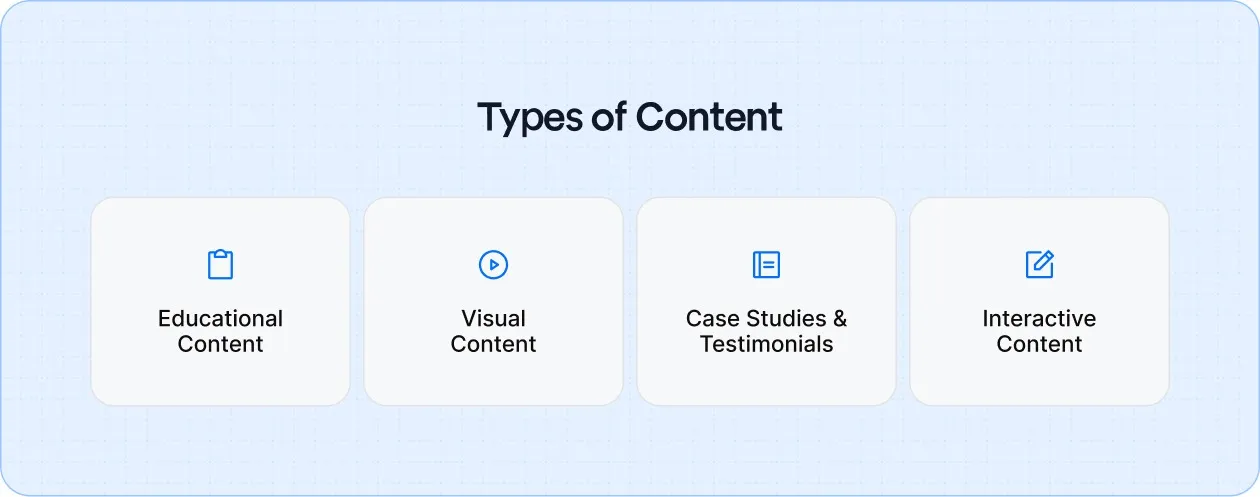
- Types of Content:
- Educational Content: Create how-to guides, blogs, and construction trend insights that answer common client questions.
- Visual Content: Share photos, time-lapse videos, or project walkthroughs to showcase your work visually.
- Case Studies & Testimonials: Real-world examples of completed projects help build credibility and trust with potential clients.
- Interactive Content: Engaging formats like quizzes, polls, or cost calculators can increase interaction and keep your audience engaged.
- Content Creation Best Practices: Always focus on clarity and usefulness. Avoid jargon and keep the language accessible. Your content should guide potential clients through their journey, from awareness to decision-making.
Partnering with content experts helps you create clear, actionable content that connects with your audience.
Let us manage the strategy and execution, driving conversions and business growth.
Let’s Build Your Content Strategy
4. Integrate SEO into Your Content Marketing Strategy
SEO helps your content show up in search results when potential clients look for construction services or solutions. Higher rankings mean more visibility, which drives more organic traffic to your website.
- Keyword Research: Conduct keyword research to identify terms your audience is searching for. Focus on both industry-specific terms and local SEO to capture clients in your region. Include these keywords naturally in your content.
- On-Page SEO: Optimize your content by using descriptive headings, meta descriptions, and image alt texts. Structuring your content with proper SEO techniques increases its chances of ranking higher on search engines.
- Off-Page SEO: Building backlinks through partnerships, guest blogs, or social media mentions can improve your content’s authority. These external links help search engines see your website as a trusted resource.
Creating content that addresses your audience’s needs positions your construction business as a trusted resource.
SEO-optimized blog posts help your content stand out and increase visibility.
Get Found with SEO
5. Implement Local SEO for Construction Businesses
Local SEO is essential for construction companies targeting clients within specific geographic regions. It helps ensure your business appears in local search results, making it easier for nearby customers to find and contact you. Here’s how to effectively implement local SEO strategies:
- Optimize Your Google Business Profile (GBP): Claim and regularly update your Google Business Profile with accurate business information, such as your company name, physical address, phone number, and business hours.
- Leverage Apple Business Connect (ABC): Ensure your business is properly listed and optimized on Apple Maps to further improve your local SEO and visibility in search results.
- Use Local Keywords: Incorporate location-specific keywords, like “construction company in Houston” or “general contractors near me,” naturally throughout your website and content.
- NAP Consistency: Ensure your Name, Address, and Phone Number are consistent across all online directories, social media profiles, and your website.
- Optimize for Mobile Searches: Ensure your website is mobile-friendly to cater to the high volume of local searches done on mobile devices.
6. Promote Your Content and Increase Reach
Creating great content is only half the battle; getting it in front of the right people is equally important.
- Distribution Channels: Use social media, email newsletters, and collaborations with industry blogs or influencers to promote your content. The more platforms your content appears on, the more potential clients you can reach.
- Repurposing Content: Repurpose your content across different formats. Turn a blog post into a video, a podcast, or a social media post. This helps extend the life of your content and broadens your reach without having to start from scratch each time.
- Social Media Best Practices: Use platforms like Instagram, LinkedIn, Facebook, TikTok, and Snapchat to share behind-the-scenes content, project updates, and industry news.
Engage with your audience through comments and messages to build relationships and encourage trust.
7. Measure the Success of Your Construction Content Marketing Efforts
Tracking your content’s performance is essential for understanding what works and where improvements can be made.
- Tracking Performance: Use analytics tools like Google Analytics to track how visitors interact with your content. Monitor metrics such as page views, bounce rates, and time spent on page.
- Analyzing Metrics: Regularly analyze the data to understand which types of content are driving the most traffic and engagement. This insight allows you to adjust your strategy to focus on what resonates most with your audience.
- Refining Your Strategy: Based on your data, tweak your content strategy to improve results.
Changing your content format, adjusting SEO tactics, or experimenting with new distribution channels, refinement is an ongoing process.
Looking to optimize your content strategy?
Partner with an expert to refine your SEO content for better performance and results.
Refine Your Content Strategy
8. Use Client Testimonials and Real-World Success Stories
One of the most effective ways to build trust and demonstrate your expertise is through client testimonials and success stories.
These real-world examples offer potential clients tangible proof of your capabilities and build your reputation as a reliable, results-driven construction company.
- Showcase Customer Experiences: Ask satisfied clients for detailed testimonials, which can include specific challenges you helped them solve and the benefits they received.
Written testimonials can be complemented by video testimonials to provide an even more personal touch.
- Systematic Review Requests: Actively ask for 5-star reviews after each successful project. Clients rarely leave reviews without prompting, so make it a habit to request them.
Having positive reviews prominently featured on your site and across platforms will significantly enhance your credibility and build further trust with new prospects.
- Highlight Successful Projects: Share detailed case studies that outline the challenges, solutions, and results of your projects. This offers insights into your technical expertise and helps potential clients visualize how you can solve similar problems for them.
These success stories position your company as a trusted partner, capable of delivering high-quality results.
For example, Paniflex focused solely on commercial projects, removing all residential content from their website. This shift led to a 40% increase in project inquiries and positioned them as a top contender for large commercial contracts. It highlights the power of niche specialization in standing out and driving growth in a competitive market.
Similarly, John Maye Company transformed its business by adopting an AI-driven SEO strategy. In just 30 days, they generated 17 qualified leads, showcasing the impact of enhancing online visibility and targeting high-intent buyers. This approach turned their sales conversations from cold outreach to productive, high-quality discussions.
9. Build Collaboration with Industry Experts and Influencers
Partnering with experts and influencers in the construction industry can significantly extend the reach of your content.
Collaborations can bring new perspectives to your content and help you tap into new audiences, establishing your company as a leader within your field.
- Industry Experts: Collaborating with architects, engineers, or industry consultants to produce co-authored articles, webinars, or interviews can increase your content’s credibility.
These experts add authority and offer additional insights that resonate with your target audience.
- Influencers: Connect with construction influencers or professionals with large followings to share your content. This might include partnering with well-known industry bloggers, podcasters, or social media influencers to expand your reach.
These collaborations can drive more qualified traffic to your website, positioning your company as a leader in your sector.
Must Read: How a Building Material Supplier Cut Lead Costs 42% - The Digital Marketing Strategy You Can Use
10. Showcase Emerging Trends in Construction Content Marketing
To stay ahead of the competition, construction companies should embrace emerging technologies and trends that enhance client engagement and optimize marketing efforts:
- AI for Content Creation and SEO: Leverage AI-powered tools to automate content creation, streamline processes, and optimize SEO efforts, saving time and improving content efficiency.
- Augmented Reality (AR) and Virtual Reality (VR): Use these technologies for virtual project walkthroughs or design visualizations, offering immersive experiences that allow clients to interact with project designs before construction begins.
- Video Content: Continue to leverage video as a powerful medium. Project showcases, time-lapse videos, and client testimonials in video format help improve engagement, making your content more interactive and persuasive for potential clients.
Embracing these trends will position your construction company as a leader in innovation, improve engagement, and help drive more qualified leads.
11. Focus on Growth Experiments
To grow your construction business effectively, it’s crucial to balance short-term experiments with long-term strategies. Here’s how you can integrate both for maximum impact:
Experiment with Paid Marketing:
- Paid campaigns like Google Ads or social media ads can generate immediate results.
- Allocate dedicated time to manage and adjust these campaigns to ensure they are targeted and efficient.
- Avoid haphazard ad spending; instead, focus on optimizing and tweaking your ads based on performance data.
SEO as a Long-Term Strategy:
- SEO is a long-term game, typically taking 6-12 months for significant ROI.
- Focus on building a solid SEO foundation with content creation, backlink building, and keyword optimization.
- While SEO delivers long-term results, combining it with paid marketing campaigns helps you achieve quicker visibility and drive immediate leads.
Start building your SEO strategy today and lay the groundwork for long-term success. With the right approach, you'll drive sustainable growth and consistent visibility over time.
Drive Business Growth with Content Marketing
Content marketing is a powerful tool that enables construction companies to build trust, engage potential clients, and showcase their expertise.
By understanding your audience, setting clear goals, and consistently creating valuable content, you can drive meaningful business growth.
These strategies help you attract leads and establish lasting relationships with clients that lead to sustained success.
Align your content strategy with your business goals and optimize continuously.
Gushwork specializes in creating high-quality, SEO-optimized content that engages readers and drives qualified leads to your business.
Book a Free Consultation

SEO
Nov 17, 2025
5 mins
10+ Local SEO Strategies for Contractors to Get Chosen in Your Area
Ishani Mitra
Most contractors win work because someone nearby noticed them at the right moment. That moment is almost always a local search. A homeowner types “roof repair near me” at 10 p.m., a property manager searches for “commercial HVAC service [city],” or a facilities lead checks reviews while shortlisting vendors. If your business does not show up there, those jobs go to someone else.
Local SEO is simple in idea and fiddly in practice. It is about the small signals that prove you are nearby, reliable, and ready to respond.
In this blog, we break down how local SEO works for contractors, what actually influences local rankings, where most businesses go wrong, and how to build steady local visibility that brings in better-fit enquiries.
Understanding Local SEO for Contractors
Local SEO is how your business shows up when someone nearby needs work done now. It’s a system that proves to Google and to people that you are real, relevant, and ready to help their particular job.
For contracting firms, good local SEO delivers the right kind of leads: phone calls, booked estimates, and urgent service requests. That happens when your online presence answers the two questions every buyer has in the first 30 seconds: can they do this job, and can they do it soon?
How Google Chooses Which Contractors to Recommend?
Google weighs three core signals and dozens of supporting signals to decide which contractors to show for a local search.
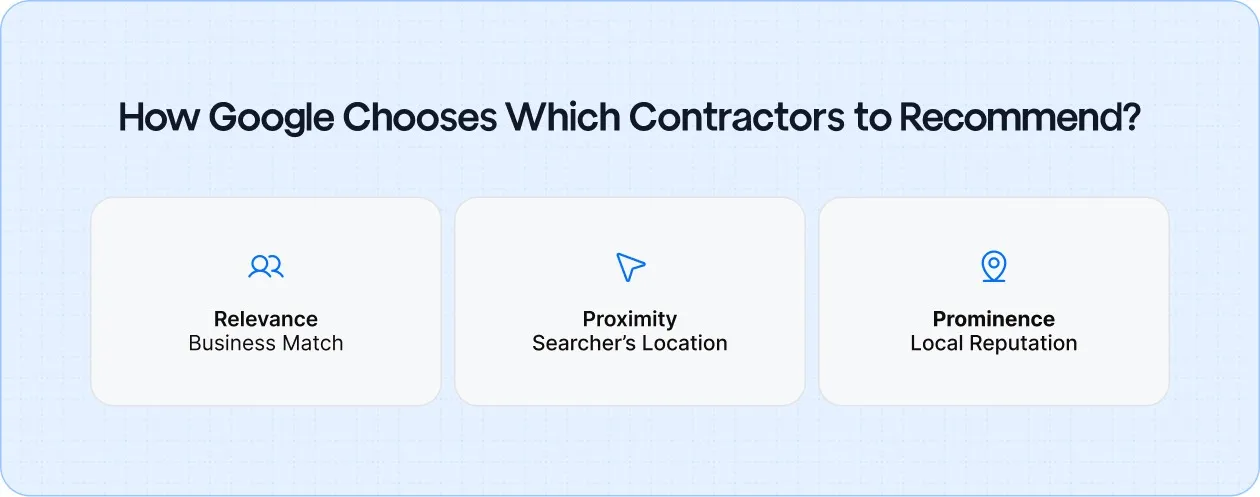
1) Relevance — Does your business match the search?
Google looks for a clear match between what the searcher wants and what you offer. That means your categories, service descriptions, and website copy must use the language real customers use: “fence installer,” “sump pump repair,” “commercial concrete.”
2) Proximity — How close are you to the searcher?
Distance still matters. For many local searches Google prioritizes businesses physically near the searcher. But proximity is not only street-to-street distance.
3) Prominence — How trustworthy and known are you locally?
Prominence is how Google estimates your real-world reputation. It pulls evidence from on-site SEO and the wider web. Signals of prominence include:
- Business profile completeness.
- Structured data and schema.
- Mobile experience and page speed.
- Verified ownership and responsiveness.
- Entity signals.
10+ Core Local SEO Strategies for Contractors
Local SEO for contractors works when every piece of your online presence backs up the same story: what you do, where you do it, and why home service customers should trust you with the job.
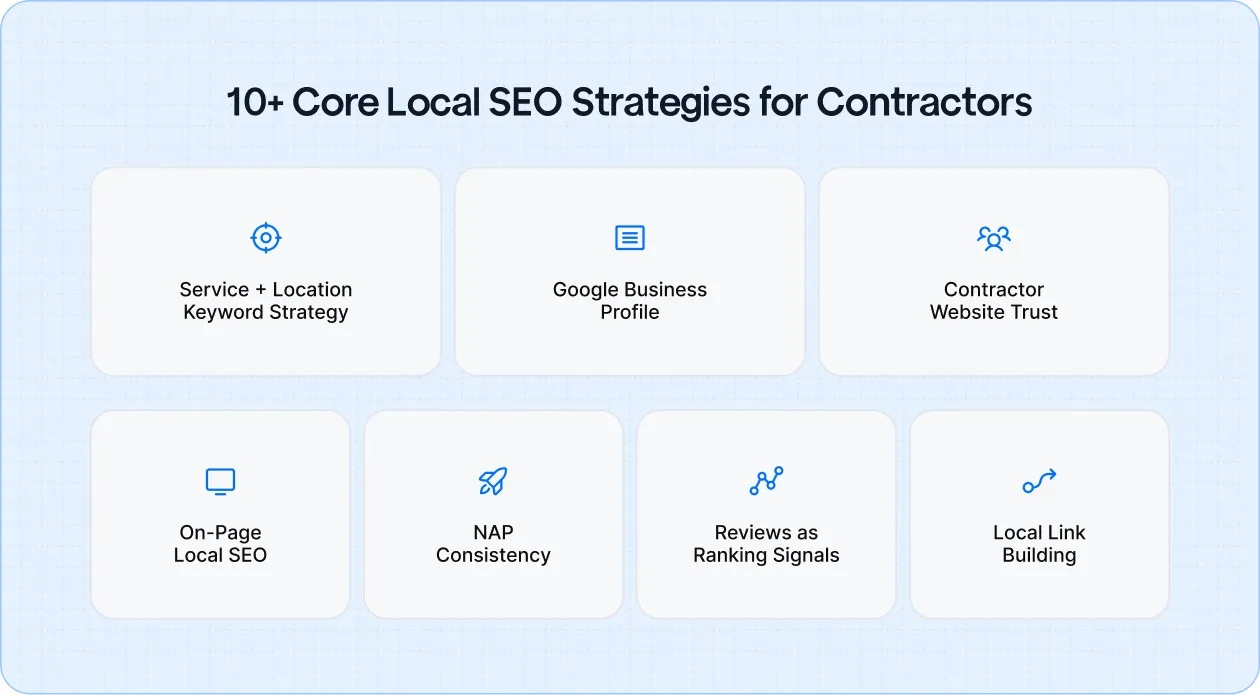
This section breaks local SEO into practical pillars you can actually execute:
Nail Your Service + Location Keyword Strategy
Contractor searches are rarely generic. People search in the exact moment they need help, usually with location and urgency baked in. Your keyword strategy should reflect how real homeowners speak, not how contractors describe their services internally.
- Start with how people search when they are ready to hire: Homeowners search using combinations like service + city, service + “near me”, or problem + urgency. That pattern tells you what matters to them: speed, trust, and relevance.
- Target four keyword buckets that drive local jobs: Build your SEO around keywords that directly map to revenue-generating work:
- Service-based keywords like “roof replacement” or “bathroom remodel”
- Location-based keywords like “HVAC repair in Austin”
- Service-area keywords like neighborhoods, suburbs, and zip codes
- Problem-based keywords like “leaking ceiling repair” or “foundation crack fix”
- Prioritise intent over volume every time: A keyword with lower search volume often produces better leads because it signals real urgency. “Cost to replace a roof in [city]” usually converts better than “roofing.”
- Use real data sources: Pull keywords from:
- Google Business Profile search queries (what people typed before they found you)
- Search Console (what you already show up for)
- Competitor service pages (how they structure and position)
- Tools like Semrush/Ahrefs to identify gaps and variations
- Don’t build content for services you don’t want to sell: If you try to rank for everything, you attract the wrong jobs and dilute relevance. Build visibility around services that are profitable, repeatable, and operationally realistic.
Target the Right Local Jobs
Identify the exact services, neighborhoods, and “urgent intent” searches that bring in serious enquiries.
Map My Keywords
Your Google Business Profile Is the Core Asset
For most contractors, your Google Business Profile is the main engine behind local calls. It shapes whether you show up in the map pack, and it heavily influences trust before anyone even visits your website.
- Set up the profile to match how customers choose contractors: Choose the right primary category, add accurate service areas, set hours properly, and write your business description in plain customer language. Avoid internal terms and focus on what homeowners want solved.
- Use content that proves you do real work locally: Upload photos that show you are active and legitimate:
- Jobsite photos with real conditions, not staged stock images
- Before-after photos that tell a story, not just visuals
- Team, trucks, and uniforms that reinforce professionalism
- Short job notes that explain what was fixed and where
- Post weekly updates that keep you “alive” in Google’s eyes: Small, consistent updates work: seasonal reminders, recent jobs, service highlights, or availability changes. This keeps your profile active and relevant.
- Treat interactions as ranking signals: Calls, direction requests, website clicks, and messages matter. Your profile should make these actions easy.
- Multi-location needs separate credibility: If you expand into a new city, it needs its own local proof. Each profile should show local job photos, reviews, service focus, and accurate service areas.
Win the Local Map Pack
Optimize your Google Business Profile, reviews, and local signals so you show up when homeowners search fast.
Improve My Local SEO
Build a Contractor Website That Google and Customers Trust
Your website is the proof layer behind everything people see on Google. If it feels unclear or generic, visitors bounce and rankings drop over time.
- Make the homepage do the heavy lifting immediately: Within seconds, the homepage should clarify:
- What you do
- Where you work
- Why you are trusted
- How to request a quote or call
This matters because local traffic often lands on your homepage first.
- Create service pages that answer real hiring questions: Every core service should have its own page, built around buyer concerns: scope, process, time required, pricing factors, and what happens next. Include FAQ blocks because homeowners always hesitate at the same points.
- Build service area pages only when you can do them properly: City pages can help when you truly serve those areas and can add real local context. A good location page includes neighborhood references, local job examples, and service specifics. Thin template pages that only swap city names usually hurt more than they help.
- Use project pages as conversion assets: Strong case studies explain: the problem, the constraints, the work done, and the result. These pages win hesitant buyers because they show competence without sounding salesy.
- Design for mobile-first behaviour: Most contractor searches are on phones. Your site must make it easy to call, request a quote, and understand your services without pinching, zooming, or hunting for info.
On-Page Local SEO That Drives Shortlisting
Contractor on-page SEO removes doubt. It helps Google understand your page and helps homeowners quickly decide whether they should contact you.
- Write titles and headings that signal local fit: Use “service + location + trust cue” in a natural way. A title like “Deck Repair in Raleigh | Licensed & Insured” works because it matches the search and builds confidence.
- Add local proof where it feels natural: Mention real service areas, job contexts, and local references inside service pages. Include review snippets where they support credibility, not as decoration.
- Build internal linking as guided navigation: Your website should guide people logically:
- Blog posts → relevant service pages
- Service pages → related service areas
- Project pages → the service they provide
This keeps people moving instead of bouncing.
- Optimise images as local proof: Rename files clearly, write useful alt text, and compress images for speed. Add context in captions or surrounding copy so Google understands what and where the work was.
- Use schema that supports contractor visibility: LocalBusiness, Service, FAQ, and Review schema help search engines interpret your business details and page intent more clearly, which supports rankings and click-throughs.
Local Citations and NAP Consistency
Citations are how Google verifies you are real across the web. If your details vary from site to site, it creates doubt, and doubt hurts local rankings.
- Treat citations like identity verification: Consistent listings reinforce your legitimacy: same business name, phone number, categories, and location details everywhere.
- Lock down your NAP rules and follow them strictly: The smallest variations create confusion: “Street” vs “St.”, two different phone numbers, or slightly different business names. Standardise and apply across every platform.
- List your business where local buyers and Google trust it: Focus on:
- Local directories and chamber listings
- Industry platforms and supplier directories
- Trusted community sites and trade bodies The goal is quality and consistency, not volume.
- Clean up old information proactively: If you moved locations, changed phone numbers, or rebranded, outdated listings can quietly damage trust. Fix these before scaling content.
- Service-area businesses need extra care: If you hide your address, your service areas and business details must be clean and consistent. Otherwise, Google struggles to place you correctly.
Reviews Are a Ranking Signal and a Deal Closer
Reviews do two things at the same time: they help you rank, and they help you get hired. For contractors, they may be the strongest trust lever you have.
- Understand what makes reviews powerful locally: Google looks at recency, quantity, sentiment, and detail. Homeowners look at proof, language, and consistency. You need both.
- Ask for reviews using timing that feels natural: The best time is right after a job is completed and the client is satisfied. Make it simple: one direct link, one clear request, no complicated process.
- Respond to every review like it matters: Replies show professionalism and reinforce service relevance. A short response that references the service and location strengthens trust signals without sounding forced.
- Use reviews across your website strategically: Don’t hide reviews on one page. Place testimonials on service pages, location pages, and near quote forms, where they influence decisions.
- Tools can support scale: Reputation management tools help collect and organise reviews, but they don’t replace real follow-through and good service.
Local Link Building That Contractors Can Actually Do
Local link building is about showing up as a real part of your community and industry, online and offline.
- Build links through relationships you already have: You can earn links through:
- Builders, suppliers, and subcontractors you work with
- Realtors and property managers you collaborate with
- Local associations, trade bodies, and memberships
- Sponsor local events that come with real visibility: Sponsorships work when they include online mentions: community events, sports teams, charity drives, or local trade programs.
- Use projects as linkable proof: Publish case studies and job spotlights that other businesses want to reference. These earn links naturally because they are useful, local, and specific.
- Avoid junk links that harm credibility: Paid spammy backlinks might look like “SEO,” but they dilute trust. Local SEO is built on reputation signals.
How to Use This Section?
Before you try advanced local SEO tactics, make sure your foundation is in place. Contractors get the fastest wins by tightening the basics that directly impact calls and quote requests.
- Optimize your Google Business Profile (services, photos, posts, hours, service areas)
- Build consistent reviews and reply to them regularly
- Publish 1–2 core service pages that target your highest-demand jobs
- Then layer in advanced tactics once the basics are stable and performing
Advanced Local SEO for Contractors
Once the basics are solid, local SEO becomes a game of refinement: making your information easy to extract by machines, easy to act on by people under pressure, and uniquely local:
Voice Search and Conversational Query Optimization
Homeowners speak differently than they type. Voice queries are question-driven and often include context like urgency or location.
What to do:
- Write conversational FAQ blocks that answer full questions people ask aloud (“Who does emergency sump pump repair near me?”).
- Use natural-language headings and short, direct answers (one to two sentences) that can be read aloud by assistants.
- Add time-sensitive phrases and availability info (“open now,” “same-day service”) where true; voice assistants surface these.
- Include local landmarks and neighborhood names in answers — voice queries often use landmarks (“near the stadium”) rather than exact addresses.
Answer What Buyers Ask First
Create service and location content that reduces doubt, builds trust, and improves call quality.
Build My Local Content Plan
AI-Answer Readiness: Make Your Pages Quotable
AI overviews and answer engines pull and summarise content. You want to be the source they quote, not an anonymous page they ignore.
What to do:
- Structure content into small, clearly titled blocks (definition, steps, pros/cons, quick checklist).
- Use short, literal sentences and include bullet lists or tables for extraction.
- Add concise one-line answers at the top of FAQ entries or how-to blocks that an AI can lift verbatim.
- Keep technical accuracy high — contradictions across pages reduce the chance AI will use you as a source.
Entity-Based SEO: Build a Local Identity
Google builds knowledge graphs from real-world signals. Your objective is to be a clearly defined local entity that connects to people, places, and institutions.
What to do:
- Ensure consistent, rich profiles for business owners, managers, and lead technicians (LinkedIn, supplier sites, association directories).
- Publish local partnerships and sponsorships with clear online citations that tie your brand to community or industry entities.
- Create authoritativeness around specific services by owning terms tied to local needs (e.g., “Seattle seismic foundation retrofit — [Your Company]”).
- Keep a short, factual team/owners page with bios that link to public profiles and association memberships. These human links strengthen the entity signal.
Multi-Location Scaling Without Cannibalization
Growing into new cities requires local proof for each location — not cloned pages.
What to do:
- Give each location unique, localised content: local project pages, staff photos, testimonials from that area, and locally relevant FAQ.
- Use a location hub page that aggregates links to each neighbourhood’s proof; avoid templated city pages that only change the name.
- Implement canonical and hreflang-like rules for service variants to prevent index competition. Keep technical metadata unique per location.
- Automate but curate: use templates for structure, but require manual local proof (one job photo, one review) before a location page goes live.
Hyperlocal Content and Neighborhood Relevance
Big-city pages are noisy. Hyperlocal pages win attention from homeowners who search with neighborhood or landmark references.
What to do:
- Create problem-solution pages for neighbourhoods (e.g., “Basement waterproofing for [neighborhood] row houses”) that include local conditions, common property types, and one nearby project example.
- Publish micro-guides about permit processes, seasonal problems, or local building quirks in each area — these are highly linkable by community sites.
- Use local data (flood zones, soil type, weather patterns) to make pages uniquely valuable and defensible.
Behavioural Signal Optimization and Microconversions
Google watches actions: calls, clicks, direction requests, booking starts. Optimize pages to generate the right signals.
What to do:
- Add intent-specific CTAs: “Request Same-Day Quote,” “Upload Drawing / Photo,” or “Check Truck Availability.” These encourage meaningful clicks.
- Implement lightweight microforms and click-to-call buttons above the fold for mobile visitors.
- Track microconversions (click-to-call, booking-start, download spec) and prioritise pages that drive them when optimising content.
- Use UTM-tagged local campaigns (ads, posts) to prove locality and push behavior that boosts map visibility.
Local PR, Partnerships and Crisis Preparedness
Real-world events move online quickly. Local PR coverage, partnerships and a crisis playbook create durable trust and protect visibility when things go wrong.
What to do:
- Maintain a simple press page with local mentions, awards, and community work; link these to partner sites for authoritative citations.
- Build an alert list of local media and trade outlets and offer expert commentary on safety, weather-related damage, or regulation changes to earn mentions.
- Prepare templated responses and a updates protocol for service interruptions or safety incidents so you can post rapid, accurate information that Google can index.
Common Local SEO Mistakes to Avoid for Contractors
Most contractor local SEO problems don’t come from “not doing SEO.” They come from doing the right things in the wrong way.
Here are the most common mistakes contractors make, and what to do instead:
Stuffing Keywords Into Your Business Name
Adding extra keywords like “Best Roofing Contractor Dallas” inside your business name might feel like a shortcut, but it often backfires.
- Google treats this as spammy behaviour and can suppress visibility or trigger profile edits.
- It also creates inconsistency across listings, which weakens trust signals.
- Keep your name exactly as it appears on signage, invoices, and legal documents. If you want to rank for services, do it through categories, services, and strong service pages.
Publishing Thin “Template” Location Pages
Contractors often create dozens of city pages by swapping names and repeating the same content. Google usually sees through it.
- These pages don’t offer real local relevance, so they rarely rank well.
- Worse, they can dilute your site’s credibility because the content feels repetitive and low-effort.
- Only create location pages when you can make them specific: actual service availability, local projects, neighborhood mentions, and job-focused FAQs.
Targeting Too Many Services You Don’t Want to Sell
Trying to rank for everything pulls you into low-quality jobs and wastes your SEO focus.
- If you include services you don’t really want, your leads become messier and harder to close.
- It also weakens clarity in your Google Business Profile and website structure.
- Focus on core services you can deliver profitably and repeatedly, then expand slowly once those pages perform.
Uploading Stock Photos Instead of Real Job Proof
Stock images make your business look generic. Real photos make it believable.
- Google Business Profile performance improves when your visuals show real work.
- Homeowners trust contractors more when they see actual teams, trucks, projects, and results.
- Use jobsite photos, before-after shots, and short job descriptions that tie visuals to services.
Conclusion
Local SEO for contractors pays off in fewer cold calls and more conversations that matter. When your listings, pages, and reviews line up with how people search, you stop competing on price and start competing on trust and availability. That means less chasing and more work that fits your schedule and margins.
Start with the basics: claim your profiles, tidy your NAP data, and make service pages that answer the exact questions clients ask. Then layer in reviews, local content, and measurement so you can see what improves enquiries. Do that consistently, and search stops being random. It becomes a dependable source of qualified local leads
Ready for Better Local Leads?
Build a system that brings in qualified enquiries without relying only on referrals or ads.
Book A Consultation

SEO
Dec 22, 2025
5 mins
7 Proven Strategies for Automotive Email Marketing
Batul Beawarwala
Connecting with customers at the right time can turn a simple interaction into a valuable opportunity. In the automotive email marketing space, it's a strategic art form that can drive real results when applied thoughtfully. With SEO-driven content, you can align your email campaigns to engage your audience and increase organic traffic.
As the automotive industry increasingly moves online, businesses need to embrace personalization and segmentation to drive results. Understanding your customers’ browsing behaviors, purchase intent, and vehicle interests will enable you to craft email campaigns that truly resonate.
Sending service reminders and personalizing vehicle recommendations with a thoughtful approach to email marketing can result in measurable improvements to your business.
A Buyer's Journey from First Thought to Final Drive
The car email marketing process is all about understanding where a customer is in their journey and engaging with them accordingly. Personalization at each stage is key to delivering relevant content, improving the customer experience, and optimizing for SEO.
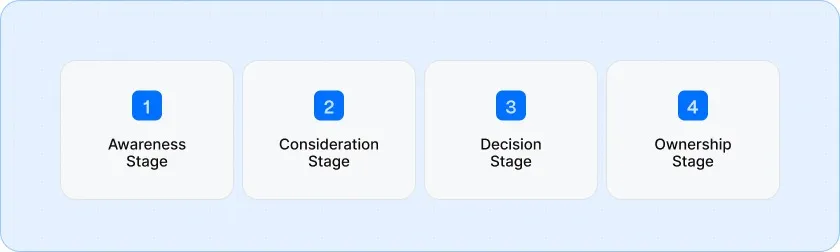
The buyer journey breakdown:
- Awareness Stage: Customers start their search for a new vehicle. At this stage, car email marketing can introduce value-driven content, such as car care tips or guides on choosing the right vehicle.
These emails can link to SEO-optimized blog posts or landing pages about car selection.
- Consideration Stage: Customers compare models, analyze features, pricing, and financing options. Use motor email marketing campaigns to send personalized recommendations, utilizing dynamic content based on browsing or previous interactions.
Real Example: BMW’s automated lead nurturing strategy uses customer data to deliver timely, relevant emails. A customer browsing BMW’s 3-series might receive a personalized email about model features and financing options, linked to SEO-optimized vehicle pages.
- Decision Stage: Customers are ready to make a decision. Focus on personalized offers or exclusive discounts linked to the vehicle they’ve shown interest in. Ensure emails include SEO-friendly landing pages for further information and easy purchase options.
Example: Send a special time-sensitive offer for the vehicle the customer has shown interest in, with a link to an SEO-optimized purchase page.
- Ownership Stage: Even after the purchase, customers need engagement through service reminders, loyalty programs, and offers for future upgrades.
Example: Tesla’s service reminder emails are automated based on service history, driving customers back to SEO-optimized service pages for maintenance bookings.
Each stage of the journey offers a unique opportunity to connect with your customer. But managing it successfully requires a carefully created strategy that delivers the right content at the right time.
Core Components of a Successful Automotive Email Marketing Program
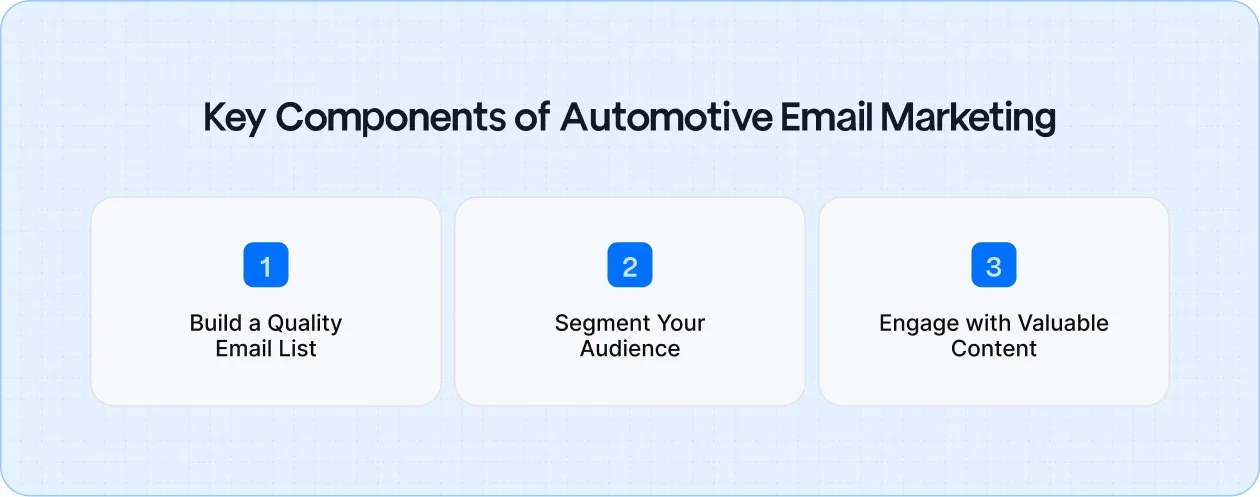
Building a successful automotive email marketing program starts with laying a solid foundation: a well-organized email list and a clear segmentation strategy. Without these, you’re simply sending messages into the void. Here’s how to get it right:
- Build a Quality Email List: The goal is to attract people who have a genuine interest in your services. Use lead magnets like exclusive offers, discounts, or valuable content to encourage sign-ups.
- Segment Your Audience: Group your audience based on their interests and stage in the buying process. New car buyers, service customers, and loyalty program members can all be segmented to receive relevant, personalized content for each group.
- Engage with Valuable Content: Keep your audience interested with maintenance tips, vehicle care guides, and special promotions. Regular, value-driven emails help maintain engagement and trust over time.
Must Read: A Complete Digital Marketing Guide For Industries in the US
7 Proven Automotive Email Marketing Strategies
Here’s how you can make your motor email marketing program stand out:
1. Capture High-Intent Leads with Vehicle-Specific Opt-ins
Create sign-up forms that are personalized to specific vehicles, offers, or promotions. When a customer expresses interest in a particular car model, offer them a chance to sign up for exclusive deals or a test drive for that model.
Why It Works: Customers engage more when the content is directly relevant to their interests. By customizing your car email marketing offers, you capture qualified leads who are more likely to act on your messages.
2. Use Behavioral Triggers for Timely Engagement
Engage customers based on their interests and interactions with your brand. For example, if a customer has shown interest in a specific vehicle or service through a website visit or past email interaction, send them a follow-up email with a relevant offer or additional information.
Why It Works: Behavioral triggers allow you to send content that aligns with the customer's preferences and actions, making your emails more relevant and timely.
This increases the likelihood of engagement and conversion, as customers receive offers that reflect their specific interests.
3. Automate Service Reminders & Ownership Lifecycle Campaigns
Automated service reminders are a great way to keep customers engaged after their purchase.
Set up automated welcome emails for new subscribers, followed by post-purchase emails to nurture leads and encourage repeat business.
Why It Works: Automation keeps customers engaged even after they’ve made a purchase, ensuring they return for service appointments or consider upgrading.
These automated touchpoints help maintain a connection with customers, building long-term loyalty.

4. Create Personalized Emails Based on Customer Preferences and Interests
Use personalized content to make your emails feel more relevant to the customer. Tesla uses personalization to send dynamic emails based on browsing or service history.
For example, a customer who shows interest in a particular model will receive personalized offers and test drive invitations, along with a direct link to an SEO-optimized test drive page.
Why It Works: Emails that reflect customer interests feel more relevant and are more likely to engage recipients. This approach makes customers feel heard and valued, strengthening brand loyalty and increasing the chances of conversions.
5. Provide Value-First Content: Educational Resources & Car Care Tips
Incorporating car care tips, vehicle maintenance guides, and finance tips can help you maintain engagement, even after a customer has purchased a car. Toyota excels in this by sending educational emails such as ‘How to Maintain Your Car in Winter’, with links to SEO-optimized pages about seasonal maintenance.”
Offer finance-related content, such as loan tips, leasing information, and even financing calculators. Ford sends educational emails explaining the benefits of leasing vs. purchasing based on a customer’s past interactions and interests.
These emails include links to SEO-optimized finance landing pages that detail loan options and help customers make informed decisions.
Follow a 3:1 content ratio in your email campaigns: Three parts educational content and one part promotional.
Why It Works: Motor email marketing with a focus on value-driven content builds trust with your audience, encouraging them to keep engaging with your emails even after they’ve made a purchase.
Must Read: Level Up Your Content: 11 Power-Packed Marketing Tips for Automotive SMBs in 2026
6. A/B Test Subject Lines, CTAs, and Send Times
Experiment with different subject lines, CTAs, and send times to see what resonates most with your audience. Test variables like emotional appeal versus practical offers to determine the best approach.
Why It Works: A/B testing helps you refine your strategy based on what your audience engages with most, leading to higher open rates and more conversions.
7. Implement List Hygiene & Clean-Up Inactive Subscribers
Regularly clean your email list by removing inactive subscribers and bounce-back emails. Implement a sunset policy for subscribers who haven’t opened or clicked emails in a certain period.
Why It Works: A clean list ensures your emails reach those who want to hear from you, improving deliverability and engagement rates. It also helps keep your campaigns more cost-effective.
3 Best Practices for Designing Engaging Automotive Emails
The goal of your email should be to get action. For example, Honda’s email focuses on getting a customer to schedule a test drive or download a brochure before pushing for the final purchase.
This builds interest and drives engagement, making it easier for customers to take the next step toward buying.
Here’s how to design emails that stand out in crowded inboxes:
1. Keep It Simple and Mobile-Friendly
With more people checking emails on mobile devices, a clean, simple design is a must. Use single-column layouts that are easy to read on smaller screens, and ensure that buttons and links are large enough to tap without frustration.
If your emails are hard to view on mobile, you risk losing valuable engagement.
2. Clear and Actionable CTAs
Every email should have a clear call to action (CTA), such as scheduling a test drive, exploring financing options, or learning more about a vehicle. Make sure your CTAs are bold, easy to find, and stand out from the rest of the content.
Create a sense of urgency with personalized scarcity. For example, Toyota sends emails like ‘Exclusive offer for you, only 24 hours left!’ These emails link to SEO-optimized pages where customers can take immediate action on the offer.
A well-placed CTA will guide readers toward taking the next step in their buying journey.
3. Consistent Branding
Your emails should reflect your dealership’s or brand’s personality. Use your brand’s colors, fonts, and logo to ensure your emails are instantly recognizable.
Consistent branding helps build trust and reinforces your business identity, making it easier for customers to recognize and connect with your brand.
Use email automation, segmentation, and A/B testing to continuously refine your email campaigns. Modern platforms like Mailchimp or HubSpot allow you to test subject lines, CTAs, and even landing page content, improving your emails’ engagement with SEO-driven personalization.
Suggested Read: 8 Industrial Manufacturing Marketing Moves Most Ignore
Tracking Success and Optimizing Campaigns
To truly elevate your email marketing efforts, it's essential to assess how your campaigns are impacting business goals.
By analyzing performance metrics, you can pinpoint what’s working, make informed adjustments, and continuously improve your strategy for better engagement and ROI.
Measuring Key Metrics
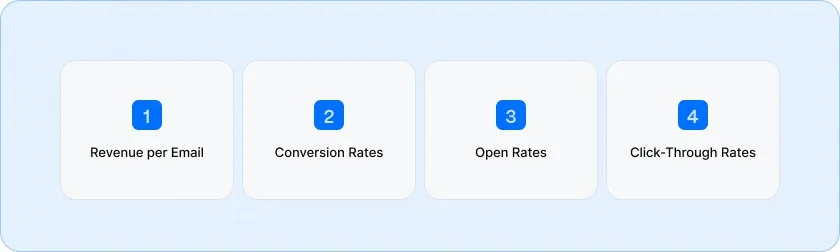
To truly gauge the effectiveness of your email campaigns, it's important to track key performance indicators (KPIs). Focus on the following metrics to get a clear picture of your campaign's success:
- Revenue per Email: This shows how much revenue each email generates, helping you measure its direct financial impact.
- Conversion Rates: Track how many recipients take the desired action, such as making a purchase or signing up for a service.
- Open Rates: Indicates the percentage of recipients who opened your email, showing how engaging your subject line and preview text are.
- Click-Through Rates (CTR): Measures how often recipients clicked on links in your email, highlighting the effectiveness of your calls-to-action.
By continuously measuring these metrics, you can identify trends and adjust your approach for even better results.
Take Your Automotive Email Marketing to the Next Level
Segmenting your audience, personalizing content, and automating lifecycle campaigns are all essential strategies for building a successful automotive email marketing program.
By implementing these tactics, you can build stronger relationships, drive more conversions, and ensure your campaigns stand out in crowded inboxes.
To achieve long-term success, your email marketing needs to be backed by SEO-optimized content.
At Gushwork, we specialize in creating content strategies that drive engagement and ensure your messages reach the right audience.
Book a Free Consultation

Digital Marketing
Nov 17, 2025
5 mins
Feeling Invisible? 60% of Construction Companies Miss Out on Social Media's Power, Let’s Change That!
Batul Beawarwala
Social media marketing is a powerful tool for your construction company to showcase your work and connect with potential clients. Platforms like Instagram, Facebook, and LinkedIn and the emerging ones, allow you to highlight your projects, share updates, and engage with your community in real time.
By creating a strong online presence, you can attract new leads, build brand awareness, and create lasting relationships with customers, all with minimal investment. Social media offers a unique opportunity to grow and stand out in a competitive market.
To help you get started, here are the top-most effective strategies for making the most of social media for your construction business.
1. Define Your Ideal Customer Avatar (ICA)
The foundation of any successful marketing strategy is understanding who you're speaking to. For construction companies, your audience can vary widely; homeowners, developers, architects, and industry professionals all have different needs and goals.
Personalize your content to these specific segments to ensure your messaging resonates.
To create an effective Ideal Customer Avatar (ICA):
- Demographics: Consider age, location, job titles, and income levels.
- Psychographics: Identify their pain points, needs, and goals (e.g., are they seeking innovative construction solutions or looking for reliable contractors?).
- Behavioral Insights: Analyze social media interactions to understand what types of posts they engage with (e.g., educational tips, project showcases, etc.).
2. Choose the Right Platforms for Your Construction Business
Each social media platform offers unique strengths, and understanding which one will best help you connect with your ideal clients is crucial. By focusing on the platforms that matter most to your target audience, you can ensure that your efforts are well-spent and effective.
- LinkedIn: Perfect for B2B connections and networking with architects and developers. LinkedIn helps establish authority in the industry through project updates, insights, and professional engagement.
- Instagram: The go-to platform for visual storytelling. It’s ideal for sharing before-and-after project photos, time-lapse videos, and drone footage to captivate homeowners and clients interested in aesthetics.
- Facebook: Great for local engagement. Share updates, community events, and project promotions, reaching customers in specific geographic areas, especially homeowners seeking services.
- Pinterest & Snapchat: Pinterest is valuable for inspiration-driven posts, while Snapchat works well for quick, dynamic project updates, great for engaging younger audiences.
3. Create a Strategic Content Calendar
Consistency is key. Regular, high-quality organic content builds trust and positions your company as a credible, reliable source of information.
Without heavy reliance on ads, consistent posting helps keep your brand at the forefront of your audience’s mind.
Align Your Content with Business Objectives
Your content must serve a clear purpose, such as educating your audience, promoting your services, or building community trust. Strike a balance between:
- Educational posts: Share insights into construction techniques or industry trends.
- Promotional content: Showcase your services through case studies or testimonials.
- Engagement content: Polls, questions, and discussions that involve your audience.
4. Strategies for Building a Loyal Community
Building a loyal community requires consistent interaction with your audience. It requires building a two-way conversation that fosters trust, loyalty, and long-term engagement.
Use Surveys for Lead Qualification
Surveys help ensure you're attracting the right prospects. By asking detailed questions about a customer's needs and preferences, you can filter leads that are most likely to benefit from your services.
This saves time and ensures your efforts are focused on high-value opportunities.
Leverage Google My Business & Apple Business Connect
Both Google My Business and Apple Business Connect are critical for local visibility. These tools allow your construction company to show up in local searches, helping you connect with potential clients in your area.
Use Hashtags and Interactive Content
Hashtags make your posts more discoverable, especially when you target local and industry-specific hashtags. Interactive posts like polls or quizzes engage followers and spark conversations, making your brand more relatable.
Must Read: 10 Must-Know Content Marketing Hacks: Make Your Home Services Impossible to Overlook
5. Incorporate User-Generated Content (UGC) and Testimonials
User-generated content (UGC) is a powerful tool that showcases real customer experiences. Sharing client photos or videos of completed projects provides social proof and establishes trust.
Client Testimonials
Sharing client success stories highlights your expertise and the tangible benefits of your services. These testimonials act as proof of quality that helps build credibility.
6. Showcase Behind-the-Scenes, Build Trust and Transparency
Clients value transparency and authenticity. By showcasing the behind-the-scenes process, you allow them to see your work, which builds trust and demonstrates the care and effort you put into every project.
Highlight Your Team and Projects
People want to know who’s behind the business. Showcasing your team and the work they do humanizes your brand and creates emotional connections with your audience.
Employee Spotlights
Introduce your team and celebrate their contributions. Share behind-the-scenes moments to show your company’s culture and values, which fosters a deeper connection with your audience.
7. Paid Advertising Strategies: Facebook and Google for Cost-Effective Lead Generation
Paid ads can be effective when used strategically. They can amplify your organic content and ensure that your message reaches a highly targeted audience, but it’s essential to be smart about your budget and focus on cost-effective strategies.
Cost-Effective Paid Ads
Paid advertising can be effective, but you need to target the right audience. Focus on hyper-local campaigns or specific project types. By targeting a niche audience, you ensure that your ads reach those who are most likely to require your services.
8. Automated Follow-Up Systems for Better Conversion Rates
Automating follow-ups ensures that you never miss an opportunity. By providing timely reminders and follow-ups, you streamline the process and ensure potential clients stay engaged.
Streamline the Conversion Process
Once a potential client expresses interest, don’t leave them hanging. Immediately direct them to a consultation booking page or provide them with the next step. This keeps them engaged and moves them further down the sales process.
Text Message Reminders
Automated follow-up reminders, such as text messages, help keep clients engaged. These reminders can confirm a meeting time or remind clients about upcoming services, ensuring your business stays top-of-mind.
How to Use Data to Improve Your Social Media Strategy
Data is your roadmap to refining your social media strategy. It requires understanding patterns in engagement, tracking what resonates with your audience, and making informed adjustments.
By closely monitoring key metrics and leveraging the right tools, you can optimize your content for maximum impact and engagement.
Key Metrics to Track
To continuously improve your social media strategy, focus on metrics that align with your goals. Each metric offers a unique insight into how your audience is interacting with your content and where you can make improvements:
- Engagement Rate: This tells you how effectively your audience is interacting with your posts. High engagement means your content resonates, while low engagement signals it’s time to re-evaluate.
- Lead Generation: Track how your social media efforts convert into actual interest or inquiries. This helps you gauge if your content is successfully pushing people down the sales funnel.
- Website Traffic: Is your content driving people to your website? Monitoring clicks from social media platforms to your site is crucial for determining how well your posts are leading to conversions or purchases.
- Conversion Rate: Ultimately, you want to know how many social media interactions turn into actual outcomes (consultations, sign-ups, or sales). Keep an eye on how well your content is driving the desired actions.
Tools to Track Performance
Understanding what’s working and what’s not requires the right tools. Here’s how to track and analyze performance effectively:
- Google Analytics: Beyond just tracking website traffic, Google Analytics allows you to track source/medium data. Understand exactly which social platforms are sending the most traffic to your site, and identify top-performing posts.
- Facebook/Meta Insights: Use Meta Business Suite to see engagement data, demographics of your audience, and the reach of each post. This gives you real-time data on what works and what doesn’t within the platform.
- Instagram Insights: If Instagram is one of your primary platforms, incorporate Instagram Insights to track metrics like impressions, reach, and top-performing content to adjust your strategy for better results.
- Other Free Tools: Tools like Hootsuite or Buffer offer a consolidated view of your social media performance across different platforms, making it easier to identify trends and patterns.
Actionable Tip:
Here’s how to make data analysis actionable and adjust your content strategy accordingly:
- Analyze Post Performance: Regularly assess how different types of posts perform. Are images outperforming videos? Are polls or questions driving more engagement? Use A/B testing to compare variations and determine what content type resonates the most.
- Track Trends Over Time: Look at the performance of your posts over weeks or months, not just days. Long-term trends will tell you what your audience consistently enjoys.
- Adapt and Refine: Once you identify your highest-performing content, refine your strategy to produce more of it. If certain topics or formats consistently yield better engagement or conversion, adjust your content calendar to reflect that.
Many construction companies struggle with manually sifting through multiple platforms’ insights. But with the right tools and expertise, this process can be made far simpler, and it will ensure that each post is more strategically aligned and impactful.
The Future of Social Media Marketing for Construction Companies (2026 and Beyond)
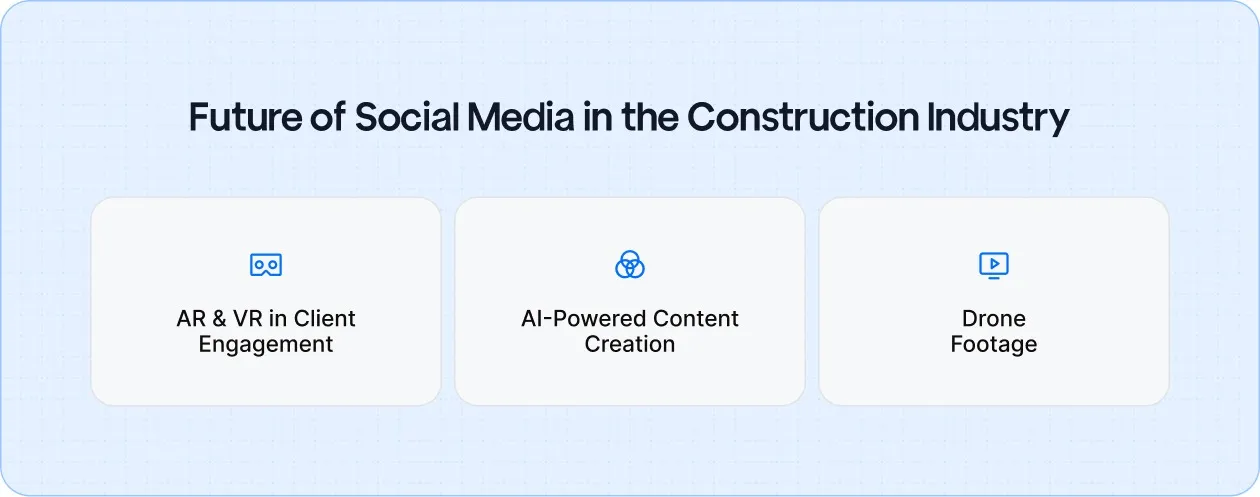
Social media marketing is continuously evolving, and staying ahead of trends can give your construction business a competitive edge. By leveraging new technologies like Augmented Reality (AR), Artificial Intelligence (AI), and drone footage, you can engage your audience in innovative ways.
These tools represent the future of how construction companies can interact with potential clients and showcase their work.
Augmented Reality (AR) and Virtual Reality (VR)
AR and VR are poised to revolutionize client engagement. These technologies allow clients to visualize projects in a more immersive way, offering virtual tours or 3D models before construction begins.
How AR/VR Can Transform Client Engagement
- Virtual walkthroughs: Clients can explore a project before it’s built.
- Interactive designs: Use AR to overlay project designs on existing spaces, making it easier for clients to understand changes.
Embracing these technologies will give your business a cutting-edge presence and help clients connect with your projects on a deeper level.
AI-Powered Content Creation
AI tools are reshaping how content is created and distributed on social media. They can automate content generation, from captions to blog posts, and help optimize your social media strategy by predicting what your audience will engage with.
How AI Improves Social Media Efficiency
- Automated content creation: AI can generate relevant content in less time, ensuring you post consistently.
- Optimized posting: AI tools suggest the best times to post for maximum engagement.
Using AI-driven tools allows your business to maintain a consistent online presence without the need for constant manual effort.
Drone Footage
Drones are transforming how construction projects are showcased. Aerial shots and time-lapse videos give your audience a unique perspective, allowing them to see the full scope of a project in a way that ground-level shots can’t.
How Drone Footage Engages Clients
- Aerial views: Showcase large projects or hard-to-reach angles.
- Time-lapse footage: Capture the evolution of your projects, adding storytelling value.
Drone footage is both engaging and highly shareable, making it perfect for increasing visibility on social media.
Must Read: 15 Proven Construction Industry Marketing Strategies for Business Growth
How SEO and SMM Work Together to Strengthen Your Construction Business
SEO (Search Engine Optimization) and SMM (Social Media Marketing) are essential for building a strong digital presence for your construction business. While SEO helps your website rank higher in search results, driving organic traffic, SMM builds relationships and engagement on platforms like Facebook, Instagram, and LinkedIn. Together, they create a powerful strategy that enhances visibility and generates leads.
Here’s how SEO and SMM complement each other:
- SEO: Increases your website’s visibility on search engines, bringing in qualified, organic traffic.
- SMM: Engages your audience on social platforms, fostering trust and increasing brand awareness.
By combining SEO and SMM:
- You increase visibility across multiple channels
- Build trust with your audience
- Drive more qualified leads
Achieving the best results from both SEO and SMM requires a cohesive strategy and expertise to implement effectively.
Looking to enhance your SEO to align with Social Media?
You are at the right place. Gushwork creates SEO-optimized content that drives website traffic, improves engagement, and strengthens your online presence to support your social media efforts.
Start With a Free Consultation
SEO
Nov 17, 2025
5 mins
SEO for Painters: A Complete Guide (2026)
Batul Beawarwala
To grow your painting business, being visible online is key. SEO (Search Engine Optimization) ensures your painting contractor or house painter business shows up when potential customers search for services in your area.
By optimizing your website, you make it easier for people to find you at the moment they need a painter.
Let's explore how painter SEO marketing can help you attract more customers and expand your business.
What is SEO for Painters and How Does It Work?
You have your painting business running, but if potential customers can't find you online, all that hard work can go unnoticed. SEO for painters is the solution to this problem.
It’s a set of strategies designed to get your painting business to show up at the top of search results on Google, making sure that when someone looks for a painter, they find you first.
Four main components of Painter SEO work together to increase your visibility:
- On-Page SEO: This is everything on your website, like the text and images. It’s about ensuring your content is clear and includes the right keywords. This helps Google understand what your business offers.
- Local SEO: This focuses on helping your business show up in searches like “painters near me.” By targeting local keywords and optimizing your online presence for your specific area, you’ll appear when people in your city or neighborhood are looking for painting services.
- Off-Page SEO: This is about building your reputation online. When other trusted websites link to your site, it signals to Google that your business is reliable. It’s similar to word-of-mouth referrals, but online, getting linked by local blogs, business directories, or industry sites can improve your SEO.
- Technical SEO: This is the behind-the-scenes work that makes sure your website is fast, mobile-friendly, and easy for Google to read. If your website is slow or hard to navigate, people may leave before they even see your services.
Create Your SEO Strategy: The Essentials
Building a solid SEO strategy is the foundation of long-term online success. By focusing on the right tactics, from keyword research to content creation and technical optimization, you can ensure your website ranks higher and attracts the right customers.
Let’s explore the key steps to craft a focused SEO strategy that drives results.
Identifying Your Ideal Customer and Service Areas
The first step to building a successful SEO strategy is understanding your customers and where they’re located. Without clearly defining your target audience and service areas, you risk wasting time and resources on searches that don’t lead to new business.
By focusing on specific, high-conversion service areas, you ensure that your efforts are more effective. Here’s why narrowing your focus is important:
- Specializing in a few services, like interior painting or cabinet painting, attracts customers looking for exactly what you offer.
- A targeted approach ensures visitors to your website are potential customers.
Clearly defining your services and locations maximizes the impact of your SEO strategy. Many businesses miss out by trying to serve everyone; focusing on your key services, makes it easier for the right audience to find you.
Keyword Research for Painters: Finding High-Intent Terms
Once you’ve identified your ideal customers and service areas, the next step is keyword research. This ensures your website appears for the terms people are actively searching for.
Without the right keyword strategy, you might end up ranking for terms that won’t drive meaningful traffic or attract the right clients. Effective keyword research helps you target terms that match what potential customers are looking for.
Using tools like Google Keyword Planner, Ahrefs, and SEMrush can help you identify high-traffic, low-competition keywords, allowing you to rank faster and more effectively. By targeting the right terms, you ensure your business shows up when it matters most.
Examples of keyword types to consider:
By targeting a mix of these keywords, we can create a robust keyword list tailored for your business over the next 6 months, ensuring that each service page targets a specific term for optimal results.
Keyword research is the foundation of Painting SEO Services.
Need help targeting high-conversion keywords? Let us help you identify the terms that will drive the right traffic and create a solid strategy for your business.
Get a 6-month Keyword Plan
Optimizing Your Website for SEO
To effectively achieve Search Engine Optimization for painting websites, it’s essential to focus on more than just adding keywords. The structure, content, and local relevance of each page must work together to improve your visibility in search results.
By strategically optimizing key elements, you can ensure your website is easy to find and compelling to your target customers.
Let’s explore the key areas you need to focus on to get your website ranking higher and attracting more local business.
On-Page SEO: Structuring Your Pages for Ranking
Optimizing key elements helps both search engines and users find what they need, but it’s easy to overlook some details. That’s why understanding the key parts of your pages is essential to ranking higher.
Here’s what to focus on:
- Title tags and meta descriptions: Your painting company SEO meta description should be concise, clear, and include your main keyword with local info. This helps search engines understand the purpose of your page and increases the chance of showing up in the right search results.
- Headings: Organize your content with the right structure. Use H1 for the main topic, H2 for subtopics, and ensure each heading includes relevant keywords.
- Content: Aim for 600-1,500 words, with natural keyword variations, related services, and local details. This content needs to engage readers while signaling to search engines that your page has valuable, relevant information.
Each blog on your website is a chance to improve your rankings.
Optimizing content for both search engines and visitors can make all the difference in driving more traffic.
Optimize My Content
Location-Specific Pages for Local SEO
To stand out with local SEO services for painting companies, you need to create unique pages for each area you serve. This process ensures your business is found by customers looking specifically for painting services in their location.
Creating these pages may seem straightforward, but the key is in how you make each page relevant to that particular area. Here's a smart structure to follow:
- Service page: Highlight the specific services you provide in that location, and be sure to mention local landmarks and areas you serve.
- Local relevance: Add testimonials and other locally focused details to make each page feel personal and specific to the area.
You might need some expert insight to ensure you're making the most of your local SEO strategy.
Building Local Authority with Google Business Profile (GBP)
To build local authority and improve your visibility in local searches, optimizing your Google Business Profile (GBP) is essential. It’s about ensuring your business details stand out to potential customers.
Let’s explore the key steps to take full advantage of your GBP and maintain consistency across all online directories.
Optimize Your Google Business Profile
Your Google Business Profile (GBP) is often the first impression potential customers get of your painting business online. It’s crucial to complete your profile and to make sure it’s optimized to attract the right people and build local authority.
Key elements to optimize:
- Name, Address, Phone Number (NAP): Ensure these are accurate and consistent to improve visibility.
- Service Descriptions: Clearly describe what you offer to match search intent.
- High-Quality Images: Add photos that showcase your work and build trust.
- Frequently Asked Questions (FAQ): Answer common questions to provide value and clarity.
- Regular Updates: Keep your profile fresh and relevant by posting updates often.
- Customer Reviews: Encourage positive reviews to increase credibility and boost rankings.
Maintaining a well-optimized GBP takes time and attention, but the benefits are immense. It can help you dominate local search results and ensure customers can easily find and trust your business.
A well-optimized GBP can make all the difference.
Let’s dive into the must-have details that will help you get more visibility in local searches.
Claim My GBP
NAP Consistency and Local Citations
NAP consistency is a critical factor in your local SEO strategy. Your name, address, and phone number must be identical across all online directories and platforms like Google, Yelp, and Angi. Any discrepancies can confuse search engines and potential customers, which can harm your rankings.
Additionally, claiming your business on local directories is essential. It helps improve your credibility and boosts your presence in local search results.
This process may sound simple, but managing NAP consistency across multiple platforms requires expertise to avoid mistakes and ensure optimal results.
Link Building for Painters: Earning Authority Online
Link building is a powerful strategy that painting company SEO experts use to improve your website's authority and boost your rankings.
Let’s dive into the essential steps for building effective backlinks that enhance your SEO.
How Backlinks Impact Painter SEO
Backlinks are essential for improving your website’s authority and increasing your rankings on search engines. When high-quality websites link to your site, it signals to Google that your business is trustworthy and relevant, which boosts your chances of ranking higher.
Key points to focus on:
- High-Quality Backlinks: Focus on obtaining links from local suppliers, partners, and industry associations. These backlinks are more valuable because they come from trusted sources within your field.
- Tools to Use: Platforms like Ahrefs can help you analyze your competitors' backlinks and uncover potential link-building opportunities.
Building a strong online presence starts with high-quality backlinks.
Let’s create a strategy to help you earn valuable links and boost your SEO.
Start Building Backlinks
Building Relationships for Better Links
Creating meaningful relationships with local blogs, online directories, and publications can help you secure guest posts and mentions that provide valuable backlinks. But don’t stop there, use content marketing to naturally attract backlinks.
Effective content types include:
- Case studies that showcase your expertise.
- How-to guides that provide practical value to readers.
- Infographics that make complex information shareable and engaging.
By offering valuable content and engaging with local influencers, you can attract backlinks that improve your SEO over time.
Technical SEO for Painters: Ensuring Your Site is Search Engine-Friendly
Technical SEO is the backbone of your online presence, ensuring that your website is both user-friendly and optimized for search engines.
From speeding up page load times to organizing your site structure, these behind-the-scenes improvements are key to making sure customers can easily find and navigate your site.
Let’s dive into the crucial steps for optimizing your site’s technical performance and boosting your SEO.
Site Speed and Mobile Optimization
A fast, mobile-friendly website is essential for ranking well on Google. With Google’s preference for mobile-first indexing, ensuring your website is fully responsive and loads quickly on all devices is key.
Tools to use:
Google PageSpeed Insights and GTMetrix are great for testing your website’s speed and mobile compatibility, helping you make necessary improvements to enhance user experience and SEO performance.
Clean Code and Site Structure
The structure of your website is just as important as the content. A clean, well-organized site makes it easier for both users and search engines to navigate.
Key optimization tips:
Schema Markup: Use LocalBusiness and Service schema to give Google more context about your business and services, improving how your site is understood and displayed in search results.
The Power of Content Marketing for Painters
Content marketing is essential for building both trust and visibility online. By creating valuable, informative content that addresses your customers’ needs and questions, you improve your SEO rankings and position your painting business as a trusted authority.
Let’s explore how the right content can attract more leads and turn visitors into loyal clients.
Creating Content That Attracts Customers
Content marketing is one of the most powerful tools in your SEO strategy. By crafting insightful blogs and guides that address common painting-related questions, you engage potential customers while improving your search engine rankings.
Focusing on customer pain points is key. Write about cost breakdowns, tips for choosing paint colors, and preparation advice, topics that directly meet your customers' needs.
This type of content helps your audience make informed decisions and increases your visibility on search engines.
Content is your secret weapon in SEO.
Let’s help you create blogs that rank and convert readers into clients.
Create Content That Converts
Visual Content for Better Engagement
Adding visual content like project galleries, before-and-after images, and videos enhances the appeal of your site while boosting user engagement, an important factor for SEO. The more engaged visitors are, the better your site performs in search results.
To maximize engagement: Embed YouTube videos on your service pages to increase dwell time.
Longer visits signal to search engines that your site is valuable, improving your ranking and online visibility.
Reputation Management: Improve Your SEO with Reviews
Managing your online reputation through reviews is a powerful SEO tool. Positive reviews help build trust, enhance your brand image, and improve your search engine rankings, all while driving more leads to your business.
Collecting and Managing Reviews
Encourage satisfied customers to leave reviews on platforms like Google Business Profile, Yelp, and Angi to boost your online credibility.
Regularly responding to both positive and negative feedback shows that you value customer input, helping you build a positive and transparent reputation.
Leveraging Reviews for SEO
Displaying positive reviews on your website and service pages helps build trust with visitors, increasing the likelihood of conversions.
You can also use customer feedback to create compelling case studies or testimonials, which highlight your expertise and contribute valuable content that enhances your SEO.
Measure Your SEO Performance
Tracking your SEO performance is essential for understanding what’s working and where improvements are needed. By measuring the right metrics, you can make informed decisions to refine your strategy and continue driving more relevant traffic to your website.
Key Metrics to Track
To evaluate the effectiveness of your SEO efforts, monitor these key metrics:
- Organic Traffic: Measure how many visitors are coming from non-paid search results.
- Keyword Rankings: Track how your main keywords are performing over time.
- Conversion Rates: Monitor how many visitors are taking actions like requesting a quote or making a call.
- Bounce Rate: Ensure visitors are engaging with your site and staying longer, indicating relevant content.
Tools to Scale Your Painting Business Online
Using the right tools can simplify the process of monitoring and improving your SEO.
- Google Analytics and Google Search Console are free tools that allow you to track website traffic, identify performance issues, and measure success.
- Paid tools like SEMrush and Ahrefs help you track keyword rankings, monitor backlinks, and analyze competitors, giving you a deeper understanding of your SEO performance.
These tools can provide you with the insights needed to refine your strategy and keep your website ahead of the competition.
Dominate Your Local Market with Proven SEO Tactics
By focusing on essential strategies, such as refining your website, building local authority, and managing your online reputation, you can ensure long-term visibility and attract a steady stream of customers.
Start with the basics, implement consistent SEO efforts, and watch your business grow. With the right approach, you can dominate your local market and stand out where it matters most.
Leave SEO strategies to the Experts.
Gushwork’s personalized SEO content strategy will help you drive sustainable business growth and stay ahead of the competition.
Book a Free Consultation

SEO
Nov 13, 2025
5 mins
Bridge the Gap Between Your Work and Visibility Using These 11 Architect SEO Strategies
Batul Beawarwala
Ask any architect where most of their time goes, and the answer rarely includes “marketing.” It goes into drawings, revisions, site visits, coordination, and problem-solving. The work is demanding, and rightly so.
The problem is that your future clients do not see any of that.
What they see is a website, a few pages in search results, and a handful of firms that appear to “fit” their project. That first impression decides who gets shortlisted and who never hears back.
Architect SEO exists in that narrow gap. The space between the quality of your work and how clearly it shows up online.
In this blog, we unpack how SEO works specifically for architects, what actually influences visibility in search, how to structure your website and content for long-term relevance, and what changes as AI reshapes how clients discover architecture firms.
Understanding SEO for Architects and Architecture Firms
SEO is the quiet word-of-mouth that actually shows up in online searches. It does the slow, patient work of making sure the right people find your studio while they are still trying to understand what they need.
Most people who hire an architect do not call the first firm they see. They compare portfolios, check locations, read about the process, and only then reach out. SEO helps your firm be part of that journey at every step.
When someone searches online, they are looking for answers.
- Who designs homes like this?
- Who has handled a similar project?
- Who works in this city and understands local constraints?
When that clarity exists, your website starts working like a filter that attracts the right enquiries and screens out the wrong ones.
Key Components of Architect SEO
A concise checklist of the SEO elements architects must get right to be found, understood, and shortlisted by clients.
- Technical foundation
- On-page SEO
- Local SEO & Google Business Profile
- Project and service pages
- Content that answers buyer intent
- Structured data
- Image and media optimization
- Internal linking and site architecture
- Authoritative backlinks
- Conversion paths and UX
- Measurement by business signals
Show Up During Shortlisting
Strengthen SEO so your firm appears when clients research, compare, and narrow down architects.
Strengthen My SEO
Core 11 SEO Strategies for Architecture Firms
Once you understand what SEO means for an architecture firm, the next step is execution.
The strategies below work best when they are treated as connected parts of the same framework. Each one supports the other, and together they build long-term visibility:
Strategy 1: Keyword Research for Architecture Firms
Keyword research shapes who discovers your firm and what they expect when they land on your site. For architects, the goal is not to attract large volumes of traffic, but to attract the right type of visitor.
- Service-based, location-based, and branded keywords: Service-based keywords capture intent tied to architectural offerings, while location-based keywords establish where your firm operates. Branded keywords become important later in the decision cycle, when clients begin verifying your firm after initial discovery.
- Long-tail keywords for architecture firms: Long-tail keywords reflect specific project requirements and usually indicate higher intent. Although search volume is lower, these keywords often align better with qualified inquiries and should be prioritized.
- Evaluating keyword intent instead of search volume: A keyword with high volume but unclear intent often brings unqualified traffic. Keywords should be assessed based on whether the searcher is researching a project, comparing firms, or simply gathering general information.
- Tools and methods to identify relevant keywords: Keyword tools can surface ideas, but manual filtering is essential. Reviewing search results, related queries, and competitor pages helps identify keywords that attract real clients rather than students or job seekers.
- Common keyword research mistakes to avoid: Targeting broad industry terms, ignoring geographic intent, or choosing keywords that do not reflect actual services often leads to low engagement and poor conversions.
Attract the Right Clients
Identify the project types, locations, and search terms that serious architecture clients actually use.
Map My ICP and Keywords
Strategy 2: On-Page SEO for Architecture Websites
On-page SEO ensures that each page communicates its purpose clearly while supporting strong visual design. For architecture firms, clarity and presentation must work together.
- Meta titles that clearly define page focus: Meta titles should state what the page offers and include relevant keywords naturally. Clear titles improve click-through rates and help search engines understand relevance.
- Meta descriptions that guide user expectations: Descriptions should explain what the visitor will find on the page and why it is useful, without sounding promotional or vague.
- Page heading structure across key pages: Headings should follow a consistent hierarchy that helps users scan content easily while signaling importance to search engines.
- Natural keyword placement within content: Keywords should support readability and context. Overuse or forced placement weakens trust and disrupts the user experience.
- Image alt text for architectural visuals: Alt text should describe images accurately, supporting accessibility and helping search engines interpret visual content without compromising aesthetics.
- Maintaining balance between design and SEO: On-page optimization should enhance clarity and performance without undermining the visual identity of the firm.
- Conversion-focused SEO elements that support enquiries: On-page SEO should also guide visitors toward the next step. Add clear CTAs on service and project pages, keep forms short, and place contact options where clients naturally look after reviewing work.
- Reducing friction for shortlisted visitors: Many visitors arrive already interested. Make it easy for them to confirm fit quickly with fast-loading pages, a clear “what we do” summary, and a simple path to request a consult or start a conversation.
Strategy 3: Content Strategy for Architectural SEO
Content allows architecture firms to demonstrate expertise and build trust before direct contact. A strong strategy ensures content supports visibility and credibility together.
- Service pages that establish clarity: Service pages should explain what the firm does, who the service is for, and how it fits into broader project needs. Clear language helps visitors quickly assess relevance.
- Portfolio pages that act as proof: Portfolios should combine visuals with context, explaining the project scope, challenges, and outcomes.
- Team and process content that reduces buyer uncertainty: A strong “team” and “process” layer helps clients understand how you work. Credentials, roles, and a clear project approach often influence shortlisting as much as visuals.
- Project descriptions that support authority: Descriptions should include location context, design intent, and constraints. This helps search engines understand relevance while reinforcing expertise.
- Project proof that shows scope and responsibility: Strengthen project pages with clear context like location, role, constraints, and outcomes. Buyers trust firms faster when they see how decisions were made.
- Blog content that reflects real-world experience: Blogs should focus on topics tied to process, regulations, planning considerations, and client questions rather than generic design commentary.
- Using content to support long-term keyword goals: Each piece of content should play a role in reinforcing service or location visibility over time.
- EEAT signals that shorten evaluation time: Architecture buyers look for credibility cues. Include awards, certifications, press mentions, and professional associations where they naturally support service and project pages.
Turn Projects Into Proof
Create service and project content that shows how your firm thinks, works, and delivers real outcomes.
Build My Content Strategy
Strategy 4: Conversion and Trust Signals for Architect SEO
SEO helps clients find your firm. Conversion happens when your website makes it easy to trust you and take the next step.
- Design your pages for scanning, not reading: Use short intros, clear subheads, and “at-a-glance” sections so buyers can confirm fit in under a minute.
- Turn every key page into a decision page: Add a “Best fit for” and “Not a fit for” line on service pages to qualify leads and build confidence through specificity.
- Move credibility to where decisions happen: Don’t hide proof on an Awards page. Pull it into service and contact moments through small callouts, logos, and short credibility lines.
- Make enquiry steps feel low-risk: Offer a softer first action like “Share your project basics” or “Request availability” before asking for long forms or commitments.
- Use project navigation that supports trust: Add filters by project type, location, and scope so visitors can quickly find work that matches what they need.
- Add expectation-setting micro-details: Mention what happens after they reach out, when they’ll hear back, and what you typically ask for first. These details quietly increase response rate.
- Reduce ‘dead-end’ pages: Ensure project pages and blogs always lead somewhere useful (relevant services, related projects, contact) so interest doesn’t drop off.
Strategy 5: Site Architecture and Content Organization
Site architecture is one of the most overlooked SEO levers for architecture firms, yet it quietly influences everything from rankings to user trust. A well-structured site helps search engines understand what your firm does and helps visitors find the information they need without friction.
- Designing a logical website hierarchy: Your site should reflect how a client thinks, not how your internal team is organized. Core services, portfolios, and insights should be clearly separated and easy to reach. Visitors should understand your focus areas within seconds of landing on the site.
- Ensuring crawlability and efficient indexing: Search engines rely on internal structure to discover and prioritize pages. Clean navigation, consistent internal links, and clear page relationships help ensure important service and portfolio pages are indexed correctly and revisited regularly.
- Managing content depth: Pages buried four or five clicks deep often lose visibility and engagement. High-value pages such as core services or flagship projects should remain close to the homepage so both users and search engines can access them easily.
- Using content silos to reinforce topical relevance: Content silos group related pages under a shared theme, such as residential services or commercial projects. This helps search engines understand your expertise in specific areas and prevents unrelated content from diluting focus.
- Building topic clusters around core services: Topic clusters allow supporting content, such as blogs or insights, to strengthen main service pages. When supporting pages link back contextually, authority compounds instead of spreading thinly across the site.
- Choosing categories over tags for clarity: Categories should define how content is grouped and discovered. Tags often create duplicate or low-value pages and should only be used when they serve a clear structural or ranking purpose.
Strategy 6: Technical SEO Essentials for Architects
Technical SEO creates the foundation that allows content, structure, and authority to perform consistently. For architecture firms, technical decisions often have an outsized impact due to image-heavy layouts and custom design elements.
- Optimizing page speed for visual-heavy pages: Architecture websites rely heavily on imagery, but unoptimized visuals slow load times. Compressing images, using modern formats, and managing scripts ensures pages load quickly without compromising presentation.
- Ensuring strong mobile performance across devices: Many clients research firms on phones and tablets. Responsive design, readable layouts, and touch-friendly navigation ensure the site functions properly regardless of screen size.
- Handling images without sacrificing quality: Image compression should reduce file size while preserving detail. Lazy loading and proper sizing prevent unnecessary performance issues on project and portfolio pages.
- Maintaining clean and consistent URLs: URLs should clearly reflect page purpose and structure. Avoid unnecessary parameters or inconsistent naming that can confuse search engines and users alike.
- Managing canonical signals and duplicate risks: Canonical tags help search engines understand which version of a page should be prioritized, especially when similar content exists across portfolios or service variations.
- Using structured data to improve understanding: Structured data helps search engines interpret services, projects, and business information more accurately, supporting richer visibility over time.
- Indexation control for portfolio-heavy sites: Architecture sites often generate duplicate or low-value pages through galleries, tags, or thin location pages. Use indexation rules intentionally so Google prioritizes your strongest service and project content.
- Redirect and site-change hygiene: Design refreshes and portfolio updates often break URLs. Maintain clean redirects, prevent 404 build-up, and protect high-performing pages during site updates to avoid sudden ranking drops.
Strategy 7: Internal Linking and Authority Flow
Internal linking determines how authority, relevance, and attention move across your website. It also shapes how visitors discover deeper content and understand your expertise.
- Passing authority from strong pages to key services: Pages that attract traffic or backlinks should be used strategically to support core service and portfolio pages, strengthening their ranking potential.
- Linking blogs, services, and portfolios: Links should reflect natural relationships, such as a blog discussing renovation challenges linking to a residential service page or relevant project.
- Avoiding excessive or random internal links: Over-linking reduces clarity and weakens topical focus. Each link should have a clear purpose for both users and search engines.
- Using internal links to reinforce topical depth: Thoughtful linking strengthens thematic connections, helping search engines recognize depth rather than scattered relevance.
Strategy 8: Local SEO for Architects
Local SEO for architects is less about walk-in traffic and more about credibility during research. Clients want to confirm where you operate, whether you understand local constraints, and whether you’ve delivered projects in similar contexts.
Optimizing Google Business Profile: Your profile should accurately reflect architectural services, not generic business categories. Service descriptions, project photos, and updates should reinforce your specialization and the type of work you actually do. This helps Google understand relevance and helps clients validate credibility.
Win Local Visibility
Optimize your Google Business Profile to support credibility, discovery, and local intent searches.
Optimize My Google Profile
- Aligning services with geographic relevance: Local SEO works best when services and locations align clearly. If your firm works across multiple cities or regions, this should be reflected intentionally rather than vaguely. Avoid listing locations where you cannot realistically take on projects.
- Creating location-specific service pages: Location pages should explain how your firm serves that area, including project types, local constraints, or planning considerations. Thin pages that only swap city names weaken trust and rarely perform well.
- Building and managing local citations: Citations should come from reputable directories, industry platforms, and local publications. Consistency in name, address, and service descriptions reinforces reliability and avoids confusion.
- Using reviews as both trust and visibility signals: Reviews influence rankings, but more importantly, they influence decision-making. Encouraging honest feedback from real clients strengthens both local SEO and client confidence.
- Competing locally through relevance: Local SEO favors firms that demonstrate genuine connection to an area. Depth of presence consistently outperforms broad but shallow coverage.
Strategy 9: Backlinks and Off-Page Authority Building
For architecture firms, backlinks are less about aggressive outreach and more about professional recognition. The goal is to reflect real-world authority online.
- Identifying backlink sources: Design publications, architecture blogs, award features, and industry platforms provide relevance that generic SEO links cannot replicate.
- Using project visibility to earn links: Completed projects often attract attention from collaborators, developers, or media outlets. Making project information accessible increases opportunities for organic mentions.
- Leveraging partnerships for authoritative mentions: Builders, engineers, consultants, and developers you work with can provide context-rich backlinks that reflect real collaboration.
- Avoiding low-quality backlinks: Links from unrelated or spam-heavy sites weaken trust and can harm long-term performance. Authority building should be selective and aligned with brand positioning.
Strategy 10: Measuring and Improving SEO Performance
SEO performance for architects should be measured against clarity and intent, not just numbers. The goal is to understand whether the right people are finding the right pages.
- Tracking metrics that reflect real progress: Traffic volume alone is misleading. Metrics like qualified sessions, engagement on service pages, and return visits provide better insight into SEO effectiveness.
- Monitoring keyword visibility with intent context: Keywords should be tracked based on services and locations tied to business goals, not generic rankings that do not influence inquiries.
- Evaluating behavior on service and portfolio pages: Time spent, scroll behavior, and navigation paths reveal whether content answers client questions and supports decision-making.
- Using Search Console to identify gaps: Search data highlights which pages appear in results but fail to attract clicks, helping refine titles, descriptions, and content focus.
- Improving SEO through iteration: Performance improves when insights are applied steadily. Small refinements to structure, content, and linking compound over time.
- Aligning SEO performance with business outcomes: The most important signal of success is whether SEO contributes to better-fit inquiries and stronger client conversations.
Strategy 11: Make Your Firm AEO and GEO Ready for AI Search
AEO (Answer Engine Optimization) and GEO (Generative Engine Optimization) are about one thing: making it easy for search engines and AI tools to confidently reference your firm. Instead of ranking a page, these systems try to pull the “best answer” or recommend a short list of firms:
- Build an Answer Hub per service: A single landing page that lists the 8–10 real questions clients ask and gives a one-line answer plus a 1–2 sentence clarification for each. Keep answers factual and unambiguous so they’re easy to surface in snippets.
- Publish Project Data Cards: Add a small, consistent facts table on every project page (project type, location, your role, timeline, key constraint, outcome). Machines and humans both read tables fast. Keep the same fields across projects.
- Add structured data using standard schema types: Restructure key facts via JSON-LD using standard schema.org types, validate the markup, and avoid inventing unsupported “project” schema types unless you can map them cleanly to existing ones.
- Write short lead answers at the top of each page: One crisp sentence that answers the most likely question someone would ask about that page. Follow it with a 2–3 sentence expansion. These short leads are the text AI models prefer to quote.
- Cite sources: When you reference planning constraints, material specs, or standards, link to the original documents, reports, or local planning pages. Clear citations improve the trustworthiness of any AI summary that references you.
- Create a lightweight QA and update log: Treat answer hubs and project cards as living assets. Record what changed and when so you can prove freshness. Generative answers degrade quickly if sources are stale.
- Test with real queries: Once a month, prompt an LLM or use a search preview tool with a few client questions and your site URL. See what text the model pulls and tweak the source phrasing until answers are accurate and concise.
- Make retrieval simple for bots: Avoid burying key facts inside long image galleries or scripts. Keep machine-readable facts near the top or in plain HTML so they do not get lost behind interactive elements.
What to Expect from SEO as an Architecture Firm?
SEO for architects tends to feel slow at the start, then quietly becomes one of the most reliable sources of qualified enquiries.
Here’s what a realistic 12-month SEO outcome looks like for architecture firms, broken into quarters:
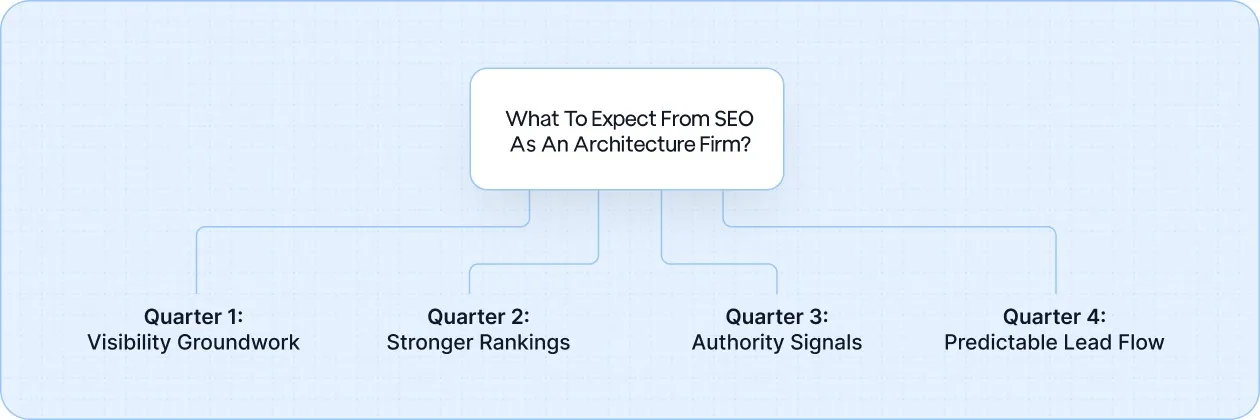
Quarter 1 (Months 1–3)
In the first few months, results are more “signal” than volume. You’ll start seeing signs that search engines are understanding your firm better, even if leads haven’t surged yet.
What you can expect:
- Your website pages begin appearing for more relevant search terms, especially branded searches and early service queries.
- Local visibility starts improving through your Google Business Profile, meaning you may show up more often for “architect near me” or “architect in [area]” searches.
- Traffic becomes slightly more targeted, with visitors spending longer on key service and portfolio pages.
- Enquiries may remain steady, but you’ll often notice better-fit prospects because the site is clearer about what you do.
Quarter 2 (Months 4–6)
This is where momentum starts becoming noticeable. Search engines have had time to crawl, index, and test your pages, and your firm begins appearing more often in meaningful searches.
What you can expect:
- Service pages start moving higher for priority terms like “residential architect in [city]” or “commercial architect for [project type].”
- Your portfolio and project pages begin driving discovery, especially for searches tied to style, location, and project type.
- You may start receiving more “informed” enquiries, where clients reference a specific project or service page they found.
- Website traffic becomes more stable rather than coming in small bursts.
Quarter 3 (Months 7–9)
By this stage, SEO starts working less like visibility and more like positioning. You’re not just being found, you’re being evaluated and shortlisted.
What you can expect:
- Your firm begins ranking for more competitive local searches, including project-specific and style-driven queries.
- You’ll see more mid-to-high intent searches bringing visitors in, such as “architect for home extension [area]” or “modern house architect [city].”
- Enquiries become more aligned with your ideal work, because your visibility is improving in the exact categories you want to be known for.
- Referral-style trust increases, where prospects already feel familiar with your work before the first call.
Quarter 4 (Months 10–12)
This is when SEO starts compounding. You are no longer dependent on constant posting or short-term boosts. Your website becomes a consistent entry point for new client conversations.
What you can expect:
- More consistent enquiries month to month, including clients who are ready to discuss timelines, budgets, and next steps.
- Better quality leads overall, with fewer “price shoppers” and more serious project enquiries.
- Increased branded search demand as more people look up your firm by name after discovering you through SEO.
- Your portfolio begins acting like an asset that keeps bringing in leads long after a project is complete.
Common SEO Mistakes to Avoid
Most SEO problems don’t come from doing nothing. They come from doing the wrong things consistently, usually because they look productive on the surface.
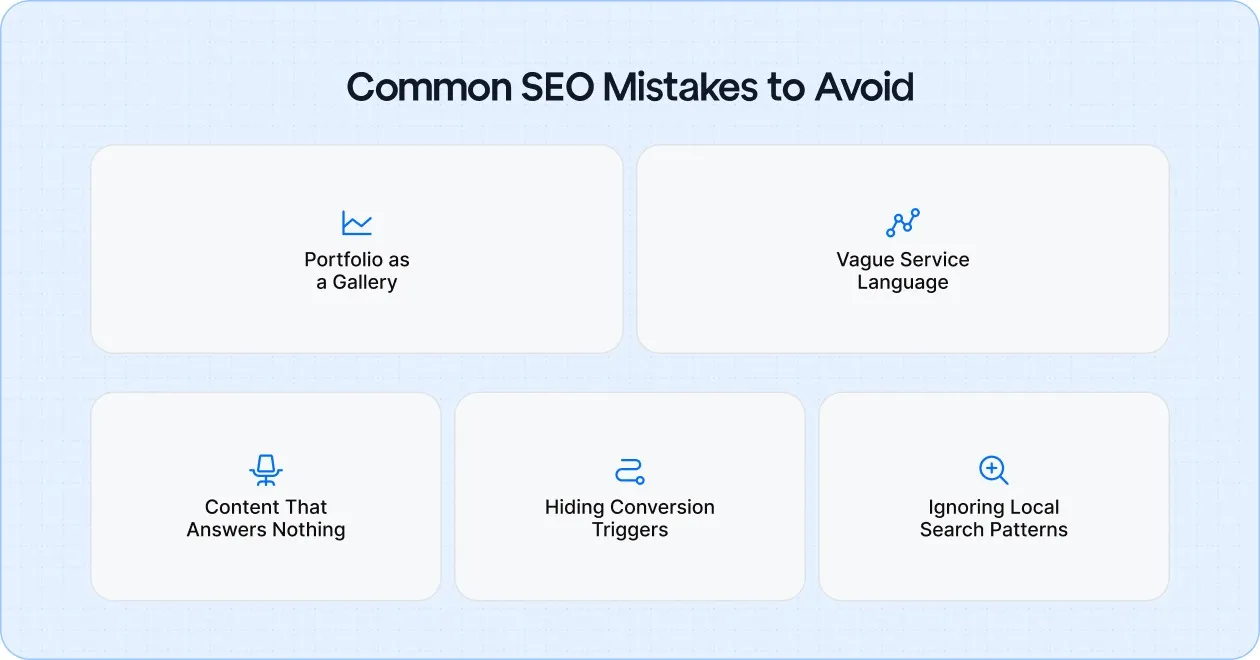
These mistakes are especially common in architecture websites:
Treating The Portfolio Like A Gallery
A beautiful grid of images may impress visitors, but search engines need context. If your projects have no written detail, Google has very little to rank.
What goes wrong:
- Project pages stay invisible because there’s no text to understand the work
- You miss out on searches tied to project type, style, and location
- Your best work never contributes to organic discovery
Using Vague Service Language
Many architecture sites rely on broad phrases like “design excellence” or “tailored solutions.” These don’t help SEO, and they don’t help clients choose you either.
What goes wrong:
- Visitors can’t quickly tell what you actually specialise in
- Your site fails to connect with high-intent searches
- Enquiries become random instead of aligned with your ideal work
Publishing Content That Sounds Smart But Answers Nothing
Thought leadership only works when it is useful. Blog posts that stay abstract or opinion-heavy rarely earn rankings, links, or enquiries.
What goes wrong:
- Pages get no traction because intent is unclear
- Readers leave without learning anything concrete
- Content becomes something you “have,” not something that performs
Hiding Conversion Triggers Behind Minimal Design
Many architecture sites prioritise minimal layouts so heavily that it becomes hard to take action. If someone is ready to reach out, they should not have to search for how.
What goes wrong:
- Strong-fit prospects drop off before enquiring
- You lose leads to firms with simpler contact paths
- Site traffic rises without improving business outcomes
Ignoring How People Actually Search For Architects Locally
Clients rarely search for “award-winning studio.” They search by location, project type, and urgency.
What goes wrong:
- Your site attracts visitors who are curious but not ready
- You miss local discovery opportunities
- Competitors with less impressive work but clearer location relevance win visibility
Conclusion
SEO, when done well, becomes part of how an architecture firm grows into its next phase.
It creates continuity. Past projects keep working for you. Service pages stay relevant as markets shift. New clients arrive already familiar with your approach, because they found clarity.
Over time, this changes the quality of conversations you have. Architect SEO is about building a presence that reflects the depth of your work and supports steady, sustainable growth, even as search behavior and technology continue to evolve.
Ready to Get Found With Clarity
Build an SEO system that reflects your work, supports referrals, and attracts better-fit projects.
Book A Consultation

“For the first time, we’re proud to add SEO services. Six months in, impact evident.”
Read Case Study

In Conversation with

Abhijith HK
Founder & CEO of Codewave
Want us to do the same for your business?
Talk to an Expert
.svg)
.svg)

