


Home

Resources
Blogs
Blog
Get insights on AI, productivity, and the future of work.


Thank you! Your submission has been received!
Oops! Something went wrong while submitting the form.

SEO
Jan 20, 2026
5 mins
Don’t Miss These Manufacturing SEO Companies Driving Growth in 2026
Percy Brown
The manufacturing industry today is more competitive than ever, and generating consistent quality leads has become a significant challenge.
With long sales cycles, technical products, and buyers who research for months, small- to medium-sized manufacturers often struggle to keep their pipelines full. Relying on cold calls, referrals, seasonal trade shows, or scattered marketing efforts isn’t enough anymore.
To grow predictably, you need a partner who understands manufacturing and prioritizes qualified leads, not vanity SEO.
To help you choose the right partner, here are the top 15+ manufacturing SEO companies for 2026–27, reviewed for their industrial expertise, lead-generation capabilities, and proven results.
Ask These Questions Before You Choose The SEO Companies
Choosing an SEO partner is difficult, especially when many agencies offer generic, one-size-fits-all services. Use these questions to filter out agencies that don’t understand industrial markets:
Ask your SEO companies the following questions:
~47,000 manufacturing searches happen daily. Are you visible?
15+ Manufacturing SEO Companies Right Now
#1. Gushwork
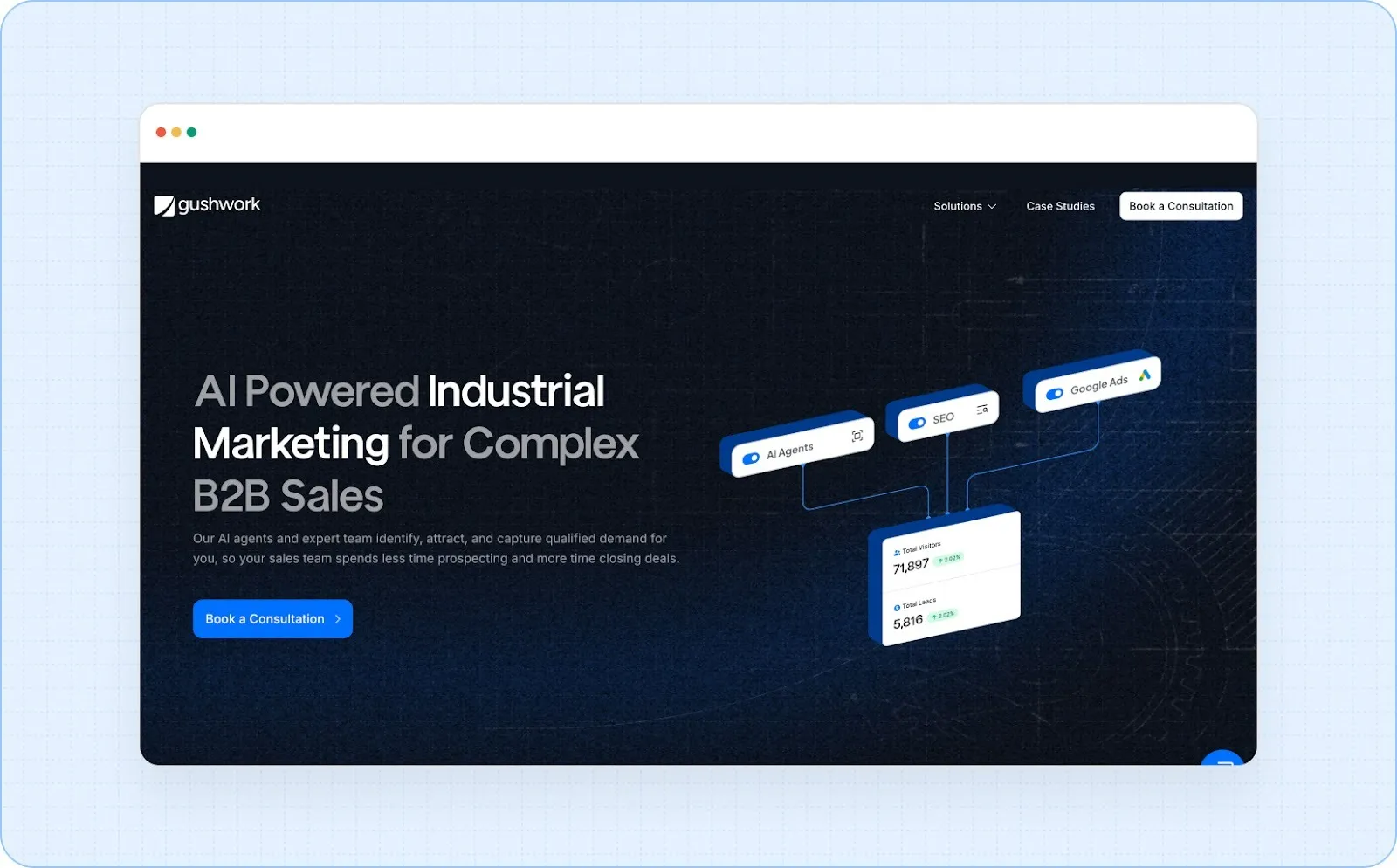
Best for: Small to mid-market manufacturers who need consistent lead generation beyond trade shows and referrals.
Why Gushwork: They are an end-to-end content engine that ranks your pages, attracts traffic, and converts buyers. They create informative web pages with high-value content designed for real buyer intent. With multi-source visibility, your brand pulls attention from diverse channels, not just search. They are conversion-focused, turning traffic into qualified leads and measurable growth.
Typical client profile: Manufacturing companies across all industrial sectors, component suppliers, industrial equipment manufacturers, contract manufacturers, fabricators, distributors, food manufacturers, and specialty manufacturers who need predictable monthly lead generation, or businesses planning major website changes with better search traffic.
Core strengths:
- Manufacturing-specific content strategy: Create technical content that answers the specific questions engineers ask during problem-solving, not generic "manufacturing SEO services" pages.
- Qualified lead focus: Measures success by leads, not vanity metrics like total traffic or clicks.
- Custom websites & landing pages: Designs and builds websites and landing pages from scratch.
- Speed and Accuracy: Gushwork’s AI SEO agents can generate 400+ SEO optimized pages in 4-6 weeks. So you start getting leads by Month 3.
- Tools and data: Gushwork’s AI SEO agents provide the best SEO tools for manufacturers, with real-time data (available anytime) and lead-tracking options.
Proven results: 17 leads in 30 days
Founded: 2023 | Team size: 51-200 employees | Pricing: $699/month onwards | Location: Global (HQ - Delaware, US)
#2. Searchbloom
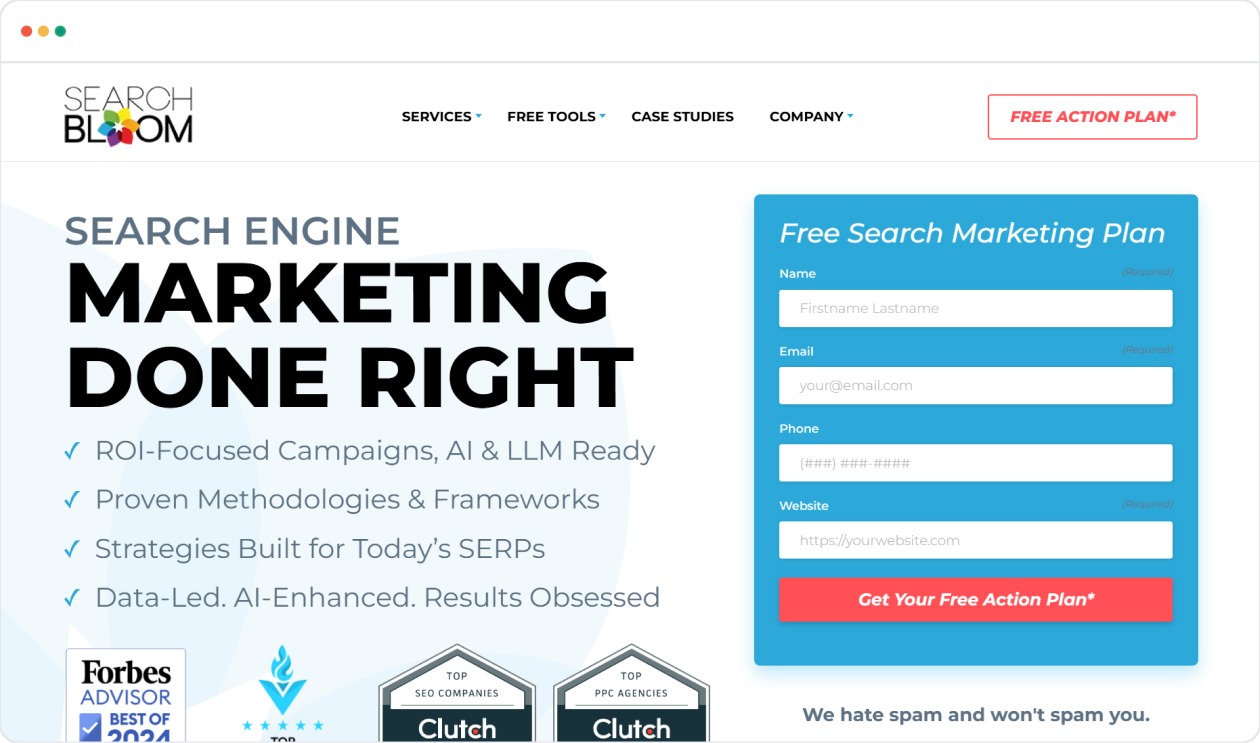
Best for: Manufacturers needing high-performance technical SEO, strong PPC programs, and ROI-focused campaigns.
Typical client profile: Industrial companies, e-commerce manufacturers, and engineering-led product firms.
Core strengths:
- Excellent technical SEO: They fix website issues like broken links, slow pages, and poor structure. This ensures your site ranks higher on Google and attracts more relevant traffic.
- Conversion optimization: They design content and web pages to guide visitors toward taking action. This helps turn casual visitors into qualified leads for your business.
- Transparent reporting: They provide reports showing traffic, leads, and campaign performance. You always know what’s working and where to improve.
- Custom strategies: They create SEO and PPC plans tailored to your company’s goals and industry. This ensures every effort drives measurable growth and ROI.
Proven results: 161% Increase in Revenue
Founded: 2014 | Team size: 50–100 | Pricing: $100–$149/hr | Location: Draper, Utah
#3. SmartSites
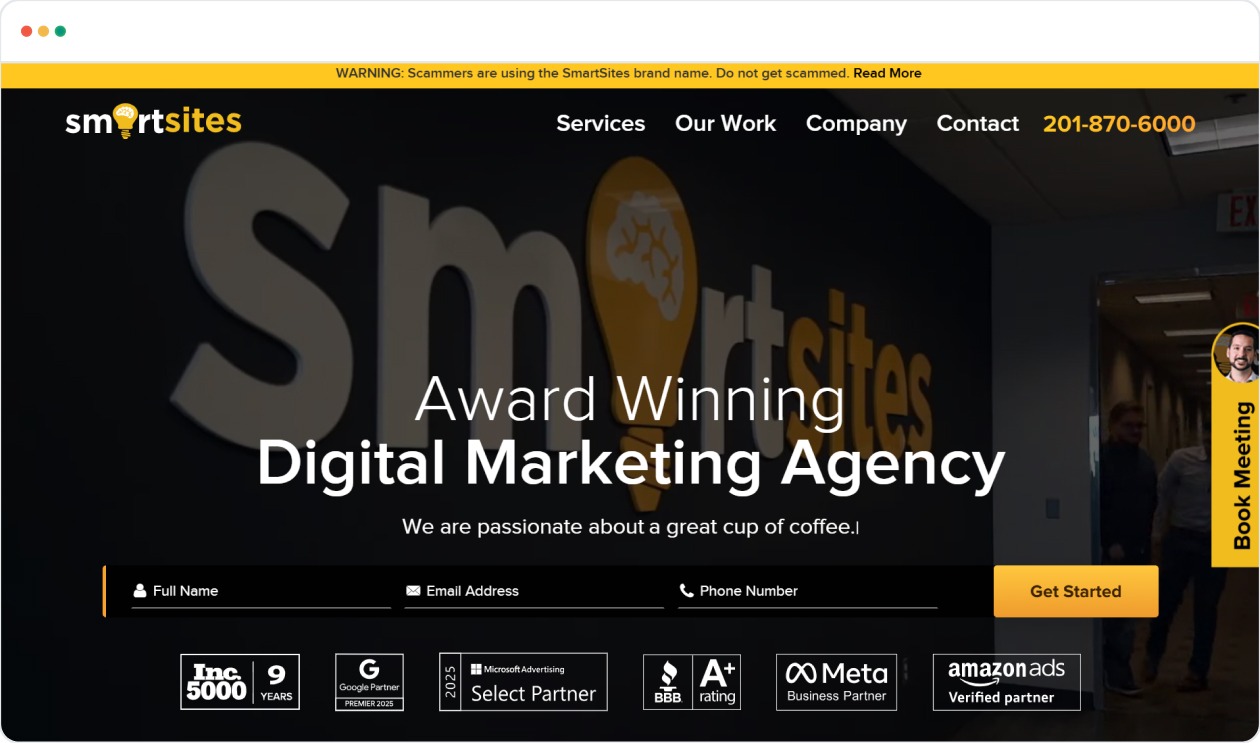
Best for: Manufacturers who need fast execution, strong SEO foundations, and data-driven paid advertising to accelerate lead generation.
Typical client profile: Small-to-mid-sized manufacturers, component suppliers, fabrication shops, industrial distributors, and engineering-led businesses looking for SEO + PPC + website optimization under one roof.
Core strengths:
- SEO + PPC synergy for broader visibility: SmartSites offers tightly integrated SEO and paid search campaigns, helping manufacturers dominate competitive keywords and capture buyers at multiple stages of the evaluation cycle.
- Fast, conversion-focused website development: Their team specializes in building clean, responsive industrial websites optimized for RFQ submissions, catalog browsing, and technical content consumption.
- Data-driven approach with transparent reporting: Every campaign includes detailed tracking dashboards showing traffic quality, keyword movement, conversion paths, and cost-per-lead — ideal for manufacturers who need measurable ROI.
- Strong experience in industrial B2B sectors: SmartSites has delivered results for machining companies, industrial e-commerce brands, metalworking suppliers, and heavy-equipment distributors.
Founded: 2011 | Team size: 300+ | Pricing: From $2,000–$3,500/month | Location: Paramus, NJ
Proven Results: 110% Increase in Site Organic Traffic
#4. Outerbox
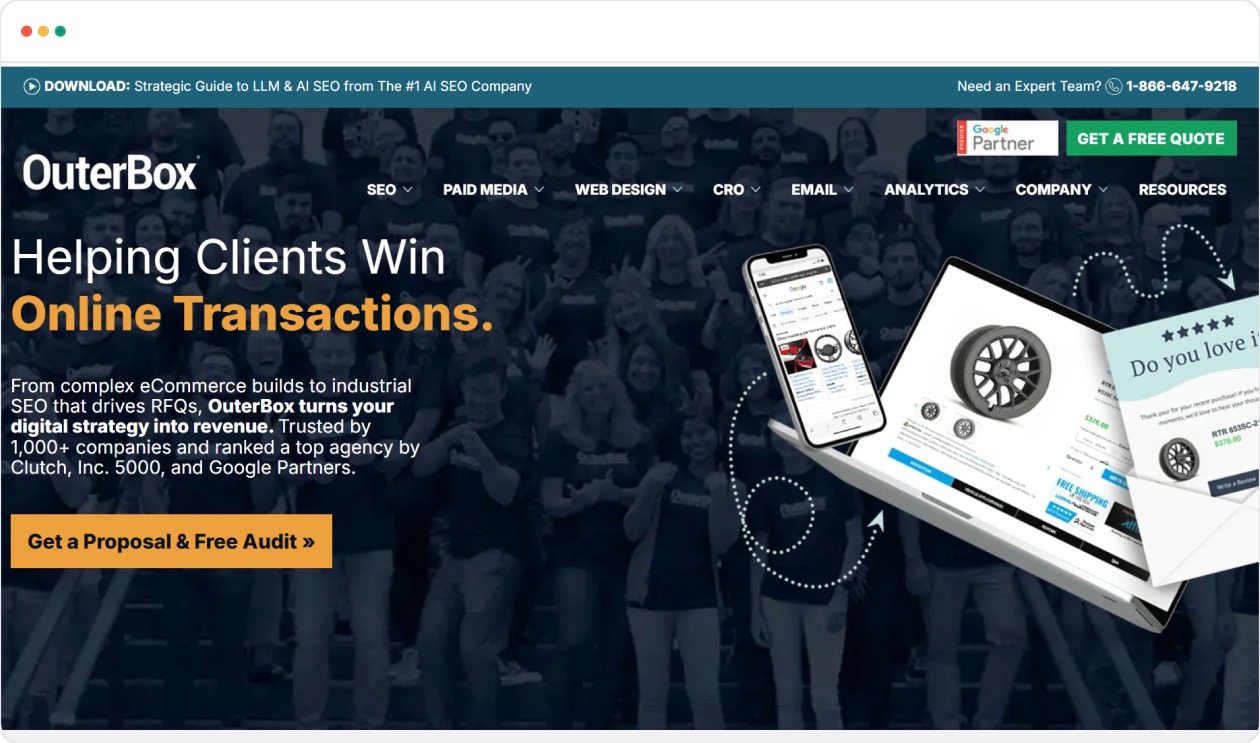
Best for: Manufacturers who need a potent combination of SEO, PPC, and e-commerce experience.
Typical client profile: B2B manufacturing brands, industrial e-commerce shops, and equipment suppliers.
Core strengths:
- Strong SEO for product-heavy sites
- Website development + UX
- E-commerce-first approach
- Proven results in technical industries
Founded: 2004 | Team size: 80–150 | Pricing: $150–$199/hr | Location: Copley, Ohio
Proven results: 105% Increase in Organic Revenue
#5. First Page Sage
Best for: Large manufacturers who want to build industry authority and credibility over time. They create content that positions manufacturing companies as experts in their field.
Typical client profile: Established manufacturers. Their clients often supply Fortune 500 companies and need to demonstrate expertise to justify premium positioning in competitive markets.
Core strengths:
- Manufacturing-specific content expertise: They hire writers who understand manufacturing processes and pair them with SEO strategists experienced in technical keyword research
- Thought leadership positioning: Focus on establishing clients as industry authorities, not just generating traffic
Founded: 14 years in business | Team size: 100-250 employees | Pricing: Custom (not publicly listed) | Location: San Francisco, CA
Proven Results: 5x Improvement in Visitor-to-Lead Conversion Rate
#6. Outpace

Best for: Automotive and aviation manufacturers who need technical SEO expertise and data-driven results. They combine computer science expertise with marketing strategy.
Typical client profile: Manufacturing companies in automotive and aviation that operate in regulated industries where accuracy is important.
Core strengths:
- Technical precision: Computer scientists on staff who understand search algorithms and can adapt strategies with time
- Measurable results: Focus on concrete metrics like keyword rankings and click-through rates rather than vanity metrics
- Continuous optimization: They test and refine strategies based on performance data, not assumptions
Founded: 2020 | Team size: 11-50 employees | Pricing: From $2,500/month | Location: Oklahoma City, OK
Proven Results: 142% Increase in Non-branded Clicks
#7. WebFX
Best for: Mid- to large-sized manufacturers that need a full-service SEO and a PPC partner with strong reporting and enterprise-level execution.
Typical client profile: Industrial brands, component makers, and B2B companies needing scalable SEO and paid acquisition.
Core strengths:
- Strong SEO + PPC integration: Their campaigns blend organic and paid strategies, which helps manufacturers dominate high-intent SERPs.
- Proprietary tech suite for reporting and ROI tracking: WebFX uses a custom platform called MarketingCloudFX that gives manufacturers real-time visibility into lead sources, ROI attribution, call tracking, and keyword performance.
- Large in-house team for complex industrial websites: With 500+ specialists, they can handle large-scale SEO executions — including multi-location manufacturing, product catalogs, CNC/machining sites, ERP-integrated sites, and highly technical pages.
- Proven manufacturing track record: WebFX has extensive experience with metal fabrication companies, industrial manufacturers, material suppliers, and B2B OEMs.
Founded: 1996 | Team size: 500+ | Pricing: From $3,000/month | Location: Harrisburg, PA
Proven Results: 60% increase in Quote Requests
#8. Windmill Strategy
Best for: Established manufacturers who need complete digital marketing solutions, not just SEO services. They handle multiple aspects of digital marketing, including SEO, web design, and marketing automation.
Typical client profile: Mid-to-large manufacturing companies ($10M+ revenue) in automotive, industrial automation, and robotics who want to overhaul their entire digital marketing approach.
Core strengths:
- Manufacturing-specific expertise: Windmill has built its content and digital strategies based on real engineering workflows, such as problem-solving queries, compliance considerations, application-based searches, and long evaluation cycles typical in industrial buying.
- Holistic digital strategy: Instead of isolated SEO tasks, Windmill aligns SEO, web design, UX, and marketing automation into a single conversion-focused system.
- High-performance website rebuilds: They are known for turning outdated industrial websites into modern, technically strong platforms with improved navigation, better product categorization, and content structures that match how engineers research solutions.
- Deep understanding of niche industrial markets: Windmill works with robotics, automation, aerospace components, testing equipment, SaaS for industrials, and manufacturing sub-industries where technical accuracy is critical.
Founded: 2006 | Team size: 11-50 employees | Pricing: From $4,500/month | Location: Global (HQ - Minneapolis, MN)
Proven Results: 63% Increase in Form Submissions
#9. Victorious
Best for: Manufacturers who want an SEO specialist agency with award-winning processes and measurable results.
Typical client profile: High-growth B2B manufacturers, industrial tech companies, and technical product makers.
Core strengths:
- Award-winning SEO methodologies
- Strong link-building and content optimization
- Transparent workflows
- Enterprise-level execution
Founded: 2013 | Team size: 100–200 | Pricing: From $5,000/month | Location: Louisville, Colorado
Proven Results: Search Visibility to Leads
#10. SALT.agency
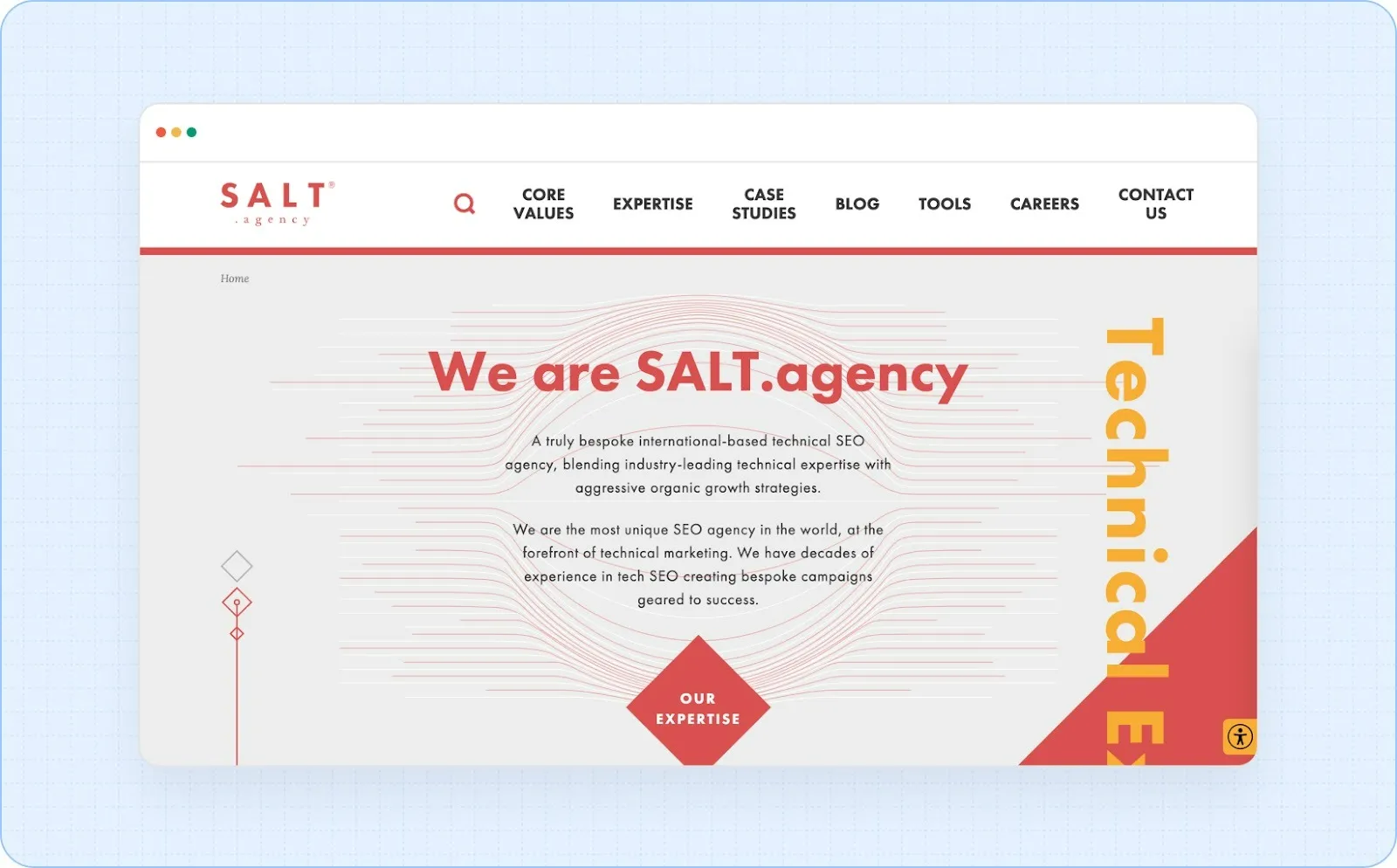
Best for: Global manufacturers with complex website problems or international SEO needs. SALT.agency specializes in fixing technical SEO problems.
Typical client profile: Large manufacturers with websites in multiple countries, companies that have lost search traffic.
Core strengths:
- Proprietary diagnostic tools: They've developed specialized tools like Hreflang Checker and Server Log File Analyzer that identify technical issues other agencies miss
- Crisis management expertise: Specialists in Google penalty removal and fixing traffic drops that can devastate manufacturing companies
- International SEO mastery: Expert at managing complex multi-country SEO for manufacturing companies with global operations
- Large-scale technical projects: Proven ability to handle website migrations while maintaining search rankings
Founded: 2014 | Team size: 11-50 employees | Pricing: Custom (not publicly listed) | Location: Leeds, UK, with London and Boston offices
Proven Results: 44% Increase in User Registrations
#11. Sixth City Marketing
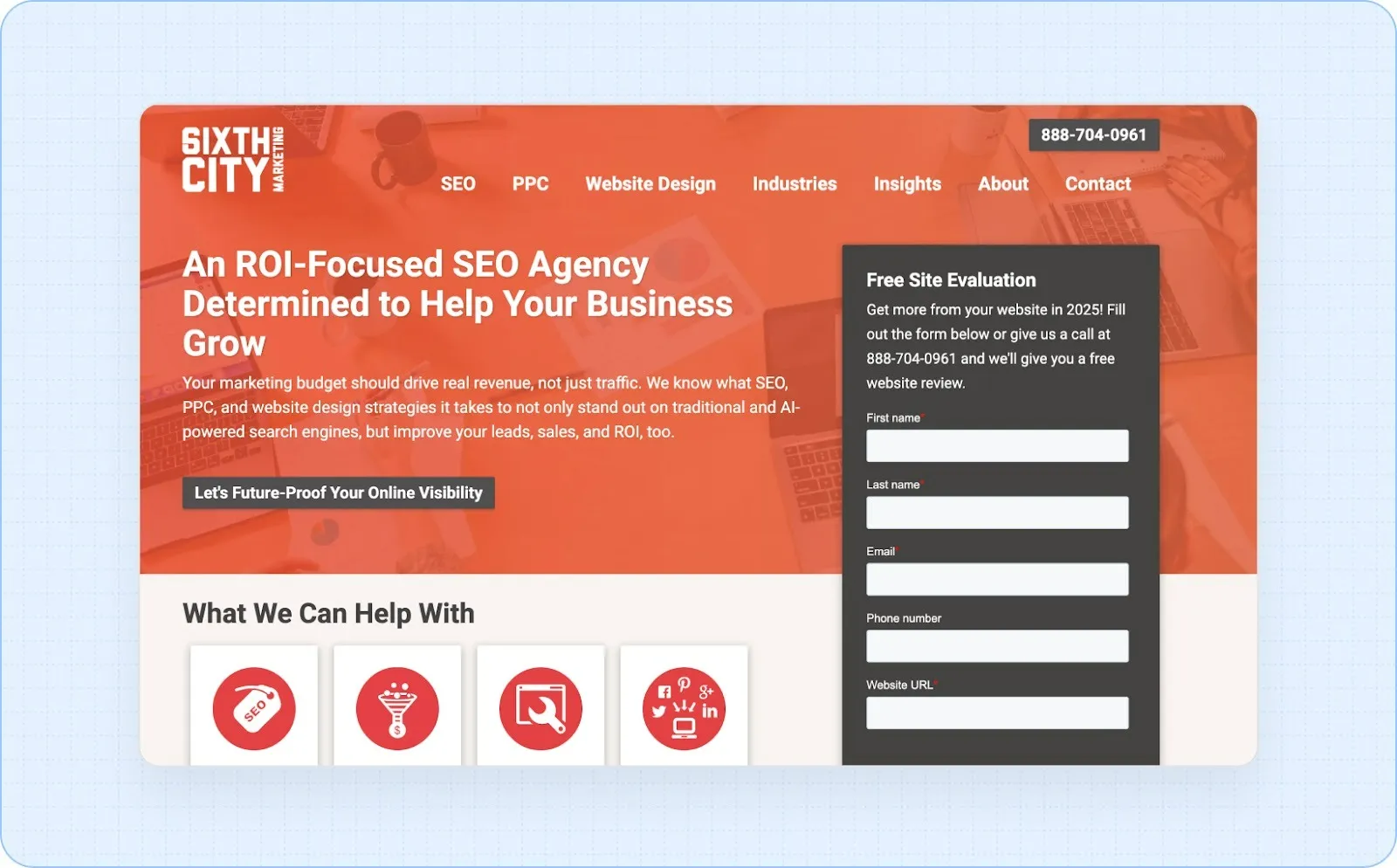
Best for: Mid-market manufacturers whose websites get visitors but don't generate enough leads. They focus on improving website conversion rates alongside SEO.
Typical client profile: Engineering and industrial companies with websites that receive traffic but struggle to convert visitors into qualified leads.
Core strengths:
- Hands-on conversion optimization: They analyze which pages convert and optimize the entire buyer journey
- Manufacturing-specific user experience: Understanding that industrial buyers need detailed technical information presented in a logical, searchable format
- Proven lead generation results: Demonstrated success with companies like TYKMA Electrox, where they drove significant increases in inbound leads from organic search
Founded: 2010 | Team size: Not specified | Pricing: From $5,000/project | Location: Cleveland, OH
Proven Results: 314% Improvement in Monthly Leads
#12. Thrive Agency
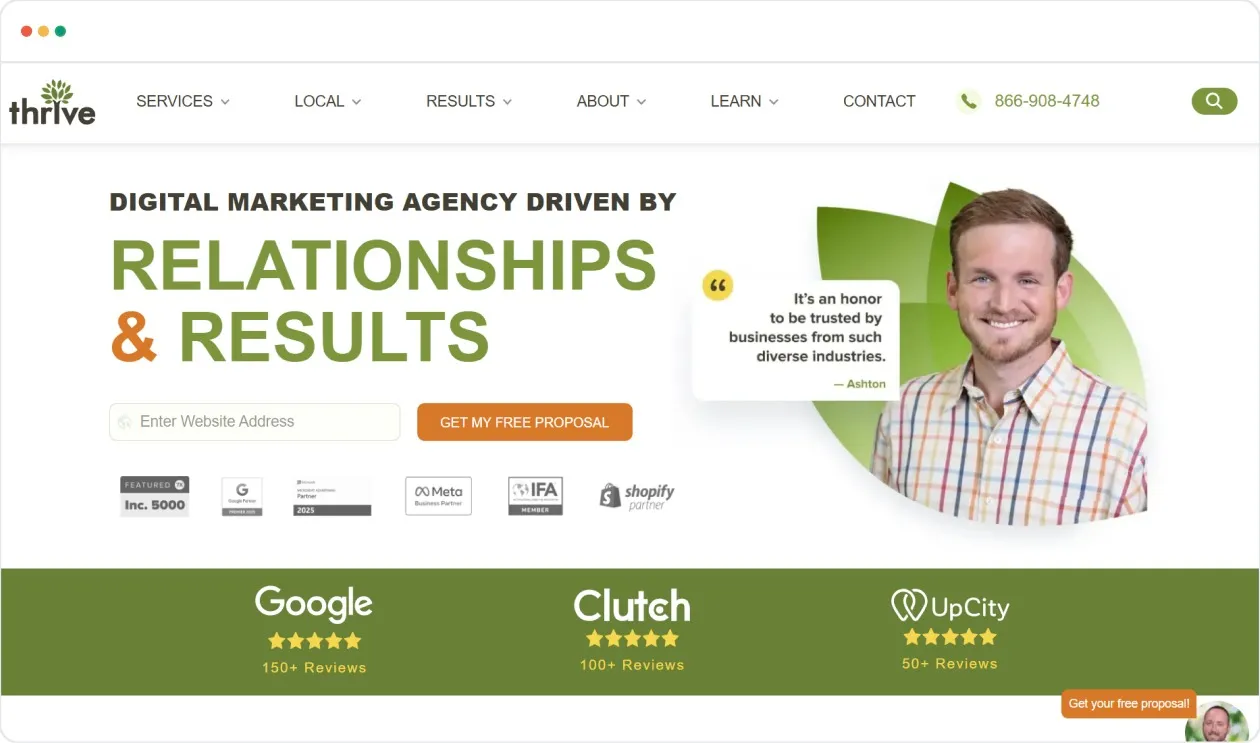
Best for: Manufacturers looking for a balanced SEO, PPC, and website design solution with hands-on support.
Typical client profile: Small to mid-market manufacturing and industrial service companies needing digital marketing.
Core strengths:
- SEO and PPC campaigns designed for industrial buyers
- Strong website design capabilities
- Multi-channel approach (SEO, PPC, social)
- Clear communication and client onboarding
Founded: 2005 | Team size: 200+ | Pricing: $100–$149/hr | Location: Arlington, Texas
Proven Results: 11K+ New Website Users
#13. Kula Partners
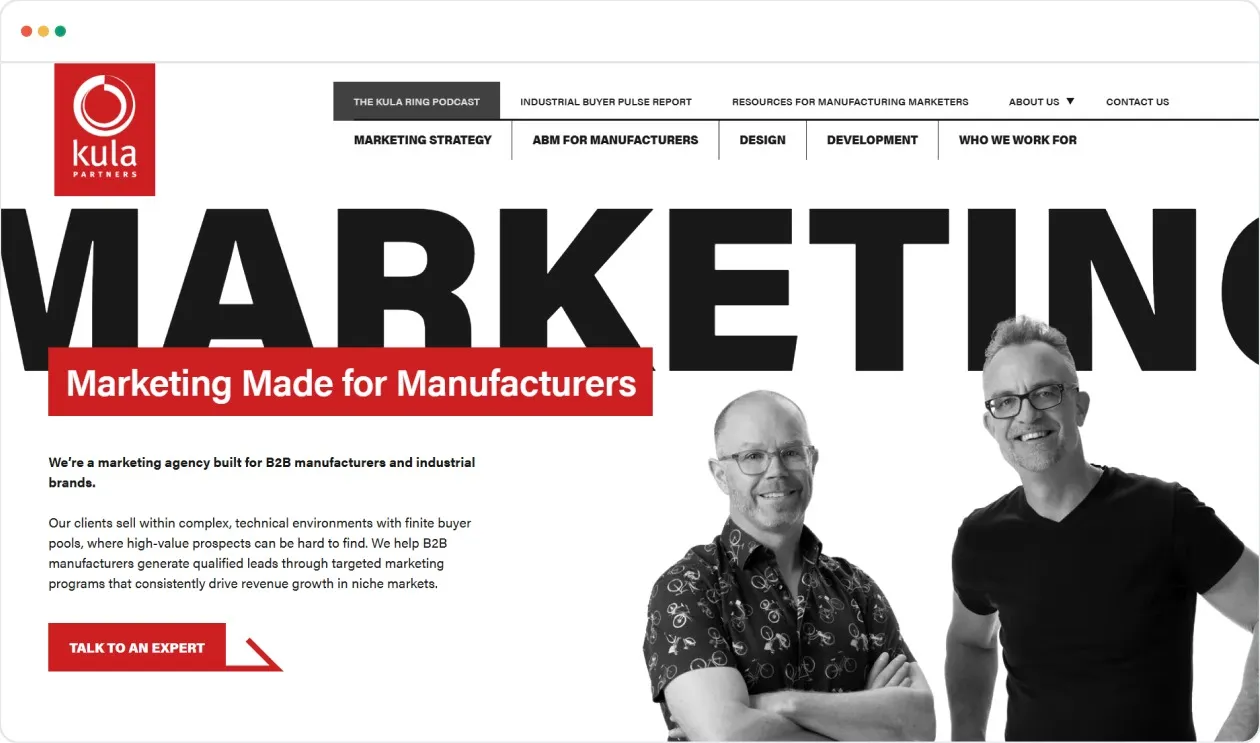
Best for: B2B manufacturers with complex offerings who need premium content, SEO, and high-performance websites.
Typical client profile: Mid-market and enterprise manufacturers, engineering firms, and industrial product companies.
Core strengths:
- Deep B2B manufacturing expertise
- Well-structured content and SEO programs
- Strategic website redesigns
- Strong alignment with complex sales cycles
Founded: 2004 | Team size: 25–50 | Pricing: Custom | Location: Halifax, Nova Scotia
Proven Results: Qualified Leads through targeted marketing
#14. Industrial Strength Marketing
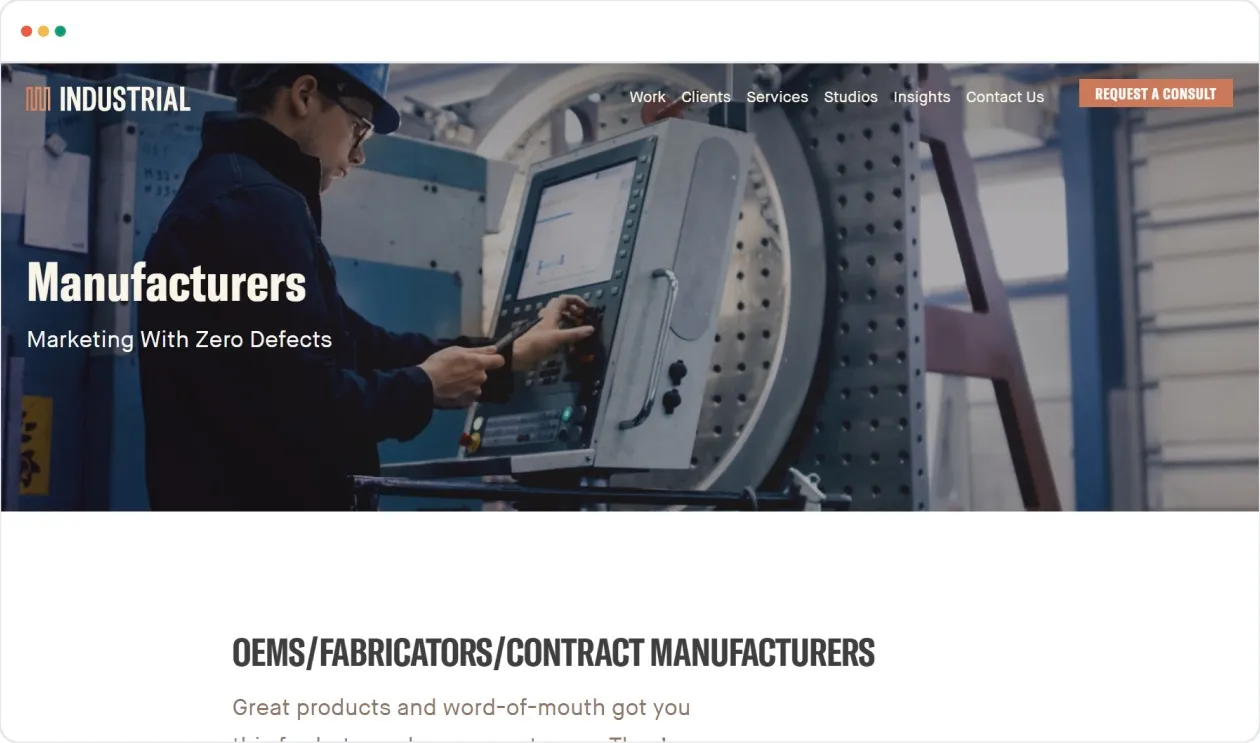
Best for: Traditional manufacturers who need branding + integrated marketing along with digital SEO services.
Typical client profile: OEMs, industrial suppliers, component manufacturers, and companies with outdated marketing systems.
Core strengths:
- Strong industrial branding + positioning
- Integrated marketing across digital and offline
- Sales enablement + marketing automation
- Experience with complex B2B industrial workflows
Founded: 2003 | Team size: 30–60 | Pricing: Custom | Location: Nashville, Tennessee
Proven Results: 200% Growth in Revenue in 1 year
#15. Skale
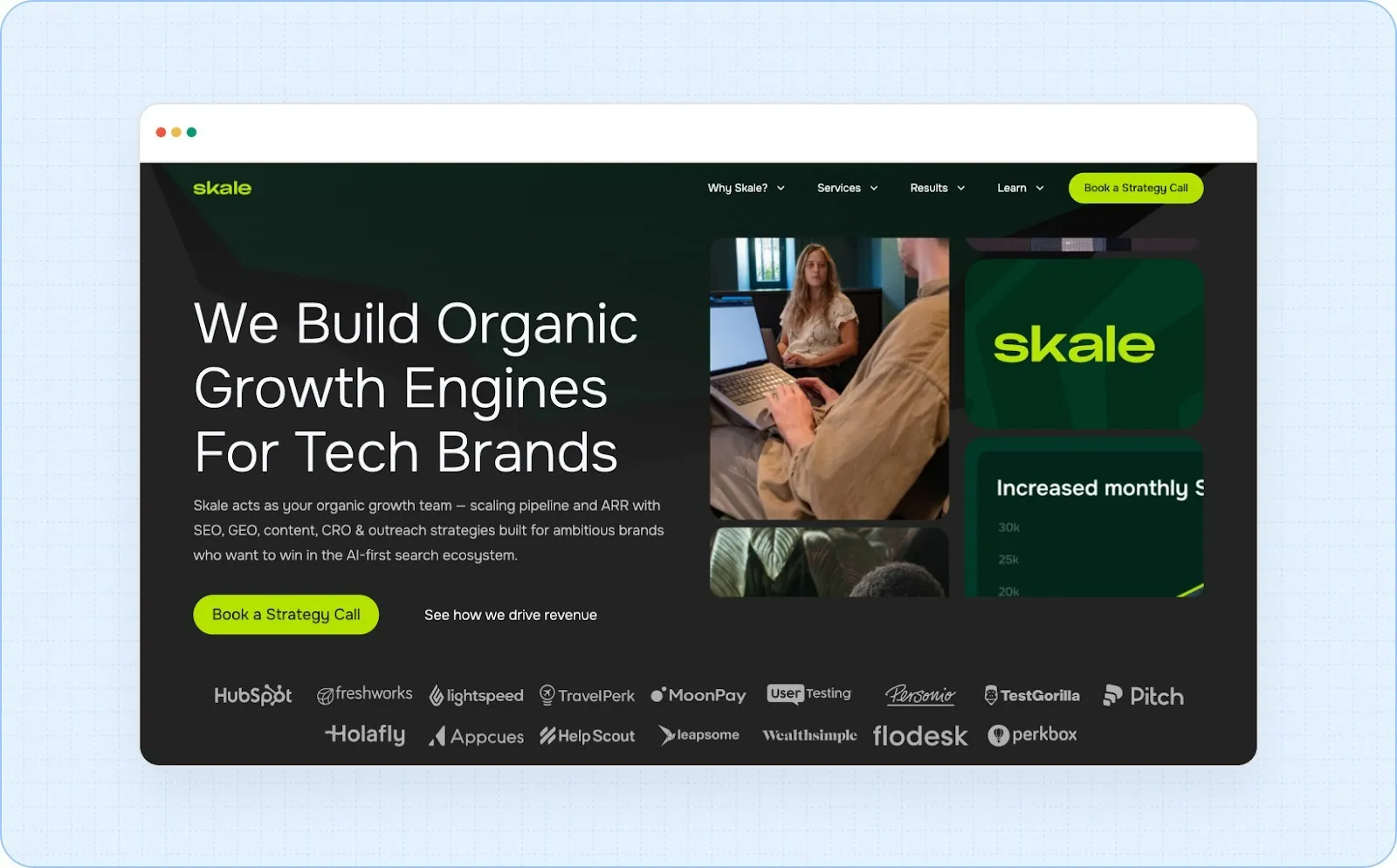
Best for: Manufacturing companies with complex websites that have technical SEO problems. They focus on SEO and technical issues rather than just creating content.
Typical client profile: Mid-to-large manufacturers (typically $10M+ revenue) with sophisticated websites, extensive product lines, and technical SEO challenges that require expertise.
Core strengths:
- Technical website optimization: They excel at cleaning up the messy technical issues that slow down complex manufacturing websites with thousands of product pages
- Strategic link building: In manufacturing, backlinks are about establishing authority. Skale focuses on earning links from credible industry sources that actually matter to your buyers
- Strategy-first execution: They don't just hand you a list of fixes and disappear. They work with you to implement, test, and adapt their recommendations
Founded: 2020 | Team size: 51-200 employees | Pricing: From $4,500/month | Location: Global (London, UK - HQ)
Proven Results: 86% Increase in Revenue in 18 Months
#16. Brandpoint
Best for: Manufacturers who need strong content marketing, PR, and brand storytelling integrated with SEO.
Typical client profile: Manufacturing companies prioritizing thought leadership, PR visibility, and content-driven branding.
Core strengths:
- High-quality content creation
- PR + media amplification
- Graphic design + branded assets
- Strong for top-of-funnel visibility
Founded: 1996 | Team size: 100–150 | Pricing: Custom | Location: Hopkins, MN
Proven Results: Sustainable B2B Thought Leader
#17 Gorilla 76
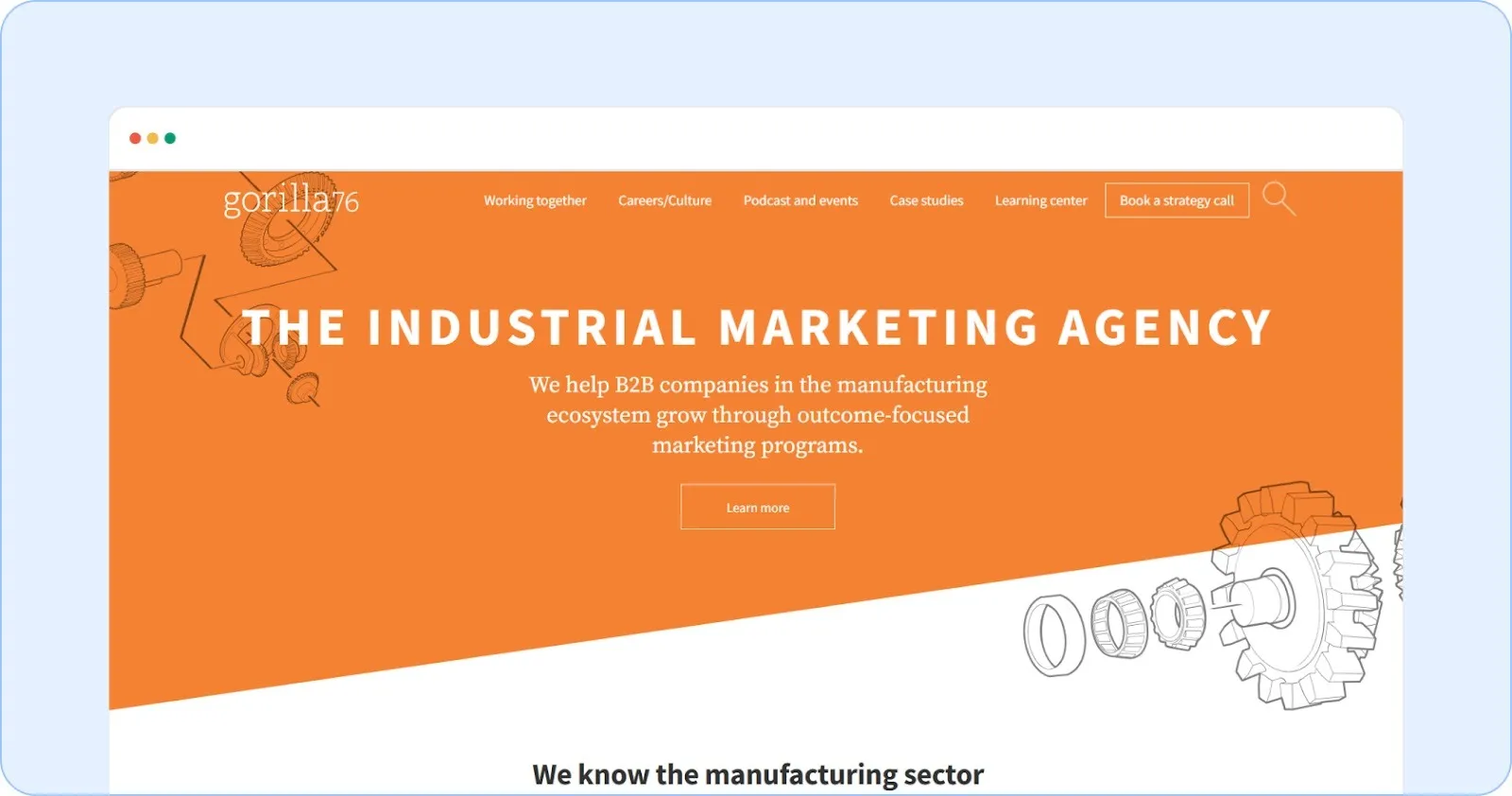
Best for: Manufacturers who need a full-service, industrial-market savvy agency that blends content, web, and demand-generation marketing tailored for complex B2B sales.
Typical client profile: Mid-sized B2B manufacturers like, OEMs, custom machine builders, robotics integrators, contract manufacturers and other industrial firms selling customized or complex solutions.
Core Strengths:
- High-impact industrial content & messaging
- Website design & full-funnel web infrastructure
- Demand generation & target-account marketing
- Outcome-driven, ROI-focused campaigns
Founded: 2006 | Team Size: 100-150 | Pricing: $10,000/per month | Location: St. Louis, MO, USA
Proven Results: 92 Qualified Leads in 1 year
#18 SEO.COM
Best for: Businesses (including B2B and industrial firms) that want a full-service SEO + digital marketing partner with deep experience, data-driven approach and a track-record in generating real revenue.
Typical client profile: Companies seeking scalable, performance-oriented SEO/digital marketing — from SMBs to larger enterprises — who value measurable ROI, comprehensive SEO (on-page, off-page, technical), and marketing automation rather than one-off fixes.
Core strengths:
- Full-spectrum SEO (technical, on-page, off-page)
- Strong data + analytics foundation
- Transparent reporting and clear deliverables
- Integrated digital marketing beyond SEO
Founded: 1995 | Location: Harrisburg, PA | Pricing: Custom
Proven Results: 131% More Form Submissions
#19. Straight North
Best for: Businesses (B2B or B2C) that want a full-service, data-driven digital marketing agency focused on generating qualified leads and revenue — not just traffic.
Typical client profile: Small to mid-market and mid-sized firms (including manufacturers) looking for transparent, ROI-focused SEO, PPC, web design and lead-generation support.
Core strengths:
- Full-spectrum SEO (local, national, e-commerce, enterprise)
- Proprietary lead-tracking and real-time reporting
- Integrated services across SEO, PPC, and web design
- Customized strategies tailored to industry and revenue goals
Founded: 1997 | Location: Downers Grove, IL | Pricing: Custom
Proven Results: 160% Organic Leads
How to Evaluate a Manufacturing SEO Company
Before you pick an agency, use the Reddit example below as a reference; this is the level of clarity, honesty, and practicality you should expect from the US SEO companies you hire.
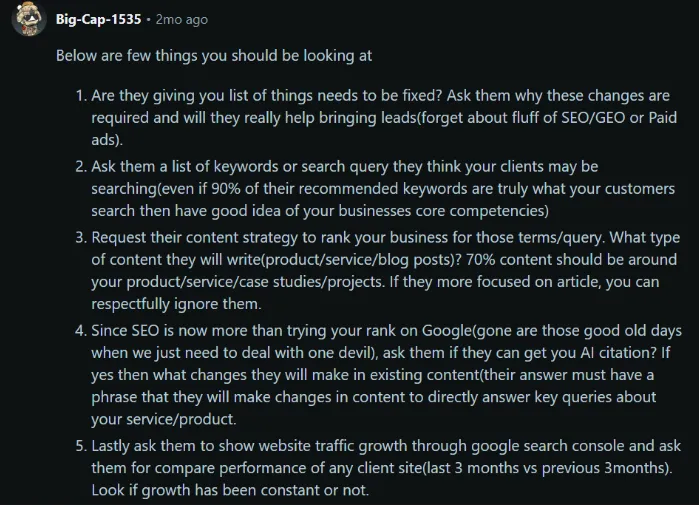
Any SEO company for manufacturers that struggles to answer these questions isn’t the right partner for your business.
Here’s a practical checklist, based on real buyer experience, to help you separate true Manufacturing SEO specialists from generic SEO vendors.
How to Choose the Right Manufacturing SEO Company in 2026
Not every manufacturing SEO company offers the same depth of expertise. Many industrial SEO agencies label themselves as full-service or best-rated, but manufacturers should evaluate them differently from SaaS or ecommerce brands.
Manufacturing SEO focuses on complex buyer journeys, technical specifications, distributor searches, and long sales cycles. A generic SEO agency for manufacturing may handle rankings, but a true manufacturing marketing agency understands:
- Industrial search behavior
- Product-driven and application-based keywords
- B2B lead qualification through content and site structure
This distinction sets manufacturing SEO experts apart from general SEO optimization companies.
What Manufacturing SEO Services Should Actually Include
When reviewing industrial marketing services, look for:
- Search engine optimization for manufacturing companies and industrial products
- Content built for engineers, procurement teams, and plant managers
- Manufacturing search engine optimization tied to revenue, not traffic
- Experience across industries like industrial equipment, components, or food manufacturing
A strong manufacturing SEO strategy matters more than claims like "number one SEO company" or "top-rated SEO."
A top SEO agency list is available, helping manufacturers compare manufacturing SEO agencies, industrial SEO marketing agencies, and SEO consultants side by side.
Instead of chasing the No. 1 SEO company, focus on fit: industry experience, process clarity, and measurable outcomes.
Why “Best SEO Agency” Lists Exist in the Market?
“Best SEO agency” lists exist because SEO buyers, especially manufacturing companies, face high information risk. Most manufacturers don’t run SEO in-house, so these lists act as a shortlisting tool, not a final decision-maker.
For manufacturers, evaluating SEO services upfront is challenging. Results take time, terminology is technical, and agency offerings often sound similar. Lists help reduce uncertainty by grouping agencies by experience, industry focus, and visible outcomes.
In the manufacturing space, these lists also serve a second purpose: industry filtering. A general best SEO agency may not understand industrial buying cycles, distributor-driven demand, or technical product content. Lists focused on manufacturing or industrial SEO help buyers identify firms that specialize in these areas.
Finally, such lists exist because “best” is subjective. The right SEO agency depends on company size, sales complexity, geography, and growth stage. These rankings provide market context, while manufacturers still need to assess fit, process, and long-term alignment.
Why Manufacturing SEO Is Different From Regular SEO
Manufacturing buyers don’t search like everyday consumers. That’s why the best manufacturing SEO agencies use a very different approach compared to generic SEO vendors.
- Buyers search with technical intent: Engineers and procurement teams use precise terms — materials, tolerances, processes, certifications. Effective manufacturing SEO focuses on these low-volume, high-intent keywords that bring real projects.
- SEO content must speak to engineers: A good SEO agency for manufacturers knows how to turn capabilities, machine lists, and case studies into clean, technical pages. No fluff. No generic blogs. Just practical information buyers trust.
- The research cycle is long and detailed: Manufacturing customers compare specs, past work, and capacity before submitting a form. Strong SEO strategy supports this journey with clear service pages, real examples, and accurate capabilities.
- Success is measured in leads, not traffic: High traffic means nothing if the right people don’t convert. Great SEO for industrial companies tracks qualified leads, quote requests, consultation bookings, or sample requests.
- Industry fluency matters: Generic agencies don’t understand procurement behavior or technical search patterns. Specialized seo agencies for manufacturing know what engineers expect and optimize your site accordingly.
Common SEO Problems Manufacturers Face (And How To Fix Them)
Most manufacturers run into the same SEO problems, mainly because generic agencies don’t understand how engineers, plant managers, or procurement teams actually search. A specialized SEO agency for manufacturing solves these issues with industry-specific strategies.
- Targeting the wrong keywords: Manufacturers often rank for broad, useless terms that bring unqualified traffic. A good SEO strategy focuses on technical, buyer-ready keywords tied to capabilities and RFQs.
- Weak or generic service pages: Most pages don’t explain tolerances, materials, machine lists, or industries served. Strong manufacturing SEO turns these into detailed, engineer-friendly pages that build trust quickly.
- No proof of capability: Buyers want case studies, certifications, and clear examples of past work. The right SEO agency helps you showcase real projects, not generic “portfolio” pages.
- Poor technical structure: Slow pages, confusing navigation, missing schema, and no internal linking are common. Experienced manufacturing SEO agencies clean this up so Google and buyers can find the right information instantly.
- Tracking the wrong metrics: Most manufacturers watch traffic instead of RFQs or qualified leads. Streamlined SEO for manufacturers sets up tracking for quote requests, calls, submissions, and buyer-ready actions.
What You Should Expect in the First 30–60 Days With a Manufacturing SEO Partner
A strong manufacturing SEO agency doesn’t waste your time with long audits or fluffy presentations. The first 30–60 days are about fixing foundations and building assets that actually bring RFQs.
- A technical audit with clear fixes: You should get a simple breakdown of what’s slowing your site down — missing pages, thin content, speed issues, broken links. Good marketing strategies for b2b manufacturers include fixes, not just a report.
- Capability-driven keyword research: Instead of chasing broad terms, your agency maps keywords to your services, tolerances, materials, certifications, and industries served. This is the core of real SEO for manufacturing companies.
- Rewriting your main service pages: The agency will rebuild your CNC machining, fabrication, molding, packaging, or other suchcapability pages to be detailed and buyer-friendly. This is where a true SEO agency for manufacturing makes the biggest early impact.
- Creating “conversion assets”: Expect new pages like
- Industries served
- Case studies
- Machine list page
- Certifications
- Accurate lead tracking setup: In the first month, your agency should set up tracking for RFQs, forms, calls, and quote requests. Good SEO agencies prioritize leads, not traffic numbers.
From 0 to 17 Leads in 30 Days: How a Packaging Manufacturer in the US Pulled It Off
The Challenge: John Maye was a trusted industry expert, but their outdated, brochure-style website made them invisible in today’s Google-first buying journey. Potential buyers were actively searching for their exact solutions but had no way to discover them.
This digital invisibility costs them qualified opportunities every single day while competitors capture the demand.
The Approach:
- AI-powered digital rebuild: Complete website overhaul + lead capture system to turn their online presence into a conversion engine.
- High-intent SEO strategy: Identified 2,262 keyword opportunities and used just 22 clusters to generate 17 qualified leads.
- Authority-building content: Expert, search-aligned content positioned John Maye as the go-to packaging equipment provider.
Measurable Results:
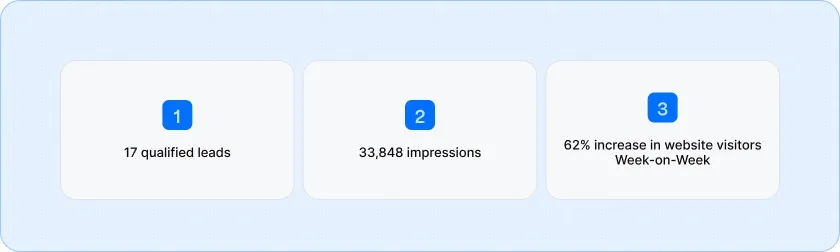
- 17 qualified leads generated in the first month.
- 100% High-intent prospects, as every lead was a genuine inquiry for packaging equipment.
- Consistent, 24/7 lead flow, operating continuously to capture prospects who were previously invisible.
Business Impact:
- Increased Sales Efficiency: The sales team was no longer wasting time on unqualified prospects.
- Competitive Advantage: Their professional online presence sets them apart from competitors.
- Wider Market Reach: The system started attracting leads from new areas within its service region.
Read the full case study here…
Check How Many Sales You Missed Today
Reveal Lost Customers

Your next big customer is researching solutions right now. Make sure they find you first.

Digital Marketing
Jan 16, 2026
5 mins
8 Heavy Equipment Email Marketing Strategies That Hold Buyer Attention Through Long Cycles
Ishani Mitra
Most heavy equipment companies already use email. Very few use it well.
Inbox messages are sent regularly, but they often feel disconnected from how equipment is actually purchased, serviced, and replaced.
When email marketing works for heavy equipment, it doesn't feel like marketing at all. It feels like continuity.
In this blog, we break down how email marketing should function in the heavy equipment industry, which strategies support sales, service, and lifecycle growth, and how email integrates with the rest of your marketing stack.
Understanding Email Marketing in the Heavy Equipment Industry
Email plays a very specific role in heavy equipment marketing. Its value lies in maintaining continuity across long gaps between awareness, evaluation, budgeting, and action.
Purchase cycles are long, decisions involve multiple stakeholders, and most recipients are not looking to buy immediately. Email here is not a closing channel. It is a timing, relevance, and relationship channel.
Understanding this role is essential before choosing tools, formats, or campaigns. Without that clarity, email efforts often feel busy but disconnected from real outcomes.
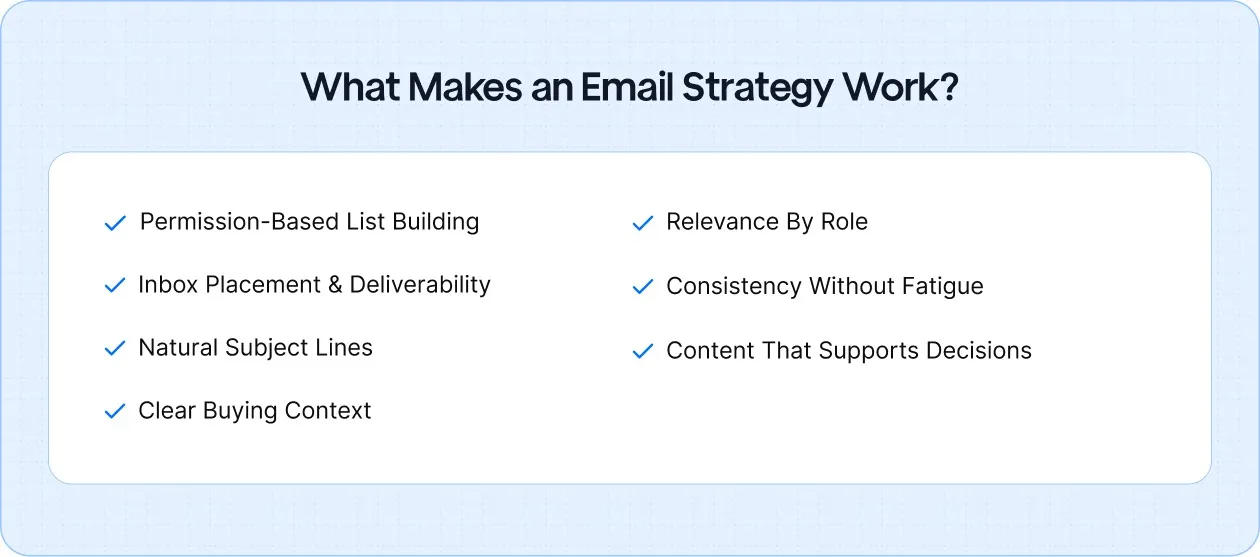
What Makes an Email Strategy Work?
An effective email strategy in heavy equipment is built on discipline, restraint, and alignment with how buyers actually behave.
- Permission-based list building
Only email people who explicitly opted in through demos, enquiries, downloads, rentals, service interactions, parts enquiries, or events. In industrial categories, trust and deliverability break fast when the list is not earned.
- Inbox placement and deliverability basics
Even “good” emails fail if they land in spam. Treat deliverability like shop maintenance:
- Authenticate your domain (SPF, DKIM, DMARC)
- Keep list hygiene tight (remove hard bounces, suppress inactive contacts)
- Avoid spam-trigger subject lines and overhyped claims, especially in the subject line
- Natural Subject lines
Heavy equipment buyers open emails that feel relevant, specific, and useful. Overhyped subject lines trigger distrust and spam filters. Your subject line should read like a professional note.
- Clear buying context
Write as if the reader is researching, maintaining, budgeting, or planning, not impulse shopping. Heavy equipment decisions move through evaluation windows, internal approvals, and timing constraints.
- Relevance by role
Owners, fleet managers, operators, procurement, and service managers care about different outcomes. Segment by role instead of sending one message to everyone.
- Consistency without inbox fatigue
Email should arrive predictably and infrequently enough to remain welcome. Sporadic blasts followed by silence weaken recall, while over-sending leads to disengagement.
- Content that supports real decisions
Effective emails provide useful input: maintenance guidance, product updates, comparisons, regulatory changes, or operational insights. Emails that exist only to promote offers lose attention quickly.
Send Emails Worth Opening
Create content that supports maintenance planning, lifecycle decisions, and real operational needs.
Build My Email Content System

- One clear CTA
Make the next step obvious (request a quote refresh, schedule service, check availability). Avoid multi-CTA emails that create indecision.
- Measurement tied to follow-up
Opens and clicks only matter if they lead to enquiries, service bookings, quote progression, or sales conversations. Track what happens after engagement and build a follow-up rule for non-opens, high-click accounts, and repeat readers.
When these principles are in place, email becomes a stabilizing layer in the marketing stack.
Core 7 Email Marketing Strategies for Heavy Equipment Growth
Email marketing in heavy equipment succeeds when it is treated as an operational system rather than a campaign channel. Growth here depends on sustained relevance across long sales cycles, multiple buyer roles, and complex product and service combinations.
The strategies in this section focus on supporting real sales, service, and lifecycle outcomes instead of short-term activity:
Strategy 1: Build A Qualified List (Earned Intent Only)
Heavy equipment email only performs when the list is earned through genuine interest and real interactions. That list quality is what makes newsletters, nurture, and lifecycle sequences work in practice.
- Lead Source Standards: Define which lead sources are allowed into marketing emails. Only add contacts from quote requests, demo requests, events, trade shows, service appointments, parts enquiries, gated resources, and account-based outreach that includes explicit permission.
- High-Intent Opt-Ins: Offer opt-ins that match equipment decision-making. Use spec checklists, maintenance calendars, “rental vs buy” calculators, application fit guides, financing and warranty explainers, and jobsite productivity templates as the value exchange.
- CRM First Capture: Route every opt-in into the CRM, not just the email tool. Require basic fields that support routing and relevance (role, location/territory, primary equipment category, ownership intent: buy/rent/service/parts). Avoid long forms that block submissions.
- List Hygiene Rules: Set minimum standards for keeping contacts marketable. Merge duplicates, fix incomplete records, and tag the original source so you can trace performance back to acquisition channels later.
Strategy 2: Segment Like an Equipment Business
Segmentation improves relevance and reduces wasted sends, but in heavy equipment, it needs to reflect role, lifecycle stage, and product category.
- Role Segmentation: Split the list by decision influence. Separate owners, fleet managers, operators, procurement, and service managers because each group cares about different proof, risks, and timelines.
- Lifecycle Segmentation: Create segments for where the account sits in the cycle. Use stages like new lead, active opportunity, customer, lapsed customer, service-only customer, rental-only customer, and parts-only customer.
- Product and Application Segmentation: Organize by equipment type and use case. Break by category (excavators, compact equipment, cranes, attachments, power systems) and by application (earthmoving, utilities, roadwork, quarry, agriculture), so email content stays specific.
- Dealer and Territory Segmentation: Respect how the business sells. Segment by dealer territory or sales region to keep offers, inventory, and service messaging accurate and avoid creating conflicts across areas.
Strategy 3: Use Three Core Campaign Types That Map to How Buyers Decide
SERP patterns cluster around newsletters, drip sequences, and nurture campaigns. The strategy is to build each type around a defined job and audience.
- Newsletter Strategy: Run a newsletter that earns attention, not one that fills a calendar. Keep it predictable and brief. Include 1–2 useful items (maintenance insight, application guidance, cost-of-downtime angle), plus one clear next step (request a spec consult, book service, view inventory) instead of multiple competing CTAs.
- Drip Strategy: Build drip campaigns around a single buyer question. Create short sequences that resolve one decision point over time, such as “what to inspect before buying used,” “how to choose the right attachment,” or “how to plan maintenance intervals.” Drip works because it maintains continuity without constant manual follow-up.
- Lead Nurture Strategy: Design nurture for long-cycle movement, not constant selling. Use nurture to move contacts from curiosity to readiness by sharing proof (field performance stories, application examples, comparison logic, financing/warranty clarity) and by prompting low-friction actions (book a call, request a quote refresh, schedule a demo).
Strategy 4: Build Lifecycle Sequences That Drive Revenue After the Sale
Heavy equipment email gets most profitable when it supports service, parts, and repeat purchases. This is where most companies leave money on the table because they treat email as “pre-sale only.”
- Post-Sale Onboarding: Set expectations and reduce early regret. Send a short sequence that covers warranty registration steps, service scheduling norms, recommended initial inspections, and operator resources. Include a single service contact path tied to a region or dealer.
- Service and Maintenance Pull-Through: Turn maintenance into a predictable motion. Trigger reminders based on time-in-service milestones (30/90/180 days) or usage bands when that data is available. Keep the message operational: what to check, what failure looks like, and how to schedule.
- Parts Repeat and Consumables: Build reorder behaviour into the system. Segment by equipment category and send parts reminders that align with typical wear intervals. Make ordering paths direct, with SKU guidance or “talk to parts” CTAs, not generic product promos.
- Reactivation for Lapsed Accounts: Re-open conversations without discounts as the default. Trigger reactivation for accounts with no service or parts activity in a defined window. Lead with operational value (inspection offer, seasonal checklist, uptime audit) before introducing pricing incentives.
Strategy 5: Make Email Sales-Usable With Simple Rules on Content and CTAs
Industrial inboxes reward clarity and punish fluff. A good strategy makes emails easy to scan and easy to act on, while staying credible to technical buyers.
- One Email, One Outcome: Choose a single intent per send. If the email is meant to drive a demo request, remove secondary offers. If it is meant to drive service bookings, do not dilute it with inventory announcements.
- Proof Over Claims: Show specifics instead of adjectives. Use performance context (application conditions, jobsite constraints, uptime implications) and customer outcomes rather than “best-in-class” language.
- CTA Discipline: Use one primary CTA and one fallback. Primary CTA should match the stage (request quote, schedule service, check availability). Fallback CTA can be “reply to this email” for high-consideration segments where direct conversation converts better.
Strategy 6: Align Brand Email With Dealer, Inventory, and Service Reality
Email breaks trust fastest when it promises something the business cannot fulfill. In heavy equipment, that usually happens through inventory mismatch, territory overlap, or service capacity disconnect.
- Inventory and Availability Sync: Do not email offers that sales cannot honor. Establish a simple weekly sync with sales or dealers on what can be promoted: available units, rental capacity, service lead times, and parts constraints.
- Dealer Enablement Versioning: Create dealer-ready variants of core campaigns. Maintain a brand template and allow dealer inserts for local proof, contact points, and territory-specific offers, so the message stays consistent without becoming inaccurate.
- Routing Rules: Decide where leads go before you hit send. Every campaign needs a defined handoff: which form routes to which rep, what qualifies as urgent, and what SLA the recipient should expect.
Strategy 7: Monetization and Optimization Beyond Direct Equipment Sales
Email delivers the most value in heavy equipment when it supports what happens after the sale. For dealers and OEM-linked service businesses, your list should drive parts, service, and lifecycle retention, not constant inventory pushes.
- Use email to grow parts and service revenue: Send maintenance reminders, inspection prompts, seasonal readiness checks, and upgrade guidance tied to lifecycle needs.
- Use partner ecosystems carefully: Keep partnerships job-site relevant (attachments, telematics, safety training, maintenance tools). Anything off-niche reduces trust.
- Keep segmentation dynamic: Segment by equipment type, lifecycle stage, service history, rental vs purchase behaviour, and role (fleet manager, operator, procurement) so messages stay relevant.
- Optimise for real outcomes: Run small A/B tests focused on clarity, then measure what matters—service bookings, parts enquiries, demo requests, and sales conversations. Opens and clicks only matter if they drive these outcomes.
Integrating Email with the Broader Equipment Marketing Stack
In heavy equipment marketing, no channel operates in a straight line. Buyers move back and forth between search, ads, content, sales conversations, dealer interactions, events, and referrals, often over long periods of time.
Each channel introduces information at a different moment and from a different angle:
How Email Works Alongside Search and Content Marketing
SEO strategies and content marketing introduce buyers to problems, options, and positioning. Email ensures that exposure does not reset every time the buyer returns.
- Carry forward the same decision logic introduced through search. If search content establishes how a buyer should think about application fit, operating cost, or risk, email should reinforce that same framework over time instead of introducing new angles.
- Reduce cognitive overload created by deep content libraries. Websites often present many parallel resources. Email helps sequence ideas so buyers absorb information gradually rather than encountering everything at once.
- Maintain thematic consistency across multiple touchpoints. Email prevents situations where a buyer reads authoritative content on-site but receives unrelated or generic messaging afterward.
Capture Demand Before the Inbox
Strengthen SEO so high-intent buyers find you before email nurtures the relationship.
Strengthen My SEO Foundation
How Email Supports Paid Media Without Competing With It
Paid media captures attention at specific moments. Email gives those moments longevity.
- Absorb short-lived paid attention into longer consideration cycles. Email allows interest generated through ads to persist beyond the initial click, without requiring constant re-exposure through paid spend.
- Stabilise messaging across acquisition bursts. When paid campaigns change frequently, email acts as the steady channel that keeps positioning consistent for known prospects.
- Reduce repetition fatigue across channels. Email prevents buyers from seeing the same acquisition messages repeatedly by carrying the conversation forward instead of restarting it.
How Email Aligns With Sales Conversations Over Time
Sales interactions in heavy equipment are episodic. Email fills the gaps between them.
- Preserve context between conversations. Email helps buyers remember what was discussed previously, reducing the need to re-establish understanding in every interaction.
- Support internal buyer alignment. Buyers often share emails internally. Email provides a reference that helps stakeholders stay aligned without sales being present.
- Prevent regression in decision stages. Without reinforcement, buyers often backslide into earlier questions. Email helps maintain forward momentum between sales touchpoints.
How Email Complements Dealer Networks and Field Activity
Dealer and field interactions introduce local variability. Email provides consistency.
Anchor local execution to a shared narrative. Email ensures that regional activity aligns with overarching brand positioning, even when execution differs locally.
Support Local Trust Signals
Optimize your Google Business Profile to reinforce credibility across dealers, service locations, and territories.
Optimize My Google Profile
- Extend the lifespan of offline interactions. Events, demos, and site visits are time-bound. Email maintains continuity after those interactions end.
- Reduce dependency on memory-based follow-ups. Email supports recall and clarity without relying solely on manual sales or dealer outreach.
Conclusion
When email is set up correctly in a heavy equipment business, something subtle changes.
Sales conversations start closer to the point. Service teams deal with fewer misunderstandings. Dealers receive leads that make sense for their territory and inventory. Internally, there is less confusion about who has seen what and why a conversation is happening now.
Heavy equipment companies that approach email this way become a part of how the business stays aligned over long cycles, supports real decisions, and grows without adding friction.
Ready to Build Long-Term Continuity?
Create a marketing system that supports long buying cycles, service revenue, and repeat relationships.
Book A Consultation

Digital Marketing
Jan 15, 2026
5 mins
How to Start a Metal Fabrication Business Without Learning Everything the Hard Way
Ishani Mitra
Running a fabrication business often looks simple from the outside. You take in drawings, cut metal, weld parts, deliver on time, and move to the next job. But anyone who has spent time on the shop floor knows that the real challenge sits outside the weld seam.
Most fabrication businesses struggle because the business side never gets the same level of attention as the work itself. Decisions around positioning, pricing, systems, and visibility quietly shape whether the shop stays stable or constantly feels under pressure.
In this blog, we break down what a fabrication business looks like today, how profitable shops are built and run, and how to approach growth once the core is strong without breaking what already works.
What a Fabrication Business Looks Like?
A fabrication business today sits at the intersection of craft and structure. The work still depends on skill, experience, and problem-solving on the shop floor. But whether the business survives or scales is decided by how well that work is organized, priced, and repeated.
The work on the shop floor is only one part of the picture. The rest happens before and after it.
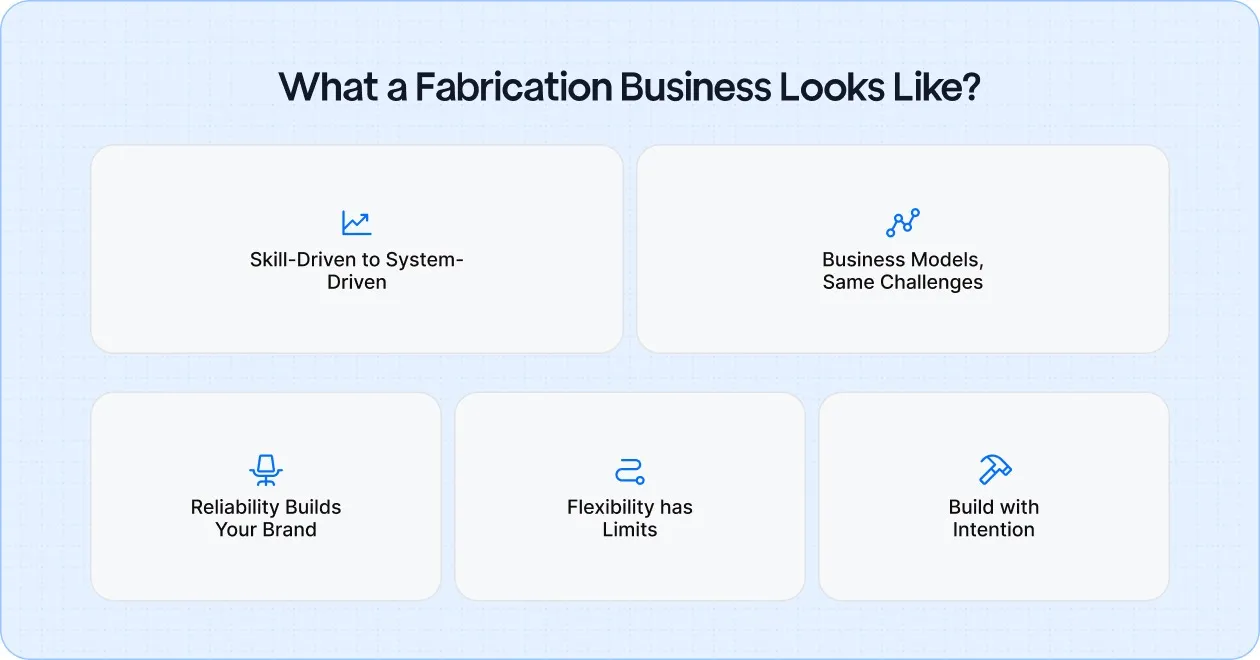
From Skill-Driven to System-Driven
In the past, many fabrication businesses were built around individual expertise. If you knew how to weld, cut, bend, or assemble well, work followed. That still holds true at the beginning.
But as soon as volume increases, skill alone stops being enough.
Today, fabrication businesses are expected to operate with:
- Clear service boundaries
- Reliable lead times
- Consistent quality across jobs
- Predictable pricing and delivery
These expectations apply whether the shop has two people or fifty. Without structure, even a small increase in work can create delays, missed margins, and frustrated customers.
Different Business Models, Same Core Challenges
Fabrication businesses now fall into clearer models, even if owners don’t always label them.
Some businesses focus on general fabrication, taking on a wide range of custom jobs. Others specialize in certain materials, processes, or industries. Some depend on one-off work, while others build around repeat customers or long-term contracts.
Each model attracts different types of work, but they all face the same underlying questions:
- What work is actually profitable
- How much capacity exists right now
- Which jobs stretch the shop too thin
- Where time and money quietly leak out
These questions matter just as much when starting out as they do when expanding.
Capability and Reliability Build Your Brand
Modern buyers assume fabrication capability. They expect machines, tools, and technical know-how to be in place.
What they pay attention to instead is reliability.
That means:
- Jobs delivered when promised
- Fewer revisions and surprises
- Clear communication when something changes
- Confidence that the next order will go smoothly
Reliability is not something you market first. It is something the business earns through repeatable processes and realistic commitments.
Flexibility Has Limits
Being flexible helps early on. Saying yes to different types of work can keep cash flowing and expose the business to different customers.
But unlimited flexibility becomes a problem as the business grows.
Too much variation increases:
- Quoting difficulty
- Scheduling conflicts
- Setup time and rework
- Stress on people and equipment
Strong fabrication businesses learn where to draw the line. They stay flexible within a defined scope instead of stretching in every direction.
A Fabrication Business Must Be Built With Intention
Whether you are starting, stabilizing, or scaling, the same truth applies. A fabrication business cannot rely only on effort.
It needs intentional design.
That design shows up in how services are defined, how capacity is understood, how jobs are priced, and how information moves from quote to production to delivery.
When these pieces work together, growth feels manageable. When they don’t, even steady demand feels overwhelming.
How to Build and Run a Profitable Fabrication Business
A profitable fabrication business is the result of deliberate choices made early and reinforced every day. Choices about what kind of work to take on, how to price it, which customers to prioritize, and how tightly the operation is run.
Let's build a plan for running a fabrication business the right way:
Define The Type of Fabrication Business
Every fabrication business operates within a model, whether the owner defines it or not. The problem is that many businesses drift into a model through circumstance rather than choice. Over time, that drift creates confusion in pricing, workflow, and customer expectations.
Being clear about what kind of fabrication business you want to run gives structure to every other decision. It determines what equipment makes sense, which jobs fit your shop, and how you should position yourself in the market.
Most fabrication businesses fall into a few clear categories:
- Job shop fabrication
- One-off or small-batch custom work
- High variability in jobs, drawings, and timelines
- Requires tight quoting and scheduling control to stay profitable
- Contract or repeat fabrication
- Ongoing production runs or preferred-vendor relationships
- More predictable demand and cash flow
- Relies heavily on consistency and delivery reliability
- Niche or specialized fabrication
- Architectural metal, structural steel, automotive custom, precision parts
- Fewer job types with deeper expertise
- Stronger pricing power when positioned correctly
Problems start when a business tries to operate across all three at once. That lack of focus increases complexity without increasing margin.
Once the model is clear, services should be shaped around the problems you solve best:
- Fast turnaround and prototyping
- Heavy-duty or industrial fabrication
- End-to-end design, fabrication, and assembly
That positioning must be obvious everywhere the business shows up:
- On the website
- In quotes and proposals
- In outreach and sales conversations
- In networking and referrals
Clear positioning does more than attract the right work. It filters out the wrong work before it reaches your shop.
Price for Profit
Pricing is where many fabrication businesses undermine themselves without realizing it. When work slows down or competition increases, pricing decisions often become emotional. Quotes are adjusted to “win the job” rather than to protect the business.
The reality is simple. A fabrication business can be busy every day and still be losing money.
Strong pricing starts with understanding your true cost base. That includes:
- Machine acquisition, depreciation, and maintenance
- Shop rent, utilities, and overhead
- Labor costs, including the owner’s time
- Consumables, materials, scrap, and rework
- Software, compliance, insurance, and safety costs
Once costs are clear, pricing needs structure so decisions are consistent, not reactive.
Profitable fabrication businesses rely on:
- Defined labor and machine hourly rates
- Minimum job fees to protect low-value work
- Rush pricing that reflects real disruption
- Complexity premiums for unclear drawings or tight tolerances
Discounting to stay busy creates long-term damage:
- It teaches customers to undervalue skilled work
- It erodes margins job by job
- It damages team morale when effort is underpriced
The moment a fabrication business stops undercharging for work that is difficult to replace, profitability improves.
Choose the Right Customers
Not all revenue is equal. Some customers create stability, while others create stress. The difference becomes obvious over time.
Profitable fabrication businesses are selective. They understand that long-term success comes from predictable, respectful buyers who value reliability as much as price.
Customers who tend to support profitable growth include:
- Industrial buyers with ongoing needs
- Engineers and product companies that value precision
- Construction and infrastructure partners who plan ahead
Customers that require caution include:
- Bargain hunters focused only on the lowest number
- Last-minute buyers expecting miracles without paying rush fees
- One-off customers with unclear specifications
Over time, strong fabrication businesses work toward building anchored relationships:
- Repeat manufacturing runs
- Contract fabrication agreements
- Preferred-vendor or retainer-style arrangements
These relationships stabilize cash flow and reduce the pressure to accept poor-fit work just to keep machines running.
Attract Better-Fit Work
Build marketing that filters serious buyers and reduces low-quality RFQs before they hit your shop.
Strengthen My Marketing
Invest in Capacity With Intent
Buying equipment feels like progress. In reality, poorly timed equipment purchases can increase financial strain without improving profitability.
Before investing in new machines, profitable fabrication businesses slow down and ask practical questions:
- Will this reduce outsourcing costs we already incur?
- Will it unlock work we are already turning away?
- Do we have consistent demand, not just short-term interest?
Smart capacity planning focuses first on bottlenecks, not wish lists.
Common constraints include:
- Cutting capacity
- Welding availability
- Finishing or coating delays
Once constraints are identified, attention shifts to utilization:
- Better scheduling to keep machines running
- Preventive maintenance to avoid downtime
- Operator training to reduce errors and rework
Idle machines quietly drain cash. Machines used consistently and intentionally protect margins.
Maintain Operational Discipline
Most fabrication businesses do not fail because of poor workmanship. They fail because the work is poorly organized.
As volume grows, relying on memory and informal communication breaks down. Profitable fabrication businesses introduce structure early:
- Intake
- Confirm drawings, specs, quantities, and timelines before quoting or scheduling
- Flag unknowns early instead of “figuring it out on the floor”
- Design and approval
- Lock drawings and revisions before production begins
- Make responsibility clear for approving changes
- Production
- Release jobs only when materials, hardware, and outsourced steps are confirmed
- Use job travelers or checklists so operators aren’t relying on memory
- Quality checks
- Build inspection points into the process
- Catch issues before they move downstream and get expensive
- Delivery and invoicing
- Close the loop cleanly so finished work doesn’t sit unpaid
- Make sure invoicing is tied to job completion
Discipline also means documenting what you already know.
Basic systems support this discipline:
- Job tracking that shows what is in progress
- Invoicing processes that ensure work gets paid for
- Deadlines with accountability, not assumptions
When work lives in systems instead of people’s heads, consistency becomes possible.
Build a Skilled, Stable Team Around Responsibility
Machines amplify output, but people determine profitability.
Strong fabrication businesses invest in building teams that take ownership of quality, safety, and efficiency. Skill matters, but reliability matters more.
This means:
- Hiring for responsibility and mindset
- Continuous training around safety and standards
- Clear expectations around quality and accountability
Retention improves when teams see:
- Fair compensation
- Clear growth paths
- Recognition for consistent performance
A fabrication business’s reputation is built every day by the people running machines, programming jobs, and checking welds. No system can replace that.
Market Like a Modern Fabrication Business
Relying only on word of mouth limits growth and visibility. Profitable fabrication businesses make it easy for serious buyers to evaluate them before making contact.
Marketing in fabrication is about clarity and proof.
A strong online presence shows:
- Real examples of completed work
- Industries served and types of jobs handled
- Capabilities, materials, and tolerances
It reinforces trust with:
- Case studies
- Before-and-after photos
- Testimonials or long-term customer relationships
Visibility also matters:
- An accurate Google Business Profile
- Consistent LinkedIn presence
- Partnerships with engineers, architects, and contractors
Buyers cannot choose you if they cannot find you or quickly confirm you are a good fit.
Protect Cash Flow Ruthlessly
Profit on paper means little without cash in the bank. Many fabrication businesses fail slowly through unpaid invoices, not lack of demand.
Strong businesses enforce payment discipline:
- Deposits upfront
- Milestone payments for larger jobs
- Clear, enforced payment terms
They avoid financing customers indefinitely:
- No silent extensions
- No open-ended credit
They track cash actively:
- Outstanding invoices
- Job-level profitability
- Monthly cash position
Cash flow is the oxygen of a fabrication business. Protecting it is essential.
Think Beyond Fabrication and Build Value
The most profitable fabrication businesses eventually stop positioning themselves as commodity vendors.
They become partners.
This often involves adding value through:
- Design support
- Engineering review
- Assembly or installation
- Early-stage manufacturing input
Over time, one-off jobs turn into long-term relationships.
Growing a Fabrication Business With 6 Strategies
Growth in a fabrication business should never come first. It comes after the shop knows what work it is good at, how it prices that work, and how reliably it delivers. When growth is chased before that foundation is stable, it usually shows up as late jobs, stressed teams, thin margins, and frustrated customers.
Once the core is understood and under control, growth becomes less about chasing more work and more about attracting the right work. This is where visibility, marketing, and reputation start to matter.
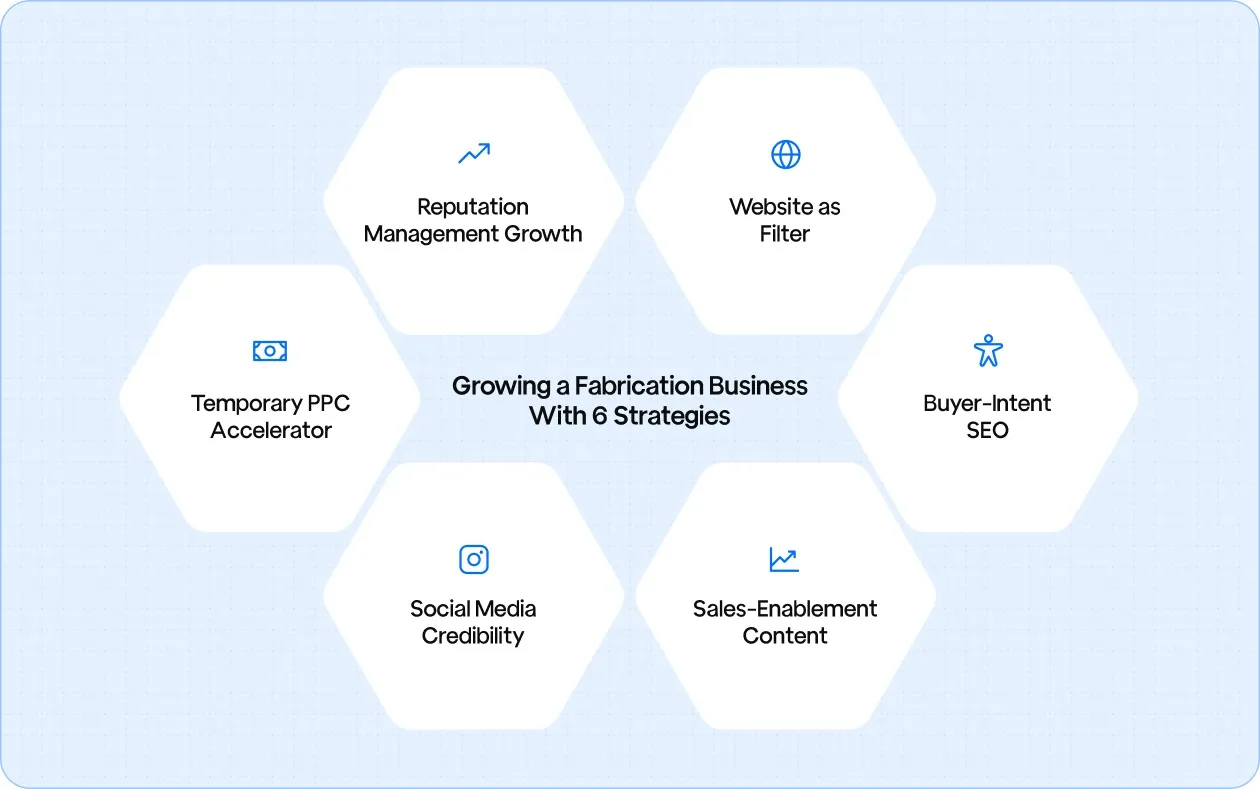
A Clear Website That Acts as a Qualification System
In fabrication, the website is not a branding asset. It is a pre-sales filter. Buyers use it to decide whether you are capable, reliable, and worth engaging before they ever send an RFQ. If the site is vague, generic, or incomplete, it attracts the wrong conversations and wastes quoting time.
What a fabrication website must include and how it should be structured:
- Capability-driven page structure: The website should have separate, indexable pages for each core capability such as cutting, welding, forming, assembly, or specialized fabrication, instead of listing everything on one generic services page.
- Performance and page speed optimization: Fabrication buyers often access sites from offices, plants, or mobile devices, so page speed matters. Image-heavy portfolio pages must be compressed properly, unnecessary scripts removed, and performance monitored continuously.
- Schema markup for industrial services: Structured data should be implemented for services, locations, and business information so search engines clearly understand what the shop does and where it operates.
- Technical clarity over marketing copy: Pages should clearly state materials handled, thickness ranges, tolerances, certifications, and industries served, so engineers and procurement teams can self-qualify quickly.
- Logical internal linking: Capability pages, content pieces, and RFQ pages should be linked intentionally so buyers can move from understanding to action without friction.
- Conversion paths that reflect real workflows: RFQ forms should request the information needed to quote accurately, such as drawings, quantities, and timelines, instead of generic contact forms.
A clear website improves growth by reducing chaos.
Qualify Buyers Before They Quote
Turn your website into a clear pre-sales filter that shows capabilities, constraints, and fit upfront.
Improve My Fabrication Website
SEO That Reflects How Fabrication Buyers Actually Search
SEO only works for fabrication businesses when it mirrors real buyer intent. Engineers and purchasing teams do not search the way marketers assume they do. They search with specific processes, materials, and problems in mind.
What SEO must include and how it should be implemented:
- Technical SEO foundation: This includes crawlability, clean URL structures, fast page loads, mobile usability, proper indexing, and resolving site errors that block search engines from accessing key pages.
- Keyword research rooted in buyer intent: Keywords should be mapped around fabrication processes, materials, industries, and applications. This includes separating informational searches from RFQ-ready searches.
- On-page SEO for service and capability pages: Each core page must be optimized with clear headings, structured content, internal links, and metadata that reflect how buyers actually search for fabrication services.
- Local SEO for fabrication suppliers: Location-based optimization, Google Business Profile alignment, and consistent NAP data help capture buyers who prefer regional fabrication partners.
- Content-led SEO for long-term demand: Blog and resource content should target technical questions, purchasing concerns, and design considerations that buyers research before shortlisting suppliers.
- Ongoing SEO audits and competitor analysis: SEO must be reviewed regularly to identify gaps, lost rankings, and competitor weaknesses that can be overtaken with better technical depth.
Proper SEO brings fewer leads, but far better ones.
Get Found by Serious Buyers
Align SEO with how engineers and procurement teams actually search for fabrication partners.
Strengthen My SEO
Content That Functions as Sales Enablement
Content in a fabrication business is not meant to entertain or build awareness. It exists to remove uncertainty for buyers who are evaluating risk quietly before making contact.
What fabrication content should cover and how it should be used:
- Technical explanation content: Content should explain fabrication processes, tolerances, material behavior, and design constraints so buyers understand what is feasible.
- Purchasing and RFQ preparation guidance: Articles and resources should help buyers submit better drawings, specifications, and timelines, reducing rework and misalignment.
- Pricing and lead-time education: Content should explain what affects pricing and delivery schedules so buyers understand why quotes differ and delays occur.
- Quality and repeatability clarification: Content should outline inspection processes, documentation, and controls that reduce risk for repeat orders.
- Sales-integrated usage: Content must be actively used by sales teams during follow-ups, quoting discussions, and early conversations instead of being left passive on the site.
- Embedded placement within service pages: Content should support core service pages directly, not live separately as disconnected blog posts.
Good content shortens sales cycles and filters out unprepared buyers.
Remove Buyer Uncertainty
Create content that explains processes, tolerances, and timelines so buyers come prepared.
Build Sales-Enablement Content
Social Media as a Credibility Reinforcement Layer
Social media does not generate demand for fabrication businesses. It validates demand that already exists. Buyers check social presence to confirm that the shop is active, real, and competent.
How social media should be structured and used:
- LinkedIn as the primary platform: Fabrication buyers are in a professional mindset on LinkedIn, making it the most relevant channel.
- Process and work visibility: Posts should show ongoing work, shop activity, process improvements, and problem-solving, not promotional graphics.
- Industry relevance over self-promotion: Sharing broader industry content helps position the business as part of the buyer’s professional ecosystem.
- Leadership and sales profile activity: Individual profiles often build more trust than company pages and should be used consistently.
- Consistency over creativity: Regular, clear posting builds familiarity and legitimacy more effectively than occasional high-effort posts.
Social media supports growth by reinforcing trust between touchpoints.
PPC as a Controlled and Temporary Accelerator
Paid advertising should never be the foundation of fabrication business growth. It should only be used to accelerate visibility for specific, well-defined services once the core systems are in place.
How PPC should be implemented without wasting budget:
- High-intent keyword targeting: Campaigns must focus on specific processes, materials, or services rather than broad fabrication terms.
- Tight geographic and audience filters: Ads should be limited to regions and buyer profiles that match operational capacity.
- Service-specific landing pages: Every ad should point to a page that directly explains the exact capability being promoted.
- Clear lead-quality monitoring: Inquiries should be reviewed for fit, not volume, and poor-quality keywords should be cut quickly.
- Short-term usage with clear exit points: PPC should support growth while SEO matures, not replace it indefinitely.
Used incorrectly, PPC attracts chaos. Used correctly, it fills controlled gaps.
Reputation Management as a Long-Term Growth Multiplier
In fabrication, reputation compounds faster than any marketing channel. Buyers remember missed deliveries and unclear communication long after they forget ads or websites.
What reputation management includes and how it should be handled:
- Delivery discipline: Meeting commitments consistently is the foundation of reputation, not online activity.
- Clear communication during issues: Early, honest updates reduce damage when constraints or delays arise.
- Intentional capture of proof: Testimonials, case examples, and repeat customer stories should be documented and reused.
- Accurate and maintained business profiles: Listings and profiles should reflect current capabilities, hours, and contact details.
- Feedback loops after completed jobs: Post-job reviews help identify issues early and reinforce strong relationships.
Reputation reduces sales friction, increases pricing power, and stabilizes growth.
How Gushwork Helps Fabrication Businesses Build Visibility?
Most fabrication shops don’t need more marketing activity. They need clearer visibility in the places buyers actually research, and a system that turns that visibility into better-fit RFQs.
Gushwork helps you build organic demand by combining AI and human expertise to improve how your fabrication services show up in search and AI-driven answers, without relying on ads or random tactics.
- AI Visibility + SEO: We map keywords to real fabrication buyer intent (process, material, use case, RFQ intent), then build and optimize pages that match how engineers and procurement teams shortlist vendors.
- Execution that stays operational: We prioritize technical health, site structure, and content that reflects real constraints, lead times, and decision criteria.
- Lead capture clarity: We support lead tracking with dashboards and alerts so enquiries don’t get missed, and you can see what drives quality conversations.
The outcome is a visibility system that filters better-fit work and makes growth feel controlled.
Conclusion
A strong fabrication business runs on clarity. When services are defined, pricing is structured, operations are organized, and visibility reflects reality, the business starts to behave differently. Conversations with customers improve. Decisions become easier. Growth feels intentional instead of forced.
This is what separates businesses that stay stuck in survival mode from those that move forward with confidence. Over time, that control compounds into better customers, healthier margins, and a business that can actually support the people running it.
Ready to Grow With Control
Build a system that supports profitability, reliability, and steady demand without adding chaos.
Book A Consultation

Digital Marketing
Jan 15, 2026
5 mins
Why Most Janitorial Service Lead Magnets Fail and How a Real Plan Fixes It
Ishani Mitra
Most janitorial businesses already get enquiries. The real issue is the quality of those enquiries.
Some prospects only want the lowest price. Others don’t understand scope, frequency, or what “good cleaning” actually includes. Even serious buyers often reach out unprepared, turning every first call into a lengthy explanation session.
A lead magnet, when done properly, fixes that starting point. It gives prospects something useful before they contact you, so conversations begin with context instead of confusion.
In this blog, you’ll learn what a janitorial service lead magnet should do, the formats that work best for cleaning businesses, where to place them so they get used, and how to follow up so downloads turn into real opportunities.
What Is a Lead Magnet?
A lead magnet is something useful you give a potential buyer before asking for a quote. Instead of pushing them to fill out a contact form right away, you offer a resource that helps them think through their decision. That could be a checklist, a guide, or a simple tool related to their problem.
When someone downloads it, they’re not just leaving an email. They’re telling you what they care about. By the time they reach out, they already understand your process, your expectations, and whether you’re a fit. That means the first conversation skips the basic questions and starts closer to a real opportunity.
For janitorial services, the best lead magnets introduce structure. They help buyers understand what affects cleaning quality, what should be included in the scope, what standards to expect, and what questions to ask before hiring a provider.
That way, you attract prospects who are serious about outcomes, not just price, and your first conversation becomes faster, clearer, and more productive.
How Can It Help Janitorial Services?
For janitorial businesses, a lead magnet changes how and when conversations begin.
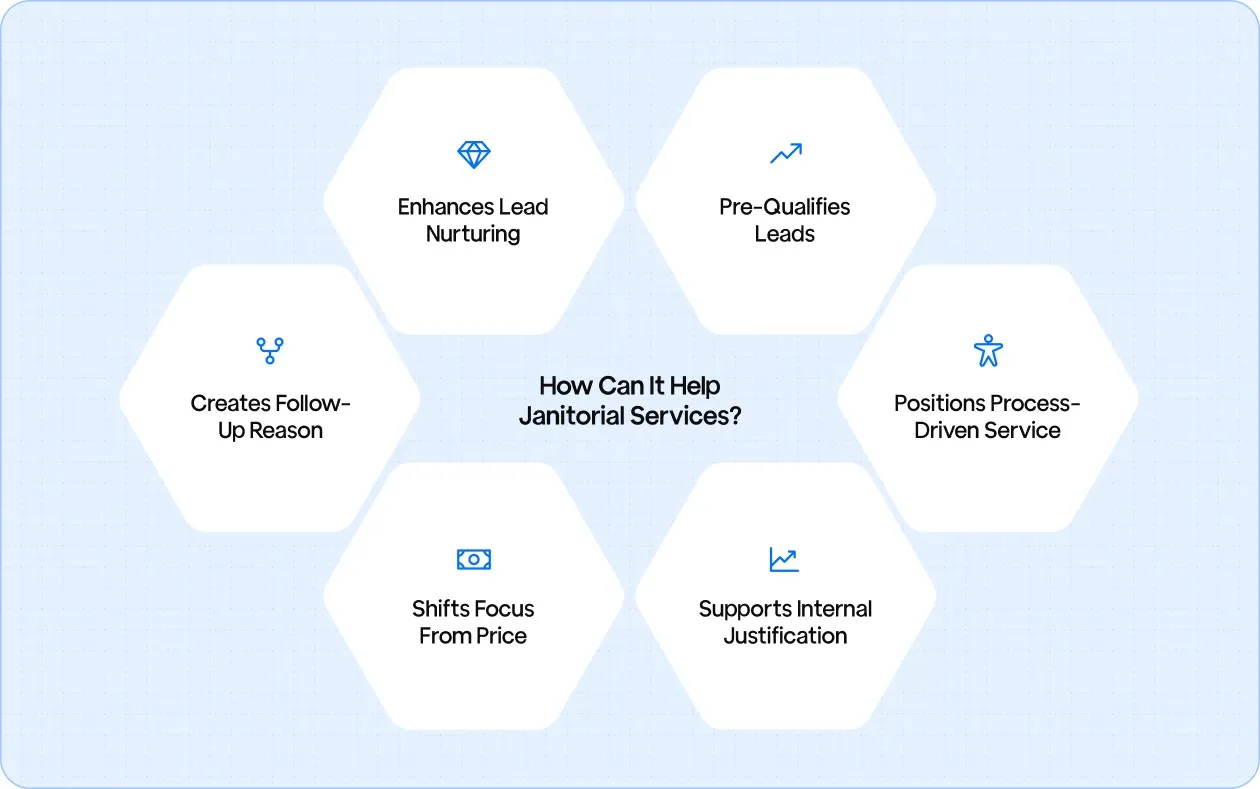
- Pre-qualifies enquiries before they reach your inbox: A well-designed lead magnet attracts people who are actively evaluating cleaning options, not just browsing. This reduces time spent on price-only or low-intent enquiries.
- Positions your service as process-driven: By explaining how cleaning scopes, frequencies, or standards actually work, the lead magnet differentiates your business from providers who rely only on price or availability.
- Supports decision-makers who need internal justification: Facility managers and office admins often need documentation to explain decisions internally. Lead magnets give them language and structure they can reuse.
- Moves conversations beyond prices: When prospects understand what affects quality and compliance, pricing discussions become more grounded and productive.
- Creates a reason to follow up without pressure: The lead magnet gives sales teams a clear context for outreach. Follow-ups feel helpful rather than intrusive.
- Improves long-term lead nurturing: Contacts who opt in through a lead magnet are more receptive to future educational content, making email follow-up more effective over time.
In janitorial services, lead magnets are about shaping better starting points for the relationships that matter.
Get More Qualified Leads
Build a system that attracts the right prospects and improves lead quality before the first conversation.
Improve My Lead Flow
How to Create a Janitorial Service Lead Magnet Plan?
A janitorial service lead magnet should do one thing well: attract the right buyer and start the relationship on your terms. For cleaning businesses, that means offering something that helps a prospect evaluate scope, standards, risk, and cost drivers.
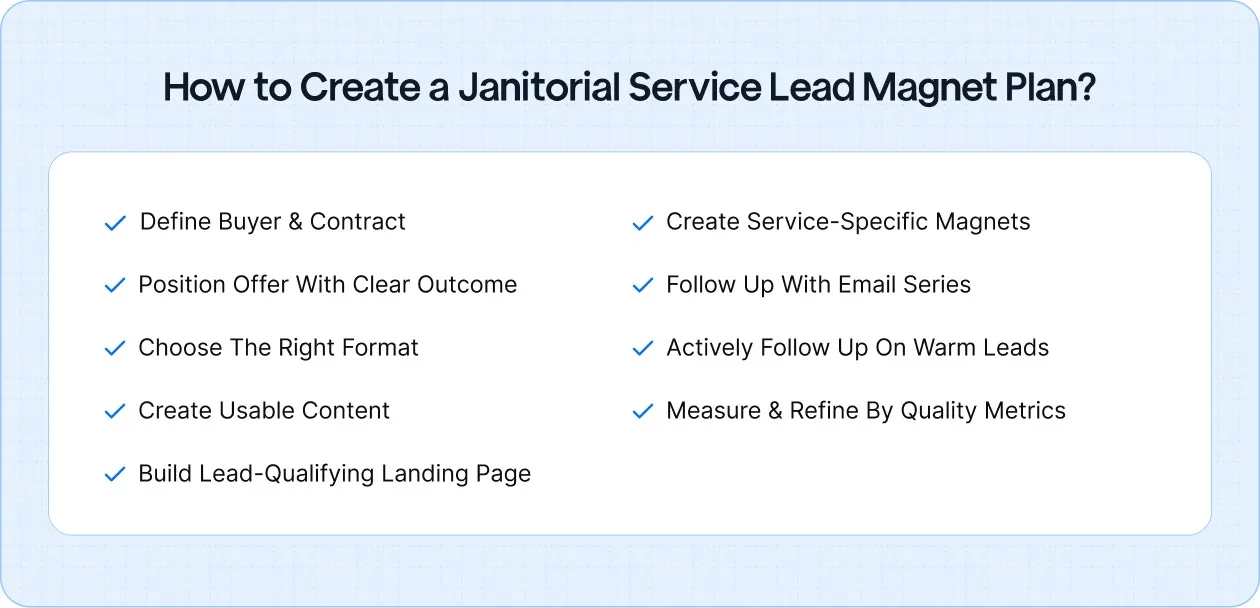
This section explains how to plan, produce, deliver, and follow up on lead magnets that attract decision-ready janitorial prospects:
Define The Buyer And Contract You Want To Attract
Before writing anything, you need clarity on who this resource is meant for and what kind of work you want it to generate. A strong lead magnet signals fit early, so the people who download it already resemble the clients you want to work with.
- Pick an industry vertical. Choose one sector and anchor the entire magnet to its operating reality. Office buildings, healthcare facilities, retail spaces, manufacturing sites, and post-construction environments all evaluate cleaning differently, so the content must reflect that context clearly.
- Name the decision role. Be explicit about who the resource is written for and use their role language throughout. Facility managers, procurement teams, property managers, and building owners respond to different concerns, and naming them directly improves relevance and trust.
- Choose service scope. Align the magnet with the specific service you want to sell next. A magnet built around recurring janitorial scope attracts a very different buyer than one focused on carpet restoration, window cleaning, or post-construction cleanup.
- Set the expected contract size. Indicate the type of facilities this resource applies to, such as square footage ranges, number of restrooms, or shift coverage. This allows smaller or misaligned prospects to self-filter without friction.
- Document the approval path. Acknowledge that many janitorial decisions require internal sign-off. When your magnet reflects that reality, your follow-up can help prospects prepare an internal justification rather than push prematurely.
Position The Offer Around A Clear Outcome
Decision-makers download lead magnets when they see immediate usefulness. The value must be obvious before the form is filled and easy to explain to others afterward.
- Write a single-line outcome headline. Lead with what the reader will be able to do after using the resource. Clear outcomes help prospects decide quickly whether the magnet is worth their time.
- Focusing on benefits over features: A common mistake is focusing solely on what the lead magnet is rather than how it benefits the customer. So instead of naming the format (“10 cleaning tips”), lead with the outcome (“a checklist that helps you reduce complaints and standardize scope in 10 minutes”). Buyers download results, not formats.
- State the deliverable in plain terms. Tell the reader exactly what they are getting and how it will be used. Ambiguity creates hesitation, especially for buyers who are accountable for operational decisions.
- List the practical benefits. Highlight two or three tangible results the resource supports, such as fewer complaints, clearer scope definition, or easier audit preparation. These benefits should feel immediately applicable.
- Set an expected time-to-value. Let the reader know how long it takes to apply the resource. Time clarity increases perceived usefulness and reduces friction.
- Be explicit about who should not download. A short exclusion line protects lead quality. It signals confidence and prevents misaligned enquiries without sounding dismissive.
Choose The Right Format For The Decision Moment
The format of the lead magnet should reflect how complex the decision is at that stage. Matching format to decision depth improves completion and downstream conversations.
- Use checklists for quick evaluation. Checklists work well when buyers want to verify coverage or spot gaps. They are easy to print, share, and use during walkthroughs.
- Use templates for internal approval. Templates support buyers who need documentation to move forward. Scope-of-work and RFP templates often travel internally long after the download.
- Use guides for vendor selection. Guides help buyers understand pricing drivers, service trade-offs, and contract considerations. They are instrumental earlier in the evaluation process.
- Offer an audit workbook for high-value prospects. Audits attract buyers who are serious about improvement or transition. They also create a natural bridge into professional assessment or walkthroughs.
- Keep file types simple and accessible. Use formats that open easily across devices and systems. Accessibility increases actual usage, which improves follow-up quality.
Create Content That Is Operational And Instantly Usable
A lead magnet should function like a tool someone could use tomorrow. Practical structure and clarity matter more than polish.
- Structure for action. Organise content so readers can apply it step by step. Clear sections, checkboxes, and short explanations improve usability.
- Include concrete standards. Measurable criteria help buyers understand what acceptable performance looks like. This reduces ambiguity and supports consistency.
- Add sample language. Provide wording buyers can reuse in scopes, reports, or internal emails. This makes the magnet more valuable and shareable.
- Keep branding minimal. Subtle branding reinforces credibility without turning the resource into marketing collateral. The content itself should do most of the work.
- Proof with a field example. One realistic example helps readers visualize the application. It grounds the content in real operations.
Turn Clarity Into Leverage
Build practical content and lead magnets that help buyers define scope, standards, and expectations before they reach out.
Build My Lead Magnet Content
Build A Landing Page That Qualifies Leads Efficiently
The landing page is where your lead magnet either filters the right prospects in or lets everyone through. Its job is not just to convert, but to confirm relevance and prepare the prospect for what happens next.
- Design the page around one decision only. Remove navigation, secondary offers, and unrelated CTAs so the visitor can focus on whether this resource applies to them. A single clear path reduces hesitation and improves the quality of opt-ins.
- Use problem-aware copy before form placement. Explain the operational situation the reader is likely to be in before presenting the form. This helps prospects self-identify and increases confidence that the resource is worth downloading.
- Ask questions that support follow-up. Only request information that will influence how you respond later, such as facility type or service interest. Every field should have a clear purpose tied to sales or operations.
- Set expectations for contact clearly and early. Tell the visitor whether someone may follow up and in what context. Transparency here reduces resistance and improves response rates later.
- Include credibility cues. A short line about who uses this resource, or a brief note on experience, reassures without turning the page into a pitch.
Build Service-Specific Magnets Once The First One Proves Traction
After one strong magnet performs, expand into focused magnets that reflect specialized needs. Each new magnet should be narrow and clearly useful.
- Use performance data to guide expansion. Identify which services generate the most qualified follow-up from your first magnet. These are the strongest candidates for additional, focused assets.
- Create magnets that reflect distinct buying concerns. Post-construction cleaning, floor care, and carpet maintenance each come with different risks and evaluation criteria. Separate magnets allow you to speak directly to those concerns.
- Vary depth based on decision complexity. Some services benefit from quick checklists, others from detailed templates or planning tools. Choose formats that match how buyers decide on that service.
- Avoid overlapping use cases between magnets. Each magnet should answer a different question. Overlap confuses attribution and weakens follow-up clarity.
Deliver And Follow Up With A Short, Relevant Email Series
Email delivery is the transition from download to relationship. The goal is to help the prospect use the resource and decide on a sensible next step. Applying the 80/20 Rule in Email Nurturing. When following up via email, 80% of the content should be value-based and educational, while only 20% should focus on selling.
- Send the asset immediately with a short note. Email the download link and include one or two sentences explaining how to apply the resource in a real setting.
- Follow with 2–3 value emails over two weeks. Help the recipient apply the magnet: offer a sample filled-in page, a short checklist for next actions, and a suggested internal message they can send.
- Include one simple CTA per email. Invite the reader to ask a question, clarify the scope, or review one area together. These feel supportive rather than sales-driven.
- Adjust cadence by intent. For audit downloads, shorten the sequence and add a same-day outreach step. For general downloads, use a relaxed 3–5 day cadence.
- Log engagement in the CRM. Tag the contact with the magnet type and any actions taken.
Follow Up Actively While The Lead Is Warm
Human outreach works best when it builds directly on what the prospect has already seen. Context makes the conversation easier for both sides.
- Prioritise same-day contacts for high-value downloads. If they downloaded an audit or RFP template, assign a sales or service rep to call or email the same business day.
- Reference the magnet directly. Open outreach with a single line: “I see you downloaded the X audit — can I help you apply it to your site?”
- Use a short diagnostic question. Ask one targeted question that reveals immediate fit, for example: “How many restrooms and what cleaning frequency do you currently run?”
- Offer a low-effort next step. Propose a 15-minute call, a short site walk, or a scoped checklist review.
- Record outcome and next action immediately. Update CRM with the result and the agreed next step to avoid duplicate outreach.
Measure And Iterate The Magnet By Quality Metrics
Judge a magnet by the leads it produces. Track the right signals and refine the offer over time.
- Track how many downloads lead to real conversations. Compare opt-ins to qualified discussions or site visits. This shows whether the magnet attracts decision-ready prospects.
- Review lead profiles for alignment. Look at facility type, role, and service interest. Patterns reveal whether the magnet matches your target audience.
- Test improvements incrementally. Adjust headlines, form placement, or delivery emails one change at a time. This keeps learning clear.
- Use sales feedback as a primary signal. If sales teams find leads easier to speak with, the magnet is doing its job.
- Retire or refine magnets that stall progress. Assets that generate activity without momentum should be updated or replaced rather than left running indefinitely.
High-Performing Lead Magnet Ideas for Janitorial Services
Good lead magnets for janitorial businesses do not try to educate broadly. They help someone make one specific decision a little easier. The ideas below are simple, proven, and easy to act on:
Cleaning Scope And Expectations Resources
These work well because many buyers are unsure what their current cleaning contract actually covers.
- Office Cleaning Checklist (Daily, Weekly, Monthly)
A clear checklist showing what should be cleaned and how often across common office areas. Buyers use this to compare vendors or check gaps in their current service.
Place this on recurring janitorial service pages and office cleaning service pages. It also performs well as an inline CTA within blog posts about cleaning schedules or service scope.
- “What Your Janitorial Service Should Include” Checklist
A straightforward breakdown of tasks most businesses assume are included but often are not. This attracts prospects who feel something is off but cannot articulate it yet.
Add this to comparison-style content, vendor evaluation pages, and “why choose us” sections. It works well as an exit-intent offer on service pages.
- Restroom Cleaning Standards Checklist
Restrooms are a major complaint area. A focused checklist here pulls in decision-makers dealing with repeated issues.
Place this on pages that talk about complaints, quality issues, or high-traffic areas. It also works well as a follow-up resource shared during sales calls.
Pricing And Planning Tools
These magnets help buyers understand cost drivers without asking for a quote immediately.
- Janitorial Pricing Factors Guide
A short resource explaining what actually affects cleaning costs, such as square footage, frequency, staffing hours, and building usage.
Place this near “Request a Quote” buttons and on pricing explanation pages. It reduces hesitation and improves enquiry quality.
- Cleaning Frequency Planner
A simple planner that helps facilities decide how often different areas should be cleaned based on foot traffic and usage.
Add this to service pages and blog posts that discuss maintenance or operational planning. It works well as a mid-page CTA after explaining why frequency matters.
- Budget Planning Worksheet For Cleaning Services
A basic worksheet buyers can use to estimate cleaning needs before talking to vendors.
Place this on pages targeting facility managers and procurement roles. It also fits well in email follow-ups after initial enquiries.
Vendor Review And Change Resources
These attract prospects who are already dissatisfied and closer to switching.
- “Is It Time To Review Your Cleaning Contract?” Checklist
A list of common warning signs, such as recurring complaints, missed tasks, or staff turnover.
Place this on comparison pages, competitor comparison content, and blog posts about switching janitorial providers.
- Janitorial Vendor Comparison Checklist
A side-by-side checklist buyers can use when evaluating two or three cleaning companies.
Add this to decision-stage content, proposal pages, and follow-up emails sent after a walkthrough or estimate.
- New Janitorial Vendor Transition Checklist
A simple guide outlining what should happen in the first few weeks after changing providers.
Place this on onboarding pages and post-estimate follow-ups. It reassures prospects who are worried about disruption.
Service-Specific Lead Magnets
These work best when you want leads for a particular service, not general cleaning.
- Post-Construction Cleaning Readiness Checklist
Helps property managers and builders prepare for handover cleaning.
Place this on post-construction cleaning service pages and project handover content. It also works well for outreach to builders and property managers.
- Carpet And Floor Care Maintenance Checklist
Focused on long-term upkeep rather than one-time cleaning.
Add this to the floor care and carpet cleaning pages, especially near service descriptions that discuss long-term maintenance.
- Window Cleaning Planning Checklist
Useful for buildings that schedule this service infrequently and forget key considerations.
Place this on window cleaning service pages and seasonal content. It works well as a reminder-style CTA.
Internal Communication Helpers
These help buyers justify decisions to others.
- Cleaning Scope Approval Template
A short document that facility managers can share internally to explain the scope and expectations.
Place this in follow-up emails after a proposal or walkthrough. It supports internal sign-off and reduces delays.
- Complaint Tracking Sheet
A simple template to log cleaning issues over time, often leading to a vendor review.
Add this to quality-focused blog posts or share it during early conversations when a prospect mentions recurring issues.
Where to Avoid Placing Lead Magnets?
- Do not place high-intent lead magnets on generic homepage banners without context.
- Avoid stacking multiple lead magnets on the same page. One strong offer per page works best.
- Do not hide lead magnets behind aggressive popups on low-intent content.
Conclusion
A strong lead magnet tries to help.
For janitorial services, that help usually looks like clarity. Clear scope. Clear expectations. Clear next steps.
If your lead magnet makes someone’s job easier before they ever speak to you, it has already done its work. Everything that comes after becomes simpler.
Ready to Improve Lead Quality
Build a system that attracts informed prospects and makes sales conversations simpler from the start.
Book A Consultation

Digital Marketing
Jan 9, 2026
5 mins
8 Proven Content Strategies to Make Your Duct Cleaning Business Unforgettable!
Batul Beawarwala
Building a successful duct cleaning business means making your expertise visible to potential customers in a way that feels authentic. With so many companies offering similar services, standing out can be a challenge.
That’s where content marketing steps in. By sharing informative and engaging content, you can address customer needs, showcase your knowledge, and highlight the importance of clean air ducts. This approach helps establish trust and keeps your business top of mind when customers are ready to make a choice.
Let's explore how content marketing can help your business grow organically and effectively.
Why Content Marketing is Essential for Duct Cleaning Businesses?
Content marketing requires building a foundation of trust and credibility with your audience. For duct cleaning businesses, effective content strategies provide an opportunity to connect with potential customers in a meaningful way and establish themselves as experts in their field.
Here's how it can benefit your business:
- Building Trust: Content marketing allows you to position your business as a trusted authority. By sharing insightful, informative content, such as how-to guides, tips, and industry updates, you're showing customers that you care about their needs and are experts in air duct cleaning.
When people feel informed and confident in your knowledge, they’re more likely to choose you over competitors.
- Sustaining Long-Term Growth: Content marketing requires nurturing your audience over time. With a solid content strategy, you’re creating valuable resources that keep customers engaged and coming back.
By consistently offering helpful content, you build relationships that lead to repeat business, referrals, and long-term growth. This approach doesn’t rely on quick ad campaigns, but instead focuses on building a strong, loyal customer base.
- Improving Local SEO: One of the most powerful ways content marketing benefits duct cleaning businesses is through local SEO.
When you produce location-specific content, such as city or neighborhood pages, service offerings, and customer testimonials, you make it easier for potential customers to find you when they search for terms like "duct cleaning near me." This helps you capture organic traffic from people who are actively looking for your services.
Must Read: Air Duct Cleaning Marketing Automation: Why Some Phones Ring and Others Stay Silent
Want to stand out in local search results?
With thoughtful content planning and optimized service pages, you can gain a competitive edge and attract the right customers to your business.
Start Dominating Local Searches
1. Understand Your Audience and Their Pain Points
To make your content marketing effective, it’s essential to truly understand your audience. Not all customers are the same, and personalizing your message to their specific needs can make all the difference. Here's how:
a) Segmenting Your Audience
- Residential Customers: Homeowners are typically concerned about indoor air quality and the health benefits of clean ducts.
- Commercial Customers: Facility managers focus more on efficiency and cost savings, seeking ways to lower energy bills and reduce HVAC maintenance costs.
Personalizing your content to speak to these different priorities will help ensure you’re meeting their exact needs.
b) Common Pain Points
Addressing the right pain points is crucial in creating relevant content:
- Poor Indoor Air Quality: Many customers worry about allergens and dust from their ducts affecting their health. Highlighting how duct cleaning improves air quality can resonate with homeowners, especially those with young children or respiratory issues.
- High Energy Bills: Both homeowners and businesses see higher bills when their HVAC systems aren’t running efficiently. Content that shows how duct cleaning can cut costs and improve system performance will appeal to those looking to save money.
- Seasonal Allergies: Dust and allergens accumulating in ducts worsen allergy symptoms. By focusing on how regular cleaning reduces allergens, you can connect with people suffering from seasonal allergies.
c) Customer Personas
Creating personas helps target content more effectively. For example:
- Sarah, the concerned mom: Sarah worries about her family’s health, especially her children with asthma. Content that emphasizes air quality and health improvements will appeal to her.
- John, the facility manager: John looks for cost-effective ways to keep his building’s HVAC system running smoothly. Highlighting the savings and efficiency benefits of duct cleaning will catch his attention.
By identifying these pain points and personas, your content can speak directly to the specific needs of your customers, creating a stronger connection and increasing the likelihood of converting them into clients.
Want to speak directly to your audience’s concerns?
Personalize your content to reflect what matters most to your customers. Strategic content planning ensures your messages connect with them at every stage.
Start Creating Now
2. Digital Content Marketing Strategies for Duct Cleaning Businesses
Effective digital marketing strategies help your duct cleaning business attract more customers and stand out in your local area. Here’s how you can take advantage of powerful digital tools to grow your business.
a) Local SEO: Get Found by Local Customers
Local SEO is critical for duct cleaning businesses. With most customers searching for services nearby, optimizing for geo-specific keywords like “duct cleaning near me” can increase your chances of appearing in local search results.
Actionable Tips:
- Optimize Your Google Business Profile: Make it easy for customers to find your contact info and business hours.
- Leverage Apple Business Connect: Ensure your business information is consistent across platforms like Google and Apple Business Connect to improve visibility and credibility.
- Create Localized Content: Focus on specific neighborhoods or cities to increase relevance in local searches.
- Encourage Reviews: Positive reviews improve your credibility and improve your visibility in local search.
Is your content resonating with the right customers?
Optimizing your service pages with clear, targeted content helps you reach the people who need your services.
Strategize to Stand Out
b) Google Local Services Ads (LSAs): Capture High-Intent Leads
Google LSAs are a pay-per-lead advertising model that puts your business at the top of search results, where customers are actively seeking duct cleaning services. With high conversion rates (30%-60%), LSAs help you capture ready-to-book customers quickly.
Why LSAs Work:
- Pay-per-Lead: You only pay when a customer contacts you.
- High Conversion Rates: Customers searching for duct cleaning services are often ready to book.
c) SEO Content Creation: Attract the Right Audience
Create content that speaks directly to your customers' needs to drive more qualified traffic to your site.
Target Long-Tail Keywords: Use specific terms like “air duct cleaning for allergies” or “emergency HVAC cleaning.” These keywords attract customers who are ready to act.
SEO Tips:
- Optimize titles, headers, and meta descriptions for better search engine visibility.
- Example blog ideas: “How Often Should You Clean Your Ducts?” or “5 Signs Your Ducts Need Cleaning.”
Must Read: 10 Content Marketing Services That Fuel Brand Reach and Sales for HVAC Manufacturers
d) PPC Campaigns: Immediate Visibility for Urgent Needs
PPC ads help you capture customers who need immediate duct cleaning services, driving fast results.
- When to Use PPC: Target urgent search queries like “emergency duct cleaning” and “HVAC cleaning services.”
- Ad Copy Best Practices: Highlight the urgency and benefits of your services. Use calls-to-action like "Book Now" or "Call for Immediate Service."
An optimized content strategy is the foundation for attracting high-quality leads.
Service pages and location-specific content help you reach the right customers without the guesswork.
Create Your Strategy
3. Best Content Creation Practices for Air Duct Cleaning
Creating the right content for your duct cleaning business is key to attracting and educating your customers. Your content needs to deliver value that connects with your audience and positions your business as the trusted expert.
Here’s how to make your content impactful:
a) Educational Content: Inform Your Audience
Educating your customers establishes trust and builds credibility. Content that answers their questions or solves their problems will keep them engaged.
- How-to Guides: Write clear, useful guides that explain why duct cleaning is important and how it improves air quality and HVAC efficiency. Example topics:
- “5 Reasons to Clean Your Ducts Regularly”
- “How Often Should You Clean Your Ducts?”
- FAQs: Address common questions like “How often should I clean my ducts?” or “What’s included in duct cleaning?” These help demystify the service and can drive traffic through search engines.
b) Visual Content: Show the Difference
People respond well to visual proof. Highlight the effectiveness of your services with before-and-after photos and video testimonials.
- Before-and-After Photos: Share images that show the clear transformation of your duct cleaning work. These make the benefits tangible and compelling.
- Video Testimonials: Use short videos where happy customers talk about the improvements they’ve noticed. Videos help build trust and show real results.
c) Storytelling: Connect with Your Audience
People love stories that connect on a personal level. Sharing stories about your customers and your team’s dedication humanizes your business.
- Customer Success Stories: Highlight real-life examples of how your service improved a customer's home or business. This makes your service relatable.
- Team Commitment: Share behind-the-scenes stories about your team’s hard work and expertise. It builds credibility and shows that you care about quality.
d) Consistency: Stay Top of Mind
Consistent content keeps your business visible and relevant. Regular posting helps build trust and improves your SEO over time.
Content Calendar: Plan out your content to ensure you're consistently publishing valuable material. A well-organized content calendar ensures you’re covering all the topics that matter to your audience.
Want your content to truly connect with your audience?
Well-planned content, such as informative guides and FAQs, delivers real value to your customers, builds trust, and keeps them engaged with your business.
Enhance Your Content
4. Traditional Marketing Methods for Duct Cleaning Businesses
While digital marketing often steals the spotlight, traditional marketing methods remain highly effective for duct cleaning businesses, especially when you’re looking to connect with your local community.
Here’s how you can leverage tried-and-true tactics to reach new customers and increase your visibility.
a) Flyers and Postcards: Stand Out in the Neighborhood
Even in a digital world, a well-designed flyer or postcard can work wonders. It’s a personal touch that grabs attention and drives immediate action.
- Design Best Practices: Use bold visuals that highlight the benefits of your service, such as before-and-after photos of ducts or images of clean, healthy air. Make sure your call-to-action (CTA) is clear and compelling, like “Book your duct cleaning today for a healthier home!”
- Targeted Distribution: Instead of sending flyers to random locations, focus on neighborhoods that are most likely to need your services, such as older communities with aging HVAC systems or areas with high allergy rates. Personalize your message to the specific concerns of these areas.
b) Direct Mail Campaigns: Reach the Right People, Personally
Direct mail remains one of the best ways to target specific households with personalized offers that speak to their needs.
- Why It Works: People pay attention to physical mail that’s relevant to them, especially when it includes a discount or special offer. Include personalized messages based on previous services or common concerns in the area.
- Personalized Offers: You can send seasonal promotions, reminders for annual cleaning, or discounts for first-time customers. The key is to make each piece feel unique to the recipient to increase engagement.
c) Networking and Referrals: Build Relationships That Drive Business
Word-of-mouth marketing is still one of the most powerful tools, and building a network of trusted partners can help you tap into a steady stream of referrals.
- Partnerships with HVAC Service Providers: Many HVAC companies don’t offer duct cleaning services, so they’re great partners for referrals. Offer a mutually beneficial agreement, such as a referral fee or shared marketing efforts, in exchange for them recommending your duct cleaning service to their clients.
- Collaborate with Property Managers and Realtors: Property managers and real estate agents are often on the lookout for reliable contractors for home maintenance, including duct cleaning. Develop relationships with these professionals and offer special deals for their clients to create a consistent pipeline of business.
d) Local Sponsorships and Events: Show Up Where Your Community Gathers
Engaging with your local community through sponsorships and events can significantly improve your visibility and credibility.
- Sponsorships: Sponsor local events like home improvement expos or community clean-up days. This raises your profile and builds goodwill, showing that you care about the community you serve. Be sure to have branded materials (flyers, banners) on hand to further reinforce your business’s presence.
- Hosting or Participating in Local Events: Host workshops or participate in local trade shows. Use these opportunities to showcase your services, answer questions, and even offer discounts for attendees.
These face-to-face interactions build trust and can convert into immediate business.
Must Read: 15 Smart Marketing Moves to Drive Growth for Your Home Services Business
5. Build a "Snowball" of Social Proof
Social proof is one of the most powerful tools for building trust and increasing your business’s credibility. When potential customers see that others have had positive experiences with your duct cleaning service, they’re more likely to choose you.
Here’s how to build a solid foundation of social proof for your business:
a) Importance of Reviews: Establish Trust Fast
Customer reviews are crucial for your online visibility, especially in the Local Service Pack or LSAs (Google Local Services Ads). These reviews help you rank higher and provide proof that your service is reliable and effective.
b) Visual Trust: Show Your Brand in Action
People trust what they can see. By showing your business in the real world, you make it easier for potential customers to visualize your work and its impact.
Branded Photos: Take photos of your vans or teams in front of local landmarks. These photos show the work being done and ground your business in the local community. Pair these photos with Google Maps reviews to increase local visibility and strengthen your presence.
c) Video Testimonials: Capture Real Experiences
Video testimonials from happy customers are one of the most engaging forms of social proof. They add authenticity and give future clients a personal glimpse into your business.
6. Measure and Analyze the Effectiveness of Your Content Marketing
To ensure your content marketing is driving results, you need to track key metrics and adjust your strategy accordingly. Here’s how you can measure success and optimize your approach.
a) Key Metrics to Track
- Website Traffic: Monitor visitors coming from content-related searches. This shows how effectively your content is driving new potential customers to your site.
- Conversion Rates: Track how many visitors take the next step, such as requesting a quote or booking a service. This indicates how well your content is motivating action.
- Social Media Engagement: Keep an eye on likes, comments, and shares to see which content resonates most with your audience.
b) Tools for Tracking
- Google Analytics: Use it to measure website traffic and identify which content is performing well.
- UTM Parameters: Add to URLs to track the effectiveness of specific campaigns and content across different platforms.
- CRM Systems: Track leads and customer interactions, helping you measure how well content is driving conversions.
c) Adjust Your Strategy
- What’s Working: Identify top-performing content and create more of it.
- What Needs Improvement: If certain content isn't converting, analyze what’s missing, such as better visuals, stronger calls-to-action, or more relevant keyword usage.
7. Focus on Hyper-Local Community Marketing
To build a strong local presence, focus on community-based marketing strategies that help you connect with potential customers on a personal level. Here’s how to do it effectively:
a) Owned Facebook Groups: Create Your Own Community
Instead of just joining local groups, start your own. This allows you to directly engage with potential customers, share helpful content, and offer promotions specific to your area. By creating a space where locals can interact with your business, you build trust and establish yourself as the expert in the community.
b) Personal Branding: Leverage Team Connections
Encourage your team members to connect with locals through their personal social media profiles. Building relationships on a personal level can help humanize your business and create stronger bonds with your community.
c) "Ask Me" Apparel: Spark Conversations
Simple branded shirts with messages like “Ask Me About Clean Air Ducts” can help start conversations in local spots like coffee shops or events. These casual interactions can lead to valuable connections and even potential customers.
8. Plan on Database Reactivation
Re-engaging with past customers can be one of the most cost-effective ways to drive business growth. By utilizing SMS marketing and personalized follow-ups, you can activate dormant leads and turn satisfied customers into repeat clients.
a) SMS Marketing: Reach Customers Directly
SMS campaigns have high open rates compared to emails, making them an effective tool for reaching out with personalized offers or reminders. Send timely promotions like seasonal discounts or exclusive offers to re-engage past clients and encourage them to schedule a cleaning.
b) Personalized Follow-Ups: Build Relationships and Encourage Referrals
Don’t let past clients forget about your services. A simple, personalized text asking about their experience or offering a follow-up discount can reactivate interest. Encourage them to refer friends or family by offering incentives for successful referrals.
Transform Your Duct Cleaning Business with Proven Content Strategies
Content marketing is your key to standing out and driving long-term growth in today’s duct cleaning industry. By incorporating local SEO, targeted content, and building a snowball of social proof, you can attract the right customers and build trust in your community.
From educational content and video testimonials to hyper-local strategies and SMS marketing, each tactic plays a crucial role in keeping your business visible and top-of-mind for potential clients.
To sustain this momentum, consistency and data-driven optimization are essential. By tracking key metrics and continuously refining your approach, you’ll ensure your content remains relevant and impactful.
Want to drive long-term growth with impactful content?
Gushwork’s content-led SEO can help ensure your business stays visible, relevant, and top of mind for your customers.
Book a Free Consultation

Digital Marketing
Jan 9, 2026
5 mins
Want to 10x Your House Cleaning Services? Here Are 12 Content Marketing Strategies You Can’t Miss!
Batul Beawarwala
Running a house cleaning business requires establishing yourself as the trusted expert who can make clients' homes shine. Content marketing lets you do just that.
By creating smart, relatable content, like cleaning hacks, tips for maintaining a tidy home, or success stories from happy clients, you can educate your audience and build a lasting relationship with them.
It’s a chance to show clients why they should choose you as their go-to partner for their home cleaning needs.
1. Show How Your Service Improves Clients’ Lives
Shift the focus from just cleaning to how your service makes your clients' lives easier and better. Focus on offering peace of mind, a healthier environment, and more free time. This is how you stand out and build emotional connections with your audience.
- Emphasize benefits like time saved, health improvements, and reduced stress.
- Use relatable language to showcase the lifestyle change your service offers.
2. Define Your Ideal Client
To create content that truly speaks to your audience, define your ideal client. Is your target market busy families, professionals, or property managers? When you know who you’re creating content for, you can personalize your messaging to address their pain points and speak directly to their needs.
- Create customer personas based on your most typical clients.
- Address specific concerns like time constraints, cleaning frequency, or eco-friendly preferences.
Wondering if your content speaks to the right audience?
Personalized content increases engagement and transforms potential leads into loyal customers.
Target Your Audience
3. Establish Clear Content Marketing Goals
Start with clear, measurable goals that align with your business objectives. Set clear goals to build awareness, generate more local inquiries, or position yourself as an industry authority. This helps you stay focused and track your progress.
- Set specific targets, like increasing local client inquiries by 20% or growing social media followers.
- Align your content with larger business outcomes to ensure it's working toward your success.
4. Create a Structured Content Plan
A structured content plan helps you stay organized and ensures you're creating the right content at the right time. This can also help you address seasonal trends or client needs more effectively, keeping your business relevant year-round.
- Create a content calendar to plan topics, publication dates, and distribution channels.
- Map out seasonal content, like spring cleaning tips or post-holiday cleaning advice.
Keeping your content organized ensures long-term success.
A content calendar helps keep your content on track, ensuring you're consistently publishing relevant and timely material.
Plan Your Content
5. Conduct Thorough Keyword Research
Keyword research is essential for understanding what your audience is searching for. By using tools like Google Keyword Planner or Ubersuggest, you can identify the best keywords to include in your content, helping potential clients find you.
- Focus on local SEO by using location-specific keywords like "house cleaning in Boston" or "eco-friendly cleaning in Chicago."
- Target long-tail keywords that capture more specific, high-converting searches.
6. Optimize Each Piece of Content for SEO
SEO is vital to ensure your content shows up first and is discoverable by clients. Proper on-page SEO, like keyword usage, meta descriptions, and image alt text, will improve your visibility in search engines, making it easier for potential clients to find you.
- Incorporate keywords naturally throughout your content.
- Structure content well with headings, bullet points, and internal/external links.
Is your content optimized to get noticed?
By structuring your content well, integrating targeted keywords, and optimizing for search engines, you make it easier for potential clients to find your cleaning services.
Optimize Your Content
7. Provide Value-Added Content
Your content should do more than just promote your services. Offer value by providing educational and actionable content, like cleaning tips, how-to guides, or helpful industry insights. This showcases your expertise and builds trust with your audience.
- Post cleaning tips for maintaining cleanliness between professional visits.
- Share “how-to” guides or DIY tips for tackling common home cleaning issues.
8. Use Before-and-After Images and Videos
Visual content, like before-and-after photos or cleaning demonstrations, gives potential clients proof of the quality of your work. People are drawn to visible transformations and tangible results, so showcase your expertise with powerful visuals.
- Showcase your work through high-quality images and videos.
- Post before-and-after transformations on social media to drive engagement.
9. Feature Customer Testimonials and Success Stories
Social proof is a trust signal that improves your credibility. Sharing positive testimonials and client success stories shows potential customers that others have trusted your services and seen great results.
- Feature video testimonials for a stronger emotional connection.
- Highlight specific success stories that demonstrate your service's impact.
Suggested Read: 10 Content Marketing Services That Fuel Brand Reach and Sales for HVAC Manufacturers
10. Maximize Social Media Engagement
Social media is a powerful platform to connect with your audience. Share content that’s relevant, valuable, and engaging, such as cleaning hacks, behind-the-scenes glimpses of your work, and customer stories. Engagement on social media builds your presence and keeps your business top-of-mind.
- Use visuals like images or short videos to engage your followers.
- Interact with your audience by responding to comments and DMs to build a community.
11. Provide Free Resources for Clients
Offering free resources, such as downloadable cleaning checklists or home maintenance guides, is a great way to build trust with your audience while capturing leads. It positions your business as an authority in the cleaning industry, making clients more likely to book your services.
- Offer free downloadable resources in exchange for email sign-ups.
- Use these resources to nurture leads and continue providing value.
12. Track, Analyze, and Adjust Your Strategy
Content marketing is an ongoing process. Use tools like Google Analytics and social media insights to measure content effectiveness and make data-driven decisions. Tracking performance helps you understand what works so that you can improve and refine your approach over time.
- Measure key metrics like engagement, website traffic, and lead generation.
- Adjust your strategy based on insights to optimize content performance.
Must Read: 15 Smart Marketing Moves to Drive Growth for Your Home Services Business
Take Charge of Your Content Marketing Strategy Today
By implementing these 12 content marketing strategies, you’re building a brand that clients trust and rely on. Each step, from creating valuable content to establishing lasting relationships, will help strengthen your online presence and set you apart from the competition.
As the digital world grows more competitive, your content will be the key to staying visible, relevant, and trusted in your local market.
Take the first step toward a more structured, intentional content strategy.
Gushwork helps you develop a custom SEO content plan that aligns with your business goals and drives real, measurable results.
Book a Free Consultation

SEO
Jan 8, 2026
5 mins
Your Demolition Contractor Business Isn’t Showing Up First in Local SEO Searches? Let’s Fix That!
Batul Beawarwala
As a demolition contractor, your success depends on being visible when potential clients are ready to act.
From tearing down old houses to clearing construction sites or handling commercial renovations, people search for demolition services when they need them most. If your business isn't showing up in those searches, you're missing the opportunity to connect with clients who truly need your expertise.
SEO for demolition contractors ensures your business is visible when clients are searching, allowing you to focus on delivering top-quality results.
What is SEO for Demolition Contractors?
SEO, or Search Engine Optimization, is the practice of making your demolition business easier to find online when potential clients search for services you offer. It’s about connecting with people actively seeking your expertise.
Why It Matters:
- Local Focus: Most people look for demolition services near them, so local SEO is crucial for getting noticed.
- Immediate Need: Demolition services often come up during urgent situations. SEO helps ensure you’re visible when people need your services the most.
Here’s how:
- Increased Trust: Clients find you through organic search, giving your business credibility.
- Ongoing Visibility: Once optimized, your site keeps showing up for relevant searches, driving steady inquiries.
- Cost-Effective Lead Generation: SEO offers long-term value, with a higher ROI compared to traditional ads.
Now that we understand why SEO is vital, let's explore the core strategies that can make it work effectively for your demolition business.
4 Key SEO Strategies for Demolition Contractors
The right SEO strategies are crucial to ensure your demolition business is visible to local clients when they need your services. From optimizing local profiles to structuring your website with targeted content, these strategies will help drive relevant traffic and build long-term visibility.
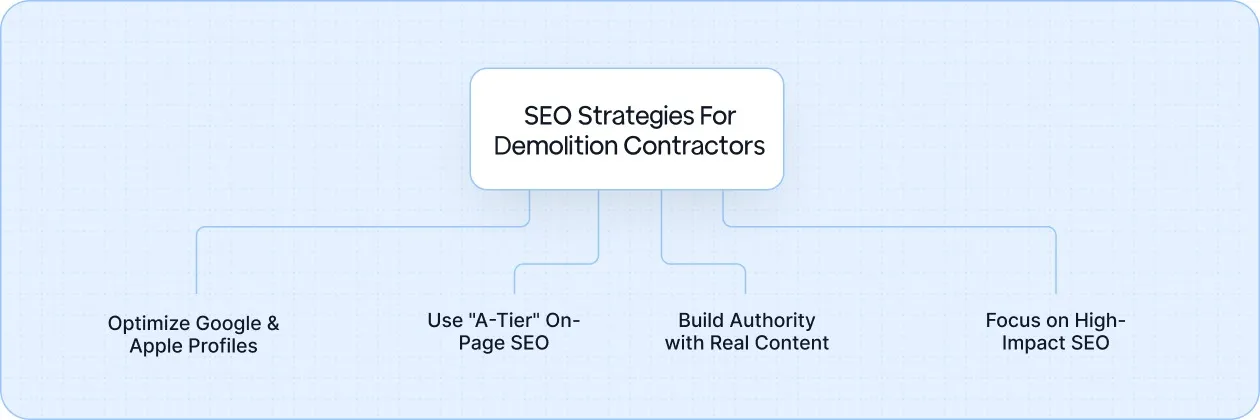
Let’s dive into the key actions that will make SEO work for you.
1. Maximize Your Google Business Profile and Apple Business Connect
Your Google Business Profile and Apple Business Connect are vital to being found by local clients. These profiles directly influence how your business shows up in search results, especially in the local “Map Pack.” Without optimized profiles, your business could be invisible when people need your services most.
Optimization Steps:
- Primary and Additional Categories: Ensure your primary category accurately reflects your core service, like “Demolition Contractor,” and add relevant secondary categories to increase discoverability.
- Completeness Is Key: Fill in every section, services, contact details, hours, photos, and business descriptions. This improves your chances of appearing in search results.
- Consistency: Keep your details consistent across platforms and regularly updated to stay relevant.
Want your business to appear when clients need it most?
Local optimization begins with accurate and detailed business profiles. A well-maintained profile is key to being seen by potential clients at the right moment.
Strengthen Your Local SEO
2. Implement "A-Tier" On-Page SEO Tactics
Optimizing your website’s on-page elements allows both users and search engines to understand exactly what services you offer and where. This is essential for targeting local customers actively searching for demolition services.
Key Focus Areas:
- Keyword Placement: Integrate your primary keywords (like “Demolition Contractor Chicago”) into your page titles, headers, and URLs to help Google understand your focus.
- Location-Specific Content: Infuse your content with location-specific terms (e.g., city names, neighborhood mentions) to align your services with local search intent.
- Dedicated Service Pages: Each of your services (e.g., “Concrete Demolition,” “Asbestos Removal”) should have its own detailed page. This increases relevance and attracts specific searches.
3. Build Your Authority with Genuine Content and Local Relationships
Google values authenticity; real content that connects with the local community improves your SEO. Share your team’s story, customer success, and local partnerships to position yourself as the go-to expert.
How to Build Authority:
- Real Proof Over AI Content: Use authentic images of your projects, team members, and equipment. Google favors this over generic, AI-generated content.
- Customer Stories and Local Engagement: Showcase testimonials, case studies, and local collaborations to strengthen your trustworthiness and relevance in the community.
Want to be seen as the trusted expert in your area?
Establish authority by sharing authentic content, customer stories and more valuable content to show your expertise and rise above your competition.
Establish My Expertise
4. Focus on High-Impact SEO Factors and What to Skip
There are a lot of low-impact SEO tactics that can waste time without providing results. Geotagging images and social media activity may seem helpful, but they don't contribute to your rankings. Instead, focus on strategies that truly matter.
Key Focus Areas:
- Don’t Overthink Geotagging: Geotagging images doesn't improve your SEO, so don’t invest unnecessary time in this.
- Skip Social Signals: While social media is important for engagement, it doesn’t directly impact your SEO rankings. Focus on content-driven SEO strategies instead.
Must Read: Get Noticed or Get Overlooked: The Ultimate SEO Guide for Contractors
Is your SEO strategy driving real results for ROI?
Description: Focus on what truly matters, backlinks and optimized content, while letting go of low-impact tactics.
Take Control of My SEO
Reviews and Internal Links to Strengthen Your SEO
Positive customer reviews and effective internal linking are essential strategies for improving your SEO. Reviews enhance your local visibility and build trust, while internal links strengthen your site’s structure and relevance.
Together, they help ensure your business stands out in search results and connects with the right clients.
a) Customer Reviews
Customer reviews directly impact your local SEO. Positive reviews attract potential clients and signal to search engines that your business is credible and relevant.
Google values customer feedback, making it a powerful tool to help you rise in local search results. Engaging with your customers through reviews also strengthens your online presence and credibility.
- Impact on Local SEO: Reviews are a key factor in local rankings, as Google prioritizes businesses with high-quality, consistent feedback.
- Trust and Social Proof: Positive reviews act as a vote of confidence, making prospects more likely to trust and choose your business.
b) Internal Linking
Internal linking connects the dots between different pages on your site, helping search engines and users navigate it more effectively. This strategy strengthens your website’s structure, making it easier for search engines to determine the relevance and relationship between your content.
Additionally, it helps keep visitors engaged, guiding them from one page to another in a logical flow.
- Improves Site Structure: Internal links enhance your website's organization, which can positively impact SEO.
- Improves Relevance: Linking relevant pages together helps Google understand the context of your content and reinforces your target keywords.
Incorporate Technical SEO to Enhance Website Performance
Website performance plays a crucial role in both user experience and search engine visibility. Fast loading times and a mobile-friendly design ensure your visitors stay engaged and help improve your rankings.
Let’s dive into how optimizing these aspects can directly impact your demolition business’s online presence.
a) Site Speed
Website speed directly impacts how users experience your business. Google prioritizes fast-loading sites because they provide a better experience for users, leading to higher engagement and lower bounce rates.
A slow website can frustrate visitors and make them leave, while a fast one keeps them on your site longer, signaling to Google that your content is valuable. Faster sites retain users longer and increase the likelihood of conversions, improving both user experience and SEO.
b) Mobile Optimization
More clients are searching for demolition services on mobile devices than ever before. In fact, mobile-first indexing means that Google now prioritizes the mobile version of your website for ranking. If your site isn’t optimized for mobile, you risk losing valuable clients and missing out on better rankings.
Ensure that all your content displays correctly across all devices, from desktops to smartphones, to provide a seamless experience for users.
Must Read: Why Construction Companies That Master SEO Get More Projects: 8 Key Strategies to Get Started
Choose the Right Keywords for Your Demolition Business
Keyword research is the backbone of your SEO strategy, helping you connect with clients who are actively searching for your demolition services. By targeting the right, specific terms and long-tail keywords, you can attract highly qualified prospects and stay ahead of the competition.
Let’s explore how to identify and use the best keywords to get your business noticed.
a) Keyword Research Process
Effective keyword research is the foundation of your SEO strategy. It requires understanding what your potential clients are actually searching for when they need demolition services.
By using tools like Google Keyword Planner or Ahrefs, you can uncover keywords that align with your audience’s search intent, allowing you to create content that answers their questions and meets their needs.
Client-Centric Search Terms: Focus on understanding the specific services your clients need, such as “emergency demolition services” or “green demolition contractors,” and target those terms.
b) Target Long-Tail Keywords
Long-tail keywords are a goldmine for demolition businesses. These highly specific search terms, such as “licensed concrete demolition in Chicago” or “affordable house demolition,” may attract fewer searches, but they bring in more qualified prospects who are closer to hiring.
People searching for these specific services know exactly what they want, making them more likely to convert into clients.
Long-tail keywords help you cater to specific needs, reducing competition and increasing the chances of connecting with users ready to take action.
Is your content attracting the right people?
Selecting precise keywords aligned with client needs makes it easier to connect with those looking for your services.
Perfect My Keyword Strategy
Build Backlinks and Local Citations to Improve Authority
Backlinks and local citations are essential for strengthening your demolition business’s online authority. These elements improve your SEO by enhancing trust and relevance in local searches, ultimately driving visibility and engagement.
Let’s dive into how you can leverage these strategies to improve your presence.
a) Backlink Building
Backlinks act as endorsements from other websites, helping search engines recognize your site’s value and authority. Focus on securing high-quality backlinks from local businesses, industry websites, and trusted directories. These connections improve your rankings and drive valuable traffic to your site.
A single backlink from a reputable local business or industry leader carries more weight than several links from lower-quality sources.
b) Local Citations
Local citations ensure your business information is accurate across various online directories, helping search engines confirm your location and credibility. Consistency in your NAP (Name, Address, Phone number) is essential for appearing in local search results. Inconsistent details can confuse search engines, harming your SEO.
Ensure your NAP details are the same across all directories to avoid penalties and enhance local search rankings.
Mobile Optimization and User Experience (UX)
Optimizing your demolition business’s website for smartphones is essential. A seamless mobile experience, coupled with a well-designed user interface, keeps visitors engaged and improves your chances of ranking higher in local searches.
Let’s explore how mobile optimization and user-friendly design can make your site stand out.
a) Mobile Search
With a large portion of clients searching for demolition services directly on their phones, mobile optimization is critical. If your website isn’t responsive or loads slowly on mobile devices, potential clients may quickly abandon it and turn to competitors.
A mobile-optimized site ensures that your business appears trustworthy and accessible when clients need it most, no matter where they are. Google now uses mobile versions of websites for ranking purposes, making it crucial for your site to deliver a smooth mobile experience.
b) User Experience (UX)
User experience is how easily and quickly visitors can navigate your site. A positive UX means users can find what they need without frustration, keeping them engaged and more likely to take action. This directly impacts your SEO, as Google prioritizes websites that provide clear, intuitive, and satisfying experiences.
An easy-to-use, clutter-free website with clear calls to action will keep users moving through your site and increase the likelihood of converting them into clients.
Suggested Read: Local SEO for Contractors: A Simple Guide to Get Noticed
Start Implementing SEO Strategies to Be Visible Locally
SEO for demolition contractors requires optimizing your website for local searches, creating structured and relevant content, building your online authority, and providing a seamless user experience that keeps clients engaged.
By focusing on these elements, you’ll improve your rankings and attract and convert more qualified leads.
If your business is ready to streamline its content strategy and improve its SEO, now is the time to take action and optimize your website for better visibility and results.
Ready to refine your content strategy for better SEO outcomes?
Gushwork helps businesses streamline their content strategies with personalized SEO approaches that enhance local visibility and drive meaningful results.
Book a Free SEO Consultation

SEO
Jan 7, 2026
5 mins
Strategically Planned and Tested Local SEO Moves to Get Your Lighting Installation Business Noticed!
Batul Beawarwala
When someone searches for “lighting installation near me,” they’re looking for someone who can solve their immediate need with expertise and reliability.
But how will they find you if your business isn’t visible where it actually should be?
Local SEO for lighting installation helps you position your business exactly where your potential clients are looking, right in their neighborhood. It’s a chance to make your expertise the first thing they see when they need help the most.
What Does Local SEO Mean For Your Lighting Installation Business?
Local SEO ensures your lighting installation business shows up when customers search for services nearby. It focuses on helping you optimize your online presence, so you appear in location-based searches like “LED lighting installation in Chicago” or “affordable lighting solutions near me.”
This targeted approach connects you directly with people in your area who need your services.
Why Local SEO Matters?
For lighting installers, being visible in local searches is essential. Most customers seek out businesses in their region.
Without local SEO, you risk losing potential customers to competitors in your area. By optimizing for local searches, you ensure that your business appears when it matters most.
The Immediate Benefits
A well-executed local SEO strategy increases your visibility and puts your business in front of customers who are already looking for services in your area. This leads to more inquiries and service calls, driving growth for your business.
Suggested Read: Landscape Lighting SEO: Strategies That Will Help Your Business Shine Bright in Search Results!
Key Local SEO Strategies for Lighting Installation Businesses
Local SEO is the key to making your lighting installation business visible to customers in your area when they need it most.
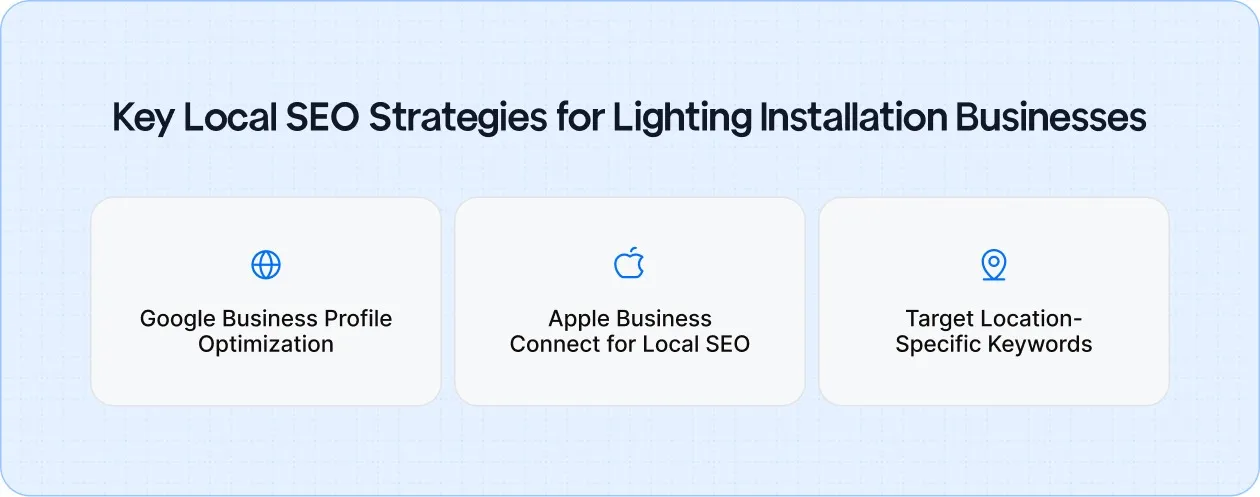
By optimizing your online presence across platforms like Google Business Profile and Apple Business Connect, and targeting location-specific keywords, you can ensure your business stands out in local search results and attracts more customers.
a) Google Business Profile Optimization
Your Google Business Profile is the cornerstone of your local SEO. If you haven’t claimed or optimized your GBP, you’re missing out on valuable opportunities to be discovered by local customers. Here’s how to make the most of it:
- Claim and Verify: Start by claiming your profile and verifying your business. This establishes your presence in Google’s local search results.
- Ensure Accuracy: Double-check that your business name, address, and phone number (NAP) are consistent across your profile, website, and other directories. Inconsistencies can hurt your ranking.
- Service Categories: Choose the right primary category (e.g., "Lighting Contractor" or "Electrical Engineer") and add up to nine secondary categories. For example, if you provide "LED retrofitting" or "energy-efficient lighting solutions," make sure to include these as secondary services to capture a broader range of searches.
- Engage with Reviews: Actively manage your customer reviews, responding to both positive and negative feedback. Engaging with customers can improve your profile's authority and lead to better rankings.
b) Apple Business Connect for Local SEO
While Google leads the charge in search, Apple Maps is a major player, especially for iPhone users. Many potential customers will use Apple Maps to find nearby services, making Apple Business Connect a must for local SEO.
- Optimize Your Listing: Just like your Google Business Profile, claim and optimize your Apple Business Connect listing. Ensure your business details are accurate, your services are clearly listed, and your images are high-quality.
- Visibility on Apple Maps: Apple Maps is used by millions of iPhone users, and optimizing for it ensures your business shows up when customers search for lighting services on their devices.
By leveraging Apple Business Connect, you’ll widen your local footprint, making it easier for iPhone users to find your lighting installation services.
c) Target Location-Specific Keywords
To dominate local SEO, your website and content need to be personalized for the specific locations you serve. Using location-specific keywords is crucial for visibility in local searches.
- Include City and Neighborhood Names: Add terms like “LED lighting installation in Chicago” or “energy-efficient lighting near Lincoln Park” to make sure you’re found when potential customers are looking for services in your area.
- Use Long-Tail Keywords: Long-tail keywords like “affordable LED installation in Chicago” or “best lighting contractors in River North” are highly specific and can capture people with strong buying intent. These are often less competitive but incredibly valuable.
Make sure that these keywords are used strategically across your website: in titles, meta descriptions, and service pages. This will help you appear in more relevant local searches, bringing in customers who are ready to act.
Must Read: Local SEO for Contractors: A Simple Guide to Get Noticed
Looking to get more local customers searching for your services?
Targeting location-specific keywords helps you show up when local customers are ready to act.
Improve Local Visibility
Optimize Your Website for Local SEO
Optimizing your website for local SEO is key to attracting nearby customers who are searching for lighting installation services.
By focusing on location-specific landing pages, on-page SEO, and site speed, you can significantly enhance your local visibility and drive more qualified traffic to your business.
a) Create Location-Specific Landing Pages
To capture local customers, create location-specific landing pages. This makes your website more relevant for searches tied to specific areas, like “Lighting Installation in Chicago” or “LED Solutions in Lincoln Park.” Key elements to include:
- Relevant Service Descriptions: Focus on the lighting services you provide in that area.
- Local Testimonials: Add feedback from customers in the same city or neighborhood.
- Project Photos: Show before-and-after images from past installations in the region.
This strategy helps search engines recognize your expertise in a specific area, increasing your chances of showing up in location-based searches.
b) On-Page SEO for Location-Specific Terms
Optimize your existing pages by adding location-specific keywords throughout:
- Title Tags & Meta Descriptions: Include city names like “Affordable Lighting Installation in Chicago.”
- Header Tags & URLs: Use specific terms, such as “LED Lighting in River North.”
This tells search engines you’re a go-to service provider in those locations, improving your chances of ranking for relevant local search queries.
Wondering how to structure your content for local SEO?
Organized, well-planned content is key to standing out in local searches.
Plan Your Content
c) Improve Site Speed
A fast website leads to better user experience and higher SEO rankings. Here’s how to improve your site’s speed:
- Optimize Images: Compress image files without sacrificing quality.
- Enable Browser Caching: Store frequently accessed data on users’ devices for faster page loads.
- Reduce Unnecessary Scripts: Eliminate or streamline unnecessary code that slows down your site.
Faster load times lead to happier visitors and better search rankings.
Create Content That Drives Local SEO
Creating content personalized to your local audience is a powerful strategy for driving relevant traffic to your lighting installation business.
By focusing on local trends, showcasing real-world projects, and offering helpful resources, you can improve your visibility in local searches while building trust with potential customers.
a) Develop Local Content That Resonates
Creating content around local topics is one of the most effective ways to drive targeted traffic. Instead of generic articles, dive into topics specific to your community and the lighting needs of residents or businesses. Here’s how:
- Lighting Trends in Your City: Write blog posts about seasonal lighting trends or new lighting technologies that are popular in your area, like “Energy-Efficient Lighting Trends for Chicago’s Historic Homes.”
- Local Regulations & Permits: Address common questions about lighting permits or safety regulations specific to your city. For instance, a post titled “What You Need to Know About Lighting Permits in Chicago” will attract local customers navigating local regulations.
- Seasonal Solutions: Highlight lighting solutions for different seasons, such as “Top Lighting Options for Chicago Winters,” to attract traffic when people are planning seasonal upgrades.
This approach improves local search rankings and positions your business as the go-to resource for area-specific lighting expertise.
Want to create content that connects with your local audience?
Focus on local trends and relevant topics to drive traffic, build trust, and attract more business from your community.
Create Impactful Content
b) Incorporate Local Case Studies and Testimonials
Nothing builds trust faster than real-world examples from your community. Showcasing local case studies and customer testimonials is a powerful way to demonstrate your expertise and reliability.
- Case Studies: Detail specific projects you’ve completed in your area. For example, a case study like “LED Retrofit Project in Chicago’s Downtown” will resonate with local commercial clients seeking similar solutions.
- Customer Testimonials: Feature reviews from satisfied customers in your service area. Highlight positive experiences with specific services like residential lighting installation in Lincoln Park or energy-efficient upgrades in River North. These authentic reviews help build credibility and show potential customers that you are in their own neighborhood.
Local case studies and testimonials provide social proof and demonstrate that you have experience serving customers with similar needs in their area.
c) Educate with Valuable Resources
Establish your business as an authority by providing educational content that solves real problems. The more useful your content, the more likely it is to attract and engage local searchers.
- How-to Guides: Offer simple, step-by-step guides on topics like “How to Choose the Right Lighting for Your Chicago Home” or “Installing Outdoor Lighting in Chicago’s Harsh Winters.” These guides show you understand local needs and make it easy for customers to take action.
- Energy-Saving Tips: Share helpful content like “5 Ways to Cut Lighting Costs in Chicago Homes,” providing practical advice while promoting energy-efficient lighting solutions you offer.
- Video Tutorials: If possible, create video tutorials that showcase your expertise in real time, such as “Behind the Scenes: A Residential Lighting Installation in Chicago.” Videos can help increase engagement, enhance your site’s SEO, and connect with users on a deeper level.
Educational resources attract visitors and position your brand as an expert, creating long-term trust with your community.
Generate Reviews and Build Local Citations
Customer reviews and local citations play a pivotal role in your lighting installation business’s local SEO. By encouraging satisfied clients to leave reviews and ensuring your business is listed consistently across local directories, you can improve visibility, build trust, and improve your search rankings.
This section shows you how to leverage both to strengthen your local online presence.
a) Encourage Customer Reviews
Positive customer reviews are one of the most effective ways to improve your local SEO. When potential customers search for lighting services, they want reassurance that your business is trustworthy and reliable. That’s where reviews come in.
- Why Reviews Matter: Google uses reviews to help determine which businesses rank higher in local search results. A strong collection of positive reviews builds credibility and trust, making it more likely that potential customers will choose your business over competitors.
- How to Encourage Reviews: Make the process as easy as possible for your customers. After a successful installation, send them a quick follow-up email or text asking for a review. If possible, include a direct link to your Google or Yelp review page to minimize friction.
b) Systemize Review Requests
Set up an automated email or text campaign to request reviews shortly after completing a service. Ask for feedback when the customer’s satisfaction is at its peak.
A simple message like “We’d love to hear your feedback!” can go a long way in encouraging customers to leave positive reviews.
c) Visual Social Proof
When your customers include photos with their reviews, it adds an extra layer of credibility. Google prioritizes reviews with images, so ask satisfied clients to snap a picture of their newly installed lighting.
This visual proof can help push their review to the top of search results and enhance your business’s trustworthiness.
d) Build Local Citations
Local citations are mentions of your business across the web, typically in directories or on local business sites. They play a crucial role in local SEO by signaling to Google that your business is active and credible in your geographic area.
- What Are Citations? Citations include your Name, Address, and Phone number (NAP). Ensuring your NAP is consistent across all platforms, such as Google, Yelp, and Yellow Pages, helps reinforce your local presence.
- Where to List Your Business: Aim to get listed in local Chicago directories and other relevant platforms that are popular in your area. Consistency is key, so make sure your business information is the same across every directory and listing.
Why Local Citations Matter?
- Visibility: Citations help your business get noticed by both search engines and potential customers.
- Credibility: Google uses the consistency of your NAP data to verify that your business is legitimate, which directly influences your local rankings.
d) Form Local Partnerships for Backlinks
Building strong, local partnerships can help your business earn high-quality backlinks, further improving your SEO efforts. Collaborate with businesses that share your audience, such as electricians, construction companies, or even local home improvement stores, to gain valuable backlinks to your site.
- Backlinks from Trusted Sources: Backlinks are an important ranking factor for Google. The more reputable the website linking to you, the more authority your site gains. Local businesses and trusted organizations can be excellent sources for these backlinks.
- How to Start: Reach out to local partners and offer to collaborate on content, co-host community events, or simply offer to link to their business on your website in exchange for a link to yours. These backlinks will improve your SEO and help establish your business as a trusted local authority.
Must Read: Search Engine Optimization for Paving Companies: Why Some Businesses Show Up First?
Track SEO Progress and Refine Your Strategy
Tracking your SEO progress is essential to ensure your efforts are driving results. By monitoring key metrics, evaluating insights from your Google Business Profile, and continuously refining your content and tactics, you can stay on top of your SEO game and adapt to ever-changing trends.
a) Monitor SEO Metrics That Matter
To gauge the success of your local SEO efforts, you need to track key metrics that give you real insight into your performance. Focus on:
- Keyword Rankings: Track how well your location-based keywords are ranking in local search results. Are terms like “Lighting Installation in Chicago” climbing the ranks?
- Organic Traffic: Use tools like Google Analytics to monitor traffic from organic searches. This helps you see if your SEO efforts are driving more visitors to your site.
- Conversions: Understand the actions users take once they land on your site. Are they requesting quotes, calling your business, or engaging with your service pages? These conversions indicate the effectiveness of your SEO strategy in attracting potential customers.
By regularly monitoring these metrics, you can get a clear picture of how your SEO is impacting your business and make adjustments to stay on track.
b) Evaluate Google Business Profile Insights
Your Google Business Profile is a goldmine for understanding how local customers interact with your business online. The insights section in GBP reveals:
- Search Queries: See which search terms led people to your profile. This helps you understand what potential customers are looking for and if your business is showing up for the right searches.
- Customer Actions: Monitor the actions customers take after viewing your profile, like clicking for directions, visiting your website, or calling your business. These insights tell you how well your profile is converting traffic into actual leads.
Regularly reviewing Google Business Profile insights lets you optimize your profile and adjust your strategy to better meet customer expectations.
c) Adjust Content and SEO Tactics
SEO is an ongoing process of refinement. Here’s how to keep improving:
- Content Performance: Review the performance of your content. Which blog posts, service pages, or landing pages are attracting the most organic traffic? Which ones are leading to conversions? This helps you identify high-performing content and areas that need improvement.
- SEO Tactics: Don’t rely on static tactics. Regularly assess your strategy by testing new keywords, refreshing old content, or exploring new local SEO opportunities like community events or partnerships. Google’s algorithm evolves, and so should your strategy.
The key is to stay proactive, using data to fine-tune your SEO efforts for better results over time.
Advanced Tips for Local SEO in the Lighting Industry
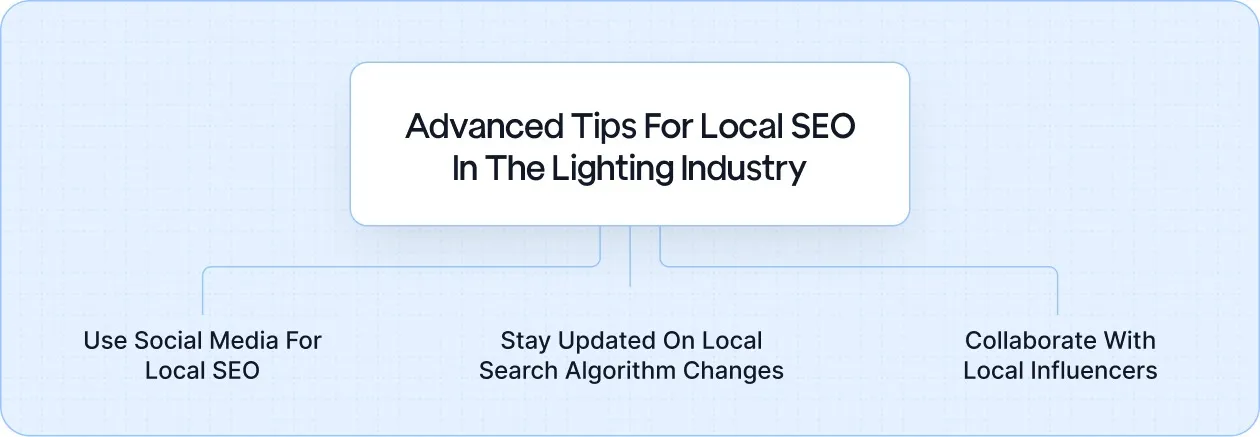
To take your local SEO to the next level, it’s crucial to embrace advanced tactics that go beyond the basics. From using social media to improve local visibility to staying on top of algorithm changes and partnering with local influencers to build credibility, these strategies will help you strengthen your presence in the local market and stand out from competitors.
a) Utilize Social Media to Improve Local SEO
Social media platforms are powerful tools for building local SEO, but they’re often underutilized for this purpose. Here’s how to use social media to drive more localized traffic and engagement:
- Geo-Tags and Location-Based Hashtags: Tag your posts with location-based hashtags like #LightingInChicago or #ChicagoLightingInstallers. Additionally, use geo-tags to show up in local searches when users browse nearby businesses or posts. This makes your business discoverable by local customers actively searching for services in their area.
- Engagement is Key: Respond to comments, share user-generated content, and promote local events or projects. Engagement signals to search engines that your business is active and trusted in the local community.
Social media is a vital local SEO tool when used strategically to engage directly with your community.
b) Stay Updated with Local Search Algorithm Changes
Google's algorithm updates frequently, and staying informed about local search algorithm changes can keep your lighting installation business ahead of the competition. Here’s why staying updated is crucial:
- Local Search Algorithm Updates: Google regularly adjusts its local search ranking factors, affecting how businesses appear in local results. For example, increased importance of reviews or changes in Google My Business ranking factors can directly influence your visibility.
- Adapt and Refine Your Strategy: If you stay informed about updates, you can tweak your content, keywords, or business profile to align with the latest algorithm preferences. This proactive approach ensures you’re always optimizing based on Google’s evolving requirements.
You don’t have to track every update, but staying aware of the most impactful changes will help you remain competitive in local search results.
c) Collaborate with Local Influencers
Building a local authority requires building relationships within your community. Local influencers can help amplify your SEO efforts by driving local traffic and building trust with your audience. Here’s how to tap into this strategy:
- Partner with Relevant Influencers: Collaborate with local influencers who have a following in your target area. For instance, a popular local home improvement blogger or a well-known interior designer in your city could help promote your lighting services. They bring credibility and exposure to your business while improving your local relevance.
- Content Collaboration: Work together to create content that appeals to your shared audience. Social media shoutouts, blog posts, and co-hosted events with influencers help create authentic content that resonates with local customers.
These partnerships give you exposure to a new, engaged audience while strengthening your brand’s presence in your community.
Suggested Read: Electrician SEO That Turns Your Website Into a Lead Machine
Take the Next Step Towards Enhanced Local SEO for Your Lighting Installation Business
Elevating your local SEO requires a strategic, multi-faceted approach that goes beyond the basics. By actively engaging with social media to enhance local visibility, staying ahead of algorithm shifts to adapt your strategy, and building authentic relationships with local influencers to increase credibility, you can create a strong local presence.
These tactics will differentiate your business from the competition and drive meaningful, long-term growth in your community.
Implement these advanced strategies today and watch your lighting installation business shine brighter in local search results.
Looking to take your local SEO to the next level?
With Gushwork’s expertise in content-led SEO, we help you create a streamlined strategy that drives local traffic and converts it into long-term growth.
Book a Free SEO Consultation

Digital Marketing
Jan 7, 2026
5 mins
Tired of Posting Without Impact? 11 Animal Services Content Marketing Strategies That Convert Care into Action
Ishani Mitra
If you work in animal services, content is never the problem. There are always animals to care for, stories to tell, updates to share, and urgent needs to communicate. The real challenge is making all that content actually work together.
Most shelters, rescues, and animal service organizations post consistently, yet still struggle with low adoption follow-through, donor drop-off, or supporters who engage emotionally but never take the next step. That disconnect usually is about structure. Content exists, but it isn’t guiding people anywhere.
Animal services content marketing is about changing that.
In this blog, you’ll learn what content marketing really means in the context of animal services, how to build a clear and realistic content marketing plan, and how supporting channels can strengthen your content so it creates a lasting impact.
What Content Marketing Means for Animal Services?
Animal services content marketing means creating helpful, story-led, trust-building content that keeps working long after you hit publish.
It’s a system that helps the right people find you, understand your work, and take a clear next step, like adopting, fostering, donating, volunteering, or partnering.
Animal services content marketing serves three purposes:
- It builds understanding.
People outside the organization rarely know what animal care, rescue, or rehabilitation actually involves. Content helps explain the work behind the scenes in a calm, transparent way.
- It builds trust.
Consistent, thoughtful content shows that your organization is stable, responsible, and intentional. Trust is especially important in animal services because supporters are emotionally invested and want reassurance that animals are cared for properly.
- It supports long-term engagement.
Content marketing creates a steady presence. It allows people to learn at their own pace and return when they are ready to take action.
In this space, content has two jobs at the same time. It has to make people feel something, and it has to make things easy. This usually includes a mix of “trust content” and “decision content.”
- Trust content builds credibility and emotional connection.
- Decision content reduces hesitation and answers questions people are already asking.
Let’s make a content marketing plan around this.
Creating an Animal Services Content Marketing Plan
An animal services content marketing plan exists to bring structure to what is otherwise constant, reactive communication.
At a basic level, the plan answers three questions clearly: who the content is for, what it needs to help them understand, and how it supports real outcomes:
1. Define Your Audiences And Goals First
Your content plan has to match who you serve and what you want to achieve.
- List your main services and segments. Write down each service and match it with who uses it most. For example: puppy owners for training, busy professionals for daycare, senior pet owners for in-home vet visits.
- Set 2–3 clear goals for content. Examples include more grooming bookings, more wellness plan sign-ups, or higher adoption applications. Avoid vague goals like “more followers.”
- Map which content supports which goal. Tie each goal to specific content ideas. A “new puppy care” email series supports training packages. A “how to prepare for grooming” guide supports first-time grooming visits.
- Decide how you will measure success. Track things like form submissions, calls, online bookings, and requests from existing clients.
2. Choose Core Content Themes Your Brand Will Own
Great animal services content repeats a few strong themes instead of chasing every trend. Think in “pillars” that match what you actually sell.
- Health and safety education. Share clear, practical advice on vaccinations, parasite control, grooming safety, behavior red flags, and seasonal risks. Avoid drama; focus on calm, expert guidance.
- Everyday care and routines. Talk about nail trims, brushing, enrichment, crate training, or litter box care. These topics show you understand real life with pets.
- Service prep and aftercare. Create content that explains what happens before, during, and after each service, like surgery, boarding, or grooming. This reduces anxiety and calls to your front desk.
- Stories and community. Use success stories, adoption updates, “day in daycare” recaps, or “patient of the week” posts to bring emotion into the plan.
3. Pick The Right Channels For Your Animal Services Content
You do not need to be everywhere. You need to be present where your specific pet owners or facility managers actually pay attention.
- Website and blog as your main home. Every key guide, FAQ, and resource should live on your website first, then be repurposed for social or email later. This improves search visibility and trust.
- Google Business Profile for local discovery. Add posts about promos, reminders, or seasonal tips. Many pet owners never reach your website if your profile already answers their questions.
- One or two social platforms. For most animal services, Facebook and Instagram work well. Shelters may also see value in TikTok. B2B animal services can use LinkedIn when dealing with clinics or suppliers.
- Email for loyalty and reminders. Use email to send appointment reminders, check-ins, health tips, and service updates. This keeps you top of mind between visits.
4. Map Content To The Pet Parent Journey
Strong content plans support every stage of the decision process, from “I think my dog has a problem” to “I am ready to book.”
- Top-of-funnel awareness content. Create posts that answer early problems, such as “Signs your cat may be stressed” or “Is my dog overweight?”, to attract new visitors.
- Mid-funnel trust and comparison content. Write pages explaining your approach versus common alternatives, such as “In-home pet sitting versus boarding,” with honest pros and cons.
- Bottom-funnel conversion content. Build service pages that show exactly what happens during appointments, what it costs, and how to book, so people can decide quickly.
- Post-visit retention content. Share aftercare guides, training refreshers, or seasonal reminders that keep clients returning instead of drifting to competitors.
5. Plan Topics By Season And Local Reality
Animal needs change with the calendar, and your content should follow those cycles. Think fleas, ticks, heat, fireworks, travel, and holiday boarding.
- Create a simple annual content calendar. Mark key months for vaccines, travel, shedding, storms, and heat, then plan matching topics and reminders around those periods.
- Align content with real local risks. If you live in a tick-heavy area, cover prevention thoroughly; if summers are brutal, talk about heatstroke, paw safety, and hydration in depth.
- Use “campaign clusters.” During busy periods, publish or share several related pieces together, such as blogs, social posts, and emails around “spring parasite prevention.”
- Leave room for unexpected events. Keep flexibility so you can respond quickly to disease outbreaks, weather events, or recall notices that affect pet safety.
6. Structure Your Website For Both Content And Conversion
Your website is your home base, where all content should eventually point. It needs structure that makes sense to both Google and pet parents.
- Create clear service pages. Dedicate one page to each core service, such as grooming, daycare, boarding, training, or wellness exams, with clear benefits and FAQs.
- Add local signals across the site. Mention your city and nearby areas naturally in headings, paragraphs, and alt text, so search engines understand where you work.
- Organize content into hubs. Group posts under themes like “Puppy Care,” “Senior Pets,” or “Behavior Basics,” with hub pages that link to all related articles.
- Use simple calls to action. Add clear buttons like “Book an appointment,” “Schedule a meet-and-greet,” or “Call us today,” so every page gives a next step.
Make Content Easy to Act On
Structure your website so stories, guides, and updates naturally lead to adoption, donations, or bookings.
Improve My Website Content
7. Turn One Strong Piece Into Many Touchpoints
You do not need to create every post from scratch. Good content plans recycle one strong idea across multiple formats and channels.
- Start with a detailed “anchor” guide. Write one high-quality article about a key topic, such as “Complete guide to puppy’s first year,” that lives on your site.
- Break the guide into social and email pieces. Turn each section into standalone posts, stories, or email tips to stretch that work across the month.
- Create a simple downloadable checklist. Offer a “new puppy checklist” or “boarding packing list” as a lead magnet in exchange for email addresses.
- Film one or two videos around the same topic. Use short clips to demonstrate parts of the guide, such as trimming nails or crate training basics.
8. Measure What Works And Adjust
A content marketing plan only improves when you pay attention to what people actually read, click, and act on. Numbers should guide your next steps, not scare you.
- Track basic website and booking metrics. Monitor page views, top pages, form fills, and calls from your website or Google profile each month.
- Watch which topics drive real actions. Look for patterns where certain posts or pages often precede bookings, then double down on those themes.
- Review social and email performance. Note posts that get saves, shares, or replies, and emails with high open and click rates, then reuse that style or topic.
- Adjust your calendar every quarter. Drop content that gets no interest, expand topics that resonate, and refine based on real audience behavior.
Be Clear and Credible
Clarify what your organization stands for so supporters understand your work and trust your process.
Clarify My Brand Positioning
Best Content Marketing Ideas For Animal Shelters In 2026
Shelters need content that actually attracts adopters, supporters, donors, foster families, and volunteers, while feeling human, emotional, and genuinely helpful.
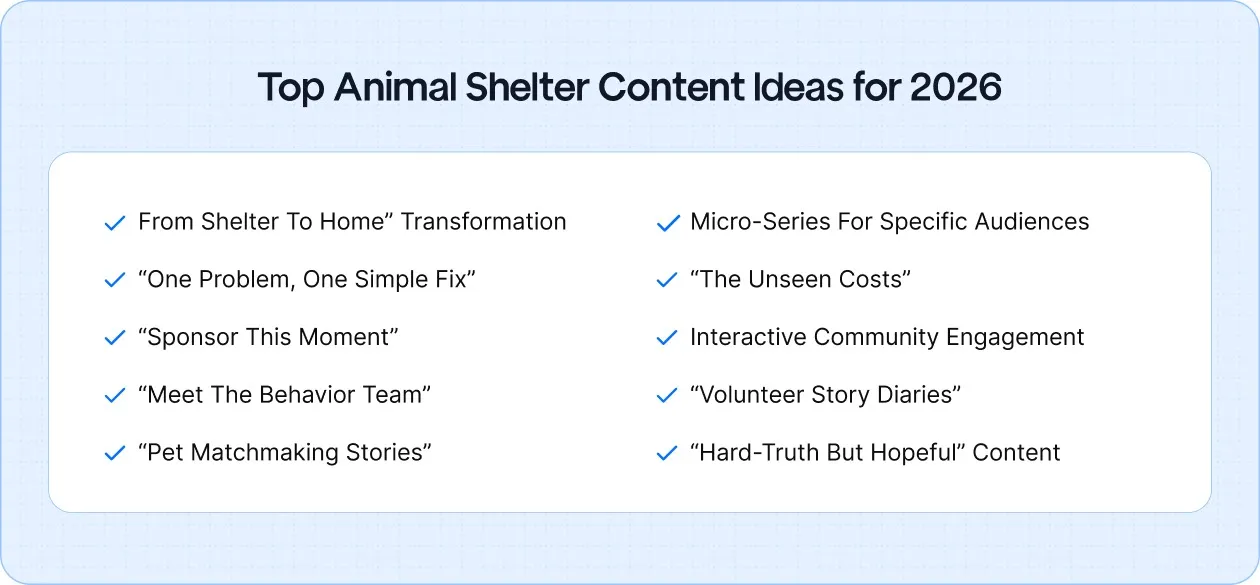
Below are fresh content ideas shelters can truly execute:
1. “From Shelter To Home” Transformation Storytelling Series
People don’t connect only to dogs or cats. They connect to before-and-after life change. This content idea focuses on the emotional transformation journey.
How to do it well:
- Tell what life was like before rescue
- Explain what changed at the shelter
- Show what life looks like in their new home
- End with: “This is what your support makes possible”
Formats you can produce:
- Photo carousel: intake ➝ recovery ➝ happy home
- Short vertical video story
- Side-by-side transformation before/after visuals
- Mini-documentary style clips for big cases
2. “One Problem, One Simple Fix” Pet Education Mini-Series
This is bite-sized, practical advice content that solves minor but stressful everyday problems pet owners face.
How to structure each content piece:
- Start with the problem in real-world language:
- Barking at delivery people
- Cat not using the litter box
- Puppy chewing furniture
- Share one simple, humane tip
- Keep tone supportive, not judgmental
- End with: “If this helps, share it, someone else is struggling too.”
Best formats:
- 30–45 sec videos
- Simple static graphics
- Short blog + short video paired
3. “Sponsor This Moment” Storytelling Content
Instead of generic donation appeals, build sponsorship content that allows donors to emotionally connect with specific moments they can fund.
What moments to create content around:
- First warm bath
- First soft bed
- First vet treatment
- First meal after neglect
- First time playing
How to execute:
- One short story per moment
- A very human emotional caption
- A simple “Sponsor this experience for the next dog like this”
4. “Meet The Behavior Team” Myth-Breaking Content
People assume animals in shelters are broken or dangerous. This content shows the effort, science, and kindness behind behavioral support.
What to show:
- Gentle training sessions
- Calm confidence-building exercises
- Enrichment activities
- Success progress clips
- Humor when appropriate
How to present:
- Short videos
- Before ➝ training ➝ improvement clips
- Friendly human narration
- Simple everyday language
5. “Pet Matchmaking Stories”
People love matchmaking stories. Show how thoughtfully you pair animals with homes rather than “first come, first served.”
What each content piece should include:
- Who the family was
- What they needed emotionally or practically
- The animal’s personality
- Why it was the perfect fit
- A happy final moment
Formats:
- Reel / TikTok explaining the match
- Photo series + story caption
- Blog-style hero adoption recap
6. Micro-Series For Specific Audiences
Different supporters consume different kinds of content. Create dedicated recurring series for specific groups.
Series ideas include:
For kids:
- “Kindness to Animals” bite-size lessons
- Fun pet facts
- Cartoon-style storytelling posts
For seniors:
- Gentle pet companionship stories
- Benefits of senior pet adoption
- Calm, emotional storytelling
For busy families:
- Low-maintenance pet care guides
- “Life with kids + pets” real stories
- Practical advice in under 60 seconds
7. “The Unseen Costs” Emotionally Honest Content
People think adopting costs money. They forget that saving animals already costs the shelter money long before adoption fees.
Create content that respectfully reveals:
- Medical treatment timelines
- Special case surgeries
- Rehab timeframes
- Medication expenses
- Emotional work from staff
Present it like:
- Real stories
- Calm, compassionate tone
- No guilt language
- Clear explanation of why donations matter
8. Interactive Community Engagement Content
Not everything should be emotional or educational. Some should make people participate.
Great interactive content ideas:
- “Name this pet” polls
- “Which personality fits you?” quizzes
- “Who wore it better: pet edition?” fun posts
- Guess the age / breed game
- Adoption anniversary shoutouts
9. “Volunteer Story Diaries”
Shelters rely on volunteers, and people love human-warming volunteer narratives. Instead of requesting for volunteers, inspire them to come forward.
Great content approaches:
- Why they joined
- First emotional experience
- Their favorite animal story
- What volunteering changed in their life
- Heartfelt closing thoughts
Formats:
- Blog-style storytelling
- Photo + heartfelt caption
- Mini-documentaries for bigger shelters
10. “Hard-Truth But Hopeful” Content
Sometimes you must talk about the difficult parts, but in a respectful, responsible, non-traumatic way.
Possible content:
- Why long-stay dogs deserve homes
- Why black cats and big dogs get overlooked
- What happens when shelters overflow (explained gently)
- Why responsible ownership matters
Structure:
- Explain gently
- Show facts
- Show real animals affected
- End with a hopeful action step
Turn Stories Into Impact
Create content that educates, builds trust, and gently guides people toward the next step.
Build My Content System
How Other Marketing Channels Support Animal Services Content Marketing?
Content marketing rarely succeeds on its own in animal services. Even the most thoughtful guides, stories, or educational resources need supporting channels to help them get discovered, trusted, and revisited over time.
These channels do not replace content marketing. They extend its reach, reinforce its credibility, and help it perform different jobs at different stages of the supporter journey:
SEO: Making Content Discoverable
Search Engine Optimization is the backbone of animal services content marketing because it determines whether your content is ever seen by people actively looking for help, information, or services.
SEO supports content marketing by aligning what you publish with how people search.
- Topic-led content planning
- Content performs best when it answers specific, real questions.
- Instead of publishing isolated posts, content should be built around related topics that help readers understand a subject fully over time.
- Keyword and intent alignment
- SEO research helps identify what people are already looking for, not what organizations assume they want to know.
- Informational keywords support early learning, while local and intent-based searches support action later.
- Technical SEO
- Fast page load times matter for mobile users
- Ensures content is easy to access and read
- Clear navigation helps readers move between related resources
- Website structure and experience
- Content needs to be easy to find, read, and navigate.
- Clear internal linking between blogs, guides, FAQs, and resource pages helps both users and search engines understand relevance.
In animal services, SEO is less about ranking for broad terms and more about becoming a trusted source for specific, useful information that continues to attract the right audience long after publication.
Get Found When People Look for Help
Strengthen SEO so your content reaches adopters, donors, and pet owners at the right moment.
Strengthen My SEO Foundation
Digital PR: Using External Trust to Reinforce Your Content
Digital PR strengthens content marketing by borrowing credibility from respected platforms and publications. When animal services organizations contribute helpful insights to established animal welfare blogs, community sites, or industry publications, it validates their expertise.
Digital PR works best when content is treated as contribution.
- Publishing value-first content
- Articles, opinion pieces, or educational features should aim to inform, not fundraise or self-promote.
- Topics like animal care standards, adoption preparation, or community challenges tend to perform better than organizational updates.
- Building authority through backlinks
- When reputable sites link back to your content, it improves search visibility and signals trustworthiness.
- These links also guide new readers back to deeper resources on your site.
- Positioning the organization as a credible voice
- Over time, consistent PR placements help your content feel less isolated and more part of a wider conversation around animal welfare.
For animal services, digital PR helps content move from “our perspective” to “recognized expertise.”
Pay-Per-Click Advertising: Accelerating the Reach of High-Value Content
PPC advertising plays a supporting role by adding speed where organic content takes time. It is especially useful when animal services need immediate visibility for adoption drives, fundraising efforts, or urgent needs.
Paid advertising works best when it amplifies existing content.
- Using ads to distribute educational content
- Ads that lead to guides, explainers, or adoption resources tend to perform better than direct donation or adoption asks.
- Content lowers hesitation and prepares people before they act.
- Intent-based targeting
- Search ads perform best when aligned with clear intent, such as adoption-related queries or care-related questions.
- Social ads work well when targeting specific demographics, interests, or local communities.
- Balancing reach and quality
- PPC should filter for relevance.
- Clear messaging helps attract genuinely interested people.
In this way, PPC supports content marketing by putting the right content in front of the right audience at the right time.
Email Marketing: Turning Content Into Ongoing Relationships
Email marketing supports content marketing by providing continuity. Many people who engage with animal services content are not ready to act immediately. Email allows organizations to stay present without constant urgency.
Email works best as a content delivery channel.
- Reusing content strategically
- Blogs, guides, and updates can be shared through newsletters to extend their lifespan.
- This reinforces learning and keeps supporters informed.
- Segmented communication
- Different audiences respond to different content.
- Adopters, donors, and volunteers should receive content that reflects their interests and stage of involvement.
- Building trust through consistency
- Regular, calm communication builds familiarity.
- Over time, this increases confidence and long-term engagement.
Email turns one-time content consumption into an ongoing relationship.
Social Media and Influencer Marketing
Social media is often where animal services content gains initial visibility, but its real strength lies in distribution rather than ownership.
Social platforms help content travel further when used intentionally.
- Repurposing long-form content
- Blog posts and guides can be broken into smaller visual or text-based pieces.
- These snippets act as entry points to deeper resources.
- Leveraging influencer and community voices
- Pet influencers and community advocates introduce content to new audiences who already trust them.
- Collaborations work best when influencers share educational or story-driven content rather than direct appeals.
- Guest content and audience sharing
- Publishing content on high-traffic pet blogs or community sites exposes your work to aligned audiences.
- This also supports authority and SEO through shared visibility.
Social media amplifies content, but content gives social media something meaningful to share.
Video Marketing: Adding Depth and Transparency to Content
Video strengthens content marketing by showing what the written content explains. In animal services, seeing care, environments, and people at work builds confidence faster than polished messaging.
Video should support clarity, not replace substance.
- Educational and explanatory videos
- Short videos explaining adoption steps, care routines, or rehabilitation processes reduce uncertainty.
- These work best when paired with written resources.
- Behind-the-scenes transparency
- Showing daily operations builds trust and realism.
- This reassures supporters that animals are cared for responsibly.
- Long-term usability
- Videos can live on websites, blogs, email campaigns, and social platforms.
- One video often supports multiple pieces of content over time.
Video helps content feel tangible and human.
Partner Marketing: Strengthening Content Through Shared Credibility
Partner marketing supports content marketing by embedding it within trusted local and industry networks.
Animal services rarely operate in isolation. Partners help content reach people who already care.
- Collaborating with aligned organizations
- Veterinary clinics, pet stores, groomers, and local businesses often share the same audience.
- Co-created content feels more community-driven and less promotional.
- Cross-publishing educational resources
- Shared guides or care resources benefit all parties involved.
- This increases reach while reinforcing trust.
- Building long-term visibility
- Partnerships help content resurface repeatedly instead of fading after one campaign.
Partner marketing turns content into a shared community asset rather than a single-organization effort.
Conclusion
Content marketing in animal services is about doing the right things with clarity and purpose.
When content is planned around real questions, real concerns, and real decision-making behavior, it becomes guidance. It helps adopters feel prepared, donors feel confident, and volunteers feel connected to something meaningful.
Over time, that consistency builds trust, and trust is what sustains animal services work.
Ready to Make Content Work Together
Build a content-driven system that creates trust, clarity, and consistent engagement over time.
Book A Consultation

“For the first time, we’re proud to add SEO services. Six months in, impact evident.”
Read Case Study

In Conversation with

Abhijith HK
Founder & CEO of Codewave
Want us to do the same for your business?
Talk to an Expert
.svg)
.svg)

