


Home

Resources
Blogs
Blog
Get insights on AI, productivity, and the future of work.


Thank you! Your submission has been received!
Oops! Something went wrong while submitting the form.
SEO
Dec 22, 2025
5 mins
15+ Strategies We Learned From Observing SEO for CNC Companies
Ishani Mitra
Most CNC companies do excellent work, but very few explain it well online. Precision machining, tight tolerances, and specialized capabilities are hard to communicate on a website, especially when most buyers only give you a few seconds of attention.
That gap between what your shop can do and how it appears in search results is where many CNC businesses lose opportunities without realizing it.
SEO for CNC companies exists to close that gap.
In this blog, we break down how SEO works specifically for CNC companies, what’s changed in the way search works today, and how manufacturers can build long-term visibility that supports real business growth.
Understanding SEO for CNC Companies
Search engines rely on signals. They read your pages, analyze how information is organized, and compare your site with others offering similar services. SEO for CNC companies essentially focuses on clearly defining services, processes, and expertise so that both search engines and buyers can understand them.
Because CNC buyers search based on process, precision, industry requirements, and trust signals, SEO for most manufacturing companies has shifted along with how those buyers evaluate suppliers.
The Changing SEO Landscape
As a result, SEO now operates across multiple layers, each aligned with how and where buyers search at different stages.
SEO for CNC Companies Works at More Than One Search Level
SEO for CNC companies operates differently depending on how the business sells. Some shops focus on local or regional visibility where proximity supports logistics or collaboration. Others compete nationally, supplying parts across states to buyers they may never meet. Advanced CNC manufacturers often work globally, attracting international buyers searching for specific processes, materials, or certifications.
Generative Engine Optimization (GEO) is Reshaping Search
GEO refers to optimizing your content so it can be understood, referenced, and recommended by generative AI tools such as ChatGPT and Google’s AI Overviews. This is one of the biggest changes SEO has seen in years.
The Rise of a Split SEO Strategy
CNC SEO has become split by intent. Informational content supports AI-driven research and early evaluation, while bottom-of-funnel pages are still responsible for converting high-intent buyers into quote requests. Both layers are required to move deals forward.
For CNC companies, this shift is an opportunity.
15+ SEO-Driven Content Strategies for CNC and Manufacturing Companies
Your content strategy should do two things: help real manufacturing buyers find your business online, and give them clear, useful answers so they take the next step with you.
Here are 15+ proven SEO practices tailored for your audiences:
1. Focus on Buyer Needs
To craft effective SEO content for machine shops and manufacturers, it’s crucial to prioritize buyer needs over simply targeting keywords. When your content speaks directly to buyer pain points and goals, it’s more likely to convert visitors into leads.
- Create Buyer-Focused Content: Rather than only targeting high-volume keywords, focus on the specific problems your ideal buyers face. For example, instead of focusing solely on "CNC machining," write content that explains how CNC machining solves production issues, like improving part accuracy or reducing operational costs.
- Provide Solution-Oriented Information: Prospective clients are seeking solutions. Create blog posts, landing pages, or FAQs that clearly outline how your services address their challenges, such as “Reducing Lead Times with Precision CNC Milling” or “Improving Product Consistency with Automated Machining.”
- Segment Your Content by Buyer Persona: Tailor your content for different buyer personas, such as engineers, procurement managers, and production managers, each of whom will have distinct questions and needs.
2. Target the Right Intent Keywords
Effective keyword targeting is a vital component of any successful SEO strategy. For CNC companies, using the right long-tail, buyer-intent keywords will help you attract more qualified leads who are actively searching for your services.
- Conduct Thorough Keyword Research: Use tools to find keywords with high search volume and strong buyer intent. Look for long-tail keywords like “precision CNC machining for aerospace parts” or “custom CNC parts suppliers near me.” These terms often have lower competition and target users who are closer to making a purchase decision.
- Use Keywords in Context: Integrating keywords naturally is important. Avoid stuffing your content with keywords. Instead, use them in a way that flows with the content.
- Track Keyword Performance: Continuously monitor the performance metrics of your keywords using analytics tools. Adjust your strategy based on which keywords drive the most qualified traffic and result in conversions.
Build a Keyword Strategy That Converts
Map keywords to how real decision-makers search, compare, and shortlist CNC suppliers.
Plan My Keywords


3. Optimize Every Page Beyond the Homepage
Optimizing individual pages on your website helps maximize your chances of ranking for a variety of terms, making your entire site work harder to attract leads.
- Optimize Service Pages for Specific Keywords: Every service page should focus on a unique keyword or set of keywords. For example, if you offer both CNC milling and CNC turning, create dedicated pages for each service, optimized for their respective keywords.
- Ensure Each Page is Fully Optimized: Each page should have:
- Unique title tags that include the page’s target keyword
- Meta descriptions that summarize the content and encourage clicks
- Header tags (H1, H2, H3) to structure content for both readers and search engines
- Internal links to related pages within your website, guiding users to other valuable content
4. Create Educational Content
Machine shops and manufacturers need to show their expertise and build trust. Educational content allows your business to position itself as an authority while helping potential customers solve problems they face.
- Develop How-To Guides and Tutorials: Include beginner-level how-to content on your website to capture early-stage research queries and introduce buyers to your capabilities without overwhelming them. These guides should explain fundamentals clearly and position your shop as a reliable, knowledgeable partner.
Examples of beginner-friendly how-to guides to publish:
- How CNC Machining Works: A Simple Overview for Buyers
- How to Choose the Right Material for CNC Machined Parts
- How to Prepare a Design File for CNC Manufacturing
- How Tolerances Affect Cost and Lead Time in CNC Machining
- How to Decide Between CNC Milling and CNC Turning
- Address Common Industry Challenges: Offer insights into common manufacturing problems and how your services can resolve them.
- Create Case Studies and Success Stories: Share real examples of how your machining services helped previous clients overcome significant challenges.
Turn Expertise Into Demand
Build content that explains your capabilities clearly, earns trust from engineers, and supports AI and search visibility.
Build Buyer-Driven Content
5. Use Internal Linking
Internal linking is one of the most important SEO practices to improve website navigation and increase the chances of ranking for a variety of keywords. Properly executed internal linking enhances both user experience and search engine crawling.
- Link Related Service Pages: If a user is reading about CNC turning, provide links to other related services like CNC milling or CNC prototyping.
- Use Anchor Text that Reflects Relevant Keywords: Instead of using generic phrases like "click here," use descriptive anchor text that includes relevant keywords.
For instance, “Learn more about our precision CNC machining services” will help users understand what the linked page offers while improving keyword relevance.
- Link to Blog Posts and Resource Pages: Linking from service pages to blog posts or resource sections can keep users engaged and improve your website’s overall SEO. It also gives you an opportunity to target long-tail keywords.
6. Speed Up Your Website
Fast-loading pages reduce bounce rates and increase time on site. From an SEO standpoint, page speed also influences how search engines evaluate user experience.
Key actions to improve site speed:
- Optimize images without compromising clarity: Machine photos, part images, and diagrams should be compressed while maintaining detail. This reduces load times without affecting credibility.
- Reduce unnecessary scripts and assets: Remove unused plugins, third-party scripts, and heavy animations that slow down page rendering.
- Enable browser caching: Caching allows returning visitors to load pages faster by storing key assets locally.
- Use tools like Google PageSpeed Insights or GTMetrix to track performance trends over time. Speed optimization works best as an ongoing process rather than a one-time fix.
7. Make Your Website Mobile-Friendly
Search engines prioritize mobile-first indexing. This means your mobile site is the primary version evaluated for rankings, not the desktop version. A mobile-friendly site improves crawlability, engagement, and conversion potential.
Best practices for mobile optimization
- Responsive layouts that adapt naturally: Content should resize and reorganize smoothly across devices without breaking layouts.
- Simple navigation and readable content: Menus, headings, and text should be easy to scan without zooming or excessive scrolling.
- Accessible CTAs and forms: RFQ buttons and contact forms must be easy to tap and complete on smaller screens.
- Using Google’s Mobile-Friendly Test: Review updates after design changes to ensure mobile usability remains consistent.
8. Build High-Quality, Relevant Backlinks
Backlinks are one of the most important ranking factors for search engines. The quality and relevance of the websites linking to your content can improve your domain authority and increase your site’s chances of ranking higher.
- Guest Blogging on Industry Websites: Contributing guest posts to reputable manufacturing or CNC-related websites can help build backlinks to your site. Aim for high-quality publications that are relevant to your industry to get the best results.
- Collaborate with Suppliers and Partners for Backlinks: Ask your suppliers, business partners, or clients to link back to your content from their websites. Industry-related backlinks are valuable for improving your SEO ranking.
- Submit Your Website to Trusted Directories: Listing your business on trusted manufacturing directories like ThomasNet or Maker’s Row provides high-quality backlinks and increases visibility.
- Monitor Competitor Backlinks: Use tools like Ahrefs or SEMrush to analyze where your competitors are earning backlinks. Find opportunities to secure similar links from authoritative websites.
9. Optimize for Local SEO
Local SEO is critical for machine shops and manufacturers that serve specific geographic regions. Optimizing your website for local search will help you attract nearby industrial leads and stand out in a competitive marketplace.
- Claim and Optimize Google My Business: Claiming and optimizing your Google My Business profile is essential for local SEO. Add accurate business details such as your address, phone number, hours of operation, and services offered.
- Use Local Keywords: Add location-based keywords like “CNC machining in [City]” or “Custom parts manufacturing in [Region]” to your website’s content. These keywords will help improve your rankings for local searches.
- Encourage Reviews from Local Clients: Positive reviews on platforms like Google or Yelp help boost your business’s credibility and visibility in local search results. Encourage satisfied customers to leave reviews, especially if they are based locally.
- Build Local Citations: Get listed in local directories and local business associations. Local citations improve your website’s trustworthiness in search engines and help with local rankings.
Make SEO Work Like a System
Align technical SEO, structure, and authority so your CNC business shows up where buyers actually research vendors.
Strengthen SEO Foundations
10. Harness Video and Multimedia to Boost Engagement
Videos and multimedia content can significantly improve engagement, increase time on page, and help rank higher in search engine results. Visual content also helps explain complex manufacturing processes in an easily digestible format.
- Create Explainer Videos for Your Services: Video content like “How It Works” or product demos can help visitors better understand your services.
- Show Behind-the-Scenes Manufacturing Processes: Give your audience a glimpse into your production process with behind-the-scenes videos. Show how your CNC machinery operates or highlight your quality control process.
- Use Video Testimonials: Video testimonials from satisfied clients can be more persuasive than written ones. Show potential clients how your services have solved real-world problems for others in the industry.
11. Strengthen Internal SEO and Site Structure
Having a well-structured website is critical to providing a good user experience and optimizing for search engines. A clear site structure helps both users and search engines find relevant content quickly.
- Create Clear Navigation and Categories: Group similar content together under clear categories, such as Services, Industries We Serve, and Case Studies.
- Use Descriptive, Keyword-Rich URLs: Ensure your URLs are short, descriptive, and keyword-rich. For example, instead of “example.com/page1,” use “example.com/precision-cnc-milling-services.”
- Optimize Your Website’s Breadcrumbs: Breadcrumbs provide a clear path for users to follow and help search engines understand the structure of your website.
- Audit Your Site Regularly for Technical SEO Issues: Use tools like Screaming Frog or Google Search Console to find and fix issues like broken links, missing meta tags, and duplicate content that could negatively affect your SEO.
12. Optimize for Featured Snippets to Capture More Visibility
Featured snippets occupy a prime position in search results, often appearing at the very top. These "Position Zero" results offer a significant opportunity for visibility. To improve your chances of being featured, structure your content in a way that search engines can easily extract for snippets.
- Answer Questions Clearly and Concisely: Featured snippets often pull answers directly from content that provides brief, clear answers to specific questions.
For example, for the query “What is CNC machining?” offer a precise and simple answer at the top of the content: “CNC machining is a computer-controlled manufacturing process used to create precise parts from a variety of materials.”
- Use Lists and Tables to Organize Information: Snippets are more likely to pull data from content organized into bullet points, numbered lists, or tables.
- Format Content for "How-to" Snippets: Google often selects “how-to” content for snippets. If your service involves processes or methods, use step-by-step instructions formatted with numbered lists.
13. Improve Technical SEO for Better Indexing and Ranking
Technical SEO ensures that search engines can crawl and index your website efficiently, which directly impacts your search rankings. By addressing technical SEO aspects, you improve the chances of your content being indexed correctly and ranked higher.
- Ensure Proper Site Structure and Navigation: Organize your website’s content into a logical structure using clear categories and subcategories. This helps both search engines and users find relevant pages.
- Improve Site Speed: Slow websites frustrate users and search engines. Compress images, reduce the number of HTTP requests, and minify CSS/JavaScript files to improve loading speed.
- Fix Crawl Errors and Redirect Issues: Identify crawl errors, broken links, or any URLs that return 404 errors. Fixing these ensures that search engines can access all important pages on your site, improving both indexing and user experience.
14. Prioritize for International SEO to Reach Global Buyers
International SEO ensures that your content is visible to potential customers worldwide. If your CNC company serves clients across various regions, it's important to tailor content for local languages, cultures, and market needs.
- Use Hreflang Tags for Multi-Language Websites: If your website serves multiple languages or regions, implement hreflang tags to indicate to search engines which version of the page should be shown to users based on their language and region. For example, hreflang="en-US" for the U.S. and hreflang="fr-FR" for French-speaking regions.
- Localize Content for Different Audiences: Tailor your content to meet the cultural and practical needs of different regions. For instance, if you're targeting European buyers, you might focus on EU regulations for precision manufacturing.
- Target Country-Specific Domains or Subdomains: For large-scale international expansion, consider using country-specific domains (like example.co.uk) or subdomains (like uk.example.com) for better localization and targeting in specific countries. This helps improve rankings in those regions.
15. Optimize for Image Search to Drive Product Inquiries
Image search is a growing channel for product discovery. By optimizing your images for search engines, you can drive traffic and product inquiries directly from visual search results.
- Use Descriptive Filenames for Images: When naming images, include relevant keywords that describe the content of the image. Instead of naming an image “IMG001.jpg,” use “cnc-machining-part.jpg” or “precision-machined-aluminum-parts.jpg”. This helps search engines index your images accurately.
- Add Descriptive Alt Text: Alt text describes images for both search engines and visually impaired users. Use keyword-rich, descriptive alt text for each image that matches the content of the page. For example, “custom CNC parts for aerospace” is more effective than just “machining parts.”
- Create High-Quality, Relevant Images: Make sure your images are high-quality and relevant to the services you offer. High-resolution images showcasing your CNC parts, equipment, or processes will stand out in image search results and attract more product inquiries.
- Use Structured Data for Product Images: Implement structured data markup for your product images. This helps search engines understand the context of the images and improves the chances of your products appearing in rich results or Google Shopping.
16. Repurpose Existing Content to Expand Your Reach
Repurposing content allows you to extend the reach of your best-performing material. By transforming existing content into different formats or across platforms, you can attract new audiences and keep your content fresh.
- Turn Blog Posts into Videos or Webinars: If you have a popular blog post, turn it into a video or webinar. This way, you can engage users on platforms like YouTube or LinkedIn, where visual content performs well. Videos can also rank in Google’s video search results, further increasing visibility.
- Convert Webinars into Blog Posts or Infographics: After hosting a webinar, write a blog post summarizing the key points or create an infographic to highlight important statistics. This makes your content more shareable and accessible to a wider audience.
- Update Older Content with New Insights: Regularly revisit old blog posts or guides and add updated information or new examples. This keeps your content relevant, improves SEO rankings, and ensures visitors are getting the latest information.
- Use Quotes and Key Takeaways for Social Media: Repurpose important quotes, facts, or statistics from your content and share them on social media platforms like Twitter, Facebook, or Instagram. This drives traffic back to your site while giving your content new life across different channels.
17. Use AI-Generated Content Strategically
AI-generated content tools can assist with the content creation process, but it’s essential to ensure that the content remains authentic, valuable, and aligned with your brand’s voice. Here’s how you can use gen AI strategically.
- Assist with Content Outlines and Drafts: Use AI tools to help generate content outlines or first drafts. This speeds up the process, but always refine the output with your expertise to ensure it meets your audience’s needs and maintains your brand's credibility.
- Generate Ideas for Long-Tail Keywords: AI tools can help identify related long-tail keywords or content ideas. These ideas can serve as inspiration for blog posts, service pages, and FAQs that answer buyer questions and drive targeted traffic.
- Repurpose AI-Generated Content with a Human Touch: AI can handle repetitive tasks or simple content, but adding a human touch ensures the content stays relevant and resonates with readers. Use AI-generated drafts as a starting point, but always ensure accuracy and authenticity in the final output.
Common SEO Mistakes Manufacturing Companies Should Avoid
Even companies that invest time and money into SEO often struggle to see results. In most cases, the issue is not effort, but misaligned execution. Manufacturing SEO has its own pitfalls, especially when strategies are copied from consumer or generic B2B playbooks.
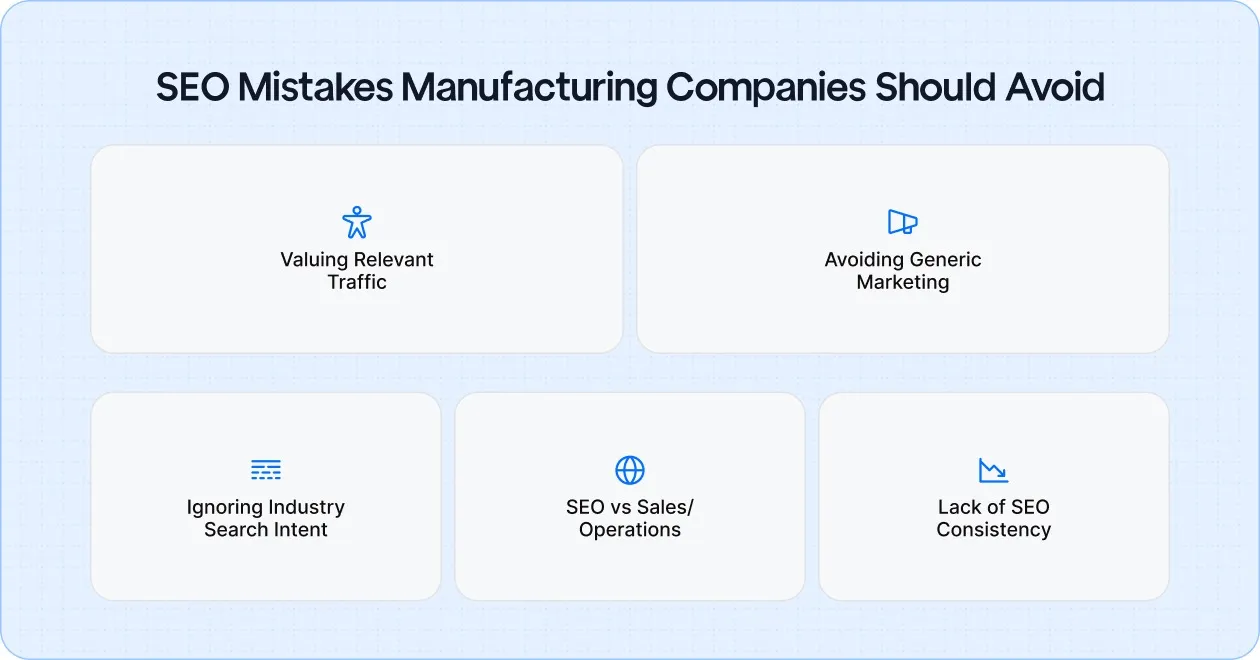
Below are common mistakes that quietly limit visibility, rankings, and lead quality for manufacturing and CNC businesses.
Treating All Traffic as Valuable Traffic
One of the most frequent mistakes is chasing traffic volume instead of buyer relevance. Manufacturing websites often rank for broad or informational terms that bring visitors who will never request a quote.
This leads to inflated traffic numbers with no commercial impact. SEO should prioritize searches tied to real purchasing intent.
Relying on Generic Marketing Language
Manufacturing buyers expect precision. When websites use vague claims or recycled marketing phrases, trust erodes quickly.
Search engines also struggle to understand pages that lack clear, specific context about processes, capabilities, and applications.
Ignoring Industry-Specific Search Intent
Manufacturing search behavior is highly specialized. Many companies fail by assuming buyers search the same way across industries.
Engineers, procurement teams, and operations managers use different terminology, specifications, and qualifiers when searching.
Separating SEO from Sales and Operations
SEO often lives in isolation, disconnected from sales teams and production realities. This creates content that ranks but fails to convert because it does not reflect real-world capabilities.
Alignment ensures accuracy, relevance, and better lead quality.
Expecting SEO Results Without Consistency
Manufacturing SEO is not a short-term tactic. Companies that abandon efforts after a few months rarely see meaningful results.
Search visibility builds gradually through consistent execution and refinement.
Conclusion
For CNC businesses that invest in getting this right, SEO does more than improve visibility. It reduces friction in the sales process, improves lead quality, and positions your shop as a serious, reliable supplier in a crowded market.
If you want your CNC company’s expertise to be easier to find, easier to understand, and easier to choose, it starts with a focused SEO strategy built for how manufacturing search actually works.
Ready to Apply This Strategically
See how these SEO principles fit your CNC business, market, and growth goals without guesswork.
Book A Consultation

Digital Marketing
Dec 22, 2025
5 mins
Email Marketing for Plumbers: 5 Genius Tips to Make Your Emails Stand Out!
Ishani Mitra
When a plumbing emergency happens, your customers need someone they trust, fast.
But how do you stay top of mind when their pipes aren’t bursting, or drains aren’t clogged? Email marketing for plumbers is the solution. It’s a straightforward, powerful way to send helpful reminders, special offers, and expert tips directly to your customers’ inboxes, keeping your business front and center when they need you the most.
No complex strategies, just simple communication that builds trust and keeps customers coming back.
Why Email Marketing Works for Plumbing Businesses?
Email marketing offers plumbing businesses a direct, cost-effective way to communicate with customers, keeping them engaged through personalized updates and timely offers.
By maintaining consistent contact, plumbers can build lasting relationships that build loyalty, increase repeat business, and generate impressive returns on investment.
a) Direct and Personalized Communication
Email marketing allows plumbing businesses to reach customers where they are, in their inboxes. With personalized messages, you can speak directly to your audience, offering timely reminders, service updates, or promotions based on their past interactions. This direct line of communication means your business stays top of mind without being lost in the noise of social media or online ads.
- Personalized messages: Reminders for seasonal check-ups or follow-ups after service calls.
- Timely offers: Discounts or special offers sent at the right time, increasing the chances of engagement.
b) Building Long-Term Relationships
Consistency is key. Regularly reaching out to your customers with helpful tips, reminders, or offers creates a sense of reliability. Email marketing gives you the chance to nurture relationships over time, turning first-time customers into loyal clients.
- Seasonal service reminders: Emailing customers about things like winterizing pipes or scheduling an annual checkup.
- Exclusive offers for repeat customers: Encourage loyalty with discounts or special offers for customers who regularly book services like drain cleaning or sewer line inspections.
c) Exceptional ROI for Plumbing Businesses
Email marketing for plumbing businesses offers one of the highest returns on investment. For every dollar spent, plumbers can expect up to $44 in return. This high ROI comes from being able to directly target interested customers with relevant, timely information.
- Cost-effective outreach: Unlike paid ads, email doesn’t require a big budget to reach a large audience.
- Targeted campaigns: By sending emails to a segmented list of customers, businesses can ensure the right message reaches the right person at the right time.
Must Read: How to Effectively Market Your Plumbing Business: 10 Proven Strategies
Set SMART Goals for Plumbing Email Campaigns
Setting clear and specific goals for your plumbing email marketing campaigns is essential for success. Without goals, it’s easy to waste resources or miss out on valuable opportunities.
By aligning your email campaigns with your broader business objectives, you ensure that every email you send contributes to your overall growth strategy.
SMART Goals for Plumbers
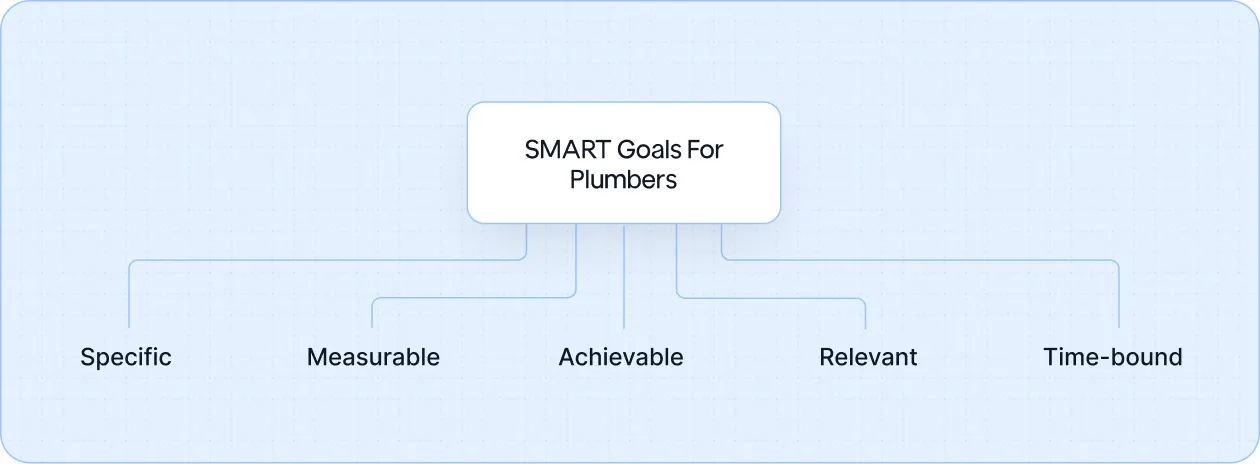
Using the SMART framework (Specific, Measurable, Achievable, Relevant, Time-bound) helps you set goals that are clear and actionable. Here are a few examples of SMART goals plumbers can focus on:
- Increase open rates for seasonal promotions by 10% in the next 3 months by improving subject lines and sending at optimal times.
- Generate 25 new service requests per month through targeted email campaigns, such as exclusive offers for first-time customers.
- Reduce customer churn by 20% through regular service reminders and value-driven content that keeps customers engaged long after the first service.
Tracking Success
Measuring the effectiveness of your campaigns is key to knowing if you’re hitting your goals. Key metrics to track include:
- Open Rates: To evaluate subject line performance and overall interest.
- Click-Through Rates (CTR): To see how engaging your content is.
- Conversions: To measure how many customers take action, like booking a service or clicking on a special offer.
By setting SMART goals and tracking key metrics, you can ensure that your plumbing email campaigns are focused, effective, and contributing directly to your business growth.
Build and Grow Your Plumbing Email List
Building a quality plumbing email list is the first step in creating meaningful customer relationships. By using ethical lead generation strategies, segmenting your audience based on needs, and maintaining a clean list, you can ensure that your emails reach the right people with the right message, leading to more engaged, loyal customers over time.
Ethical Lead Generation
Growing your email list ethically is the first step toward establishing a strong and trustworthy connection with your audience. Focus on methods that encourage customers to opt-in willingly and feel confident about receiving emails.
- Opt-in Forms: Embed simple, clear forms on your website and landing pages, offering value such as a free plumbing guide or a maintenance checklist in exchange for their contact details.
- Lead Magnets: Offer practical resources like “Top 10 Plumbing Tips” or seasonal maintenance guides. These encourage sign-ups and position you as a helpful, trusted resource.
- Incentives: Reward new subscribers with exclusive discounts or special service offers like a free inspection or discounted drain cleaning. This adds immediate value and motivates potential customers to join your list.
Segmentation for Relevance
Segmentation ensures that your emails are relevant and personalized, increasing engagement and reducing unsubscribes. By personalizing your messages, you ensure they reach the right people at the right time.
- Customer Type: Segment by new customers, recurring clients, or high-value customers to send personalized messages that speak directly to their needs.
- Service History: Target specific customer groups based on past services (e.g., those who previously booked sewer line inspections might be interested in maintenance reminders).
- Seasonal Needs: Segment based on service requirements tied to time of year, such as reminding customers about winter pipe protection or scheduling spring drain cleaning.
List Hygiene and Maintenance
A clean, updated list is essential for maximizing engagement and ensuring that your emails are reaching active, interested customers.
- Remove Inactive Subscribers: Regularly scrub your list to remove contacts who haven’t engaged in months. This keeps your list fresh and improves overall deliverability.
- Update Information: Make sure email addresses are correct by using double opt-ins or periodic re-engagement campaigns, ensuring your emails always go to the right place.
- Monitor Engagement: Track how recipients interact with your emails (opens, clicks) and segment based on this behavior. If certain users are disengaging, it’s a signal to revisit your content strategy.
By focusing on ethical lead generation, relevant segmentation, and list maintenance, plumbing businesses can build an engaged, high-quality email list that drives long-term results without wasting resources on uninterested subscribers.
This foundational step is essential for ongoing success in email marketing.
Must Read: 15 Smart Marketing Moves to Drive Growth for Your Home Services Business
Create Effective Plumbing Email Content
Creating engaging plumbing email content is about making every email personal, relevant, and action-oriented. By using personalized details, creating compelling subject lines, and including clear, action-driven CTAs, you can ensure your emails stand out in inboxes and drive meaningful responses from your customers.
Personalization
Personalizing your plumbing emails is about making your emails feel personalized and relevant to the recipient.
- Use Service History: Reference past services (e.g., "Your annual drain cleaning is coming up, book today for a 10% discount!").
- Location-Specific Offers: Include location-based details, like local weather-related tips (e.g., "Winterize your pipes before the cold hits in Chicago").
- Customer Preferences: Leverage data like service frequency or specific requests to send targeted emails that resonate with individual customers, increasing both open rates and engagement.
Compelling Subject Lines
The subject line is the first thing your customers see, and it decides if they'll open your email. A great subject line piques curiosity or promises value right away.
- Be Clear and Direct: Use subject lines that clearly convey value (e.g., "Prevent Costly Plumbing Issues This Winter, Act Now!").
- Create Urgency: Encourage immediate action with time-sensitive language (e.g., "Last Chance to Save on Drain Cleaning Services").
- Use Curiosity: Make the recipient want to know more (e.g., "Is Your Home Ready for a Plumbing Emergency? Find Out").
Clear Call-to-Actions (CTAs)
Every email you send should have a clear and compelling CTA that prompts your customers to take action. From booking a service to requesting an estimate or signing up for a seasonal inspection, make it easy for them to take action.
- Action-Oriented: Use strong verbs like "Book," "Get," "Claim," and "Save" to direct attention to the desired action (e.g., "Schedule Your Service Now and Save 10%").
- Keep It Simple: Ensure your CTA is easy to find and click on mobile devices, using a button or text link (e.g., 'Get Your Free Plumbing Inspection Today').
- Urgency: Include language that encourages urgency without being pushy (e.g., "Claim Your Spot Before Slots Fill Up").
By focusing on personalization, effective subject lines, and clear CTAs, plumbing businesses can create email content that gets opened and drives customers to take immediate action.
Great email content starts with great SEO.
At Gushwork, we help you create SEO-focused blog posts and landing pages that support your email marketing campaigns, driving more engagement and conversions.
Start with SEO-Powered Content
Optimize Plumbing Emails for Mobile Devices
With more customers reading emails on their phones, optimizing your plumbing email campaigns for mobile is crucial to ensure your messages are easily readable and engaging.
By using simple layouts, large buttons, and testing emails across devices, you can improve the customer experience and drive better results from your campaigns.
Mobile Optimization
With a growing number of customers checking their emails on smartphones, mobile optimization is essential. If your emails don’t display properly on mobile devices, you risk losing customer engagement.
- Simple Layout: Use a single-column layout to make content easy to read on smaller screens.
- Large, Clickable Buttons: Ensure CTAs are easy to click by using large, touch-friendly buttons (at least 44px by 44px).
- Concise Text: Keep your content short and to the point. Mobile users tend to skim, so make sure your message is easily scannable with clear headings and bullet points.
- Readable Fonts: Use larger fonts (at least 14px for body text) to enhance readability on smaller screens.
Testing for Mobile
Before hitting send, always test your emails on mobile devices to ensure they display correctly. Emails that look great on desktops can easily get distorted on phones, leading to a poor customer experience.
- Check Layouts and Fonts: Ensure everything aligns well and the text is legible on all devices.
- Test CTAs: Make sure buttons are easy to click and lead to the right landing pages.
- Use Email Testing Tools: Incorporate tools like Litmus or Email on Acid to preview how your emails will appear on different devices.
Optimizing your plumbing email campaigns for mobile ensures that your messages are readable, engaging, and actionable, no matter where your customers are checking their inboxes.
Suggested Read: 20+ Plumbing Lead Strategies That Get You Found, Booked, and Paid
Automate Plumbing Email Campaigns
Automation takes the repetitive tasks off your plate, giving you more time to focus on delivering great service. By automating routine emails like service reminders, follow-up emails, and seasonal promotions, plumbing businesses can ensure consistent communication without manual effort.
This results in higher efficiency and improved customer engagement, all while maintaining a personal touch.
Automated Campaign Examples
- Service Reminders: Set up automated emails to remind customers about regular maintenance, such as annual pipe inspections or drain cleaning. These emails can be triggered based on service dates, ensuring no customer misses an important reminder.
- Follow-Ups for Estimates: If a potential customer receives a quote but hasn’t booked the service yet, automated follow-up emails can gently nudge them to take action, increasing the chances of conversion.
- New Customer Onboarding: Welcome new customers with an automated introductory email that introduces your business, highlights your services, and offers a special deal on their next booking. It’s a simple yet effective way to build rapport from the start.
By automating these plumbing email campaigns, businesses can streamline their marketing efforts, ensuring they stay in touch with customers at the right moments without extra time investment.
A/B Testing for Plumbing Email Campaigns
A/B testing helps you identify which elements of your plumbing email campaigns resonate best with your audience. By experimenting with small changes, you can optimize your emails for better engagement and higher conversions. Key components to test include:
- Subject Lines: Experiment with different wording to see which gets more opens (e.g., "Save 10% on Your Next Service" vs. "Fix Leaks Before Winter").
- Call-to-Actions (CTAs): Test variations of your CTAs, such as “Book Now” vs. “Claim Your Discount,” to see which prompts more action.
- Email Design: Compare text-heavy emails with more image-focused designs to determine what drives higher engagement.
Best Practices for A/B Testing
- Small Tweaks, Big Impact: Even minor changes can significantly improve performance. For instance, subject lines with urgency ("Limited-Time Offer!") vs. value-driven messaging ("Save on Your Next Drain Cleaning") can lead to noticeable differences in open rates.
- Test One Element at a Time: Focus on testing one element at a time—whether it's the subject line, CTA, or design. This ensures that you can attribute results to specific changes.
- Track and Compare Results: After running your tests, analyze the results to determine which version performed better. Use these insights to refine future campaigns and optimize your approach over time.
By merging A/B testing with best practices, plumbing businesses can continuously improve their email marketing strategy. This iterative approach helps refine content, optimize designs, and create more effective campaigns, ultimately driving better engagement and conversions.
Best Practices for Plumbing Email Campaigns
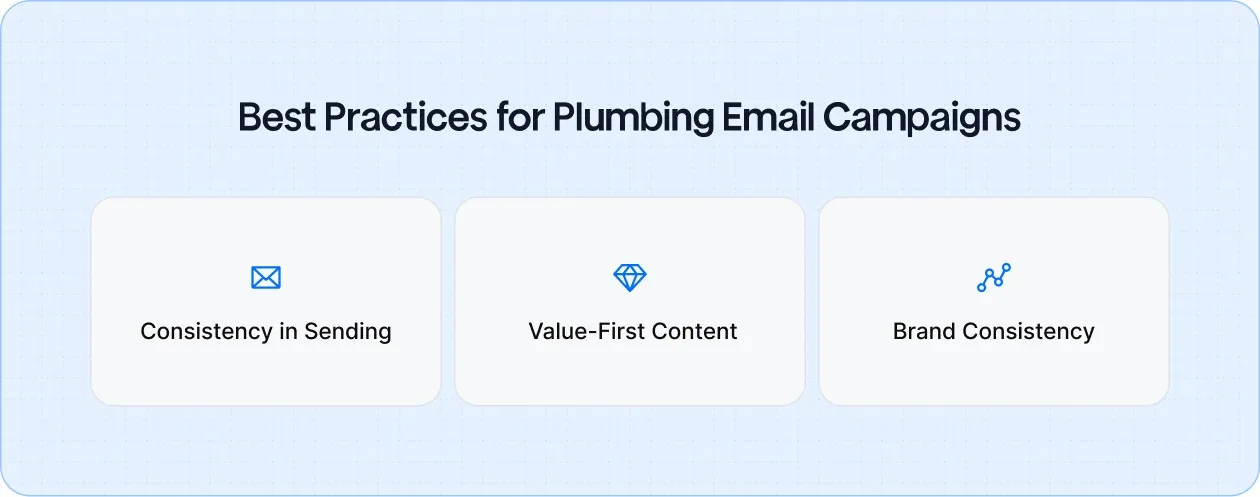
Building successful plumbing email campaigns requires consistency, offering valuable content, and maintaining brand identity. By sticking to a regular schedule, providing helpful insights, and ensuring all communications reflect your brand’s voice, you can build trust, engage customers, and create a lasting connection.
a) Consistency in Sending
To keep your plumbing business top-of-mind, it's crucial to send emails on a regular schedule. Consistency builds trust and recognition, ensuring customers look forward to hearing from you. Consider setting a bi-weekly or monthly schedule for:
- Maintenance tips (e.g., "How to Prevent Winter Pipe Freezes").
- Seasonal reminders (e.g., “Time for Your Annual Plumbing Inspection”).
This routine helps customers feel connected to your business and keeps them engaged without overwhelming them.
b) Value-First Content
In email marketing, always put value first. Rather than bombarding customers with sales pitches, offer them useful insights that help them maintain their plumbing systems or save money. This could include:
- Helpful plumbing tips (e.g., "How to Identify a Leaky Faucet").
- Safety advice (e.g., “Protect Your Pipes from Freezing This Winter”).
By sharing valuable content, you position yourself as a trusted expert and ensure customers feel they are receiving valuable insights.
c) Brand Consistency
Every email should align with your brand’s identity to create a cohesive customer experience. From your logo and color scheme to the tone of voice, ensure all your emails are instantly recognizable as coming from your business. This consistency:
- Reinforces trust with your audience.
- Enhances recognition across all customer touchpoints, from your website to social media and customer service interactions.
By maintaining a strong and consistent brand presence in your emails, you strengthen your relationship with customers and build a more professional image.
By following these best practices, plumbers can create email campaigns that are effective and build lasting customer relationships.
Let’s Get Started: Build Your Plumbing Email Campaigns That Drive Results
Creating effective plumbing email campaigns is about setting clear goals, building a quality email list, and delivering valuable content.
By following the steps of personalizing your approach, optimizing for mobile devices, and measuring performance, you can build lasting relationships with customers and see measurable success in no time.
Want to elevate your plumbing email campaigns?
Gushwork helps you create SEO-driven content that powers your email marketing and drives meaningful customer engagement.
Book a Free Consultation

SEO
Dec 22, 2025
5 mins
SEO for Septic Services: Stand Out, Get Noticed, and Grow Your Business in 2026!
Batul Beawarwala
Many people begin their search for septic tank services online, especially when they need help close to home. If your business doesn’t appear in search results or local listings, potential customers may choose another provider instead.
That’s where SEO steps in, making it easier for people to find your septic services when they need them. You can start with straightforward steps without needing a large marketing budget or a big team.
Let’s look at how septic tank services SEO training can help your business get noticed online.
What is SEO, and How Does It Benefit Septic Services?
SEO, or Search Engine Optimization, refers to improving your website so that search engines like Google can understand and rank it higher in search results. Here's how it works:
- Keyword Optimization: Using the right keywords ensures your services show up when customers search.
- Content Quality: Creating valuable content that answers the questions people are asking.
- Local SEO: Ensuring your business shows up in local searches for services like "septic tank repair near me."
Septic Services and SEO: Helping You Get Found
For septic businesses, SEO ensures that your company appears when people search for services you provide. Here’s how SEO benefits septic service businesses:
- Improved Visibility: When people search for "septic tank services," your business is more likely to appear in their results.
- Targeted Reach: SEO connects you with local customers actively searching for septic services.
- Building Trust: Showing up in search results builds credibility in the eyes of potential customers.
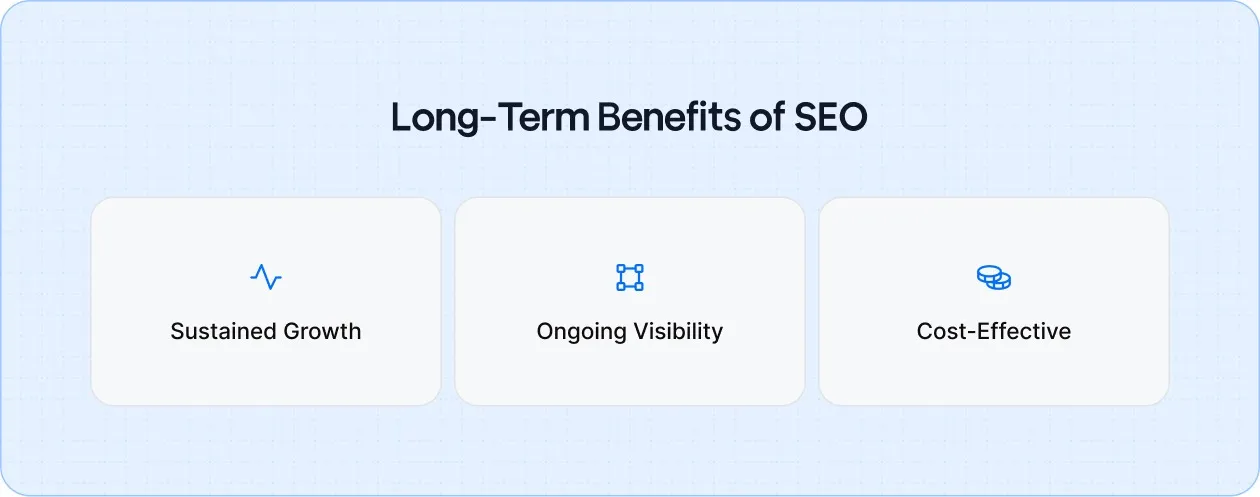
Long-Term Benefits of SEO
SEO offers long-term growth and stability for your business. Here's why it pays off:
- Sustained Growth: Once optimized, your website continues to attract visitors without ongoing costs.
- Ongoing Visibility: SEO provides long-lasting visibility, unlike paid ads, which stop working once the campaign ends.
- Cost-Effective: Over time, SEO offers a more affordable way to maintain a strong online presence compared to continuously paying for ads.
By consistently implementing SEO strategies, your septic services can continue to grow and attract customers over the long haul.
Keyword Research to Help Get the Right Keywords for Your Business
Keyword research ensures that when potential customers search for septic services, your business appears in the results. Without it, even the best services can go unnoticed.
a) How to Choose the Right Keywords
- Think like a customer: Use terms your customers are likely to search, such as "septic tank pumping near me" or "emergency septic tank repair."
- Use local keywords: Include specific location terms like “septic services in Austin” or “septic tank cleaning in Dallas” to make sure people in your area find you.
- Focus on search intent: Understand whether customers are searching for a service ("septic tank pumping") or information ("how to maintain a septic tank").
b) Tools to Find Keywords
- Google Keyword Planner: Helps you discover keywords that customers are searching for.
- SEMrush: Provides insights into your competitors' keywords and their performance.
- Ubersuggest: Suggests keywords and shows their search volume and competition.
c) Targeting Long-Tail Keywords
Long-tail keywords like “affordable septic tank pumping in Austin” or “emergency septic tank services in Dallas” are specific, easier to rank for, and attract customers who are ready to book.
Must Read: Want More Drain Cleaning Calls? Try These Powerful SEO Hacks Today
Keyword research is the cornerstone of SEO success.
Finding the right search terms is key to attracting the right customers, but it’s not possible without the right strategy.
Fix Keyword Confusion
On-Page SEO to Optimize Your Website for Better Visibility
Your website content should be both helpful and relevant. Provide practical advice that addresses the needs of potential customers. For septic services, this could be guides on tank maintenance, troubleshooting common issues, or tips for keeping systems running smoothly.
The more useful your content, the more likely visitors will return and trust your business.
a) Optimizing Metadata for Search Engines
Metadata like page titles, meta descriptions, and headers help search engines understand your content and attract clicks. Here’s how to optimize them:
- Page Titles: Use clear, descriptive titles with your main keywords (e.g., "Affordable Septic Tank Pumping in Austin").
- Meta Descriptions: Keep it concise and include your target keywords to encourage users to click.
- Headers: Use headers to break up content and include keywords for better search engine recognition.
b) User Experience (UX): Smooth, Fast, Mobile-Friendly
Your site’s performance directly affects your SEO. Make sure it’s mobile-friendly, fast-loading, and easy to navigate. Websites that deliver a smooth experience are rewarded with higher rankings.
- Mobile Optimization: Ensure your site works well on all devices.
- Page Speed: Aim for fast loading times using tools like Google PageSpeed Insights to keep users engaged.
- Navigation: Simplify your site structure to guide visitors directly to what they need.
Septic tank services website optimization focuses on making service pages clear, fast, and easy to understand for people looking for help.
On-page SEO focuses on clarity and usability.
Making sure your content speaks to customers and your website is easy to use can have lasting benefits.
Make Content Work
Local SEO Helps You Get Found in Your Area Easily
Local SEO is the key to ensuring your septic services business stands out when customers are searching for solutions in your area.
a) Claim and Optimize Google My Business (GMB) and Apple Business Connect
To ensure your septic service business is visible to local customers, claiming and optimizing your Google My Business (GMB) and Apple Business Connect profiles is crucial. These platforms directly influence how you appear in local search results. Here’s what to do:
- Claim your profile: Claim your GMB and Apple Business Connect profiles. Ensure your business information (name, address, phone number, website, and operating hours) is correct and consistent.
- Enhance your profile: Add clear photos of your work, service areas, and team. Fill out the business description with relevant keywords, and be specific about the areas you serve (e.g., “septic tank pumping in Austin” or “emergency septic repair in Round Rock”).
- Add service areas: In GMB, list the regions or neighborhoods you service so that you show up when potential customers search specifically for local providers.
b) Build Trust and Credibility
Active engagement on both platforms can improve your visibility and credibility. Here's how to make the most of GMB and Apple Business Connect:
- Encourage reviews: Reviews are a key factor for ranking higher in local search results. Ask satisfied customers to leave feedback. Positive reviews improve your ranking and help build trust with potential clients.
- Post regular updates: Share updates about promotions, new services, or seasonal tips related to septic services. Regular posts keep your profile fresh and engaging, signaling to Google and Apple that your business is active and trustworthy.
- Share images and videos: Visual content can engage potential customers better than just text. Upload photos of your work, behind-the-scenes shots, or videos of your services in action. This makes your profile more attractive and informative.
c) Use Location-Based Keywords to Strengthen Your Local Presence
Local SEO is all about connecting with customers in your area. By incorporating location-based keywords, you can increase your chances of being found by local searchers:
- Use specific city and neighborhood keywords: Include your location in the content throughout your website (e.g., “septic tank services in Austin” or “emergency septic tank pumping in South Austin”). This will help search engines match your business to local searches.
- Long-tail keywords: Consider using more detailed phrases, like "affordable septic tank cleaning in Austin" or "septic repair services near Hyde Park.” These keywords tend to have less competition and attract customers who know exactly what they need.
Suggested Read: How To Reach A Lead Searching For A Drain Cleaner In 30 Seconds?
d) Use Local Citations to Strengthen Your Online Presence
Building local citations from trusted online sources can help you establish your business as relevant and credible in your area. This can significantly improve your local search visibility:
- Get listed on local directories: Ensure your business is in trusted directories like Yelp, Yellow Pages, and Angie’s List. This helps Google understand your business's relevance in your local area.
- Maintain consistent NAP (Name, Address, Phone Number): Ensure that your NAP information is consistent across all directories. Inconsistent information can confuse search engines and hurt your local ranking.
Appearing in local search results can make a huge difference.
Efficient local SEO requires creating a consistent, engaging online presence that resonates with your target audience.
Get Found Nearby
Off-Page SEO to Build Trust and Authority
Off-page SEO is all about building your business’s credibility and authority online. By earning backlinks, engaging on social media, and managing your reputation, you create a strong digital presence that helps your septic service stand out in local searches.
These efforts improve visibility and build trust with potential customers.
a) Earn Backlinks to Establish Credibility
Backlinks from reputable websites are crucial for building trust and improving your site’s authority. When high-quality sites link to you, search engines see this as a vote of confidence, increasing your visibility. Here’s how to earn them:
- Focus on local blogs and industry-specific sites that your potential customers visit.
- Engage with media outlets: Offer your expertise to be featured in local news or industry publications.
- Guest posting: Write valuable content for other websites in exchange for a backlink to your own.
Earning septic tank services backlinks from credible sources improves trust and long-term visibility.
b) Social Media Engagement to Expand Your Reach
Engaging with your audience across multiple social platforms can significantly increase your business's visibility. Along with Facebook and Instagram, here are some other platforms to consider:
- Twitter: Share quick tips and updates, and engage in industry-related conversations.
- LinkedIn: Establish yourself as an expert by sharing in-depth articles and updates relevant to your business.
- Pinterest: Share helpful infographics or guides on septic tank care and maintenance.
- Snapchat: Give behind-the-scenes glimpses into your business, building a more personal connection with potential customers.
Septic tank services' social media optimization supports visibility by keeping your business active and consistent across platforms that customers already use.
c) Online Reputation Management to Stay Proactive
Your online reputation is a reflection of your business, and managing it well can have a direct impact on customer trust and SEO. Here’s how to stay on top of it:
- Encourage customer reviews: Ask satisfied customers to leave reviews on Google, Yelp, and other platforms.
- Respond to feedback: Acknowledge both positive and negative reviews to show that you value customer input.
- Maintain consistency: Keep your business details consistent across all platforms and directories.
By actively managing your reputation, you’ll improve your SEO and build long-lasting trust with your customers.
Technical SEO to Improve Site Performance
Ensuring your website performs at its best is crucial for both user experience and search engine rankings. By focusing on site speed, mobile optimization, and structured data, you can enhance your website's usability and visibility.
These technical improvements lay the foundation for long-term SEO success.
a) Mobile Optimization
With more people searching on mobile devices than ever before, having a mobile-friendly website is essential. Google evaluates websites using mobile-first indexing in its rankings, meaning if your site isn’t responsive, you’re missing out on valuable visibility.
Here’s how to ensure your site is mobile-ready:
- Check mobile usability: Use Google Lighthouse (via Chrome DevTools or PageSpeed Insights) to see if your site is optimized for mobile devices.
- Simplify design: Ensure buttons are easy to tap, and text is legible without zooming in.
- Responsive design: Your website should automatically adjust its layout depending on the screen size, offering a seamless experience across all devices.
Ensuring your site works well on mobile improves SEO rankings and enhances user experience, keeping visitors engaged.
b) Page Speed
Page load time directly affects both your rankings and user satisfaction. A slow-loading website can cause visitors to bounce, negatively impacting your SEO. Here’s how to speed things up:
- Compress images: Use tools like TinyPNG or ImageOptim to reduce image file sizes without losing quality.
- Minify code: Compress HTML, CSS, and JavaScript files to eliminate unnecessary space and speed up loading times.
- Leverage browser caching: Enable caching to store parts of your website on users' devices, so they don’t have to load everything from scratch each time.
Faster websites provide a better user experience and are more likely to rank higher in search results.
c) Structured Data to Improve Visibility with Schema Markup
Structured data, also known as schema markup, helps search engines understand the content of your website. By adding schema, you improve the way your pages appear in search results, making them more engaging. Here’s how it works:
- Add schema markup: Use JSON-LD to add structured data to your site’s code. This tells search engines exactly what your content is about, from reviews to services.
- Rich snippets: Schema markup can help your site display additional information in search results, such as star ratings, prices, or event details, making your listing stand out.
By implementing schema, you improve your SEO and the visibility of your website in rich search results, making it more likely that users will click on your page.
Content Marketing to Connect with Your Audience
Effective content marketing drives visitors to your site and builds trust and authority in your industry. By providing helpful and informative content, you position your business as a go-to resource for customers.
Repurposing and strategically distributing that content ensures you're reaching a wider audience and keeping them engaged with your brand.
a) Create Valuable Content to Provide Real Value
Your content needs to genuinely help your audience. Focus on delivering content that answers their questions and addresses their pain points. Here’s how:
- Blog Posts: Write posts that tackle common problems your customers face, like septic tank maintenance or repair tips. Septic tank services blog post optimization helps older articles stay useful and visible as customer needs change.
- Guides and Tutorials: Create detailed, step-by-step guides on services you offer. This positions you as an expert.
- FAQs: Provide quick answers to the questions your customers ask the most. This builds trust and encourages them to return to your site.
Septic tank services SEO writing works best when the content is practical, easy to read, and focused on real customer questions.
b) Repurpose Content to Expand Your Reach
Repurposing your content can help you reach a broader audience without reinventing the wheel. Turn your high-performing content into various formats:
- Blog to Video: Create short videos explaining your blog content, ideal for social platforms like YouTube or Instagram.
- Blog to Social Media Posts: Pull out key tips or statistics from your blog to share on Facebook, LinkedIn, or Twitter.
- Blog to Infographics: Make the key takeaways visually engaging and shareable through Pinterest or your website.
This approach lets you maximize the value of each piece of content and engage with different segments of your audience.
c) Content Distribution to Amplify Your Message
Creating great content is only part of the equation; getting it in front of the right people is where distribution comes in. Share your content strategically to increase your reach:
- Social Media: Share posts on Facebook, LinkedIn, Instagram, and Pinterest to engage your audience and drive traffic.
- Email Newsletters: Keep your audience updated with useful content, seasonal tips, or promotions, ensuring your business stays top of mind.
- Paid Ads: If you want to give your content a push, consider using Google Ads or social media promotions to increase visibility and attract more visitors.
By distributing your content on multiple platforms, you extend your reach and ensure potential customers see it at different touchpoints.
Content is what brings visitors to your website.
Creating valuable, well-optimizedcontent ensures visitors find what they need and keeps them coming back.
Create Engaging Content
d) Track SEO Progress
Tracking your SEO performance with tools like Google Analytics is crucial for understanding how your website is performing and where you can improve. Here’s what to focus on:
- Bounce Rate: High bounce rates could indicate that users aren’t finding what they expected. Lowering bounce rates can improve user experience and SEO.
- Session Duration: The longer visitors stay on your site, the better it signals your content’s value to search engines.
- Page Views: Monitoring which pages are getting the most attention helps identify your best-performing content and areas needing improvement.
Tracking septic tank services web traffic helps you understand which pages bring visitors and which ones need improvement.
e) Assess Keyword Rankings to Track Performance with Google Search Console
To measure keyword performance, Google Search Console provides insights into which terms are driving traffic to your website and how well they’re performing in search results. Key data to focus on includes:
- Keyword Impressions: See how often your site appears in search results for a specific keyword.
- Average Position: Track your average ranking for specific keywords. If you’re not in the top results, it’s time to optimize.
- Click-Through Rate (CTR): A higher CTR suggests your content is compelling and relevant. Low CTR may indicate you need to improve your meta descriptions or title tags.
By using Google Search Console, you get real-time insights into your keyword performance and can make adjustments to improve rankings.
f) Adjust Strategies to Adapt Based on Data
SEO is a dynamic process that requires regular refinement based on performance metrics. Here's how to adjust your strategy:
- Refine Underperforming Keywords: If a keyword isn’t ranking well, optimize your content, or consider targeting a more specific long-tail keyword.
- Revise Content: If certain pages aren’t engaging visitors, update them with more relevant information, visuals, or calls to action.
- Link Building: If your site’s backlinks aren’t contributing to rankings, focus on acquiring high-quality, authoritative links.
By acting on the data you gather, you ensure that your SEO strategy remains agile, effective, and aligned with your goals.
Scale Your SEO to Build for Long-Term Success
As your business grows, so should your SEO strategy. Continuously refining your keywords, adding fresh content, and using paid ads alongside organic SEO efforts will help ensure long-term success.
These ongoing improvements create a strong foundation for your website to attract more customers and maintain visibility.
a) Ongoing Keyword Optimization to Evolve as You Grow
SEO is not a one-time task; keyword optimization is an ongoing process that evolves as your business grows. As you scale, your target audience and their search intent may shift, and so should your keyword strategy. Here’s how to refine it over time:
- Regularly revisit your keyword list: As your business expands, new services or locations might need targeted keywords. Reevaluate your keywords based on current trends and search volumes.
- Focus on long-tail keywords: These often represent more specific queries with higher intent. As you rank for broad keywords, consider incorporating more niche terms to capture less competitive, yet highly relevant searches.
- Use competitive analysis tools: Keep an eye on what your competitors are ranking for using tools like SEMrush or Ahrefs. If they’re ranking for terms that you aren’t, it may be worth targeting those as well.
Constantly adjusting and expanding your keyword focus ensures that your SEO remains aligned with your business growth and continues driving relevant traffic.
b) Expand Content to Keep Your Site Fresh and Valuable
As your business evolves, so should your content. Regularly adding fresh, high-quality content improves SEO and keeps your audience engaged and coming back for more. Here’s why ongoing content expansion matters:
- Build topical authority: The more valuable content you produce around your services and industry, the more search engines will see you as an authority on the subject.
- Focus on evergreen content: Create articles, guides, and FAQs that stand the test of time and continue to attract traffic year after year.
- Cover new industry trends: Stay updated with changes in the septic service industry and write about new trends or technologies, ensuring your content remains relevant to your audience’s needs.
Regularly posting new, relevant content ensures that your site continues to provide value, stays competitive in search rankings, and meets the evolving needs of your customers.
c) Leverage Paid Ads in Conjunction with SEO
While SEO is essential for long-term growth, pay-per-click (PPC) ads can offer an immediate improve, helping to complement your organic strategy.
Combining these two strategies creates a well-rounded digital marketing approach that delivers short-term results and builds long-term sustainability. Here's how they work together:
- Immediate visibility with PPC: As your SEO efforts take time to build, PPC ads can help your business appear at the top of search results right away. This is especially helpful for targeting high-intent keywords that you’re still working to rank for organically.
- Test and refine with paid ads: Use PPC ads to test which keywords and landing pages resonate most with your audience. The insights gained can inform your organic SEO strategy, helping you refine your content and keywords for better results.
- Retargeting for sustained engagement: Paid ads can help retarget visitors who engaged with your website but didn’t convert, bringing them back to complete their actions, such as requesting a service.
By integrating paid ads with SEO, you create a comprehensive marketing plan that addresses both immediate needs and long-term growth.
Next Steps to Implement Your SEO Strategy
Now that you’ve learned the essential SEO strategies for your septic services business, it’s time to put them into action.
From refining your keyword strategy to creating valuable content and incorporating local SEO, each step builds on the other to improve your online visibility.
SEO is a long-term commitment, but with consistent effort, the results will follow.
SEO works best when it’s done consistently and with intent.
Gushwork helps septic service businesses build and scale content-led SEO without needing a large in-house team.
Book a Free Consultation

Digital Marketing
Dec 22, 2025
5 mins
Is Your Drywall Installation Repair Business Invisible on Mobile? Here’s How to Change That with Marketing!
Batul Beawarwala
Customers aren't flipping through yellow pages or asking neighbors for recommendations anymore; they're pulling out their phones to find a reliable drywall business nearby.
Drywall installation repair mobile marketing ensure your services appear exactly when customers need help, from home renovations to urgent repairs.
This guide will show you how to get your business in front of the right people at the right moment, creating real connections through mobile marketing.
The Shift from "Finding" to "Being Found"
In the past, drywall businesses grew on referrals and word of mouth. Today, however, customers are searching for your services on their smartphones. Your focus should now be on being found rather than actively seeking clients.
Actionable Strategy
To be visible, drywall businesses must prioritize mobile-first visibility. Here’s how:
- Optimize your Google My Business and Apple Business Connect profiles to ensure your business shows up in local searches.
- Keep your contact details consistent across all platforms so search engines can easily link your business to local search queries.
- Focus on local SEO: Use location-based keywords like “drywall repair near me” to make your business easy to find.
Example: 76% of people who search for something nearby visit a business within a day (Google). If you’re not visible on Google, Yelp, or Apple Business Connect, you’re missing out on customers ready to book your services.
Optimize Your Mobile Website for Lead Conversion
As a drywall contractor, you know that customers expect speed and convenience. The first step in ensuring you don’t miss out on potential business? Make sure your website is mobile-friendly.
With so many people searching for services on their smartphones, it’s crucial that your website works on mobile and is designed to convert visitors into paying clients.
A smooth, quick, and professional mobile experience can make all the difference when potential customers decide to call you for an estimate or look elsewhere.
Best Practices for Mobile Optimization
- Prioritize Speed: Mobile users don’t wait around for slow websites. If your site takes more than 3 seconds to load, you’re at risk of losing 50% of your visitors. A fast, responsive design is more than a convenience; it directly impacts if users stay on your page and take action.
- Geo-Targeted Keywords: When people search for drywall services on their phones, they’re usually looking for something local. Use geo-targeted keywords like “drywall repair near me” or “affordable drywall installation in Boston” throughout your website.
This helps search engines understand your location and ensures your business shows up in local searches. Don’t forget to include these keywords in your page titles, headings, and meta descriptions.
- Clear Call-to-Action (CTA): Make it easy for visitors to get in touch with you by including prominent, easy-to-click CTAs like “Call for Free Estimate” or “Book Appointment Now”. On mobile, buttons should be large enough to tap easily, and they should stand out on the page. Consider making these CTAs sticky, meaning they remain visible as users scroll down the page.
- Simple and Clear Design: Keep things clean and clutter-free. A busy site with too many options can overwhelm visitors. Focus on highlighting the key services and make contact details easily accessible. One-click calls (e.g., “Call Now” button) and simple forms to request quotes should be front and center.
Outcome: A mobile-optimized site ensures that potential clients can quickly find what they need and take action, without third-party lead providers.
Must Read: The Remodeling Contractor’s Toolbox: 9 Digital Marketing Strategies You MUST Know!
Master SMS Marketing for Immediate Client Engagement
SMS marketing is one of the most direct ways to communicate with your customers. With people constantly checking their phones, sending quick, personalized messages can keep your drywall business top-of-mind.
Reminding a client about their appointment or offering a special discount, SMS allows you to engage instantly, building trust and encouraging action..
Best Practices for SMS Marketing
- Personalize Your Messages: Make each message feel unique. Example: “Reminder: Your drywall repair appointment is tomorrow!”
- Keep It Short & Sweet: SMS is all about quick engagement. Use clear, action-oriented language: “Reply for a free consultation.”
- Retarget Interested Clients: SMS is perfect for follow-ups. Send a reminder or offer to clients who’ve shown interest but haven’t booked yet.
Outcome: With SMS marketing, drywall businesses can reach potential clients directly and immediately, ensuring they don’t miss an opportunity to engage or close a sale. It’s a simple, cost-effective way to nurture relationships and keep your business in the spotlight.
Build Local SEO to Improve Mobile Search Visibility
When customers search for drywall services, they’re often looking for someone nearby. If your business doesn’t appear in those local searches, you’re missing out on prime opportunities. Local SEO helps ensure your business shows up in front of local clients when they need your services the most.
Optimizing for mobile searches makes your business visible on the platforms customers use most, Google, Apple Business Connect, and local directories.
Why Local SEO Matters: For drywall contractors, local SEO is about being found by customers right when they need you. Mobile searches like “drywall repair near me” or “affordable drywall installation in Chicago” have become the go-to method for homeowners and contractors seeking services.
Key Strategies for Local SEO
- Google My Business & Apple Business Connect: Optimize these profiles to ensure accuracy and visibility. Add high-quality photos, customer reviews, and detailed service information to build trust and encourage potential clients to call. The more complete your profiles, the better your chances of showing up in mobile search results.
- Consistent NAP (Name, Address, Phone number): Make sure your business details are consistent across every online platform, from your website to online directories like Yelp and Yellow Pages. This helps search engines trust your business and rank it higher in local mobile searches.
- Local Listings: Keep your business listed in local directories and on platforms like Google Maps and Apple Business Connect. Claim your listings, update your info, and encourage clients to leave reviews. The more data you have on these platforms, the higher your business will show up when someone searches for drywall services nearby.
Get discovered by the right audience at the right time with optimized content
Enhance your content’s relevance through local SEO strategies that put you on the map, literally.
Increase Local Visibility
Social Media Marketing for Drywall Businesses
Social media today is a place for businesses to show off their skills and build trust. For drywall contractors, platforms like Facebook, Instagram, Pinterest, and TikTok are perfect for showcasing your work and engaging with local clients.
Mobile-Specific Tips
- Post Before-and-After Photos: Show the quality of your work with clear images of your drywall projects. These photos instantly demonstrate your expertise and professionalism.
- Use Location Tags & Hashtags: Engage with your local community by tagging your location and using hashtags like # DrywallRepairChicago to increase your visibility in local searches.
- Share Stories: Instagram and Facebook Stories are ideal for real-time updates. Post about ongoing projects, promotions, or even behind-the-scenes looks at your process. These are quick, mobile-friendly ways to keep your audience connected and engaged.
Outcome: By strategically using social media, drywall businesses can build their brand, attract local clients, and showcase their work in a way that resonates with potential customers, especially when viewed on mobile devices.
Must Read: 15 Smart Marketing Moves to Drive Growth for Your Home Services Business
Utilize Paid Mobile Ads to Capture Targeted Leads
Paid mobile ads are a powerful way to attract local customers who are actively searching for drywall services. By using platforms like Google Ads and Facebook Ads, you can drive targeted traffic to your website from potential clients who are already looking for services like yours.
Mobile-Specific Tips
- Mobile-Friendly Ads: Your paid ads should be tailored for mobile devices. Keep your messaging clear, concise, and easy for users to engage with, on both small screens and when tapping through to your site.
- Geo-Targeting: With geo-targeting, you can focus your ads on local searches, ensuring you’re appearing to users in your service area. This makes your ads highly relevant to those looking for drywall installation or repair nearby.
- Retargeting: Not all visitors convert the first time. Use retargeting ads to reach out to people who have interacted with your website or social media but haven’t booked a service yet. This increases your chances of converting them into paying customers.
Outcome: Paid mobile ads give drywall businesses the opportunity to connect with customers at the exact moment they’re looking for your services. By optimizing your ads and targeting them locally, you can ensure you're visible and relevant to your audience when it counts most.
Create Compelling Content Marketing for Mobile Devices
Content marketing is about offering value that resonates with your audience at the right time and in the right format. For drywall businesses, creating content that’s optimized for mobile devices ensures that potential clients can easily engage with your services, at home or on the go.
Mobile-optimized content helps you educate clients, build trust, and stay top-of-mind.
Types of Content
- Blogs: Write brief, actionable posts about common drywall issues, things like drywall repair tips or how to choose the right drywall for different needs. Keep them concise so they’re quick to read on a mobile device.
- Videos: Share short, mobile-friendly videos that showcase your work, such as drywall installation, repair tutorials, or quick maintenance tips. Videos are highly engaging and can help explain your process visually.\
- Infographics: Use mobile-optimized infographics to break down complex drywall concepts or pricing structures. These are easy to digest and work well on small screens.
Outcome: By creating mobile-friendly content, drywall businesses can educate and engage potential clients directly on their smartphones. This builds trust, keeps your business relevant, and encourages conversions from customers who are ready to take action.
Measure the Effectiveness of Your Mobile Marketing
To grow your drywall business, it’s not enough to just implement mobile marketing strategies; you need to measure their impact. By tracking key metrics, you can understand which tactics are driving results and optimize accordingly.
Key Metrics
- Mobile Traffic: Monitor how much of your website traffic is coming from mobile users. This helps you see if your mobile marketing efforts are reaching the right audience.
- Conversion Rates: Track how many mobile visitors are taking the desired actions, such as booking consultations or calling for estimates. This gives you a clear picture if your mobile site and content are successfully driving business.
- Campaign Tracking: Use tools like Google Analytics and Facebook Ads Manager to track SMS campaigns, paid ads, and social media interactions. This allows you to evaluate your return on investment (ROI) for each marketing channel.
Outcome: By tracking the effectiveness of your mobile marketing, you can make data-driven decisions that improve your results. The more you measure, the better you can tailor your content and ads to meet your customers’ needs and ultimately grow your business.
Suggested Read: 15 Proven Construction Industry Marketing Strategies for Business Growth
Common Mistakes to Avoid in Mobile Marketing for Drywall Contractors
When it comes to mobile marketing, a few missteps can cost you leads and business. Avoid these common mistakes to ensure your mobile marketing efforts are working for you, not against you.
Mistake 1: Failing to Optimize for Mobile Devices
Your customers are searching for drywall services on their smartphones; make sure your website is easy to use on mobile. If your site is slow, hard to navigate, or doesn't load properly on phones, you risk losing potential clients before they even get a chance to see your work.
Mistake 2: Not Using Local SEO
If you’re not optimizing for local searches, your drywall business could be invisible to nearby customers. Make sure your website includes geo-targeted keywords like “drywall repair near me,” and your business is listed on platforms like Google My Business and Apple Business Connect.
Mistake 3: Overcomplicating Content
Mobile users prefer quick, easy-to-read content. Avoid long paragraphs and complicated jargon. Focus on providing concise, action-oriented information that helps potential clients understand your services immediately.
Mistake 4: Ignoring Customer Reviews
Your customers trust online reviews as much as personal referrals. Neglecting to ask for reviews on Google or social media can hurt your credibility. Positive reviews improve your local SEO and help build trust with potential clients.
Avoiding mistakes means refining your content strategy for better results.
Learn from the missteps of others and create a clear, actionable content plan that avoids pitfalls and sets your drywall business up for success.
Refine Your Approach
Drive Real Growth for Your Drywall Business with Mobile Marketing
Mobile marketing is essential for drywall businesses looking to stay competitive and grow. By making sure your business shows up in mobile searches, connecting with clients through SMS and social media, and optimizing your local SEO, you can ensure that potential customers find you exactly when they need you.
These strategies are the future of how your business can stand out and grow in today’s digital-first world.
Content is king, but strategy is what drives its success.
Start implementing these mobile marketing strategies today with Gushwork to grow your customer base and drive results.
Book a Free Consultation

Digital Marketing
Dec 19, 2025
5 mins
10 Construction Equipment Marketing Strategies That Make Buyers Stop Comparing You
Ishani Mitra
Construction equipment marketing usually fails for a boring reason: the work is spread across too many places, with no single system holding it together.
One person runs ads. Someone else posts on social. The website has a few product pages. A PDF brochure exists somewhere. Sales does its own follow-ups. None of it is “wrong”, but it’s disconnected. So even when marketing is active, it doesn’t compound.
The brands that win don’t necessarily do more. They do fewer things, but they connect them properly. Every channel supports the next step. Every asset has a job. And nothing exists just to look present.
In this blog, we’ll break down what a real construction equipment marketing system looks like, how to structure your channels and content so they support each other, and what to prioritize if you want consistent inbound leads.
What is Construction Equipment Marketing?
Construction equipment marketing sits at the intersection of high-cost assets, operational risk, and time-sensitive decisions.
Buyers are trying to avoid downtime, missed deadlines, and costly mistakes. That makes marketing here less about persuasion and more about removing uncertainty. The challenge is that the rules have changed, while many tactics have not.
What’s Changed in the Construction Equipment Market?
Even five years ago, a strong dealer network, repeat relationships, and word-of-mouth could carry most heavy equipment businesses.
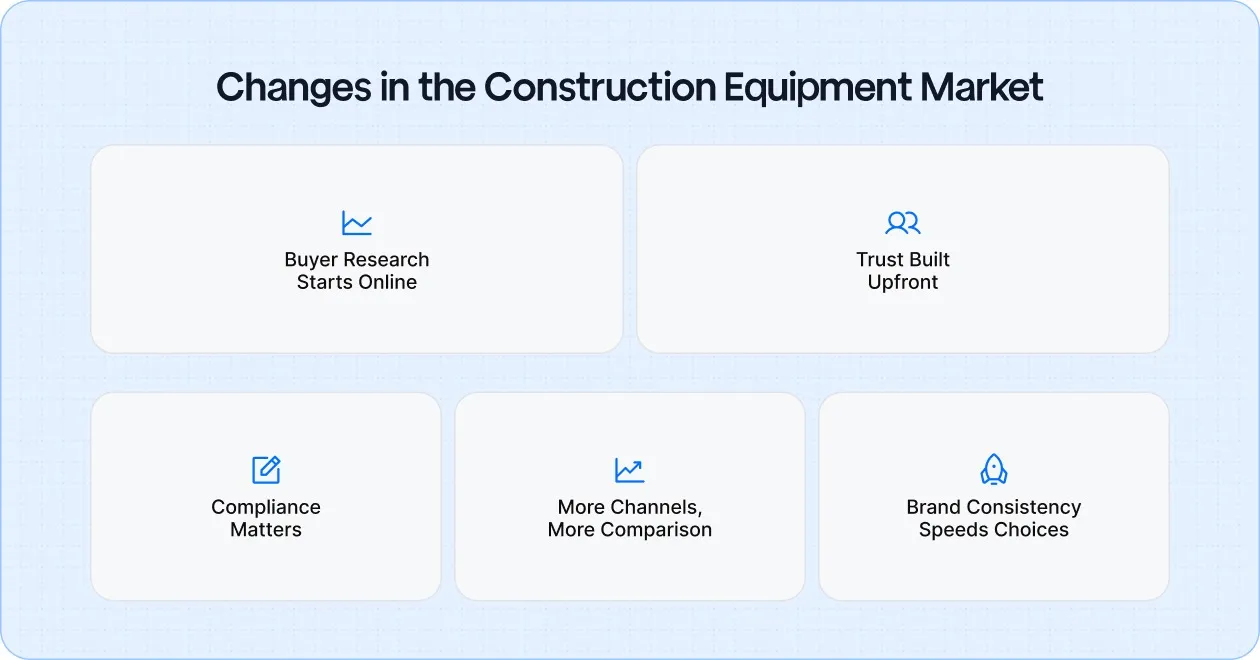
The market today has changed in ways that force brands to market like modern operators:
- Buyer research starts digitally. Search, maps, reviews, and inventory pages are often checked long before a call is made. If your online presence is thin or outdated, you may never enter the shortlist.
- Trust is evaluated upfront. Buyers look for visible proof like recent reviews, real equipment photos, clear inventory status, and how quickly you respond to enquiries. Silence or vague pages signal risk.
- Compliance and liability matter more. Safety standards, warranty terms, certifications, and contract clarity influence who gets contacted. Marketing that skips these details feels unsafe.
- More channels, more comparison. Buyers encounter brands through search, ads, marketplaces, social content, and dealer networks. Inconsistency across these touchpoints creates doubt.
- Brand consistency affects speed. When suppliers look similar on paper, buyers move faster with the one that feels organised, current, and dependable everywhere they look.
What Construction Equipment Buyers Actually Need Before They Enquire?
Most equipment brands think enquiries come from “interest.” In reality, enquiries come when the buyer feels confident enough to risk a conversation. Your marketing has to deliver that confidence early, using the details that matter in real purchase decisions.
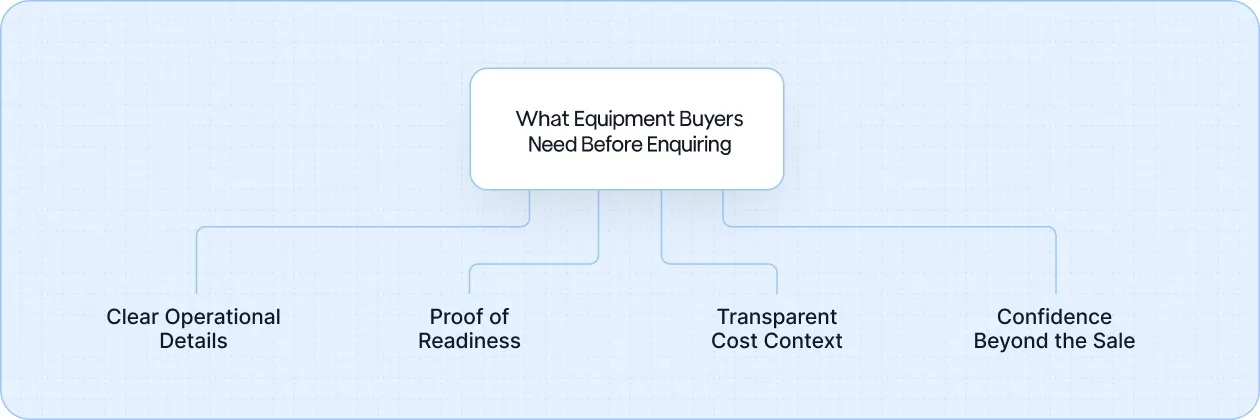
- Clear operational details. Availability, lead times, delivery coverage, and service scope should be obvious. Buyers should not have to ask basic questions.
- Proof of readiness. Evidence of uptime support, field service capability, maintenance processes, and jobsite experience reduces perceived risk.
- Transparent cost context. While final pricing may vary, buyers want to understand rental terms, service inclusions, parts availability, and what typically drives cost changes.
- Confidence beyond the sale. Support after delivery matters. Marketing should signal reliability after handover.
When construction equipment marketing addresses these needs directly, it starts functioning as decision support. That is what moves buyers from research to enquiry.
10 Best Construction Equipment Marketing Strategies
The construction equipment industry does not reward vague awareness campaigns or generic “lead gen.” Buyers move fast when a machine is down, and they move cautiously when the purchase is expensive.
The strategies below focus on clarity, intent, and credibility, so marketing supports real revenue instead of surface-level visibility:
1. Define Your Ideal Buyer + “Equipment Fit”
A lot of equipment marketing underperforms because the business is trying to sell to everyone. The fastest way to improve outcomes is to define exactly who you want, what you want them to buy, and what “fit” looks like in the real world.
- Segment by business model first. Decide if the core growth comes from sales, rentals, servicing, parts, or fleet partnerships. Each model has a different urgency level, decision cycle, and trust requirement.
- Build buyer avatars based on buying behaviour. A contractor buying for a project behaves differently from a fleet manager optimising uptime or procurement sourcing multiple vendors. Map content and offers to their decision style.
- Match messaging to the real purchase driver. Uptime, compliance, cost control, delivery speed, and service coverage matter more than brand story. Pick one driver per buyer type so you don’t dilute the message.
- Align marketing to future jobs. If you want more rentals for earthmoving equipment or more service contracts for heavy machinery, your website and content should reflect that direction clearly.
2. Positioning That Makes Buyers Choose You
In construction equipment, buyers don’t choose the loudest brand. They choose the supplier that feels dependable under pressure. Positioning should reduce perceived risk.
- Make your category focus obvious. Buyers should instantly understand whether you sell, rent, service, or supply parts. When all offerings are blended together, the site feels like a generalist, and trust drops.
- Lead with differentiators that matter on a jobsite. Inventory depth, turnaround time, field service availability, parts readiness, and response speed are the real decision triggers. Bring these forward early.
- Use trust language that sounds operational. Avoid big claims. Write in the language of reliability: dispatch windows, service coverage, inspection standards, typical lead times, and what happens after the call.
- Build urgency-based offers that match real situations. Breakdown support needs a fast-contact flow. Short-term rentals need availability clarity. Fleet agreements need confidence, process, and long-term service proof.
Know Who You’re Selling To
Map the exact buyer types, equipment categories, and high-intent searches that lead to real calls, rentals, and RFQs.
Build My Buyer Map
3. Search Visibility That Captures High-Intent Demand
Search is where high-intent buyers show up when they need equipment, service, or answers quickly. The goal is not traffic. The goal is to rank for searches that lead to calls, bookings, and quotes.
- Target “ready-to-buy” searches that signal action. Build pages for model + rental, “price,” “availability,” “near me,” and “delivery.” These searches convert because the buyer already has intent.
- Treat local SEO as the backbone. Service radius, dispatch zones, and branch locations should be built into your site structure. If you operate across regions, create location-specific hubs that match real coverage.
- Use Google Business Profile as a living proof asset. Post recent jobs, inventory snapshots, service work, and team photos. Keep it current, because buyers treat it like a credibility check before calling.
- Create comparison pages that help shortlisting. Buyers compare before they enquire. Pages like “new vs used,” “rental vs purchase,” and “model vs model” earn trust because they answer the question buyers are already asking.
- Capture service intent properly. Pages like “equipment repair + brand + location” or emergency support pages should make response time, service scope, and booking frictionless.
Get Found When It’s Urgent
Rank for equipment, rental, parts, and service searches that signal a buyer is ready to act, not just browse.
Improve My Search Visibility
4. Paid Demand Generation That Budgets Urgency
Paid marketing works in this category when it targets urgent intent and removes friction. If your campaigns send people to generic pages, the cost per lead rises fast.
- Use PPC where urgency is highest. Rentals, urgent repairs, and parts replacement are the fastest-converting categories because need is immediate and measurable.
- Separate campaigns by intent level. Emergency searches should route to fast-call pages. Research searches should route to comparison or capability pages. Long-term procurement searches should route to trust-heavy pages with deeper proof.
- Match landing pages to the ad promise. If the ad says “same-week rental,” the page must show availability logic, delivery radius, and next-step CTAs. Misalignment kills conversion.
- Retarget for repeat visits and delayed decisions. Even urgent buyers often compare 2–3 suppliers. Use retargeting to stay visible with proof content.
5. Website Strategy for Construction Equipment Marketing
A strong equipment website does three jobs at once: it proves operational readiness, guides buyers to the right solution fast, and makes enquiry frictionless when urgency is high.
What an effective construction equipment website must do:
- Make your role obvious within seconds. Buyers should instantly know whether you sell, rent, service, or supply parts, and which equipment categories you specialise in.
- Surface availability and service coverage early. Delivery zones, service areas, response timelines, and support scope should be visible without forcing a call.
- Structure pages around real buying intent. Separate pages for rentals, sales, service, parts, and emergency support help buyers land exactly where they need to, especially during breakdown or time-sensitive situations.
- Use inventory and capability pages as proof. Equipment pages should show condition, inspection process, maintenance standards, and typical use cases.
- Design for mobile-first urgency. Most high-intent visits happen on phones. Tap-to-call, quick quote forms, and messaging options should be easy to find and fast to use.
- Guide visitors toward the next step. Every page should answer “what do I do now?” with one clear action, whether that’s calling, requesting availability, or booking service.
6. Content That Builds Trust in a Risk-Heavy Industry
Content marketing for equipment brands is not for “engagement.” It’s decision support that reduces the fear of choosing wrong. The best-performing content answers what buyers hesitate about.
- Write content around real buyer risk. Downtime impact, wrong machine selection, service reliability, warranty clarity, and part availability are the issues buyers quietly worry about. Build content that addresses them directly.
- Publish jobsite-proof content that demonstrates capability. Show how you inspect machines, maintain fleets, deliver safely, and respond to breakdowns. Practical proof builds trust faster than long explanations.
- Use comparison content to help buyers decide. “Versus” articles and decision guides work well because they match the evaluation process. They also attract high-intent traffic that converts better than general awareness posts.
- Write case studies with operational outcomes. Don’t frame them like marketing wins. Frame them like jobsite wins: reduced downtime, faster turnaround, smoother delivery, improved availability, or better maintenance response.
Turn Proof Into Demand
Create jobsite-first content that answers buyer questions fast and builds trust before they ever talk to sales.
Create Trust-Driven Content
7. Social and Mobile Marketing That Drives Real Leads
Construction equipment buyers spend time on social, but they don’t want polished content. They want reality. Social works best when it proves presence, capability, and responsiveness.
- Use social to stay familiar between buying cycles. Most buyers don’t purchase daily. Social helps your brand stay remembered when the next urgent need hits.
- Post short-form content that feels jobsite-real. Walkarounds, delivery drops, inspections, teardown clips, before-after service work, and quick comparisons outperform branded “corporate videos.”
- Use employee visibility strategically. Feature technicians, operators, and service teams. Then encourage them to share. This works because people trust people more than logos.
- Make mobile conversion frictionless. Tap-to-call, WhatsApp, and quote forms should be the default. Most urgent searches happen on phones, and buyers won’t fight your website to enquire.
- Use native lead capture for fast response categories. Facebook lead forms and click-to-message are useful for rentals and services because they remove steps and speed up conversion.
8. Email Marketing for Equipment Dealers, Rentals, and Service Providers
Email works in equipment marketing when it feels useful and relevant. It’s how you stay top-of-mind, bring repeat customers back, and turn quotes into closed deals.
- Segment by buying relationship. Contractors, fleet buyers, procurement, and repeat renters should not get the same emails. Their decision triggers are different.
- Send newsletters with operational value. Inventory updates, availability drops, service reminders, seasonal preparedness, and local project updates get read because they feel relevant.
- Build nurturing sequences that follow real deal flow. Enquiry → quote follow-up → scheduling → delivery → repeat cycle. The goal is to remove drop-offs and keep communication consistent.
- Use seasonal hooks that match equipment reality. Monsoon readiness, winter maintenance, end-of-quarter fleet planning, and local infrastructure seasonality give email a reason to exist.
9. Trade Shows, Events, and Offline Marketing
Events still matter in this industry, but only when you treat them as lead systems. Brand presence alone doesn’t pay for the booth.
- Design events around capture and follow-up. Every conversation should have a next step: QR scans, quick forms, demo scheduling, quote requests, or follow-up calls booked on the spot.
- Automate event follow-up into your CRM. Speed matters. If follow-up happens two weeks later, the lead has moved on.
- Repurpose event content immediately. Turn it into recap videos, product highlights, team clips, and social proof posts so the event keeps working after it ends.
- Equip sales with decision tools. Bring spec sheets, comparison guides, inspection checklists, and service capability sheets. These are what buyers take back to their team.
10. Partner and Dealer Network Marketing (Cross-Promoted Growth)
Partnerships work well in equipment marketing because buying decisions often involve ecosystems: builders, contractors, OEMs, safety vendors, and service networks.
- Co-market with adjacent partners who share the same buyers. Contractors, builders, safety vendors, and OEM partners help you reach decision-makers with built-in trust.
- Design referral programs that reward operational value. Prioritised service slots, fleet perks, or faster dispatch create a stronger referral loop than discounts.
- Create cross-promoted educational content. Joint jobsite checklists, safety readiness guides, maintenance planning resources, and “equipment selection” sessions build credibility for both partners.
- Use local partnerships to strengthen trust in specific regions. Region-based credibility matters. A known partner’s association can reduce buyer hesitation quickly.
Common Mistakes in Construction Equipment Marketing
Below are the mistakes that quietly kill performance, even when teams are “doing marketing,” and what to do instead.
1) Treating equipment like a product, not a service experience
Buyers don’t only choose a machine. They choose delivery reliability, responsiveness, uptime support, parts availability, and the headache factor of working with you.
How to avoid it: Build your messaging around the ownership and operations experience. Show what happens after the sale or rental starts: installation, site readiness, maintenance support, breakdown handling, and escalation paths.
2) Hiding commercial clarity behind “contact us”
Many equipment websites force buyers to call just to learn basic details. That slows down decision-making and creates frustration, especially for urgent needs.
How to avoid it: Publish practical clarity upfront: service coverage, typical lead times, delivery regions, documentation needed, and how fast you respond. You don’t need to reveal every price, but you do need to remove uncertainty.
3) Using generic marketing copy that sounds interchangeable
“Trusted,” “reliable,” “best service,” and “quality equipment” reads like every other supplier. Buyers ignore it because it doesn’t help them evaluate anything.
How to avoid it: Replace generic claims with specifics buyers can validate. Mention actual capabilities, constraints, response windows, supported brands, supported job types, and operational proof points that a competitor can’t copy overnight.
4) Relying on old brochures and outdated inventory presentation
Construction equipment buyers assume outdated information means slow operations. Even if your business is solid, stale digital presence signals poor execution.
How to avoid it: Keep your core pages current. Update inventory visibility, refresh jobsite photos, retire old promos, and replace low-quality images with real equipment visuals. A “current” brand feels safer to buy from.
5) Not building marketing around seasonality and project cycles
Demand for construction equipment is cyclical. Many businesses market the same way year-round and miss the moments when buyers are actively planning.
How to avoid it: Plan campaigns around real triggers: infrastructure cycles, monsoons/winter readiness, project ramp-up periods, budget closures, and peak rental seasons. Your best leads often come from timing.
6) Speaking to the wrong buyer in the same message
A contractor, a fleet manager, and procurement don’t react to the same language. If your messaging is broad, no one feels like it’s meant for them.
How to avoid it: Write for one decision-maker at a time. Use dedicated sections or pages that speak directly to their priorities: job completion, operating cost, compliance, or vendor reliability.
7) Measuring activity instead of business impact
Posting more, running more ads, or getting more impressions can feel productive while revenue stays flat. The gap comes from tracking the wrong outcomes.
How to avoid it: Tie marketing to pipeline movement. Track what leads to real enquiries, quoted jobs, bookings, and repeat work. If the metric can’t influence a commercial decision, it’s not worth prioritising.
8) Copying “good marketing” from unrelated industries
Construction equipment marketing is not SaaS, not retail, not lifestyle ecommerce. Borrowing those playbooks usually creates content that looks polished but doesn’t convert.
How to avoid it: Anchor everything in operational reality. Buyers want useful proof, decision clarity, and supplier confidence. Build your marketing to answer what can go wrong, and how you prevent it.
Popular Trends in Construction Equipment Marketing
Once the basics are in place, the next competitive edge comes from how fast marketing is adapting to new formats, new buyer expectations around proof, and new ways equipment brands are being evaluated online.
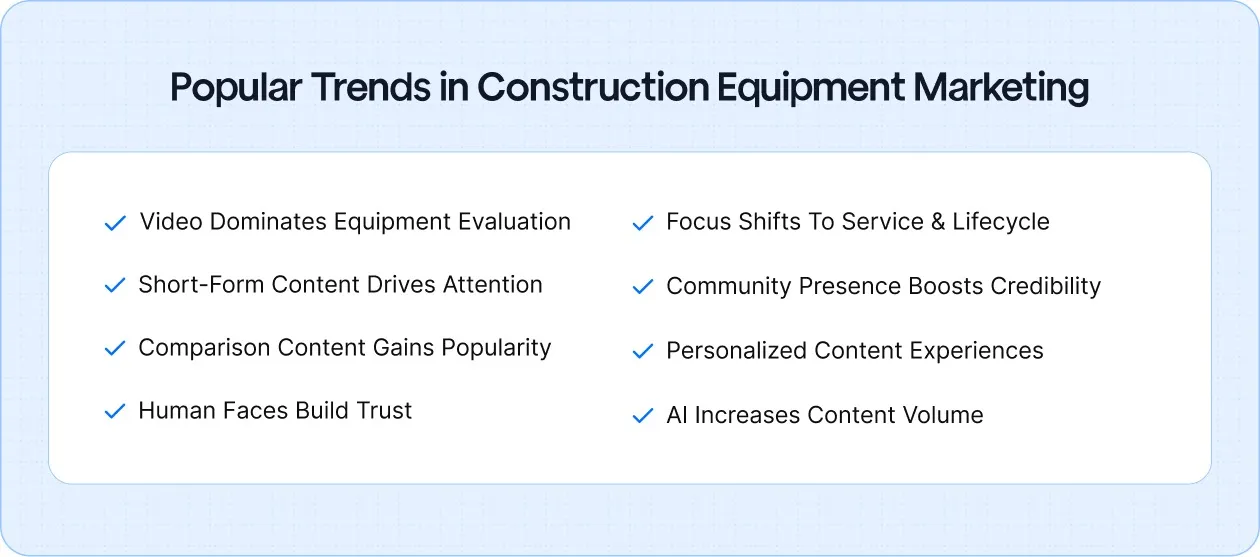
1) Video is becoming the default format for equipment evaluation
Equipment is hard to judge through text alone. The market is leaning heavily into walkarounds, real jobsite footage, and visual demonstrations because they help buyers assess size, condition, controls, and usability faster than specs ever can.
2) Short-form content is doing the top-of-funnel heavy lifting
Snackable clips are now carrying early attention. A 20–40 second video showing equipment in action often travels further than a brochure-style post, especially on mobile-first platforms.
3) Comparison-style content is gaining traction in high-intent research
More buyers want help choosing between options. Content framed around comparisons, trade-offs, and selection criteria is increasingly shaping shortlists, especially for common category decisions.
4) The “human face” of equipment businesses is becoming a differentiator
Brands are moving away from purely product-led communication and leaning into people: technicians, operators, service teams, and delivery crews. In a trust-heavy industry, buyers respond strongly to signals of competence and real operational depth.
5) Marketing is moving closer to service and lifecycle support narratives
Attention is shifting toward long-term equipment outcomes: uptime, maintenance readiness, parts support, inspections, and field responsiveness. Even when a buyer’s primary interest is acquisition, lifecycle confidence is shaping their supplier preference.
6) Community presence is becoming a credibility channel
Construction equipment brands are tying themselves more visibly to local projects, contractor communities, and regional activity. This is not “branding for the sake of it.” It’s becoming a signal of seriousness and real-world involvement.
7) Personalisation is showing up in content experiences
Instead of one generic message, brands are moving toward content tailored by equipment category, job type, or buyer profile. This trend is strongest in multi-branch and multi-category suppliers who need clarity at scale.
8) AI-assisted content production is increasing content volume
More brands are publishing frequently using AI tools, which is making “basic content” less competitive. The gap is widening between content that looks generated and content that feels field-informed, experience-backed, and commercially useful.
Build a Construction Equipment Marketing System That Compounds
If your marketing feels busy but unpredictable, it’s usually because the work is scattered. Ads run in one corner, the website sits untouched, social posts go out when someone remembers, and sales follow-ups happen with no repeatable flow.
Gushwork fixes that by building one connected system where every channel supports the next step and every asset has a job.
What Gushwork Helps You Execute:
- High-intent SEO that captures buyers when urgency hits: We target searches tied to rentals, repairs, parts, and availability so you show up when someone actually needs equipment.
- Website and landing pages built to convert fast: Clear inventory pathways, tap-to-call actions, frictionless quote forms, and pages that answer the questions buyers ask before they reach out.
- Content that reduces buyer hesitation: Walkarounds, comparison pages, inspection/process proof, and jobsite-ready explainers that support decisions and shorten sales cycles.
- Local visibility that makes you the obvious nearby option: Strong Google Business Profiles, service-area coverage, location hubs, and trust signals that help you win map pack clicks.
- Paid campaigns that match urgency and route to the right pages: Rentals and service ads go to fast-action pages, not generic homepages. Research traffic goes to comparison and capability pages.
What You Get Without Building a Whole Internal Team:
- A clean channel plan that fits how equipment gets bought
- Consistent execution across SEO, content, website, and local
- Faster lead handoffs with fewer “unqualified” enquiries
- A marketing engine that stays current, not one-off campaigns
If you’re ready to stop running disconnected tactics and start generating consistent inbound enquiries, Gushwork can build and run your construction equipment marketing engine.
Conclusion
The real win is momentum. When your best pages keep ranking, your ads point to the right inventory and service offers, and your content answers the same questions your sales team hears every week, lead quality improves without constant rework.
If you want help building that kind of marketing engine, Gushwork can take it off your plate. We help construction equipment brands turn inventory, service capability, and local visibility into a steady flow of qualified enquiries, with content, SEO, and conversion-focused execution that actually matches how this industry sells.
Build a Marketing System That Compounds
If your ads, content, and local visibility aren’t working together, leads stay inconsistent. Let’s fix the engine, not just the output.
Book A Consultation

SEO
Dec 19, 2025
5 mins
Crack the Code of Home Service Franchise SEO: Get Seen Locally to Scale Big!
Batul Beawarwala
Owning a home service franchise means being visible when customers need help the most. Home service franchise SEO is the primary way to improve your chances of showing up in local search results.
When potential customers look for services like yours, appearing in the right places at the right time can make all the difference.
What if your franchise was the first option they saw? Let’s explore how local SEO can help make that happen.
Why Local SEO is Essential for Home Service Franchises?
Owning a home service franchise means competing for visibility in a growing market. With more people using search engines to find services, your franchise must stand out online. Here’s why local SEO should be a priority:
The Growing Opportunity
The home service industry in the U.S. is a booming market, valued at around $657 billion in 2022 and projected to continue growing. Services like cleaning, maintenance, and repairs are in high demand, driven by a growing, aging population that needs ongoing support.
While this broad market offers significant opportunities, the home service franchise sector alone is valued at $22.5 billion in 2024 and expected to reach $39.6 billion by 2032. This fragmented market presents a clear challenge: franchises must ensure they stand out in local searches to gain visibility and attract new customers.
The Role of Local SEO
Local SEO ensures that your franchise appears in front of the right customers at the right time. By focusing on local searches, your business becomes more visible and accessible to the people who need your services.
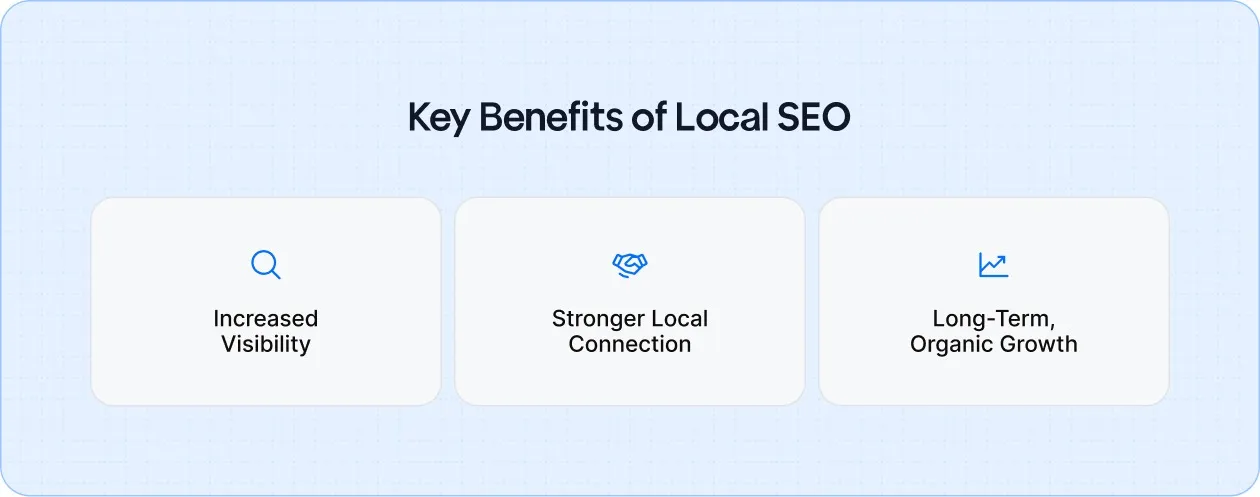
Key Benefits of Local SEO
- Increased visibility in local searches
- Stronger local connection and trust
- Long-term, organic growth as your franchise gains more local attention
Challenges for Franchises
- Duplicate content across multiple locations can confuse search engines.
- Ensuring NAP (Name, Address, Phone number) consistency across directories is crucial for maintaining local rankings.
Actionable Insight
Each franchise location should have a customized SEO strategy to ensure:
- Localized content personalized to its specific area
- Consistent NAP details across online listings
- Unique pages for each location to stand out and avoid internal competition
By addressing these elements, franchises can improve visibility and maintain a strong local presence.
Must Read: 11 Proven SEO Strategies for Home Services to Increase Calls and Leads
Don’t let your franchise blend in with the crowd!
Stand out in local searches with personalized SEO strategies for every location. Ensure your business gets the visibility it deserves.
Get Your Free SEO Audit
The Core of Franchise SEO: Corporate vs. Local
When it comes to SEO, especially for franchises, there's a key difference between corporate SEO and local SEO that you need to understand.
Google first decides who you are and where you fit in the bigger picture before deciding where to place you in search results.
How Google Decides Who You Are Before It Decides Where You Rank
Before Google ranks your franchise, it essentially puts your business into a category, defining your business model and footprint.
Google looks at how relevant your business is to the local area and how well it fits within that space. For franchises, this means you’re competing with others in your industry and with independent businesses that often have simpler, more defined footprints.
This is where local SEO comes into play. Google tends to favor single-location businesses because their relevance and authority within a community are easier to define.
For a multi-location franchise, however, the challenge is how to ensure that each location is seen as relevant and authentic in its local area, without being overshadowed by the brand’s national presence.
Corporate SEO vs. Local SEO: What's the Difference?
- Corporate SEO focuses on building brand-level visibility across a broad audience. It’s about getting your franchise name out there and making sure the brand is recognized nationally.
- Local SEO, however, is about getting your franchise location-specific visibility. It ensures that each franchise location appears in local search results, driving traffic to the right place at the right time.
How to Make Local SEO Work for Your Franchise
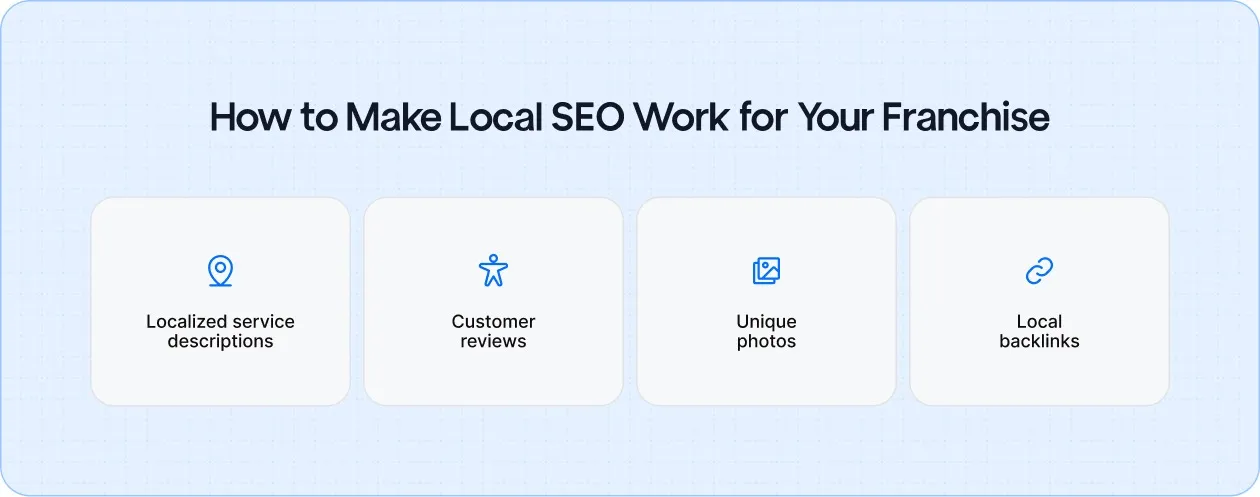
For your franchise to succeed in local SEO, each individual location must send local signals to Google. Customize your content for each location, ensuring it resonates with local customers and highlights unique services. Here's how you can do this:
- Localized service descriptions: Personalize content for each location’s specific services, needs, and customers.
- Customer reviews: Real, local reviews are crucial for building credibility and showing Google that each location is trusted in its community.
- Unique photos: Show your franchise’s presence through photos that reflect the local environment, reinforcing the idea that your franchise is an active part of the community.
- Local backlinks: Engage with local businesses or community organizations to earn backlinks that strengthen your local presence.
By focusing on these key factors, you can ensure that each location gets the local recognition it deserves, preventing issues like duplicate content and ensuring NAP consistency across all your listings.
This strategic approach will make your franchise stand out in local searches and drive more customers to your locations.
Optimize Your Google Business Profile and Apple Business Connect for Maximum Local Impact
Your Google Business Profile (GBP) and Apple Business Connect are vital tools for local search success. Optimizing these profiles ensures your franchise appears in local searches and increases your chances of showing up in the map pack, making it easier for customers to find and contact you.
Why GBP and Apple Business Connect Matter?
Both platforms are essential for improving your local search rankings. Google and Apple use these profiles to understand where your business is and how relevant it is to nearby customers, directly impacting your visibility in local search results.
3 Simple Steps to Optimize
- Step 1. Claim and Complete Profiles
Ensure accurate business details (hours, services, phone number) and consistent information across all platforms.
- Step 2. Post Regular Updates
Share seasonal promotions, special offers, and other timely updates to keep your profile active and engaging.
- Step 3. Collect and Respond to Reviews
Encourage reviews from satisfied customers and respond to them regularly to build credibility and improve your local ranking
Build Unique Location Pages for Each Franchise
Each franchise location needs its own dedicated location page. These pages are key to ensuring that customers searching for services in your area find exactly what they need, and they help your business rank higher in local search results.
Without personalized location pages, you risk blending into the broader franchise brand, missing out on valuable local visibility.
Why Location-Specific Pages Matter?
Dedicated location pages are essential for franchises to ensure customers in specific areas can easily find the services they need. These pages help your business show up in local searches and drive foot traffic and calls, especially in the local map pack.
- Local Relevance: Personalize content to the community’s specific needs, which improves visibility in search results.
- Personalized Content: Highlight services that are unique to the area and feature local customer testimonials to create a stronger connection with the community.
- Improved User Experience: A well-designed location page simplifies the customer journey by providing easily accessible service details and promotions.
How to Optimize Location Pages
- Create Unique, Relevant Content: Ensure each page is personalized to the location with details specific to that area. Incorporate local services and real testimonials that add credibility.
- Incorporate Local Keywords: Use local keywords, such as “best plumbing in Boston,” to ensure the page ranks for relevant searches.
- Ensure Consistency with NAP: Keep your Name, Address, and Phone number consistent across all online listings, including Google Business Profile and Yelp.
- Earn Local Backlinks: Build relationships with local businesses and events to gain backlinks that will improve SEO.
- Keep Content Fresh: Regularly update location pages with current promotions or seasonal offerings to keep them relevant and active in search engines’ eyes.
Suggested Read: 10 Must-Know Content Marketing Hacks: Make Your Home Services Impossible to Overlook
Make Use of Customer Reviews to Improve Local Rankings
Customer reviews are one of the most powerful tools in your local SEO strategy. They directly impact your rankings in search results.
In fact, Google and Apple both use reviews as an indicator of local relevance and credibility, making them an essential component of your overall SEO efforts.
The Power of Reviews in Local SEO
Customer reviews are a powerful local SEO tool. They directly influence rankings and increase your franchise’s credibility, showcasing to Google and customers that your business is active and trustworthy in its community.
- Reviews and Local Relevance: Positive reviews improve local search visibility and establish your franchise’s authenticity and trustworthiness.
- Customer Impact: Engaging reviews help potential customers feel confident in their decision to choose your franchise, especially when the reviews are specific and relevant to their local area.
How to Leverage Reviews for SEO Success
- Create an Automated Review Collection System: Integrate review collection into your Point-of-Sale (POS) system. This ensures a consistent, streamlined process for gathering reviews post-service.
- Prompt at the Right Time: The best time to request reviews is immediately after completing a service, when the customer’s experience is fresh, and they’re most likely to leave positive feedback.
- Engage with Reviews: Respond to every review, both positive and negative. This shows that you value feedback and encourages further engagement, which improves SEO.
- Incorporate Reviews Into Location Pages: Display customer feedback directly on your franchise’s location pages, adding real, localized content that will improve both user experience and SEO rankings.
- Encourage Reviews on Multiple Platforms: Request reviews on Google, Apple, and across other platforms like Yelp and Facebook. This increases your local presence across a wider range of search platforms.
Local Link Building to Strengthen SEO
Local backlinks are essential for improving your franchise’s local SEO. They signal to search engines that your business is trusted within its community.
Why Local Links Matter?
Local links show that your franchise is an active and relevant part of the community. These links improve your authority and help you rank higher for local searches, driving more customers to your business.
Effective Link-Building Strategies
- Partner with Local Businesses: Collaborate with local businesses or sponsor community events to earn high-quality backlinks from their websites.
- Guest Blogging on Local Sites: Write articles for local publications or industry-related blogs to showcase your expertise and gain backlinks.
- Create Locally Relevant Content: Develop content that directly speaks to your local audience, making it more likely to be linked to by local sources.
- Leverage Local Directories and Reviews: Ensure your business is listed on local directories and review sites for valuable backlinks.
- Engage with Local Influencers: Partner with local influencers or experts to earn backlinks through collaborations and shared content.
Give it a Read: Stop Being Invisible! Local SEO Will Get Your Remodeling Business the Recognition It Deserves
Mobile Optimization
With the majority of local searches happening on mobile devices, ensuring your site is mobile-optimized is crucial for ranking well and converting visitors into customers.
Google now prioritizes mobile-friendly sites, making optimization a key factor in your franchise's SEO strategy.
Why Mobile Matters?
Google’s mobile-first indexing means that your mobile site determines your rankings. A slow or poorly optimized mobile site can hurt both your rankings and user engagement, as 53% of users abandon sites that take longer than 3 seconds to load.
Mobile SEO Best Practices
- Responsive Design: Ensure your site adapts smoothly to all screen sizes, offering a seamless user experience on mobile devices.
- Speed Optimization: Use tools like Google PageSpeed Insights to identify slow elements and improve load times by compressing images, minifying code, and enabling browser caching.
- Prioritize Local Content: Make your key contact information, location, and services easy to find, especially for users searching for nearby businesses.
Paid Ads for Local Leads
While organic SEO is essential, paid ads like Google Ads and Local Services Ads (LSA) can quickly generate high-quality local leads. These ads are especially useful for reaching customers actively searching for your services in nearby areas.
The Role of Paid Ads in Local SEO
Paid ads help increase local visibility by appearing at the top of search results, giving you the chance to capture immediate and high-intent traffic. They complement your organic strategy and bring in customers who need services right now.
How to Run Effective Local Ads
- Geo-Targeting: Direct your ads to specific local areas like neighborhoods or service zones to ensure you’re targeting the right audience.
- Focus on High-Intent Keywords: Use keywords that signal immediate need, such as “emergency plumbing near me” or “best cleaners in Chicago.”
- Use Local Services Ads (LSA): LSA is designed for local businesses, showing your franchise directly to customers in need, with the added credibility of a Google-backed guarantee.
Ongoing SEO Support for Home Service Franchises
SEO is a long-term commitment, and its success depends on continuous maintenance and optimization. For home service franchises, staying ahead of competitors means keeping up with trends, search algorithm changes, and local market shifts.
Consistent effort ensures that your franchise remains visible to potential customers, year after year.
Why is Continuous SEO Effort Important?
SEO is a dynamic process that requires regular updates to maintain and improve your online presence. Without ongoing adjustments, your franchise can easily fall behind, especially as new competitors emerge and consumer search behavior evolves.
Routine SEO Tasks for Franchisees
- Regularly Refresh Location Pages
Update your location-specific pages with fresh content to reflect seasonal promotions, new services, or customer reviews. This keeps the page relevant and signals to search engines that the content is active and up-to-date.
- Track Performance and Adjust
Use tools like Google Analytics to monitor how well your franchise’s pages are performing. Look for trends, areas where traffic is dropping, and keywords that need optimization. Adjust your content and strategies based on these insights to keep improving your rankings.
- Stay on Top of Local SEO Changes
Local SEO is heavily influenced by trends in the area and local competition. Continuously assess how changes in neighborhood demographics, search volume trends, and customer reviews impact your rankings. This insight will help you adapt and stay competitive.
- Audit Technical Aspects Regularly
Regularly perform technical audits to ensure your website remains mobile-friendly, fast, and crawlable by search engines. Even small issues, like broken links or slow loading times, can damage your rankings.
Pumped to Lead Locally? Take Charge of Your Franchise’s SEO Today!
Local SEO is the lifeblood of your home service franchise’s online success. By optimizing for local search, creating personalized content, and staying engaged with your customers through reviews, your franchise can become the go-to service provider in your area.
Don’t let your competitors capture all the attention; ensure that your franchise is visible and relevant in every local search. Start now by optimizing your Google Business Profile and Apple Business Connect, creating location-specific pages, and actively collecting reviews to improve your online credibility.
Ready to dominate your local market?
Gushwork's expert SEO services will help you enhance your online presence, ensuring your franchise gets noticed by the right customers.
Book a Free Consultation

Digital Marketing
Dec 19, 2025
5 mins
Air Duct Cleaning Marketing Automation: Why Some Phones Ring and Others Stay Silent
Batul Beawarwala
Some weeks your phone keeps ringing non-stop, and other weeks it slows down without warning. It feels confusing because you know homeowners still need duct cleaning, yet your business doesn't get a steady flow of calls.
What often makes the difference is how visible and responsive you appear to customers. Air duct cleaning marketing automation is what helps you stay present when people search, follow up before they forget, and stay top-of-mind when they need you again.
This guide breaks down how simple systems can make your work more predictable, without hiring extra staff or dealing with complicated tools.
What Does Air Duct Cleaning Marketing Automation Mean for Your Business?
Air duct cleaning marketing automation is a way to keep your business visible, responsive, and remembered without doing every task by hand. It supports everyday actions such as:
- Following up after someone calls
- Asking for reviews once a job is done
- Sending reminders when service is due
- Sharing useful information that keeps you on a customer’s mind
Most duct cleaners know these steps matter, but small teams often struggle to keep up. When you’re out on jobs, paperwork and follow-ups fall behind. When work slows, outreach happens too late.
Automation gives these tasks structure so they run even when you are busy or understaffed. The harder part is to set it up, write messages that people respond to, choose timing that works, and know what to prioritize.
Automation works only when your words do
Most duct cleaning systems send messages; the difference is turning automation from something you “try” into something that actually drives steady work.
Optimize Your Content Strategy
The Customer Journey and Three-Pillar Automation Framework
Duct cleaning demand moves between businesses. The gap usually lies in how consistently a company shows up, responds, and stays remembered.
A typical buyer path looks like:

Automation supports each step, so work becomes steady rather than unpredictable.
To make this run smoothly, use a simple structure built on three pillars.
Pillar 1: Attract
The Attract Phase is about being visible and appealing to the right customers at the right time. It's the first impression that can make the difference between a customer reaching out or moving on to the next option.
a) Meta Ads Done the Smart Way
Meta (Facebook and Instagram) ads can be incredibly effective when done the right way. Here’s how to maximize them:
- Messaging-first campaigns: These ads are about building a conversation, not just collecting details.
- Pre-qualification questions: Ask questions like location, service needs, or urgency to better filter potential customers.
- Focus on offer & creative: Let Meta’s algorithm target the audience; focus on crafting an offer and creative that resonate with your audience.
- $4-$10 inquiries: It's realistic to generate quality inquiries within this range when the ad speaks clearly to customer needs.
- Urgency & limited-time pricing: Special pricing with an expiration date can motivate quicker decisions.
Want more people to ask for your service instead of your competitors?
Make sure you build strong and relevant content that makes you the top choice.
Get Seen Online with SEO
b) Local Visibility That Scales
SEO plays a huge role in local visibility. Here are simple but powerful strategies:
- Google Business Profile and Apple Business Connect: Keep these profiles updated and optimized to show up when customers search nearby.
- Area-based landing pages: Creating location-specific service pages helps you rank better for region-specific searches.
- Automated reviews: Collecting positive reviews consistently can increase trust and visibility, especially on platforms like Google.
c) Google Local Services Ads (LSA)
LSAs are powerful for high-intent calls:
- You pay only when someone calls, ensuring your ad spend is tied directly to actual leads.
- A strong review count can drive better visibility on LSAs, so keeping reviews high and consistent is key.
- For example, a $500 investment in LSAs could potentially bring in $10,000 in booked jobs with effective follow-through.
d) Referrals and Partner Networks
Referrals are often the most powerful leads. To get them, consider partnering with:
- HVAC companies
- Property managers
- Realtors
- Restoration firms
When you position your service as supporting their customer relationships, partnerships stick, and referrals become regular.
Pillar 2: Respond & Convert
Respond & Convert focuses on turning inquiries into bookings. Fast response times and clear communication are crucial.
a) Lead Capture Triggers
Automating lead capture ensures that no inquiry slips through the cracks, enabling a smooth and responsive customer experience.
- Multiple touchpoints: Capture leads from forms, calls, chats, and text messages, making sure all channels are covered.
- Instant automated replies: Acknowledge inquiries right away, signaling to customers that you’re responsive and reliable.
This automation ensures that you never miss an opportunity to connect with potential customers, keeping your pipeline full.
b) Missed Call & After-Hours Recovery
Missed calls or inquiries outside of business hours can often be lost opportunities, but auto-responses help maintain customer interest until you’re able to follow up.
Auto-responses let customers know their inquiry was received and when to expect a response, keeping the connection intact.
By automating this process, you reduce missed opportunities and keep potential leads engaged, even when you're unavailable.
c) Quote Follow-Ups That Work
An automated quote follow-up system ensures you stay on top of leads without overwhelming them.
- Day 1: Acknowledge the inquiry and express gratitude for their interest.
- Day 3: Send a gentle reminder, offering additional information or assistance.
- Day 7: A final nudge to encourage a response.
Stopping the sequence once they engage prevents over-communication and helps close deals without pressuring customers.
d) CRM Pipeline for Small Teams
For small teams, simplicity is key when managing leads.
- Stages: New → Contacted → Quote Sent → Booked → Job Done → Review Sent
- Automated alerts: Notify you if leads stall, ensuring no opportunity is missed.
This streamlined process ensures that no lead is left behind and provides a clear path from initial inquiry to repeat customer.
Pillar 3: Retain & Grow
The goal is to turn one-time clients into repeat customers and generate referrals that fuel ongoing business.
a) Review Automation
Automating review requests is key to maintaining a strong online presence and building trust.
- Immediate requests right after job completion increase the chances of getting timely feedback.
- Gentle reminders ensure that reviews continue to roll in, improving your online credibility and local visibility.
By automating this process, you keep reviews coming consistently without manual follow-up, helping you stay top-of-mind for future work.
b) Referral Automation from Happy Customers
Automating referral requests is a great way to expand your customer base without additional effort.
- Timing is key: Ask for referrals shortly after completing a job while the customer is still happy with your service.
- Automated follow-ups: Make the process easy, turning satisfied clients into repeat customers and referral sources.
This structured approach ensures you get consistent referrals with minimal input, growing your business organically over time.
c) Seasonal and Service Interval Reminders
Seasonal and service interval reminders are automatic prompts that keep your business top-of-mind without extra effort. They are an effective, low-maintenance way to ensure that your customers remember to book their next service, even after the job is done.
- Allergy season: Remind customers to clean their ducts to reduce allergens during peak allergy times, improving indoor air quality.
- Dryer vent safety: Send safety reminders for dryer vent cleaning to prevent potential fires and maintain system efficiency.
- Peak HVAC periods: A timely reminder before summer or winter helps customers prepare their ducts for the busy HVAC season, improving air quality and system performance.
Automating these reminders ensures that you stay relevant year-round and helps retain customers with minimal effort.
d) The Organic Snowball
As you collect reviews and referrals, your business gradually shifts from reliance on paid ads to organic growth.
- Repeat work rises: Satisfied customers are more likely to return for future services.
- Recommendations increase: Happy clients refer others, creating a steady stream of new business.
- Ad dependence shrinks: As reviews and referrals grow, your organic visibility increases, reducing the need for paid ads.
Many larger duct cleaning businesses spend under 1% on ads once this momentum builds. Small businesses reach this stage sooner when they have automation and clear messaging instead of trying to do everything manually.
Your Marketing Automation Stack
Your marketing automation stack doesn’t need to be strategic. The following tools are critical in keeping your workflow smooth and your marketing efforts effective:
- CRM (Customer Relationship Management): Tracks leads, inquiries, and follow-ups to ensure no potential business slips through the cracks.
- SEO-driven content: Converts website visitors into inquiries. Content that answers your customers’ questions and provides value builds trust and authority, ensuring you show up when they search for air duct cleaning.
- Review systems: Automates requests for reviews after a job, helping to build trust and increase visibility.
- Booking tools: Confirm appointments and send reminders to reduce no-shows and cancellations, making sure your schedule stays full.
These tools work best when integrated with SEO efforts, making sure that customers are contacting and finding your business consistently, organically, and reliably.
Tools fail when the words behind them fall flat.
Companies often buy software but still miss growth because their content does not attract or persuade; expert guidance bridges that gap.
Fix Your Content
Residential vs Commercial Automation
Residential duct cleaning buyers act fast: they search, compare, and book within days. Commercial buyers take longer, involve multiple decision-makers, and often require documentation or proposals before approving work. The automation you use should match the way these audiences behave.
Residential Automation Priorities
For homeowners, the goal is speed and convenience:
- Fast acknowledgment when they inquire
- Quote reminders within days and not weeks
- Simple review requests right after job completion
- Seasonal reminders for allergens, HVAC stress periods, and dryer vent safety
These touchpoints help households choose you quickly and remember you next time.
Commercial Automation Priorities
Commercial clients operate differently. They value clarity, reliability, and professional follow-through:
- A pipeline that includes proposal sent → site visit → approval → scheduling
- Follow-ups spaced further apart
- Job documentation, before-and-after reporting, and invoice records
- Renewal or contract-based reminders tied to building schedules or compliance dates
Commercial buyers hire based on trust, detail, and consistency.
Here’s What Both Have in Common
Service apartments, manufacturing facilities, and more, automation works best when:
- Quotes don’t sit unanswered
- Reviews get asked for instead of forgotten
- Past clients hear from you before they shop elsewhere
The difference is timing, language, and structure; residential needs faster nudges, commercial needs organized multi-step engagement.
Getting both systems right often requires expert planning because the messaging, follow-up pace, and workflows aren't interchangeable. Most businesses that try to build one sequence for everyone end up missing both audiences.
Tracking & Optimization
Automation only pays off when you can see which efforts bring actual booked work. Many duct cleaning companies assume ads are the only way to get noticed, but SEO sits quietly in the background to shape who finds you, what they read, and how they decide.
With a variety of channels, from Meta ads to LSAs, you need to track which sources are actually bringing in booked jobs.
- Meta ads are excellent for quick inquiries, but they require refined targeting and strong follow-up to be effective.
- LSAs are ideal for capturing high-intent calls, but success here depends on maintaining high review counts and visibility in local search.
- SEO and content are slow but steady; over time, they’ll help you stay visible even when customers aren’t urgently searching for duct cleaning.
Regularly review your SEO pages, ads, and content to ensure you’re attracting qualified leads and high-conversion customers rather than just aiming for traffic numbers. Optimize your content based on what customers are asking about and what leads to booked jobs.
Instead of comparing channels by volume alone (how many leads or inquiries each source generates), judge them by outcomes:
- Which source leads to booked jobs and happy customers?
- Which one produces homeowners who trust your pricing and your services?
- Which source results in repeat work or long-term customer relationships?
When you focus on quality over quantity, you’ll see how channels like SEO and content can outperform paid channels in the long run, delivering sustained growth.
Why SEO Often Wins?
While SEO might seem like a slow burn compared to instant advertising results, it brings long-term benefits that paid ads can’t match. Here are some ways SEO-driven content helps duct cleaning businesses:
- Customer education: When you create educational content, your customers get the information they need before they even reach out to you. Content that addresses pain points like "how to improve indoor air quality" or "when to schedule duct cleaning" builds trust and positions you as an authority in your field.
This drives organic traffic and sets the stage for a more qualified audience.
- Higher average job value: SEO-driven content helps customers make more informed decisions, meaning they’re often more willing to spend on higher-value services. By clearly explaining the benefits of your services and the value you provide, you can justify higher prices and increase your average job value.
- Long-term repeat business: By continuously adding high-quality SEO content to your website, you’ll build a reputation and attract returning customers over time.
In fact, businesses that invest in SEO often see organic growth leading to a reduction in ad spend. Once the organic snowball is rolling, you’ll find that you can rely more on repeat work and referrals than on paid channels.
A Simple Monthly SEO Optimization Routine
Most small teams adjust ads but ignore their content footprint. A balanced monthly review includes:
- Updating offers and messaging on your website and landing pages
- Refreshing content so your keywords match how customers speak
- Adding regional phrases that customers type into search
- Reviewing which SEO pages or articles bring high-quality calls
- Reinforcing sources that lead to booked jobs rather than filling inboxes
Without proper guidance, duct cleaning companies often waste time:
- Changing the wrong messages without a clear direction.
- Rewriting pages without a solid strategy.
- Chasing views instead of booking jobs.
Support from specialists helps you prioritise changes that make SEO do more of the heavy lifting, so your business shows up organically instead of racing behind ads forever.
90-Day Automation Roadmap (Built for Small Teams)
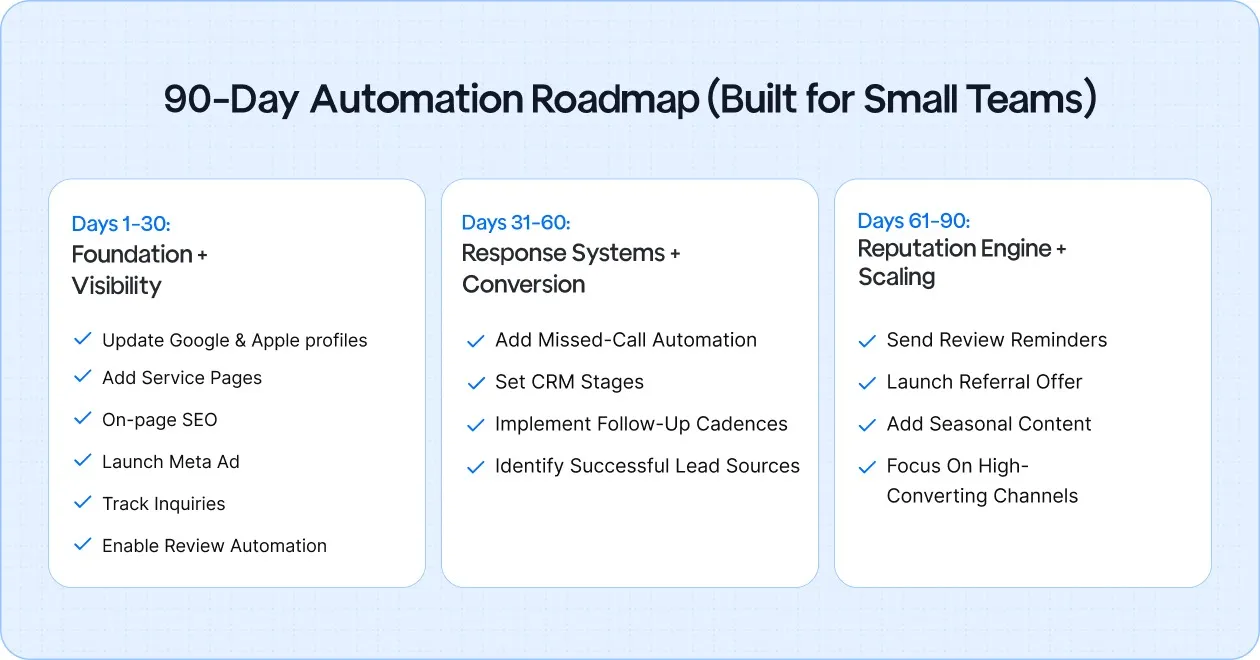
The fastest wins come from organising what drives work, then reinforcing it month after month.
This 90-day plan is simple enough for duct cleaners to follow, yet strategic enough to create momentum without hiring large teams.
Days 1-30: Foundation + Visibility

- Claim/update profiles on Google Business Profile and Apple Business Connect
- Add service pages targeting each city or neighbourhood you actually serve
- Write customer-focused website messaging (simple language, clear offers)
- Turn on review request automation after each job
- Launch one messaging-first Meta ad campaign with a clear offer
- Track incoming calls and inquiries by source
Your output at the end of Month 1 should be:
- A stronger online footprint
- Calls reaching you from multiple entry points
- Messages and offers aligned with what customers search for
SEO note: Month 1 requires you to ensure presence and clarity so searchers understand why you exist.
Days 31-60: Response Systems + Conversion

- Add missed-call response text automation
- Set a simple CRM pipeline stage sequence
- Implement quote follow-up cadences (Day 1, Day 3, Day 7)
- Identify which keywords, pages, or ads led to booked work
- Make small content edits based on what callers asked about
During Month 2, most duct cleaners realise a hard truth: the words used in follow-ups matter more than automations themselves.
That’s where outside expertise helps shape messaging that people respond to.
SEO note: Your website and service pages should start reflecting real customer objections; this is what turns SEO traffic into booked jobs.
Days 61-90: Reputation Engine + Scaling

- Send segmented review reminders (job type, property type, timing)
- Launch a referral follow-up offer after positive reviews
- Add seasonal educational content or FAQs to your website
- Review lead quality across channels, Meta vs LSAs vs referrals vs SEO
- Increase focus on organic pages that generate “good callers,” not volume
- Pause wasted ad spend and shift effort to what compounding channels are producing
By the end of 90 days, you should begin seeing:
- Faster, more consistent call-backs
- Higher success rate per inquiry
- Early signs of organic demand increasing
- A structure where your business shows up even when ads slow down
This is where many small teams hit a wall; they know what to do, but the execution and content creation become too heavy without help.
That’s exactly the gap expert partners bridge, refining messaging, strengthening SEO pages, and maintaining consistent improvements while you handle jobs.
Stop Letting Good Work Go Quiet
Air duct cleaning marketing automation requires having a simple system that helps people find you, get responses fast, and remember you when they need help again. The three pillars you saw, attract, respond & convert, retain & grow, work best when they run consistently.
Most teams learn this the hard way: software does nothing without messages, timing, and follow-through. Once you organise how inquiries are handled, quotes are chased, and reviews are collected, your business feels less random and steadier.
Pick one pillar, improve it, and build momentum. Small steps compound when your business becomes easier to find and easier to choose.
Growing your duct cleaning business shouldn't be a trial and error.
Gushwork helps duct cleaning companies stand out with expert SEO-led content that brings more enquiries, explains your services clearly, and supports steadier bookings.
Book a Free SEO Consultation

SEO
Dec 19, 2025
5 mins
14 Local SEO Strategies HVAC Contractors Need to Master for Consistent Lead Flow
Ishani Mitra
HVAC is one of the few services customers can’t afford to get wrong. When someone needs maintenance, a new system, or a technician they can trust, they almost always check online first. And the contractors who consistently show up in those local results are the ones who win the calls, the quotes, and the long-term relationships.
That’s why Local SEO matters. It helps you get found by the customers already in your service area and ensures your business appears credible, established, and worth contacting.
In this blog, you’ll learn how Local SEO works for HVAC contractors, why it impacts your revenue more than most marketing tactics, and the practical steps you can take to improve your visibility where it counts.
What Is Local SEO?
Local SEO helps your HVAC business appear in the exact places homeowners look when their heating or cooling system fails. It improves how well you show up in Google Maps, local search results, and city-specific searches, making it easier for people nearby to find and contact you. When done right, it ensures your company appears ahead of competitors at the moment someone needs fast, reliable service.
Why Local SEO Matters for HVAC Companies?
- Local search influences who gets the call: Homeowners search based on proximity, service type, and urgency. Most choose one of the top results they see.
- Competition is high in HVAC, and visibility decides winners: HVAC is one of the most saturated home service industries. Local SEO helps you stand out without relying entirely on paid ads.
- Local SEO brings higher-intent leads: Calls from Maps and “near me” searches are among the highest converting leads in HVAC. These searchers already know the service they need and often want same-day or next-day help.
- Strong local visibility reduces your long-term marketing cost: Appearing organically for searches like AC repair near me or furnace repair in [city] brings continuous leads without constant ad spend.
How to Rank in Google Maps?
Showing up in the top three Map Pack results is essential for HVAC companies because homeowners often search in moments of urgency. These listings get the fastest clicks, the most calls, and the highest-intent leads. Ranking here requires the following:
1. Optimize Your Google Business Profile (GBP)
Your Google Business Profile is the foundation of Map Pack rankings. Google relies on it to understand what you do, where you work, and whether you are a trusted HVAC provider.
- Complete every field: Business name, primary/secondary categories, service areas, hours (including emergency hours), phone, website, and service descriptions.
- Use the Services tab: List every service with short, keyword-aware descriptions (AC repair, furnace repair, heat pump installation).
- Keep GBP active: Publish short posts weekly to show activity and relevance.
- Photos that convert: Upload project photos, trucks, technicians, equipment installs, and before/after shots. Geo-tag important images when possible.
- Q&A hygiene: Pre-seed common Q&A items with helpful answers so searchers and Google see consistent messaging.
- Enable messaging/click-to-call: Make it frictionless to contact you directly from Maps.
Fix Your HVAC Google Business Profile
If your GBP isn’t complete, active, and optimized, you’re losing map visibility to weaker competitors.
Strengthen My GBP
2. Build a Review and Reputation System
Reviews are one of the strongest signals for Map Pack visibility and customer trust. Google prioritizes HVAC companies with steady, recent reviews.
- Ask consistently and naturally: Request reviews at handover, after a completed repair, or via a follow-up SMS with a direct review link.
- Aim for steady volume: Regular monthly reviews beat infrequent bursts; many competitive listings have ~50+ reviews.
- Respond to every review: Thank positive reviewers and resolve negatives publicly and calmly. This improves conversions and signals responsiveness.
3. Maintain NAP Consistency and Local Citations
Google uses your Name, Address, and Phone number (NAP) across the web to confirm your business identity.
- Exact-match NAP: Ensure name, address, phone format are identical across GBP, website footer, and top directories.
- Key citations: Submit or fix listings on Yelp, Angi/HomeAdvisor, Houzz, BBB, Chamber, and local business directories.
- Apple Maps and Bing Places: Don’t ignore these. They feed ecosystem signals that can indirectly affect Google.
4. Build Local Presence Signals (Beyond Just Citations)
Local SEO isn’t only digital. Google values real-world proof that you operate within a community.
- Local partnerships and mentions: Sponsor local events, join the Chamber, get supplier or realtor shoutouts; offline presence creates online mentions.
- Local PR & features: Local news stories, community blogs, and homeowner association mentions generate high-trust citations.
- Service-area accuracy: Set GBP service radius truthfully; avoid creating location pages for areas you don’t realistically serve.
5. Embed Maps and Local Signals on Your Website
Your website should support and reinforce the same service areas listed in GBP.
- Embed Google Maps: Put an embedded map on Contact and location pages to reinforce locality.
- Localized microcopy: Add neighborhood names, zip codes, and local permit info in page copy to strengthen regional relevance.
- Photo & post engagement: Include photos labeled by location when possible.
How to Rank in Google Search?
Organic rankings attract homeowners who research, compare HVAC companies, check costs, and consider long-term service providers. These searches often lead to higher-value installs, contract work, and recurring maintenance clients.
Along with SEO, implement the strategies listed below. You can significantly improve your HVAC business's online visibility, attract more high-intent leads, and drive long-term growth:
1. Build the Right HVAC Website Foundation
A clear, intuitive website structure helps both search engines and homeowners quickly understand your services.
- Simple hierarchy: Home > Services > Service Type > Location Pages > Project Pages.
- Homepage clarity: Display core services, service area, and clear CTAs.
- Dedicated service pages: One for each major service like AC repair or furnace installation.
- Location pages: Create pages for areas served with unique local content.
Build a Website That Ranks and Converts
HVAC buyers leave fast if your site is slow, unclear, or missing key service pages. Make your website work like a real sales engine.
Improve My Website
2. On-Page Optimization and Relevance
On-page SEO helps Google match your content to the exact query a homeowner enters. Each page should target one keyword and answer the searcher's intent fully and clearly.
- Target one keyword per page: Avoid keyword cannibalization.
- Placement checklist: Include keywords in title tag, URL, H1, meta description, and image alt text.
- Answer intent fully: Address symptoms, costs, FAQs, and next actions clearly.
- Structured content: Use headings, bullet points, and schema for better readability.
3. Support Your Local SEO With Social Media Activity
While social media doesn’t directly rank you in Maps, it reinforces trust and signals real activity to users.
- Post regularly: Share HVAC tips, before/after installs, and seasonal reminders.
- Use Stories/Reels: Show quick demos and micro-educational content.
- Drive traffic to GBP: Share links to Google Business Profile via social posts.
4. Technical SEO Essentials
HVAC customers often search from mobile phones during breakdowns, meaning speed and usability directly affect sales.
- SSL (HTTPS): Required for trust and ranking.
- Page speed & Core Web Vitals: Optimize images, use caching, and CDN.
- Mobile-first UX: Make sure the site is fast and user-friendly on mobile devices.
- Indexation & sitemaps: Submit XML sitemaps to Search Console.
- Schema: Implement LocalBusiness, Service, and Review JSON-LD.
Fix the SEO Issues Holding Your HVAC Business Back
Technical gaps, weak internal links, and missing schema cost you rankings in both Maps and organic.
Fix My SEO
5. Keyword Strategy Built for HVAC
Your keyword strategy should follow the HVAC buyer journey:
emergency → troubleshooting → planning.
Use a mix of urgent, mid-funnel, and supporting keywords to reach homeowners at every stage.
- Target buyer journey: Focus on urgent, mid-funnel, and supporting keywords.
- Start with local long-tail keywords: Lower competition but valuable volume.
- Cluster keywords: Organize content by buyer stage and related queries.
Target the Keywords Your HVAC Customers Actually Use
Stop guessing what homeowners search. Use real data to match urgent, location-based HVAC intent.
Find My Best Keywords
6. Create High-Value HVAC Content That Ranks
Content marketing builds authority and attracts backlinks, which service pages rarely earn naturally.
- Bottom-funnel content: Focus on urgency-driven terms like “AC repair near me.”
- Mid-funnel content: Guides, seasonal checklists, and troubleshooting tips.
- Top-funnel content: Local guides, cost breakdowns, and project case studies.
Publish Content That Builds HVAC Authority
Troubleshooting guides, seasonal tips, and project pages help your brand show up for real questions homeowners ask daily.
Improve My Content
7. Off-Page & Backlink Strategy
Backlinks remain one of the strongest ranking signals for HVAC companies. The goal is to earn relevant, trustworthy links that reinforce your expertise.
- Backlink gap analysis: Find and replicate competitor’s high-value links.
- Local link sources: Target local news, associations, and allied trades.
- Digital PR: Pitch relevant seasonal tips or project stories to local press.
- Avoid low-quality links: Prioritize relevance and trust over quantity.
8. Strategic Internal Linking
Internal linking guides both users and Google through your site. A well-connected site strengthens your most important pages and improves rankings.
- Funnel authority: Link blog posts to service pages, and service pages to location pages.
- Anchor text discipline: Use relevant, natural anchor text instead of over-optimized keywords.
- Orphan page checks: Ensure all key pages are well-connected with internal links.
9. AI Search Behavior and Modern SERPs
Search engines increasingly evaluate clarity, structure, and authority through AI-driven signals.
AI-powered SERPs reward pages that answer questions cleanly, completely, and in structured formats.
- Clarity wins: AI-powered SERPs favor clear, structured content.
- Structured data: Implement schema to improve content visibility in AI summaries.
- Long-tail opportunity: Target multiple angles of a topic with structured content pillars.
- AI-readiness: Make content scannable and structured so AI-derived SERP features or summaries can reference your pages.
Monitor, Track and Improve SEO Performance
With the right tools and metrics, you can see where growth is happening, where visibility is slipping, and which updates will produce the strongest results.
Tools to Use
To understand your performance clearly, you need tools that measure traffic, calls, rankings, and engagement.
- GA4: Measures organic traffic, engagement, conversion actions, and user behavior across your site.
- Google Search Console: Shows which keywords trigger impressions, how often people click, indexation issues, and page-level performance.
- Call tracking tools (CallRail, WhatConverts): Attribute calls to SEO, track call quality, and see which pages generate the most service inquiries.
- Local rank tracking (grid tools): Tools like Local Falcon or Local Viking show how your HVAC business ranks across neighborhoods, not just one ZIP code.
How to Iterate Monthly
SEO improves when you consistently refine and expand what you’ve already built.
- Improve underperforming pages: Add missing details, increase content depth, update metadata, or strengthen internal links.
- Track SERP fluctuations: Identify ranking drops early and adjust content or backlinks as needed.
- Add missing service or location pages: Fill content gaps to cover all profitable services and real service areas.
- Update blog content every season: Refresh cost pages, troubleshooting guides, and seasonal maintenance content to stay relevant.
Understanding Competition Levels in HVAC SEO
Competition varies by location. Smaller markets often respond well to clean on-page optimization and a strong Google Business Profile, while larger cities require deeper content, more authority, and ongoing backlink acquisition:
What to expect based on your service area
- Small towns and rural areas: Solid on-page SEO, accurate service pages, and steady reviews are often enough to earn top visibility.
- Mid-size cities: You’ll need consistent content, better technical performance, and a healthy flow of citations and reviews to stand out.
- Metropolitan markets: High competition means you must invest in backlinks, digital PR, press features, and a large content library. Expect a longer timeline.
- Highly saturated HVAC regions: Competing brands may publish hundreds of blogs and run aggressive link-building campaigns. Matching authority becomes essential.
Local SEO for HVAC contractors comes down to two goals: showing up in Google Maps when homeowners need fast service, and appearing in the organic search results where people compare companies, read reviews, and evaluate expertise. To win both, you need a strategy built on accurate local signals, strong service pages, solid technical foundations, and ongoing authority building.
Should You DIY HVAC SEO or Hire an Agency?
HVAC SEO can be handled in-house or with outside help, depending on your goals, competition level, and available time. The right choice depends on how complex your market is and how quickly you want results.
When DIY Makes Sense
Small HVAC companies or those in low-competition areas can often manage the basics themselves with steady effort.
- Small towns or rural regions where a well-optimized GBP and solid service pages go a long way.
- Slow seasons when you have time to update your website, publish content, or gather reviews.
- When you’re familiar with simple tools like Search Console, GA4, or WordPress SEO plugins.
- When the priority is keeping costs low while still improving foundational visibility.
What a Good HVAC SEO Agency Should Provide?
A strong agency brings a complete system. They should cover all sides of local and organic search.
- Local SEO: Full GBP management, reviews strategy, citations, service-area optimization, and map ranking improvements.
- Content: High-quality service pages, city pages, troubleshooting guides, case studies, and seasonal HVAC content.
- Technical SEO: Site speed fixes, mobile optimization, schema markup, crawlability improvements, and indexation checks.
- Tracking & Reporting: Call tracking, GA4 setup, rank tracking, and clear reporting on real lead generation.
- Backlink Strategy: Local partnerships, PR outreach, supplier/manufacturer links, and long-term authority building.
For personalized guidance on optimizing your HVAC business's SEO, contact us today and let our team help you achieve your goals.
Conclusion
Local homeowners have options, and the HVAC companies that rise above the noise are the ones that treat Local SEO as a core business system.
Think of Local SEO as long-term infrastructure for your business. It keeps working in the background, building your reputation, strengthening your presence, and bringing in customers who want exactly what you offer.
If you're ready to make your HVAC company easier to find and easier to choose, this is the roadmap that gets you there.
Ready to Win More Local HVAC Calls?
Get a clear SEO plan built for your service area, competition level, and growth goals.
Book A Consultation
Digital Marketing
Dec 17, 2025
5 mins
2026 Belongs to Printed Circuit Boards Businesses That Use Direct Marketing. Here Are their 7 Best Moves
Ishani Mitra
If you’ve ever handled PCB sales, you know the real fight is never on your website; it's in someone else’s inbox. Buyers don’t browse casually for PCB suppliers the way consumers shop for sneakers. They already have long-standing vendor relationships and approved supplier lists that dictate who gets a PO.
So when RFQs slow down, waiting for “organic demand” is the fastest way to watch production lines sit idle and machines collect dust. The shops winning today are the ones actively positioning themselves inside engineering inboxes, LinkedIn DMs, and procurement channels before a buyer even knows they need a second source.
That’s where printed circuit boards direct marketing changes the game. It lets you control who sees your expertise, when the right decision makers meet you, and how quickly casual interest turns into qualified RFQs.
In this blog, you’ll learn about what direct marketing actually means for PCB manufacturers, the components of a high-performing direct strategy, and how to reach engineering and procurement buyers without being ignored.
What Is Direct Marketing for PCB Manufacturers?
Direct marketing is a targeted, one-to-one communication approach in which you reach out to potential PCB buyers rather than waiting for them to find you through search or ads.
Unlike broad advertising or generic catalogs, direct marketing speaks to a specific person, at a specific company, with a specific need. The goal is to start meaningful conversations, share real manufacturing value, and turn interest into qualified RFQs.
How Direct Marketing Helps PCB Businesses?
Direct marketing is especially effective in electronics manufacturing because PCB purchasing decisions are complex, high-stakes, and highly relationship-based. It gives you the ability to:
- Reach buyers before they begin vendor research and influence spec decisions early.
- Show technical credibility through samples, case studies, tolerances, and capabilities.
- Build trust with consistent follow-ups, rather than waiting for rare inbound inquiries.
- Shorten sales cycles by speaking directly to decision-makers instead of gatekeepers.
- Increase repeat business through proactive communication and value-driven updates.
Ready to Increase High-Intent Traffic?
Put your PCB manufacturing capabilities in front of engineers and buyers actively searching for solutions.
Improve My PCB SEO
Printed circuit boards direct marketing is about relevance and timing. If you deliver the right capability proof to the right engineer or sourcing lead at the moment they need a board revision or production run, you’re already ahead of competitors still relying on passive marketing.
Key Components of a Successful Printed Circuit Boards Direct Marketing Strategy
Effective printed circuit boards direct marketing is about speaking to the right roles with the right level of technical detail, at the exact stage they’re in: design, sourcing, NPI, or cost-down. Here are the core components that make a PCB direct marketing strategy actually work:
1. Clear ICP and Role-Based Targeting
Before you write a single email, you need absolute clarity on who you’re talking to and what they care about.
In PCB, the “buyer” is rarely just one person. You’re selling into a buying group:
- Hardware / Design engineers care about stack-ups, DFM feedback, impedance control, and build reliability.
- Sourcing / Supply chain care about pricing stability, lead times, on-time delivery, and risk diversification.
- Ops / Program managers care about launch dates, flexibility, and how fast you can respond when things go wrong.
If your message tries to talk to everyone at once, it resonates with no one.
2. A Differentiated Technical Positioning
Your direct marketing needs a sharp technical hook buyers can remember and repeat internally.
Buyers are comparing factories constantly. You become memorable when you’re the shop that’s best at:
- Complex HDI builds or high-layer-count with via-in-pad.
- Quick-turn proto with strong DFM feedback loops.
- Specific certifications (e.g., automotive, aerospace, medical) plus traceability.
- Tight impedance control for RF / high-speed digital.
3. Targeted, Helpful Email Sequences
Cold email still works in PCB, if it’s relevant, respectful, and technically useful.
You stand out by:
- Mentioning their actual industry or product type.
- Sharing something that helps them make a better board or hit a tighter deadline.
- Keeping the ask small (e.g., “Can I send you our stack-up and capability table?” instead of “Give us all your business”).
4. Content That Feels Like Pre-Sales Engineering
In PCB, your best “ad” is often a clear, technical explanation that makes a buyer’s job easier.
Design engineers and buyers are juggling: controlled impedance, stack-ups, cost targets, DFM constraints, and supplier reliability.
A strong printed circuit board content strategy helps align technical content with buyer stages, boosting both PCB content marketing and overall sales outcomes.
5. Tight Integration with RFQ and CRM Workflows
Direct marketing only pays off if responses and RFQs are captured, qualified, and followed up systematically.
PCB buyers move fast; your internal process needs to match it.
Speed = Perceived reliability.
6. Multi-Channel Touches (Email + LinkedIn + Events)
Most PCB relationships still start with email, but multiple, light-touch channels reinforce them.
Serious buyers get hit from many angles: trade shows, distributor reps, LinkedIn messages, Google, referrals. When they see your name in more than one place, you jump from “cold vendor” to “available option.”
7. Continuous List Cleaning, Feedback, and Refinement
Direct marketing for printed circuit boards works best when you treat it like an ongoing engineering experiment.
What this means and why it helps:
Markets shift: some segments slow down, others surge. Job titles, companies, and programs change. Your list and message must adapt.
Stop Being Invisible Online
If competitors show up first on Google, they win the project. Let’s change that.
Boost My Digital Presence
Direct Marketing Strategies for PCB Manufacturers
Once you know who you’re targeting and what matters to them, the real work begins:
1. Build Tight, Account-Based “Shortlists”
Most PCB revenue comes from a relatively small group of good-fit accounts: EMS providers, OEMs, and design houses that reorder regularly. Treat them as named targets.
What this looks like
- Segment your ideal accounts by:
- Vertical (EV, industrial controls, medical, aerospace, IoT, consumer)
- Volume type (prototype, mid-volume, mass)
- Geography and logistics constraints
- Map real people inside those accounts: sourcing managers, PCB designers, hardware leads, NPI engineers, etc.
How to execute
- Build 30–100 “Tier 1” accounts and research each one: current suppliers, required certifications, and likely pain points (e.g., long lead times, via-in-pad issues, HDI constraints).
- Create account-specific outreach sequences:
- Email 1: short intro + one relevant proof (case study or capability that clearly matches their world).
- Email 2: technical resource (DFM checklist, stack-up template, impedance guide).
- Email 3: invite to review a single pilot job or second-source a problem board.
- Align sales and marketing so all touchpoints (email, LinkedIn, calls) share the same context.
2. Lead With Engineer-Grade Content
PCB buyers and designers bookmark practical, technical answers they can use in their day-to-day work.
What this looks like
- DFM guides for specific technologies (e.g., “DFM for 8–10 Layer HDI,” “Aluminum PCB thermal design basics”).
- Capability cheat sheets (minimum drill, aspect ratio, copper weights, stack-up libraries).
- Failure-analysis stories (“How we rescued a warped 10-layer board before launch”).
How to execute
- Turn your process engineers into co-authors: interview them once a month and turn that into:
- A PDF guide you can attach in outreach.
- A landing page you link to in emails.
- Short LinkedIn posts your sales team can share.
- Use these assets as the core offer in direct marketing:
- “We put together a quick DFM guide for impedance-controlled 8-layer boards. Want a copy?”
- Gate only the high-value pieces (e.g., calculator, checklist) behind short forms to generate warm leads.
3. Design Smarter RFQ & Sample Offers
Busy buyers are buried by vendors who claim they can quote everything. Stand out by offering one specific, low-friction next step.
What this looks like
- “Free manufacturability review on one complex board per account.”
- “Parallel quote on your next 4-layer production build with a lead-time guarantee.”
- “Prototype + small-run bundle for new designs.”
How to execute
- Choose 1–2 flagship offers that align with your strengths: quick-turn protos, thick copper, RF boards, rigid-flex, etc.
- Build a lightweight RFQ intake flow:
- Dedicated landing page for that offer.
- Required fields tuned to your process (layer count, material, thickness, expected annual volume, target lead time).
- Use email + LinkedIn outreach that points to that specific offer.
- Track uptake and close rate per offer; kill the ones that generate lots of noise but few repeat orders.
4. Use LinkedIn Like a Targeted Conference
Your buyers and engineers are on LinkedIn, but they’re not scrolling looking for vendors. They’re checking peers, tech updates, and job news. You need to fit into that context.
What this looks like
- Sales and technical leads with strong profiles that look like expert partners.
- Regular, short posts that show you understand real design & sourcing problems.
How to execute
- Have 2–3 people at your company commit to:
- Posting 2–3x per week (DFM tips, photos from the line, quick “how we fixed X issue” stories).
- Commenting meaningfully on posts from hardware founders, EMS buyers, and electronics communities.
- Use LinkedIn search and filters to build lists (job title + keywords + region), then:
- Connect with a short, relevant note (e.g., “We help IoT teams solve thermal issues on small form-factor boards”).
- After connection, share one genuinely useful asset (no hard pitch).
- Retarget visitors who hit your key PCB capability pages with sponsored posts featuring case studies or event invites.
- Use printed circuit boards retargeting ads on LinkedIn or Google to reinforce direct outreach and improve printed circuit boards advertising ROI.
5. Engineer-Led Email Sequences
Generic newsletters get archived. Short, surgical sequences that solve real board problems get forwarded internally.
What this looks like
- 3–5 email “micro-series” around a topic:
- “Avoiding warpage on large-format boards”
- “Checklist before moving from proto to production”
- “What to send your PCB fab for fewer CAM questions”
How to execute
- For each priority vertical (e.g., medical, EV, industrial), build a dedicated sequence:
- Email 1: quick problem story + 2–3 concrete tips.
- Email 2: DFM or stack-up resource.
- Email 3: offer a review of one existing design or a brief call with your CAM/pre-production engineer.
- Write from a named engineer or technical account manager within the business, not “Marketing@”.
- Segment by behaviour:
- If they clicked on HDI content, send them the HDI sequence.
- If they visited your certifications page, follow up with content on quality systems, traceability, and audit readiness.
- Pair your engineer‑led email sequences with marketing automation tools and CRM workflows to trigger personalized outreach, track behavior, and improve PCB marketing automation results.
6. Use Events, Samples, and Plant Tours As Content Engines
Trade shows, factory tours, and sample kits are expensive if they’re one-off. They’re highly effective when treated as content creation moments that fuel your direct marketing for months.
What this looks like
- Short videos of line walkthroughs, AOI/X-ray in action, or stack-up discussions.
- Physical sample kits that showcase material variety, controlled-impedance examples, and microvia structures.
- Post-event follow-ups that are hyper-specific to what was discussed at the booth or tour.
How to execute
- Before an event:
- Build a target list of accounts attending and let them pre-book timeslots (“Bring your toughest board; we’ll review it live.”).
- During the event:
- Capture mini case-study stories and photos (with permission) for later use in emails and on LinkedIn.
- After the event:
- Send each contact a tailored email: “You mentioned via reliability at high temp. Here’s a short note from our process engineer + a stack-up suggestion.”
- Offer sample kits as a core direct-marketing asset:
- Promote them via email and LinkedIn (“Want to feel our HDI and heavy copper builds? We’ll mail a small kit.”).
- Follow up with a call/email to discuss where those technologies might fit into the recipient’s roadmap.
7. Close the Loop With Pipeline-Level Tracking
The biggest mistake in direct marketing for printed circuit boards is judging campaigns by opens and clicks. In PCB land, the true metric is qualified RFQs that turn into repeat orders.
What this looks like:
- Clear definition of a “good lead”: right role, right company type, realistic volume and tech fit.
- Unified view of:
- What content did they observe.
- Which offer did they respond to.
- Which boards did they actually send (and if you won them).
How to execute
- Connect your email / marketing tools to your CRM or ERP:
- Tag leads by campaign, vertical, and offer.
- Track RFQs and won jobs back to their first touch.
- Review monthly:
- Which sequences generated profitable accounts?
- Which verticals show the highest repeat order rate?
- Which engineers or buyers should move into a higher-touch, account-based program?
- Share these insights with your engineering and ops teams so they know which capabilities to highlight or expand next.
- Track campaign performance across platforms to evaluate PCB marketing platform effectiveness, from email opens to ad campaign ROI.
Closing Notes
In PCB manufacturing, you don’t win by waiting. Direct marketing is disciplined, technical, and consistent. When you show up with real expertise, proof, and fast response times, you become the supplier people think of when something goes wrong, or when they’re ready to scale.
And once that trust is built, lead flow stops feeling unpredictable.
If you want support in building a direct outreach system that brings real buyers, Gushwork can help set up the engine so your team can focus on closing.
Let’s build a pipeline that doesn’t rely on luck.
Turn Capability Into Demand
Stand out with data-driven direct marketing that highlights your engineering strength, capacity, and reliability.
Talk to Our Marketing Expert

“For the first time, we’re proud to add SEO services. Six months in, impact evident.”
Read Case Study

In Conversation with

Abhijith HK
Founder & CEO of Codewave
Want us to do the same for your business?
Talk to an Expert
.svg)
.svg)

