









Most people don’t pick a home builder after one conversation. They browse quietly. They look at portfolios, compare recent projects, read reviews, and try to understand how a builder works before they ever reach out. All of this happens before they ever step into your office or call you.
So even if you have solid workmanship and happy clients, you can still be overlooked if your business isn’t showing up where people search, especially in local results and map listings.
Home builder SEO solves this problem. It makes sure the right people find you at the right time.
This guide will walk you through local search works, the types of SEO that matter most for home builders, and the practical steps that help you stand out in your market.
Why Do Home Builders Need to Invest in SEO?
Home builder SEO is the process of helping your business appear in the exact places where local buyers search for builders. It improves how clearly you show up in Google’s local results, how confidently buyers can evaluate your work online, and how easily they can contact you when they’re ready.
Here’s why they are important:
- Stronger Visibility Where Buyers Look First: Most clicks go to the first three search results. People rarely scroll. Builders outside the top results become almost invisible to active buyers.
- Buyers Start Their Research on Google: Roughly 93 percent of people turn to Google before choosing a business. Appearing during that research phase puts you on the shortlist before a buyer speaks to any builder.
- More Qualified Inquiries From Local Searches: Local searches tend to convert at higher rates because they come from people who already know what they want.
- Long-Term Growth Without Continuous Ad Spend: Unlike ads that stop the moment you stop paying, organic visibility continues to bring in leads month after month.
- A Competitive Advantage in Your Local Market: Many rely only on referrals or generic websites. Strong SEO lets you outperform competitors who overlook online visibility.
Ready to Improve Your Local Visibility?
Get a clean, clear SEO setup that helps the right clients find you.


How to Build a 10-Point SEO Strategy That Helps Home Builders Stand Out
A strong SEO strategy works on several layers at once. It helps your business show up in local searches, makes your website clearer and more trustworthy, and builds the authority you need to compete in your market. This section brings all of those pieces together into one practical plan you can follow.
Understand What Your Buyers Are Searching For
Before you improve rankings, you need to know which terms your ideal clients use. This shapes every page you build and every update you make.
Define your keyword approach
- Know what SEO is doing for you: SEO helps Google understand when your page should appear for terms like home builder near me or contractor near me.
- Target easier wins first: Start with keywords that have low competition but steady search volume. These are the “low-hanging fruit” that help you gain visibility faster.
- Use tools for clarity: Tools like SEMrush let you check keyword difficulty, search volume, and what your competitors rank for.
- Choose highly local phrases: Prioritize phrases tied to neighborhoods, counties, and build types such as “new construction downtown Chicago” or “cost to build a house in Chicago”.
- Create content from your research: Each key topic deserves its own page or blog post. This improves relevance and makes it easier for buyers to find useful answers.
Make Your Website Clear, Relevant, and Easy to Understand
Your website needs to match the exact search intent of your visitors. When a page aligns cleanly with what someone searches for, it has a much better chance of ranking.
Apply on-page optimization correctly
- Match the keyword to the topic: A page about building a home in Chicago should directly answer that topic.
- Use one keyword per page: This keeps your content focused and helps Google understand the purpose of each page.
- Place keywords where Google expects them: Add your main term to your title tag, URL, H1, meta description, first paragraph, and image alt text.
- Strengthen your site structure: Pages should be organized in a simple, intuitive layout. If the structure is weak, fix it early.
- Use helpful WordPress plugins: Plugins like All-in-One SEO, Yoast, or Rank Math make optimization easier.
- Secure your website: An SSL certificate protects user data and signals trust. Visitors should see the padlock icon next to your URL.
Build a Website That Shows What You’re Capable Of
We’ll create a clean, professional site from the ground up, designed to help local buyers see your best work and contact you easily.
Build Local Visibility With a Strong Google Business Profile
Local SEO connects you with buyers in your service areas. Your profile on Google Maps often becomes the first impression someone sees.
Optimize your profile for trust and relevance
- Solidify your Maps presence: A well-maintained listing brings in traffic that is ready to contact you.
- Earn steady reviews: Businesses with around fifty reviews tend to perform better. Ask every client for a quick, honest review.
- Service area accuracy: Define primary and secondary build zones in GBP and on the website; don’t create location pages for places you cannot realistically serve.
- Tune your profile details: Add a clear description, strong keywords, service categories, and recent photos.
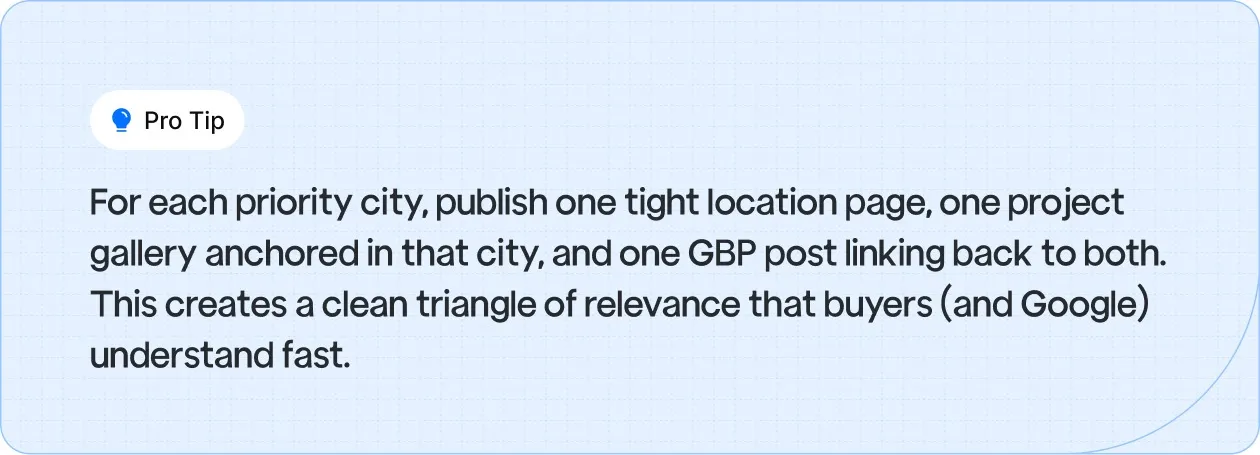
- GBP posts & media: Publish a GBP post monthly linking to new location or project pages; add geotagged images when possible.
- Local citations: Maintain NAP consistency across directories (NAHB, HBA, Chamber, Houzz, Angi). Fix duplicates and mismatches.
Be the Builder They Find First
We’ll claim, verify, and optimize your Google Business Profile so local buyers see your projects and call you.
Optimizing On-Page SEO
On-page is how you signal to search engines what a page is about and why it should rank.
Apply on-page optimization correctly
- One keyword per page: Keep pages focused and avoid trying to rank one page for many unrelated queries.
- Keyword placement checklist: Put the main term in the title tag, URL, H1, meta description, first paragraph, and image alt text.
- Content relevance: Answer the query fully. Include costs, timelines, permitting notes, and local context.
- Site structure matters: Use a simple path such as Home > Services > Service Type > Location Pages > Project Pages. Fix weak structure early.
- WordPress tools: Use Yoast, Rank Math, or All-in-One SEO to manage meta tags, sitemaps, and schema basics.
- Internal linking rule: Each new blog should link to at least two service or location pages, and each project page should link back to its related service and location pillars.
Off-Page SEO
Off-page signals are third-party endorsements that lift your domain authority and local trust. This makes Google view your site as credible.
Build authority through real connections
- Necessity of backlinks: Backlinks remain a strong ranking factor, especially for competitive local terms.
- Quality over quantity: Seek links from suppliers, architects, local news outlets, industry associations, and municipal or chamber pages.
- Acquisition tactics: Earn links through project features, press releases, guest content, sponsorships, and community involvement; vet curated link sources carefully.
- Sustaining rankings: A steady backlink program strengthens long-term visibility even as markets shift.
- Local PR and partnerships: Work with local partners to increase natural mentions and credibility signals.
Get a SEO Plan That Works
We’ll build location pages, tune your site, and track leads so you get steady, qualified inquiries without extra hassle.
Build Content That Answers Real Buyer Questions
Your content marketing should help people understand how you build, what the process looks like, and what they can expect. This builds authority and reduces hesitation.
Use practical content formats
- Project pages as conversion assets: Include a clear title, 2–4 sentence summary, specs, a timeline, 4–6 optimized photos with captions, and FAQs.
- Symptom and cost pages: Create pages for early-stage problem questions and location-specific cost breakdowns.
- Media strategy: Use WebP or JPEG, size hero images around 1200px, compress files, add descriptive alt text with city and project type, and geotag important photos.
- Video and short form: Publish walkthroughs and quick explanations; repurpose these as Google Business Profile posts and social snippets.
- Editorial calendar: Schedule content around seasonality; publish cost and planning guides 6–8 weeks before peak building periods.
Technical SEO
Technical SEO creates a solid foundation for ranking and converting leads.
Fix technical issues early
- SSL certificate: Serve your site over HTTPS. SSL is a trust signal, and visitors should see the padlock icon.
- Page speed: Compress images, enable caching, use a CDN, and remove render-blocking scripts to improve load times.
- Mobile-first: Ensure galleries, buttons, and contact elements function cleanly on mobile; add a sticky click-to-call button where possible.
- Sitemap and robot rules: Submit an XML sitemap via Google Search Console and make sure robots.txt doesn’t block key content.
- Crawlability and AI crawl signals: Avoid hiding important text behind scripts; ensure content loads in a way search engines can interpret.
Attribution, Calls, and Conversion Tracking
Tracking these signals helps you refine your strategy, double down on what works, and stop spending time on what doesn’t.
Measure the actions that reflect real growth:
- Organic traffic: Review how many visitors reach your site from unpaid search results. Steady growth shows stronger visibility and relevance.
- Keyword rankings: Track where your priority terms sit in search results and how those positions change month to month. Rising rankings often align with increased inquiries.
- Click-through rate (CTR): Measure how often people click your result after seeing it in Google. Higher CTR signals strong titles, meta descriptions, and relevance.
- Conversion rate: Track how many visitors take action like calling, filling out a form, or scheduling a consultation. This reveals whether your pages are answering buyer questions well.
- Leads generated: Count form submissions, calls, and consultation requests tied to organic traffic. These numbers show the real impact your SEO is having on your pipeline.
- Cost per lead: Compare your SEO investment against the number of qualified inquiries you receive. A lower cost per lead over time means your strategy is compounding effectively.
The Role of AI in Home Builder SEO
AI helps you work faster and identify patterns, but human judgment still leads the strategy.
Use AI where it adds real value
- Keyword clustering: Group related search terms into themes and buyer stages.
- AI cost estimators and tools: These attract backlinks and increase engagement.
- AI for UX testing: Heatmap predictions and layout suggestions help optimize conversions.
- AI for internal linking: Automated recommendations help connect pages logically and boost authority
- Caveats: AI drafts ideas but can’t replace local expertise or industry understanding; review everything for accuracy.
What an Actual SEO Timeline Looks Like for Builders?
A clear marketing timeline for home builders sets expectations and helps keep improvements steady.
Build momentum in phases:
- First 30 days: Fix major technical issues, activate SSL, clean up your Google Business Profile, audit site structure, and resolve urgent UX issues.
- 60–90 days: Publish service and location pages, initial project pages, and start a review request flow.
- 3–6 months: Increase content production, begin link outreach, and improve What makes SEO for home builders different from other industries? Love internal linking; expect early ranking and Maps improvements.
- 6–12 months: Build authority with press, larger project pages, and consistent backlinks; rankings for harder terms often appear here.
- Ongoing: Keep GBP active, gather reviews, refresh galleries, and update cost pages as markets shift.
Let Gushwork build a clear, step-by-step SEO marketing timeline that helps you grow visibility, attract qualified local buyers, and turn steady search interest into real project inquiries.
Building Visibility Is Just as Important as Building Homes
People need to find great work first. Home builder SEO is how you make that happen.
If you’ve already built your reputation on quality and service for your business, SEO is what ensures people actually see it.
Your next client might be searching today. The question is, will they find you?
Ready to Be the Builder Buyers Find First?
Get a clear, practical SEO setup that helps local clients see your best work and contact you with confidence.


.webp)







.webp)


.svg)


