










Most lawn care businesses don’t struggle because they lack skill. They struggle because the work is consistent, but the planning behind it isn’t. You can mow a yard perfectly, but without a clear structure for pricing, routes, costs, and marketing, the business feels unpredictable week after week.
A good lawn care business plan changes that. It gives you clarity on what to offer, how to charge, which neighborhoods to target, and how to stay profitable even when the season gets hectic. When you know where you’re headed, your day-to-day decisions become easier, and your growth becomes intentional instead of accidental.
In this blog, you’ll learn how to build a practical, easy-to-follow lawn care business plan, from defining services and pricing, to handling legal steps, to setting up the marketing foundation that brings you steady local clients.
What Does a “Lawn Care Business Plan” Mean?
A solid lawn care business plan starts with understanding what a lawn care business is at its core.
In simple terms, a lawn care business offers outdoor maintenance and upkeep services, ranging from mowing, edging, and trimming to fertilisation, aeration, and seasonal clean‑ups, to homeowners and commercial properties.
What sets a successful lawn care business apart:
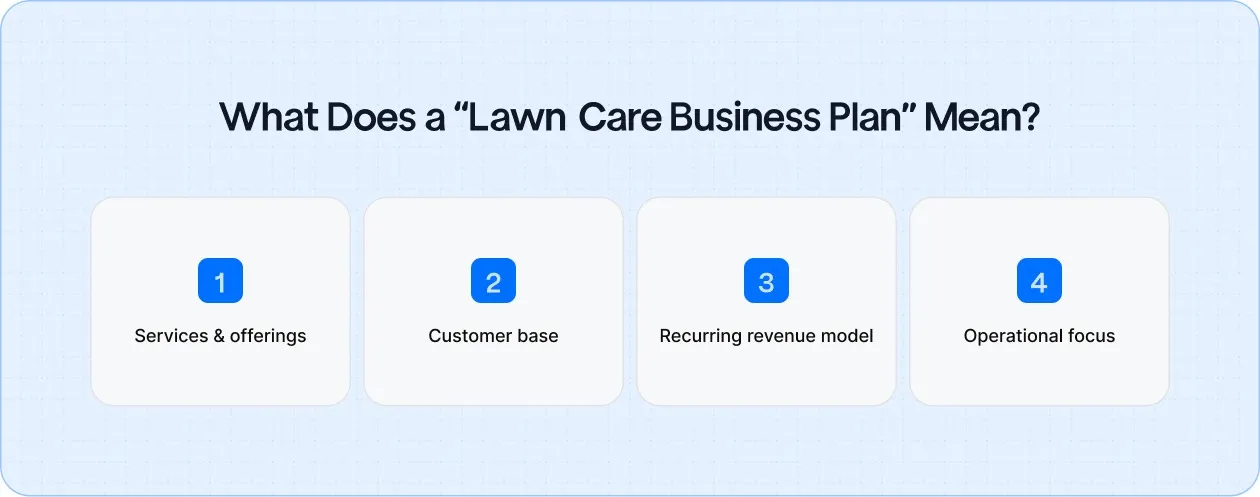
- Services & offerings: Your offerings might range from simple mowing and trimming to more detailed work like fertilization, weed control, and lawn restoration.
- Customer base: You will serve residential clients, commercial properties (office parks, schools, apartment complexes), or both, each has its own expectations and opportunities.
- Recurring revenue model: Unlike one‑time jobs, the most sustainable lawn care businesses offer ongoing contracts (weekly, bi‑weekly, monthly). They secure long‑term clients rather than simply one‑and‑done jobs.
- Operational focus: You’ll manage equipment, scheduling, materials, and weather‑related challenges. You’ll also need a reliable marketing and growth strategy, one that’s part of your business plan.
A lawn care business operates at the intersection of ongoing service delivery, customer relationships, and operational reliability. Your business plan should reflect this by clearly outlining what you will offer, who you will serve, and how you’ll deliver consistent, high‑quality service that earns repeat customers.
Turn Your Business Into a Top Result in Your Area
Clean, practical SEO helps you show up in Maps, get more calls, and build recurring clients.


How to Create a Lawn Care Business Plan (Step-by-Step)
Below is a clear, organized breakdown of everything your plan should include, backed by current industry expectations and real operational needs.
1. Study Your Local Lawn Care Market
Before writing anything in your business plan, you need a real understanding of the market you’re about to serve.
A proper market assessment gives you clarity on where to focus and how to position yourself from day one.
How to do it:
- Identify your customer types: Determine whether you’ll serve homeowners, landlords, HOAs, commercial properties, or a mix. Each group has different expectations and pricing tolerances.
- Evaluate competitors: Look at 5–10 nearby lawn care companies. Note their pricing, service lists, response times, and gaps in their offerings.
- Check local demand: Use Google Trends, social media groups, and search volume tools to understand peak seasons and most-requested services in your area.
- Study pricing ranges: Compare local pricing for weekly mowing, seasonal services, and specialty work so you don’t undercharge or overprice yourself.
- Find underserved neighborhoods: Identify ZIP codes with older homes, larger lawns, or high turnover, these often have steady maintenance demand.
This research anchors every decision you make next: your services, pricing, target ZIP codes, and marketing priorities.
2. Build Your Core Business Plan
Once you understand your market, shape that knowledge into a clear business plan.
How to do it:
- Define your services: List your core weekly services and your seasonal or add-on offerings. Make it clear what you’ll say yes or no to when customers ask for extras.
- Clarify your target market: Document the customer types, incomes, property sizes, or industries you’ll serve most.
- Set financial expectations: Outline your startup costs, monthly expenses, expected revenue, and break-even timeframe so you know what you must earn to stay profitable.
- Write your one-year and three-year goals: Include client count goals, revenue milestones, service expansion plans, and equipment upgrades.
- Create your operational philosophy: Describe how you want your business to run: response time standards, quality controls, communication style, and job workflow.
Your business plan isn’t a formality. It’s your stability guide when the season gets busy, allowing you to grow intentionally instead of reacting week to week.
3. Choose the Right Business Structure
Your business structure determines how you’re taxed, what legal protections you have, and how easy it is to scale later. Many lawn care owners skip this step or choose the simplest option, which can create problems when they grow or hire.
How to do it:
- Compare common structures:
- Sole Proprietorship: Easy to start, but no liability protection.
- LLC: Best balance of simplicity and legal protection for most owners.
- S-Corp: Helpful once you grow and need payroll and tax optimization.
- Assess liability exposure: Since you're working with equipment on client property, an LLC is typically the safest way to protect your personal assets.
- Consider your long-term plans: If you want multiple crews or commercial contracts later, choose a structure that grows with you.
- Research your state requirements: Some states have specific registration rules, annual fees, or publication requirements for LLCs.
Choosing the right structure early prevents legal issues later and sets the foundation for clean bookkeeping, insurance, and tax management.
4. Register Your Lawn Care Business
After selecting your structure, the next step is to make your lawn care business official. Registration ensures you’re recognized by state and local authorities, which protects you legally and allows you to operate without interruptions. It also gives you access to essential items like tax accounts, business banking, and insurance.
How to do it:
- Register your business name: File an LLC or DBA with your state, depending on your chosen structure.
- Obtain an EIN/TIN: Apply for a free Employer Identification Number from the IRS so you can hire, pay taxes, and open business accounts.
- Check local city/county requirements: Some areas require home-service providers to hold specific permits even if the state doesn’t.
- Secure your state business license (if required): Regulations vary widely, so confirm what applies in your area before starting work.
Getting registered early prevents future complications when you expand to new neighborhoods or take on larger contracts.
5. Secure the Required Permits and Licenses
Depending on your service offerings, you may need additional licenses before you take your first client. This applies especially if you plan to offer fertilization, weed control, or pest treatment, services that fall under chemical application laws in most states.
How to do it:
- General business license: Many municipalities require a standard operating license for service businesses.
- Pesticide/fertilizer license: If you’ll apply chemicals, complete your state’s required training and pass certification exams.
- Sales tax permit: Necessary in states where lawn care services are taxable.
- Vehicle and trailer permits: Ensure your truck, trailer, and any mounted equipment meet local transport regulations.
Obtaining the right licenses elevates your professionalism and keeps you legally protected as you scale.
6. Get Proper Insurance for Protection and Credibility
Lawn care work comes with risks, property damage, injuries, equipment theft, and vehicle accidents. Insurance protects your business from financial loss and reassures clients that you operate responsibly.
How to do it:
- General Liability Insurance: Covers accidental damage to customer property, injuries, or mishaps on-site.
- Commercial Auto Insurance: Protects your truck and trailer when used for business operations.
- Workers' Compensation: Required if you plan to hire employees, protecting both you and your crew.
- Equipment Insurance: Covers theft, breakdown, or replacement costs for high-value tools.
- Umbrella policy (optional but helpful): Adds an extra layer of protection for growing teams.
7. Set Up Your Finances the Right Way
A lawn care business becomes unmanageable fast if you mix personal and business finances. Clean financial setup protects you during tax season, makes you look credible to customers, and helps you understand whether your routes are actually profitable.
How to do it:
- Open a dedicated business bank account: Keep all income and expenses separate from personal finances. This simplifies taxes and avoids legal issues.
- Choose bookkeeping software: Tools like QuickBooks or Xero help track invoices, expenses, fuel costs, payroll, and route profitability.
- Prepare for quarterly taxes: Contractors typically pay estimated taxes every quarter. Set money aside so you aren’t surprised later.
- Create a basic budget plan: Map out your expected revenue, fuel costs, maintenance, marketing spend, and replacements for wear-and-tear items.
- Track payment methods: Offer card, ACH, and automatic billing to improve cash flow and reduce delayed payments.
Strong financial organization keeps your business stable even through weather swings or seasonal slowdowns.
Set Pricing Using a Clear and Defensible Formula
Pricing is one of the most important parts of your lawn care business plan and many new owners guess incorrectly.
Use a simple calculation:
Time per yard + equipment + travel + overhead = visit rate
Then create a pricing table for:
- Small lawns
- Medium lawns
- Large lawns
- Weekly vs. biweekly visits
Your business plan should also outline:
- Minimum job price
- Route-based discounts or surcharges
- Pricing for add-on services
8. Purchase the Equipment You Need to Operate
Once your business is legally and financially set, it’s time to invest in tools that can handle daily work.
How to do it:
- Start with essential tools: A commercial mower (push or riding), trimmer, edger, blower, PPE, and fuel storage.
- Choose equipment that matches your service type: A zero-turn mower is ideal for larger properties, while a self-propelled model may suit smaller city lawns.
- Document maintenance schedules: Clean blades, change oil, and check belts weekly to prevent breakdowns mid-route.
- Plan for transport: A truck with racks or a small trailer is typical. Ensure your trailer has proper tags and meets local transport rules.
- Buy gradually: Start lean. Upgrade only when routes become predictable and income justifies the investment.
Good equipment builds your reputation for reliability because clients notice the quality of your cuts and consistency of your service.
9. Plan What Services You’ll Offer
Your service list is one of the most important parts of your business plan because it determines your pricing, your schedule, your equipment needs, and the types of clients you’ll attract.
How to do it:
- Start with a core service lineup: Build your base around the services you can deliver reliably every week such as mowing, edging, trimming, and blowing. These form the foundation of your recurring revenue.
- Add seasonal or high-margin add-ons: Include aeration, overseeding, mulching, leaf cleanup, hedge trimming, and spring or fall cleanups. These fill slow months and increase average ticket value.
- Decide whether to offer chemical services: Fertilization, weed control, and pest control require licensing in most states. If you plan to offer them, include training, certification, and insurance updates in your plan.
- Create clear service packages: Build tiered plans like “Basic Mowing,” “Full Maintenance,” or “Premium Lawn Care” so customers understand exactly what’s included. Packages simplify pricing and make upsells easier.
- Set boundaries for what you don’t offer: Clearly list services you won’t handle like irrigation repairs, tree removal, or hardscaping if those aren’t in your scope. This eliminates confusion and filters out low-fit requests.
- Define service frequency: Decide whether you’ll offer weekly, biweekly, or monthly visits and how those schedules affect your pricing and route planning.
10. Build a Marketing Plan
A strong marketing plan helps you show up where homeowners actually look: Google, Maps, local directories, and social platforms. This shifts your business from word-of-mouth luck to reliable, ongoing client flow.
How to do it:
Set Up Google Business Profile (GBP)
Your Google Business Profile is the most important tool for showing up in local searches and getting calls from nearby homeowners.
How to set it up correctly:
- Add all service areas so Google knows exactly where to show your listing.
- Upload real project photos that show lawns you’ve serviced. This boosts trust and engagement.
- Complete every field including hours, description, and services.
- Post weekly updates to stay active in Google’s system and increase visibility.
- Enable messaging and calls so customers can reach you instantly.
Get Seen by Local Homeowners
Set up a strong Google Business Profile and make your lawn care services show up where people are already searching.
Apple Business Connect
This is Apple’s version of Google Business Profile. It controls how your business appears in Apple Maps and on Siri searches. Many homeowners use iPhones, so having an updated Apple Business Connect profile helps you show up there too.
Create a Simple, Clear Website
Your website needs to be clean, mobile-friendly, and built to help visitors understand what you offer and how to contact you.
What to include on your website:
- A services page outlining everything you offer, written in plain language.
- Pricing ranges or starting rates to set expectations and reduce unqualified inquiries.
- Areas you serve so homeowners know you cover their neighborhood.
- High-quality photos of your work to build trust immediately.
- Strong call-to-action buttons like Call Now or Get a Quote on every page.
- Fast load speed and mobile-first layout to prevent drop-offs.
Add Local SEO Basics
Local landscaping SEO helps your website and GBP appear when homeowners search for terms like “lawn care near me.” These simple steps make your business easier for Google to index and easier for customers to find.
Local SEO essentials to implement:
- Use location-based keywords like “lawn care in [City]” in titles, headers, and service pages.
- Keep your NAP (name, address, phone) consistent across your website, GBP, and directories.
- Add schema markup to help search engines understand your business details.
- Create separate service-area pages if you serve multiple cities or neighborhoods.
- Optimize image alt text with descriptive, local terms.
Make Local Customers Find You First
Strengthen your local SEO so your lawn care business shows up where homeowners are already searching.
Social Media Marketing
Social media is one of the fastest ways for a lawn care business to stay visible in the neighborhoods you want to serve. Homeowners want to see who they’re hiring, and platforms like Facebook, Instagram, and Nextdoor let you show your work while building a local following that turns into real customers.
- Post project photos and videos regularly including before-and-after cuts, clean edges, and transformations. Visual proof builds trust faster than any ad.
- Share short tips and seasonal reminders such as mowing heights, fertilizing windows, or storm prep. Helpful advice keeps you top-of-mind.
- Use location tags and neighborhood hashtags to get discovered by homeowners in specific communities you want to target.
- Respond to comments and questions quickly to show you’re active and easy to work with.
- Feature client shoutouts or repeat customers to reinforce reliability and encourage referrals.
- Join Facebook and Nextdoor groups where homeowners ask for local recommendations. Be present, answer questions, and become the go-to pro.
Use Yard Signs to Build Hyperlocal Awareness
A single yard sign can generate multiple inquiries because it shows real proof of your work right where potential customers live. It’s one of the simplest and cheapest ways to grow inside targeted neighborhoods.
11. Offer Referrals
Referrals and local incentives work incredibly well in lawn care because homeowners trust recommendations from neighbors more than anything else.
How to do it:
- Referral offers: Give a small discount to clients who refer friends and neighbors. Keep the offer simple and easy to redeem.
- Block pricing: Offer reduced rates for multiple homes in the same street or in the same HOA to strengthen route density and cut down drive time.
- Loyalty perks: For long-term clients, offer an annual cleanup discount or a one-time edging upgrade.
- Door-to-door follow-ups: After finishing a job, introduce yourself to nearby homeowners with a card or door hanger.
- Local business partnerships: Connect with realtors, home inspectors, and property managers who can refer steady work.
These strategies help you grow where it matters most and reduce wasted time driving between distant properties.
12. Create an Operations Plan
An operations plan helps you manage service frequency, weather disruptions, equipment care, and communication so you’re not constantly reacting to chaos.
How to do it:
- Set weekly service cycles: Lock in which neighborhoods you visit on which days to avoid backtracking and wasted time.
- Create weather backup rules: Decide how you’ll handle rain delays, rescheduling, and notifying clients so expectations stay clear.
- Set standard service checklists: Define exactly what each visit includes (cutting height, trimming borders, blowing debris) for consistent results.
- Prepare maintenance routines: Track blade sharpening, oil changes, tire checks, and general equipment upkeep weekly or biweekly.
- Plan fuel and supply runs: Schedule these on low-volume days so they never disrupt your route.
- Document communication templates: Keep ready-made texts or emails for quotes, delays, and completion notifications.
A reliable operations plan makes your workload easier to predict and helps you look professional even during your busiest weeks.
13. Hire and Train Your First Crew
Your first hires shape your reputation. Whether you bring in one helper or start building a team, you need clear expectations, repeatable processes, and basic training to maintain consistent service.
How to do it:
- Start with part-time help: This reduces risk and lets you build demand steadily before bringing someone full-time.
- Create a simple onboarding checklist: Include equipment handling, safety rules, mowing patterns, trimming standards, and customer etiquette.
- Shadow training: Have new team members ride along for at least a week to learn your exact methods.
- Set quality standards: Use photos or short videos showing your expected finish work for edging, blowing, and mowing lines.
- Rotate responsibilities: Cross-train every crew member so no task depends on one person.
- Offer performance incentives: Bonuses for punctuality, quality scores, or zero callbacks help maintain standards.
When your crew delivers consistent quality, you build the trust and reliability that keep clients long-term.
14. Get Your First Lawn Care Customers
Before you think about scaling, you need to land your first few clients. Your goal here is to generate momentum through simple, local, high-trust channels that homeowners respond to.
How to do it:
- Leverage your neighborhood first: Door hangers, yard signs, and direct introductions in the areas you want to service.
- Offer opening-week discounts or bundled rates: Not long-term cuts, but small incentives to get early traction.
- Ask for reviews immediately after service: These first reviews boost your Google Business Profile visibility.
- Join local groups: Facebook community pages, Nextdoor, and HOA newsletters often bring quick leads for new operators.
- Network with related businesses: Landscapers, real estate agents, and property managers frequently need lawn care partners.
Once you have a handful of customers in one ZIP code, you’ll build route density faster and reduce drive time between jobs.
A plan becomes truly useful when it’s practical and when it evolves with your business.
Best Practices for Crafting a Lawn Care Business Plan
A solid lawn care business plan helps you focus on the right goals and keep your business on track. To make your plan as effective as possible, here are some practical best practices to follow:
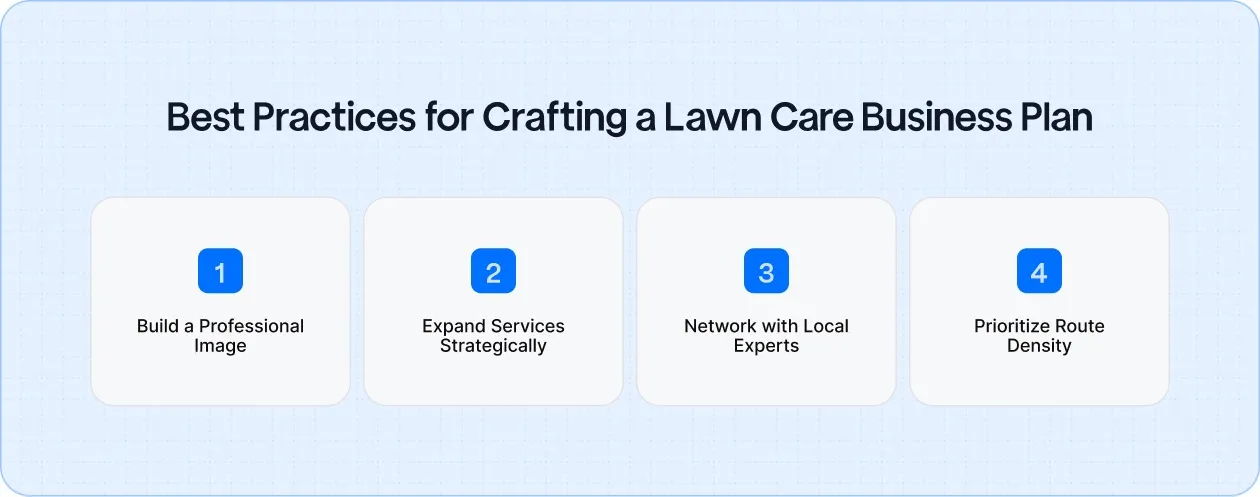
- Build a strong professional image: Your logo, uniforms, truck decals, website, and yard signs shape the first impression homeowners get. A clean, consistent look builds trust instantly, while a sloppy presentation can raise doubts before you even quote the job.
- Expand your services once you’re stable: After you have steady mowing routes, add higher-margin services such as fertilization, weed control, landscape cleanups, or small installs. These services increase revenue per client and help you stand out in a crowded market.
- Network with other local experts: Connect with nearby lawn care operators, landscape companies, and weed-control specialists. Many trade referrals, mowing leads go one way, chemical services the other, and these relationships often bring easier, warmer jobs.
- Prioritize route density: Aim to group clients in tight clusters so you spend more time mowing and less time driving. High-density routes make your schedule efficient and greatly improve profitability.
Conclusion
A strong lawn care business grows from a simple, repeatable plan that tells you what to offer, who to serve, and how to stay profitable as you add more clients. Once your service list, routes, pricing, and marketing foundation are set, the business becomes far easier to run and far easier to scale.
If you’re serious about turning lawn care into a long-term business instead of a seasonal side job, your plan is the first step. Put the structure in place now, and everything that comes after, the clients, the reviews, the referrals, becomes much easier.
Are you ready? Let’s get you started!
Want Steady Lawn Care Leads Without Relying on Ads?
Build an SEO foundation that brings in consistent calls from local homeowners.


.webp)








.webp)


.svg)


